engine CHEVROLET CITY EXPRESS 2016 Owner's Guide
[x] Cancel search | Manufacturer: CHEVROLET, Model Year: 2016, Model line: CITY EXPRESS, Model: CHEVROLET CITY EXPRESS 2016Pages: 297, PDF Size: 4.52 MB
Page 162 of 297
Black plate (21,1)Chevrolet City Express Owner Manual (GMNA-Localizing-U.S./Canada-
7707496) - 2015 - CRC - 11/26/14
Driving and Operating 9-21Shift Lock Release
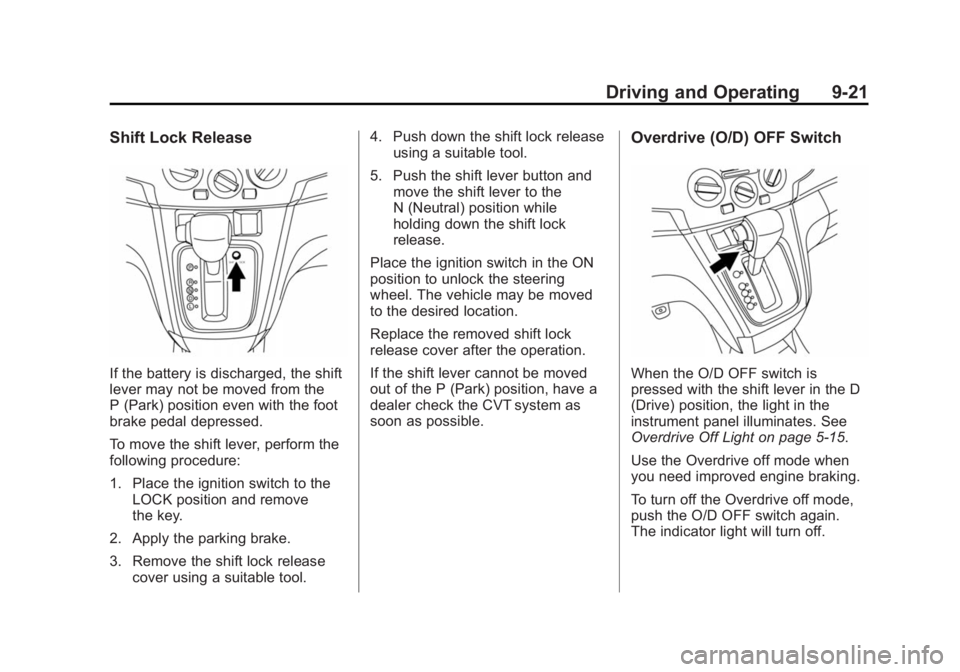
If the battery is discharged, the shift
lever may not be moved from the
P (Park) position even with the foot
brake pedal depressed.
To move the shift lever, perform the
following procedure:
1. Place the ignition switch to the
LOCK position and remove
the key.
2. Apply the parking brake.
3. Remove the shift lock release
cover using a suitable tool. 4. Push down the shift lock release
using a suitable tool.
5. Push the shift lever button and
move the shift lever to the
N (Neutral) position while
holding down the shift lock
release.
Place the ignition switch in the ON
position to unlock the steering
wheel. The vehicle may be moved
to the desired location.
Replace the removed shift lock
release cover after the operation.
If the shift lever cannot be moved
out of the P (Park) position, have a
dealer check the CVT system as
soon as possible. Overdrive (O/D) OFF Switch
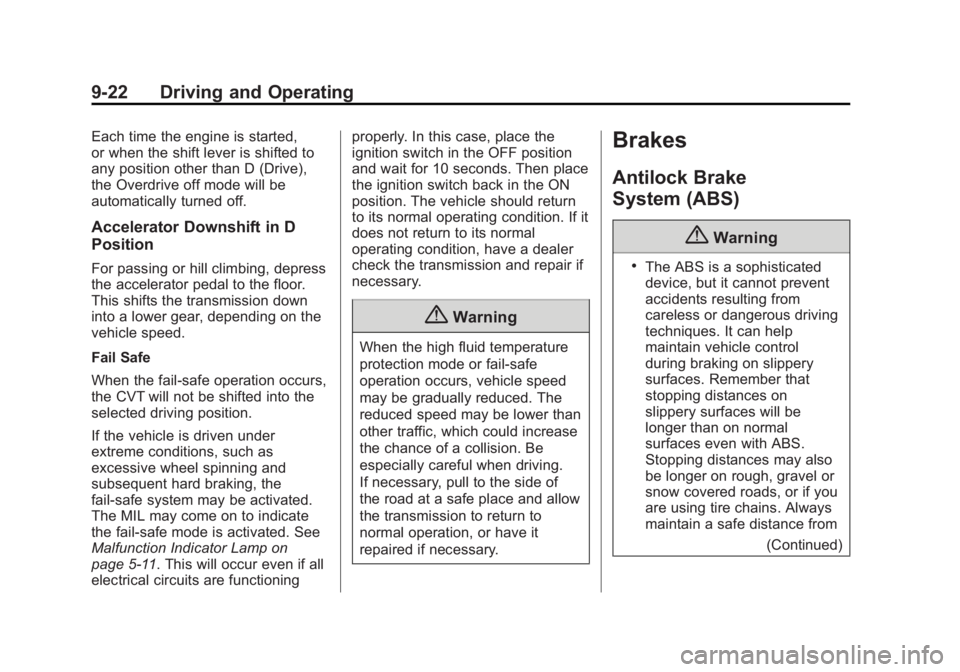
When the O/D OFF switch is
pressed with the shift lever in the D
(Drive) position, the light in the
instrument panel illuminates. See
Overdrive Off Light on page 5-15 .
Use the Overdrive off mode when
you need improved engine braking.
To turn off the Overdrive off mode,
push the O/D OFF switch again.
The indicator light will turn off.
Page 163 of 297
Black plate (22,1)Chevrolet City Express Owner Manual (GMNA-Localizing-U.S./Canada-
7707496) - 2015 - CRC - 11/26/14
9-22 Driving and Operating Each time the engine is started,
or when the shift lever is shifted to
any position other than D (Drive),
the Overdrive off mode will be
automatically turned off.
Accelerator Downshift in D
Position For passing or hill climbing, depress
the accelerator pedal to the floor.
This shifts the transmission down
into a lower gear, depending on the
vehicle speed.
Fail Safe
When the fail-safe operation occurs,
the CVT will not be shifted into the
selected driving position.
If the vehicle is driven under
extreme conditions, such as
excessive wheel spinning and
subsequent hard braking, the
fail-safe system may be activated.
The MIL may come on to indicate
the fail-safe mode is activated. See
Malfunction Indicator Lamp on
page 5-11 . This will occur even if all
electrical circuits are functioning properly. In this case, place the
ignition switch in the OFF position
and wait for 10 seconds. Then place
the ignition switch back in the ON
position. The vehicle should return
to its normal operating condition. If it
does not return to its normal
operating condition, have a dealer
check the transmission and repair if
necessary.
{ WarningWhen the high fluid temperature
protection mode or fail-safe
operation occurs, vehicle speed
may be gradually reduced. The
reduced speed may be lower than
other traffic, which could increase
the chance of a collision. Be
especially careful when driving.
If necessary, pull to the side of
the road at a safe place and allow
the transmission to return to
normal operation, or have it
repaired if necessary. Brakes Antilock Brake
System (ABS)
{ Warning .
The ABS is a sophisticated
device, but it cannot prevent
accidents resulting from
careless or dangerous driving
techniques. It can help
maintain vehicle control
during braking on slippery
surfaces. Remember that
stopping distances on
slippery surfaces will be
longer than on normal
surfaces even with ABS.
Stopping distances may also
be longer on rough, gravel or
snow covered roads, or if you
are using tire chains. Always
maintain a safe distance from
(Continued)
Page 166 of 297
Black plate (25,1)Chevrolet City Express Owner Manual (GMNA-Localizing-U.S./Canada-
7707496) - 2015 - CRC - 11/26/14
Driving and Operating 9-252. Pull the parking brake handle up
until you can press the release
button.
3. Hold the release button in as
you move the brake handle all
the way down.
{ CautionDriving with the parking brake on
can overheat the brake system
and cause premature wear or
damage to brake system parts.
Make sure that the parking brake
is fully released and the brake
warning light is off before driving.
Parking Brake Break-in
Break-in the brake shoes whenever
the effect of the parking brake is
weakened or whenever the brake
shoes and/or drums are replaced, in
order to assure the best brake
performance. This procedure can be
performed at the dealer. Ride Control Systems Traction Control/
Electronic Stability
Control System Operation The vehicle has a Traction Control
System (TCS) and Electronic
Stability Control, an electronic
stability control system. These
systems use various sensors to
monitor driver inputs and vehicle
motion. Under certain driving
conditions, the TCS and Electronic
Stability Control systems help to
perform the following functions: .
Control brake pressure to reduce
wheel slip on one slipping drive
wheel so power is transferred to
a non – slipping drive wheel on
the same axle. .
Control brake pressure and
engine output to reduce drive
wheel slip based on vehicle
speed (traction control function). .
Control brake pressure at
individual wheels and engine
output to help the driver maintain
control of the vehicle in the
following conditions:
‐ Understeer (vehicle tends to
not follow the steered path
despite increased steering
input)
‐ Oversteer (vehicle tends to
spin due to certain road or
driving conditions)
TCS and Electronic Stability Control
can help the driver to maintain
control of the vehicle, but cannot
prevent loss of vehicle control in all
driving situations.
When the TCS and Electronic
Stability Control systems operate,
the
d indicator in the instrument
cluster flashes to note the following: .
The road may be slippery or the
system may determine some
action is required to help keep
the vehicle on the steered path.
Page 167 of 297
Black plate (26,1)Chevrolet City Express Owner Manual (GMNA-Localizing-U.S./Canada-
7707496) - 2015 - CRC - 11/26/14
9-26 Driving and Operating .
You may feel a pulsation in the
brake pedal and hear a noise or
vibration from under the hood.
This is normal and indicates that
the traction control system is
working properly. .
Adjust your speed and driving to
the road conditions.
See Traction Control System (TCS)/
Electronic Stability Control Light on
page 5-16 and Electronic Stability
Control (ESC) Off Light on
page 5-16 .
If a malfunction occurs in the
systems, the
d indicator comes on
in the instrument cluster. The TCS
and Electronic Stability Control
systems automatically turn off when
the indicator light is on. Turning the Systems Off
and On
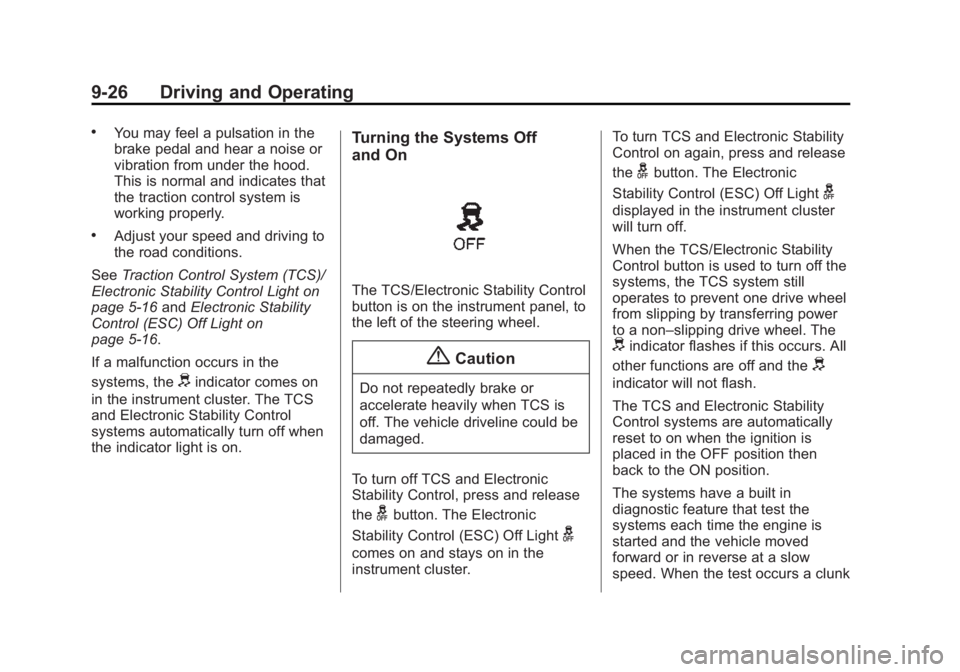
The TCS/Electronic Stability Control
button is on the instrument panel, to
the left of the steering wheel.
{ CautionDo not repeatedly brake or
accelerate heavily when TCS is
off. The vehicle driveline could be
damaged.
To turn off TCS and Electronic
Stability Control, press and release
the
g button. The Electronic
Stability Control (ESC) Off Light
gcomes on and stays on in the
instrument cluster. To turn TCS and Electronic Stability
Control on again, press and release
the
g button. The Electronic
Stability Control (ESC) Off Light
gdisplayed in the instrument cluster
will turn off.
When the TCS/Electronic Stability
Control button is used to turn off the
systems, the TCS system still
operates to prevent one drive wheel
from slipping by transferring power
to a non – slipping drive wheel. The
d indicator flashes if this occurs. All
other functions are off and the
d indicator will not flash.
The TCS and Electronic Stability
Control systems are automatically
reset to on when the ignition is
placed in the OFF position then
back to the ON position.
The systems have a built in
diagnostic feature that test the
systems each time the engine is
started and the vehicle moved
forward or in reverse at a slow
speed. When the test occurs a clunk
Page 168 of 297
Black plate (27,1)Chevrolet City Express Owner Manual (GMNA-Localizing-U.S./Canada-
7707496) - 2015 - CRC - 11/26/14
Driving and Operating 9-27noise may be heard and/or a
pulsation in the brake pedal may be
felt. This is normal and is not an
indication of a malfunction.
Adding accessories can affect the
vehicle performance. See
Accessories and Modifications on
page 10-3 .
{ Warning .
The Traction Control System
(TCS) and Electronic Stability
Control (ESC) system are
designed to help the driver
maintain stability but do not
prevent accidents due to
abrupt steering operation at
high speeds or by careless or
dangerous driving
techniques. Reduce vehicle
speed and be especially
careful when driving and
cornering on slippery
surfaces and always drive
carefully.
(Continued) Warning (Continued) .
Do not modify the vehicle ’ s
suspension. If suspension
parts such as shock
absorbers, struts, springs,
stabilizer bars, bushings, and
wheels are not recommended
for your vehicle or are
extremely deteriorated, the
TCS and ESC systems may
not operate properly. This
could adversely affect vehicle
handling performance, and
the
d indicator may flash or
the
d indicator light may
illuminate. .
If brake related parts such as
brake pads, rotors, and
calipers are not
recommended or are
extremely deteriorated, the
TCS and ESC systems may
(Continued) Warning (Continued) not operate properly and the
d indicator light may
illuminate. .
If engine control related parts
are not recommended or are
extremely deteriorated, the
d indicator light may illuminate. .
When driving on extremely
inclined surfaces such as
higher banked corners, the
TCS and ESC systems may
not operate properly and the
d indicator may flash or the
d indicator light may
illuminate. Do not drive on
these types of roads. .
When driving on an unstable
surface such as a turntable,
ferry, elevator, or ramp, the
d indicator may flash or the
d indicator light may illuminate.
(Continued)
Page 169 of 297
Black plate (28,1)Chevrolet City Express Owner Manual (GMNA-Localizing-U.S./Canada-
7707496) - 2015 - CRC - 11/26/14
9-28 Driving and Operating Warning (Continued) This is not a malfunction.
Restart the engine after
driving onto a stable surface. .
If wheels or tires other than
the recommended ones are
used, the TCS and ESC
systems may not operate
properly and the
d indicator
may flash or the
d indicator
light may illuminate. .
The TCS and ESC systems
are not a substitute for winter
tires or tire chains on a snow
covered road. Cruise Control
{ WarningCruise control can be dangerous
where you cannot drive safely at
a steady speed. Do not use
cruise control on winding roads or
in heavy traffic.
Cruise control can be dangerous
on slippery roads. On such roads,
fast changes in tire traction can
cause excessive wheel slip, and
you could lose control. Do not use
cruise control on slippery roads.
If equipped with cruise control, a
speed of about 48 km/h (30 mph) or
more can be maintained without
keeping your foot on the
accelerator. Cruise control does not
work at speeds below about
48 km/h (30 mph).
If the brakes are applied, cruise
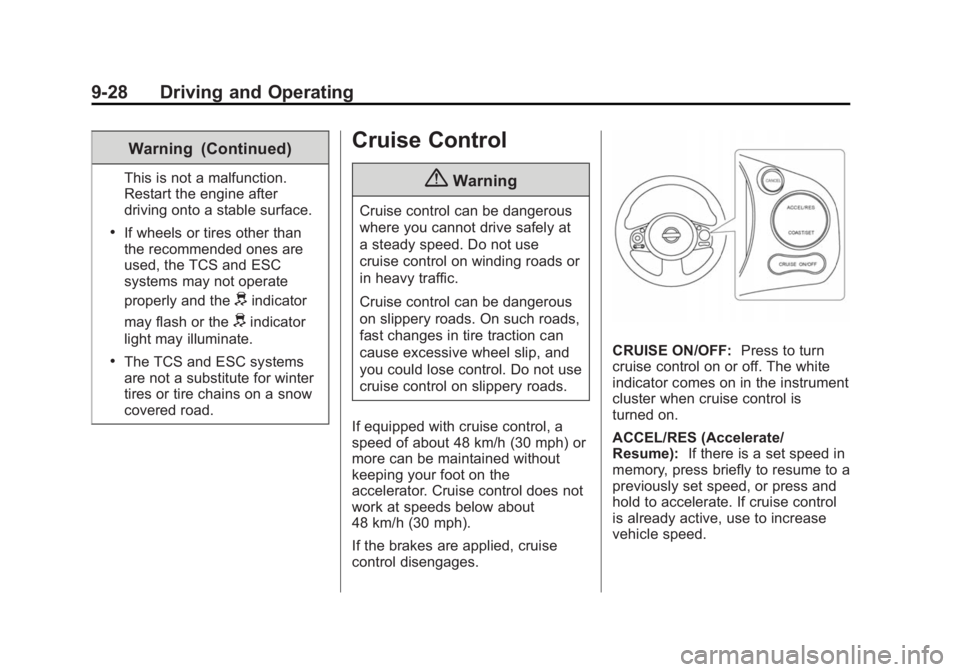
control disengages. CRUISE ON/OFF: Press to turn
cruise control on or off. The white
indicator comes on in the instrument
cluster when cruise control is
turned on.
ACCEL/RES (Accelerate/
Resume): If there is a set speed in
memory, press briefly to resume to a
previously set speed, or press and
hold to accelerate. If cruise control
is already active, use to increase
vehicle speed.
Page 178 of 297
Black plate (37,1)Chevrolet City Express Owner Manual (GMNA-Localizing-U.S./Canada-
7707496) - 2015 - CRC - 11/26/14
Driving and Operating 9-37
Fuel Use of the recommended fuel is an
important part of the proper
maintenance of this vehicle. When
driving in the U.S. and Canada, to
help keep the engine clean and
maintain optimum vehicle
performance, we recommend using
TOP TIER Detergent Gasolines.
See www.toptiergas.com for a list of
TOP TIER Detergent Gasolines.
Use regular unleaded gasoline
meeting ASTM specification D4814
with a posted octane rating of 87 or higher. Do not use gasoline with an
octane rating below 87, as it may
cause engine damage and will lower
fuel economy.
Use of Seasonal Fuels
Use summer and winter fuels in the
appropriate season. The fuels
industry automatically modifies the
fuel for the appropriate season.
If fuel is left in the vehicle tank for
long periods of time, driving or
starting could be affected. Drive the
vehicle until the fuel is at one-half
tank or less, then refuel with the
current seasonal fuel.
Prohibited Fuels
Gasolines containing oxygenates
such as ethers and ethanol, as well
as reformulated gasolines, are
available in some cities. If these
gasolines comply with the
previously described specification,
then they are acceptable to use. { Warning .
Using a fuel other than what
is specified could adversely
affect the emission control
system, and may also affect
the warranty coverage. .
Under no circumstances
should either a leaded
gasoline or gasoline with
MMTbe used. Doing so will
damage the catalytic
converter. .
Do not use E-15 or E-85 fuel
in your vehicle. Your vehicle
is not designed to run on
E-15 or E-85 fuel. Using E-15
or E-85 fuel in a vehicle not
specifically designed for E-15
or E-85 fuel can adversely
damage the emission control
devices and systems of the
vehicle. Damage caused by
such fuel is not covered by
the new vehicle limited
warranty.
Page 179 of 297
Black plate (38,1)Chevrolet City Express Owner Manual (GMNA-Localizing-U.S./Canada-
7707496) - 2015 - CRC - 11/26/14
9-38 Driving and Operating Some gasolines, mainly high octane
racing gasolines, can contain an
octane-enhancing additive called
methylcyclopentadienyl manganese
tricarbonyl (MMT). Do not use
gasolines and/or fuel additives with
MMT as they will reduce spark plug
life and affect emission control
system. The malfunction indicator
lamp may turn on. If this occurs, see
your dealer for service.
California Fuel
Requirements If the vehicle is certified to meet
California Emissions Standards, it is
designed to operate on fuels that
meet California specifications. See
the underhood emission control
label. If this fuel is not available in
states adopting California Emissions
Standards, the vehicle will operate
satisfactorily on fuels meeting
federal specifications, but emission
control system performance might
be affected. The malfunction
indicator lamp could turn on and the
vehicle may not pass a smog-check test. See Malfunction Indicator
Lamp on page 5-11 . If this occurs,
return to your authorized dealer for
diagnosis. If it is determined that the
condition is caused by the type of
fuel used, repairs may not be
covered by the vehicle warranty.
Fuels in Foreign
Countries If planning to drive in countries
outside the U.S. or Canada, the
proper fuel might be hard to find.
Check regional auto club or fuel
retail brand websites for availability
in the country where driving. Never
use leaded gasoline, fuel containing
methanol, manganese, or any other
fuel not recommended. Costly
repairs caused by use of improper
fuel would not be covered by the
vehicle warranty. Fuel Additives To keep fuel systems clean, TOP
TIER Detergent Gasoline is
recommended. See Fuel on
page 9-37 .
If TOP TIER Detergent Gasoline is
not available, one bottle of Fuel
System Treatment PLUS added to
the fuel tank at every engine oil
change can help. Fuel System
Treatment PLUS is the only
gasoline additive recommended by
General Motors. It is available at
your dealer.
Do not use additives with E85 or
FlexFuel.
Page 180 of 297
Black plate (39,1)Chevrolet City Express Owner Manual (GMNA-Localizing-U.S./Canada-
7707496) - 2015 - CRC - 11/26/14
Driving and Operating 9-39
Filling the Tank
{ WarningFuel vapors and fuel fires burn
violently and can cause injury or
death. .
To help avoid injuries to you
and others, read and follow
all the instructions on the fuel
pump island. .
Turn off the engine when
refueling. .
Keep sparks, flames, and
smoking materials away
from fuel. .
Do not leave the fuel pump
unattended. .
Do not reenter the vehicle
while pumping fuel. .
Keep children away from the
fuel pump and never let
children pump fuel.
(Continued) Warning (Continued) .
Fuel can spray out if the fuel
cap is opened too quickly.
This spray can happen if the
tank is nearly full, and is
more likely in hot weather.
Open the fuel cap slowly and
wait for any hiss noise to stop
then unscrew the cap all
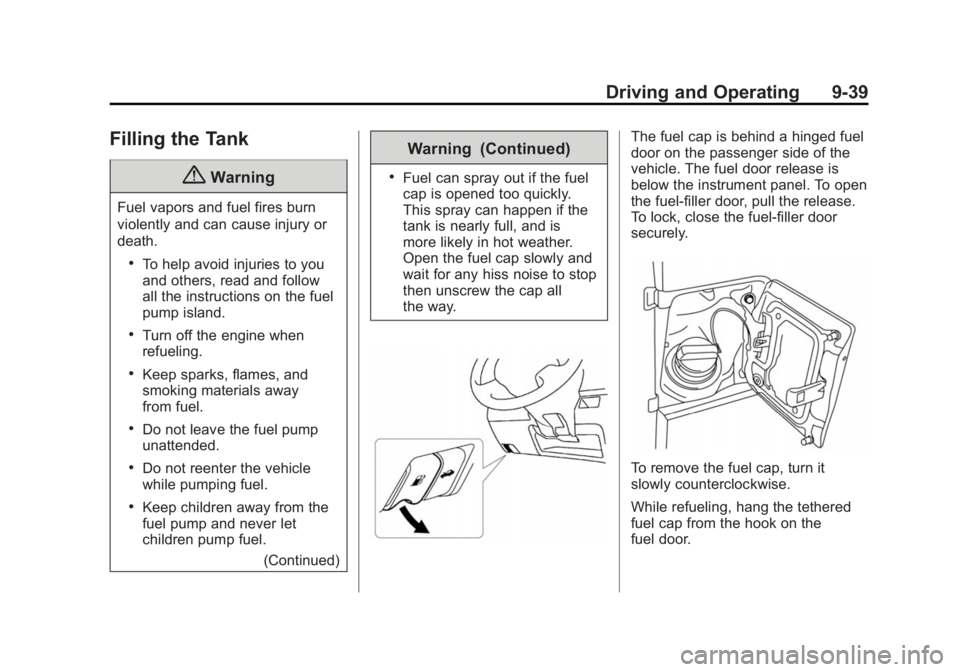
the way. The fuel cap is behind a hinged fuel
door on the passenger side of the
vehicle. The fuel door release is
below the instrument panel. To open
the fuel-filler door, pull the release.
To lock, close the fuel-filler door
securely.
To remove the fuel cap, turn it
slowly counterclockwise.
While refueling, hang the tethered
fuel cap from the hook on the
fuel door.
Page 184 of 297
Black plate (1,1)Chevrolet City Express Owner Manual (GMNA-Localizing-U.S./Canada-
7707496) - 2015 - CRC - 11/26/14
Vehicle Care 10-1
Vehicle Care General Information General Information . . . . . . . . . . 10-2
California Proposition
65 Warning . . . . . . . . . . . . . . . . . 10-2
California Perchlorate
Materials Requirements . . . . 10-2
Accessories and
Modifications . . . . . . . . . . . . . . . 10-3
Vehicle Checks Doing Your Own
Service Work . . . . . . . . . . . . . . . 10-4
Hood . . . . . . . . . . . . . . . . . . . . . . . . 10-5
Engine Compartment
Overview . . . . . . . . . . . . . . . . . . . 10-7
Engine Oil . . . . . . . . . . . . . . . . . . . 10-8
Continuously Variable
Transmission (CVT)
Fluid . . . . . . . . . . . . . . . . . . . . . . 10-11
Engine Air Cleaner/Filter . . . . 10-11
Cooling System . . . . . . . . . . . . 10-13
Engine Coolant . . . . . . . . . . . . . 10-13
Engine Overheating . . . . . . . . 10-16
Overheated Engine
Protection
Operating Mode . . . . . . . . . . . 10-17 Washer Fluid . . . . . . . . . . . . . . . 10-18
Brakes . . . . . . . . . . . . . . . . . . . . . 10-19
Brake Fluid . . . . . . . . . . . . . . . . . 10-19
Battery . . . . . . . . . . . . . . . . . . . . . 10-21
Wiper Blade
Replacement . . . . . . . . . . . . . . 10-22
Headlamp Aiming Headlamp Aiming . . . . . . . . . . 10-23
Bulb Replacement Bulb Replacement . . . . . . . . . . 10-23
Halogen Bulbs . . . . . . . . . . . . . . 10-23
Headlamps, Front Turn
Signal and Parking
Lamps . . . . . . . . . . . . . . . . . . . . 10-23
Replacement Bulbs . . . . . . . . . 10-23
Electrical System Electrical System
Overload . . . . . . . . . . . . . . . . . . 10-24
Fuses and Circuit
Breakers . . . . . . . . . . . . . . . . . . 10-25
Engine Compartment Fuse
Block . . . . . . . . . . . . . . . . . . . . . 10-25
Instrument Panel Fuse
Block . . . . . . . . . . . . . . . . . . . . . 10-26 Wheels and Tires Tires . . . . . . . . . . . . . . . . . . . . . . . . 10-26
All-Season Tires . . . . . . . . . . . . 10-27
Winter Tires . . . . . . . . . . . . . . . . 10-27
Summer Tires . . . . . . . . . . . . . . 10-28
All-Terrain Tires . . . . . . . . . . . . 10-28
Tire Sidewall Labeling . . . . . . 10-28
Tire Designations . . . . . . . . . . . 10-30
Tire Terminology and
Definitions . . . . . . . . . . . . . . . . 10-32
Tire Pressure . . . . . . . . . . . . . . . 10-35
Tire Pressure Monitor
System . . . . . . . . . . . . . . . . . . . 10-36
Tire Pressure Monitor
Operation . . . . . . . . . . . . . . . . . 10-37
Tire Inspection . . . . . . . . . . . . . . 10-39
Tire Rotation . . . . . . . . . . . . . . . 10-39
When It Is Time for New
Tires . . . . . . . . . . . . . . . . . . . . . . 10-41
Buying New Tires . . . . . . . . . . . 10-41
Different Size Tires and
Wheels . . . . . . . . . . . . . . . . . . . 10-43
Uniform Tire Quality
Grading . . . . . . . . . . . . . . . . . . . 10-44
Wheel Alignment and Tire
Balance . . . . . . . . . . . . . . . . . . . 10-45
Wheel Replacement . . . . . . . . 10-45
Tire Chains . . . . . . . . . . . . . . . . . 10-46