engine CHEVROLET CITY EXPRESS 2016 Repair Manual
[x] Cancel search | Manufacturer: CHEVROLET, Model Year: 2016, Model line: CITY EXPRESS, Model: CHEVROLET CITY EXPRESS 2016Pages: 297, PDF Size: 4.52 MB
Page 214 of 297
Black plate (31,1)Chevrolet City Express Owner Manual (GMNA-Localizing-U.S./Canada-
7707496) - 2015 - CRC - 11/26/14
Vehicle Care 10-31the tire size means a passenger
vehicle tire engineered to
standards set by the U.S. Tire
and Rim Association.
(2) Tire Width :
The three-digit
number indicates the tire section
width in millimeters from
sidewall to sidewall.
(3) Aspect Ratio :
A two-digit
number that indicates the tire
height-to-width measurements.
For example, if the tire size
aspect ratio is 75, as shown in
item 3 of the illustration, it would
mean that the tire's sidewall is
75 percent as high as it is wide.
(4) Construction Code :
A letter
code is used to indicate the type
of ply construction in the tire.
The letter R means radial ply
construction; the letter D means
diagonal or bias ply
construction; and the letter B
means belted-bias ply
construction. (5) Rim Diameter :
Diameter of
the wheel in inches.
(6) Service Description :
These
characters represent the load
index and speed rating of the
tire. The load index represents
the load carrying capacity a tire
is certified to carry. The speed
rating is the maximum speed a
tire is certified to carry a load.
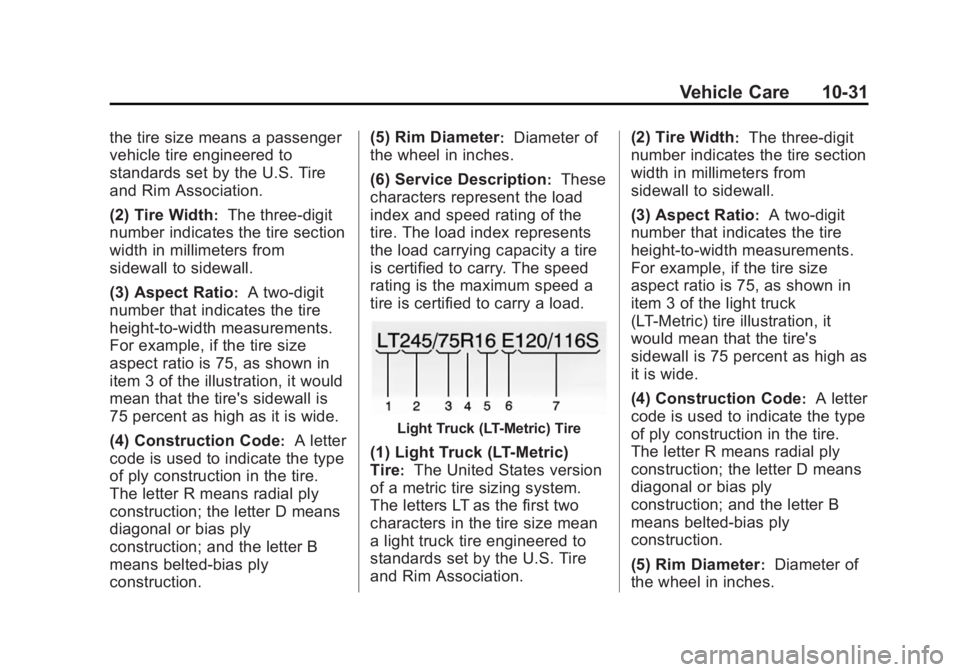
Light Truck (LT-Metric) Tire
(1) Light Truck (LT-Metric)
Tire :
The United States version
of a metric tire sizing system.
The letters LT as the first two
characters in the tire size mean
a light truck tire engineered to
standards set by the U.S. Tire
and Rim Association. (2) Tire Width :
The three-digit
number indicates the tire section
width in millimeters from
sidewall to sidewall.
(3) Aspect Ratio :
A two-digit
number that indicates the tire
height-to-width measurements.
For example, if the tire size
aspect ratio is 75, as shown in
item 3 of the light truck
(LT-Metric) tire illustration, it
would mean that the tire's
sidewall is 75 percent as high as
it is wide.
(4) Construction Code :
A letter
code is used to indicate the type
of ply construction in the tire.
The letter R means radial ply
construction; the letter D means
diagonal or bias ply
construction; and the letter B
means belted-bias ply
construction.
(5) Rim Diameter :
Diameter of
the wheel in inches.
Page 231 of 297
Black plate (48,1)Chevrolet City Express Owner Manual (GMNA-Localizing-U.S./Canada-
7707496) - 2015 - CRC - 11/26/14
10-48 Vehicle Care
{ WarningChanging a tire can be
dangerous. The vehicle can slip
off the jack and roll over or fall
causing injury or death. Find a
level place to change the tire. To
help prevent the vehicle from
moving:
1. Set the parking brake firmly.
2. Put an automatic
transmission in P (Park) or a
manual transmission in
1 (First) or R (Reverse).
3. Turn off the engine and do
not restart while the vehicle
is raised.
4. Do not allow passengers to
remain in the vehicle.
5. Place wheel blocks,
if equipped, on both sides of
the tire at the opposite
corner of the tire being
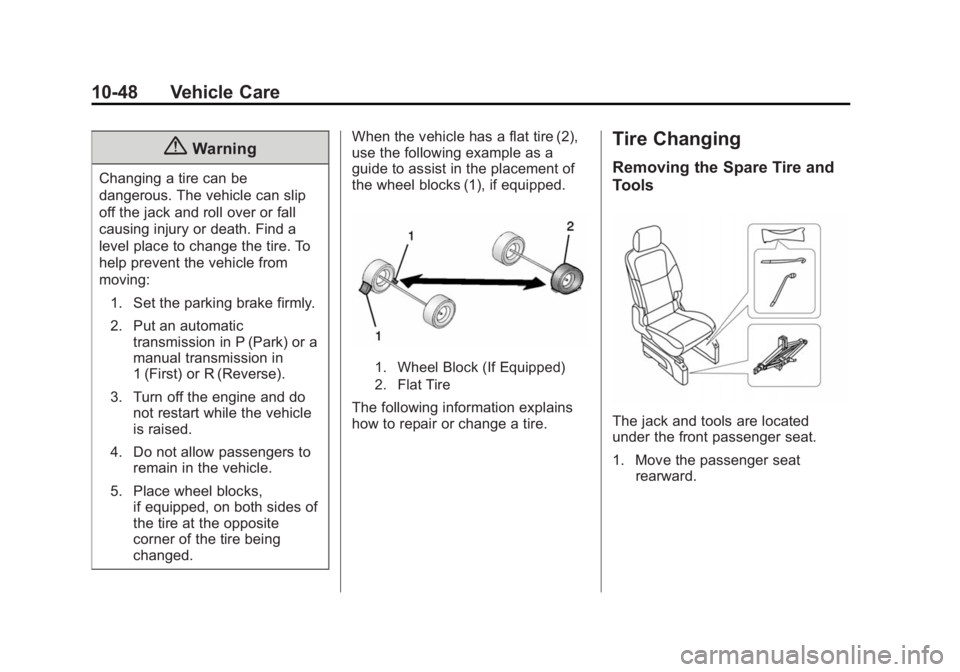
changed. When the vehicle has a flat tire (2),
use the following example as a
guide to assist in the placement of
the wheel blocks (1), if equipped.
1. Wheel Block (If Equipped)
2. Flat Tire
The following information explains
how to repair or change a tire. Tire Changing Removing the Spare Tire and
Tools
The jack and tools are located
under the front passenger seat.
1. Move the passenger seat
rearward.
Page 240 of 297
Black plate (57,1)Chevrolet City Express Owner Manual (GMNA-Localizing-U.S./Canada-
7707496) - 2015 - CRC - 11/26/14
Vehicle Care 10-572. Get the vehicles close enough
so the jumper cables can reach,
but be sure the vehicles are not
touching each other. If they are,
it could cause a ground
connection you do not want. You
would not be able to start your
vehicle, and the bad grounding
could damage the electrical
systems.
To avoid the possibility of the
vehicles rolling, set the parking
brake firmly on both vehicles
involved in the jump start
procedure. Put an automatic
transmission in P (Park) or a
manual transmission in Neutral
before setting the parking brake.
{ Caution
If any accessories are left on or
plugged in during the jump
starting procedure, they could be
damaged. The repairs would not
be covered by the vehicle
(Continued) Caution (Continued) warranty. Whenever possible, turn
off or unplug all accessories on
either vehicle when jump starting.
3. Turn off the ignition on both
vehicles. Unplug unnecessary
accessories from the cigarette
lighter or the accessory power
outlet. Turn off the radio and all
lamps that are not needed. This
will avoid sparks and help save
both batteries. And it could save
the radio!
4. Open the hoods and locate the
positive (+) and negative ( − )
terminal locations of the other
vehicle.
{ Warning
Using a match near a battery can
cause battery gas to explode.
People have been hurt doing this,
(Continued) Warning (Continued) and some have been blinded.
Use a flashlight if you need more
light.
Battery fluid contains acid that
can burn you. Do not get it on
you. If you accidentally get it in
your eyes or on your skin, flush
the place with water and get
medical help immediately.
{ Warning
Fans or other moving engine
parts can injure you badly. Keep
your hands away from moving
parts once the engine is running.
Page 241 of 297
Black plate (58,1)Chevrolet City Express Owner Manual (GMNA-Localizing-U.S./Canada-
7707496) - 2015 - CRC - 11/26/14
10-58 Vehicle Care 5. Check that the jumper cables do
not have loose or missing
insulation. If they do, you could
get a shock. The vehicles could
be damaged too.
Before you connect the cables,
here are some basic things you
should know. Positive (+) will go
to positive (+) or to a remote
positive (+) terminal if equipped.
Negative ( − ) will go to an
unpainted metal part or to a
remote negative ( − ) terminal if
equipped.
Do not connect positive (+) to
negative ( − ) or you will get a
short that would damage the
battery and possibly other parts
too. Do not connect the
negative ( − ) cable to the
negative ( − ) terminal on the dead
battery because this can cause
sparks.
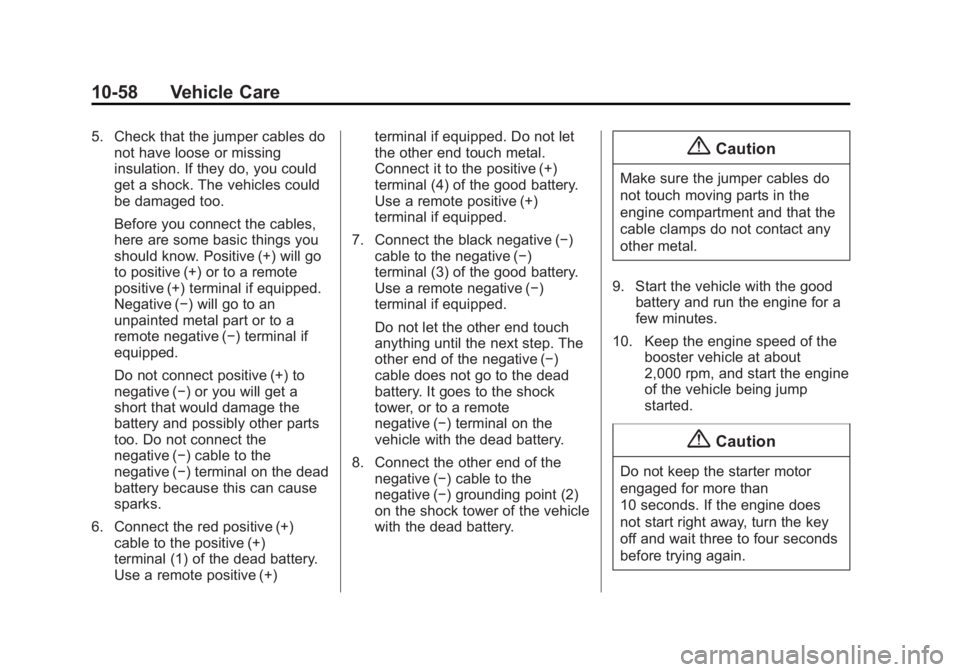
6. Connect the red positive (+)
cable to the positive (+)
terminal (1) of the dead battery.
Use a remote positive (+) terminal if equipped. Do not let
the other end touch metal.
Connect it to the positive (+)
terminal (4) of the good battery.
Use a remote positive (+)
terminal if equipped.
7. Connect the black negative ( − )
cable to the negative ( − )
terminal (3) of the good battery.
Use a remote negative ( − )
terminal if equipped.
Do not let the other end touch
anything until the next step. The
other end of the negative ( − )
cable does not go to the dead
battery. It goes to the shock
tower, or to a remote
negative ( − ) terminal on the
vehicle with the dead battery.
8. Connect the other end of the
negative ( − ) cable to the
negative ( − ) grounding point (2)
on the shock tower of the vehicle
with the dead battery. { CautionMake sure the jumper cables do
not touch moving parts in the
engine compartment and that the
cable clamps do not contact any
other metal.
9. Start the vehicle with the good
battery and run the engine for a
few minutes.
10. Keep the engine speed of the
booster vehicle at about
2,000 rpm, and start the engine
of the vehicle being jump
started.
{ Caution
Do not keep the starter motor
engaged for more than
10 seconds. If the engine does
not start right away, turn the key
off and wait three to four seconds
before trying again.
Page 242 of 297
Black plate (59,1)Chevrolet City Express Owner Manual (GMNA-Localizing-U.S./Canada-
7707496) - 2015 - CRC - 11/26/14
Vehicle Care 10-5911. After starting the engine,
disconnect jumper cables as
directed below.
12. If it will not start after a few
tries, it probably needs service.
{ CautionIf the jumper cables are
connected or removed in the
wrong order, electrical shorting
may occur and damage the
vehicle. The repairs would not be
covered by the vehicle warranty.
Always connect and remove the
jumper cables in the correct order,
making sure that the cables do
not touch each other or other
metal.
Jumper Cable Removal
Reverse the sequence exactly when
removing the jumper cables. Push Starting
{ Caution .
Do not push start this vehicle.
The three-way catalyst may
be damaged. .
Continuously Variable
Transmission (CVT) models
cannot be push-started or
tow-started. Attempting to do
so may cause transmission
damage. Towing the Vehicle
{ CautionIncorrectly towing a disabled
vehicle may cause damage. The
damage would not be covered by
the vehicle warranty.
Have the vehicle towed on a flatbed
car carrier or a wheel lift tow truck. If
a wheel lift tow truck is used, the
drive wheels cannot contact the
road while the vehicle is being
towed. A wheel dolly must be used
to lift all drive wheels off the ground.
Consult your dealer or a
professional towing service if the
disabled vehicle must be towed.
Recreational Vehicle
Towing Recreational vehicle towing means
towing the vehicle behind another
vehicle, such as behind a motor
home. The two most common types
Page 256 of 297
Black plate (3,1)Chevrolet City Express Owner Manual (GMNA-Localizing-U.S./Canada-
7707496) - 2015 - CRC - 11/26/14
Service and Maintenance 11-3
Maintenance
Schedule Owner Checks and Services At Each Fuel Stop .
Check the engine oil level. See
Engine Oil on page 10-8 .
Once a Month .
Check the tire inflation
pressures. See Tire Pressure on
page 10-35 ..
Inspect the tires for wear. See
Tire Inspection on page 10-39 ..
Check the windshield washer
fluid level. See Washer Fluid on
page 10-18 . Oil Change, Tire Rotation, and
Required Services Every
8 000 km/5,000 mi Rotate the tires, if recommended for
the vehicle, and perform the
following services. See Tire
Rotation on page 10-39 . .
Change engine oil and filter. See
Engine Oil on page 10-8 . .
Check engine coolant level. See
Engine Coolant on page 10-13 ..
Check drive shaft boots. .
Check windshield washer fluid
level. See Washer Fluid on
page 10-18 . .
Visually inspect windshield wiper
blades for wear, cracking,
or contamination. See Exterior
Care on page 10-61 . Replace
worn or damaged wiper blades.
See Wiper Blade Replacement
on page 10-22 . .
Check tire inflation pressures.
See Tire Pressure on
page 10-35 . .
Inspect tire wear. See Tire
Inspection on page 10-39 . .
Visually check for fluid leaks. .
Inspect engine air cleaner filter.
See Engine Air Cleaner/Filter on
page 10-11 .
Page 258 of 297
Black plate (5,1)Chevrolet City Express Owner Manual (GMNA-Localizing-U.S./Canada-
7707496) - 2015 - CRC - 11/26/14
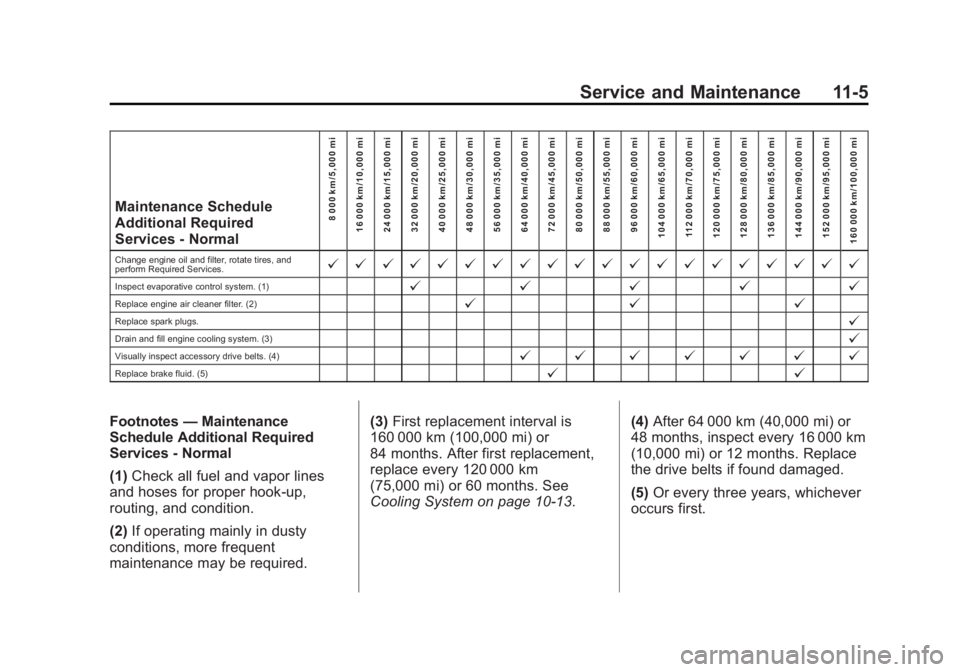
Service and Maintenance 11-5Maintenance Schedule
Additional Required
Services - Normal
8 000 km/5,000 mi
16 000 km/10,000 mi
24 000 km/15,000 mi
32 000 km/20,000 mi
40 000 km/25,000 mi
48 000 km/30,000 mi
56 000 km/35,000 mi
64 000 km/40,000 mi
72 000 km/45,000 mi
80 000 km/50,000 mi
88 000 km/55,000 mi
96 000 km/60,000 mi
104 000 km/65,000 mi
112 000 km/70,000 mi
120 000 km/75,000 mi
128 000 km/80,000 mi
136 000 km/85,000 mi
144 000 km/90,000 mi
152 000 km/95,000 mi
160 000 km/100,000 miChange engine oil and filter, rotate tires, and
perform Required Services.
@ @ @ @ @ @ @ @ @ @ @ @ @ @ @ @ @ @ @ @Inspect evaporative control system. (1)
@ @ @ @ @Replace engine air cleaner filter. (2)
@ @ @Replace spark plugs.
@Drain and fill engine cooling system. (3)
@Visually inspect accessory drive belts. (4)
@ @ @ @ @ @ @Replace brake fluid. (5)
@ @
Footnotes — Maintenance
Schedule Additional Required
Services - Normal
(1) Check all fuel and vapor lines
and hoses for proper hook-up,
routing, and condition.
(2) If operating mainly in dusty
conditions, more frequent
maintenance may be required. (3) First replacement interval is
160 000 km (100,000 mi) or
84 months. After first replacement,
replace every 120 000 km
(75,000 mi) or 60 months. See
Cooling System on page 10-13 . (4) After 64 000 km (40,000 mi) or
48 months, inspect every 16 000 km
(10,000 mi) or 12 months. Replace
the drive belts if found damaged.
(5) Or every three years, whichever
occurs first.
Page 259 of 297
Black plate (6,1)Chevrolet City Express Owner Manual (GMNA-Localizing-U.S./Canada-
7707496) - 2015 - CRC - 11/26/14
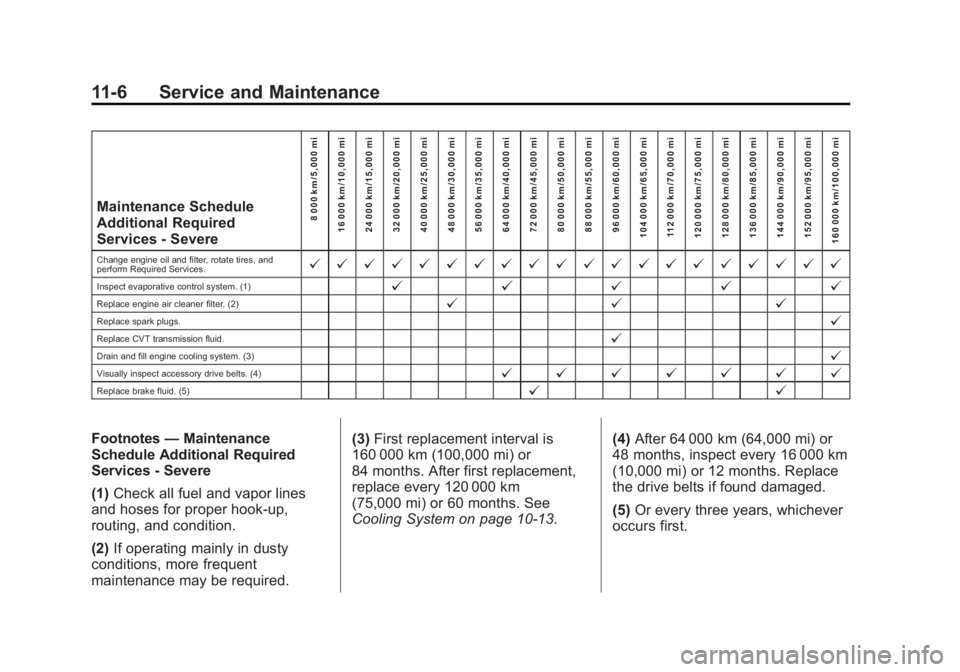
11-6 Service and Maintenance Maintenance Schedule
Additional Required
Services - Severe
8 000 km/5,000 mi
16 000 km/10,000 mi
24 000 km/15,000 mi
32 000 km/20,000 mi
40 000 km/25,000 mi
48 000 km/30,000 mi
56 000 km/35,000 mi
64 000 km/40,000 mi
72 000 km/45,000 mi
80 000 km/50,000 mi
88 000 km/55,000 mi
96 000 km/60,000 mi
104 000 km/65,000 mi
112 000 km/70,000 mi
120 000 km/75,000 mi
128 000 km/80,000 mi
136 000 km/85,000 mi
144 000 km/90,000 mi
152 000 km/95,000 mi
160 000 km/100,000 miChange engine oil and filter, rotate tires, and
perform Required Services.
@ @ @ @ @ @ @ @ @ @ @ @ @ @ @ @ @ @ @ @Inspect evaporative control system. (1)
@ @ @ @ @Replace engine air cleaner filter. (2)
@ @ @Replace spark plugs.
@Replace CVT transmission fluid.
@Drain and fill engine cooling system. (3)
@Visually inspect accessory drive belts. (4)
@ @ @ @ @ @ @Replace brake fluid. (5)
@ @
Footnotes — Maintenance
Schedule Additional Required
Services - Severe
(1) Check all fuel and vapor lines
and hoses for proper hook-up,
routing, and condition.
(2) If operating mainly in dusty
conditions, more frequent
maintenance may be required. (3) First replacement interval is
160 000 km (100,000 mi) or
84 months. After first replacement,
replace every 120 000 km
(75,000 mi) or 60 months. See
Cooling System on page 10-13 . (4) After 64 000 km (64,000 mi) or
48 months, inspect every 16 000 km
(10,000 mi) or 12 months. Replace
the drive belts if found damaged.
(5) Or every three years, whichever
occurs first.
Page 260 of 297
Black plate (7,1)Chevrolet City Express Owner Manual (GMNA-Localizing-U.S./Canada-
7707496) - 2015 - CRC - 11/26/14
Service and Maintenance 11-7
Special Application
Services .
Severe Commercial Use
Vehicles Only: Lubricate chassis
components every 5 000 km/
3,000 mi. .
Have underbody flushing service
performed. See “ Underbody
Maintenance ” in Exterior Care
on page 10-61 .
Additional
Maintenance and Care Your vehicle is an important
investment and caring for it properly
may help to avoid future costly
repairs. To maintain vehicle
performance, additional
maintenance services may be
required.
It is recommended that your dealer
perform these services — their
trained dealer technicians know
your vehicle best. Your dealer can
also perform a thorough
assessment with a multi-point
inspection to recommend when your
vehicle may need attention. The following list is intended to
explain the services and conditions
to look for that may indicate
services are required.
Battery
The battery supplies power to start
the engine and operate any
additional electrical accessories. .
To avoid break-down or failure to
start the vehicle, maintain a
battery with full cranking power. .
Trained dealer technicians have
the diagnostic equipment to test
the battery and ensure that the
connections and cables are
corrosion-free.
Page 261 of 297
Black plate (8,1)Chevrolet City Express Owner Manual (GMNA-Localizing-U.S./Canada-
7707496) - 2015 - CRC - 11/26/14
11-8 Service and Maintenance Belts .
Belts may need replacing if they
squeak or show signs of
cracking or splitting. .
Trained dealer technicians have
access to tools and equipment
to inspect the belts and
recommend adjustment or
replacement when necessary.
Brakes
Brakes stop the vehicle and are
crucial to safe driving. .
Signs of brake wear may include
chirping, grinding, or squealing
noises, or difficulty stopping. .
Trained dealer technicians have
access to tools and equipment
to inspect the brakes and
recommend quality parts
engineered for the vehicle. Fluids
Proper fluid levels and approved
fluids protect the vehicle ’ s systems
and components. See
Recommended Fluids and
Lubricants on page 11-11 for GM
approved fluids. .
Engine oil and windshield
washer fluid levels should be
checked at every fuel fill. .
Instrument cluster lights may
come on to indicate that fluids
may be low and need to be
filled. Hoses
Hoses transport fluids and should
be regularly inspected to ensure
that there are no cracks or leaks.
With a multi-point inspection, your
dealer can inspect the hoses and
advise if replacement is needed.
Lamps
Properly working headlamps,
taillamps, and brake lamps are
important to see and be seen on
the road. .
Signs that the headlamps need
attention include dimming, failure
to light, cracking, or damage.
The brake lamps need to be
checked periodically to ensure
that they light when braking. .
With a multi-point inspection,
your dealer can check the lamps
and note any concerns.