wheel CHEVROLET CITY EXPRESS 2016 Owner's Guide
[x] Cancel search | Manufacturer: CHEVROLET, Model Year: 2016, Model line: CITY EXPRESS, Model: CHEVROLET CITY EXPRESS 2016Pages: 297, PDF Size: 4.52 MB
Page 164 of 297
Black plate (23,1)Chevrolet City Express Owner Manual (GMNA-Localizing-U.S./Canada-
7707496) - 2015 - CRC - 11/26/14
Driving and Operating 9-23Warning (Continued) the vehicle in front of you.
Ultimately, the driver is
responsible for safety. .
Tire type and condition may
also affect braking
effectiveness. .
When replacing tires, install
the specified size of tires on
all four wheels. .
When installing a spare tire,
make sure that it is the proper
size and type as specified on
the Tire and Loading
Information label. .
For additional information,
refer to “ Wheels and Tires ” in
the “ Vehicle Care ” section of
this manual.
This vehicle has ABS, an advanced
electronic braking system that helps
prevent a braking skid. The ABS operates at speeds above
5 – 10 km/h (3 – 6 mph). The speed
varies according to road conditions.
When the vehicle begins to drive
away, ABS checks itself.
A momentary motor or clicking noise
might be heard while this test is
going on, and it might even be
noticed that the brake pedal moves
a little. This is normal.
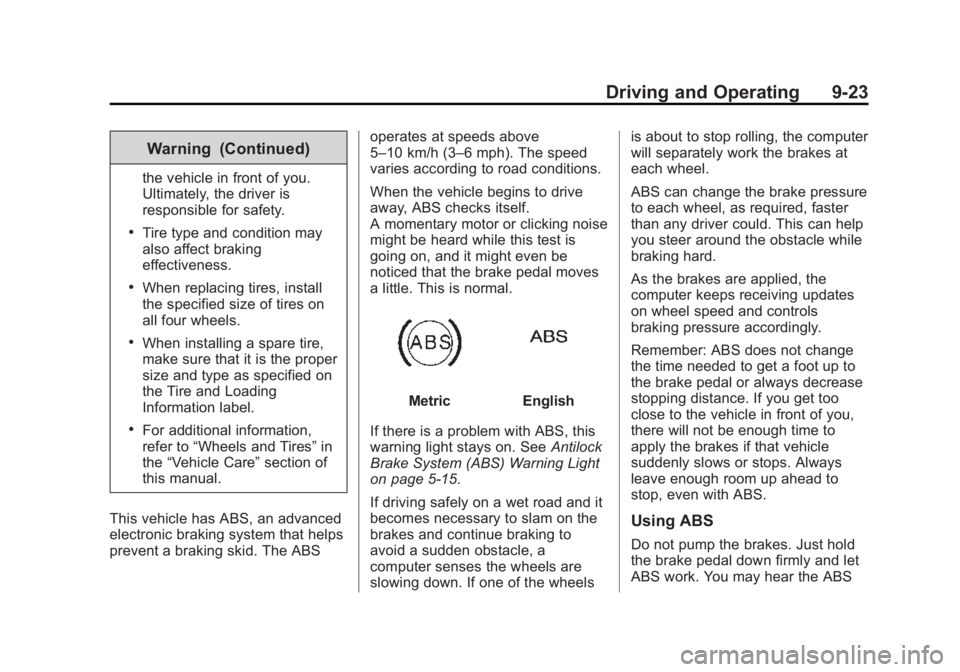
Metric English
If there is a problem with ABS, this
warning light stays on. See Antilock
Brake System (ABS) Warning Light
on page 5-15 .
If driving safely on a wet road and it
becomes necessary to slam on the
brakes and continue braking to
avoid a sudden obstacle, a
computer senses the wheels are
slowing down. If one of the wheels is about to stop rolling, the computer
will separately work the brakes at
each wheel.
ABS can change the brake pressure
to each wheel, as required, faster
than any driver could. This can help
you steer around the obstacle while
braking hard.
As the brakes are applied, the
computer keeps receiving updates
on wheel speed and controls
braking pressure accordingly.
Remember: ABS does not change
the time needed to get a foot up to
the brake pedal or always decrease
stopping distance. If you get too
close to the vehicle in front of you,
there will not be enough time to
apply the brakes if that vehicle
suddenly slows or stops. Always
leave enough room up ahead to
stop, even with ABS.
Using ABS
Do not pump the brakes. Just hold
the brake pedal down firmly and let
ABS work. You may hear the ABS
Page 165 of 297
Black plate (24,1)Chevrolet City Express Owner Manual (GMNA-Localizing-U.S./Canada-
7707496) - 2015 - CRC - 11/26/14
9-24 Driving and Operating pump or motor operating and feel
the brake pedal pulsate. This is
normal.
Braking in Emergencies ABS allows you to steer and brake
at the same time. In many
emergencies, steering can help
more than even the very best
braking.
Brake Force Distribution During braking while driving through
turns, the system optimizes the
distribution of force to each of the
four wheels depending on the radius
of the turn. Parking Brake
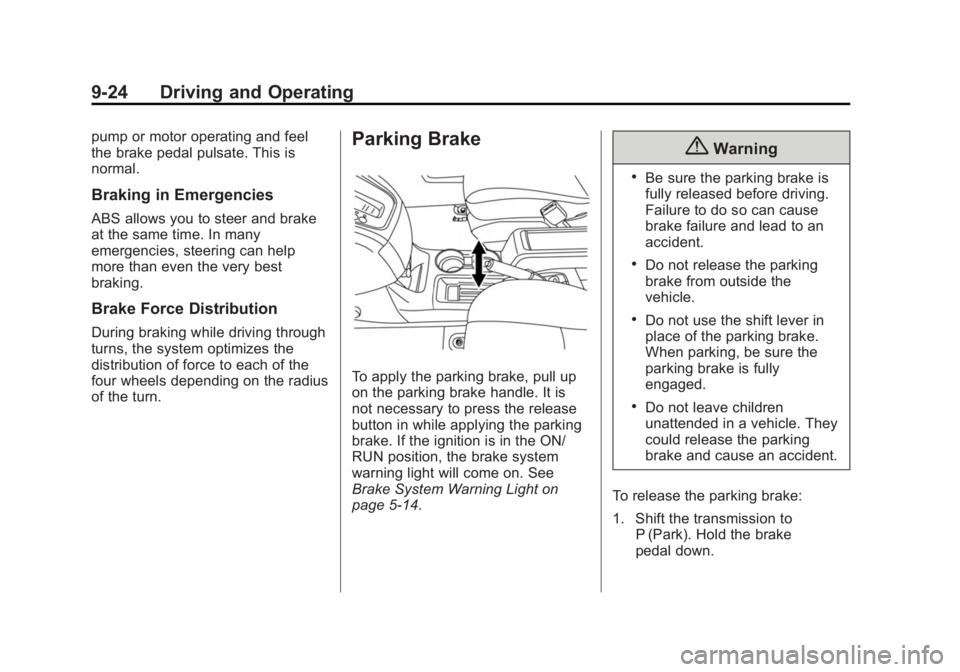
To apply the parking brake, pull up
on the parking brake handle. It is
not necessary to press the release
button in while applying the parking
brake. If the ignition is in the ON/
RUN position, the brake system
warning light will come on. See
Brake System Warning Light on
page 5-14 .{ Warning .
Be sure the parking brake is
fully released before driving.
Failure to do so can cause
brake failure and lead to an
accident. .
Do not release the parking
brake from outside the
vehicle. .
Do not use the shift lever in
place of the parking brake.
When parking, be sure the
parking brake is fully
engaged. .
Do not leave children
unattended in a vehicle. They
could release the parking
brake and cause an accident.
To release the parking brake:
1. Shift the transmission to
P (Park). Hold the brake
pedal down.
Page 166 of 297
Black plate (25,1)Chevrolet City Express Owner Manual (GMNA-Localizing-U.S./Canada-
7707496) - 2015 - CRC - 11/26/14
Driving and Operating 9-252. Pull the parking brake handle up
until you can press the release
button.
3. Hold the release button in as
you move the brake handle all
the way down.
{ CautionDriving with the parking brake on
can overheat the brake system
and cause premature wear or
damage to brake system parts.
Make sure that the parking brake
is fully released and the brake
warning light is off before driving.
Parking Brake Break-in
Break-in the brake shoes whenever
the effect of the parking brake is
weakened or whenever the brake
shoes and/or drums are replaced, in
order to assure the best brake
performance. This procedure can be
performed at the dealer. Ride Control Systems Traction Control/
Electronic Stability
Control System Operation The vehicle has a Traction Control
System (TCS) and Electronic
Stability Control, an electronic
stability control system. These
systems use various sensors to
monitor driver inputs and vehicle
motion. Under certain driving
conditions, the TCS and Electronic
Stability Control systems help to
perform the following functions: .
Control brake pressure to reduce
wheel slip on one slipping drive
wheel so power is transferred to
a non – slipping drive wheel on
the same axle. .
Control brake pressure and
engine output to reduce drive
wheel slip based on vehicle
speed (traction control function). .
Control brake pressure at
individual wheels and engine
output to help the driver maintain
control of the vehicle in the
following conditions:
‐ Understeer (vehicle tends to
not follow the steered path
despite increased steering
input)
‐ Oversteer (vehicle tends to
spin due to certain road or
driving conditions)
TCS and Electronic Stability Control
can help the driver to maintain
control of the vehicle, but cannot
prevent loss of vehicle control in all
driving situations.
When the TCS and Electronic
Stability Control systems operate,
the
d indicator in the instrument
cluster flashes to note the following: .
The road may be slippery or the
system may determine some
action is required to help keep
the vehicle on the steered path.
Page 167 of 297
Black plate (26,1)Chevrolet City Express Owner Manual (GMNA-Localizing-U.S./Canada-
7707496) - 2015 - CRC - 11/26/14
9-26 Driving and Operating .
You may feel a pulsation in the
brake pedal and hear a noise or
vibration from under the hood.
This is normal and indicates that
the traction control system is
working properly. .
Adjust your speed and driving to
the road conditions.
See Traction Control System (TCS)/
Electronic Stability Control Light on
page 5-16 and Electronic Stability
Control (ESC) Off Light on
page 5-16 .
If a malfunction occurs in the
systems, the
d indicator comes on
in the instrument cluster. The TCS
and Electronic Stability Control
systems automatically turn off when
the indicator light is on. Turning the Systems Off
and On
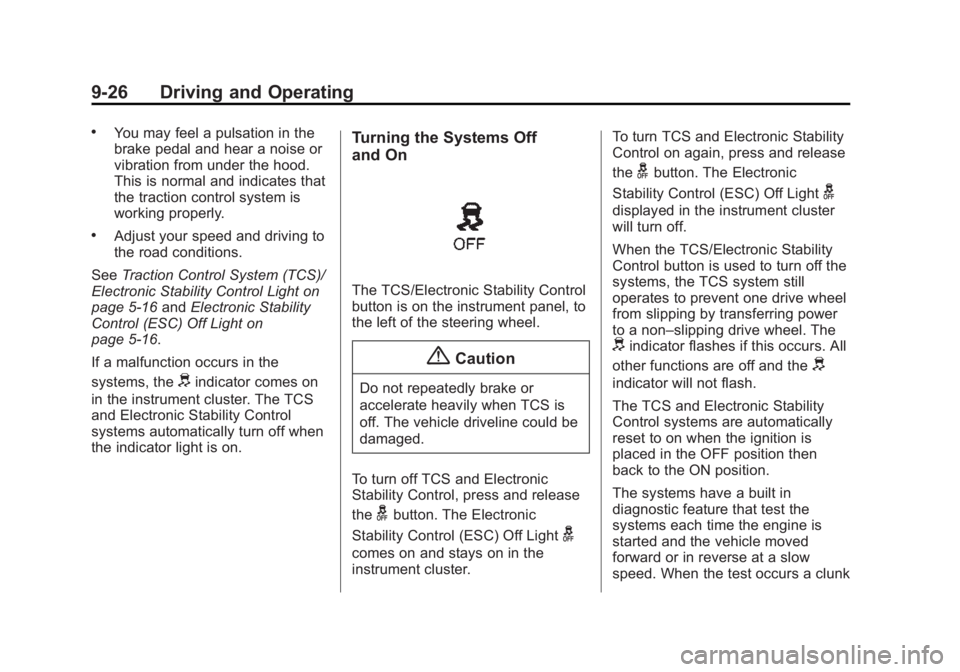
The TCS/Electronic Stability Control
button is on the instrument panel, to
the left of the steering wheel.
{ CautionDo not repeatedly brake or
accelerate heavily when TCS is
off. The vehicle driveline could be
damaged.
To turn off TCS and Electronic
Stability Control, press and release
the
g button. The Electronic
Stability Control (ESC) Off Light
gcomes on and stays on in the
instrument cluster. To turn TCS and Electronic Stability
Control on again, press and release
the
g button. The Electronic
Stability Control (ESC) Off Light
gdisplayed in the instrument cluster
will turn off.
When the TCS/Electronic Stability
Control button is used to turn off the
systems, the TCS system still
operates to prevent one drive wheel
from slipping by transferring power
to a non – slipping drive wheel. The
d indicator flashes if this occurs. All
other functions are off and the
d indicator will not flash.
The TCS and Electronic Stability
Control systems are automatically
reset to on when the ignition is
placed in the OFF position then
back to the ON position.
The systems have a built in
diagnostic feature that test the
systems each time the engine is
started and the vehicle moved
forward or in reverse at a slow
speed. When the test occurs a clunk
Page 168 of 297
Black plate (27,1)Chevrolet City Express Owner Manual (GMNA-Localizing-U.S./Canada-
7707496) - 2015 - CRC - 11/26/14
Driving and Operating 9-27noise may be heard and/or a
pulsation in the brake pedal may be
felt. This is normal and is not an
indication of a malfunction.
Adding accessories can affect the
vehicle performance. See
Accessories and Modifications on
page 10-3 .
{ Warning .
The Traction Control System
(TCS) and Electronic Stability
Control (ESC) system are
designed to help the driver
maintain stability but do not
prevent accidents due to
abrupt steering operation at
high speeds or by careless or
dangerous driving
techniques. Reduce vehicle
speed and be especially
careful when driving and
cornering on slippery
surfaces and always drive
carefully.
(Continued) Warning (Continued) .
Do not modify the vehicle ’ s
suspension. If suspension
parts such as shock
absorbers, struts, springs,
stabilizer bars, bushings, and
wheels are not recommended
for your vehicle or are
extremely deteriorated, the
TCS and ESC systems may
not operate properly. This
could adversely affect vehicle
handling performance, and
the
d indicator may flash or
the
d indicator light may
illuminate. .
If brake related parts such as
brake pads, rotors, and
calipers are not
recommended or are
extremely deteriorated, the
TCS and ESC systems may
(Continued) Warning (Continued) not operate properly and the
d indicator light may
illuminate. .
If engine control related parts
are not recommended or are
extremely deteriorated, the
d indicator light may illuminate. .
When driving on extremely
inclined surfaces such as
higher banked corners, the
TCS and ESC systems may
not operate properly and the
d indicator may flash or the
d indicator light may
illuminate. Do not drive on
these types of roads. .
When driving on an unstable
surface such as a turntable,
ferry, elevator, or ramp, the
d indicator may flash or the
d indicator light may illuminate.
(Continued)
Page 169 of 297
Black plate (28,1)Chevrolet City Express Owner Manual (GMNA-Localizing-U.S./Canada-
7707496) - 2015 - CRC - 11/26/14
9-28 Driving and Operating Warning (Continued) This is not a malfunction.
Restart the engine after
driving onto a stable surface. .
If wheels or tires other than
the recommended ones are
used, the TCS and ESC
systems may not operate
properly and the
d indicator
may flash or the
d indicator
light may illuminate. .
The TCS and ESC systems
are not a substitute for winter
tires or tire chains on a snow
covered road. Cruise Control
{ WarningCruise control can be dangerous
where you cannot drive safely at
a steady speed. Do not use
cruise control on winding roads or
in heavy traffic.
Cruise control can be dangerous
on slippery roads. On such roads,
fast changes in tire traction can
cause excessive wheel slip, and
you could lose control. Do not use
cruise control on slippery roads.
If equipped with cruise control, a
speed of about 48 km/h (30 mph) or
more can be maintained without
keeping your foot on the
accelerator. Cruise control does not
work at speeds below about
48 km/h (30 mph).
If the brakes are applied, cruise
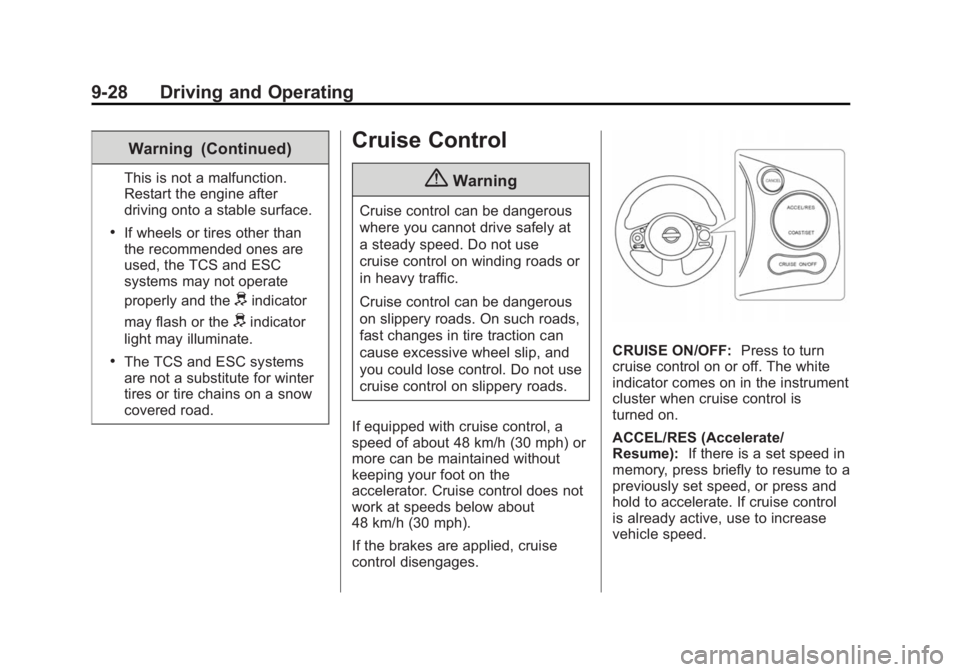
control disengages. CRUISE ON/OFF: Press to turn
cruise control on or off. The white
indicator comes on in the instrument
cluster when cruise control is
turned on.
ACCEL/RES (Accelerate/
Resume): If there is a set speed in
memory, press briefly to resume to a
previously set speed, or press and
hold to accelerate. If cruise control
is already active, use to increase
vehicle speed.
Page 184 of 297
Black plate (1,1)Chevrolet City Express Owner Manual (GMNA-Localizing-U.S./Canada-
7707496) - 2015 - CRC - 11/26/14
Vehicle Care 10-1
Vehicle Care General Information General Information . . . . . . . . . . 10-2
California Proposition
65 Warning . . . . . . . . . . . . . . . . . 10-2
California Perchlorate
Materials Requirements . . . . 10-2
Accessories and
Modifications . . . . . . . . . . . . . . . 10-3
Vehicle Checks Doing Your Own
Service Work . . . . . . . . . . . . . . . 10-4
Hood . . . . . . . . . . . . . . . . . . . . . . . . 10-5
Engine Compartment
Overview . . . . . . . . . . . . . . . . . . . 10-7
Engine Oil . . . . . . . . . . . . . . . . . . . 10-8
Continuously Variable
Transmission (CVT)
Fluid . . . . . . . . . . . . . . . . . . . . . . 10-11
Engine Air Cleaner/Filter . . . . 10-11
Cooling System . . . . . . . . . . . . 10-13
Engine Coolant . . . . . . . . . . . . . 10-13
Engine Overheating . . . . . . . . 10-16
Overheated Engine
Protection
Operating Mode . . . . . . . . . . . 10-17 Washer Fluid . . . . . . . . . . . . . . . 10-18
Brakes . . . . . . . . . . . . . . . . . . . . . 10-19
Brake Fluid . . . . . . . . . . . . . . . . . 10-19
Battery . . . . . . . . . . . . . . . . . . . . . 10-21
Wiper Blade
Replacement . . . . . . . . . . . . . . 10-22
Headlamp Aiming Headlamp Aiming . . . . . . . . . . 10-23
Bulb Replacement Bulb Replacement . . . . . . . . . . 10-23
Halogen Bulbs . . . . . . . . . . . . . . 10-23
Headlamps, Front Turn
Signal and Parking
Lamps . . . . . . . . . . . . . . . . . . . . 10-23
Replacement Bulbs . . . . . . . . . 10-23
Electrical System Electrical System
Overload . . . . . . . . . . . . . . . . . . 10-24
Fuses and Circuit
Breakers . . . . . . . . . . . . . . . . . . 10-25
Engine Compartment Fuse
Block . . . . . . . . . . . . . . . . . . . . . 10-25
Instrument Panel Fuse
Block . . . . . . . . . . . . . . . . . . . . . 10-26 Wheels and Tires Tires . . . . . . . . . . . . . . . . . . . . . . . . 10-26
All-Season Tires . . . . . . . . . . . . 10-27
Winter Tires . . . . . . . . . . . . . . . . 10-27
Summer Tires . . . . . . . . . . . . . . 10-28
All-Terrain Tires . . . . . . . . . . . . 10-28
Tire Sidewall Labeling . . . . . . 10-28
Tire Designations . . . . . . . . . . . 10-30
Tire Terminology and
Definitions . . . . . . . . . . . . . . . . 10-32
Tire Pressure . . . . . . . . . . . . . . . 10-35
Tire Pressure Monitor
System . . . . . . . . . . . . . . . . . . . 10-36
Tire Pressure Monitor
Operation . . . . . . . . . . . . . . . . . 10-37
Tire Inspection . . . . . . . . . . . . . . 10-39
Tire Rotation . . . . . . . . . . . . . . . 10-39
When It Is Time for New
Tires . . . . . . . . . . . . . . . . . . . . . . 10-41
Buying New Tires . . . . . . . . . . . 10-41
Different Size Tires and
Wheels . . . . . . . . . . . . . . . . . . . 10-43
Uniform Tire Quality
Grading . . . . . . . . . . . . . . . . . . . 10-44
Wheel Alignment and Tire
Balance . . . . . . . . . . . . . . . . . . . 10-45
Wheel Replacement . . . . . . . . 10-45
Tire Chains . . . . . . . . . . . . . . . . . 10-46
Page 188 of 297
Black plate (5,1)Chevrolet City Express Owner Manual (GMNA-Localizing-U.S./Canada-
7707496) - 2015 - CRC - 11/26/14
Vehicle Care 10-5This vehicle has an airbag system.
Before attempting to do your own
service work, see Servicing the
Airbag-Equipped Vehicle on
page 3-28 .
Keep a record with all parts receipts
and list the mileage and the date of
any service work performed. See
Maintenance Records on
page 11-13 .
{ CautionEven small amounts of
contamination can cause damage
to vehicle systems. Do not allow
contaminants to contact the fluids,
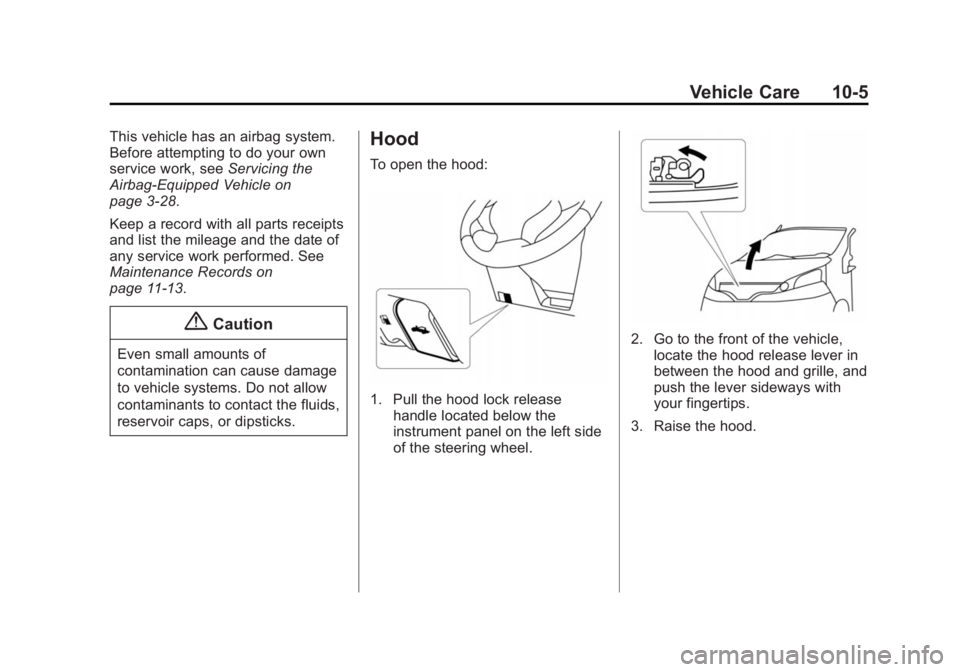
reservoir caps, or dipsticks. Hood To open the hood:
1. Pull the hood lock release
handle located below the
instrument panel on the left side
of the steering wheel. 2. Go to the front of the vehicle,
locate the hood release lever in
between the hood and grille, and
push the lever sideways with
your fingertips.
3. Raise the hood.
Page 202 of 297
Black plate (19,1)Chevrolet City Express Owner Manual (GMNA-Localizing-U.S./Canada-
7707496) - 2015 - CRC - 11/26/14
Vehicle Care 10-19
Brakes Disc brake pads have built-in wear
indicators that make a high-pitched
warning sound when the brake pads
are worn and new pads are needed.
The sound can come and go or be
heard all the time when the vehicle
is moving, except when applying the
brake pedal firmly.
{ WarningThe brake wear warning sound
means that soon the brakes will
not work well. That could lead to
a crash. When the brake wear
warning sound is heard, have the
vehicle serviced.
{ Caution
Continuing to drive with worn-out
brake pads could result in costly
brake repair. Some driving conditions or climates
can cause a brake squeal when the
brakes are first applied or lightly
applied. This does not mean
something is wrong with the brakes.
Properly torqued wheel nuts are
necessary to help prevent brake
pulsation. When tires are rotated,
inspect brake pads for wear and
evenly tighten wheel nuts in the
proper sequence to torque
specifications. See Capacities and
Specifications on page 12-2 .
Brake pads should be replaced as
complete sets.
Brake Pedal Travel See your dealer if the brake pedal
does not return to normal height,
or if there is a rapid increase in
pedal travel. This could be a sign
that brake service may be required.
Replacing Brake System Parts
Always replace brake system parts
with new, approved replacement
parts. If this is not done, the brakes
may not work properly. The braking performance expected can change
in many other ways if the wrong
replacement brake parts are
installed or parts are improperly
installed.
Brake Fluid
The brake master cylinder reservoir
is filled with DOT 3 brake fluid. See
Engine Compartment Overview on
page 10-7 for the location of the
reservoir.
There are only two reasons why the
brake fluid level in the reservoir
might go down: .
The brake fluid level goes down
because of normal brake lining
wear. When new linings are
installed, the fluid level goes
back up.
Page 209 of 297
Black plate (26,1)Chevrolet City Express Owner Manual (GMNA-Localizing-U.S./Canada-
7707496) - 2015 - CRC - 11/26/14
10-26 Vehicle Care
Instrument Panel Fuse
Block
{ CautionSpilling liquid on any electrical
component on the vehicle may
damage it. Always keep the
covers on any electrical
component.
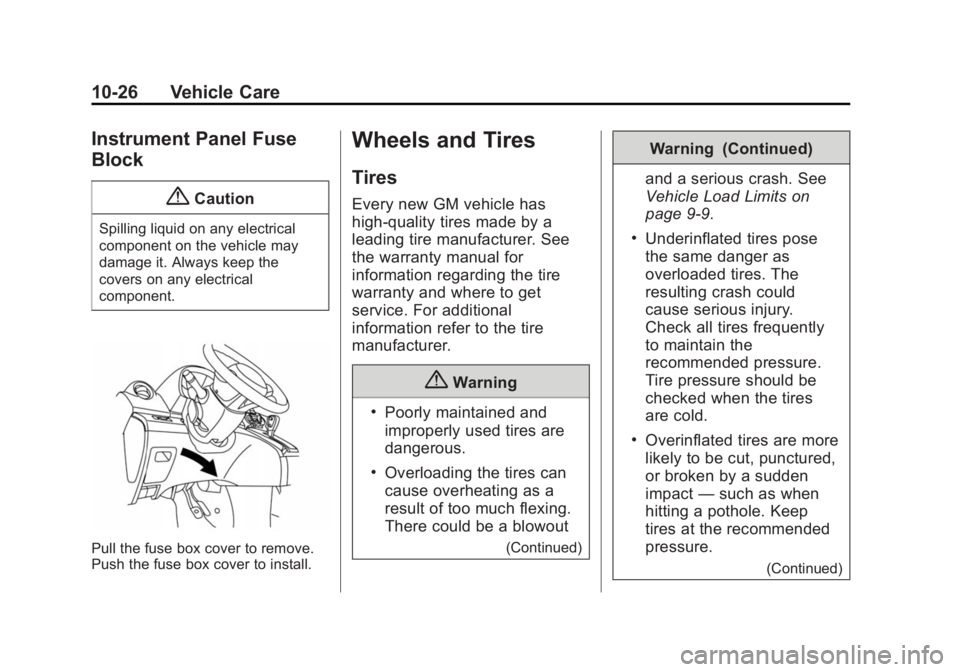
Pull the fuse box cover to remove.
Push the fuse box cover to install. Wheels and Tires Tires Every new GM vehicle has
high-quality tires made by a
leading tire manufacturer. See
the warranty manual for
information regarding the tire
warranty and where to get
service. For additional
information refer to the tire
manufacturer.
{ Warning .
Poorly maintained and
improperly used tires are
dangerous. .
Overloading the tires can
cause overheating as a
result of too much flexing.
There could be a blowout
(Continued) Warning (Continued)
and a serious crash. See
Vehicle Load Limits on
page 9-9 . .
Underinflated tires pose
the same danger as
overloaded tires. The
resulting crash could
cause serious injury.
Check all tires frequently
to maintain the
recommended pressure.
Tire pressure should be
checked when the tires
are cold. .
Overinflated tires are more
likely to be cut, punctured,
or broken by a sudden
impact — such as when
hitting a pothole. Keep
tires at the recommended
pressure.
(Continued)