brakes CHEVROLET CITY EXPRESS 2018 User Guide
[x] Cancel search | Manufacturer: CHEVROLET, Model Year: 2018, Model line: CITY EXPRESS, Model: CHEVROLET CITY EXPRESS 2018Pages: 287, PDF Size: 4.19 MB
Page 163 of 287
Chevrolet City Express Owner Manual (GMNA-Localizing-U.S./Canada-
11683523) - 2018 - CRC - 7/10/17
162 Driving and Operating
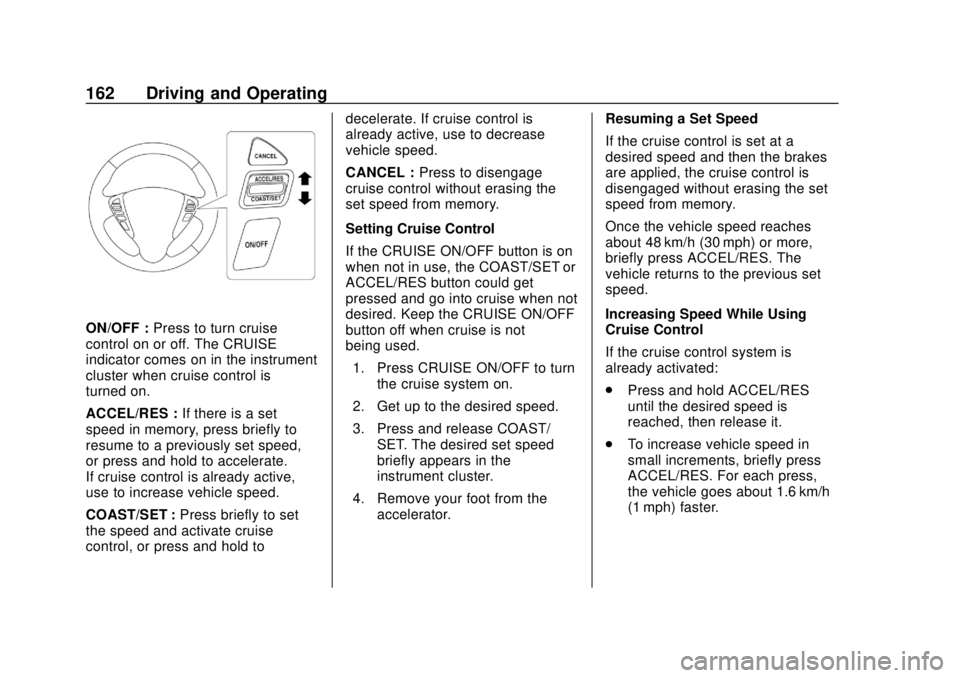
ON/OFF :Press to turn cruise
control on or off. The CRUISE
indicator comes on in the instrument
cluster when cruise control is
turned on.
ACCEL/RES : If there is a set
speed in memory, press briefly to
resume to a previously set speed,
or press and hold to accelerate.
If cruise control is already active,
use to increase vehicle speed.
COAST/SET : Press briefly to set
the speed and activate cruise
control, or press and hold to decelerate. If cruise control is
already active, use to decrease
vehicle speed.
CANCEL :
Press to disengage
cruise control without erasing the
set speed from memory.
Setting Cruise Control
If the CRUISE ON/OFF button is on
when not in use, the COAST/SET or
ACCEL/RES button could get
pressed and go into cruise when not
desired. Keep the CRUISE ON/OFF
button off when cruise is not
being used.
1. Press CRUISE ON/OFF to turn the cruise system on.
2. Get up to the desired speed.
3. Press and release COAST/ SET. The desired set speed
briefly appears in the
instrument cluster.
4. Remove your foot from the accelerator. Resuming a Set Speed
If the cruise control is set at a
desired speed and then the brakes
are applied, the cruise control is
disengaged without erasing the set
speed from memory.
Once the vehicle speed reaches
about 48 km/h (30 mph) or more,
briefly press ACCEL/RES. The
vehicle returns to the previous set
speed.
Increasing Speed While Using
Cruise Control
If the cruise control system is
already activated:
.
Press and hold ACCEL/RES
until the desired speed is
reached, then release it.
. To increase vehicle speed in
small increments, briefly press
ACCEL/RES. For each press,
the vehicle goes about 1.6 km/h
(1 mph) faster.
Page 177 of 287
Chevrolet City Express Owner Manual (GMNA-Localizing-U.S./Canada-
11683523) - 2018 - CRC - 7/10/17
176 Vehicle Care
Vehicle Care
General Information
General Information . . . . . . . . . . 177
California Proposition65 Warning . . . . . . . . . . . . . . . . . 177
California Perchlorate Materials Requirements . . . . . 178
Accessories and Modifications . . . . . . . . . . . . . . . . 178
Vehicle Checks
Doing Your OwnService Work . . . . . . . . . . . . . . . 178
Hood . . . . . . . . . . . . . . . . . . . . . . . . . 179
Engine Compartment Overview . . . . . . . . . . . . . . . . . . . . 181
Engine Oil . . . . . . . . . . . . . . . . . . . . 182
Engine Air Cleaner/Filter . . . . . . 184
Cooling System . . . . . . . . . . . . . . 186
Engine Overheating . . . . . . . . . . 190
Overheated Engine Protection Operating Mode . . . . . . . . . . . . . 190
Washer Fluid . . . . . . . . . . . . . . . . . 191
Brakes . . . . . . . . . . . . . . . . . . . . . . . 192
Brake Fluid . . . . . . . . . . . . . . . . . . . 193
Battery - North America . . . . . . 194
Wiper Blade Replacement . . . . 195
Gas Strut(s) . . . . . . . . . . . . . . . . . . 196
Headlamp Aiming
Headlamp Aiming . . . . . . . . . . . . 197
Bulb Replacement
Bulb Replacement . . . . . . . . . . . . 197
Halogen Bulbs . . . . . . . . . . . . . . . . 197
Headlamps, Front Turn Signal and Parking Lamps . . . . . . . . . 198
Electrical System
Electrical System Overload . . . 198
Fuses and Circuit Breakers . . . 199
Engine Compartment FuseBlock . . . . . . . . . . . . . . . . . . . . . . . . 199
Instrument Panel Fuse Block . . . . . . . . . . . . . . . . . . . . . . . . 200
Wheels and Tires
Tires . . . . . . . . . . . . . . . . . . . . . . . . . . 200
All-Season Tires . . . . . . . . . . . . . . 201
Winter Tires . . . . . . . . . . . . . . . . . . 201
Summer Tires . . . . . . . . . . . . . . . . 202
All-Terrain Tires . . . . . . . . . . . . . . . 202
Tire Sidewall Labeling . . . . . . . . 202
Tire Designations . . . . . . . . . . . . . 204
Tire Terminology andDefinitions . . . . . . . . . . . . . . . . . . 206
Tire Pressure . . . . . . . . . . . . . . . . . 208
Tire Pressure Monitor System . . . . . . . . . . . . . . . . . . . . . . 210 Tire Pressure Monitor
Operation . . . . . . . . . . . . . . . . . . . 211
Tire Inspection . . . . . . . . . . . . . . . . 213
Tire Rotation . . . . . . . . . . . . . . . . . 213
When It Is Time for New Tires . . . . . . . . . . . . . . . . . . . . . . . . 214
Buying New Tires . . . . . . . . . . . . . 215
Different Size Tires and Wheels . . . . . . . . . . . . . . . . . . . . . . 216
Uniform Tire Quality Grading . . . . . . . . . . . . . . . . . . . . . 217
Wheel Alignment and Tire Balance . . . . . . . . . . . . . . . . . . . . . 218
Wheel Replacement . . . . . . . . . . 219
Tire Chains . . . . . . . . . . . . . . . . . . . 219
If a Tire Goes Flat . . . . . . . . . . . . 220
Tire Changing . . . . . . . . . . . . . . . . 221
Full-Size Spare Tire . . . . . . . . . . 226
Jump Starting
Jump Starting - North America . . . . . . . . . . . . . . . . . . . . . 227
Towing the Vehicle
Towing the Vehicle . . . . . . . . . . . 231
Recreational VehicleTowing . . . . . . . . . . . . . . . . . . . . . . 231
Page 179 of 287

Chevrolet City Express Owner Manual (GMNA-Localizing-U.S./Canada-
11683523) - 2018 - CRC - 7/10/17
178 Vehicle Care
California Perchlorate
Materials Requirements
Certain types of automotive
applications, such as airbag
initiators, seat belt pretensioners,
and lithium batteries contained in
Remote Keyless Entry transmitters,
may contain perchlorate materials.
Special handling may be necessary.
For additional information, see
www.dtsc.ca.gov/hazardouswaste/
perchlorate.
Accessories and
Modifications
Adding non-dealer accessories or
making modifications to the vehicle
can affect vehicle performance and
safety, including such things as
airbags, braking, stability, ride and
handling, emissions systems,
aerodynamics, durability, and
electronic systems like antilock
brakes, traction control, and stability
control. These accessories or
modifications could even cause
malfunction or damage not covered
by the vehicle warranty.Damage to suspension components
caused by modifying vehicle height
outside of factory settings will not be
covered by the vehicle warranty.
Damage to vehicle components
resulting from modifications or the
installation or use of non-GM
certified parts, including control
module or software modifications, is
not covered under the terms of the
vehicle warranty and may affect
remaining warranty coverage for
affected parts.
GM Accessories are designed to
complement and function with other
systems on the vehicle. See your
dealer to accessorize the vehicle
using genuine GM Accessories
installed by a dealer technician.
Also, see
Adding Equipment to the
Airbag-Equipped Vehicle 063.
Vehicle Checks
Doing Your Own
Service Work
{Warning
It can be dangerous to work on
your vehicle if you do not have
the proper knowledge, service
manual, tools, or parts. Always
follow owner ’s manual procedures
and consult the service manual
for your vehicle before doing any
service work.
If doing some of your own service
work, use the proper service
manual. It tells you much more
about how to service the vehicle
than this manual can. To order the
proper service manual, see Service
Publications Ordering Information
0 272.
Page 193 of 287

Chevrolet City Express Owner Manual (GMNA-Localizing-U.S./Canada-
11683523) - 2018 - CRC - 7/10/17
192 Vehicle Care
Caution (Continued)
.Do not use engine coolant
(antifreeze) in the
windshield washer. It can
damage the windshield
washer system and paint.
. Do not mix water with
ready-to-use washer fluid.
Water can cause the
solution to freeze and
damage the washer fluid
tank and other parts of the
washer system.
. When using concentrated
washer fluid, follow the
manufacturer instructions for
adding water.
. Fill the washer fluid tank
only three-quarters full when
it is very cold. This allows
for fluid expansion if
freezing occurs, which could
damage the tank if it is
completely full.
Brakes
Disc brake pads have built-in wear
indicators that make a high-pitched
warning sound when the brake pads
are worn and new pads are needed.
The sound can come and go or can
be heard all the time when the
vehicle is moving, except when
applying the brake pedal firmly.
{Warning
The brake wear warning sound
means that soon the brakes will
not work well. That could lead to
a crash. When the brake wear
warning sound is heard, have the
vehicle serviced.
Caution
Continuing to drive with worn-out
brake pads could result in costly
brake repair. Some driving conditions or climates
can cause a brake squeal when the
brakes are first applied or lightly
applied. This does not mean
something is wrong with the brakes.
Properly torqued wheel nuts are
necessary to help prevent brake
pulsation. When tires are rotated,
inspect brake pads for wear and
evenly tighten wheel nuts in the
proper sequence to torque
specifications. See
Capacities and
Specifications 0261.
Brake pads should be replaced as
complete sets.
Brake Pedal Travel
See your dealer if the brake pedal
does not return to normal height,
or if there is a rapid increase in
pedal travel. This could be a sign
that brake service may be required.
Replacing Brake System Parts
Always replace brake system parts
with new, approved replacement
parts. If this is not done, the brakes
may not work properly. The braking
performance expected can change
Page 194 of 287

Chevrolet City Express Owner Manual (GMNA-Localizing-U.S./Canada-
11683523) - 2018 - CRC - 7/10/17
Vehicle Care 193
in many other ways if the wrong
replacement brake parts are
installed or if parts are improperly
installed.
Brake Fluid
The brake master cylinder reservoir
is filled with DOT 3 brake fluid. See
Engine Compartment Overview
0181 for the location of the
reservoir.
There are only two reasons why the
brake fluid level in the reservoir
might go down:
. The brake fluid level goes down
because of normal brake lining
wear. When new linings are
installed, the fluid level goes
back up. .
A fluid leak in the brake
hydraulic system can also cause
a low fluid level. Have the brake
hydraulic system fixed, since a
leak means that sooner or later
the brakes will not work well.
Do not top off the brake fluid.
Adding fluid does not correct a leak.
If fluid is added when the linings are
worn, there will be too much fluid
when new brake linings are
installed. Add or remove brake fluid,
as necessary, only when work is
done on the brake hydraulic system.
{Warning
If too much brake fluid is added, it
can spill on the engine and burn,
if the engine is hot enough. You
or others could be burned, and
the vehicle could be damaged.
Add brake fluid only when work is
done on the brake hydraulic
system. See “Checking Brake
Fluid” in this section. Refer to the Maintenance Schedule
to determine when to check the
brake fluid. See
Maintenance
Schedule 0246.
Checking Brake Fluid
Check brake fluid by looking at the
brake fluid reservoir. See Engine
Compartment Overview 0181.
The fluid level should be above
MIN. If it is not, have the brake
hydraulic system checked to see if
there is a leak.
Page 195 of 287
Chevrolet City Express Owner Manual (GMNA-Localizing-U.S./Canada-
11683523) - 2018 - CRC - 7/10/17
194 Vehicle Care
After work is done on the brake
hydraulic system, make sure the
level is above the MIN but not over
the MAX mark.
If the brake fluid is below the MIN
line, the brake warning light will
illuminate. Add brake fluid up to the
MAX line.
What to Add
Use only new DOT 3 brake fluid
from a sealed container. See
Recommended Fluids and
Lubricants0257.
Always clean the brake fluid
reservoir cap and the area around
the cap before removing it. This
helps keep dirt from entering the
reservoir.
{Warning
With the wrong kind of fluid in the
brake hydraulic system, the
brakes might not work well. This
could cause a crash. Always use
the proper brake fluid.
Caution
. Using the wrong fluid can
badly damage brake
hydraulic system parts. For
example, just a few drops of
mineral-based oil, such as
engine oil, in the brake
hydraulic system can
damage brake hydraulic
system parts so badly that
they will have to be
replaced. Do not let
someone put in the wrong
kind of fluid.
. If brake fluid is spilled on
the vehicle's painted
surfaces, the paint finish
can be damaged. Be careful
not to spill brake fluid on the
vehicle. If you do, wash it off
immediately.
Battery - North America
The original equipment battery is
maintenance free. Do not remove
the cap and do not add fluid. Refer to the replacement number
shown on the original battery label
when a new battery is needed. See
Engine Compartment Overview
0
181 for battery location.
{Warning
WARNING: Battery posts,
terminals, and related
accessories contain lead and lead
compounds, chemicals known to
the State of California to cause
cancer and birth defects or other
reproductive harm. Batteries also
contain other chemicals known to
the State of California to cause
cancer. WASH HANDS AFTER
HANDLING. For more information
go to www.P65Warnings.ca.gov/
passenger-vehicle.
See California Proposition
65 Warning 0177 and the back
cover.
Page 217 of 287
Chevrolet City Express Owner Manual (GMNA-Localizing-U.S./Canada-
11683523) - 2018 - CRC - 7/10/17
216 Vehicle Care
Warning (Continued)
and wheel assembly with a
similar overall diameter as the
road tires and wheels, so it is
all right to drive on it. The
spare tire was developed for
use on this vehicle and will not
affect vehicle handling.
{Warning
Using bias-ply tires on the
vehicle may cause the wheel
rim flanges to develop cracks
after many miles of driving.
A tire and/or wheel could fail
suddenly and cause a crash.
Use only radial-ply tires with
the wheels on the vehicle.
Winter tires with the same speed
rating as the original equipment
tires may not be available for H,
V, W, Y and ZR speed rated tires. Never exceed the winter
tires’
maximum speed capability
when using winter tires with a
lower speed rating.
When replacement tires are
needed, GM strongly
recommends buying the same
original equipment spec tires.
This vehicle is equipped with
special high load tires with a
load index of 94.
When purchasing replacement
tires, this load index must be
followed, or max payload
capacity will be reduced.
Refer to the tire information
label.
Size Cold Tire
Inflation
Pressure
Front Original Tire:
185/60R15C 94/92T 44 psi
(300 kPa)
Rear Original Tire:
185/60R15C 94/92T 48 psi
(325 kPa) Size
Cold Tire
Inflation
Pressure
Spare Tire (Front):
185/60R15C 94/92T 44 psi
(300 kPa)
Spare Tire (Rear):
185/60R15C 94/92T 48 psi
(325 kPa)
The Tire and Loading
Information label indicates the
original equipment tires on the
vehicle. See Vehicle Load Limits
0 140 for the label location and
more information about the Tire
and Loading Information label.
Different Size Tires and
Wheels
If wheels or tires are installed that
are a different size than the original
equipment wheels and tires, vehicle
performance, including its braking,
ride and handling characteristics,
stability, and resistance to rollover
may be affected. If the vehicle has
electronic systems such as antilock
brakes, rollover airbags, traction
Page 245 of 287

Chevrolet City Express Owner Manual (GMNA-Localizing-U.S./Canada-
11683523) - 2018 - CRC - 7/10/17
244 Service and Maintenance
wheel or seat vibrates at normal
highway speeds, wheel balancing
may be needed.
For additional information regarding
tires, refer to the warranty manual.
Windshield :Clean the windshield
on a regular basis. Check the
windshield at least every six months
for cracks or other damage. Have a
damaged windshield repaired by a
qualified repair facility.
Windshield wiper blades* : Check
for cracks or wear if they do not
wipe properly.
Inside the Vehicle
The maintenance items listed here
should be checked on a regular
basis, such as when performing
scheduled maintenance, cleaning
the vehicle, etc.
Accelerator pedal : Check the
pedal for smooth operation and
make sure the pedal does not catch
or require uneven effort. Keep the
floor mat away from the pedal. Brake pedal :
Check the pedal for
smooth operation. If the brake pedal
suddenly goes down further than
normal, if the pedal feels spongy,
or if the vehicle seems to take
longer to stop, have your vehicle
checked immediately. It is
recommended that you see your
dealer for this service. Keep the
floor mat away from the pedal.
Brakes : Check that the brakes do
not pull the vehicle to one side
when applied.
Continuously Variable
Transmission (CVT) P (Park)
position mechanism : On a fairly
steep hill check that the vehicle is
held securely with the shift lever in
the P (Park) position without
applying any brakes.
Parking brake : Check the parking
brake operation regularly. The
vehicle should be securely held on
a fairly steep hill with only the
parking brake applied. If the parking
brake needs adjustment, it is
recommended that you see your
dealer for this service. Seats :
Check seat position controls
such as seat adjusters, seatback
recliner, etc., to ensure they operate
smoothly and all latches lock
securely in every position. Check
that the head restraints/headrests
move up and down smoothly and
the locks (if equipped) hold securely
in all latched positions.
Seat belts : Check that all parts of
the seat belt system (for example,
buckles, anchors, adjusters, and
retractors) operate properly and
smoothly, and are installed securely.
Check the belt webbing for cuts,
fraying, wear, or damage.
Steering wheel : Check for
changes in the steering system,
such as excessive free play, hard
steering, or strange noises.
Warning lights and chimes : Make
sure all warning lights and chimes
are operating properly.
Windshield defroster : Check that
the air comes out of the defroster
outlets properly and in sufficient
quantity when operating the heater
or air conditioner.
Page 256 of 287

Chevrolet City Express Owner Manual (GMNA-Localizing-U.S./Canada-
11683523) - 2018 - CRC - 7/10/17
Service and Maintenance 255
Brakes
Brakes stop the vehicle and are
crucial to safe driving.
.Signs of brake wear may include
chirping, grinding, or squealing
noises, or difficulty stopping.
. Trained dealer technicians have
access to tools and equipment
to inspect the brakes and
recommend quality parts
engineered for the vehicle.
Fluids
Proper fluid levels and approved
fluids protect the vehicle’s systems
and components. See
Recommended Fluids and
Lubricants 0257 for GM approved
fluids.
. Engine oil and windshield
washer fluid levels should be
checked at every fuel fill.
. Instrument cluster lights may
come on to indicate that fluids
may be low and need to be
filled. Hoses
Hoses transport fluids and should
be regularly inspected to ensure
that there are no cracks or leaks.
With a multi-point inspection, your
dealer can inspect the hoses and
advise if replacement is needed.
Lamps
Properly working headlamps,
taillamps, and brake lamps are
important to see and be seen on
the road.
.
Signs that the headlamps need
attention include dimming, failure
to light, cracking, or damage.
The brake lamps need to be
checked periodically to ensure
that they light when braking.
. With a multi-point inspection,
your dealer can check the lamps
and note any concerns. Shocks and Struts
Shocks and struts help aid in control
for a smoother ride.
.
Signs of wear may include
steering wheel vibration, bounce/
sway while braking, longer
stopping distance, or uneven
tire wear.
. As part of the multi-point
inspection, trained dealer
technicians can visually inspect
the shocks and struts for signs
of leaking, blown seals,
or damage, and can advise
when service is needed.
Tires
Tires need to be properly inflated,
rotated, and balanced. Maintaining
the tires can save money and fuel,
and can reduce the risk of tire
failure.
. Signs that the tires need to be
replaced include three or more
visible treadwear indicators; cord
or fabric showing through the
Page 273 of 287

Chevrolet City Express Owner Manual (GMNA-Localizing-U.S./Canada-
11683523) - 2018 - CRC - 7/10/17
272 Customer Information
Gather the following information:
.Driver name, address, and
telephone number
. Driver license number
. Owner name, address, and
telephone number
. Vehicle license plate number
. Vehicle make, model, and
model year
. Vehicle Identification
Number (VIN)
. Insurance company and policy
number
. General description of the
damage to the other vehicle
Choose a reputable repair facility
that uses quality replacement parts.
See “Collision Parts” earlier in this
section.
If the airbag has inflated, see What
Will You See after an Airbag
Inflates? 055.Managing the Vehicle Damage
Repair Process
In the event that the vehicle requires
damage repairs, GM recommends
that you take an active role in its
repair. If you have a pre-determined
repair facility of choice, take the
vehicle there, or have it towed there.
Specify to the facility that any
required replacement collision parts
be original equipment parts, either
new Genuine GM parts or recycled
original GM parts. Remember,
recycled parts will not be covered by
the GM vehicle warranty.
Insurance pays the bill for the repair,
but you must live with the repair.
Depending on your policy limits,
your insurance company may
initially value the repair using
aftermarket parts. Discuss this with
the repair professional, and insist on
Genuine GM parts. Remember,
if the vehicle is leased, you may be
obligated to have the vehicle
repaired with Genuine GM parts,
even if your insurance coverage
does not pay the full cost. If another party's insurance
company is paying for the repairs,
you are not obligated to accept a
repair valuation based on that
insurance company's collision policy
repair limits, as you have no
contractual limits with that company.
In such cases, you can have control
of the repair and parts choices as
long as the cost stays within
reasonable limits.
Service Publications
Ordering Information
Service Manuals
Service Manuals have the diagnosis
and repair information on the
engines, transmission, axle,
suspension, brakes, electrical,
steering, body, etc.