warning CHEVROLET CITY EXPRESS 2018 Service Manual
[x] Cancel search | Manufacturer: CHEVROLET, Model Year: 2018, Model line: CITY EXPRESS, Model: CHEVROLET CITY EXPRESS 2018Pages: 287, PDF Size: 4.19 MB
Page 69 of 287
Chevrolet City Express Owner Manual (GMNA-Localizing-U.S./Canada-
11683523) - 2018 - CRC - 7/10/17
68 Seats and Restraints
Warning (Continued)
crash, young children should
always be secured in appropriate
child restraints.
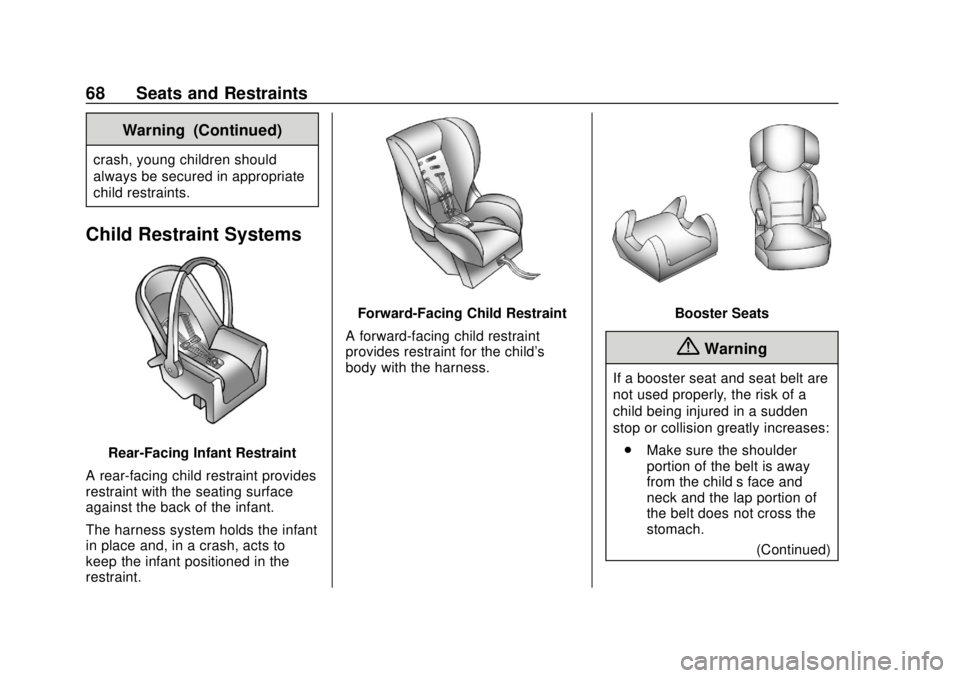
Child Restraint Systems
Rear-Facing Infant Restraint
A rear-facing child restraint provides
restraint with the seating surface
against the back of the infant.
The harness system holds the infant
in place and, in a crash, acts to
keep the infant positioned in the
restraint.
Forward-Facing Child Restraint
A forward-facing child restraint
provides restraint for the child's
body with the harness.Booster Seats
{Warning
If a booster seat and seat belt are
not used properly, the risk of a
child being injured in a sudden
stop or collision greatly increases: . Make sure the shoulder
portion of the belt is away
from the child’s face and
neck and the lap portion of
the belt does not cross the
stomach.
(Continued)
Page 70 of 287
Chevrolet City Express Owner Manual (GMNA-Localizing-U.S./Canada-
11683523) - 2018 - CRC - 7/10/17
Seats and Restraints 69
Warning (Continued)
.Make sure the shoulder belt
is not behind the child or
under the child’s arm.
. A booster seat must only be
installed in a seating
position that has a lap/
shoulder belt.
A belt positioning booster seat is
used for children who have
outgrown their forward facing child
restraint. Boosters are designed to
improve the fit of the vehicle's seat
belt system until the child is large
enough for the vehicle seat belts to
fit properly without a booster seat.
See the seat belt fit test in Older
Children 064.
Booster seats of various sizes are
offered by several manufacturers.
When selecting any booster seat,
keep the following points in mind:
. Choose only a booster seat with
a label certifying that it complies
with Federal Motor Vehicle Safety Standard 213 or
Canadian Motor Vehicle Safety
Standard 213.
. Check the booster seat in your
vehicle to be sure it is
compatible with the vehicle’ s
seat and seat belt system.
. Make sure the child’s head will
be properly supported by the
booster seat or vehicle seat. The
seatback must be at or above
the center of the child’s ears. For
example, if a low back booster
seat is chosen, the vehicle
seatback must be at or above
the center of the child’s ears.
If the seatback is lower than the
center of the child’s ears, a high
back booster seat should
be used.
. If the booster seat is compatible
with your vehicle, place the child
in the booster seat and check
the various adjustments to be
sure the booster seat is
compatible with the child.
Always follow all recommended
procedures. All U.S. states and Canadian
provinces or territories require that
infants and small children be
restrained in an approved child
restraint at all times while the
vehicle is being operated.
The instructions in this section apply
to booster seat installation in the
front passenger seat. See
“Securing
a Booster Seat” underSecuring
Child Restraints 075.
Securing an Add-On Child
Restraint in the Vehicle
{Warning
A child can be seriously injured or
killed in a crash if the child
restraint is not properly secured in
the vehicle. Secure the child
restraint properly in the vehicle
using the vehicle’s seat belt or
LATCH system, following the
instructions that came with that
child restraint and the instructions
in this manual.
Page 71 of 287
Chevrolet City Express Owner Manual (GMNA-Localizing-U.S./Canada-
11683523) - 2018 - CRC - 7/10/17
70 Seats and Restraints
To help reduce the chance of injury,
the child restraint must be secured
in the vehicle. Child restraints must
be secured in vehicle seats by lap
belts or the lap belt portion of a
lap-shoulder belt, or by the LATCH
system. SeeLower Anchors and
Tethers for Children (LATCH
System) 071 for more information.
Children can be endangered in a
crash if the child restraint is not
properly secured in the vehicle.
When securing an add-on child
restraint, refer to the instructions
that come with the restraint which
may be on the restraint itself or in a
booklet, or both, and to this manual.
The child restraint instructions are
important, so if they are not
available, obtain a replacement
copy from the manufacturer.
Keep in mind that an unsecured
child restraint can move around in a
collision or sudden stop and injure
people in the vehicle. Be sure to
properly secure any child restraint in
the vehicle —even when no child is
in it. In some areas of the United States
and Canada, Certified Child
Passenger Safety Technicians
(CPSTs) are available to inspect
and demonstrate how to correctly
use and install child restraints. In
the U.S., refer to the National
Highway Traffic Safety
Administration (NHTSA) website to
locate the nearest child safety seat
inspection station. For CPST
availability in Canada, check with
Transport Canada or the Provincial
Ministry of Transportation office.
Securing the Child Within the
Child Restraint
{Warning
A child can be seriously injured or
killed in a crash if the child is not
properly secured in the child
restraint. Secure the child
properly following the instructions
that came with that child restraint.
Where to Put the
Restraint
According to accident statistics,
children and infants are safer when
properly restrained in an appropriate
child restraint secured in a rear
seating position.
Whenever possible, children aged
12 and under should be secured in
a rear seating position.
Never put a rear-facing child
restraint in the front. This is because
the risk to the rear-facing child is so
great if the airbag deploys.
{Warning
A child in a rear-facing child
restraint can be seriously injured
or killed if the front passenger
frontal airbag inflates. This is
because the back of the
rear-facing child restraint would
be very close to the inflating
airbag. A child in a forward-facing
child restraint can be seriously
(Continued)
Page 72 of 287
Chevrolet City Express Owner Manual (GMNA-Localizing-U.S./Canada-
11683523) - 2018 - CRC - 7/10/17
Seats and Restraints 71
Warning (Continued)
injured or killed if the front
passenger frontal airbag inflates
and the passenger seat is in a
forward position.
Even if the passenger sensing
system has turned off the front
passenger frontal airbag, no
system is fail-safe. No one can
guarantee that an airbag will not
deploy under some unusual
circumstance, even though it is
turned off.
Do not secure a rear-facing child
restraint in the vehicle.
SeePassenger Sensing System
0 56 for additional information.
When securing a child restraint in
the front outboard passenger seat,
study the instructions that came with
the child restraint to make sure it is
compatible with this vehicle. Child restraints and booster seats
vary considerably in size, and some
may fit in certain seating positions
better than others.
Keep in mind that an unsecured
child restraint can move around in a
collision or sudden stop and injure
people in the vehicle. Be sure to
properly secure any child restraint in
the vehicle
—even when no child is
in it.
Lower Anchors and
Tethers for Children
(LATCH System)
Some child restraints have a LATCH
system. As part of the LATCH
system, your child restraint may
have lower attachments and/or a top
tether. The LATCH system can help
hold the child restraint in place
during driving or in a crash. Some
vehicles have lower and/or top
tether anchors designed to secure a
child restraint with lower
attachments and/or a top tether. Your vehicle does not have lower
anchors to accommodate lower
attachments. Your vehicle does
have a top tether anchor. If your
child restraint has a top tether, make
sure your child restraint is properly
installed using the top tether anchor
and the vehicle's seat belt. A child
restraint must never be attached
using only the top tether. Refer to
your child restraint instructions and
see
Securing Child Restraints 075
for instructions on securing your
child restraint using the vehicle's
seat belts.
In order to use the top tether
anchors in your vehicle, you need a
child restraint equipped with a top
tether. The child restraint
manufacturer will provide you with
instructions on how to use the child
restraint and its top tether. The
following explains how to attach a
child restraint with the top tether in
your vehicle.
Page 74 of 287
Chevrolet City Express Owner Manual (GMNA-Localizing-U.S./Canada-
11683523) - 2018 - CRC - 7/10/17
Seats and Restraints 73
Securing a Child Restraint Using
Top Tether Anchor
{Warning
A child could be seriously injured
or killed in a crash if the child
restraint is not properly attached
to the vehicle using either the
LATCH anchors or the vehicle
seat belt. Follow the instructions
that came with the child restraint
and the instructions in this
manual.
{Warning
Children can be seriously injured
or strangled if a shoulder belt is
wrapped around their neck. The
shoulder belt can tighten but
cannot be loosened if it is locked.
The shoulder belt locks when it is
pulled all the way out of the
retractor. It unlocks when the
shoulder belt is allowed to go all(Continued)
Warning (Continued)
the way back into the retractor,
but it cannot do this if it is
wrapped around a child’s neck.
If the shoulder belt is locked and
tightened around a child’s neck,
the only way to loosen the belt is
to cut it.
Buckle any unused seat belts
behind the child restraint so
children cannot reach them. Pull
the shoulder belt all the way out
of the retractor to set the lock,
and tighten the belt behind the
child restraint after the child
restraint has been installed.
{Warning
A child in a rear-facing child
restraint can be seriously injured
or killed if the right front
passenger airbag inflates. This is
because the back of the(Continued)
Warning (Continued)
rear-facing child restraint would
be very close to the inflating
airbag. A child in a forward-facing
child restraint can be seriously
injured or killed if the right front
passenger airbag inflates and the
passenger seat is in a forward
position.
Even if the passenger sensing
system has turned off the right
front passenger frontal airbag, no
system is fail-safe. No one can
guarantee that an airbag will not
deploy under some unusual
circumstance, even though it is
turned off.
Since this vehicle does not have
a rear seat that will accommodate
a rear-facing child restraint, a
rear-facing child restraint should
not be installed in your vehicle,
even if the airbag is off.
SeePassenger Sensing System
0 56 for additional information.
Page 76 of 287
Chevrolet City Express Owner Manual (GMNA-Localizing-U.S./Canada-
11683523) - 2018 - CRC - 7/10/17
Seats and Restraints 75
Replacing LATCH System
Parts After a Crash
{Warning
A crash can damage the LATCH
system in the vehicle. A damaged
LATCH system may not properly
secure the child restraint,
resulting in serious injury or even
death in a crash. To help make
sure the LATCH system is
working properly after a crash,
see your dealer to have the
system inspected and any
necessary replacements made as
soon as possible.
If the vehicle has the LATCH system
and it was being used during a
crash, new LATCH system parts
may be needed.
New parts and repairs may be
necessary even if the LATCH
system was not being used at the
time of the crash.
Securing Child Restraints
This vehicle has airbags. In
addition, the vehicle has a
passenger sensing system which is
designed to turn off the front
outboard passenger frontal airbag
under certain conditions.
See Passenger Sensing System
0 56 and Passenger Airbag Status
Indicator 090 for more information,
including important safety
information.
Never put a rear-facing child seat in
the front. This is because the risk to
the rear-facing child is so great if the
airbag deploys.
{Warning
A child in a rear-facing child
restraint can be seriously injured
or killed if the front outboard
passenger frontal airbag inflates.
This is because the back of the
rear-facing child restraint would
be very close to the inflating
airbag. A child in a forward-facing
(Continued)
Warning (Continued)
child restraint can be seriously
injured or killed if the front
outboard passenger frontal airbag
inflates and the passenger seat is
in a forward position.
Even if the passenger sensing
system has turned off the front
outboard passenger frontal
airbag, no system is fail-safe. No
one can guarantee that an airbag
will not deploy under some
unusual circumstance, even
though it is turned off.
Do not secure a rear-facing child
restraint in the vehicle.
If you secure a forward-facing
child restraint in the vehicle,
always move the front passenger
seat as far back as it will go.
SeePassenger Sensing System
0 56 for additional information.
Page 79 of 287
Chevrolet City Express Owner Manual (GMNA-Localizing-U.S./Canada-
11683523) - 2018 - CRC - 7/10/17
78 Seats and Restraints
To remove the child restraint,
unbuckle the vehicle seat belt and
let it return to the stowed position.
Securing a Booster Seat
{Warning
Do not use the child restraint
locking feature when using a
booster seat with the seat belts.
Follow these steps to install a
booster seat in the front
passenger seat: 1. If you must install a booster seat in the front seat, move the
seat to the rear-most position.
2. Position the booster seat on the seat. Only place it in a
front-facing direction. Always
follow the booster seat
manufacturer ’s instructions.
3. The booster seat should be positioned on the vehicle seat
so that it is stable. If necessary, adjust or remove
the head restraint to obtain the
correct booster seat fit. If the
head restraint is removed,
store it in a secure place. Be
sure to reinstall the head
restraint when the booster seat
is removed. For more
information, see
Head
Restraints 037 for head
restraint adjustment, removal,
and installation information.
If the seating position does not
have an adjustable head
restraint and it is interfering
with the proper booster seat fit,
try a different booster seat.
4. Position the lap portion of the seat belt low and snug on the
child’s hips. Be sure to follow
the booster seat
manufacturer ’s instructions for
adjusting the seat belt routing.
5. Pull the shoulder belt portion of the seat belt toward the
retractor to take up the extra
slack. Be sure the shoulder belt
is positioned across the top,
middle portion of the child’s shoulder. Be sure to follow the
booster seat manufacturer
’s
instructions for adjusting the
seat belt routing.
6. Follow the warnings, cautions, and instructions for properly
fastening a seat belt. See
Lap-Shoulder Belt 045.
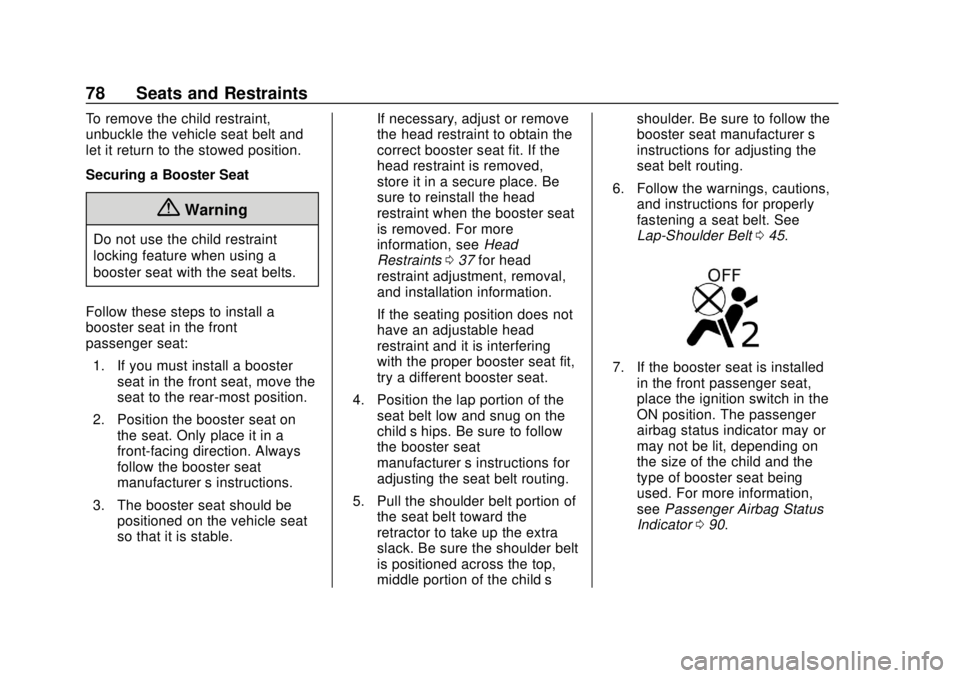
7. If the booster seat is installed
in the front passenger seat,
place the ignition switch in the
ON position. The passenger
airbag status indicator may or
may not be lit, depending on
the size of the child and the
type of booster seat being
used. For more information,
see Passenger Airbag Status
Indicator 090.
Page 80 of 287
Chevrolet City Express Owner Manual (GMNA-Localizing-U.S./Canada-
11683523) - 2018 - CRC - 7/10/17
Storage 79
Storage
Storage Compartments
Storage Compartments . . . . . . . . 79
Glove Box . . . . . . . . . . . . . . . . . . . . . 79
Underseat Storage . . . . . . . . . . . . . 79
Additional Storage Features
Cargo Tie-Downs . . . . . . . . . . . . . . 80
Storage
Compartments
{Warning
Do not store heavy or sharp
objects in storage compartments.
In a crash, these objects may
cause the cover to open and
could result in injury.
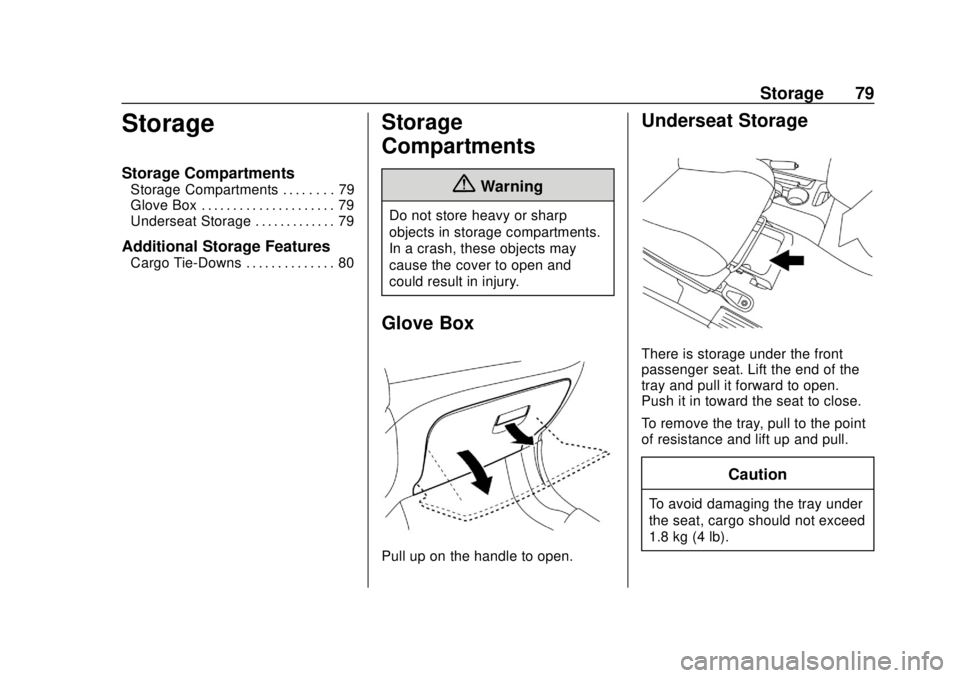
Glove Box
Pull up on the handle to open.
Underseat Storage
There is storage under the front
passenger seat. Lift the end of the
tray and pull it forward to open.
Push it in toward the seat to close.
To remove the tray, pull to the point
of resistance and lift up and pull.
Caution
To avoid damaging the tray under
the seat, cargo should not exceed
1.8 kg (4 lb).
Page 81 of 287
Chevrolet City Express Owner Manual (GMNA-Localizing-U.S./Canada-
11683523) - 2018 - CRC - 7/10/17
80 Storage
Additional Storage
Features
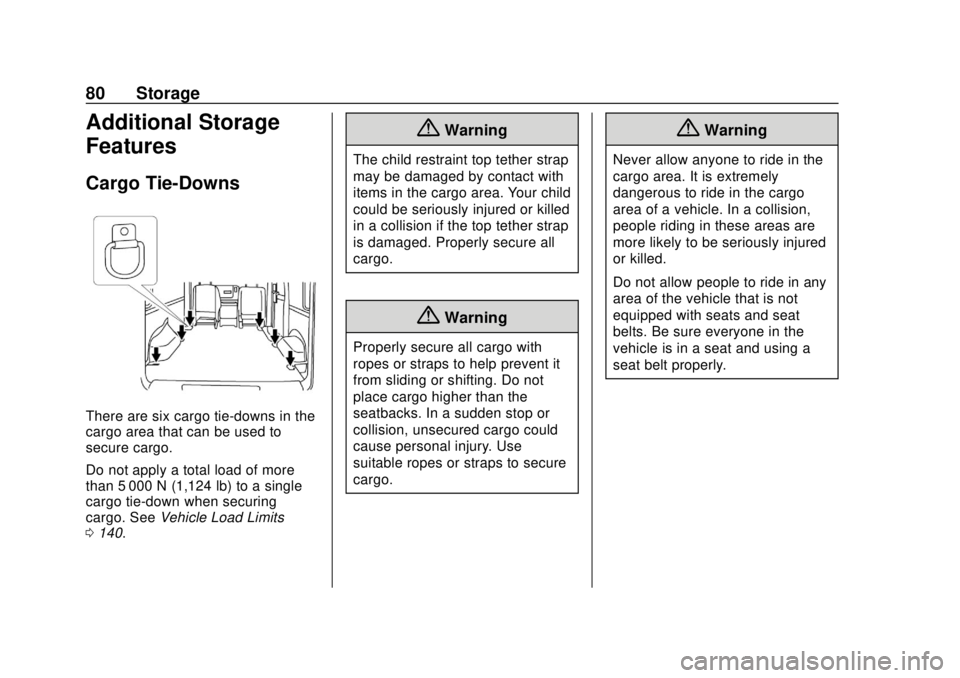
Cargo Tie-Downs
There are six cargo tie-downs in the
cargo area that can be used to
secure cargo.
Do not apply a total load of more
than 5 000 N (1,124 lb) to a single
cargo tie-down when securing
cargo. SeeVehicle Load Limits
0 140.
{Warning
The child restraint top tether strap
may be damaged by contact with
items in the cargo area. Your child
could be seriously injured or killed
in a collision if the top tether strap
is damaged. Properly secure all
cargo.
{Warning
Properly secure all cargo with
ropes or straps to help prevent it
from sliding or shifting. Do not
place cargo higher than the
seatbacks. In a sudden stop or
collision, unsecured cargo could
cause personal injury. Use
suitable ropes or straps to secure
cargo.
{Warning
Never allow anyone to ride in the
cargo area. It is extremely
dangerous to ride in the cargo
area of a vehicle. In a collision,
people riding in these areas are
more likely to be seriously injured
or killed.
Do not allow people to ride in any
area of the vehicle that is not
equipped with seats and seat
belts. Be sure everyone in the
vehicle is in a seat and using a
seat belt properly.
Page 82 of 287
Chevrolet City Express Owner Manual (GMNA-Localizing-U.S./Canada-
11683523) - 2018 - CRC - 7/10/17
Instruments and Controls 81
Instruments and
Controls
Controls
Steering Wheel Controls . . . . . . . 82
Horn . . . . . . . . . . . . . . . . . . . . . . . . . . . 83
Windshield Wiper/Washer . . . . . . 83
Clock . . . . . . . . . . . . . . . . . . . . . . . . . . 83
Power Outlets . . . . . . . . . . . . . . . . . 84
Cigarette Lighter . . . . . . . . . . . . . . . 85
Ashtrays . . . . . . . . . . . . . . . . . . . . . . . 85
Warning Lights, Gauges, and
Indicators
Warning Lights, Gauges, andIndicators . . . . . . . . . . . . . . . . . . . . 86
Instrument Cluster . . . . . . . . . . . . . 87
Speedometer . . . . . . . . . . . . . . . . . . 88
Odometer . . . . . . . . . . . . . . . . . . . . . . 88
Trip Odometer . . . . . . . . . . . . . . . . . 88
Tachometer . . . . . . . . . . . . . . . . . . . . 88
Fuel Gauge . . . . . . . . . . . . . . . . . . . . 88
Seat Belt Reminders . . . . . . . . . . . 89
Airbag Readiness Light . . . . . . . . 89
Passenger Airbag Status Indicator . . . . . . . . . . . . . . . . . . . . . . 90
Charging System Light . . . . . . . . . 91 Malfunction Indicator Lamp
(Check Engine Light) . . . . . . . . . 91
Brake System Warning Light . . . 93
Antilock Brake System (ABS) Warning Light . . . . . . . . . . . . . . . . 94
Overdrive Off Light . . . . . . . . . . . . . 94
Power Steering Warning Light . . . . . . . . . . . . . . . . . . . . . . . . . 95
Traction Control System (TCS)/ Electronic Stability Control
Light . . . . . . . . . . . . . . . . . . . . . . . . . 95
Electronic Stability Control (ESC) Off Light . . . . . . . . . . . . . . . 96
Engine Coolant Temperature Warning Light . . . . . . . . . . . . . . . . 96
Tire Pressure Light . . . . . . . . . . . . 96
Engine Oil Pressure Light . . . . . . 97
Low Fuel Warning Light . . . . . . . . 97
Security Light . . . . . . . . . . . . . . . . . . 97
High-Beam On Light . . . . . . . . . . . 98
Low Washer Fluid Warning Light . . . . . . . . . . . . . . . . . . . . . . . . . 98
Cruise Control Light . . . . . . . . . . . 98
Door Ajar Light . . . . . . . . . . . . . . . . 98
Vehicle Messages
Fuel System Messages . . . . . . . . 99
Tire Messages . . . . . . . . . . . . . . . . . 99
Trip Computer
Trip Computer . . . . . . . . . . . . . . . . . 99
Vehicle Personalization
Vehicle Personalization (Radio with Touchscreen Only) . . . . . 100