brake fluid CHEVROLET CITY EXPRESS 2018 Owner's Manual
[x] Cancel search | Manufacturer: CHEVROLET, Model Year: 2018, Model line: CITY EXPRESS, Model: CHEVROLET CITY EXPRESS 2018Pages: 287, PDF Size: 4.19 MB
Page 82 of 287
Chevrolet City Express Owner Manual (GMNA-Localizing-U.S./Canada-
11683523) - 2018 - CRC - 7/10/17
Instruments and Controls 81
Instruments and
Controls
Controls
Steering Wheel Controls . . . . . . . 82
Horn . . . . . . . . . . . . . . . . . . . . . . . . . . . 83
Windshield Wiper/Washer . . . . . . 83
Clock . . . . . . . . . . . . . . . . . . . . . . . . . . 83
Power Outlets . . . . . . . . . . . . . . . . . 84
Cigarette Lighter . . . . . . . . . . . . . . . 85
Ashtrays . . . . . . . . . . . . . . . . . . . . . . . 85
Warning Lights, Gauges, and
Indicators
Warning Lights, Gauges, andIndicators . . . . . . . . . . . . . . . . . . . . 86
Instrument Cluster . . . . . . . . . . . . . 87
Speedometer . . . . . . . . . . . . . . . . . . 88
Odometer . . . . . . . . . . . . . . . . . . . . . . 88
Trip Odometer . . . . . . . . . . . . . . . . . 88
Tachometer . . . . . . . . . . . . . . . . . . . . 88
Fuel Gauge . . . . . . . . . . . . . . . . . . . . 88
Seat Belt Reminders . . . . . . . . . . . 89
Airbag Readiness Light . . . . . . . . 89
Passenger Airbag Status Indicator . . . . . . . . . . . . . . . . . . . . . . 90
Charging System Light . . . . . . . . . 91 Malfunction Indicator Lamp
(Check Engine Light) . . . . . . . . . 91
Brake System Warning Light . . . 93
Antilock Brake System (ABS) Warning Light . . . . . . . . . . . . . . . . 94
Overdrive Off Light . . . . . . . . . . . . . 94
Power Steering Warning Light . . . . . . . . . . . . . . . . . . . . . . . . . 95
Traction Control System (TCS)/ Electronic Stability Control
Light . . . . . . . . . . . . . . . . . . . . . . . . . 95
Electronic Stability Control (ESC) Off Light . . . . . . . . . . . . . . . 96
Engine Coolant Temperature Warning Light . . . . . . . . . . . . . . . . 96
Tire Pressure Light . . . . . . . . . . . . 96
Engine Oil Pressure Light . . . . . . 97
Low Fuel Warning Light . . . . . . . . 97
Security Light . . . . . . . . . . . . . . . . . . 97
High-Beam On Light . . . . . . . . . . . 98
Low Washer Fluid Warning Light . . . . . . . . . . . . . . . . . . . . . . . . . 98
Cruise Control Light . . . . . . . . . . . 98
Door Ajar Light . . . . . . . . . . . . . . . . 98
Vehicle Messages
Fuel System Messages . . . . . . . . 99
Tire Messages . . . . . . . . . . . . . . . . . 99
Trip Computer
Trip Computer . . . . . . . . . . . . . . . . . 99
Vehicle Personalization
Vehicle Personalization (Radio with Touchscreen Only) . . . . . 100
Page 95 of 287
Chevrolet City Express Owner Manual (GMNA-Localizing-U.S./Canada-
11683523) - 2018 - CRC - 7/10/17
94 Instruments and Controls
When the ignition is on, the brake
system warning light also comes on
when the parking brake is set. See
Parking Brake0156. The light stays
on if the parking brake does not fully
release. If it stays on after the
parking brake is fully released, it
means the vehicle has a brake
problem.
If the light comes on while driving,
pull off the road and stop carefully.
The pedal might be harder to push,
or the pedal might go closer to the
floor. It could take longer to stop.
If the light is still on, check the brake
fluid level and have the vehicle
towed for service. See Towing the
Vehicle 0231.
{Warning
The brake system might not be
working properly if the brake
system warning light is on.
Driving with the brake system
warning light on can lead to a
crash. If the light is still on after
(Continued)
Warning (Continued)
the vehicle has been pulled off
the road and carefully stopped,
have the vehicle towed for
service.
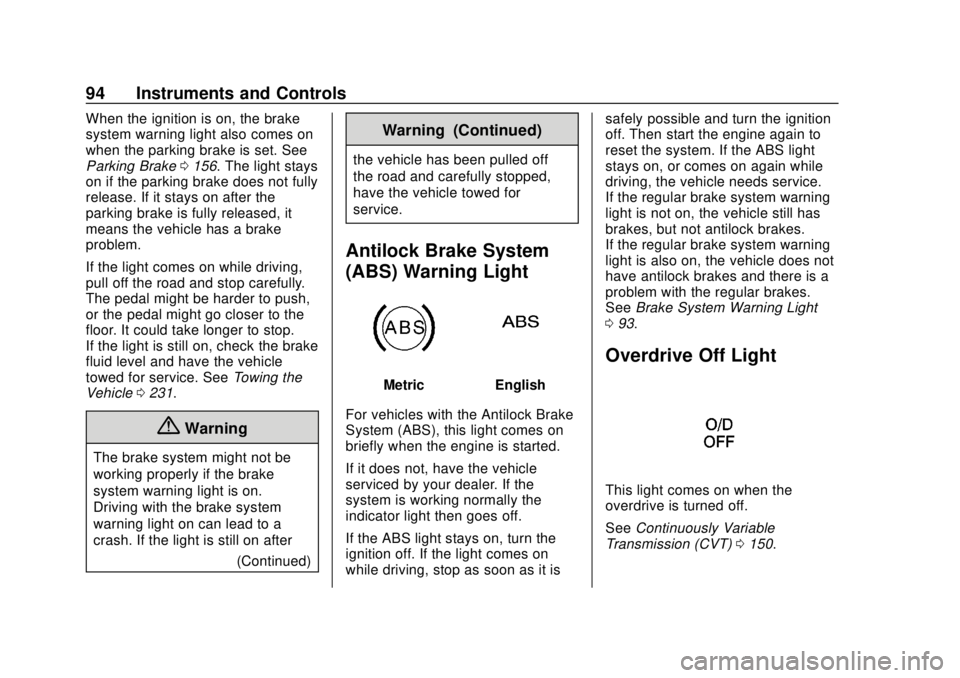
Antilock Brake System
(ABS) Warning Light
MetricEnglish
For vehicles with the Antilock Brake
System (ABS), this light comes on
briefly when the engine is started.
If it does not, have the vehicle
serviced by your dealer. If the
system is working normally the
indicator light then goes off.
If the ABS light stays on, turn the
ignition off. If the light comes on
while driving, stop as soon as it is safely possible and turn the ignition
off. Then start the engine again to
reset the system. If the ABS light
stays on, or comes on again while
driving, the vehicle needs service.
If the regular brake system warning
light is not on, the vehicle still has
brakes, but not antilock brakes.
If the regular brake system warning
light is also on, the vehicle does not
have antilock brakes and there is a
problem with the regular brakes.
See
Brake System Warning Light
0 93.
Overdrive Off Light
This light comes on when the
overdrive is turned off.
See Continuously Variable
Transmission (CVT) 0150.
Page 136 of 287
Chevrolet City Express Owner Manual (GMNA-Localizing-U.S./Canada-
11683523) - 2018 - CRC - 7/10/17
Driving and Operating 135
.Focus on the task of driving.
Drunk Driving
Death and injury associated with
drinking and driving is a global
tragedy.
{Warning
Drinking and then driving is very
dangerous. Your reflexes,
perceptions, attentiveness, and
judgment can be affected by even
a small amount of alcohol. You
can have a serious —or even
fatal —collision if you drive after
drinking.
Do not drink and drive or ride with
a driver who has been drinking.
Ride home in a cab; or if you are
with a group, designate a driver
who will not drink.
Control of a Vehicle
Braking, steering, and accelerating
are important factors in helping to
control a vehicle while driving.
Braking
Braking action involves perception
time and reaction time. Deciding to
push the brake pedal is perception
time. Actually doing it is
reaction time.
Average driver reaction time is
about three-quarters of a second. In
that time, a vehicle moving at
100 km/h (60 mph) travels 20 m
(66 ft), which could be a lot of
distance in an emergency.
Helpful braking tips to keep in mind
include:
. Keep enough distance between
you and the vehicle in front
of you.
. Avoid needless heavy braking.
. Keep pace with traffic.
Vacuum Assisted Brakes
The brake booster aids braking by
using engine vacuum. If the engine
stops, you can stop the vehicle by
pressing the brake pedal. However,
greater foot pressure on the brake pedal will be required to stop the
vehicle, and stopping distance will
be longer.
{Warning
If the engine is not running or is
turned off while driving, the power
assist for the brakes will not work.
Braking will be harder.
Steering
Electric Power Steering
The vehicle has electric power
steering. It does not have power
steering fluid. Regular maintenance
is not required.
If power steering assist is lost due
to a system malfunction, the vehicle
can be steered, but may require
increased effort.
If the steering assist is used for an
extended period of time while the
vehicle is not moving, power assist
may be reduced.
Page 139 of 287
Chevrolet City Express Owner Manual (GMNA-Localizing-U.S./Canada-
11683523) - 2018 - CRC - 7/10/17
138 Driving and Operating
There is no hard and fast rule about
hydroplaning. The best advice is to
slow down when the road is wet.
Other Rainy Weather Tips
Besides slowing down, other wet
weather driving tips include:
.Allow extra following distance.
. Pass with caution.
. Keep windshield wiping
equipment in good shape.
. Keep the windshield washer fluid
reservoir filled.
. Have good tires with proper
tread depth. See Tires0200.
. Turn off cruise control.
Hill and Mountain Roads
Driving on steep hills or through
mountains is different than driving
on flat or rolling terrain. Tips include:
.
Keep the vehicle serviced and in
good shape.
. Check all fluid levels and brakes,
tires, cooling system, and
transmission. .
Shift to a lower gear when going
down steep or long hills.
{Warning
Using the brakes to slow the
vehicle on a long downhill slope
can cause brake overheating, can
reduce brake performance, and
could result in a loss of braking.
Shift the transmission to a lower
gear to let the engine assist the
brakes on a steep downhill slope.
{Warning
Coasting downhill in N (Neutral)
or with the ignition off is
dangerous. This can cause
overheating of the brakes and
loss of steering assist. Always
have the engine running and the
vehicle in gear. .
Drive at speeds that keep the
vehicle in its own lane. Do not
swing wide or cross the
center line.
. Be alert on top of hills;
something could be in your lane
(e.g., stalled car, accident).
. Pay attention to special road
signs (e.g., falling rocks area,
winding roads, long grades,
passing or no-passing zones)
and take appropriate action.
Winter Driving
Driving on Snow or Ice
Snow or ice between the tires and
the road creates less traction or
grip, so drive carefully. Wet ice can
occur at about 0 °C (32 °F) when
freezing rain begins to fall. Avoid
driving on wet ice or in freezing rain
until roads can be treated.
For Slippery Road Driving:
.Accelerate gently. Accelerating
too quickly causes the wheels to
spin and makes the surface
under the tires slick.
Page 177 of 287
Chevrolet City Express Owner Manual (GMNA-Localizing-U.S./Canada-
11683523) - 2018 - CRC - 7/10/17
176 Vehicle Care
Vehicle Care
General Information
General Information . . . . . . . . . . 177
California Proposition65 Warning . . . . . . . . . . . . . . . . . 177
California Perchlorate Materials Requirements . . . . . 178
Accessories and Modifications . . . . . . . . . . . . . . . . 178
Vehicle Checks
Doing Your OwnService Work . . . . . . . . . . . . . . . 178
Hood . . . . . . . . . . . . . . . . . . . . . . . . . 179
Engine Compartment Overview . . . . . . . . . . . . . . . . . . . . 181
Engine Oil . . . . . . . . . . . . . . . . . . . . 182
Engine Air Cleaner/Filter . . . . . . 184
Cooling System . . . . . . . . . . . . . . 186
Engine Overheating . . . . . . . . . . 190
Overheated Engine Protection Operating Mode . . . . . . . . . . . . . 190
Washer Fluid . . . . . . . . . . . . . . . . . 191
Brakes . . . . . . . . . . . . . . . . . . . . . . . 192
Brake Fluid . . . . . . . . . . . . . . . . . . . 193
Battery - North America . . . . . . 194
Wiper Blade Replacement . . . . 195
Gas Strut(s) . . . . . . . . . . . . . . . . . . 196
Headlamp Aiming
Headlamp Aiming . . . . . . . . . . . . 197
Bulb Replacement
Bulb Replacement . . . . . . . . . . . . 197
Halogen Bulbs . . . . . . . . . . . . . . . . 197
Headlamps, Front Turn Signal and Parking Lamps . . . . . . . . . 198
Electrical System
Electrical System Overload . . . 198
Fuses and Circuit Breakers . . . 199
Engine Compartment FuseBlock . . . . . . . . . . . . . . . . . . . . . . . . 199
Instrument Panel Fuse Block . . . . . . . . . . . . . . . . . . . . . . . . 200
Wheels and Tires
Tires . . . . . . . . . . . . . . . . . . . . . . . . . . 200
All-Season Tires . . . . . . . . . . . . . . 201
Winter Tires . . . . . . . . . . . . . . . . . . 201
Summer Tires . . . . . . . . . . . . . . . . 202
All-Terrain Tires . . . . . . . . . . . . . . . 202
Tire Sidewall Labeling . . . . . . . . 202
Tire Designations . . . . . . . . . . . . . 204
Tire Terminology andDefinitions . . . . . . . . . . . . . . . . . . 206
Tire Pressure . . . . . . . . . . . . . . . . . 208
Tire Pressure Monitor System . . . . . . . . . . . . . . . . . . . . . . 210 Tire Pressure Monitor
Operation . . . . . . . . . . . . . . . . . . . 211
Tire Inspection . . . . . . . . . . . . . . . . 213
Tire Rotation . . . . . . . . . . . . . . . . . 213
When It Is Time for New Tires . . . . . . . . . . . . . . . . . . . . . . . . 214
Buying New Tires . . . . . . . . . . . . . 215
Different Size Tires and Wheels . . . . . . . . . . . . . . . . . . . . . . 216
Uniform Tire Quality Grading . . . . . . . . . . . . . . . . . . . . . 217
Wheel Alignment and Tire Balance . . . . . . . . . . . . . . . . . . . . . 218
Wheel Replacement . . . . . . . . . . 219
Tire Chains . . . . . . . . . . . . . . . . . . . 219
If a Tire Goes Flat . . . . . . . . . . . . 220
Tire Changing . . . . . . . . . . . . . . . . 221
Full-Size Spare Tire . . . . . . . . . . 226
Jump Starting
Jump Starting - North America . . . . . . . . . . . . . . . . . . . . . 227
Towing the Vehicle
Towing the Vehicle . . . . . . . . . . . 231
Recreational VehicleTowing . . . . . . . . . . . . . . . . . . . . . . 231
Page 183 of 287
Chevrolet City Express Owner Manual (GMNA-Localizing-U.S./Canada-
11683523) - 2018 - CRC - 7/10/17
182 Vehicle Care
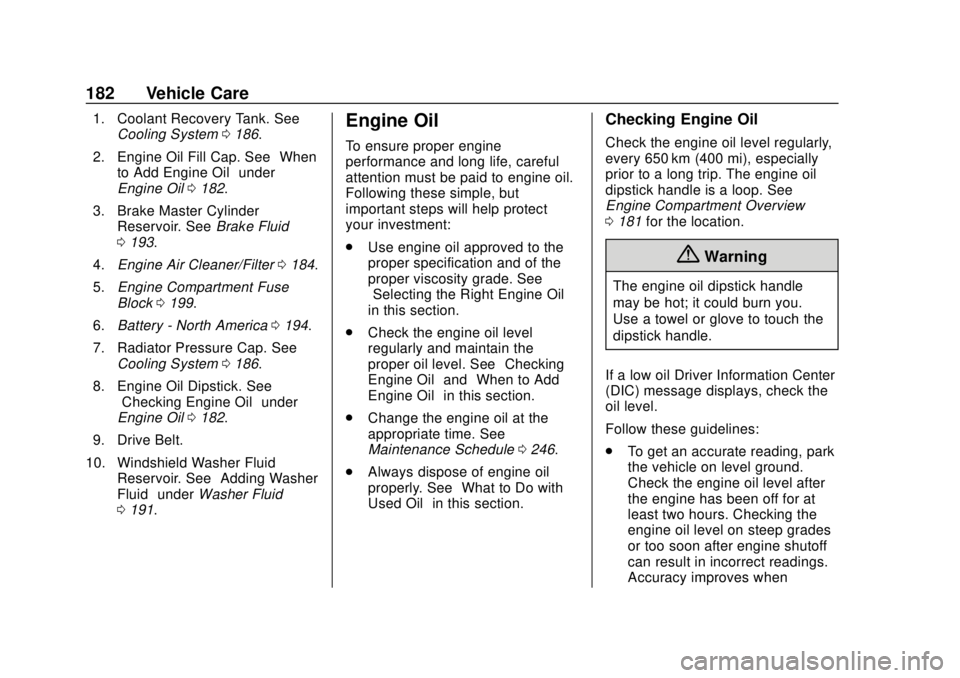
1. Coolant Recovery Tank. SeeCooling System 0186.
2. Engine Oil Fill Cap. See “When
to Add Engine Oil” under
Engine Oil 0182.
3. Brake Master Cylinder Reservoir. See Brake Fluid
0 193.
4. Engine Air Cleaner/Filter 0184.
5. Engine Compartment Fuse
Block 0199.
6. Battery - North America 0194.
7. Radiator Pressure Cap. See Cooling System 0186.
8. Engine Oil Dipstick. See “Checking Engine Oil” under
Engine Oil 0182.
9. Drive Belt.
10. Windshield Washer Fluid Reservoir. See “Adding Washer
Fluid” under Washer Fluid
0 191.Engine Oil
To ensure proper engine
performance and long life, careful
attention must be paid to engine oil.
Following these simple, but
important steps will help protect
your investment:
.
Use engine oil approved to the
proper specification and of the
proper viscosity grade. See
“Selecting the Right Engine Oil”
in this section.
. Check the engine oil level
regularly and maintain the
proper oil level. See “Checking
Engine Oil” and“When to Add
Engine Oil” in this section.
. Change the engine oil at the
appropriate time. See
Maintenance Schedule 0246.
. Always dispose of engine oil
properly. See “What to Do with
Used Oil” in this section.
Checking Engine Oil
Check the engine oil level regularly,
every 650 km (400 mi), especially
prior to a long trip. The engine oil
dipstick handle is a loop. See
Engine Compartment Overview
0181 for the location.
{Warning
The engine oil dipstick handle
may be hot; it could burn you.
Use a towel or glove to touch the
dipstick handle.
If a low oil Driver Information Center
(DIC) message displays, check the
oil level.
Follow these guidelines:
. To get an accurate reading, park
the vehicle on level ground.
Check the engine oil level after
the engine has been off for at
least two hours. Checking the
engine oil level on steep grades
or too soon after engine shutoff
can result in incorrect readings.
Accuracy improves when
Page 193 of 287

Chevrolet City Express Owner Manual (GMNA-Localizing-U.S./Canada-
11683523) - 2018 - CRC - 7/10/17
192 Vehicle Care
Caution (Continued)
.Do not use engine coolant
(antifreeze) in the
windshield washer. It can
damage the windshield
washer system and paint.
. Do not mix water with
ready-to-use washer fluid.
Water can cause the
solution to freeze and
damage the washer fluid
tank and other parts of the
washer system.
. When using concentrated
washer fluid, follow the
manufacturer instructions for
adding water.
. Fill the washer fluid tank
only three-quarters full when
it is very cold. This allows
for fluid expansion if
freezing occurs, which could
damage the tank if it is
completely full.
Brakes
Disc brake pads have built-in wear
indicators that make a high-pitched
warning sound when the brake pads
are worn and new pads are needed.
The sound can come and go or can
be heard all the time when the
vehicle is moving, except when
applying the brake pedal firmly.
{Warning
The brake wear warning sound
means that soon the brakes will
not work well. That could lead to
a crash. When the brake wear
warning sound is heard, have the
vehicle serviced.
Caution
Continuing to drive with worn-out
brake pads could result in costly
brake repair. Some driving conditions or climates
can cause a brake squeal when the
brakes are first applied or lightly
applied. This does not mean
something is wrong with the brakes.
Properly torqued wheel nuts are
necessary to help prevent brake
pulsation. When tires are rotated,
inspect brake pads for wear and
evenly tighten wheel nuts in the
proper sequence to torque
specifications. See
Capacities and
Specifications 0261.
Brake pads should be replaced as
complete sets.
Brake Pedal Travel
See your dealer if the brake pedal
does not return to normal height,
or if there is a rapid increase in
pedal travel. This could be a sign
that brake service may be required.
Replacing Brake System Parts
Always replace brake system parts
with new, approved replacement
parts. If this is not done, the brakes
may not work properly. The braking
performance expected can change
Page 194 of 287

Chevrolet City Express Owner Manual (GMNA-Localizing-U.S./Canada-
11683523) - 2018 - CRC - 7/10/17
Vehicle Care 193
in many other ways if the wrong
replacement brake parts are
installed or if parts are improperly
installed.
Brake Fluid
The brake master cylinder reservoir
is filled with DOT 3 brake fluid. See
Engine Compartment Overview
0181 for the location of the
reservoir.
There are only two reasons why the
brake fluid level in the reservoir
might go down:
. The brake fluid level goes down
because of normal brake lining
wear. When new linings are
installed, the fluid level goes
back up. .
A fluid leak in the brake
hydraulic system can also cause
a low fluid level. Have the brake
hydraulic system fixed, since a
leak means that sooner or later
the brakes will not work well.
Do not top off the brake fluid.
Adding fluid does not correct a leak.
If fluid is added when the linings are
worn, there will be too much fluid
when new brake linings are
installed. Add or remove brake fluid,
as necessary, only when work is
done on the brake hydraulic system.
{Warning
If too much brake fluid is added, it
can spill on the engine and burn,
if the engine is hot enough. You
or others could be burned, and
the vehicle could be damaged.
Add brake fluid only when work is
done on the brake hydraulic
system. See “Checking Brake
Fluid” in this section. Refer to the Maintenance Schedule
to determine when to check the
brake fluid. See
Maintenance
Schedule 0246.
Checking Brake Fluid
Check brake fluid by looking at the
brake fluid reservoir. See Engine
Compartment Overview 0181.
The fluid level should be above
MIN. If it is not, have the brake
hydraulic system checked to see if
there is a leak.
Page 195 of 287
Chevrolet City Express Owner Manual (GMNA-Localizing-U.S./Canada-
11683523) - 2018 - CRC - 7/10/17
194 Vehicle Care
After work is done on the brake
hydraulic system, make sure the
level is above the MIN but not over
the MAX mark.
If the brake fluid is below the MIN
line, the brake warning light will
illuminate. Add brake fluid up to the
MAX line.
What to Add
Use only new DOT 3 brake fluid
from a sealed container. See
Recommended Fluids and
Lubricants0257.
Always clean the brake fluid
reservoir cap and the area around
the cap before removing it. This
helps keep dirt from entering the
reservoir.
{Warning
With the wrong kind of fluid in the
brake hydraulic system, the
brakes might not work well. This
could cause a crash. Always use
the proper brake fluid.
Caution
. Using the wrong fluid can
badly damage brake
hydraulic system parts. For
example, just a few drops of
mineral-based oil, such as
engine oil, in the brake
hydraulic system can
damage brake hydraulic
system parts so badly that
they will have to be
replaced. Do not let
someone put in the wrong
kind of fluid.
. If brake fluid is spilled on
the vehicle's painted
surfaces, the paint finish
can be damaged. Be careful
not to spill brake fluid on the
vehicle. If you do, wash it off
immediately.
Battery - North America
The original equipment battery is
maintenance free. Do not remove
the cap and do not add fluid. Refer to the replacement number
shown on the original battery label
when a new battery is needed. See
Engine Compartment Overview
0
181 for battery location.
{Warning
WARNING: Battery posts,
terminals, and related
accessories contain lead and lead
compounds, chemicals known to
the State of California to cause
cancer and birth defects or other
reproductive harm. Batteries also
contain other chemicals known to
the State of California to cause
cancer. WASH HANDS AFTER
HANDLING. For more information
go to www.P65Warnings.ca.gov/
passenger-vehicle.
See California Proposition
65 Warning 0177 and the back
cover.
Page 237 of 287
Chevrolet City Express Owner Manual (GMNA-Localizing-U.S./Canada-
11683523) - 2018 - CRC - 7/10/17
236 Vehicle Care
can be removed by rubbing with a
clean cloth. SeeRecommended
Fluids and Lubricants 0257.
Tires
Use a stiff brush with tire cleaner to
clean the tires.
Caution
Using petroleum-based tire
dressing products on the vehicle
may damage the paint finish and/
or tires. When applying a tire
dressing, always wipe off any
overspray from all painted
surfaces on the vehicle.
Wheels and Trim —Aluminum
or Chrome
Use a soft, clean cloth with mild
soap and water to clean the wheels.
After rinsing thoroughly with clean
water, dry with a soft, clean towel.
A wax may then be applied.
Caution
Chrome wheels and other chrome
trim may be damaged if the
vehicle is not washed after driving
on roads that have been sprayed
with magnesium, calcium,
or sodium chloride. These
chlorides are used on roads for
conditions such as ice and dust.
Always wash the chrome with
soap and water after exposure.
Caution
To avoid surface damage, do not
use strong soaps, chemicals,
abrasive polishes, cleaners,
brushes, or cleaners that contain
acid on aluminum or
chrome-plated wheels. Use only
approved cleaners. Also, never
drive a vehicle with aluminum or
chrome-plated wheels through an
automatic car wash that uses
(Continued)
Caution (Continued)
silicone carbide tire cleaning
brushes. Damage could occur
and the repairs would not be
covered by the vehicle warranty.
Brake System
Visually inspect brake lines and
hoses for proper hook-up, binding,
leaks, cracks, chafing, etc. Inspect
disc brake pads for wear and rotors
for surface condition. Inspect drum
brake linings/shoes for wear or
cracks. Inspect all other brake parts.
Steering, Suspension, and
Chassis Components
Visually inspect steering,
suspension, and chassis
components for damaged, loose,
or missing parts or signs of wear at
least once a year.
Inspect power steering for proper
attachment, connections, binding,
leaks, cracks, chafing, etc.