seats CHEVROLET CLASSIC 2004 User Guide
[x] Cancel search | Manufacturer: CHEVROLET, Model Year: 2004, Model line: CLASSIC, Model: CHEVROLET CLASSIC 2004Pages: 348, PDF Size: 5.32 MB
Page 59 of 348
Your vehicle has a right front passenger air bag.Never
put a rear-facing child restraint in this seat. Here is why:
{CAUTION:
A child in a rear-facing child restraint can be
seriously injured or killed if the right front
passenger’s air bag inates. This is because
the back of the rear-facing child restraint
would be very close to the inating air bag.
Always secure a rear-facing child restraint in a
rear seat.A rear seat is a safer place to secure a forward-facing
child restraint. If you need to secure a forward-facing
child restraint in the right front seat, you will be using the
lap-shoulder belt to secure the restraint in this position.
Be sure to follow the instructions that came with the
child restraint. Secure the child in the child restraint
when and as the instructions say.
1. Because your vehicle has a right front passenger
air bag, always move the seat as far back as it will
go before securing a forward-facing child restraint.
SeeManual Seats on page 1-2.
2. Put the restraint on the seat.
3. Pick up the latch plate, and run the lap and shoulder
portions of the vehicle’s safety belt through or
around the restraint. The child restraint instructions
will show you how.
1-53
Page 90 of 348
Automatic Transaxle Operation
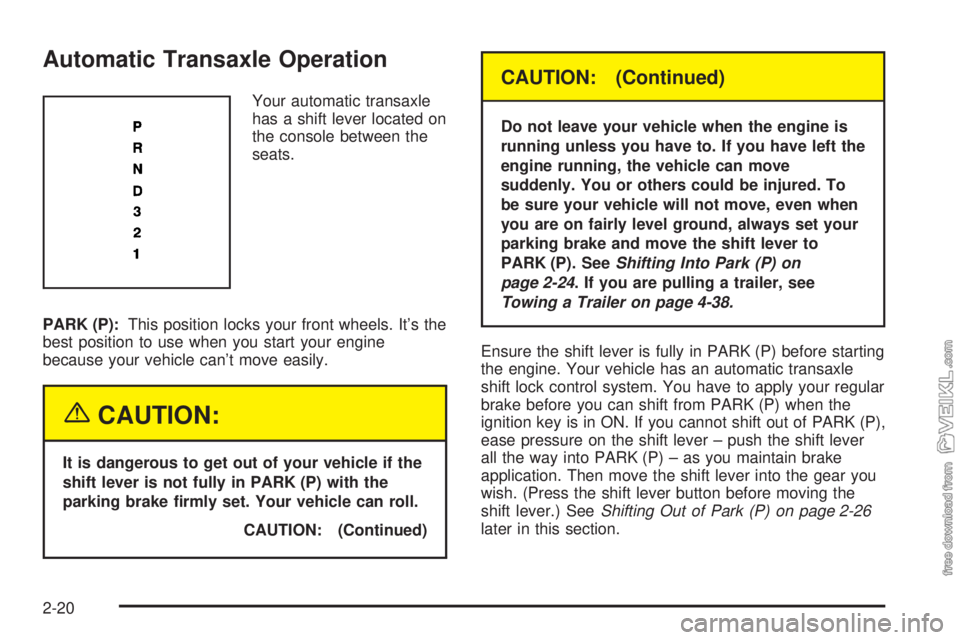
Your automatic transaxle
has a shift lever located on
the console between the
seats.
PARK (P):This position locks your front wheels. It’s the
best position to use when you start your engine
because your vehicle can’t move easily.
{CAUTION:
It is dangerous to get out of your vehicle if the
shift lever is not fully in PARK (P) with the
parking brake rmly set. Your vehicle can roll.
CAUTION: (Continued)
CAUTION: (Continued)
Do not leave your vehicle when the engine is
running unless you have to. If you have left the
engine running, the vehicle can move
suddenly. You or others could be injured. To
be sure your vehicle will not move, even when
you are on fairly level ground, always set your
parking brake and move the shift lever to
PARK (P). SeeShifting Into Park (P) on
page 2-24. If you are pulling a trailer, see
Towing a Trailer on page 4-38.
Ensure the shift lever is fully in PARK (P) before starting
the engine. Your vehicle has an automatic transaxle
shift lock control system. You have to apply your regular
brake before you can shift from PARK (P) when the
ignition key is in ON. If you cannot shift out of PARK (P),
ease pressure on the shift lever – push the shift lever
all the way into PARK (P) – as you maintain brake
application. Then move the shift lever into the gear you
wish. (Press the shift lever button before moving the
shift lever.) SeeShifting Out of Park (P) on page 2-26
later in this section.
2-20
Page 123 of 348
Outlet Adjustment
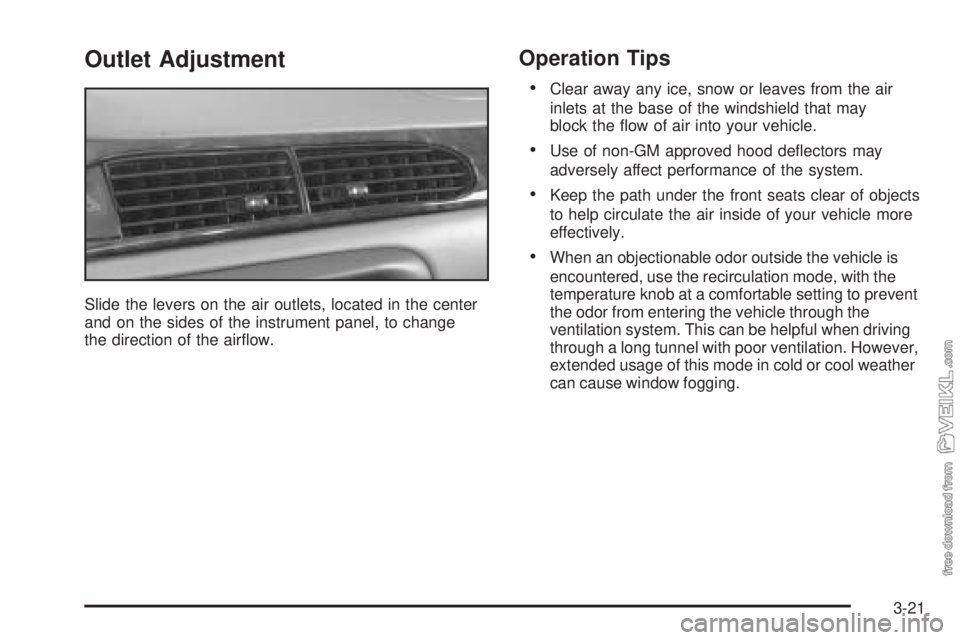
Slide the levers on the air outlets, located in the center
and on the sides of the instrument panel, to change
the direction of the airflow.
Operation Tips
•Clear away any ice, snow or leaves from the air
inlets at the base of the windshield that may
block the flow of air into your vehicle.
•Use of non-GM approved hood deflectors may
adversely affect performance of the system.
•Keep the path under the front seats clear of objects
to help circulate the air inside of your vehicle more
effectively.
•When an objectionable odor outside the vehicle is
encountered, use the recirculation mode, with the
temperature knob at a comfortable setting to prevent
the odor from entering the vehicle through the
ventilation system. This can be helpful when driving
through a long tunnel with poor ventilation. However,
extended usage of this mode in cold or cool weather
can cause window fogging.
3-21
Page 195 of 348
{CAUTION:
Do not load your vehicle any heavier than the
GVWR, or either the maximum front or rear
GAWR. If you do, parts on your vehicle can
break, and it can change the way your vehicle
handles. These could cause you to lose
control and crash. Also, overloading can
shorten the life of your vehicle.
{CAUTION:
Things you put inside your vehicle can strike
and injure people in a sudden stop or turn, or
in a crash.
Put things in the trunk of your vehicle. In a
trunk, put them as far forward as you can.
Try to spread the weight evenly.
Never stack heavier things, like suitcases,
inside the vehicle so that some of them
are above the tops of the seats.
Do not leave an unsecured child restraint
in your vehicle.
When you carry something inside the
vehicle, secure it whenever you can.
Do not leave a seat folded down unless
you need to.
4-37
Page 259 of 348
Tire Terminology and Denitions
Air Pressure:The amount of air inside the tire pressing
outward on each square inch of the tire. Air pressure
is expressed in pounds per square inch (psi) or
kilopascal (kPa).
Accessory Weight:This means the combined weight
of optional accessories. Some examples of optional
accessories are, automatic transmission, power steering,
power brakes, power windows, power seats, and air
conditioning.
Aspect Ratio:The relationship of a tire’s height to
its width.
Belt:A rubber coated layer of cords that is located
between the plies and the tread. Cords may be made
from steel or other reinforcing materials.
Bead:The tire bead contains steel wires wrapped by
steel cords that hold the tire onto the rim.
Bias Ply Tire:A pneumatic tire in which the plies are
laid at alternate angles substantially less than 90
degrees to the centerline of the tread.
Cold Ination Pressure:The amount of air pressure in
a tire, measured in pounds per square inch (psi)
before a tire has built up heat from driving. See
Ination - Tire Pressure on page 5-59.Curb Weight:This means the weight of a motor
vehicle with standard and optional equipment including
the maximum capacity of fuel, oil and coolant, but
without passengers and cargo.
DOT Markings:A code molded into the sidewall of a
tire signifying that the tire is in compliance with the U.S.
Department of Transportation motor vehicle safety
standards. The DOT code includes the Tire Identification
Number (TIN), an alphanumeric designator which can
also identify the tire manufacturer, production plant,
brand and date of production.
GVWR:Gross Vehicle Weight Rating, seeLoading
Your Vehicle on page 4-32.
GAWR FRT:Gross Axle Weight Rating for the front
axle, seeLoading Your Vehicle on page 4-32.
GAWR RR:Gross Axle Weight Rating for the rear axle,
seeLoading Your Vehicle on page 4-32.
Intended Outboard Sidewall:The side of an
asymmetrical tire that must always face outward when
mounted on a vehicle.
Kilopascal (kPa):The metric unit for air pressure.
There are 6.9 kPa’s to one psi.
5-57
Page 293 of 348
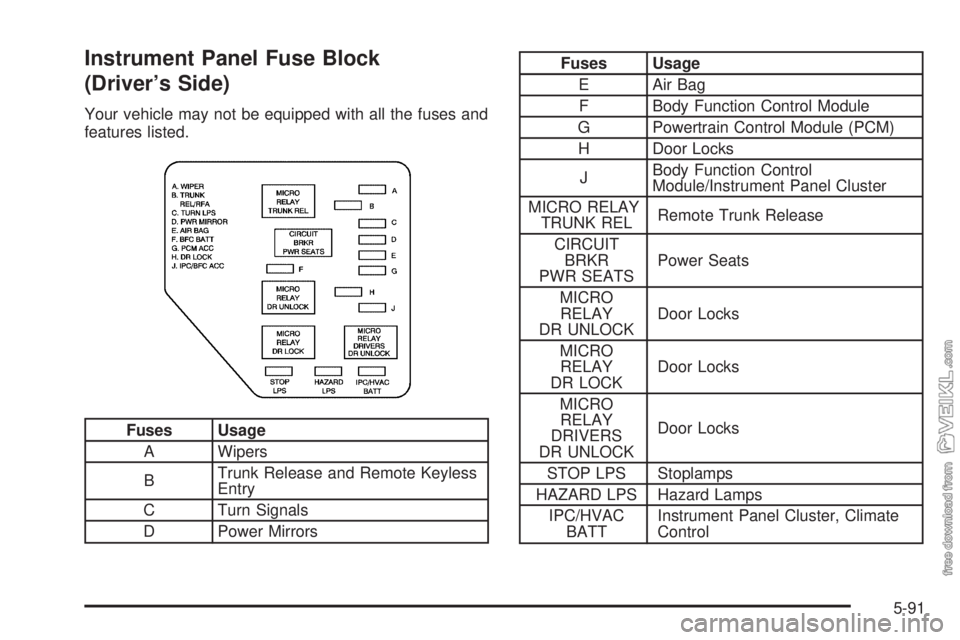
Instrument Panel Fuse Block
(Driver’s Side)
Your vehicle may not be equipped with all the fuses and
features listed.
Fuses Usage
A Wipers
BTrunk Release and Remote Keyless
Entry
C Turn Signals
D Power Mirrors
Fuses Usage
E Air Bag
F Body Function Control Module
G Powertrain Control Module (PCM)
H Door Locks
JBody Function Control
Module/Instrument Panel Cluster
MICRO RELAY
TRUNK RELRemote Trunk Release
CIRCUIT
BRKR
PWR SEATSPower Seats
MICRO
RELAY
DR UNLOCKDoor Locks
MICRO
RELAY
DR LOCKDoor Locks
MICRO
RELAY
DRIVERS
DR UNLOCKDoor Locks
STOP LPS Stoplamps
HAZARD LPS Hazard Lamps
IPC/HVAC
BATTInstrument Panel Cluster, Climate
Control
5-91
Page 295 of 348
Engine Compartment Fuse Block
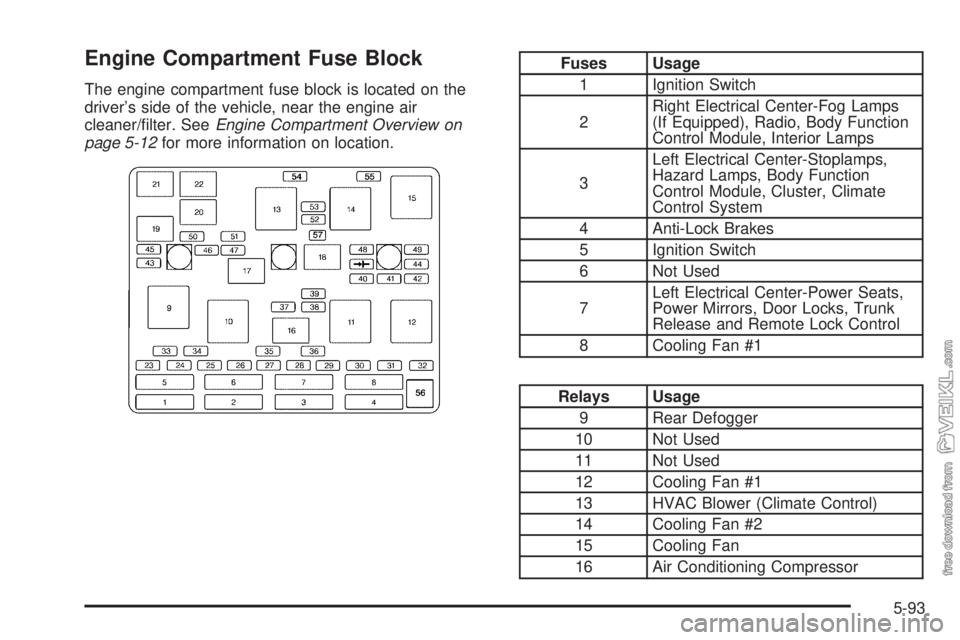
The engine compartment fuse block is located on the
driver’s side of the vehicle, near the engine air
cleaner/filter. SeeEngine Compartment Overview on
page 5-12for more information on location.
Fuses Usage
1 Ignition Switch
2Right Electrical Center-Fog Lamps
(If Equipped), Radio, Body Function
Control Module, Interior Lamps
3Left Electrical Center-Stoplamps,
Hazard Lamps, Body Function
Control Module, Cluster, Climate
Control System
4 Anti-Lock Brakes
5 Ignition Switch
6 Not Used
7Left Electrical Center-Power Seats,
Power Mirrors, Door Locks, Trunk
Release and Remote Lock Control
8 Cooling Fan #1
Relays Usage
9 Rear Defogger
10 Not Used
11 Not Used
12 Cooling Fan #1
13 HVAC Blower (Climate Control)
14 Cooling Fan #2
15 Cooling Fan
16 Air Conditioning Compressor
5-93
Page 342 of 348
Locks
Delayed Locking........................................... 2-8
Door........................................................... 2-7
Leaving Your Vehicle....................................2-11
Lockout Protection.......................................2-11
Power Door.................................................. 2-8
Programmable Automatic Door Locks............... 2-9
Rear Door Security Locks.............................2-10
Long Trip/Highway Definition.............................. 6-6
Long Trip/Highway Intervals............................... 6-6
Long Trip/Highway Scheduled Maintenance........6-12
Loss of Control...............................................4-13
Low Coolant Warning Light..............................3-29
Low Washer Fluid Warning Light.......................3-34
M
Maintenance, Normal Replacement Parts............5-96
Maintenance Schedule
At Each Fuel Fill.........................................6-16
At Least Once a Month................................6-16
At Least Once a Year..................................6-17
At Least Twice a Year..................................6-17
Brake System Inspection..............................6-21
Engine Cooling System Inspection.................6-21
Exhaust System Inspection...........................6-20
Fuel System Inspection................................6-20Maintenance Schedule (cont.)
How This Section is Organized....................... 6-3
Introduction.................................................. 6-2
Long Trip/Highway Scheduled Maintenance.......6-12
Maintenance Requirements............................. 6-2
Part A - Scheduled Maintenance Services......... 6-4
Part B - Owner Checks and Services.............6-16
Part C - Periodic MaintenanceInspections......6-20
Part D - Recommended Fluids and
Lubricants...............................................6-22
Part E - Maintenance Record........................6-23
Selecting the Right Schedule.......................... 6-5
Short Trip/City Scheduled Maintenance............. 6-6
Steering, Suspension and Front Drive Axle
Boot and Seal Inspection..........................6-20
Throttle System Inspection............................6-21
Using Your................................................... 6-4
Your Vehicle and the Environment................... 6-2
Maintenance When Trailer Towing.....................4-44
Making Turns.................................................4-42
Malfunction Indicator Light................................3-30
Manual Seats................................................... 1-2
Matching Transmitter(s) to Your Vehicle............... 2-5
Mexico, Central America and Caribbean
Islands/Countries (Except Puerto Rico
and U.S. Virgin Islands) – Customer
Assistance................................................... 7-5
8
Page 345 of 348
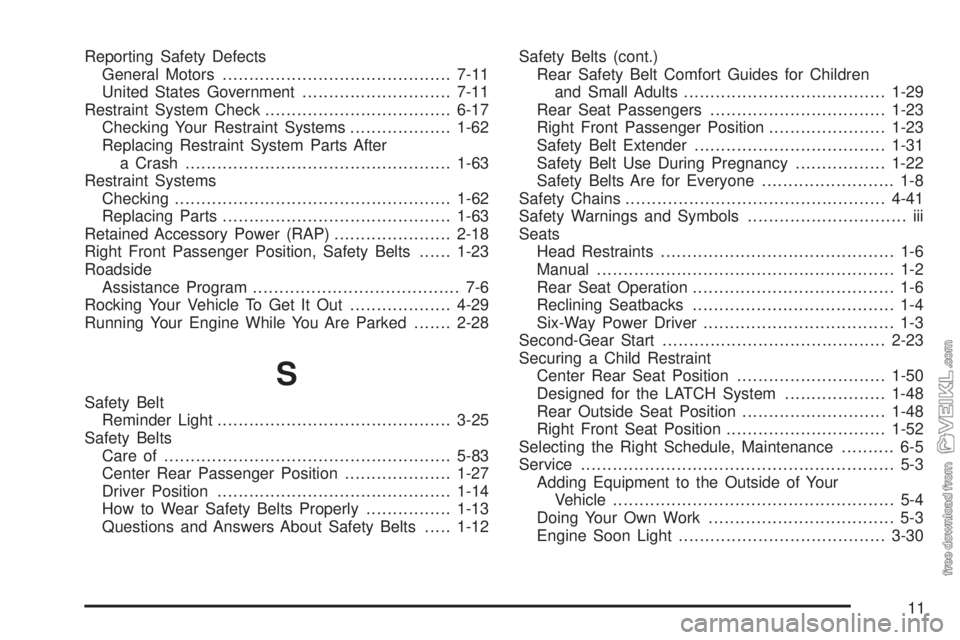
Reporting Safety Defects
General Motors...........................................7-11
United States Government............................7-11
Restraint System Check...................................6-17
Checking Your Restraint Systems...................1-62
Replacing Restraint System Parts After
a Crash..................................................1-63
Restraint Systems
Checking....................................................1-62
Replacing Parts...........................................1-63
Retained Accessory Power (RAP)......................2-18
Right Front Passenger Position, Safety Belts......1-23
Roadside
Assistance Program....................................... 7-6
Rocking Your Vehicle To Get It Out...................4-29
Running Your Engine While You Are Parked.......2-28
S
Safety Belt
Reminder Light............................................3-25
Safety Belts
Care of......................................................5-83
Center Rear Passenger Position....................1-27
Driver Position............................................1-14
How to Wear Safety Belts Properly................1-13
Questions and Answers About Safety Belts.....1-12Safety Belts (cont.)
Rear Safety Belt Comfort Guides for Children
and Small Adults......................................1-29
Rear Seat Passengers.................................1-23
Right Front Passenger Position......................1-23
Safety Belt Extender....................................1-31
Safety Belt Use During Pregnancy.................1-22
Safety Belts Are for Everyone......................... 1-8
Safety Chains.................................................4-41
Safety Warnings and Symbols.............................. iii
Seats
Head Restraints............................................ 1-6
Manual........................................................ 1-2
Rear Seat Operation...................................... 1-6
Reclining Seatbacks...................................... 1-4
Six-Way Power Driver.................................... 1-3
Second-Gear Start..........................................2-23
Securing a Child Restraint
Center Rear Seat Position............................1-50
Designed for the LATCH System...................1-48
Rear Outside Seat Position...........................1-48
Right Front Seat Position..............................1-52
Selecting the Right Schedule, Maintenance.......... 6-5
Service........................................................... 5-3
Adding Equipment to the Outside of Your
Vehicle..................................................... 5-4
Doing Your Own Work................................... 5-3
Engine Soon Light.......................................3-30
11