lock CHEVROLET CLASSIC 2004 Workshop Manual
[x] Cancel search | Manufacturer: CHEVROLET, Model Year: 2004, Model line: CLASSIC, Model: CHEVROLET CLASSIC 2004Pages: 348, PDF Size: 5.32 MB
Page 199 of 348
Total Weight on Your Vehicle’s Tires
Be sure your vehicle’s tires are inflated to the upper limit
for cold tires. You will find these numbers on the
Tire-Loading Information label at the rear edge of the
driver’s door or seeLoading Your Vehicle on page 4-32.
Then be sure you don’t go over the GVW limit for
your vehicle, including the weight of the trailer tongue.
Hitches
It is important to have the correct hitch equipment.
Crosswinds, large trucks going by and rough roads are
a few reasons why you will need the right hitch. Here
are some rules to follow:
•The rear bumper on your vehicle is not intended for
hitches. Do not attach rental hitches or other
bumper-type hitches to it. Use only a
frame-mounted hitch that does not attach to the
bumper.
•Will you have to make any holes in the body of
your vehicle when you install a trailer hitch? If
you do, then be sure to seal the holes later when
you remove the hitch. If you do not seal them,
deadly carbon monoxide (CO) from your exhaust
can get into your vehicle. SeeEngine Exhaust
on page 2-27. Dirt and water can, too.
Safety Chains
You should always attach chains between your vehicle
and your trailer. Cross the safety chains under the
tongue of the trailer so that the tongue will not drop to
the road if it becomes separated from the hitch.
Instructions about safety chains may be provided by the
hitch manufacturer or by the trailer manufacturer.
Follow the manufacturer’s recommendation for attaching
safety chains and do not attach them to the bumper.
Always leave just enough slack so you can turn
with your rig. And, never allow safety chains to drag on
the ground.
Trailer Brakes
Does your trailer have its own brakes?
Be sure to read and follow the instructions for the trailer
brakes so you’ll be able to install, adjust and maintain
them properly. And because you may have anti-lock
brakes, do not try to tap into your vehicle’s brake system.
If you do, both systems won’t work well, or at all.
4-41
Page 210 of 348
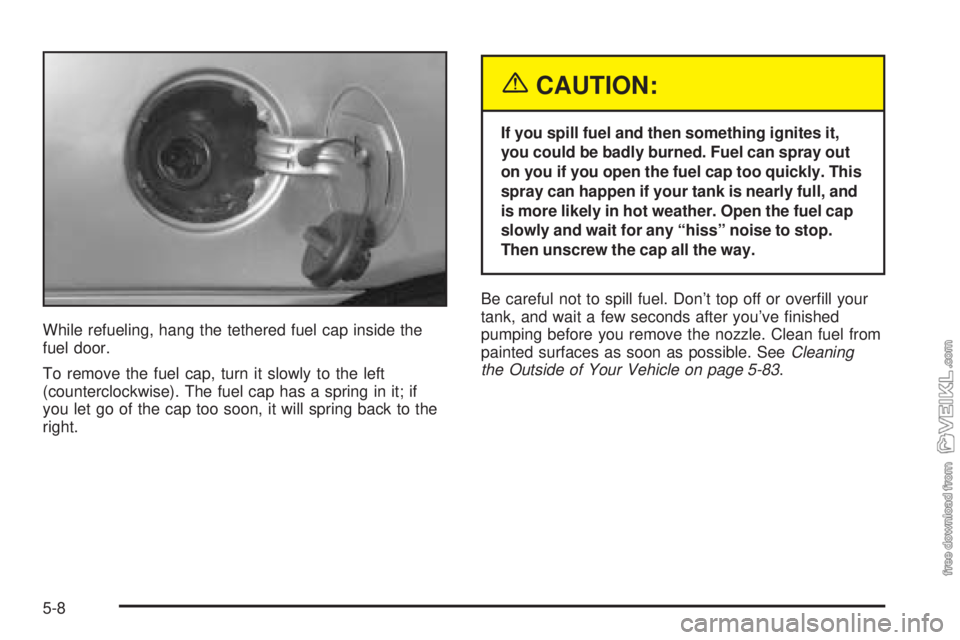
While refueling, hang the tethered fuel cap inside the
fuel door.
To remove the fuel cap, turn it slowly to the left
(counterclockwise). The fuel cap has a spring in it; if
you let go of the cap too soon, it will spring back to the
right.
{CAUTION:
If you spill fuel and then something ignites it,
you could be badly burned. Fuel can spray out
on you if you open the fuel cap too quickly. This
spray can happen if your tank is nearly full, and
is more likely in hot weather. Open the fuel cap
slowly and wait for any “hiss” noise to stop.
Then unscrew the cap all the way.
Be careful not to spill fuel. Don’t top off or overfill your
tank, and wait a few seconds after you’ve finished
pumping before you remove the nozzle. Clean fuel from
painted surfaces as soon as possible. SeeCleaning
the Outside of Your Vehicle on page 5-83.
5-8
Page 211 of 348
When you put the fuel cap back on, turn it to the right
(clockwise) until you hear a clicking sound. Make
sure you fully install the cap. The diagnostic system can
determine if the fuel cap has been left off or improperly
installed. This would allow fuel to evaporate into the
atmosphere. SeeMalfunction Indicator Lamp on
page 3-30.
{CAUTION:
If a re starts while you are refueling, do not
remove the nozzle. Shut off the ow of fuel by
shutting off the pump or by notifying the
station attendant. Leave the area immediately.
Notice:If you need a new fuel cap, be sure to get
the right type. Your dealer can get one for you.
If you get the wrong type, it may not t properly.
This may cause your malfunction indicator lamp to
light and may damage your fuel tank and emissions
system. See “Malfunction Indicator Lamp” in the
Index.
Filling a Portable Fuel Container
{CAUTION:
Never ll a portable fuel container while it is in
your vehicle. Static electricity discharge from
the container can ignite the gasoline vapor.
You can be badly burned and your vehicle
damaged if this occurs. To help avoid injury to
you and others:
Dispense gasoline only into approved
containers.
Do not ll a container while it is inside a
vehicle, in a vehicle’s trunk, pickup bed or
on any surface other than the ground.
Bring the ll nozzle in contact with the
inside of the ll opening before operating
the nozzle. Contact should be maintained
until the lling is complete.
Do not smoke while pumping gasoline.
5-9
Page 212 of 348
Checking Things Under the
Hood
Hood Release
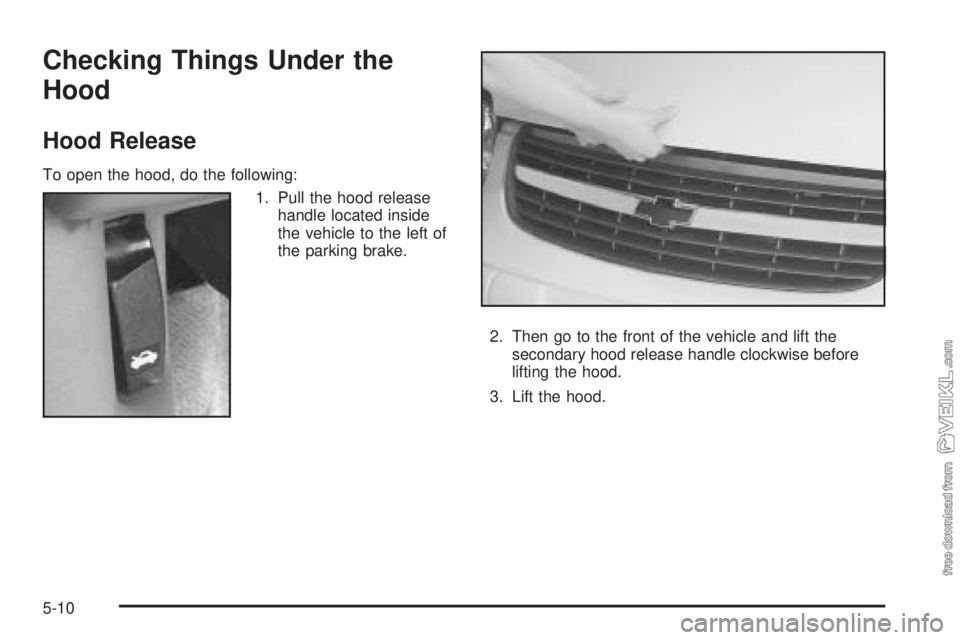
To open the hood, do the following:
1. Pull the hood release
handle located inside
the vehicle to the left of
the parking brake.
2. Then go to the front of the vehicle and lift the
secondary hood release handle clockwise before
lifting the hood.
3. Lift the hood.
5-10
Page 215 of 348
A. Engine Coolant Surge Tank. SeeCooling System on
page 5-25.
B. Ground. SeeJump Starting on page 5-39.
C. Engine Oil Dipstick. See “Checking Engine Oil” in
Engine Oil on page 5-13.
D. Engine Oil Fill Cap. See “When to Add Engine Oil”
inEngine Oil on page 5-13.
E. Brake Fluid Reservoir. See “Brake Fluid” inBrakes
on page 5-34.
F. Power Steering Fluid Reservoir. SeePower Steering
Fluid on page 5-31.
G. Engine Compartment Fuse Block. SeeFuses and
Circuit Breakers on page 5-90.
H. Engine Air Cleaner/Filter. SeeEngine Air
Cleaner/Filter on page 5-17.
I. Battery. SeeBattery on page 5-38.
J. Windshield Washer Fluid Reservoir. SeeWindshield
Washer Fluid on page 5-32.Engine Oil
Checking Engine Oil
It is a good idea to check your engine oil every time you
get fuel. In order to get an accurate reading, the oil
must be warm and the vehicle must be on level ground.
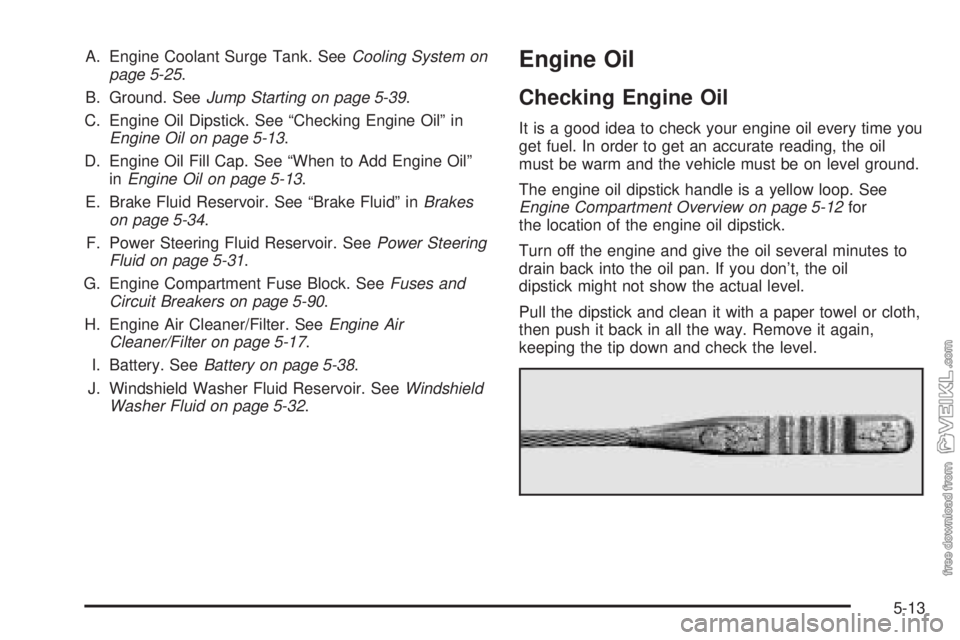
The engine oil dipstick handle is a yellow loop. See
Engine Compartment Overview on page 5-12for
the location of the engine oil dipstick.
Turn off the engine and give the oil several minutes to
drain back into the oil pan. If you don’t, the oil
dipstick might not show the actual level.
Pull the dipstick and clean it with a paper towel or cloth,
then push it back in all the way. Remove it again,
keeping the tip down and check the level.
5-13
Page 231 of 348
{CAUTION:
You can be burned if you spill coolant on hot
engine parts. Coolant contains ethylene glycol
and it will burn if the engine parts are hot
enough. Do not spill coolant on a hot engine.
1. Park the vehicle on a level surface.
You can remove the coolant surge tank pressure
cap when the cooling system, including the coolant
surge tank pressure cap and upper radiator
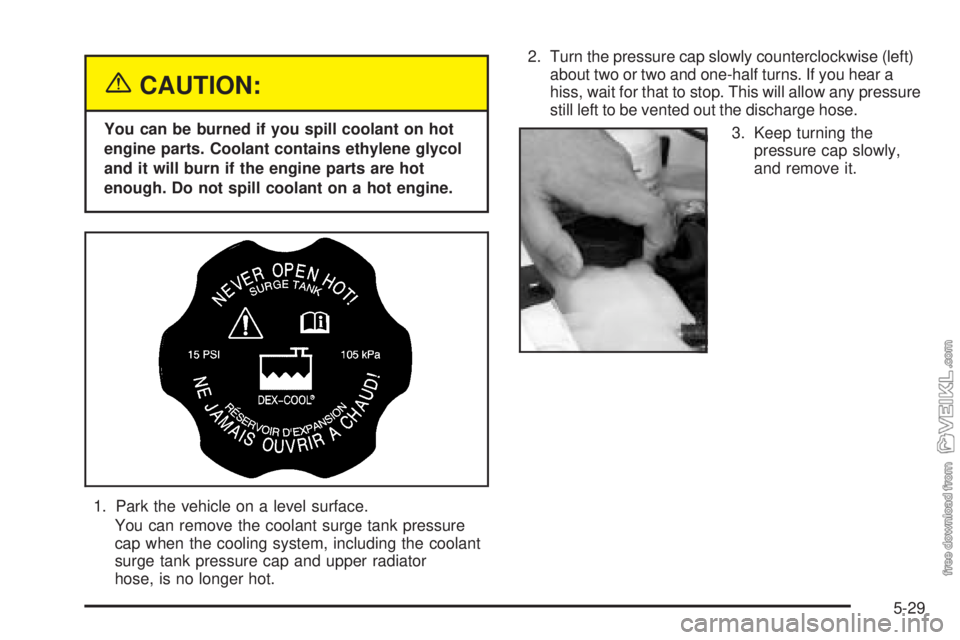
hose, is no longer hot.2. Turn the pressure cap slowly counterclockwise (left)
about two or two and one-half turns. If you hear a
hiss, wait for that to stop. This will allow any pressure
still left to be vented out the discharge hose.
3. Keep turning the
pressure cap slowly,
and remove it.
5-29
Page 248 of 348
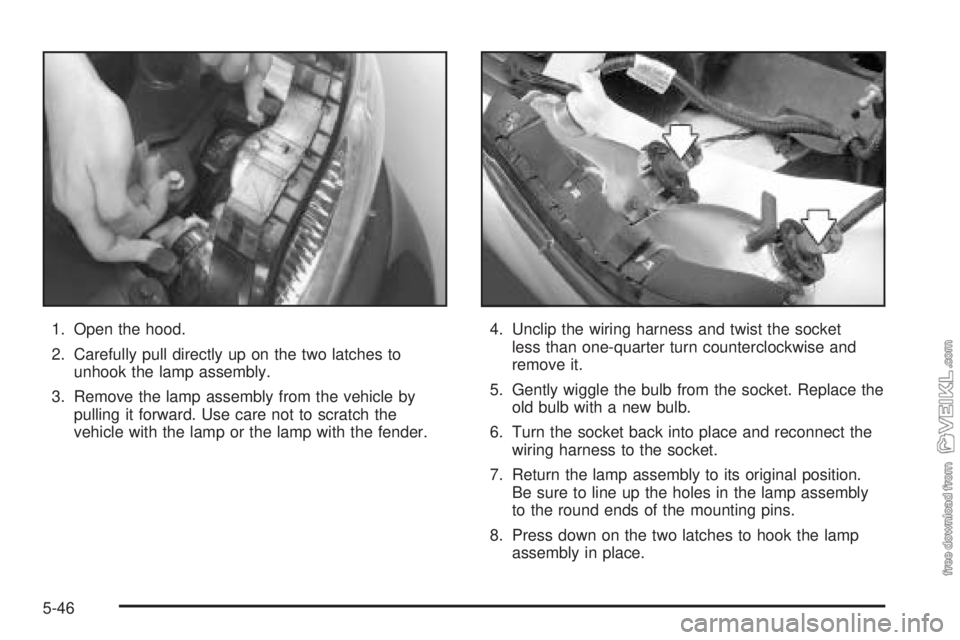
1. Open the hood.
2. Carefully pull directly up on the two latches to
unhook the lamp assembly.
3. Remove the lamp assembly from the vehicle by
pulling it forward. Use care not to scratch the
vehicle with the lamp or the lamp with the fender.4. Unclip the wiring harness and twist the socket
less than one-quarter turn counterclockwise and
remove it.
5. Gently wiggle the bulb from the socket. Replace the
old bulb with a new bulb.
6. Turn the socket back into place and reconnect the
wiring harness to the socket.
7. Return the lamp assembly to its original position.
Be sure to line up the holes in the lamp assembly
to the round ends of the mounting pins.
8. Press down on the two latches to hook the lamp
assembly in place.
5-46
Page 249 of 348
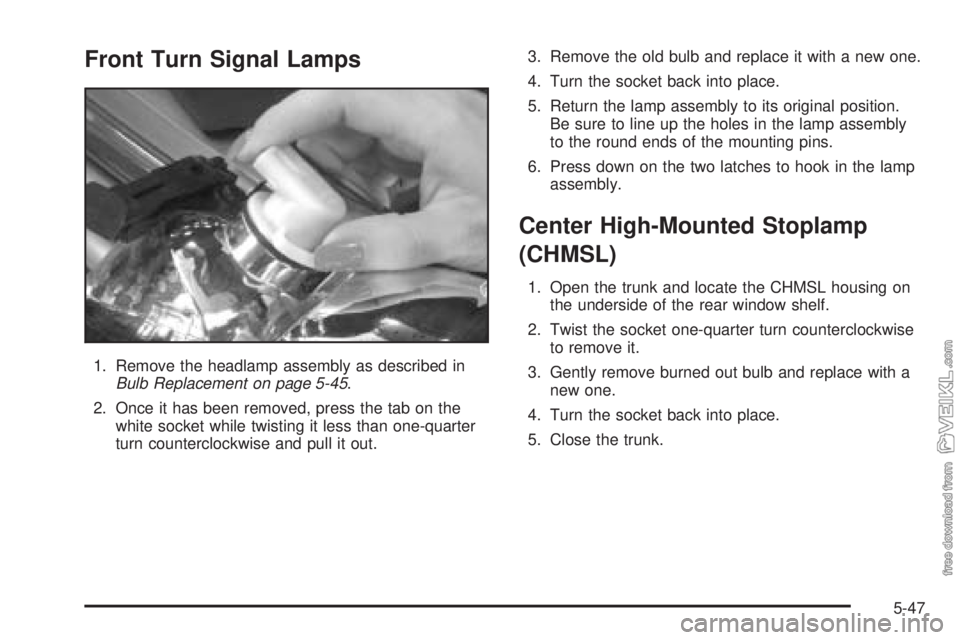
Front Turn Signal Lamps
1. Remove the headlamp assembly as described in
Bulb Replacement on page 5-45.
2. Once it has been removed, press the tab on the
white socket while twisting it less than one-quarter
turn counterclockwise and pull it out.3. Remove the old bulb and replace it with a new one.
4. Turn the socket back into place.
5. Return the lamp assembly to its original position.
Be sure to line up the holes in the lamp assembly
to the round ends of the mounting pins.
6. Press down on the two latches to hook in the lamp
assembly.
Center High-Mounted Stoplamp
(CHMSL)
1. Open the trunk and locate the CHMSL housing on
the underside of the rear window shelf.
2. Twist the socket one-quarter turn counterclockwise
to remove it.
3. Gently remove burned out bulb and replace with a
new one.
4. Turn the socket back into place.
5. Close the trunk.
5-47
Page 270 of 348
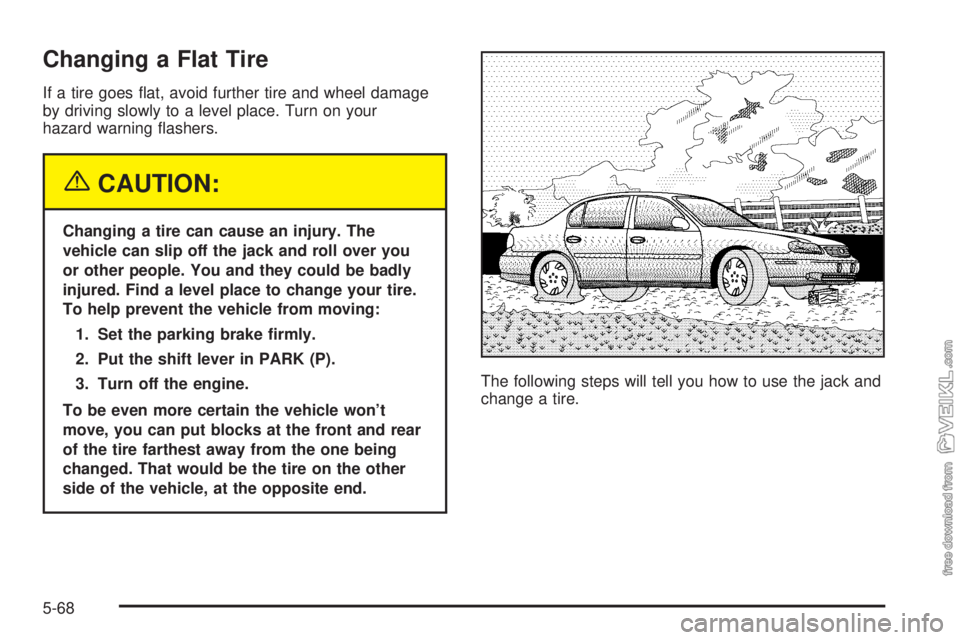
Changing a Flat Tire
If a tire goes flat, avoid further tire and wheel damage
by driving slowly to a level place. Turn on your
hazard warning flashers.
{CAUTION:
Changing a tire can cause an injury. The
vehicle can slip off the jack and roll over you
or other people. You and they could be badly
injured. Find a level place to change your tire.
To help prevent the vehicle from moving:
1. Set the parking brake rmly.
2. Put the shift lever in PARK (P).
3. Turn off the engine.
To be even more certain the vehicle won’t
move, you can put blocks at the front and rear
of the tire farthest away from the one being
changed. That would be the tire on the other
side of the vehicle, at the opposite end.The following steps will tell you how to use the jack and
change a tire.
5-68
Page 271 of 348
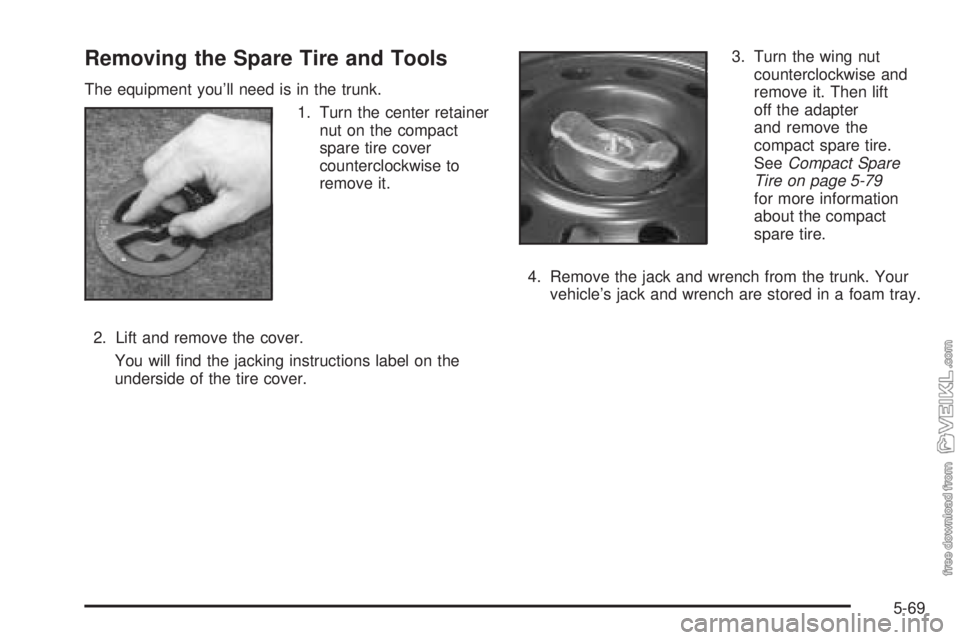
Removing the Spare Tire and Tools
The equipment you’ll need is in the trunk.
1. Turn the center retainer
nut on the compact
spare tire cover
counterclockwise to
remove it.
2. Lift and remove the cover.
You will find the jacking instructions label on the
underside of the tire cover.3. Turn the wing nut
counterclockwise and
remove it. Then lift
off the adapter
and remove the
compact spare tire.
SeeCompact Spare
Tire on page 5-79
for more information
about the compact
spare tire.
4. Remove the jack and wrench from the trunk. Your
vehicle’s jack and wrench are stored in a foam tray.
5-69