instrument panel CHEVROLET CLASSIC 2005 Owner's Guide
[x] Cancel search | Manufacturer: CHEVROLET, Model Year: 2005, Model line: CLASSIC, Model: CHEVROLET CLASSIC 2005Pages: 320, PDF Size: 4.86 MB
Page 182 of 320
When towing a trailer, the arrows on your instrument
panel will flash for turns even if the bulbs on the trailer
are burned out. Thus, you may think drivers behind
you are seeing your signal when they are not. It
is important to check occasionally to be sure the trailer
bulbs are still working.
Driving On Grades
Notice:Do not tow on steep continuous grades
exceeding 6 miles (9.6 km). Extended, higher
than normal engine and transaxle temperatures
may result and damage your vehicle. Frequent stops
are very important to allow the engine and transaxle
to cool.
Reduce speed and shift to a lower gearbeforeyou start
down a long or steep downgrade. If you do not shift
down, you might have to use your brakes so much that
they would get hot and no longer work well.
Pay attention to the engine coolant gage. If the indicator
is in the red area, turn off the air conditioning to
reduce engine load. SeeEngine Overheating on
page 5-22.
Parking on Hills
{CAUTION:
You really should not park your vehicle, with a
trailer attached, on a hill. If something goes
wrong, your rig could start to move. People
can be injured, and both your vehicle and the
trailer can be damaged.
But if you ever have to park your rig on a hill, here is
how to do it:
1. Apply your regular brakes, but do not shift into
PARK (P) yet.
2. Have someone place chocks under the trailer
wheels.
3. When the wheel chocks are in place, release the
regular brakes until the chocks absorb the load.
4. Reapply the regular brakes. Then apply your
parking brake and shift into PARK (P).
5. Release the regular brakes.
4-40
Page 186 of 320
If a Tire Goes Flat........................................5-60
Changing a Flat Tire.....................................5-60
Removing the Spare Tire and Tools................5-62
Removing the Flat Tire and Installing
the Spare Tire..........................................5-63
Storing a Flat or Spare Tire and Tools............5-69
Compact Spare Tire......................................5-70
Appearance Care............................................5-71
Fabric/Carpet...............................................5-71
Vinyl...........................................................5-73
Instrument Panel..........................................5-73
Interior Plastic Components............................5-73
Glass Surfaces.............................................5-73
Care of Safety Belts......................................5-73
Weatherstrips...............................................5-74
Washing Your Vehicle...................................5-74
Cleaning Exterior Lamps/Lenses.....................5-74
Finish Care..................................................5-74
Windshield and Wiper Blades.........................5-75
Aluminum Wheels.........................................5-75Tires...........................................................5-76
Sheet Metal Damage.....................................5-76
Finish Damage.............................................5-76
Underbody Maintenance................................5-76
Chemical Paint Spotting.................................5-77
Vehicle Care/Appearance Materials..................5-77
Vehicle Identication......................................5-78
Vehicle Identification Number (VIN).................5-78
Service Parts Identification Label.....................5-78
Electrical System............................................5-79
Add-On Electrical Equipment..........................5-79
Headlamp Wiring..........................................5-79
Windshield Wiper Fuses................................5-79
Power Windows and Other Power Options.......5-79
Fuses and Circuit Breakers............................5-80
Instrument Panel Fuse Block..........................5-80
Engine Compartment Fuse Block....................5-83
Capacities and Specications..........................5-85
Normal Maintenance Replacement Parts..........5-86
Section 5 Service and Appearance Care
5-2
Page 204 of 320
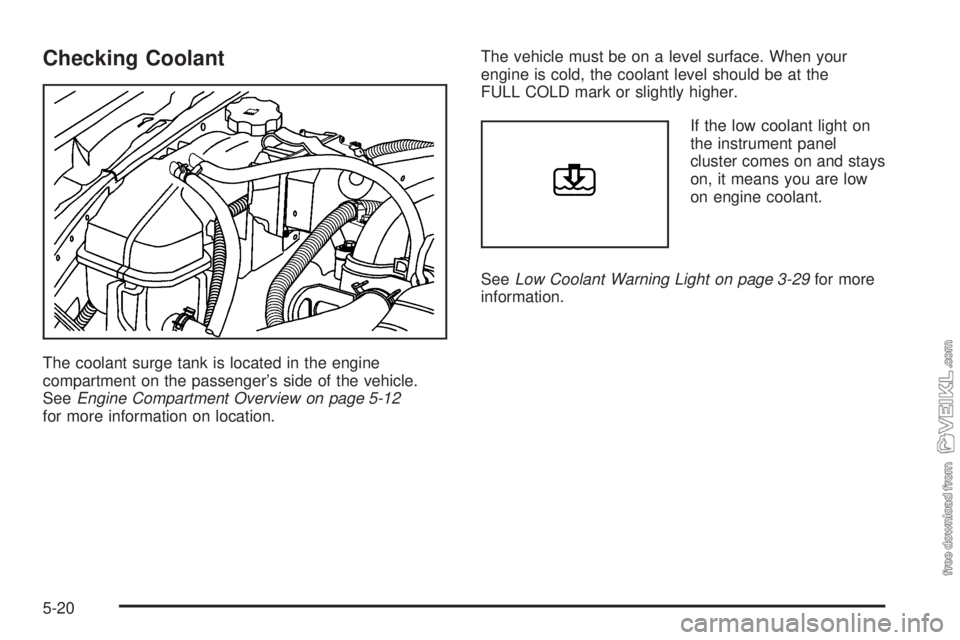
Checking Coolant
The coolant surge tank is located in the engine
compartment on the passenger’s side of the vehicle.
SeeEngine Compartment Overview on page 5-12
for more information on location.The vehicle must be on a level surface. When your
engine is cold, the coolant level should be at the
FULL COLD mark or slightly higher.
If the low coolant light on
the instrument panel
cluster comes on and stays
on, it means you are low
on engine coolant.
SeeLow Coolant Warning Light on page 3-29for more
information.
5-20
Page 206 of 320
Engine Overheating
You will find a coolant temperature gage and a low
coolant level warning light on your vehicle’s instrument
panel. SeeEngine Coolant Temperature Gage on
page 3-29andLow Coolant Warning Light on page 3-29.
If Steam Is Coming From Your Engine
{CAUTION:
Steam from an overheated engine can burn
you badly, even if you just open the hood. Stay
away from the engine if you see or hear steam
coming from it. Just turn it off and get
everyone away from the vehicle until it cools
down. Wait until there is no sign of steam or
coolant before you open the hood.
If you keep driving when your engine is
overheated, the liquids in it can catch re. You
or others could be badly burned. Stop your
engine if it overheats, and get out of the
vehicle until the engine is cool.
Notice:If your engine catches re because you
keep driving with no coolant, your vehicle can
be badly damaged. The costly repairs would not be
covered by your warranty.
5-22
Page 257 of 320
Vinyl
Use warm water and a clean cloth.
•Rub with a clean, damp cloth to remove dirt.
This may have to be done more than once.
•Things like tar, asphalt, and shoe polish will stain
if they are not removed quickly. Use a clean cloth
and vinyl cleaner. See your dealer for this product.
Instrument Panel
Use only mild soap and water to clean the top surfaces
of the instrument panel. Sprays containing silicones
or waxes may cause annoying reflections in the
windshield and even make it difficult to see through
the windshield under certain conditions.
Interior Plastic Components
Use only a mild soap and water solution on a soft
cloth or sponge. Commercial cleaners may affect the
surface finish.
Glass Surfaces
Notice:If you use abrasive cleaners when cleaning
glass surfaces on your vehicle, you could scratch
the glass. When cleaning the glass on your vehicle,
use only a soft cloth and glass cleaner.
Glass should be cleaned often. Your dealer can provide
an approved cleaner, or a liquid household glass
cleaner will remove normal tobacco smoke and dust
films on interior glass. SeeVehicle Care/Appearance
Materials on page 5-77.
Care of Safety Belts
Keep belts clean and dry.
{CAUTION:
Do not bleach or dye safety belts. If you do,
it may severely weaken them. In a crash,
they might not be able to provide adequate
protection. Clean safety belts only with mild
soap and lukewarm water.
5-73
Page 262 of 320
Vehicle Identication
Vehicle Identication Number (VIN)
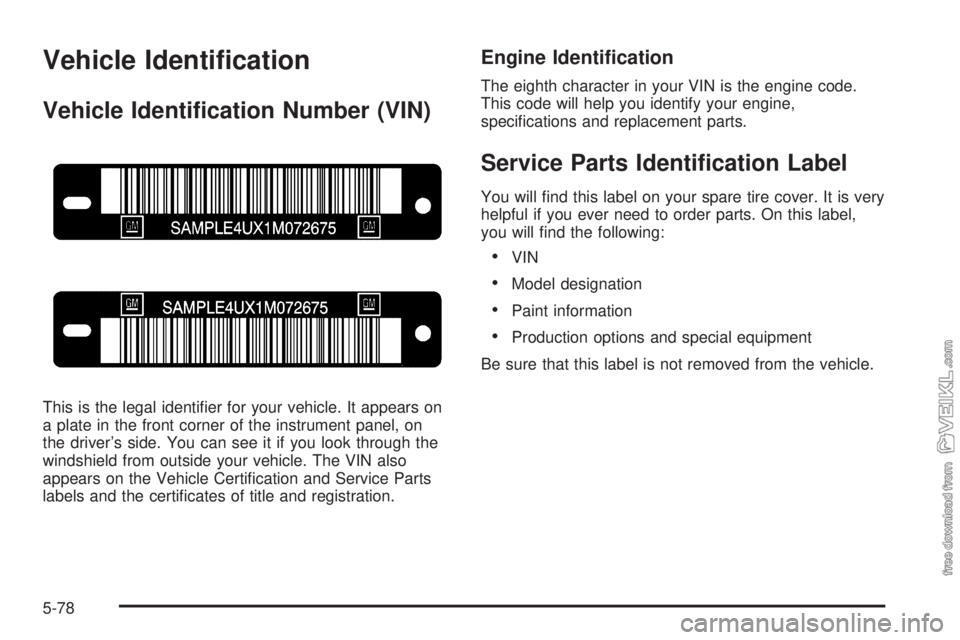
This is the legal identifier for your vehicle. It appears on
a plate in the front corner of the instrument panel, on
the driver’s side. You can see it if you look through the
windshield from outside your vehicle. The VIN also
appears on the Vehicle Certification and Service Parts
labels and the certificates of title and registration.
Engine Identication
The eighth character in your VIN is the engine code.
This code will help you identify your engine,
specifications and replacement parts.
Service Parts Identication Label
You will find this label on your spare tire cover. It is very
helpful if you ever need to order parts. On this label,
you will find the following:
•VIN
•Model designation
•Paint information
•Production options and special equipment
Be sure that this label is not removed from the vehicle.
5-78
Page 264 of 320
Fuses and Circuit Breakers
The wiring circuits in your vehicle are protected from
short circuits by a combination of fuses, circuit breakers
and fusible thermal links in the wiring itself.
Look at the silver-colored band inside the fuse. If the
band is broken or melted, replace the fuse. Be sure you
replace a bad fuse with a new one of the identical
size and rating.
If you ever have a problem on the road and don’t have
a spare fuse, you can borrow one that has the same
amperage. Just pick a feature of your vehicle that
you can get along without — like the radio or cigarette
lighter — and use its fuse, if it is the correct amperage.
Replace it as soon as you can.
There are three fuse blocks in your vehicle:
two instrument panel fuse blocks and the engine
compartment fuse block.
There is a fuse puller located on the engine
compartment fuse block. It can be used to easily
remove fuses from the fuse block.
Instrument Panel Fuse Block
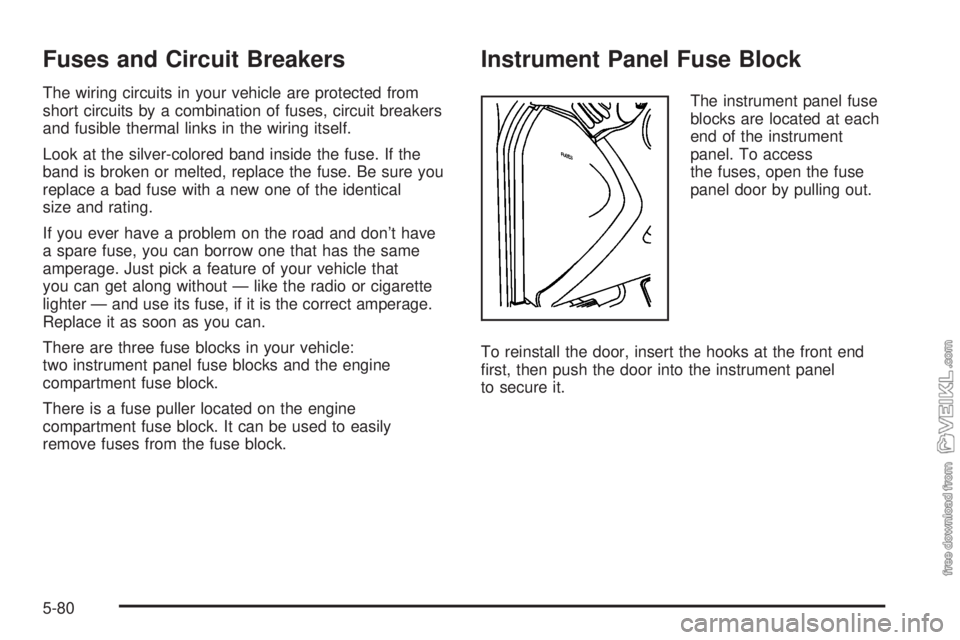
The instrument panel fuse
blocks are located at each
end of the instrument
panel. To access
the fuses, open the fuse
panel door by pulling out.
To reinstall the door, insert the hooks at the front end
first, then push the door into the instrument panel
to secure it.
5-80
Page 265 of 320
Driver’s Side
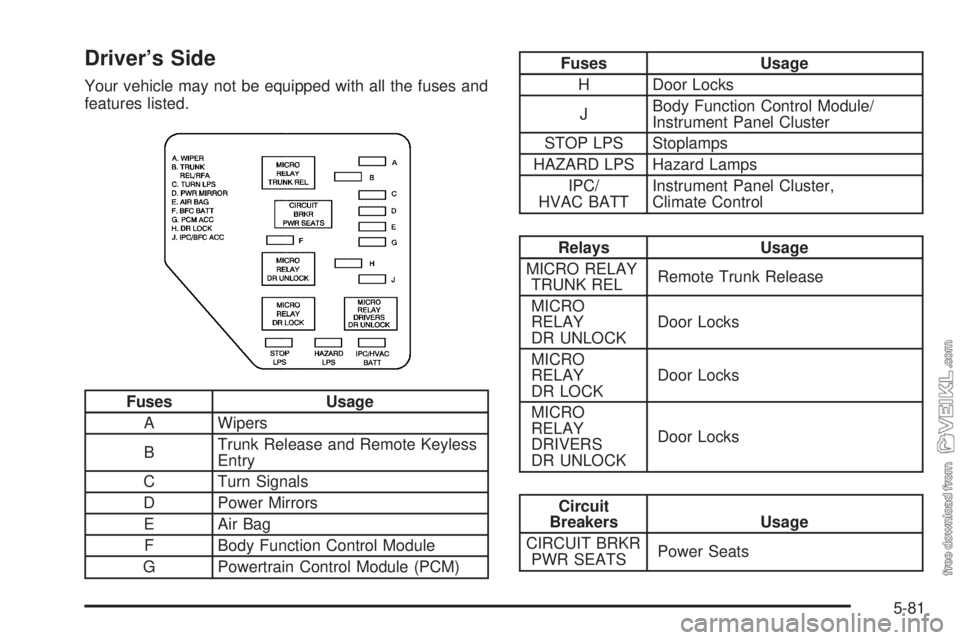
Your vehicle may not be equipped with all the fuses and
features listed.
Fuses Usage
A Wipers
BTrunk Release and Remote Keyless
Entry
C Turn Signals
D Power Mirrors
E Air Bag
F Body Function Control Module
G Powertrain Control Module (PCM)
Fuses Usage
H Door Locks
JBody Function Control Module/
Instrument Panel Cluster
STOP LPS Stoplamps
HAZARD LPS Hazard Lamps
IPC/
HVAC BATTInstrument Panel Cluster,
Climate Control
Relays Usage
MICRO RELAY
TRUNK RELRemote Trunk Release
MICRO
RELAY
DR UNLOCKDoor Locks
MICRO
RELAY
DR LOCKDoor Locks
MICRO
RELAY
DRIVERS
DR UNLOCKDoor Locks
Circuit
Breakers Usage
CIRCUIT BRKR
PWR SEATSPower Seats
5-81
Page 266 of 320
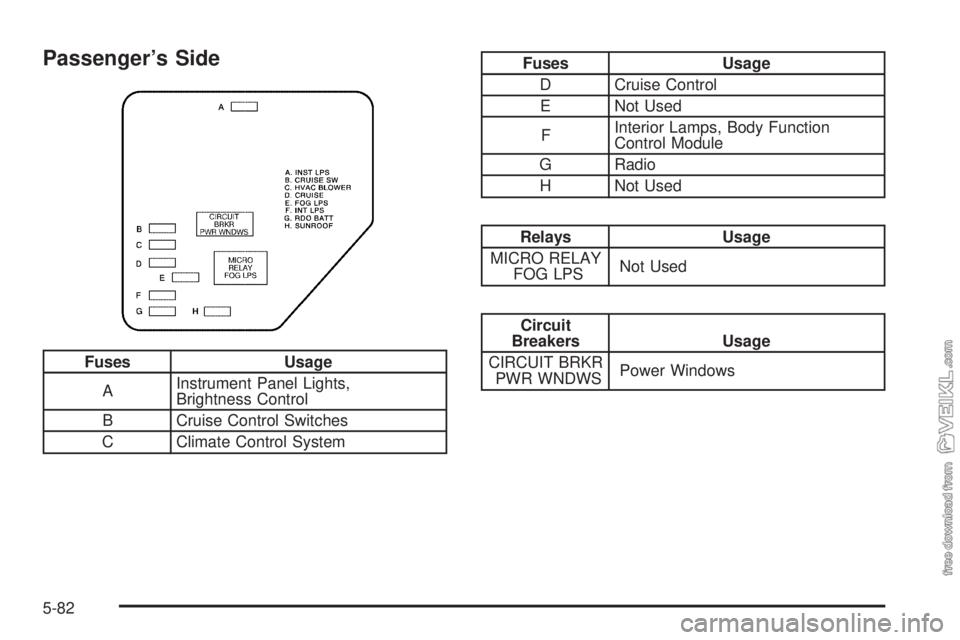
Passenger’s Side
Fuses Usage
AInstrument Panel Lights,
Brightness Control
B Cruise Control Switches
C Climate Control System
Fuses Usage
D Cruise Control
E Not Used
FInterior Lamps, Body Function
Control Module
G Radio
H Not Used
Relays Usage
MICRO RELAY
FOG LPSNot Used
Circuit
Breakers Usage
CIRCUIT BRKR
PWR WNDWSPower Windows
5-82
Page 298 of 320
Customer Assistance and
Information
Customer Satisfaction Procedure
Your satisfaction and goodwill are important to
your dealer and to Chevrolet. Normally, any concerns
with the sales transaction or the operation of your
vehicle will be resolved by your dealer’s sales or service
departments. Sometimes, however, despite the best
intentions of all concerned, misunderstandings can
occur. If your concern has not been resolved to your
satisfaction, the following steps should be taken:
STEP ONE:Discuss your concern with a member of
dealership management. Normally, concerns can
be quickly resolved at that level. If the matter has
already been reviewed with the sales, service or parts
manager, contact the owner of the dealership or
the general manager.
STEP TWO:If after contacting a member of dealership
management, it appears your concern cannot be
resolved by the dealership without further help, contact
the Chevrolet Customer Assistance Center by calling
1-800-222-1020.We encourage you to call the toll-free number in order
to give your inquiry prompt attention. Please have
the following information available to give the Customer
Assistance Representative:
•Vehicle Identification Number (VIN). This is
available from the vehicle registration or title, or the
plate at the top left of the instrument panel and
visible through the windshield.
•Dealership name and location
•Vehicle delivery date and present mileage
When contacting Chevrolet, please remember that your
concern will likely be resolved at a dealer’s facility.
That is why we suggest you follow Step One first if you
have a concern.
STEP THREE:Both General Motors and your dealer
are committed to making sure you are completely
satisfied with your new vehicle. However, if you continue
to remain unsatisfied after following the procedure
outlined in Steps One and Two, you should file with the
GM/BBB Auto Line Program to enforce any additional
rights you may have.
7-2