light CHEVROLET COBALT 2007 1.G Owner's Manual
[x] Cancel search | Manufacturer: CHEVROLET, Model Year: 2007, Model line: COBALT, Model: CHEVROLET COBALT 2007 1.GPages: 450, PDF Size: 2.48 MB
Page 109 of 450
PASS-Key®III+
The PASS-Key®III+ system operates on a radio
frequency subject to Federal Communications
Commission (FCC) Rules and with Industry
Canada.
This device complies with Part 15 of the FCC
Rules. Operation is subject to the following
two conditions:
1. This device may not cause harmful
interference.
2. This device must accept any interference
received, including interference that may
cause undesired operation.
This device complies with RSS-210 of Industry
Canada. Operation is subject to the following
two conditions:
1. This device may not cause interference.
2. This device must accept any interference
received, including interference that may
cause undesired operation of the device.
Changes or modications to this system by other
than an authorized service facility could void
authorization to use this equipment.PASS-Key
®III+ uses a radio frequency
transponder in the key that matches a decoder in
your vehicle.
PASS-Key®III+ Operation
Your vehicle has PASS-Key®III+ (Personalized
Automotive Security System) theft-deterrent
system. PASS-Key
®III+ is a passive
theft-deterrent system. This means you do not
have to do anything special to arm or disarm the
system. It works when you insert or remove
the key from the ignition.
When the PASS-Key
®III+ system senses that
someone is using the wrong key, it prevents
the vehicle from starting. Anyone using a
trial-and-error method to start the vehicle will
be discouraged because of the high number of
electrical key codes.
When trying to start the vehicle if the engine does
not start and the security light comes on, the
key may have a damaged transponder. Turn the
ignition off and try again.
109
Page 110 of 450
If the engine still does not start, and the key
appears to be undamaged, try another ignition
key. At this time, you may also want to check
the fuse, seeFuses and Circuit Breakers on
page 384. If the engine still does not start with
the other key, your vehicle needs service. If your
vehicle does start, the rst key may be faulty.
See your dealer/retailer who can service the
PASS-Key
®III+ to have a new key made.
In an emergency, contact Roadside Assistance.
SeeRoadside Assistance Program on page 420,
for more information.
It may be possible for the PASS-Key
®III+ decoder
to “learn” the transponder value of a new or
replacement key. Up to 10 keys may be
programmed for the vehicle. The following
procedure is for programming additional keys only.
If all the currently programmed keys are lost or do
not operate, you must see your dealer/retailer or a
locksmith who can service PASS-Key
®III+ to have
keys made and programmed to the system.
See your dealer/retailer or a locksmith who can
service PASS-Key
®III+ to get a new key blank that
is cut exactly as the ignition key that operates
the system.To program the new key:
1. Verify that the new key has a
1stamped
on it.
2. Insert the already programmed key in the
ignition and start the engine. If the engine
will not start, see your dealer/retailer for
service.
3. After the engine has started, turn the key to
LOCK, and remove the key.
4. Insert the key to be programmed and turn it to
the RUN position within ve seconds of the
original key being turned to the LOCK position.
The security light will turn off once the key
has been programmed.
5. Repeat Steps 1 through 4 if additional keys
are to be programmed.
If you are ever driving and the security light comes
on and stays on, you may be able to restart
your engine if you turn it off. Your PASS-Key
®III+
system, however, is not working properly and
must be serviced by your dealer/retailer.
Your vehicle is not protected by the
PASS-Key
®III+ system at this time.
110
Page 113 of 450
R(RUN):This is the position the switch returns
to after you start your engine and release the
switch. The switch stays in the RUN position when
the engine is running. But even when the ignition
is not running, you can use RUN to operate
your electrical accessories and to display some
warning and indicator lights.
The battery could be drained if you leave the key
in the ACC or RUN position with the engine
off. You may not be able to start your vehicle if
the battery is allowed to drain for an extended
period of time.
/(START):This position starts the engine. When
the engine starts, release the key. The ignition
switch will return to RUN for normal driving.
A warning tone will sound if you open the driver’s
door while in LOCK or ACC, when the key has not
been removed from the ignition.
Key In the Ignition
Never leave your vehicle with the keys inside, as it
is an easy target for joy riders or thieves. If you
leave the key in the ignition and park your
vehicle,a chime will sound, when you open the
driver’s door. Always remember to remove
your key from the ignition and take it with you.
This will lock your ignition and transaxle.
Also, always remember to lock the doors.
The battery could be drained if you leave the key
in the ignition while your vehicle is parked.
You may not be able to start your vehicle after it
has been parked for an extended period of time.
113
Page 120 of 450
DRIVE (D):This position is for normal driving with
the automatic transaxle. It provides the best fuel
economy for your vehicle. If you need more power
for passing, and you are:
Going less than about 35 mph (55 km/h), push
your accelerator pedal about halfway down.
Going about 35 mph (55 km/h), push
your accelerator all the way down.
Downshifting the transaxle in slippery road
conditions could result in skidding, see “Skidding”
underLoss of Control on page 241.
INTERMEDIATE (I):This position is also used for
normal driving. However, it reduces vehicle speed
without using your brakes for slight downgrades
where the vehicle would otherwise accelerate due
to steepness of grade. If constant upshifting or
downshifting occurs while driving up steep hills, this
position can be used to prevent repetitive types of
shifts. You might choose INTERMEDIATE (I)
instead of DRIVE (D) when driving on hilly, winding
roads and when towing a trailer, so that there is less
shifting between gears.LOW (L):This position reduces vehicle speed
more than INTERMEDIATE (I) without actually
using your brakes. You can use it on very steep
hills, or in deep snow or mud. If the shift lever
is put in LOW (L), the transaxle will not shift into
LOW (L) until the vehicle is going slowly enough.
Notice:Spinning the tires or holding the
vehicle in one place on a hill using only the
accelerator pedal may damage the transaxle.
If you are stuck, do not spin the tires. When
stopping on a hill, use the brakes, or parking
brake to hold the vehicle in place.
120
Page 122 of 450
Shift Speeds
{CAUTION:
If you skip a gear when you downshift,
you could lose control of your vehicle.
You could injure yourself or others. Do
not shift down more than one gear at a
time when you downshift.
Up-Shift Light
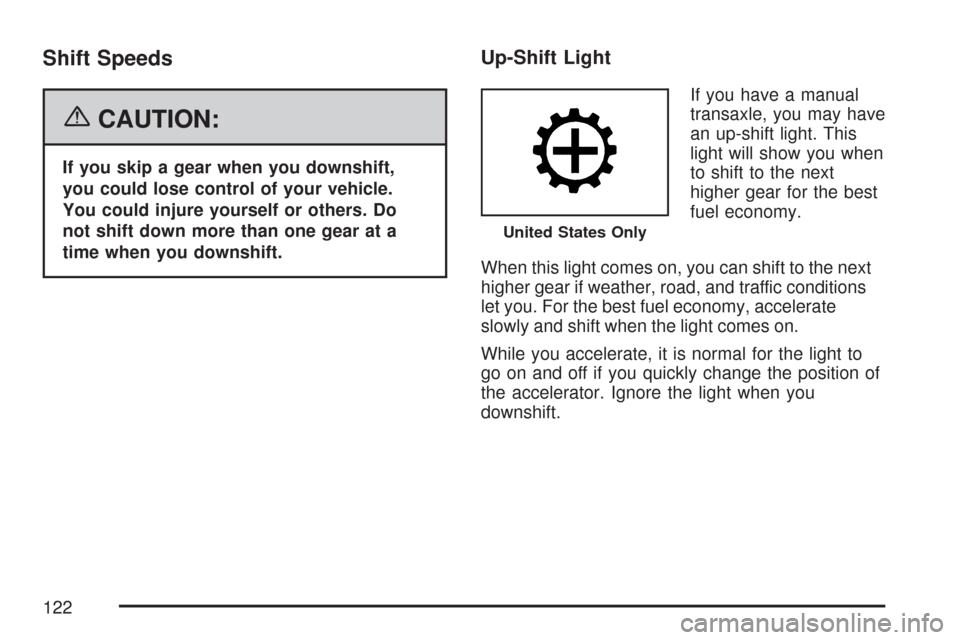
If you have a manual
transaxle, you may have
an up-shift light. This
light will show you when
to shift to the next
higher gear for the best
fuel economy.
When this light comes on, you can shift to the next
higher gear if weather, road, and traffic conditions
let you. For the best fuel economy, accelerate
slowly and shift when the light comes on.
While you accelerate, it is normal for the light to
go on and off if you quickly change the position of
the accelerator. Ignore the light when you
downshift.
United States Only
122
Page 123 of 450
Parking Brake
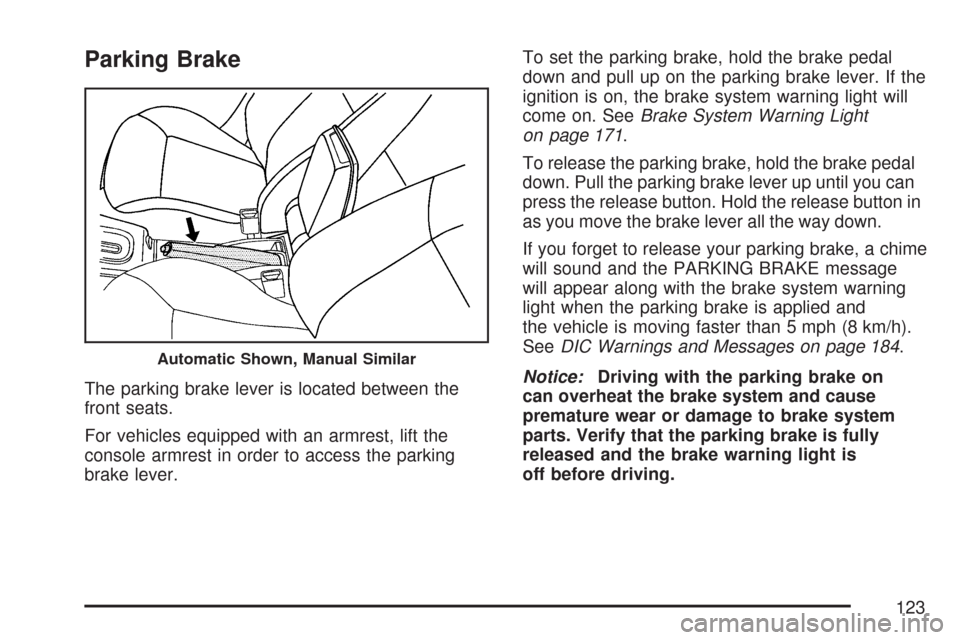
The parking brake lever is located between the
front seats.
For vehicles equipped with an armrest, lift the
console armrest in order to access the parking
brake lever.To set the parking brake, hold the brake pedal
down and pull up on the parking brake lever. If the
ignition is on, the brake system warning light will
come on. SeeBrake System Warning Light
on page 171.
To release the parking brake, hold the brake pedal
down. Pull the parking brake lever up until you can
press the release button. Hold the release button in
as you move the brake lever all the way down.
If you forget to release your parking brake, a chime
will sound and the PARKING BRAKE message
will appear along with the brake system warning
light when the parking brake is applied and
the vehicle is moving faster than 5 mph (8 km/h).
SeeDIC Warnings and Messages on page 184.
Notice:Driving with the parking brake on
can overheat the brake system and cause
premature wear or damage to brake system
parts. Verify that the parking brake is fully
released and the brake warning light is
off before driving.
Automatic Shown, Manual Similar
123
Page 135 of 450
OnStar®service cannot work unless your vehicle
is in a place where OnStar®has an agreement
with a wireless service provider for service in that
area. OnStar
®service also cannot work unless
you are in a place where the wireless service
provider OnStar
®has hired for that area
has coverage, network capacity and reception
when the service is needed, and technology that
is compatible with the OnStar
®service. Not all
services are available everywhere, particularly in
remote or enclosed areas, or at all times.
OnStar
®service that involves location information
about your vehicle cannot work unless GPS
satellite signals are unobstructed and available in
that place as well.Your vehicle must have a working electrical
system (including adequate battery power) for the
OnStar
®equipment to operate. There are other
problems OnStar®cannot control that may prevent
OnStar®from providing OnStar®service to you
at any particular time or place. Some examples are
damage to important parts of your vehicle in an
accident, hills, tall buildings, tunnels, weather
or wireless phone network congestion.
Your Responsibility
You may need to increase the volume of your
radio to hear the OnStar®advisor. If the light next
to the OnStar®buttons is red, this means that
your system is not functioning properly and should
be checked by your dealer/retailer. If the light
appears clear (no light is appearing), your OnStar
®
subscription has expired. You can always press
the OnStar®button to conrm that your OnStar®
equipment is active.
135
Page 139 of 450
Instrument Panel Overview........................ 142
Hazard Warning Flashers.......................... 144
Other Warning Devices............................. 144
Horn.......................................................... 144
Tilt Wheel.................................................. 145
Turn Signal/Multifunction Lever.................. 145
Turn and Lane-Change Signals................. 146
Headlamp High/Low-Beam Changer.......... 146
Flash-to-Pass............................................ 146
Windshield Wipers..................................... 147
Windshield Washer.................................... 148
Cruise Control........................................... 149
Headlamps................................................ 152
Wiper Activated Headlamps....................... 153
Headlamps on Reminder........................... 153
Daytime Running Lamps (DRL)................. 153
Fog Lamps................................................ 154
Instrument Panel Brightness...................... 154
Dome Lamp.............................................. 155
Entry/Exit Lighting...................................... 155
Mirror Reading Lamps............................... 155
Electric Power Management...................... 155
Battery Run-Down Protection..................... 156
Accessory Power Outlet(s)........................ 156
Ashtray(s) and Cigarette Lighter................ 157Climate Controls......................................... 158
Climate Control System............................. 158
Outlet Adjustment...................................... 161
Passenger Compartment Air Filter............. 162
Warning Lights, Gages, and Indicators..... 164
Instrument Panel Cluster........................... 165
Speedometer and Odometer...................... 166
Tachometer............................................... 166
Safety Belt Reminder Light........................ 166
Passenger Safety Belt Reminder Light....... 167
Airbag Readiness Light............................. 167
Passenger Airbag Status Indicator............. 168
Charging System Light.............................. 170
Up-Shift Light............................................ 171
Brake System Warning Light..................... 171
Anti-Lock Brake System Warning Light...... 172
Enhanced Traction System
Warning Light......................................... 173
Engine Coolant Temperature
Warning Light........................................ 174
Malfunction Indicator Lamp........................ 174
Oil Pressure Light..................................... 178
Security Light............................................ 179
Fog Lamp Light......................................... 179
Section 3 Instrument Panel
139
Page 140 of 450
Highbeam On Light................................... 179
Fuel Gage................................................. 179
Boost Gage............................................... 180
Driver Information Center (DIC).................. 181
DIC Operation and Displays...................... 181
DIC Warnings and Messages.................... 184
DIC Vehicle Personalization....................... 186
Audio System(s)......................................... 192
Setting the Time........................................ 194
Radio with CD (Base)............................... 197Radio with CD (MP3)................................ 202
Using an MP3........................................... 212
XM Radio Messages................................. 220
Theft-Deterrent Feature............................. 222
Audio Steering Wheel Controls.................. 222
Radio Reception........................................ 223
Care of Your CDs..................................... 224
Care of the CD Player.............................. 224
Fixed Mast Antenna.................................. 224
XM™ Satellite Radio Antenna System....... 224
Section 3 Instrument Panel
140
Page 143 of 450
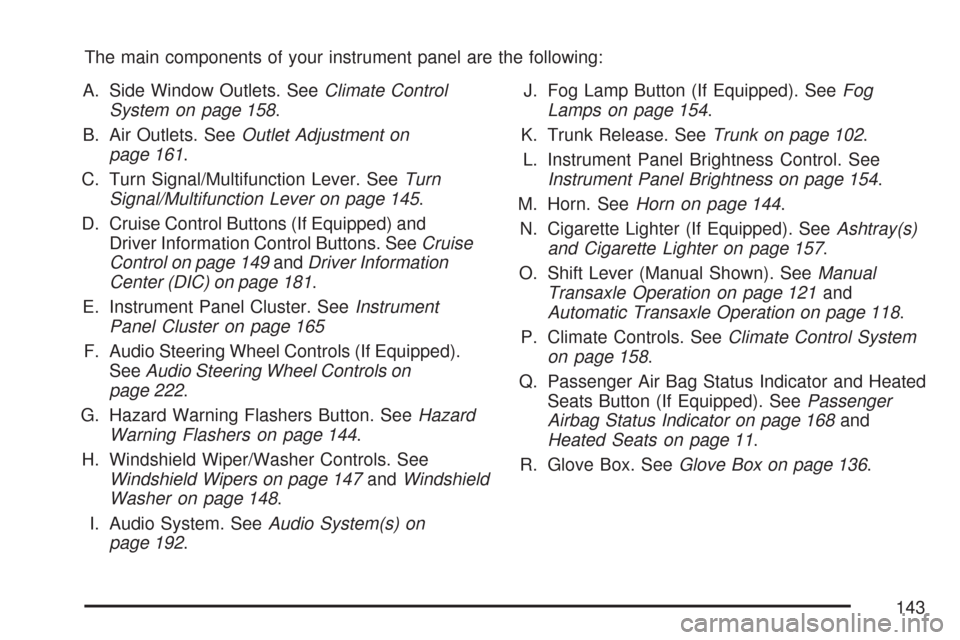
The main components of your instrument panel are the following:
A. Side Window Outlets. SeeClimate Control
System on page 158.
B. Air Outlets. SeeOutlet Adjustment on
page 161.
C. Turn Signal/Multifunction Lever. SeeTurn
Signal/Multifunction Lever on page 145.
D. Cruise Control Buttons (If Equipped) and
Driver Information Control Buttons. SeeCruise
Control on page 149andDriver Information
Center (DIC) on page 181.
E. Instrument Panel Cluster. SeeInstrument
Panel Cluster on page 165
F. Audio Steering Wheel Controls (If Equipped).
SeeAudio Steering Wheel Controls on
page 222.
G. Hazard Warning Flashers Button. SeeHazard
Warning Flashers on page 144.
H. Windshield Wiper/Washer Controls. See
Windshield Wipers on page 147andWindshield
Washer on page 148.
I. Audio System. SeeAudio System(s) on
page 192.J. Fog Lamp Button (If Equipped). SeeFog
Lamps on page 154.
K. Trunk Release. SeeTrunk on page 102.
L. Instrument Panel Brightness Control. See
Instrument Panel Brightness on page 154.
M. Horn. SeeHorn on page 144.
N. Cigarette Lighter (If Equipped). SeeAshtray(s)
and Cigarette Lighter on page 157.
O. Shift Lever (Manual Shown). SeeManual
Transaxle Operation on page 121and
Automatic Transaxle Operation on page 118.
P. Climate Controls. SeeClimate Control System
on page 158.
Q. Passenger Air Bag Status Indicator and Heated
Seats Button (If Equipped). SeePassenger
Airbag Status Indicator on page 168and
Heated Seats on page 11.
R. Glove Box. SeeGlove Box on page 136.
143