belt CHEVROLET COBALT 2007 1.G Workshop Manual
[x] Cancel search | Manufacturer: CHEVROLET, Model Year: 2007, Model line: COBALT, Model: CHEVROLET COBALT 2007 1.GPages: 450, PDF Size: 2.48 MB
Page 85 of 450
Replacing Restraint System Parts
After a Crash
{CAUTION:
A crash can damage the restraint systems
in your vehicle. A damaged restraint
system may not properly protect the
person using it, resulting in serious injury
or even death in a crash. To help make sure
your restraint systems are working
properly after a crash, have them inspected
and any necessary replacements made as
soon as possible.
If you have had a crash, do you need new belts or
LATCH system parts?
After a very minor collision, nothing may be
necessary. But if the belts were stretched, as they
would be if worn during a more severe crash,
then you need new parts.
If the LATCH system was being used during a
more severe crash, you may need new LATCH
system parts.If belts are cut or damaged, replace them.
Collision damage also may mean you will need to
have LATCH system, safety belt or seat parts
repaired or replaced. New parts and repairs may
be necessary even if the belt or LATCH system
was not being used at the time of the collision.
If an airbag inates, you will need to replace airbag
system parts. See the part on the airbag system
earlier in this section.
If the frontal airbags inate, you will also need to
replace the driver’s and right front passenger’s
safety belt assemblies. Be sure to do so. Then the
new assemblies will be there to help protect you
in a collision.
After a crash you may need to replace the driver
and front passenger’s safety belt assemblies,
even if the frontal airbags have not deployed.
The driver and front passenger’s safety belt
assemblies contain the safety belt pretensioners.
Have your safety belt pretensioners checked if
your vehicle has been in a collision, or if your
airbag readiness light stays on after you start your
vehicle or while you are driving. SeeAirbag
Readiness Light on page 167.
85
Page 98 of 450
Doors and Locks
Door Locks
{CAUTION:
Unlocked doors can be dangerous.
Passengers, especially children, can
easily open the doors and fall out of a
moving vehicle. When a door is locked,
the handle will not open it. You
increase the chance of being thrown
out of the vehicle in a crash if the doors
are not locked. So, wear safety belts
properly and lock the doors whenever
you drive.
Young children who get into unlocked
vehicles may be unable to get out.
A child can be overcome by extreme
heat and can suffer permanent injuries
or even death from heat stroke. Always
lock your vehicle whenever you
leave it.
CAUTION: (Continued)
CAUTION: (Continued)
Outsiders can easily enter through an
unlocked door when you slow down
or stop your vehicle. Locking your
doors can help prevent this from
happening.
There are several ways to lock and unlock your
vehicle.
To lock the driver’s door from the outside, turn the
key clockwise. To unlock the door, turn the key
counterclockwise.
You can also use the remote keyless entry
transmitter, if equipped, to lock and unlock the
doors.
From the inside, use the manual lock knobs on
each door or the power door lock switch to
lock and unlock all doors.
98
Page 139 of 450
Instrument Panel Overview........................ 142
Hazard Warning Flashers.......................... 144
Other Warning Devices............................. 144
Horn.......................................................... 144
Tilt Wheel.................................................. 145
Turn Signal/Multifunction Lever.................. 145
Turn and Lane-Change Signals................. 146
Headlamp High/Low-Beam Changer.......... 146
Flash-to-Pass............................................ 146
Windshield Wipers..................................... 147
Windshield Washer.................................... 148
Cruise Control........................................... 149
Headlamps................................................ 152
Wiper Activated Headlamps....................... 153
Headlamps on Reminder........................... 153
Daytime Running Lamps (DRL)................. 153
Fog Lamps................................................ 154
Instrument Panel Brightness...................... 154
Dome Lamp.............................................. 155
Entry/Exit Lighting...................................... 155
Mirror Reading Lamps............................... 155
Electric Power Management...................... 155
Battery Run-Down Protection..................... 156
Accessory Power Outlet(s)........................ 156
Ashtray(s) and Cigarette Lighter................ 157Climate Controls......................................... 158
Climate Control System............................. 158
Outlet Adjustment...................................... 161
Passenger Compartment Air Filter............. 162
Warning Lights, Gages, and Indicators..... 164
Instrument Panel Cluster........................... 165
Speedometer and Odometer...................... 166
Tachometer............................................... 166
Safety Belt Reminder Light........................ 166
Passenger Safety Belt Reminder Light....... 167
Airbag Readiness Light............................. 167
Passenger Airbag Status Indicator............. 168
Charging System Light.............................. 170
Up-Shift Light............................................ 171
Brake System Warning Light..................... 171
Anti-Lock Brake System Warning Light...... 172
Enhanced Traction System
Warning Light......................................... 173
Engine Coolant Temperature
Warning Light........................................ 174
Malfunction Indicator Lamp........................ 174
Oil Pressure Light..................................... 178
Security Light............................................ 179
Fog Lamp Light......................................... 179
Section 3 Instrument Panel
139
Page 166 of 450
Speedometer and Odometer
Your speedometer lets you see your speed
in both miles per hour (mph) and kilometers
per hour (km/h).
Your vehicle’s odometer works together with the
driver information center. You can set a Trip A and
Trip B odometer. See “Trip Information” under
DIC Operation and Displays on page 181.
The odometer mileage can be checked without
the vehicle running. Simply open the driver’s door
and the mileage will be displayed briey.
If your vehicle ever needs a new odometer
installed, the new one will be set to the correct
mileage total of the old odometer.
Tachometer
The tachometer displays the engine speed in
revolutions per minute (rpm).
Notice:If you operate the engine with the
tachometer in the shaded warning area, your
vehicle could be damaged, and the damages
would not be covered by your warranty.
Do not operate the engine with the tachometer
in the shaded warning area.
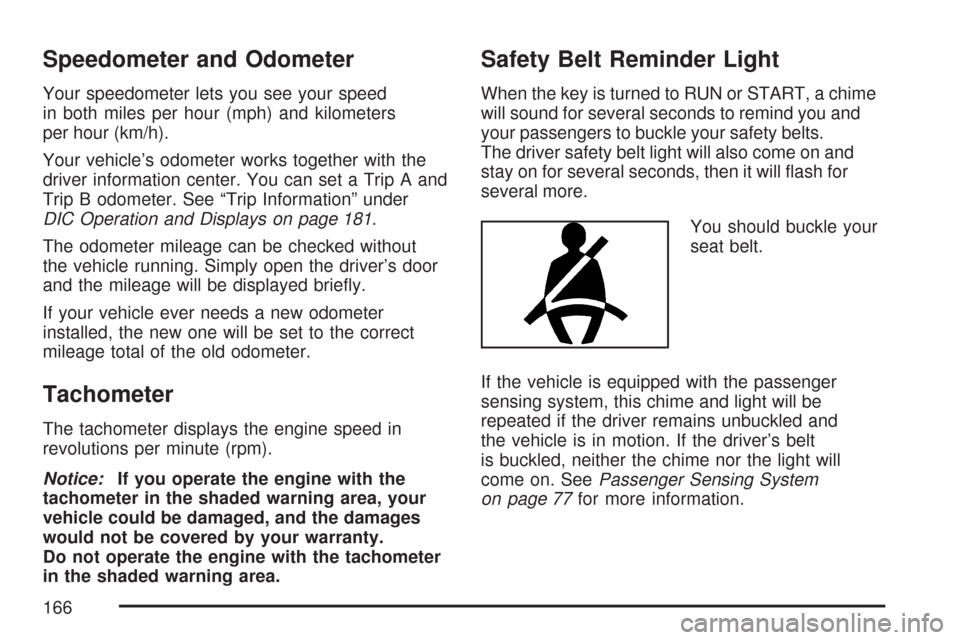
Safety Belt Reminder Light
When the key is turned to RUN or START, a chime
will sound for several seconds to remind you and
your passengers to buckle your safety belts.
The driver safety belt light will also come on and
stay on for several seconds, then it will ash for
several more.
You should buckle your
seat belt.
If the vehicle is equipped with the passenger
sensing system, this chime and light will be
repeated if the driver remains unbuckled and
the vehicle is in motion. If the driver’s belt
is buckled, neither the chime nor the light will
come on. SeePassenger Sensing System
on page 77for more information.
166
Page 167 of 450
Passenger Safety Belt
Reminder Light
If your vehicle has this feature, several seconds
after the key is turned to RUN or START, a chime
will sound for several seconds to remind the front
passenger to buckle their safety belt. This would
only occur if the passenger airbag is enabled. See
Passenger Sensing System on page 77for more
information. The passenger safety belt light will also
come on and stay on for several seconds, then it
will ash for several more.
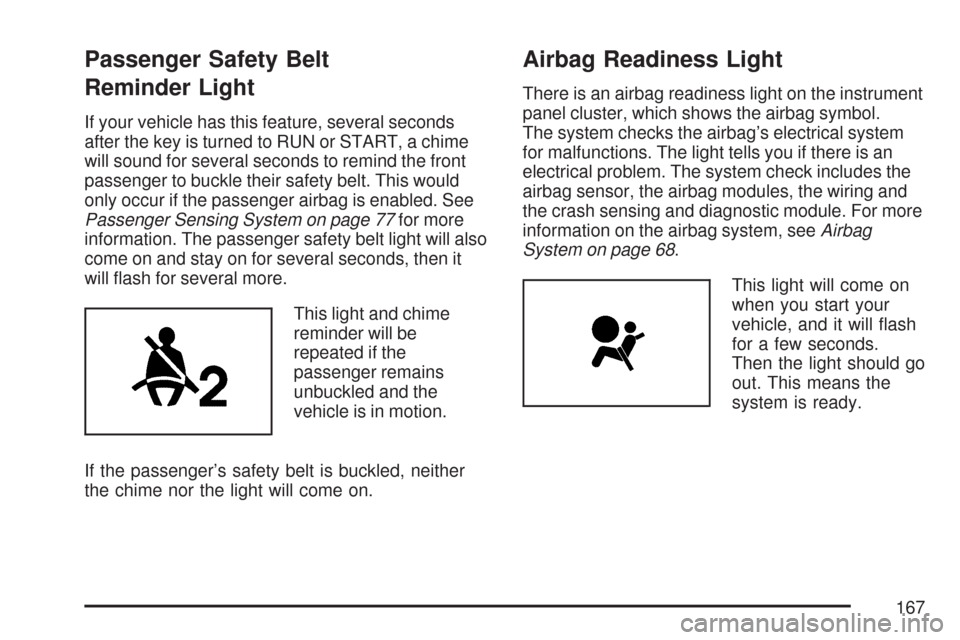
This light and chime
reminder will be
repeated if the
passenger remains
unbuckled and the
vehicle is in motion.
If the passenger’s safety belt is buckled, neither
the chime nor the light will come on.
Airbag Readiness Light
There is an airbag readiness light on the instrument
panel cluster, which shows the airbag symbol.
The system checks the airbag’s electrical system
for malfunctions. The light tells you if there is an
electrical problem. The system check includes the
airbag sensor, the airbag modules, the wiring and
the crash sensing and diagnostic module. For more
information on the airbag system, seeAirbag
System on page 68.
This light will come on
when you start your
vehicle, and it will ash
for a few seconds.
Then the light should go
out. This means the
system is ready.
167
Page 226 of 450
Your Driving, the Road, and
Your Vehicle
Defensive Driving
The best advice anyone can give about driving is:
Drive defensively.
Please start with a very important safety device in
your vehicle: Buckle up. SeeSafety Belts: They
Are for Everyone on page 18.
{CAUTION:
Defensive driving really means “Be ready
for anything.” On city streets, rural roads,
or expressways, it means “Always expect
the unexpected.” Assume that pedestrians
or other drivers are going to be careless
and make mistakes. Anticipate what they
might do and be ready. Rear-end collisions
are about the most preventable of
accidents. Yet they are common. Allow
enough following distance. Defensive
driving requires that a driver concentrate
on the driving task. Anything that distracts
from the driving task makes proper
defensive driving more difficult and can
even cause a collision, with resulting
injury. Ask a passenger to help do these
things, or pull off the road in a safe place to
do them. These simple defensive driving
techniques could save your life.
226
Page 238 of 450
Steering in Emergencies
There are times when steering can be more
effective than braking. For example, you come
over a hill and nd a truck stopped in your lane, or
a car suddenly pulls out from nowhere, or a
child darts out from between parked cars and
stops right in front of you. You can avoid these
problems by braking — if you can stop in time.
But sometimes you cannot; there is not room.
That is the time for evasive action — steering
around the problem.
Your vehicle can perform very well in emergencies
like these. First apply the brakes — but, unless
you have anti-lock brakes, not enough to lock the
wheels. SeeBraking on page 230. It is better
to remove as much speed as you can from
a possible collision. Then steer around the
problem, to the left or right depending on the
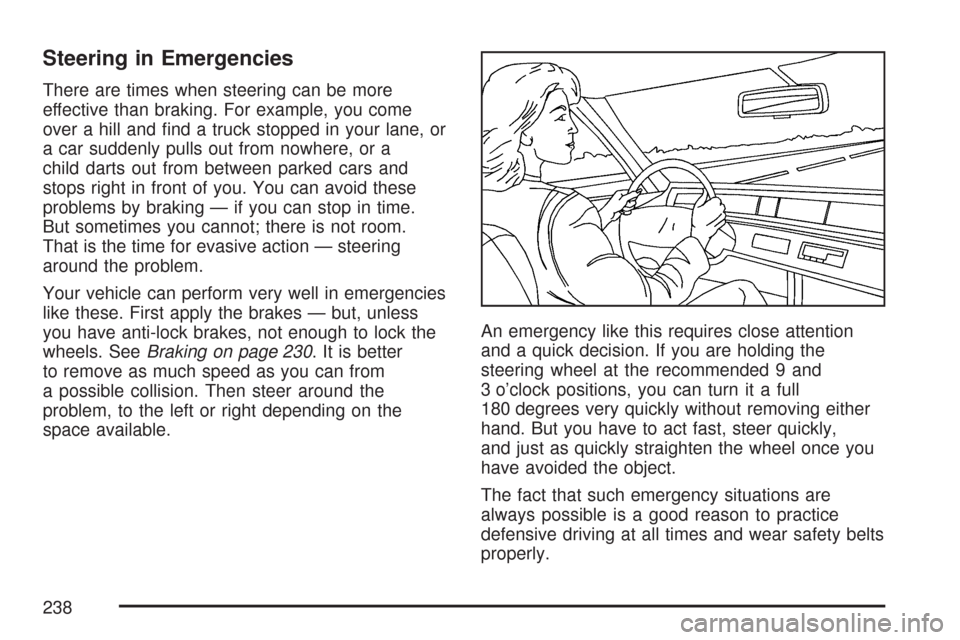
space available.An emergency like this requires close attention
and a quick decision. If you are holding the
steering wheel at the recommended 9 and
3 o’clock positions, you can turn it a full
180 degrees very quickly without removing either
hand. But you have to act fast, steer quickly,
and just as quickly straighten the wheel once you
have avoided the object.
The fact that such emergency situations are
always possible is a good reason to practice
defensive driving at all times and wear safety belts
properly.
238
Page 276 of 450
When You Are Ready to Leave After
Parking on a Hill
1. Apply your regular brakes and hold the pedal
down while you:
Start your engine.
Shift into a gear.
Release the parking brake.
2. Let up on the brake pedal.
3. Drive slowly until the trailer is clear of the
chocks.
4. Stop and have someone pick up and store
the chocks.
Maintenance When Trailer Towing
Your vehicle will need service more often when
you are pulling a trailer. SeeScheduled
Maintenance on page 396for more on this.
Things that are especially important in trailer
operation are transaxle uid (do not overll),
engine oil, drive belt, cooling system and brake
system.
Each of these is covered in this manual, and the
Index will help you nd them quickly. If you
are trailering, it is a good idea to review this
information before you start your trip.
Check periodically to see that all hitch nuts and
bolts are tight.
Engine Cooling When Trailer Towing
Your cooling system may temporarily overheat
during severe operating conditions. SeeEngine
Overheating on page 309.
276
Page 278 of 450
Windshield Wiper Blade Replacement....... 337
Tires............................................................ 338
Winter Tires.............................................. 339
Tire Sidewall Labeling............................... 340
Tire Terminology and Denitions............... 344
Ination - Tire Pressure............................. 347
High-Speed Operation............................... 349
Tire Inspection and Rotation...................... 349
When It Is Time for New Tires.................. 351
Buying New Tires...................................... 351
Different Size Tires and Wheels................ 353
Uniform Tire Quality Grading..................... 354
Wheel Alignment and Tire Balance............ 355
Wheel Replacement.................................. 355
Tire Chains............................................... 357
If a Tire Goes Flat.................................... 358
Changing a Flat Tire................................. 358
Removing the Spare Tire and Tools.......... 360
Removing the Flat Tire and Installing
the Spare Tire....................................... 364
Storing a Flat or Spare Tire and Tools...... 369
Compact Spare Tire.................................. 372Appearance Care........................................ 373
Cleaning the Inside of Your Vehicle.......... 373
Fabric/Carpet............................................. 374
Leather...................................................... 375
Instrument Panel, Vinyl, and Other
Plastic Surfaces..................................... 376
Care of Safety Belts.................................. 376
Weatherstrips............................................ 376
Washing Your Vehicle............................... 377
Cleaning Exterior Lamps/Lenses................ 377
Finish Care............................................... 377
Windshield and Wiper Blades.................... 378
Aluminum or Chrome-Plated
Wheels and Trim................................... 378
Tires......................................................... 379
Sheet Metal Damage................................. 380
Finish Damage.......................................... 380
Underbody Maintenance............................ 380
Chemical Paint Spotting............................ 381
Vehicle Care/Appearance Materials............ 381
Vehicle Identication.................................. 382
Vehicle Identication Number (VIN)........... 382
Service Parts Identication Label............... 382
Section 5 Service and Appearance Care
278
Page 343 of 450
(G) TPC Spec (Tire Performance Criteria
Specication):Original equipment tires designed
to GM’s specic tire performance criteria have
a TPC specication code molded onto the sidewall.
GM’s TPC specications meet or exceed all
federal safety guidelines.
Tire Size
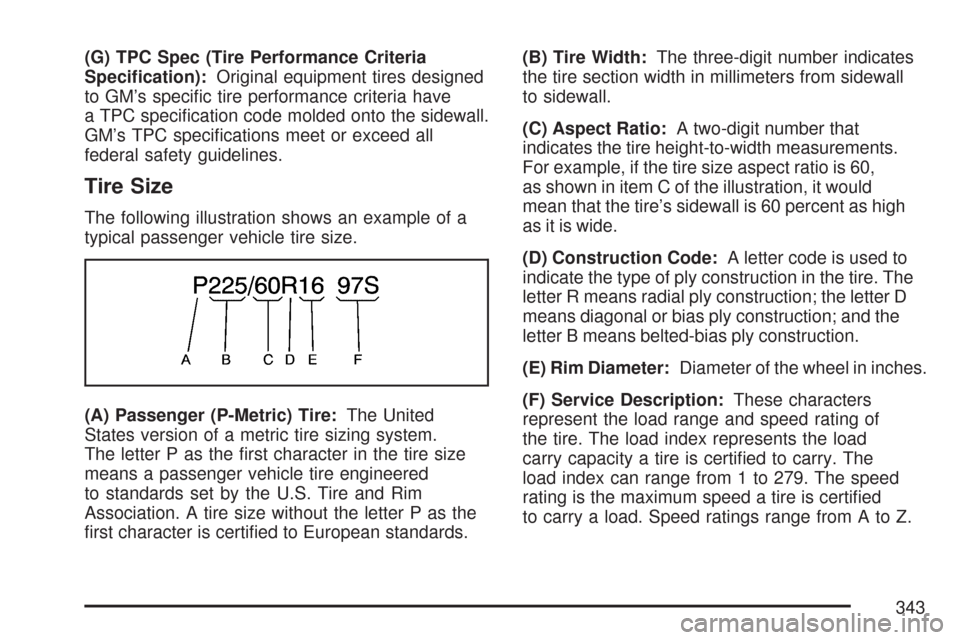
The following illustration shows an example of a
typical passenger vehicle tire size.
(A) Passenger (P-Metric) Tire:The United
States version of a metric tire sizing system.
The letter P as the rst character in the tire size
means a passenger vehicle tire engineered
to standards set by the U.S. Tire and Rim
Association. A tire size without the letter P as the
rst character is certied to European standards.(B) Tire Width:The three-digit number indicates
the tire section width in millimeters from sidewall
to sidewall.
(C) Aspect Ratio:A two-digit number that
indicates the tire height-to-width measurements.
For example, if the tire size aspect ratio is 60,
as shown in item C of the illustration, it would
mean that the tire’s sidewall is 60 percent as high
as it is wide.
(D) Construction Code:A letter code is used to
indicate the type of ply construction in the tire. The
letter R means radial ply construction; the letter D
means diagonal or bias ply construction; and the
letter B means belted-bias ply construction.
(E) Rim Diameter:Diameter of the wheel in inches.
(F) Service Description:These characters
represent the load range and speed rating of
the tire. The load index represents the load
carry capacity a tire is certied to carry. The
load index can range from 1 to 279. The speed
rating is the maximum speed a tire is certied
to carry a load. Speed ratings range from A to Z.
343