deactivate CHEVROLET COLORADO 2006 1.G Owners Manual
[x] Cancel search | Manufacturer: CHEVROLET, Model Year: 2006, Model line: COLORADO, Model: CHEVROLET COLORADO 2006 1.GPages: 434, PDF Size: 2.57 MB
Page 79 of 434
Airbags should never be regarded as anything more
than a supplement to safety belts, and then only in
moderate to severe frontal or near-frontal collisions for
the driver’s and right front passenger’s frontal airbags,
and only in moderate to severe side collisions for side
impact airbags.
What Will You See After an
Airbag Inates?
After a frontal airbag inates, it quickly deates,
so quickly that some people may not even realize the
airbag inated. Roof-mounted side impact airbags
deate more slowly and may still be at least partially
inated minutes after the vehicle comes to rest.
Some components of the airbag module — the steering
wheel hub for the driver’s airbag, the instrument
panel for the right front passenger’s airbag or the
ceiling of your vehicle near the side windows — may
be hot for a short time. The parts of the airbag that
come into contact with you may be warm, but not too
hot to touch. There will be some smoke and dust coming
from the vents in the deated airbags. Airbag ination
does not prevent the driver from seeing out of the
front windshield or being able to steer the vehicle,
nor does it stop people from leaving the vehicle.
{CAUTION:
When an airbag inates, there is dust in the
air. This dust could cause breathing problems
for people with a history of asthma or other
breathing trouble. To avoid this, everyone in
the vehicle should get out as soon as it is
safe to do so. If you have breathing problems
but cannot get out of the vehicle after an
airbag inates, then get fresh air by opening a
window or a door. If you experience breathing
problems following an airbag deployment,
you should seek medical attention.
Your vehicle has a feature that may automatically
unlock the doors (if equipped with power door locks),
turn the interior lamps on, ash the hazard warning
ashers, and turn off the radio when the airbag inates
(if battery power is available). You can lock the doors
again by using the door lock. The interior lamps
and hazard warning ashers will deactivate after
approximately 15 minutes. You can use the radio
controls to adjust the radio.
1-73
Page 118 of 434
Parking Brake
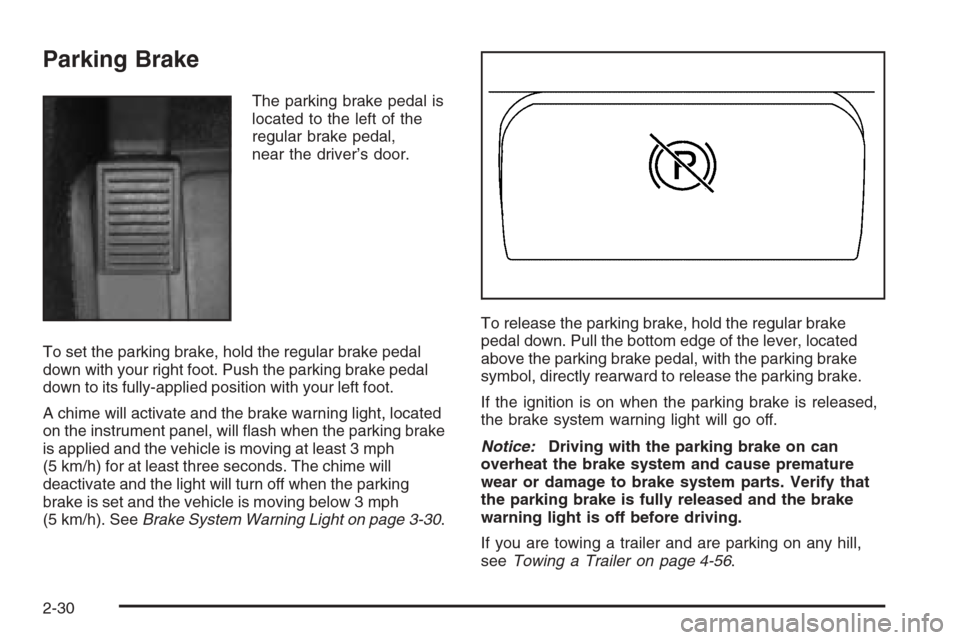
The parking brake pedal is
located to the left of the
regular brake pedal,
near the driver’s door.
To set the parking brake, hold the regular brake pedal
down with your right foot. Push the parking brake pedal
down to its fully-applied position with your left foot.
A chime will activate and the brake warning light, located
on the instrument panel, will ash when the parking brake
is applied and the vehicle is moving at least 3 mph
(5 km/h) for at least three seconds. The chime will
deactivate and the light will turn off when the parking
brake is set and the vehicle is moving below 3 mph
(5 km/h). SeeBrake System Warning Light on page 3-30.To release the parking brake, hold the regular brake
pedal down. Pull the bottom edge of the lever, located
above the parking brake pedal, with the parking brake
symbol, directly rearward to release the parking brake.
If the ignition is on when the parking brake is released,
the brake system warning light will go off.
Notice:Driving with the parking brake on can
overheat the brake system and cause premature
wear or damage to brake system parts. Verify that
the parking brake is fully released and the brake
warning light is off before driving.
If you are towing a trailer and are parking on any hill,
seeTowing a Trailer on page 4-56.
2-30