fog light CHEVROLET COLORADO 2006 1.G Owners Manual
[x] Cancel search | Manufacturer: CHEVROLET, Model Year: 2006, Model line: COLORADO, Model: CHEVROLET COLORADO 2006 1.GPages: 434, PDF Size: 2.57 MB
Page 135 of 434
Instrument Panel Overview...............................3-4
Hazard Warning Flashers................................3-6
Other Warning Devices...................................3-6
Horn .............................................................3-6
Tilt Wheel.....................................................3-7
Turn Signal/Multifunction Lever.........................3-7
Turn and Lane-Change Signals........................3-8
Headlamp High/Low-Beam Changer..................3-9
Flash-to-Pass.................................................3-9
Windshield Wipers..........................................3-9
Windshield Washer.......................................3-10
Cruise Control..............................................3-11
Exterior Lamps.............................................3-14
Headlamps on Reminder................................3-15
Daytime Running Lamps (DRL).......................3-15
Automatic Headlamp System..........................3-15
Fog Lamps ..................................................3-16
Exterior Cargo Lamps....................................3-17
Interior Lamps..............................................3-17
Instrument Panel Brightness...........................3-17
Dome Lamp .................................................3-17
Dome Lamp Override....................................3-17
Exit Lighting.................................................3-18
Battery Run-Down Protection..........................3-18
Accessory Power Outlet(s).............................3-18
Ashtray(s) and Cigarette Lighter......................3-19Climate Controls............................................3-19
Climate Control System.................................3-19
Outlet Adjustment.........................................3-21
Warning Lights, Gages,
and Indicators.............................................3-22
Instrument Panel Cluster................................3-23
Speedometer and Odometer...........................3-24
Trip Odometer..............................................3-24
Tachometer.................................................3-24
Safety Belt Reminder Light.............................3-25
Passenger Safety Belt Reminder Light.............3-25
Airbag Readiness Light..................................3-26
Passenger Airbag Status Indicator...................3-27
Battery Warning Light....................................3-29
Up-Shift Light (Manual Transmission)...............3-30
Brake System Warning Light..........................3-30
Anti-Lock Brake System Warning Light.............3-31
Engine Coolant Temperature Gage..................3-32
Malfunction Indicator Lamp.............................3-32
Oil Pressure Light.........................................3-35
Security Light...............................................3-36
Cruise Control Light......................................3-36
Highbeam On Light.......................................3-36
Daytime Running Lamps (DRL) Indicator
Light........................................................3-37
Fuel Gage...................................................3-37
Section 3 Instrument Panel
3-1
Page 139 of 434
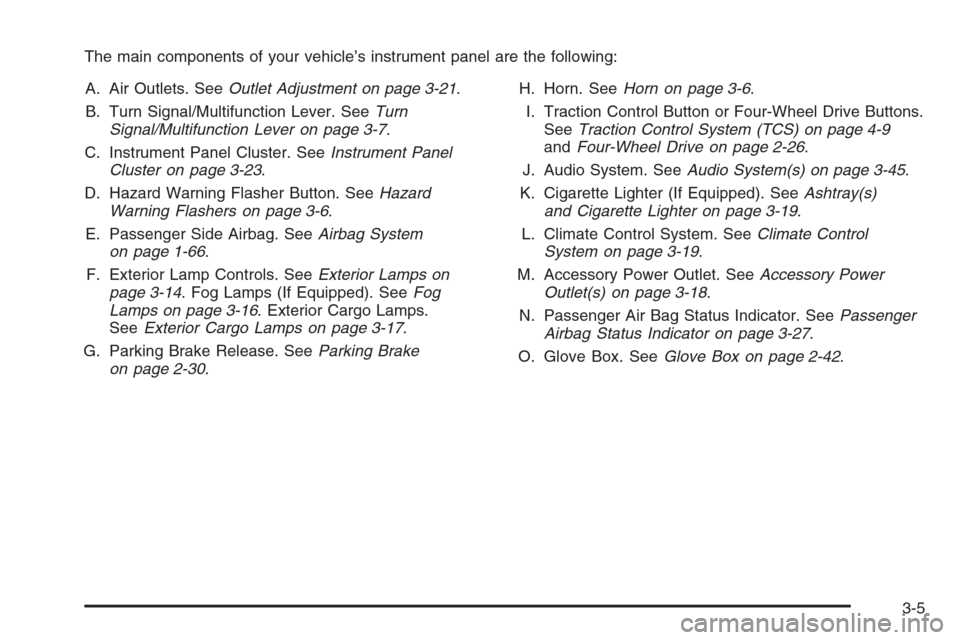
The main components of your vehicle’s instrument panel are the following:
A. Air Outlets. SeeOutlet Adjustment on page 3-21.
B. Turn Signal/Multifunction Lever. SeeTurn
Signal/Multifunction Lever on page 3-7.
C. Instrument Panel Cluster. SeeInstrument Panel
Cluster on page 3-23.
D. Hazard Warning Flasher Button. SeeHazard
Warning Flashers on page 3-6.
E. Passenger Side Airbag. SeeAirbag System
on page 1-66.
F. Exterior Lamp Controls. SeeExterior Lamps on
page 3-14. Fog Lamps (If Equipped). SeeFog
Lamps on page 3-16. Exterior Cargo Lamps.
SeeExterior Cargo Lamps on page 3-17.
G. Parking Brake Release. SeeParking Brake
on page 2-30.H. Horn. SeeHorn on page 3-6.
I. Traction Control Button or Four-Wheel Drive Buttons.
SeeTraction Control System (TCS) on page 4-9
andFour-Wheel Drive on page 2-26.
J. Audio System. SeeAudio System(s) on page 3-45.
K. Cigarette Lighter (If Equipped). SeeAshtray(s)
and Cigarette Lighter on page 3-19.
L. Climate Control System. SeeClimate Control
System on page 3-19.
M. Accessory Power Outlet. SeeAccessory Power
Outlet(s) on page 3-18.
N. Passenger Air Bag Status Indicator. SeePassenger
Airbag Status Indicator on page 3-27.
O. Glove Box. SeeGlove Box on page 2-42.
3-5
Page 150 of 434
There is a delay in the transition between the daytime
and nighttime operation of the Daytime Running
Lamps (DRL) and the automatic headlamp system so
that driving under bridges or bright overhead street lights
does not affect the system. The DRL and automatic
headlamp system will only be affected when the
light sensor sees a change in lighting lasting longer
than the delay.
If you start your vehicle in a dark garage, the automatic
headlamp system will come on immediately. Once
you leave the garage, it will take approximately
one minute for the automatic headlamp system to
change to DRL if it is light outside. During that delay,
your instrument panel cluster may not be as bright
as usual. Make sure your instrument panel brightness
control is in the full bright position. SeeInstrument
Panel Brightness on page 3-17.Fog Lamps
If your vehicle has fog lamps, you can use them for
better vision in foggy or misty conditions. Your parking
lamps and/or low-beam headlamps must be on for
your fog lamps to work.
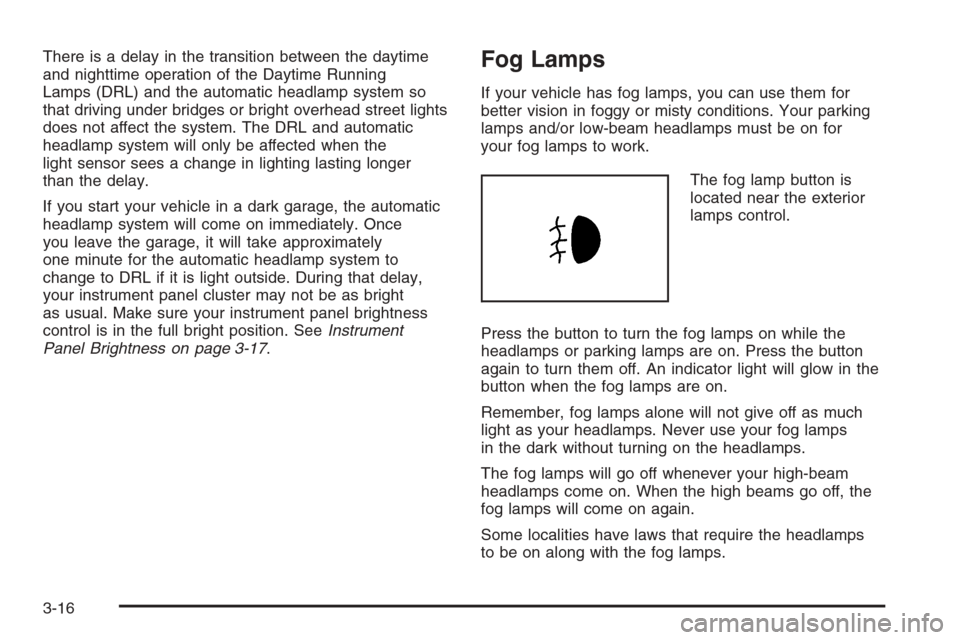
The fog lamp button is
located near the exterior
lamps control.
Press the button to turn the fog lamps on while the
headlamps or parking lamps are on. Press the button
again to turn them off. An indicator light will glow in the
button when the fog lamps are on.
Remember, fog lamps alone will not give off as much
light as your headlamps. Never use your fog lamps
in the dark without turning on the headlamps.
The fog lamps will go off whenever your high-beam
headlamps come on. When the high beams go off, the
fog lamps will come on again.
Some localities have laws that require the headlamps
to be on along with the fog lamps.
3-16
Page 154 of 434
Fan Knob
9
(Fan):The center knob on the control panel is used
to control the fan speed. Turn the knob clockwise or
counterclockwise to increase or decrease the fan speed.
If the knob is set on “0” (zero), some outside air will
still enter the vehicle and will be directed according to
the position of the mode knob.
Mode Knob
The right knob on the control panel is used to direct
the airow inside your vehicle. Turn the knob to select
one of the following modes:
H(Vent):Select this mode to direct air to the
instrument panel outlets.
\(Bi-Level):Select this mode to direct approximately
half of the air to the instrument panel outlets, and the
remaining air to the oor outlets and the defroster
and side window outlets. Cooler air is directed to the
upper outlets and warmer air to the oor outlets.
[(Floor):Select this mode to direct air to the oor
outlets. Recirculation is disabled in this mode because
interior window could fog under some conditions. If
this occurs, see “Defogging and Defrosting” following.
Mode Buttons
@
(Recirculation):If your vehicle has air
conditioning, you will have the recirculation feature.
This mode recirculates air inside the cabin, and prevents
outside air from coming in the vehicle. It can be used
to prevent outside odors from entering your vehicle
and cool the air inside your vehicle more quickly.
Press this button to turn the recirculation mode on or
off. An indicator light on the button will come on to
let you know the recirculation mode is activated.
Recirculation is only available in the bi-level and vent
modes. It should only be used while in bi-level and vent
modes. Recirculation is not available, and the light
will not come on or ash while in heat, oor, oor/defog,
or defrost modes.
#(Air Conditioning):Your vehicle may have air
conditioning. Press this button to turn the air-conditioning
system on or off. An indicator light on the button will come
on to let you know the air conditioning is activated. When
the system is on, this setting cools and dehumidies the
air entering your vehicle.
The air conditioning will not function if the fan is
turned off.
3-20
Page 155 of 434
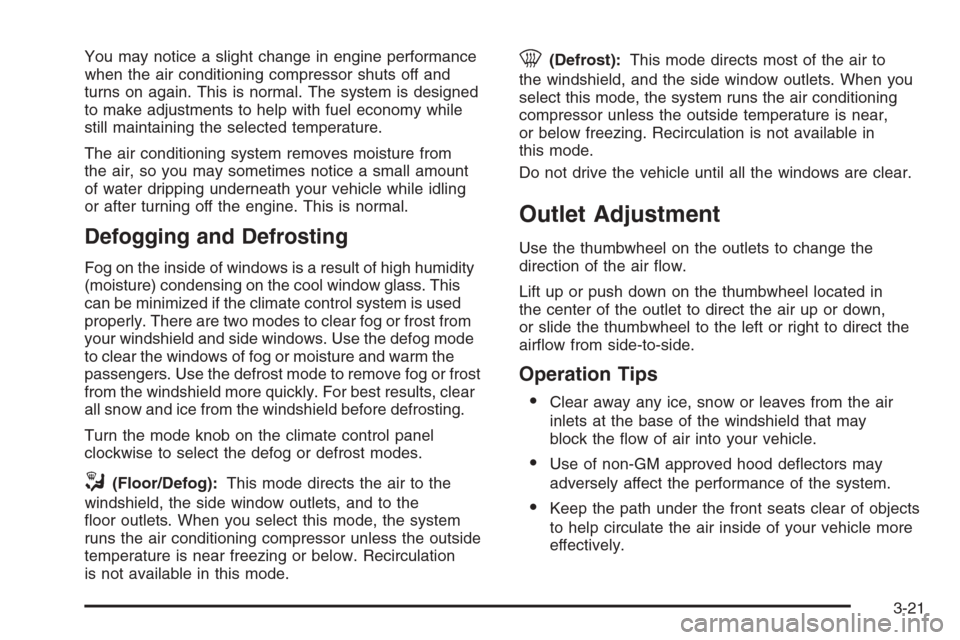
You may notice a slight change in engine performance
when the air conditioning compressor shuts off and
turns on again. This is normal. The system is designed
to make adjustments to help with fuel economy while
still maintaining the selected temperature.
The air conditioning system removes moisture from
the air, so you may sometimes notice a small amount
of water dripping underneath your vehicle while idling
or after turning off the engine. This is normal.
Defogging and Defrosting
Fog on the inside of windows is a result of high humidity
(moisture) condensing on the cool window glass. This
can be minimized if the climate control system is used
properly. There are two modes to clear fog or frost from
your windshield and side windows. Use the defog mode
to clear the windows of fog or moisture and warm the
passengers. Use the defrost mode to remove fog or frost
from the windshield more quickly. For best results, clear
all snow and ice from the windshield before defrosting.
Turn the mode knob on the climate control panel
clockwise to select the defog or defrost modes.
/(Floor/Defog):This mode directs the air to the
windshield, the side window outlets, and to the
oor outlets. When you select this mode, the system
runs the air conditioning compressor unless the outside
temperature is near freezing or below. Recirculation
is not available in this mode.
0(Defrost):This mode directs most of the air to
the windshield, and the side window outlets. When you
select this mode, the system runs the air conditioning
compressor unless the outside temperature is near,
or below freezing. Recirculation is not available in
this mode.
Do not drive the vehicle until all the windows are clear.
Outlet Adjustment
Use the thumbwheel on the outlets to change the
direction of the air ow.
Lift up or push down on the thumbwheel located in
the center of the outlet to direct the air up or down,
or slide the thumbwheel to the left or right to direct the
airow from side-to-side.
Operation Tips
Clear away any ice, snow or leaves from the air
inlets at the base of the windshield that may
block the ow of air into your vehicle.
Use of non-GM approved hood deectors may
adversely affect the performance of the system.
Keep the path under the front seats clear of objects
to help circulate the air inside of your vehicle more
effectively.
3-21
Page 383 of 434
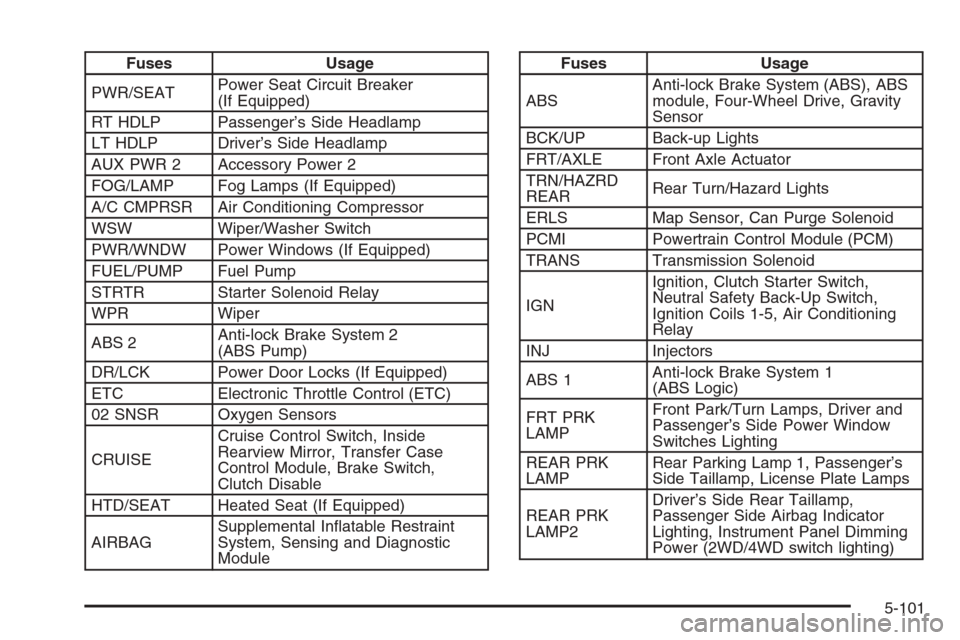
Fuses Usage
PWR/SEATPower Seat Circuit Breaker
(If Equipped)
RT HDLP Passenger’s Side Headlamp
LT HDLP Driver’s Side Headlamp
AUX PWR 2 Accessory Power 2
FOG/LAMP Fog Lamps (If Equipped)
A/C CMPRSR Air Conditioning Compressor
WSW Wiper/Washer Switch
PWR/WNDW Power Windows (If Equipped)
FUEL/PUMP Fuel Pump
STRTR Starter Solenoid Relay
WPR Wiper
ABS 2Anti-lock Brake System 2
(ABS Pump)
DR/LCK Power Door Locks (If Equipped)
ETC Electronic Throttle Control (ETC)
02 SNSR Oxygen Sensors
CRUISECruise Control Switch, Inside
Rearview Mirror, Transfer Case
Control Module, Brake Switch,
Clutch Disable
HTD/SEAT Heated Seat (If Equipped)
AIRBAGSupplemental Inatable Restraint
System, Sensing and Diagnostic
ModuleFuses Usage
ABSAnti-lock Brake System (ABS), ABS
module, Four-Wheel Drive, Gravity
Sensor
BCK/UP Back-up Lights
FRT/AXLE Front Axle Actuator
TRN/HAZRD
REARRear Turn/Hazard Lights
ERLS Map Sensor, Can Purge Solenoid
PCMI Powertrain Control Module (PCM)
TRANS Transmission Solenoid
IGNIgnition, Clutch Starter Switch,
Neutral Safety Back-Up Switch,
Ignition Coils 1-5, Air Conditioning
Relay
INJ Injectors
ABS 1Anti-lock Brake System 1
(ABS Logic)
FRT PRK
LAMPFront Park/Turn Lamps, Driver and
Passenger’s Side Power Window
Switches Lighting
REAR PRK
LAMPRear Parking Lamp 1, Passenger’s
Side Taillamp, License Plate Lamps
REAR PRK
LAMP2Driver’s Side Rear Taillamp,
Passenger Side Airbag Indicator
Lighting, Instrument Panel Dimming
Power (2WD/4WD switch lighting)
5-101
Page 384 of 434
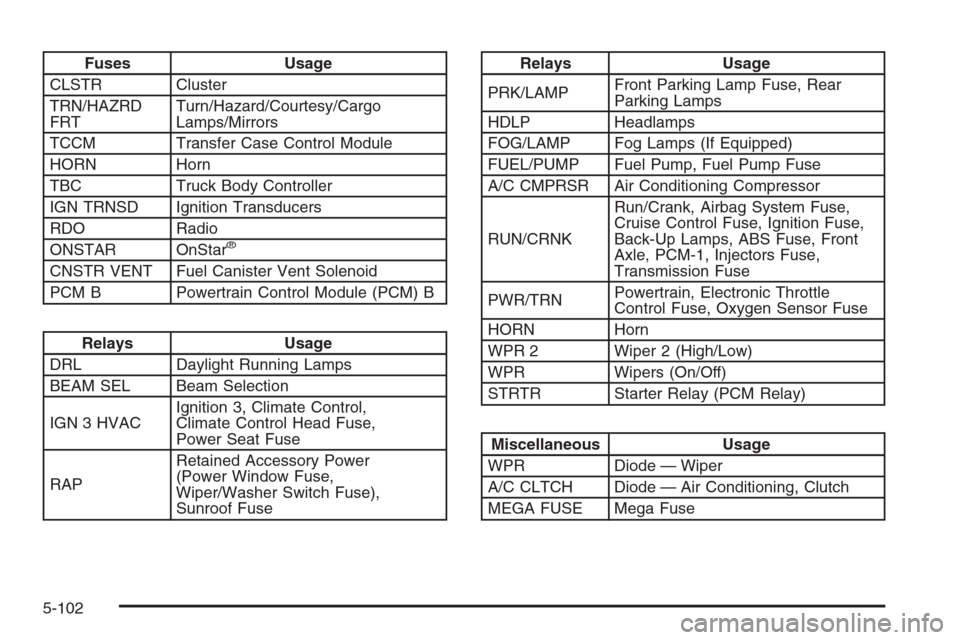
Fuses Usage
CLSTR Cluster
TRN/HAZRD
FRTTurn/Hazard/Courtesy/Cargo
Lamps/Mirrors
TCCM Transfer Case Control Module
HORN Horn
TBC Truck Body Controller
IGN TRNSD Ignition Transducers
RDO Radio
ONSTAR OnStar
®
CNSTR VENT Fuel Canister Vent Solenoid
PCM B Powertrain Control Module (PCM) B
Relays Usage
DRL Daylight Running Lamps
BEAM SEL Beam Selection
IGN 3 HVACIgnition 3, Climate Control,
Climate Control Head Fuse,
Power Seat Fuse
RAPRetained Accessory Power
(Power Window Fuse,
Wiper/Washer Switch Fuse),
Sunroof Fuse
Relays Usage
PRK/LAMPFront Parking Lamp Fuse, Rear
Parking Lamps
HDLP Headlamps
FOG/LAMP Fog Lamps (If Equipped)
FUEL/PUMP Fuel Pump, Fuel Pump Fuse
A/C CMPRSR Air Conditioning Compressor
RUN/CRNKRun/Crank, Airbag System Fuse,
Cruise Control Fuse, Ignition Fuse,
Back-Up Lamps, ABS Fuse, Front
Axle, PCM-1, Injectors Fuse,
Transmission Fuse
PWR/TRNPowertrain, Electronic Throttle
Control Fuse, Oxygen Sensor Fuse
HORN Horn
WPR 2 Wiper 2 (High/Low)
WPR Wipers (On/Off)
STRTR Starter Relay (PCM Relay)
Miscellaneous Usage
WPR Diode — Wiper
A/C CLTCH Diode — Air Conditioning, Clutch
MEGA FUSE Mega Fuse
5-102
Page 425 of 434
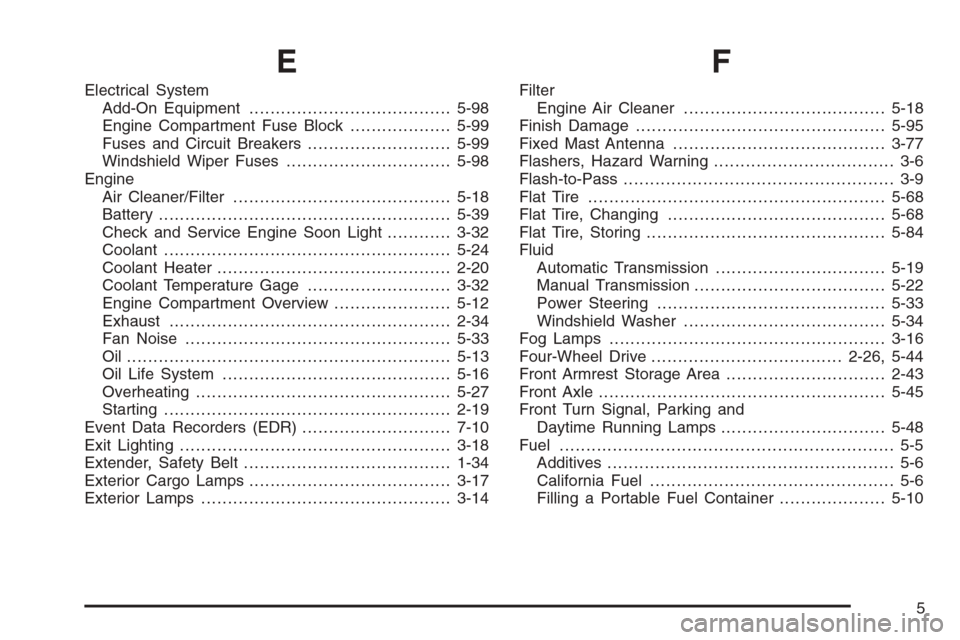
E
Electrical System
Add-On Equipment......................................5-98
Engine Compartment Fuse Block...................5-99
Fuses and Circuit Breakers...........................5-99
Windshield Wiper Fuses...............................5-98
Engine
Air Cleaner/Filter.........................................5-18
Battery.......................................................5-39
Check and Service Engine Soon Light............3-32
Coolant......................................................5-24
Coolant Heater............................................2-20
Coolant Temperature Gage...........................3-32
Engine Compartment Overview......................5-12
Exhaust.....................................................2-34
Fan Noise..................................................5-33
Oil .............................................................5-13
Oil Life System...........................................5-16
Overheating................................................5-27
Starting......................................................2-19
Event Data Recorders (EDR)............................7-10
Exit Lighting...................................................3-18
Extender, Safety Belt.......................................1-34
Exterior Cargo Lamps......................................3-17
Exterior Lamps...............................................3-14
F
Filter
Engine Air Cleaner......................................5-18
Finish Damage...............................................5-95
Fixed Mast Antenna........................................3-77
Flashers, Hazard Warning.................................. 3-6
Flash-to-Pass................................................... 3-9
Flat Tire........................................................5-68
Flat Tire, Changing.........................................5-68
Flat Tire, Storing.............................................5-84
Fluid
Automatic Transmission................................5-19
Manual Transmission....................................5-22
Power Steering...........................................5-33
Windshield Washer......................................5-34
Fog Lamps ....................................................3-16
Four-Wheel Drive....................................2-26, 5-44
Front Armrest Storage Area..............................2-43
Front Axle......................................................5-45
Front Turn Signal, Parking and
Daytime Running Lamps...............................5-48
Fuel............................................................... 5-5
Additives...................................................... 5-6
California Fuel.............................................. 5-6
Filling a Portable Fuel Container....................5-10
5
Page 427 of 434
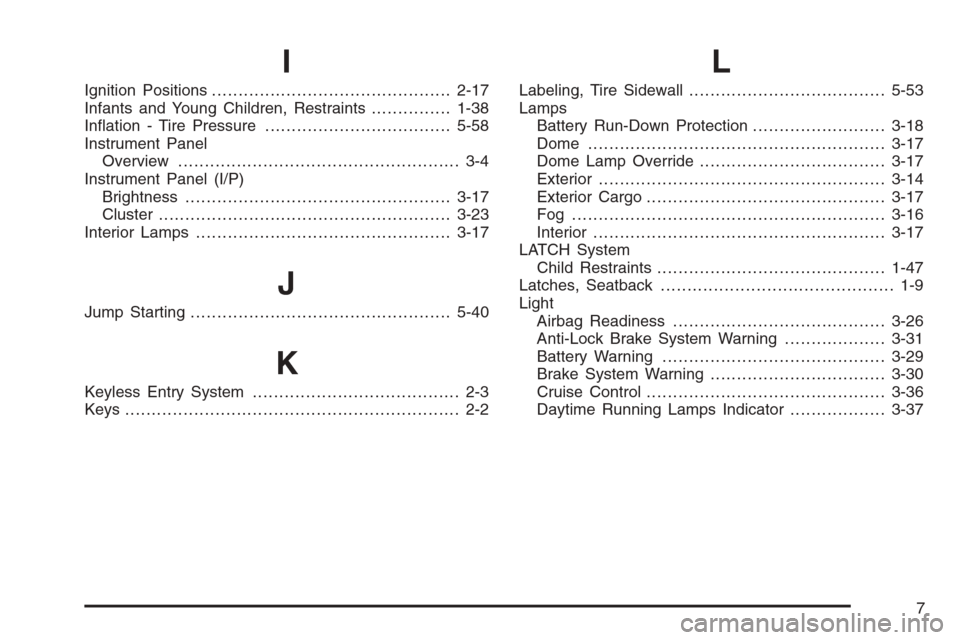
I
Ignition Positions.............................................2-17
Infants and Young Children, Restraints...............1-38
Ination - Tire Pressure...................................5-58
Instrument Panel
Overview..................................................... 3-4
Instrument Panel (I/P)
Brightness..................................................3-17
Cluster.......................................................3-23
Interior Lamps................................................3-17
J
Jump Starting.................................................5-40
K
Keyless Entry System....................................... 2-3
Keys............................................................... 2-2
L
Labeling, Tire Sidewall.....................................5-53
Lamps
Battery Run-Down Protection.........................3-18
Dome ........................................................3-17
Dome Lamp Override...................................3-17
Exterior......................................................3-14
Exterior Cargo.............................................3-17
Fog ...........................................................3-16
Interior.......................................................3-17
LATCH System
Child Restraints...........................................1-47
Latches, Seatback............................................ 1-9
Light
Airbag Readiness........................................3-26
Anti-Lock Brake System Warning...................3-31
Battery Warning..........................................3-29
Brake System Warning.................................3-30
Cruise Control.............................................3-36
Daytime Running Lamps Indicator..................3-37
7