traction control CHEVROLET COLORADO 2011 1.G Owner's Manual
[x] Cancel search | Manufacturer: CHEVROLET, Model Year: 2011, Model line: COLORADO, Model: CHEVROLET COLORADO 2011 1.GPages: 392, PDF Size: 6.37 MB
Page 222 of 392
Black plate (48,1)Chevrolet Colorado Owner Manual - 2011
9-48 Driving and Operating
portion of traction control will work.
The engine speed management will
be disabled. In this mode, engine
power is not reduced automatically
and the drive wheels can spin more
freely. This can cause the
brake-traction control to activate
constantly. SeeIf the Vehicle is
Stuck on page 9‑19.
The StabiliTrak/TCS light will flash
on the instrument panel cluster
when the TCS system or StabiliTrak
is both on and activated.
The StabiliTrak/TCS button is
located on the instrument panel.
To turn off TCS, press and release
the StabiliTrak/TCS button. The
StabiliTrak/TCS light comes on in
the instrument panel cluster, and
TRAC OFF comes on the DIC. To
turn TCS back on, press and
release the StabiliTrak/TCS button.
To turn off TCS and StabiliTrak,
press and hold the StabiliTrak/TCS
button until the TRAC OFF and
STAB SYS OFF messages come on
the DIC and the StabiliTrak/TCS
light comes on the instrument panel.
To turn TCS and StabiliTrak back
on, press and release the
StabiliTrak/TCS button. When the TCS or StabiliTrak system
is turned off, the StabiliTrak/TCS
light and the appropriate TRAC OFF
or STAB SYS OFF message will be
displayed on the DIC. The vehicle
will still have brake-traction control
when TCS or StabiliTrak is off, but
will not be able to use the engine
speed management system. The
StabiliTrak/TCS light flashes when
either system is actively working.
See
Traction Control System (TCS)
on page 9‑46 for more information.
Limited-Slip Rear Axle
Vehicles with a limited-slip rear axle
can give more traction on snow,
mud, ice, sand or gravel. It works
like a standard axle most of the
time, but when traction is low, this
feature allows the drive wheel with
the most traction to move the
vehicle.
Page 223 of 392
Black plate (49,1)Chevrolet Colorado Owner Manual - 2011
Driving and Operating 9-49
Cruise Control
With cruise control, a speed of
about 40 km/h (25 mph) or more can
be maintained without keeping your
foot on the accelerator. Cruise
control does not work at speeds
below about 40 km/h (25 mph).
If the brakes are applied, the cruise
control shuts off.
{WARNING
Cruise control can be dangerous
where you cannot drive safely at
a steady speed. So, do not use
the cruise control on winding
roads or in heavy traffic.
Cruise control can be dangerous
on slippery roads. On such roads,
fast changes in tire traction can
cause excessive wheel slip, and
you could lose control. Do not use
cruise control on slippery roads.If the vehicle's StabiliTrak
®/Traction
Control System (TCS) begins to limit
wheel spin while the cruise control
is on, the cruise control
automatically disengages. See
StabiliTrak
®System on page 9‑47 or
Traction Control System (TCS) on
page 9‑46. When road conditions
allow you to safely use it again, the
cruise control can be turned
back on.
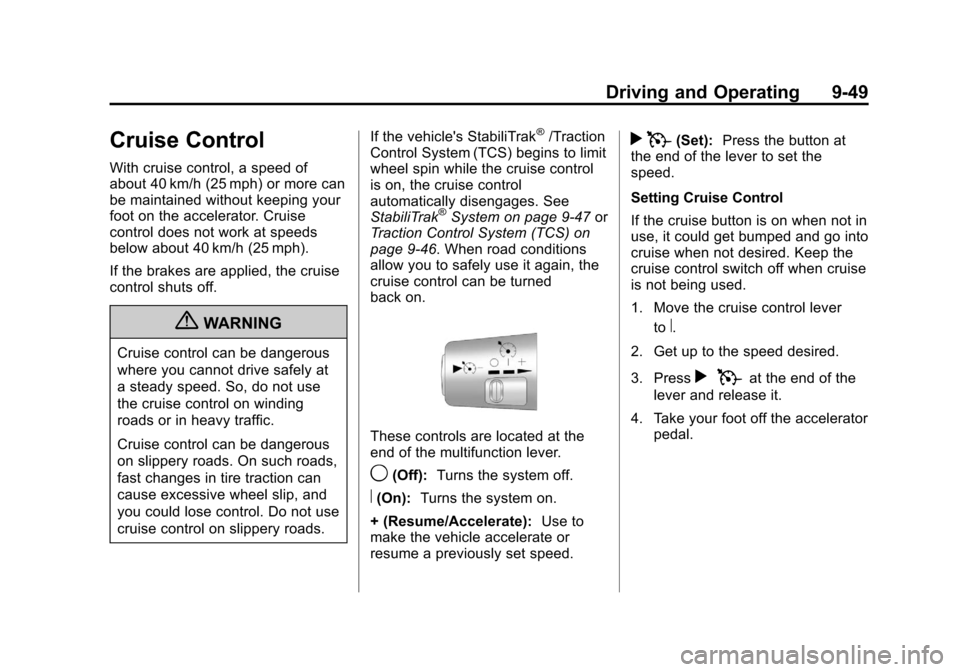
These controls are located at the
end of the multifunction lever.
9(Off): Turns the system off.
R(On):Turns the system on.
+ (Resume/Accelerate): Use to
make the vehicle accelerate or
resume a previously set speed.
r T(Set): Press the button at
the end of the lever to set the
speed.
Setting Cruise Control
If the cruise button is on when not in
use, it could get bumped and go into
cruise when not desired. Keep the
cruise control switch off when cruise
is not being used.
1. Move the cruise control lever
to
R.
2. Get up to the speed desired.
3. Press
r Tat the end of the
lever and release it.
4. Take your foot off the accelerator pedal.
Page 244 of 392
Black plate (4,1)Chevrolet Colorado Owner Manual - 2011
10-4 Vehicle Care
Accessories and
Modifications
Adding non‐dealer accessories to
the vehicle can affect vehicle
performance and safety, including
such things as airbags, braking,
stability, ride and handling,
emissions systems, aerodynamics,
durability, and electronic systems
like antilock brakes, traction control,
and stability control. Some of these
accessories could even cause
malfunction or damage not covered
by the vehicle warranty.
Damage to vehicle components
resulting from the installation or use
of non‐GM certified parts, including
control module modifications, is not
covered under the terms of the
vehicle warranty and may affect
remaining warranty coverage for
affected parts.GM Accessories are designed to
complement and function with other
systems on the vehicle. Your GM
dealer can accessorize the vehicle
using genuine GM Accessories.
When you go to your GM dealer and
ask for GM Accessories, you will
know that GM-trained and
supported service technicians will
perform the work using genuine GM
Accessories.
Also, see
Adding Equipment to the
Airbag-Equipped Vehicle on
page 3‑37.
Vehicle Checks
Doing Your Own
Service Work
{WARNING
You can be injured and the
vehicle could be damaged if you
try to do service work on a vehicle
without knowing enough about it.
.Be sure you have sufficient
knowledge, experience,
the proper replacement
parts, and tools before
attempting any vehicle
maintenance task.
.Be sure to use the proper
nuts, bolts, and other
fasteners. English and metric
fasteners can be easily
confused. If the wrong
fasteners are used, parts can
later break or fall off. You
could be hurt.
Page 302 of 392

Black plate (62,1)Chevrolet Colorado Owner Manual - 2011
10-62 Vehicle Care
Buying New Tires
GM has developed and matched
specific tires for your vehicle. The
original equipment tires installed on
your vehicle, when it was new, were
designed to meet General Motors
Tire Performance Criteria
Specification (TPC spec) system
rating. If you need replacement
tires, GM strongly recommends that
you get tires with the same TPC
Spec rating. This way, your vehicle
will continue to have tires that are
designed to give the same
performance and vehicle safety,
during normal use, as the original
tires.GM's exclusive TPC Spec system
considers over a dozen critical
specifications that impact the overall
performance of your vehicle,
including brake system
performance, ride and handling,
traction control, and tire pressure
monitoring performance. GM's TPC
Spec number is molded onto the
tire's sidewall near the tire size.
If the tires have an all‐season tread
design, the TPC spec number will
be followed by an MS for mud and
snow. See
Tire Sidewall Labeling on
page 10‑47 for additional
information. GM recommends replacing tires in
sets of four. This is because uniform
tread depth on all tires will help
keep your vehicle performing most
like it did when the tires were new.
Replacing less than a full set of tires
can affect the braking and handling
performance of your vehicle. See
Tire Inspection on page 10‑59
and
Tire Rotation on page 10‑60 for
information on proper tire rotation.
{WARNING
Tires could explode during
improper service. You or others
could be injured or killed if you
attempt to mount or dismount a
tire. Only your dealer or an
authorized tire service center
should mount and dismount the
tires.
Page 304 of 392

Black plate (64,1)Chevrolet Colorado Owner Manual - 2011
10-64 Vehicle Care
Different Size Tires and
Wheels
If you add wheels or tires that are a
different size than the original
equipment wheels and tires, this
could affect the way the vehicle
performs, including its braking, ride
and handling characteristics,
stability, and resistance to rollover.
Additionally, if the vehicle has
electronic systems such as antilock
brakes, rollover airbags, traction
control, and electronic stability
control, the performance of these
systems can be affected.
{WARNING
If you add different sized wheels,
the vehicle may not provide an
acceptable level of performance
and safety if tires not
recommended for those wheels
are selected. You may increase
the chance that you will crash and
suffer serious injury. Only use GM
specific wheel and tire systems
developed for the vehicle, and
have them properly installed by a
GM certified technician.
See Buying New Tires on
page 10‑62 andAccessories and
Modifications on page 10‑4 for
additional information.
Uniform Tire Quality
Grading
Quality grades can be found
where applicable on the tire
sidewall between tread shoulder
and maximum section width. For
example:
Treadwear 200 Traction AA
Temperature A
The following information relates
to the system developed by the
United States National Highway
Traffic Safety Administration
(NHTSA), which grades tires
by treadwear, traction, and
temperature performance. This
applies only to vehicles sold in
the United States. The grades
are molded on the sidewalls of
most passenger car tires. The
Uniform Tire Quality Grading
(UTQG) system does not apply
to deep tread, winter-type snow
tires, space-saver, or temporary
Page 305 of 392
Black plate (65,1)Chevrolet Colorado Owner Manual - 2011
Vehicle Care 10-65
use spare tires, tires with
nominal rim diameters of
10 to 12 inches (25 to 30 cm),
or to some limited-production
tires.
While the tires available on
General Motors passenger cars
and light trucks may vary with
respect to these grades, they
must also conform to federal
safety requirements and
additional General Motors Tire
Performance Criteria (TPC)
standards.
All Passenger Car Tires Must
Conform to Federal Safety
Requirements In Addition To
These Grades.Treadwear
The treadwear grade is a
comparative rating based on the
wear rate of the tire when tested
under controlled conditions on a
specified government test
course. For example, a tire
graded 150 would wear one and
a half (1½) times as well on the
government course as a tire
graded 100. The relative
performance of tires depends
upon the actual conditions of
their use, however, and may
depart significantly from the
norm due to variations in driving
habits, service practices and
differences in road
characteristics and climate.Traction
–AA, A, B, C
The traction grades, from
highest to lowest, are AA, A, B,
and C. Those grades represent
the tire's ability to stop on wet
pavement as measured under
controlled conditions on
specified government test
surfaces of asphalt and
concrete. A tire marked C may
have poor traction performance.
Warning: The traction grade
assigned to this tire is based on
straight-ahead braking traction
tests, and does not include
acceleration, cornering,
hydroplaning, or peak traction
characteristics.
Page 308 of 392

Black plate (68,1)Chevrolet Colorado Owner Manual - 2011
10-68 Vehicle Care
Tire Chains
{WARNING
If your vehicle has P215/70R16,
P235/75R16, P265/70R17, P235/
50R18, or P265/65R18 size tires,
do not use tire chains. They can
damage your vehicle because
there is not enough clearance.
Tire chains used on a vehicle
without the proper amount of
clearance can cause damage to
the brakes, suspension, or other
vehicle parts. The area damaged
by the tire chains could cause you
to lose control of your vehicle and
you or others may be injured in a
crash.(Continued)
WARNING (Continued)
Use another type of traction
device only if its manufacturer
recommends it for use on your
vehicle and tire size combination
and road conditions. Follow that
manufacturer's instructions. To
help avoid damage to your
vehicle, drive slowly, readjust,
or remove the device if it is
contacting your vehicle. Do not
spin the vehicle's wheels.
If you do find traction devices that
will fit, install them on the rear
tires. Notice:
If your vehicle has a tire
size other than P215/70R16, P235/
75R16, P265/70R17, P235/50R18,
or P265/65R18 use tire chains
only where legal and only when
you must. Use chains that are the
proper size for your tires. Install
them on the tires of the rear axle.
Do not use chains on the tires of
the front axle. Tighten them as
tightly as possible with the ends
securely fastened. Drive slowly
and follow the chain
manufacturer's instructions.
If you can hear the chains
contacting your vehicle, stop and
retighten them. If the contact
continues, slow down until it
stops. Driving too fast or
spinning the wheels with chains
on will damage your vehicle.
Page 386 of 392
Black plate (6,1)Chevrolet Colorado Owner Manual - 2011
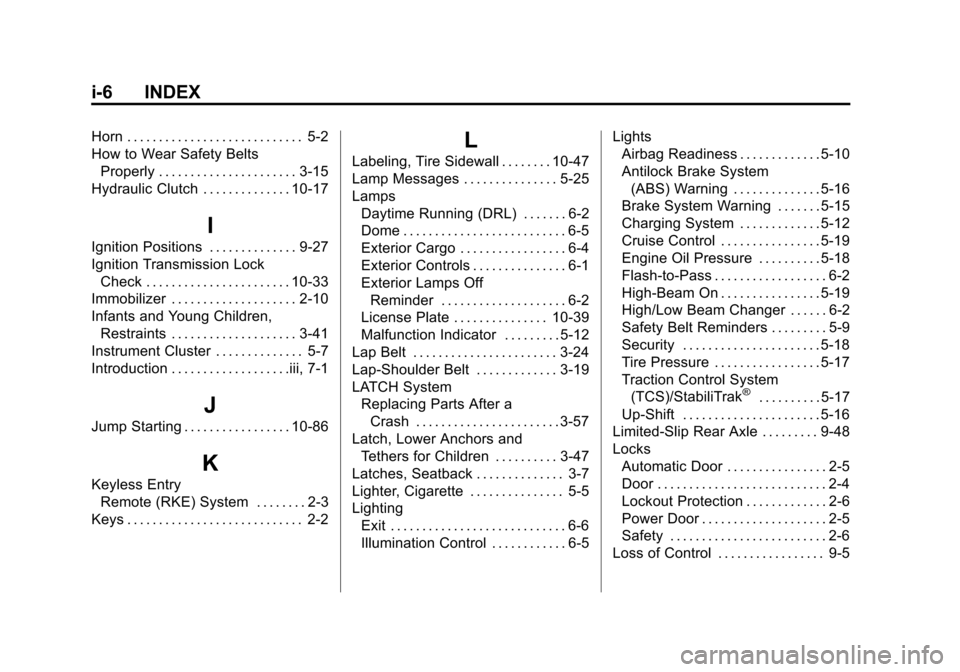
i-6 INDEX
Horn . . . . . . . . . . . . . . . . . . . . . . . . . . . . 5-2
How to Wear Safety BeltsProperly . . . . . . . . . . . . . . . . . . . . . . 3-15
Hydraulic Clutch . . . . . . . . . . . . . . 10-17
I
Ignition Positions . . . . . . . . . . . . . . 9-27
Ignition Transmission Lock Check . . . . . . . . . . . . . . . . . . . . . . . 10-33
Immobilizer . . . . . . . . . . . . . . . . . . . . 2-10
Infants and Young Children, Restraints . . . . . . . . . . . . . . . . . . . . 3-41
Instrument Cluster . . . . . . . . . . . . . . 5-7
Introduction . . . . . . . . . . . . . . . . . . .iii, 7-1
J
Jump Starting . . . . . . . . . . . . . . . . . 10-86
K
Keyless Entry
Remote (RKE) System . . . . . . . . 2-3
Keys . . . . . . . . . . . . . . . . . . . . . . . . . . . . 2-2
L
Labeling, Tire Sidewall . . . . . . . . 10-47
Lamp Messages . . . . . . . . . . . . . . . 5-25
Lamps
Daytime Running (DRL) . . . . . . . 6-2
Dome . . . . . . . . . . . . . . . . . . . . . . . . . . 6-5
Exterior Cargo . . . . . . . . . . . . . . . . . 6-4
Exterior Controls . . . . . . . . . . . . . . . 6-1
Exterior Lamps OffReminder . . . . . . . . . . . . . . . . . . . . 6-2
License Plate . . . . . . . . . . . . . . . 10-39
Malfunction Indicator . . . . . . . . . 5-12
Lap Belt . . . . . . . . . . . . . . . . . . . . . . . 3-24
Lap-Shoulder Belt . . . . . . . . . . . . . 3-19
LATCH System Replacing Parts After a
Crash . . . . . . . . . . . . . . . . . . . . . . . 3-57
Latch, Lower Anchors and Tethers for Children . . . . . . . . . . 3-47
Latches, Seatback . . . . . . . . . . . . . . 3-7
Lighter, Cigarette . . . . . . . . . . . . . . . 5-5
Lighting
Exit . . . . . . . . . . . . . . . . . . . . . . . . . . . . 6-6
Illumination Control . . . . . . . . . . . . 6-5 Lights
Airbag Readiness . . . . . . . . . . . . . 5-10
Antilock Brake System
(ABS) Warning . . . . . . . . . . . . . . 5-16
Brake System Warning . . . . . . . 5-15
Charging System . . . . . . . . . . . . . 5-12
Cruise Control . . . . . . . . . . . . . . . . 5-19
Engine Oil Pressure . . . . . . . . . . 5-18
Flash-to-Pass . . . . . . . . . . . . . . . . . . 6-2
High-Beam On . . . . . . . . . . . . . . . . 5-19
High/Low Beam Changer . . . . . . 6-2
Safety Belt Reminders . . . . . . . . . 5-9
Security . . . . . . . . . . . . . . . . . . . . . . 5-18
Tire Pressure . . . . . . . . . . . . . . . . . 5-17
Traction Control System (TCS)/StabiliTrak
®. . . . . . . . . . 5-17
Up-Shift . . . . . . . . . . . . . . . . . . . . . . 5-16
Limited-Slip Rear Axle . . . . . . . . . 9-48
Locks Automatic Door . . . . . . . . . . . . . . . . 2-5
Door . . . . . . . . . . . . . . . . . . . . . . . . . . . 2-4
Lockout Protection . . . . . . . . . . . . . 2-6
Power Door . . . . . . . . . . . . . . . . . . . . 2-5
Safety . . . . . . . . . . . . . . . . . . . . . . . . . 2-6
Loss of Control . . . . . . . . . . . . . . . . . 9-5
Page 391 of 392

Black plate (11,1)Chevrolet Colorado Owner Manual - 2011
INDEX i-11
T
Tachometer . . . . . . . . . . . . . . . . . . . . . 5-8
Tailgate . . . . . . . . . . . . . . . . . . . . . . . . . 2-7
TaillampsBulb Replacement . . . . . . . . . . 10-37
Text Telephone (TTY) Users . . . 13-6
Theft-Deterrent Systems . . . . . . . . . . . . . . . 2-10, 2-12
Immobilizer . . . . . . . . . . . . . . . . . . . 2-10
Time . . . . . . . . . . . . . . . . . . . . . . . . . . . . 5-4
Tires Buying New Tires . . . . . . . . . . . 10-62
Chains . . . . . . . . . . . . . . . . . . . . . . 10-68
Changing . . . . . . . . . . . . . . . . . . . 10-71
Compact Spare . . . . . . . . . . . . . 10-84
Designations . . . . . . . . . . . . . . . 10-49
Different Size . . . . . . . . . . . . . . . 10-64
Full-Size Spare . . . . . . . . . . . . . 10-85
If a Tire Goes Flat . . . . . . . . . . 10-69
Inflation Monitor System . . . . 10-56 Tires (cont.)
Inspection . . . . . . . . . . . . . . . . . . 10-59
Messages . . . . . . . . . . . . . . . . . . . . 5-26
Pressure . . . . . . . . . . . . . . . . . . . . 10-54
Pressure Light . . . . . . . . . . . . . . . . 5-17
Pressure Monitor System . . . 10-55
Rotation . . . . . . . . . . . . . . . . . . . . 10-60
Secondary Latch System . . . 10-82
Sidewall Labeling . . . . . . . . . . . 10-47
Terminology and
Definitions . . . . . . . . . . . . . . . . . 10-50
Uniform Tire Quality Grading . . . . . . . . . . . . . . . . . . . 10-64
Wheel Alignment and Tire
Balance . . . . . . . . . . . . . . . . . . . 10-66
Wheel Replacement . . . . . . . . 10-66
When It Is Time for New Tires . . . . . . . . . . . . . . . . . . . . . . 10-61
Towing Driving Characteristics . . . . . . . . 9-56
Equipment . . . . . . . . . . . . . . . . . . . . 9-65
General Information . . . . . . . . . . 9-56
Recreational Vehicle . . . . . . . . 10-90
Trailer . . . . . . . . . . . . . . . . . . . . . . . . 9-60
Vehicle . . . . . . . . . . . . . . . . . . . . . 10-90 Traction
Control System (TCS) . . . . . . . . 9-46
Control System (TCS)/
StabiliTrak
®Light . . . . . . . . . . . . 5-17
Limited-Slip Rear Axle . . . . . . . . 9-48
Trailer Towing . . . . . . . . . . . . . . . . . 9-60
Transfer Case . . . . . . . . . . . . . . . . . 9-39
Transmission Automatic . . . . . . . . . . . . . . . . . . . . . 9-35
Fluid, Automatic . . . . . . . . . . . . 10-13
Fluid, Manual . . . . . . . . . . . . . . . 10-16
Messages . . . . . . . . . . . . . . . . . . . . 5-26
Transportation Program, Courtesy . . . . . . . . . . . . . . . . . . . . 13-10
Trip Odometer . . . . . . . . . . . . . . . . . . 5-8
Truck-Camper Loading Information . . . . . . . . . . . . . . . . . . . 9-26
Turn and Lane-Change Signals . . . . . . . . . . . . . . . . . . . . . . . . 6-4
Turn Signal Bulb Replacement . . . . . . . . . . 10-37