maintenance CHEVROLET COLORADO 2011 1.G Owner's Guide
[x] Cancel search | Manufacturer: CHEVROLET, Model Year: 2011, Model line: COLORADO, Model: CHEVROLET COLORADO 2011 1.GPages: 392, PDF Size: 6.37 MB
Page 301 of 392
Black plate (61,1)Chevrolet Colorado Owner Manual - 2011
Vehicle Care 10-61
Lightly coat the center of the
wheel hub with wheel bearing
grease after a wheel change or
tire rotation to prevent corrosion
or rust build-up. Do not get
grease on the flat wheel
mounting surface or on the
wheel nuts or bolts.
When It Is Time for New
Tires
Various factors, such as
maintenance, temperatures, driving
speeds, vehicle loading, and road
conditions influence when you need
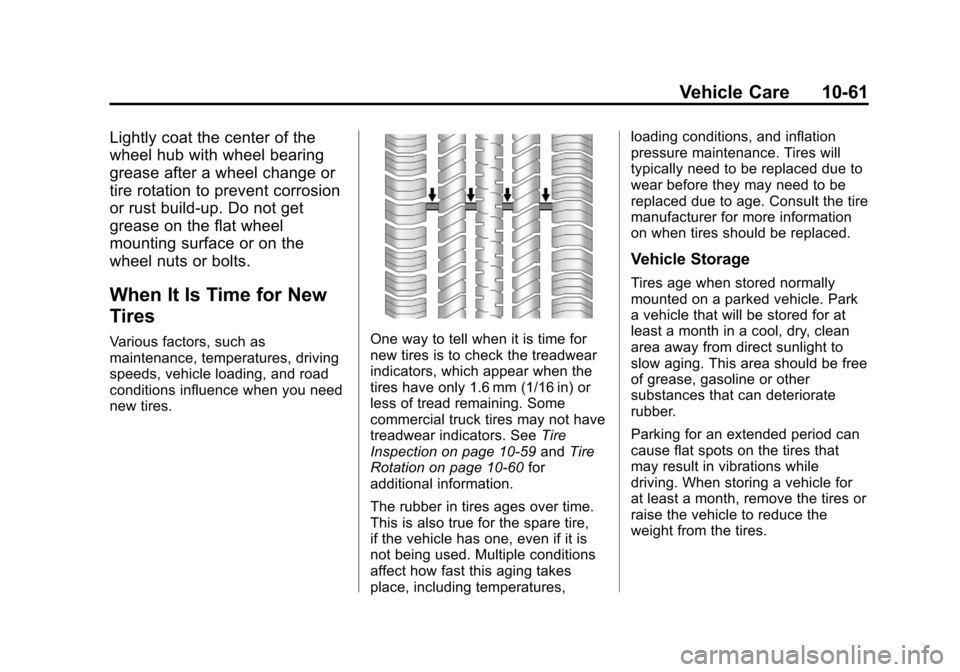
new tires.One way to tell when it is time for
new tires is to check the treadwear
indicators, which appear when the
tires have only 1.6 mm (1/16 in) or
less of tread remaining. Some
commercial truck tires may not have
treadwear indicators. SeeTire
Inspection on page 10‑59 andTire
Rotation on page 10‑60 for
additional information.
The rubber in tires ages over time.
This is also true for the spare tire,
if the vehicle has one, even if it is
not being used. Multiple conditions
affect how fast this aging takes
place, including temperatures, loading conditions, and inflation
pressure maintenance. Tires will
typically need to be replaced due to
wear before they may need to be
replaced due to age. Consult the tire
manufacturer for more information
on when tires should be replaced.
Vehicle Storage
Tires age when stored normally
mounted on a parked vehicle. Park
a vehicle that will be stored for at
least a month in a cool, dry, clean
area away from direct sunlight to
slow aging. This area should be free
of grease, gasoline or other
substances that can deteriorate
rubber.
Parking for an extended period can
cause flat spots on the tires that
may result in vibrations while
driving. When storing a vehicle for
at least a month, remove the tires or
raise the vehicle to reduce the
weight from the tires.
Page 309 of 392
Black plate (69,1)Chevrolet Colorado Owner Manual - 2011
Vehicle Care 10-69
If a Tire Goes Flat
It is unusual for a tire to blowout
while you are driving, especially if
you maintain your vehicle's tires
properly. If air goes out of a tire, it is
much more likely to leak out slowly.
But if you should ever have a
blowout, here are a few tips about
what to expect and what to do:
If a front tire fails, the flat tire
creates a drag that pulls the vehicle
toward that side. Take your foot off
the accelerator pedal and grip the
steering wheel firmly. Steer to
maintain lane position, and then
gently brake to a stop, well off the
road, if possible.
A rear blowout, particularly on a
curve, acts much like a skid and
may require the same correction
you would use in a skid. In any rear
blowout remove your foot from the
accelerator pedal. Get the vehicle
under control by steering the way
you want the vehicle to go. It maybe very bumpy and noisy, but you
can still steer. Gently brake to a
stop, well off the road, if possible.
{WARNING
Driving on a flat tire will cause
permanent damage to the tire.
Re-inflating a tire after it has been
driven on while severely
underinflated or flat may cause a
blowout and a serious crash.
Never attempt to re-inflate a tire
that has been driven on while
severely underinflated or flat.
Have your dealer or an authorized
tire service center repair or
replace the flat tire as soon as
possible.
{WARNING
Lifting a vehicle and getting under
it to do maintenance or repairs is
dangerous without the
appropriate safety equipment and
training. If a jack is provided with
the vehicle, it is designed only for
changing a flat tire. If it is used for
anything else, you or others could
be badly injured or killed if the
vehicle slips off the jack. If a jack
is provided with the vehicle, only
use it for changing a flat tire.
If a tire goes flat, the next part
shows how to use the jacking
equipment to change a flat tire
safely.
Page 339 of 392

Black plate (99,1)Chevrolet Colorado Owner Manual - 2011
Vehicle Care 10-99
Sheet Metal Damage
If the vehicle is damaged and
requires sheet metal repair or
replacement, make sure the body
repair shop applies anti-corrosion
material to parts repaired or
replaced to restore corrosion
protection.
Original manufacturer replacement
parts will provide the corrosion
protection while maintaining the
vehicle warranty.
Finish Damage
Any stone chips, fractures or deep
scratches in the finish should be
repaired right away. Bare metal will
corrode quickly and may develop
into major repair expense.
Minor chips and scratches can be
repaired with touch-up materials
available from your dealer. Larger
areas of finish damage can be
corrected in your dealer's body and
paint shop.Chemicals used for ice and snow
removal and dust control can collect
on the underbody. If these are not
removed, corrosion and rust can
develop on the underbody parts
such as fuel lines, frame, floor pan,
and exhaust system even though
they have corrosion protection.
At least every spring, flush these
materials from the underbody with
plain water. Clean any areas where
mud and debris can collect. Dirt
packed in close areas of the frame
should be loosened before being
flushed. Your dealer or an
underbody car washing system can
do this.
Underbody Maintenance
Chemicals used for ice and snow
removal and dust control can collect
on the underbody. If these are not
removed, corrosion and rust can
develop on the underbody parts
such as fuel lines, frame, floor pan,
and exhaust system even though
they have corrosion protection.At least every spring, flush these
materials from the underbody with
plain water. Clean any areas where
mud and debris can collect. Dirt
packed in close areas of the frame
should be loosened before being
flushed. Your dealer or an
underbody car washing system can
do this.
Chemical Paint Spotting
Some weather and atmospheric
conditions can create a chemical
fallout. Airborne pollutants can fall
upon and attack painted surfaces on
the vehicle. This damage can take
two forms: blotchy, ring-shaped
discolorations, and small, irregular
dark spots etched into the paint
surface.
Although no defect in the paint job
causes this, we will repair, at no
charge to the owner, the surfaces of
new vehicles damaged by this
fallout condition within 12 months or
20 000 km (12,000 miles) of
purchase, whichever occurs first.
Page 345 of 392
Black plate (1,1)Chevrolet Colorado Owner Manual - 2011
Service and Maintenance 11-1
Service and
Maintenance
General Information
General Information . . . . . . . . . . 11-1
Scheduled Maintenance
Scheduled Maintenance . . . . . 11-2
Recommended Fluids,
Lubricants, and Parts
Recommended Fluids andLubricants . . . . . . . . . . . . . . . . . . 11-6
Maintenance Replacement Parts . . . . . . . . . . . . . . . . . . . . . . . 11-9
Maintenance Records
Maintenance Records . . . . . . 11-10
General Information
Notice: Maintenance intervals,
checks, inspections,
recommended fluids, and
lubricants are necessary to keep
this vehicle in good working
condition. Damage caused by
failure to follow scheduled
maintenance might not be
covered by the vehicle warranty.
As the vehicle owner, you are
responsible for the scheduled
maintenance in this section. We
recommend having your dealer
perform these services. Proper
vehicle maintenance helps to keep
the vehicle in good working
condition, improves fuel economy,
and reduces vehicle emissions for
better air quality. Because of all the different ways
people use vehicles, maintenance
needs vary. The vehicle might need
more frequent checks and services.
Please read the information under
Scheduled Maintenance. To keep
the vehicle in good condition, see
your dealer.
The maintenance schedule is for
vehicles that:
.Carry passengers and cargo
within recommended limits on
the Tire and Loading Information
label. See
Vehicle Load Limits
on page 9‑20.
.Are driven on reasonable road
surfaces within legal driving
limits.
Page 346 of 392
Black plate (2,1)Chevrolet Colorado Owner Manual - 2011
11-2 Service and Maintenance
.Are driven off-road in the
recommended manner. See
Off-Road Driving on page 9‑6.
.Use the recommended fuel. See
Recommended Fuel on
page 9‑51.
{WARNING
Performing maintenance work can
be dangerous. Some jobs can
cause serious injury. Perform
maintenance work only if you
have the required know-how and
the proper tools and equipment.
If in doubt, see your dealer to
have a qualified technician do the
work. SeeDoing Your Own
Service Work on page 10‑4. At your dealer, you can be certain
that you will receive the highest
level of service available. Your
dealer has specially trained service
technicians, uses genuine
replacement parts, as well as,
up‐to‐date tools and equipment to
ensure fast and accurate
diagnostics.
The proper replacement parts,
fluids, and lubricants to use are
listed in
Recommended Fluids and
Lubricants on page 11‑6 and
Maintenance Replacement Parts on
page 11‑9. We recommend the use
of genuine parts from your dealer.
Rotation of New Tires
To maintain ride, handling, and
performance of the vehicle, it is
important that the first rotation
service for new tires be performed.
Tires should be rotated every
12 000 km/7,500 miles. See Tire
Rotation on page 10‑60.
Scheduled
Maintenance
When the Change Oil Message
Displays
Change engine oil and filter. See
Engine Oil on page 10‑9. An
Emission Control Service.
When the CHANGE OIL message
displays, service is required for the
vehicle as soon as possible, within
the next 1 000 km/600 miles.
If driving under the best conditions,
the engine oil life system might not
indicate the need for vehicle service
for more than a year. The engine oil
and filter must be changed at least
once a year and the oil life system
must be reset. Your dealer has
trained service technicians who will
perform this work and reset the
system. If the engine oil life system
is reset accidentally, service the
vehicle within 5 000 km/3,000 miles
since the last service. Reset the oil
Page 347 of 392
Black plate (3,1)Chevrolet Colorado Owner Manual - 2011
Service and Maintenance 11-3
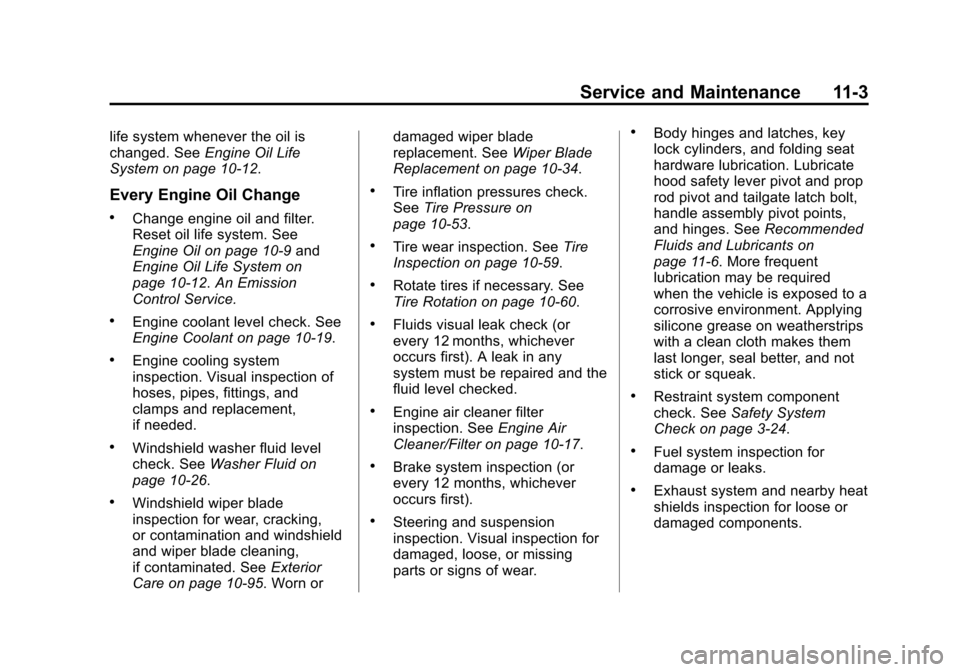
life system whenever the oil is
changed. SeeEngine Oil Life
System on page 10‑12.
Every Engine Oil Change
.Change engine oil and filter.
Reset oil life system. See
Engine Oil on page 10‑9 and
Engine Oil Life System on
page 10‑12. An Emission
Control Service.
.Engine coolant level check. See
Engine Coolant on page 10‑19.
.Engine cooling system
inspection. Visual inspection of
hoses, pipes, fittings, and
clamps and replacement,
if needed.
.Windshield washer fluid level
check. See Washer Fluid on
page 10‑26.
.Windshield wiper blade
inspection for wear, cracking,
or contamination and windshield
and wiper blade cleaning,
if contaminated. See Exterior
Care on page 10‑95. Worn or damaged wiper blade
replacement. See
Wiper Blade
Replacement on page 10‑34.
.Tire inflation pressures check.
See Tire Pressure on
page 10‑53.
.Tire wear inspection. See Tire
Inspection on page 10‑59.
.Rotate tires if necessary. See
Tire Rotation on page 10‑60.
.Fluids visual leak check (or
every 12 months, whichever
occurs first). A leak in any
system must be repaired and the
fluid level checked.
.Engine air cleaner filter
inspection. See Engine Air
Cleaner/Filter on page 10‑17.
.Brake system inspection (or
every 12 months, whichever
occurs first).
.Steering and suspension
inspection. Visual inspection for
damaged, loose, or missing
parts or signs of wear.
.Body hinges and latches, key
lock cylinders, and folding seat
hardware lubrication. Lubricate
hood safety lever pivot and prop
rod pivot and tailgate latch bolt,
handle assembly pivot points,
and hinges. See Recommended
Fluids and Lubricants on
page 11‑6. More frequent
lubrication may be required
when the vehicle is exposed to a
corrosive environment. Applying
silicone grease on weatherstrips
with a clean cloth makes them
last longer, seal better, and not
stick or squeak.
.Restraint system component
check. See Safety System
Check on page 3‑24.
.Fuel system inspection for
damage or leaks.
.Exhaust system and nearby heat
shields inspection for loose or
damaged components.
Page 348 of 392
Black plate (4,1)Chevrolet Colorado Owner Manual - 2011
11-4 Service and Maintenance
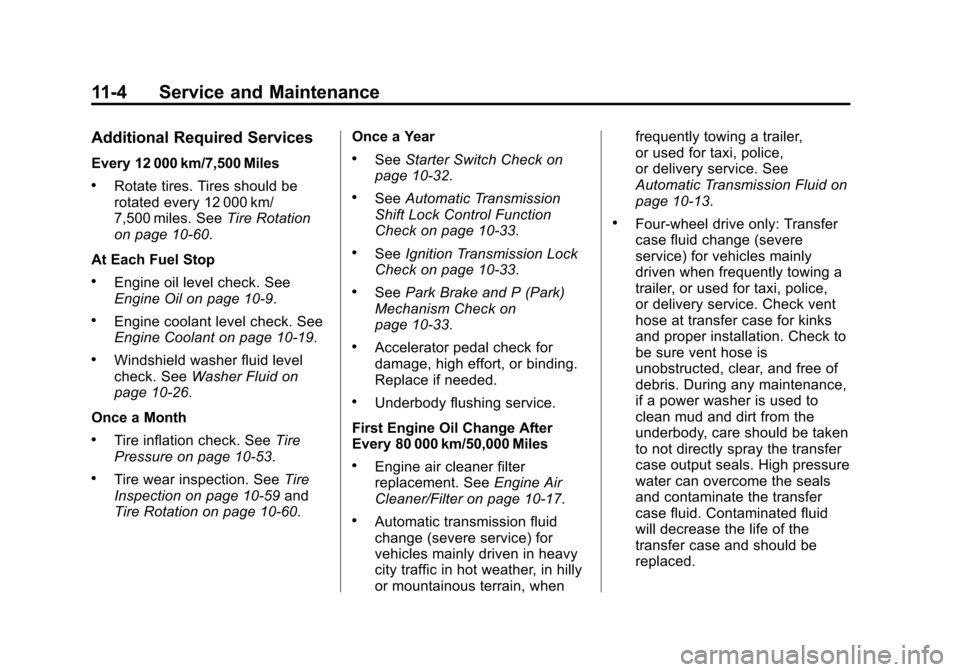
Additional Required Services
Every 12 000 km/7,500 Miles
.Rotate tires. Tires should be
rotated every 12 000 km/
7,500 miles. SeeTire Rotation
on page 10‑60.
At Each Fuel Stop
.Engine oil level check. See
Engine Oil on page 10‑9.
.Engine coolant level check. See
Engine Coolant on page 10‑19.
.Windshield washer fluid level
check. See Washer Fluid on
page 10‑26.
Once a Month
.Tire inflation check. See Tire
Pressure on page 10‑53.
.Tire wear inspection. See Tire
Inspection on page 10‑59 and
Tire Rotation on page 10‑60. Once a Year
.See
Starter Switch Check on
page 10‑32.
.See Automatic Transmission
Shift Lock Control Function
Check on page 10‑33.
.See Ignition Transmission Lock
Check on page 10‑33.
.See Park Brake and P (Park)
Mechanism Check on
page 10‑33.
.Accelerator pedal check for
damage, high effort, or binding.
Replace if needed.
.Underbody flushing service.
First Engine Oil Change After
Every 80 000 km/50,000 Miles
.Engine air cleaner filter
replacement. See Engine Air
Cleaner/Filter on page 10‑17.
.Automatic transmission fluid
change (severe service) for
vehicles mainly driven in heavy
city traffic in hot weather, in hilly
or mountainous terrain, when frequently towing a trailer,
or used for taxi, police,
or delivery service. See
Automatic Transmission Fluid on
page 10‑13.
.Four‐wheel drive only: Transfer
case fluid change (severe
service) for vehicles mainly
driven when frequently towing a
trailer, or used for taxi, police,
or delivery service. Check vent
hose at transfer case for kinks
and proper installation. Check to
be sure vent hose is
unobstructed, clear, and free of
debris. During any maintenance,
if a power washer is used to
clean mud and dirt from the
underbody, care should be taken
to not directly spray the transfer
case output seals. High pressure
water can overcome the seals
and contaminate the transfer
case fluid. Contaminated fluid
will decrease the life of the
transfer case and should be
replaced.
Page 349 of 392
Black plate (5,1)Chevrolet Colorado Owner Manual - 2011
Service and Maintenance 11-5
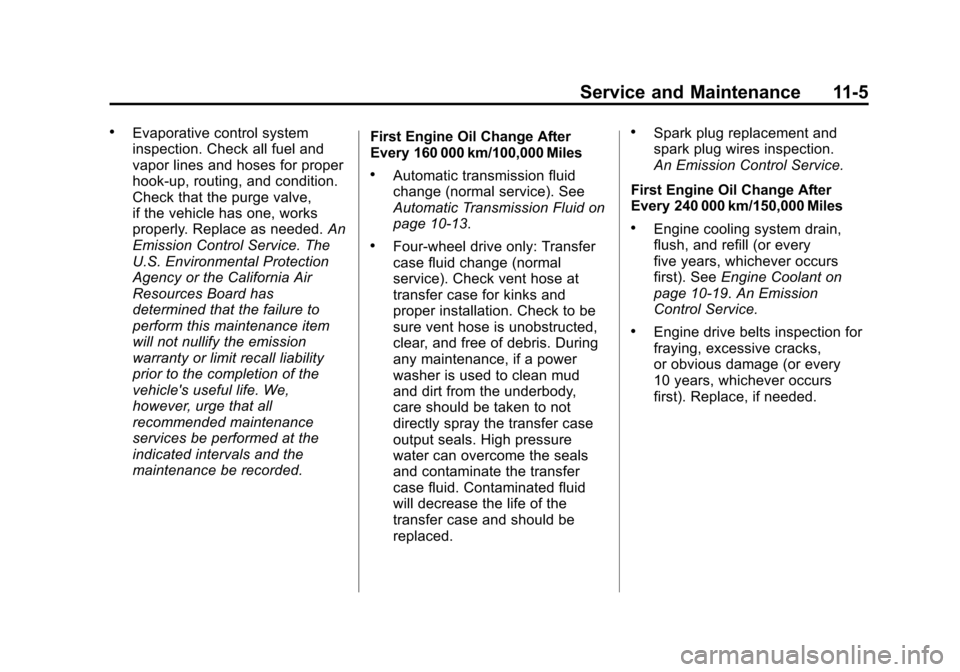
.Evaporative control system
inspection. Check all fuel and
vapor lines and hoses for proper
hook‐up, routing, and condition.
Check that the purge valve,
if the vehicle has one, works
properly. Replace as needed.An
Emission Control Service. The
U.S. Environmental Protection
Agency or the California Air
Resources Board has
determined that the failure to
perform this maintenance item
will not nullify the emission
warranty or limit recall liability
prior to the completion of the
vehicle's useful life. We,
however, urge that all
recommended maintenance
services be performed at the
indicated intervals and the
maintenance be recorded. First Engine Oil Change After
Every 160 000 km/100,000 Miles
.Automatic transmission fluid
change (normal service). See
Automatic Transmission Fluid on
page 10‑13.
.Four‐wheel drive only: Transfer
case fluid change (normal
service). Check vent hose at
transfer case for kinks and
proper installation. Check to be
sure vent hose is unobstructed,
clear, and free of debris. During
any maintenance, if a power
washer is used to clean mud
and dirt from the underbody,
care should be taken to not
directly spray the transfer case
output seals. High pressure
water can overcome the seals
and contaminate the transfer
case fluid. Contaminated fluid
will decrease the life of the
transfer case and should be
replaced.
.Spark plug replacement and
spark plug wires inspection.
An Emission Control Service.
First Engine Oil Change After
Every 240 000 km/150,000 Miles
.Engine cooling system drain,
flush, and refill (or every
five years, whichever occurs
first). See Engine Coolant on
page 10‑19. An Emission
Control Service.
.Engine drive belts inspection for
fraying, excessive cracks,
or obvious damage (or every
10 years, whichever occurs
first). Replace, if needed.
Page 350 of 392

Black plate (6,1)Chevrolet Colorado Owner Manual - 2011
11-6 Service and Maintenance
Recommended Fluids, Lubricants, and Parts
Recommended Fluids and Lubricants
Fluids and lubricants identified below by name, part number, or specification can be obtained from your dealer.Usage Fluid/Lubricant
Engine Oil The engine requires engine oil approved to the dexos™
specification. Oils
meeting this specification can be identified with the dexos™ certification
mark. Look for and use only an engine oil that displays the dexos™
certification mark of the proper viscosity grade. See Engine Oil on
page 10‑9.
Engine Coolant 50/50 mixture of clean, drinkable water and use only DEX-COOL Coolant.
See
Engine Coolant on page 10‑19.
Hydraulic Brake System DOT 3 Hydraulic Brake Fluid (GM Part No. 12377967, in
Canada 89021320).
Windshield Washer Optikleen
®Washer Solvent.
Parking Brake Cable Guides Chassis Lubricant (GM Part No. 12377985, in Canada 88901242) or
lubricant meeting requirements of NLGI #2, Category LB or GC-LB.
Power Steering System GM Power Steering Fluid (GM Part No. 89021184, in Canada 89021186).
Automatic Transmission DEXRON
®-VI Automatic Transmission Fluid.
Manual Transmission Manual Transmission Fluid (GM Part No. 89021806, in Canada 89021807).
Page 351 of 392

Black plate (7,1)Chevrolet Colorado Owner Manual - 2011
Service and Maintenance 11-7
UsageFluid/Lubricant
Hydraulic Clutch System Hydraulic Clutch Fluid (GM Part No. 12345347, in Canada 10953517) or
equivalent DOT-3 brake fluid.
Key Lock Cylinders Multi-Purpose Lubricant, Superlube (GM Part No. 12346241, in
Canada 10953474).
Chassis Lubrication Chassis Lubricant (GM Part No. 12377985, in Canada 88901242) or
lubricant meeting requirements of NLGI #2, Category LB or GC-LB.
Front and Rear Axle SAE 75W-90 Synthetic Axle Lubricant (GM Part No. 89021677, in
Canada 89021678).
Transfer Case Synchromesh Transmission Fluid (GM Part No. 12345349, in
Canada 10953465).
Rear Driveline Center Spline and Universal Joints Chassis Lubricant (GM Part No. 12377985, in Canada 88901242) or
lubricant meeting requirements of NLGI #2, Category LB or GC-LB.
Constant Velocity Universal Joint Chassis Lubricant (GM Part No. 12377985, in Canada 88901242) or
lubricant meeting requirements of NLGI #2, Category LB or GC-LB.
Hood Latch Assembly, Secondary Latch, Pivots, Spring Anchor, and
Release Pawl Lubriplate Lubricant Aerosol (GM Part No. 12346293, in Canada 992723)
or lubricant meeting requirements of NLGI #2, Category LB or GC-LB.
Hood and Door Hinges, Body Door Hinge Pins, Liftgate Hinge and
Linkage, Folding Seats, and Fuel
Door Hinge Multi-Purpose Lubricant, Superlube (GM Part No. 12346241, in
Canada 10953474).