ignition CHEVROLET COLORADO 2011 1.G Repair Manual
[x] Cancel search | Manufacturer: CHEVROLET, Model Year: 2011, Model line: COLORADO, Model: CHEVROLET COLORADO 2011 1.GPages: 392, PDF Size: 6.37 MB
Page 299 of 392
Black plate (59,1)Chevrolet Colorado Owner Manual - 2011
Vehicle Care 10-59
listen for a single horn chirp. The
single horn chirp should sound
within 15 seconds, confirming
that the sensor identification
code has been matched to this
tire and wheel position. If you do
not hear the confirming single
horn chirp, turn the ignition
switch to LOCK and start over
beginning with Step 2.
6. Proceed to the passenger side front tire, and repeat the
procedure in Step 5.
7. Proceed to the passenger side rear tire, and repeat the
procedure in Step 5.
8. Proceed to the driver side rear tire, and repeat the procedure in
Step 5.
9. After hearing the confirming horn chirp for the driver side rear tire,
check to see if the TPMS low tire
warning light and the DIC LOW
TIRE messages have turned off.
If yes, the TPMS sensors have
been relearned. Turn the ignition
switch to LOCK/OFF. If the low tire warning light and
the SERV TPM message on the
DIC are on after completing
Step 5 for the driver side rear
tire, the sensor relearn process
has not been successful. Turn
the ignition switch to LOCK/OFF
and repeat the matching process
beginning with Step 2.
10. Set all four tires to the recommended air pressure
level as indicated on the Tire
and Loading Information label.
11. Put the valve caps back on the valve stems.
Tire Inspection
We recommend that you
regularly inspect the vehicle's
tires, including the spare tire,
if the vehicle has one, for signs
of wear or damage at least once
a month. Always remove the tires if any of
the following statements
are true:
.You can see the indicators at
three or more places around
the tire.
.You can see cord or fabric
showing through the tire's
rubber.
.The tread or sidewall is
cracked, cut, or snagged
deep enough to show cord or
fabric.
.The tire has a bump, bulge,
or split.
.The tire has a puncture, cut,
or other damage that cannot
be repaired well because of
the size or location of the
damage.
Page 327 of 392
Black plate (87,1)Chevrolet Colorado Owner Manual - 2011
Vehicle Care 10-87
Notice:Ignoring these steps
could result in costly damage to
the vehicle that would not be
covered by the warranty.
Trying to start the vehicle by
pushing or pulling it will not
work, and it could damage the
vehicle.
1. Check the other vehicle. It must
have a 12‐volt battery with a
negative ground system.
Notice: Only use a vehicle that
has a 12-volt system with a
negative ground for jump
starting. If the other vehicle does
not have a 12-volt system with a
negative ground, both vehicles
can be damaged.
2. Get the vehicles close enough so the jumper cables can reach,
but be sure the vehicles are not
touching each other. If they are,
it could cause a ground
connection you do not want. You
would not be able to start your vehicle, and the bad grounding
could damage the electrical
systems.
To avoid the possibility of the
vehicles rolling, set the parking
brake firmly on both vehicles
involved in the jump start
procedure. Put an automatic
transmission in P (Park) or a
manual transmission in Neutral
before setting the parking brake.
If you have a four-wheel-drive
vehicle, be sure the transfer
case is not in Neutral.
Notice: If the radio or other
accessories are left on during the
jump starting procedure, they
could be damaged. The repairs
would not be covered by the
warranty. Always turn off the
radio and other accessories when
jump starting the vehicle. 3. Turn off the ignition on both
vehicles. Unplug unnecessary
accessories plugged into the
cigarette lighter or the accessory
power outlets. Turn off the radio
and all lamps that are not
needed. This will avoid sparks
and help save both batteries.
And it could save the radio!
4. Open the hoods and locate the positive (+) and negative (−)
terminal locations on the other
vehicle. Your vehicle has a
remote positive (+) and a remote
negative (−) jump starting
terminal. See Engine
Compartment Overview on
page 10‑6 for more information
on the terminal locations.
Page 332 of 392
Black plate (92,1)Chevrolet Colorado Owner Manual - 2011
10-92 Vehicle Care
{WARNING
Shifting a full‐time
four‐wheel‐drive vehicle's transfer
case into N (Neutral) can cause
the vehicle to roll even if the
automatic transmission is in
P (Park) or the manual
transmission is in any gear. You
or others could be injured. Make
sure the parking brake is firmly
set before the transfer case is
shifted to N (Neutral).
5. Shift the transfer case to N (Neutral). See “Shifting into
N (Neutral)” underFour-Wheel
Drive on page 10‑30.
6. Turn the ignition to LOCK/OFF and remove the key —the front
wheels will still turn.
7. Release the parking brake only after the vehicle being towed is
firmly attached to the towing
vehicle. After towing see
“Shifting Out of
N (Neutral)” underFour-Wheel Drive
on page 10‑30.
If the vehicle being towed will not be
started or driven for six weeks or
more, remove the battery cable from
the negative terminal (post) of the
battery to prevent the battery from
draining.
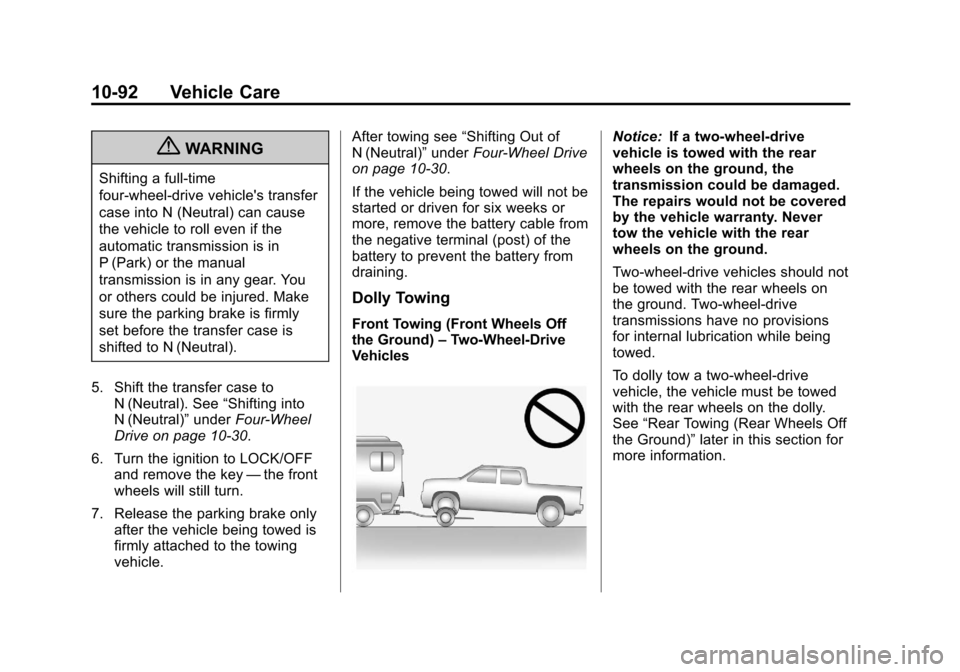
Dolly Towing
Front Towing (Front Wheels Off
the Ground) –Two‐Wheel‐Drive
Vehicles
Notice: If a two-wheel-drive
vehicle is towed with the rear
wheels on the ground, the
transmission could be damaged.
The repairs would not be covered
by the vehicle warranty. Never
tow the vehicle with the rear
wheels on the ground.
Two-wheel-drive vehicles should not
be towed with the rear wheels on
the ground. Two-wheel-drive
transmissions have no provisions
for internal lubrication while being
towed.
To dolly tow a two‐wheel‐drive
vehicle, the vehicle must be towed
with the rear wheels on the dolly.
See “Rear Towing (Rear Wheels Off
the Ground)” later in this section for
more information.
Page 333 of 392
Black plate (93,1)Chevrolet Colorado Owner Manual - 2011
Vehicle Care 10-93
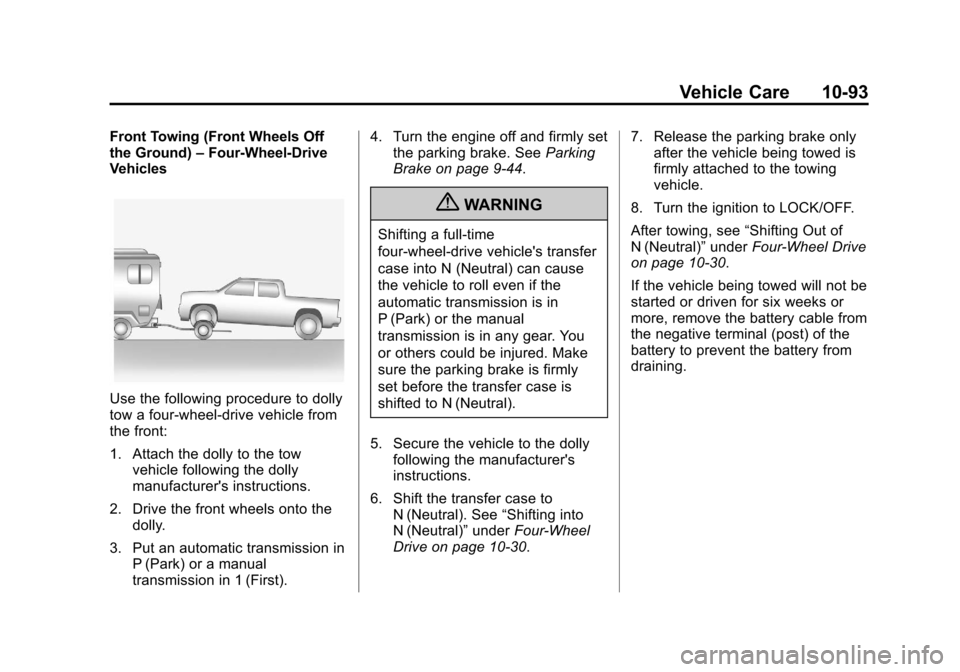
Front Towing (Front Wheels Off
the Ground)–Four-Wheel-Drive
Vehicles
Use the following procedure to dolly
tow a four-wheel-drive vehicle from
the front:
1. Attach the dolly to the tow
vehicle following the dolly
manufacturer's instructions.
2. Drive the front wheels onto the dolly.
3. Put an automatic transmission in P (Park) or a manual
transmission in 1 (First). 4. Turn the engine off and firmly set
the parking brake. See Parking
Brake on page 9‑44.
{WARNING
Shifting a full‐time
four‐wheel‐drive vehicle's transfer
case into N (Neutral) can cause
the vehicle to roll even if the
automatic transmission is in
P (Park) or the manual
transmission is in any gear. You
or others could be injured. Make
sure the parking brake is firmly
set before the transfer case is
shifted to N (Neutral).
5. Secure the vehicle to the dolly following the manufacturer's
instructions.
6. Shift the transfer case to N (Neutral). See “Shifting into
N (Neutral)” underFour-Wheel
Drive on page 10‑30. 7. Release the parking brake only
after the vehicle being towed is
firmly attached to the towing
vehicle.
8. Turn the ignition to LOCK/OFF.
After towing, see “Shifting Out of
N (Neutral)” underFour-Wheel Drive
on page 10‑30.
If the vehicle being towed will not be
started or driven for six weeks or
more, remove the battery cable from
the negative terminal (post) of the
battery to prevent the battery from
draining.
Page 334 of 392
Black plate (94,1)Chevrolet Colorado Owner Manual - 2011
10-94 Vehicle Care
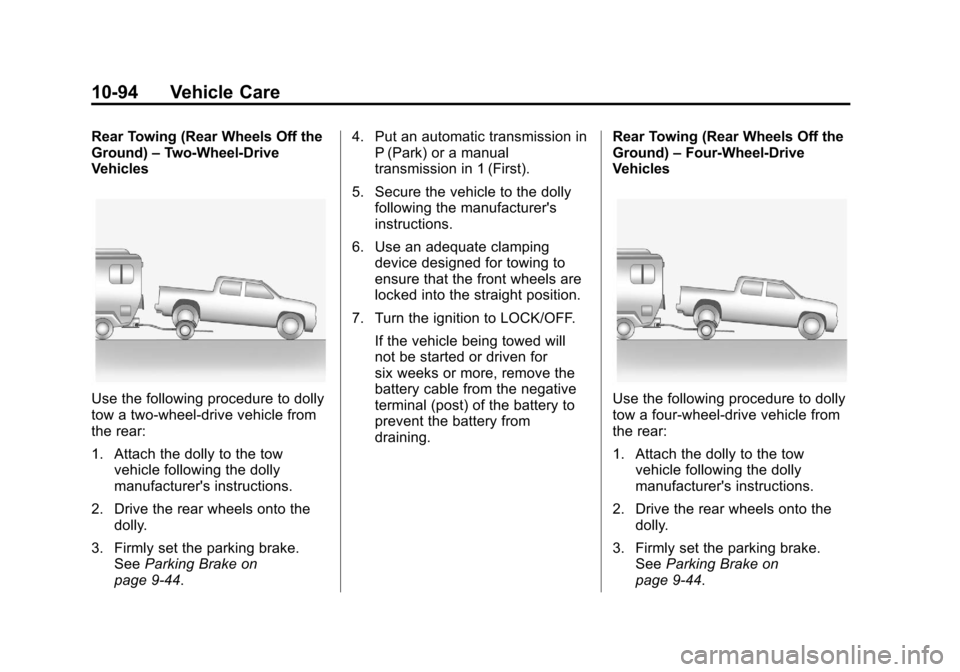
Rear Towing (Rear Wheels Off the
Ground)–Two‐Wheel‐Drive
Vehicles
Use the following procedure to dolly
tow a two-wheel-drive vehicle from
the rear:
1. Attach the dolly to the tow
vehicle following the dolly
manufacturer's instructions.
2. Drive the rear wheels onto the dolly.
3. Firmly set the parking brake. See Parking Brake on
page 9‑44. 4. Put an automatic transmission in
P (Park) or a manual
transmission in 1 (First).
5. Secure the vehicle to the dolly following the manufacturer's
instructions.
6. Use an adequate clamping device designed for towing to
ensure that the front wheels are
locked into the straight position.
7. Turn the ignition to LOCK/OFF. If the vehicle being towed will
not be started or driven for
six weeks or more, remove the
battery cable from the negative
terminal (post) of the battery to
prevent the battery from
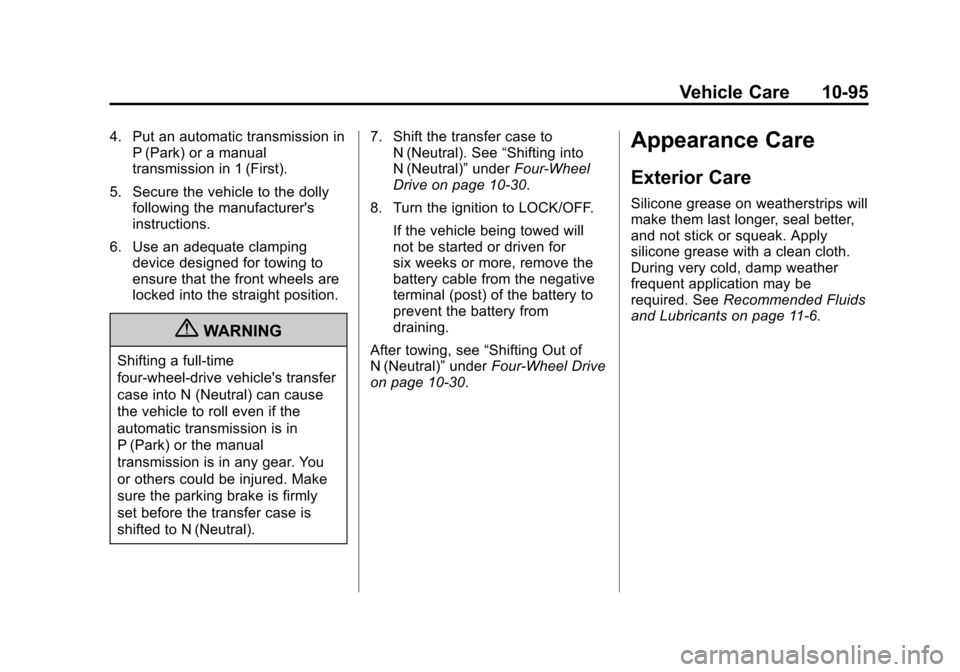
draining. Rear Towing (Rear Wheels Off the
Ground)
–Four‐Wheel‐Drive
VehiclesUse the following procedure to dolly
tow a four-wheel-drive vehicle from
the rear:
1. Attach the dolly to the tow
vehicle following the dolly
manufacturer's instructions.
2. Drive the rear wheels onto the dolly.
3. Firmly set the parking brake. See Parking Brake on
page 9‑44.
Page 335 of 392
Black plate (95,1)Chevrolet Colorado Owner Manual - 2011
Vehicle Care 10-95
4. Put an automatic transmission inP (Park) or a manual
transmission in 1 (First).
5. Secure the vehicle to the dolly following the manufacturer's
instructions.
6. Use an adequate clamping device designed for towing to
ensure that the front wheels are
locked into the straight position.
{WARNING
Shifting a full‐time
four‐wheel‐drive vehicle's transfer
case into N (Neutral) can cause
the vehicle to roll even if the
automatic transmission is in
P (Park) or the manual
transmission is in any gear. You
or others could be injured. Make
sure the parking brake is firmly
set before the transfer case is
shifted to N (Neutral). 7. Shift the transfer case to
N (Neutral). See “Shifting into
N (Neutral)” underFour-Wheel
Drive on page 10‑30.
8. Turn the ignition to LOCK/OFF. If the vehicle being towed will
not be started or driven for
six weeks or more, remove the
battery cable from the negative
terminal (post) of the battery to
prevent the battery from
draining.
After towing, see “Shifting Out of
N (Neutral)” underFour-Wheel Drive
on page 10‑30.
Appearance Care
Exterior Care
Silicone grease on weatherstrips will
make them last longer, seal better,
and not stick or squeak. Apply
silicone grease with a clean cloth.
During very cold, damp weather
frequent application may be
required. See Recommended Fluids
and Lubricants on page 11‑6.
Page 348 of 392
Black plate (4,1)Chevrolet Colorado Owner Manual - 2011
11-4 Service and Maintenance
Additional Required Services
Every 12 000 km/7,500 Miles
.Rotate tires. Tires should be
rotated every 12 000 km/
7,500 miles. SeeTire Rotation
on page 10‑60.
At Each Fuel Stop
.Engine oil level check. See
Engine Oil on page 10‑9.
.Engine coolant level check. See
Engine Coolant on page 10‑19.
.Windshield washer fluid level
check. See Washer Fluid on
page 10‑26.
Once a Month
.Tire inflation check. See Tire
Pressure on page 10‑53.
.Tire wear inspection. See Tire
Inspection on page 10‑59 and
Tire Rotation on page 10‑60. Once a Year
.See
Starter Switch Check on
page 10‑32.
.See Automatic Transmission
Shift Lock Control Function
Check on page 10‑33.
.See Ignition Transmission Lock
Check on page 10‑33.
.See Park Brake and P (Park)
Mechanism Check on
page 10‑33.
.Accelerator pedal check for
damage, high effort, or binding.
Replace if needed.
.Underbody flushing service.
First Engine Oil Change After
Every 80 000 km/50,000 Miles
.Engine air cleaner filter
replacement. See Engine Air
Cleaner/Filter on page 10‑17.
.Automatic transmission fluid
change (severe service) for
vehicles mainly driven in heavy
city traffic in hot weather, in hilly
or mountainous terrain, when frequently towing a trailer,
or used for taxi, police,
or delivery service. See
Automatic Transmission Fluid on
page 10‑13.
.Four‐wheel drive only: Transfer
case fluid change (severe
service) for vehicles mainly
driven when frequently towing a
trailer, or used for taxi, police,
or delivery service. Check vent
hose at transfer case for kinks
and proper installation. Check to
be sure vent hose is
unobstructed, clear, and free of
debris. During any maintenance,
if a power washer is used to
clean mud and dirt from the
underbody, care should be taken
to not directly spray the transfer
case output seals. High pressure
water can overcome the seals
and contaminate the transfer
case fluid. Contaminated fluid
will decrease the life of the
transfer case and should be
replaced.
Page 379 of 392
Black plate (17,1)Chevrolet Colorado Owner Manual - 2011
Customer Information 13-17
GM will not access this data or
share it with others except: with the
consent of the vehicle owner or,
if the vehicle is leased, with the
consent of the lessee; in response
to an official request by police or
similar government office; as part of
GM's defense of litigation through
the discovery process; or, as
required by law. Data that GM
collects or receives may also be
used for GM research needs or may
be made available to others for
research purposes, where a need is
shown and the data is not tied to a
specific vehicle or vehicle owner.
OnStar®
If your vehicle is equipped with an
active OnStar system, that system
may also record data in crash or
near crash‐like situations. The
OnStar Terms and Conditions
provides information on data
collection and use and is available
in the OnStar glove box kit, at
www.onstar.com (U.S.) orwww.onstar.ca (Canada), or by
pressing the
Qbutton and
speaking to an advisor.
Radio Frequency
Identification (RFID)
RFID technology is used in some
vehicles for functions such as tire
pressure monitoring and ignition
system security, as well as in
connection with conveniences such
as key fobs for remote door locking/
unlocking and starting, and
in-vehicle transmitters for garage
door openers. RFID technology in
GM vehicles does not use or record
personal information or link with any
other GM system containing
personal information.
Radio Frequency
Statement
This vehicle has systems that
operate on a radio frequency that
comply with Part 15 of the Federal
Communications Commission (FCC)
rules and with Industry Canada
Standards RSS‐210/220/310.
Operation is subject to the following
two conditions:
1. The device may not cause interference.
2. The device must accept any interference received, including
interference that may cause
undesired operation of the
device.
Changes or modifications to any of
these systems by other than an
authorized service facility could void
authorization to use this equipment.
Page 382 of 392

Black plate (2,1)Chevrolet Colorado Owner Manual - 2011
i-2 INDEX
B
Battery . . . . . . . . . . . . . . . . . . . . . . . 10-30Jump Starting . . . . . . . . . . . . . . . 10-86
Load Management . . . . . . . . . . . . . 6-6
Power Protection . . . . . . . . . . . . . . 6-6
Voltage and ChargingMessages . . . . . . . . . . . . . . . . . . . 5-23
Blade Replacement, Wiper . . . 10-34
Bluetooth . . . . . . . . . . . . . . . . . . . . . . 7-20
Brake System Warning Light . . . 5-15
Brakes . . . . . . . . . . . . . . . . . . . . . . . . 10-27 Antilock . . . . . . . . . . . . . . . . . . . . . . . 9-43
Assist . . . . . . . . . . . . . . . . . . . . . . . . . 9-45
Fluid . . . . . . . . . . . . . . . . . . . . . . . . 10-28
Parking . . . . . . . . . . . . . . . . . . . . . . . 9-44
System Messages . . . . . . . . . . . . 5-23
Braking . . . . . . . . . . . . . . . . . . . . . . . . . 9-3
Break-In, New Vehicle . . . . . . . . . 9-26
Bulb Replacement . . . . . . . . . . . . 10-39 Center High-Mounted
Stoplamp (CHMSL) . . . . . . . 10-38
Fog Lamps . . . . . . . . . . . . . . . . . . . . 6-4
Front Turn Signal, Parking, Sidemarker,
and Daytime Running
Lamps (DRL) . . . . . . . . . . . . . . 10-37 Bulb Replacement (cont.)
Halogen Bulbs . . . . . . . . . . . . . . 10-36
Headlamp Aiming . . . . . . . . . . . 10-35
Headlamps . . . . . . . . . . . . . . . . . 10-36
License Plate Lamps . . . . . . . 10-39
Taillamps, Turn Signal,
Stoplamps, and
Back-Up Lamps . . . . . . . . . . . 10-37
Buying New Tires . . . . . . . . . . . . . 10-62
C
Calibration . . . . . . . . . . . . . . . . . . . . . . 5-3
California
Fuel Requirements . . . . . . . . . . . 9-52
Perchlorate MaterialsRequirements . . . . . . . . . . . . . . . 10-3
Warning . . . . . . . . . . . . . . . . . . . . . . 10-3
Canadian Vehicle Owners . . . . . . . . iii
Capacities and Specifications . . . . . . . . . . . . . . . . 12-2
Carbon Monoxide Engine Exhaust . . . . . . . . . . . . . . . 9-33
Tailgate . . . . . . . . . . . . . . . . . . . . . . . . 2-7
Winter Driving . . . . . . . . . . . . . . . . 9-17 Cautions, Danger, and
Warnings . . . . . . . . . . . . . . . . . . . . . . . . iv
CD Player . . . . . . . . . . . . . . . . . . . . . 7-14
Center Console Storage . . . . . . . . 4-3
Center High-Mounted Stoplamp (CHMSL) . . . . . . . . . 10-38
Chains, Tire . . . . . . . . . . . . . . . . . . 10-68
Charging
System Light . . . . . . . . . . . . . . . . . 5-12
Check Engine Light . . . . . . . . . . . . . . . . . . 5-12
Ignition
Transmission Lock . . . . . . . . 10-33
Child Restraints Infants and YoungChildren . . . . . . . . . . . . . . . . . . . . . 3-41
Lower Anchors and Tethers for Children . . . . . . . . . 3-47
Older Children . . . . . . . . . . . . . . . . 3-39
Securing . . . . . . . . . . . . . . . . 3-58, 3-60
Systems . . . . . . . . . . . . . . . . . . . . . . 3-44
Cigarette Lighter . . . . . . . . . . . . . . . . 5-5
Circuit Breakers . . . . . . . . . . . . . . 10-40
Page 386 of 392

Black plate (6,1)Chevrolet Colorado Owner Manual - 2011
i-6 INDEX
Horn . . . . . . . . . . . . . . . . . . . . . . . . . . . . 5-2
How to Wear Safety BeltsProperly . . . . . . . . . . . . . . . . . . . . . . 3-15
Hydraulic Clutch . . . . . . . . . . . . . . 10-17
I
Ignition Positions . . . . . . . . . . . . . . 9-27
Ignition Transmission Lock Check . . . . . . . . . . . . . . . . . . . . . . . 10-33
Immobilizer . . . . . . . . . . . . . . . . . . . . 2-10
Infants and Young Children, Restraints . . . . . . . . . . . . . . . . . . . . 3-41
Instrument Cluster . . . . . . . . . . . . . . 5-7
Introduction . . . . . . . . . . . . . . . . . . .iii, 7-1
J
Jump Starting . . . . . . . . . . . . . . . . . 10-86
K
Keyless Entry
Remote (RKE) System . . . . . . . . 2-3
Keys . . . . . . . . . . . . . . . . . . . . . . . . . . . . 2-2
L
Labeling, Tire Sidewall . . . . . . . . 10-47
Lamp Messages . . . . . . . . . . . . . . . 5-25
Lamps
Daytime Running (DRL) . . . . . . . 6-2
Dome . . . . . . . . . . . . . . . . . . . . . . . . . . 6-5
Exterior Cargo . . . . . . . . . . . . . . . . . 6-4
Exterior Controls . . . . . . . . . . . . . . . 6-1
Exterior Lamps OffReminder . . . . . . . . . . . . . . . . . . . . 6-2
License Plate . . . . . . . . . . . . . . . 10-39
Malfunction Indicator . . . . . . . . . 5-12
Lap Belt . . . . . . . . . . . . . . . . . . . . . . . 3-24
Lap-Shoulder Belt . . . . . . . . . . . . . 3-19
LATCH System Replacing Parts After a
Crash . . . . . . . . . . . . . . . . . . . . . . . 3-57
Latch, Lower Anchors and Tethers for Children . . . . . . . . . . 3-47
Latches, Seatback . . . . . . . . . . . . . . 3-7
Lighter, Cigarette . . . . . . . . . . . . . . . 5-5
Lighting
Exit . . . . . . . . . . . . . . . . . . . . . . . . . . . . 6-6
Illumination Control . . . . . . . . . . . . 6-5 Lights
Airbag Readiness . . . . . . . . . . . . . 5-10
Antilock Brake System
(ABS) Warning . . . . . . . . . . . . . . 5-16
Brake System Warning . . . . . . . 5-15
Charging System . . . . . . . . . . . . . 5-12
Cruise Control . . . . . . . . . . . . . . . . 5-19
Engine Oil Pressure . . . . . . . . . . 5-18
Flash-to-Pass . . . . . . . . . . . . . . . . . . 6-2
High-Beam On . . . . . . . . . . . . . . . . 5-19
High/Low Beam Changer . . . . . . 6-2
Safety Belt Reminders . . . . . . . . . 5-9
Security . . . . . . . . . . . . . . . . . . . . . . 5-18
Tire Pressure . . . . . . . . . . . . . . . . . 5-17
Traction Control System (TCS)/StabiliTrak
®. . . . . . . . . . 5-17
Up-Shift . . . . . . . . . . . . . . . . . . . . . . 5-16
Limited-Slip Rear Axle . . . . . . . . . 9-48
Locks Automatic Door . . . . . . . . . . . . . . . . 2-5
Door . . . . . . . . . . . . . . . . . . . . . . . . . . . 2-4
Lockout Protection . . . . . . . . . . . . . 2-6
Power Door . . . . . . . . . . . . . . . . . . . . 2-5
Safety . . . . . . . . . . . . . . . . . . . . . . . . . 2-6
Loss of Control . . . . . . . . . . . . . . . . . 9-5