ignition CHEVROLET CORVAIR 1986 2.G User Guide
[x] Cancel search | Manufacturer: CHEVROLET, Model Year: 1986, Model line: CORVAIR, Model: CHEVROLET CORVAIR 1986 2.GPages: 56, PDF Size: 22.23 MB
Page 24 of 56
Downloaded from www.Manualslib.com manuals search engine CHEVROLET "ALL TRANSISTOR" RADIOS
••• AM Radios
of the station selector knob allows use of front, rear or
both
speakers .
The
left hand control knob is the "on-off" switch and Five push buttons allow station selection. To preset,
volume
control. At its base is the tone control wing knob. pull the push button "out" as far as it will go, tune in the
The right
hand knob is the manual station selector. With desired station manually and then push the button fully
the optional rear seat speaker, a wing knob at the base "in." Repeat for each push button .
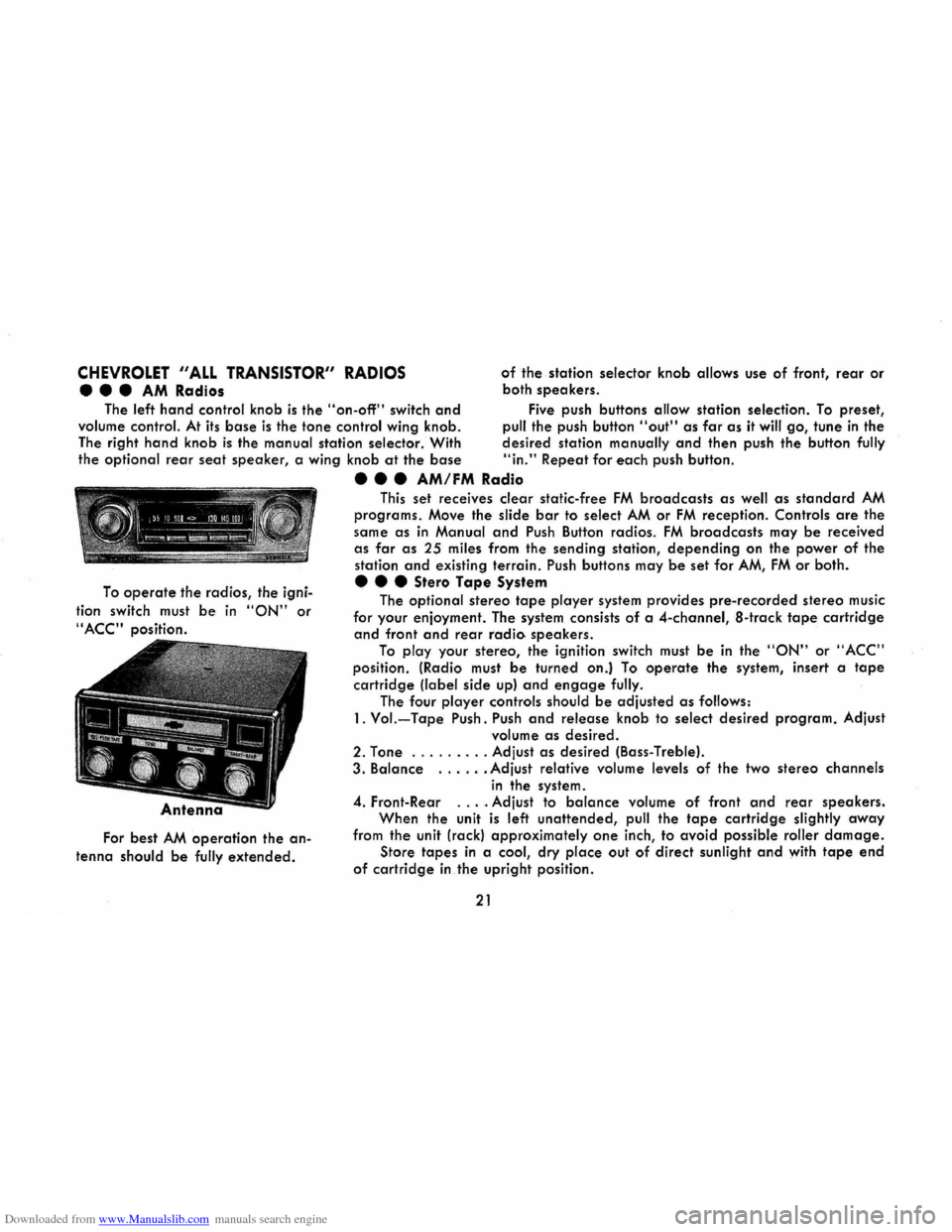
To operate the radios, the igni
tion switch must
be in "ON" or
"ACC" position.
For best AM operation the an
tenna should be fully extended.
• • • AM/FM Radio
This set receives clear static-free FM broadcasts as well as standard AM
programs. Move the slide bar to select AM or FM reception. Controls are the
same
as in Manual and Push Button radios. FM broadcasts may be received
as far as 25 miles from the sending station, depending on the power of the
station
and existing terrain. Push buttons may be set for AM, FM or both .
• • • Stero Tape System
The optional stereo tape player system provides pre-recorded stereo music
for your enjoyment. The system consists
of a 4-channel, a-track tape cartridge
and front and rear radio speakers.
To play your stereo, the ignition switch must be in the "ON" or "ACC"
position. (Radio must be turned on.) To operate the system, insert a tape
cartridge (label side up) and engage fully.
The four player controls should be adjusted as follows:
1. Vol.-Tape Push. Push and release knob to select desired program. Adjust
volume
as desired.
2. Tone ... .
..... Adjust as desired (Bass-Treble).
3. Balance ...... Adjust relative volume levels of the two stereo channels
in the system.
4. Front-Rear .... Adjust to balance volume of front and rear speakers.
When the unit
is left unattended, pull the tape cartridge slightly away
from the unit (rack) approximately one inch, to avoid possible roller damage.
Store tapes in a cool, dry place out of direct sunlight and with tape end
of cartridge in the upright position.
21
Page 25 of 56
Downloaded from www.Manualslib.com manuals search engine AIR VENTS
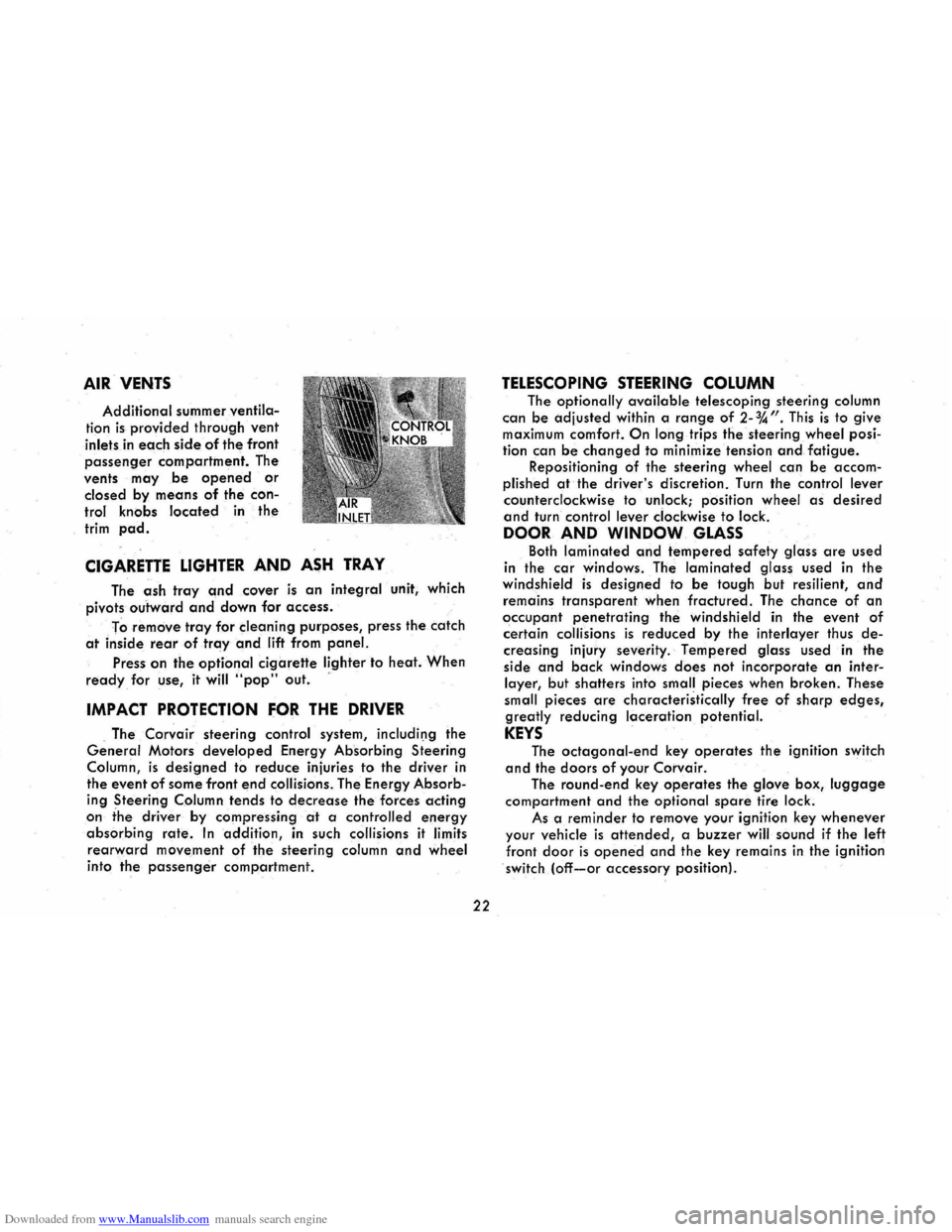
Additional summer ventila
tion is provided through vent
inlets in each side of the front
passenger compartment. The
vents
may be opened or
closed by means of the con
trol knobs located in the
trim pad.
CIGARETTE LIGHTER AND ASH TRAY
The ash tray and cover is an integral unit, which
pivots
outward and down for access.
To
remove tray for cleaning purposes, press the catch
at inside rear of tray and lift from panel.
Press on the optional cigarette lighter to heat. When
ready for use, it will "pop" out. '
IMPACT PROTECTION FOR THE DRIVER
. The Corvair steering control system, includil)g the
General Motors developed Energy Absorbing Steering
Column,
is designed to reduce injuries to the driver in
the event
of some front end collisions. The Energy Absorb
ing Steering Column tends to decrease the forces acting
on the driver by compressing at a controlled energy
absorbing rate. In addition, in such collisions it limits
rearward movement of the steering column and wheel
into the passenger compartment.
22
TELESCOPING STEERING COLUMN
The optionally available telescoping steering column
can be adjusted
within a range of 2-%". This is to give maximum comfort. On long trips the steering wheel posi
tion can
be changed to minimize tension and fatigue. Repositioning of the steering wheel can be accom
plished
at the driver's discretion. Turn the control lever
counterclockwise to unlock; position wheel as desired
and turn control lever clockwise to lock.
DOOR AND WINDOW GLASS
Both laminated and tempered safety glass are used
in the
car windows. The laminated glass used in the windshield is designed to be tough but resilient, and
remains transparent when fractured. The chance of an
occupant penetrating the windshield in the event of
certain collisions is reduced by the interlayer thus de
creasing injury severity. Tempered glass used in the
side
and back windows does not incorporate an inter
layer, but shatters into small pieces when broken. These
small pieces
are characteristically free of sharp edges,
greatly reducing laceration potential.
KEYS
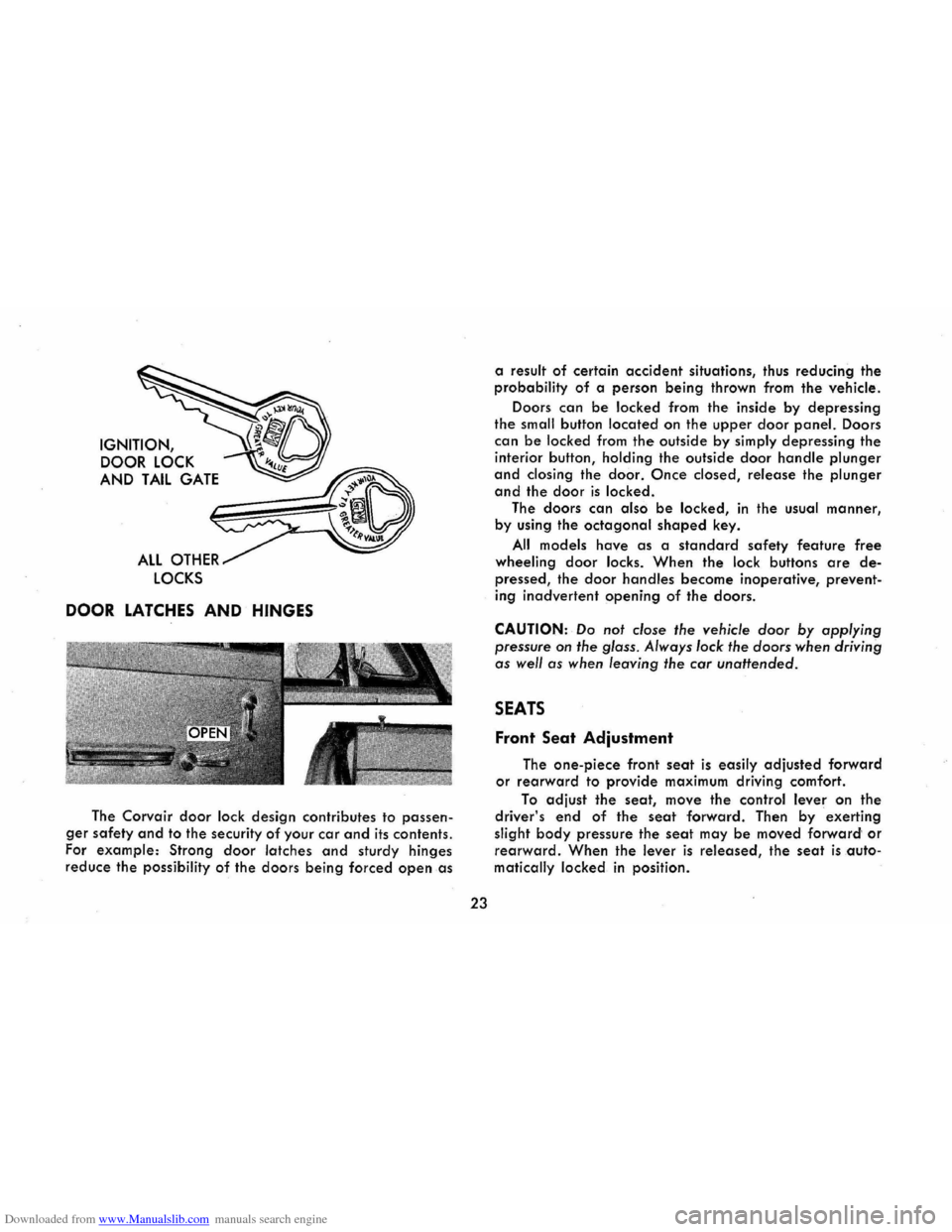
The octagonal-end key operates the ignition switch
and the doors of your Corvair.
The round-end key operates the glove box, luggage
compartment and the optional spare tire lock.
As a
reminder to remove your ignition key whenever
your vehicle is attended, a buzzer will sound if the left
front door is opened and the key remains in the ignition
switch (off-or accessory position).
Page 26 of 56
Downloaded from www.Manualslib.com manuals search engine IGNITION, DOOR
LOCK
AND TAIL GATE
ALL OTHER
LOCKS
DOOR LATCHES AND HINGES
The Corvair door lock design contributes to passen
ger safety and to the security of your car and its contents.
For
example: Strong door latches and sturdy hinges
reduce the possibility of the doors being forced open as
23
a result of certain accident situations, thus reducing the
probability
of a person being thrown from the vehicle.
Doors
can be locked from the inside by depressing
the small button located on the upper door panel. Doors
can be locked from the outside by simply depressing the
interior button, holding the outside door handle plunger
and closing the door. Once closed, release the plunger
and the door is locked.
The doors
can also be locked, in the usual manner,
by using
the octagonal shaped key.
All models have as a standard safety feature free
wheeling door locks. When the lock buttons are de
pressed, the door handles become inoperative, prevent
ing
inadvertent opening of the doors.
CAUTION: Do not close the vehicle door by applying
pressure
on the glass. Always lock the doors when driving
as well as when leaving the car unattended.
SEATS
Front Seat Adjustment
The one-piece front seat is easily adjusted forward
or rearward to provide maximum driving comfort.
To adjust the seat, move the control lever on the
driver's end of the seat forward. Then by exerting
slight
body pressure the seat may be moved forward' or
rearward. When the lever is released, the seat is auto
matically locked
in position.
Page 40 of 56
Downloaded from www.Manualslib.com manuals search engine PERIODIC MAINTENANCE AND LUBRICATION
The time or mileage intervals on the following pages
are intended as a general guide for establishing regular
maintenance and lubrication periods for your Corvair.
Sustained heavy duty or high speed operations or oper-
A WORD ABOUT VEHICLE EMISSIONS
All new 1968 Corvairs are certified by the United States Department of Health, Education and Welfare as
conforming to the requirements of the regulations for
the Control of Air Pollution from New Motor Vehicles
and New Motor Vehicle Engines.
General Motors has developed control systems which
are highly effective in reducing undesirable crankcase
and exhaust emissions. It is very important that the owner make certain that the engine is serviced regularly
in order to maintain its efficiency and to keep emissions
below maximum allowable limits.
The emission control system on
your 1968 Corvair is
relatively easy to maintain, requiring only specific serv
ices as recommended by Chevrolet. To function properly,
this system must be inspected periodically and engine
tune-up performed at specified intervals by qualified
repairmen. For ready reference, pertinent information regarding ignition timing and idle speed and fuel mix
ture specifications is shown on a sticker affixed under
the hood of your vehicle. Following the prescribed main-
37
ation under adverse conditions may necessitate more
frequent servicing. For specific recommendations for con
ditions under which you use your vehicle, consult your
authorized Chevrolet Dealer.
tenance services
will help assure cleaner air and will
provide better running, longer lasting engines for greater
all-around satisfaction, economy and performance.
POSITIVE CRANKCASE VENTILATION (P.C.V')
The Positive Crankcase Ventilation system, which is
standard equipment on your vehicle, prevents emission
of gases from the crankcase. The P .C.V. system connects
the crankcase and intake manifold of the engine and
crankcase gases are returned through this system to the
combustion
chamber where they are burned. Periodic
inspection
and required servicing of your P.C.V. system
assures a cleaner, better-performing, longer-lasting
engine. A plugged P.C.V. system results in a loss of
crankcase ventilation which can cause condensation of
blow-by gases in the crankcase, resulting in the forma
tion of acids, sludge build-up and oil dilution. This also
results in
an increase in exhaust emissions due to car
buretor enrichment. Every 12,000 miles or 12 months,
whichever occurs first, the PCV valve should be replaced.
Page 41 of 56
Downloaded from www.Manualslib.com manuals search engine Also, all hoses, fittings and the inlet air filter should be
inspected, cleaned and replciced if necessary.
NOTE: If the positive crankcase ventilator valve should
become
dogged, the engine idle will be adversely
affect~d. Therefore, if the engine idle becomes too slow
or rough, the ventilator valve should be checked before
any carburetor ad;ustments are made to compensate for
the trouble.
AIR INJECTION REACTOR (A.I.R.l
The Air
Injection Reactor system is designed to re
duce .air pollution caused by exhaust emissions. It is entirely separate from the Positive Crankcase Ventilating
system. The Air
Injection Reactor system operates by
oxidizing (or burning) the
hydrocarbons and carbon
monoxide as they are expelled from the combustion
chamber into the exhaust. A positive displacement air
pump, driven by the engine, compresses clean frltered
air, which
is distributed and injected at the exhaust part
of each cylinder. This fresh air mixes with the hot exhaust
gases and promotes further oxidation (or burning) of
both hydrocarbons and carbon monoxide by converting
some
of them to carbon dioxide and water. This does not
reduce the danger of inhaling carbon monoxide in con
frned areas. See page 7 for carbon monoxide warning.
Supplementing
the air pump a special carburetor and
distributor plus related components are required.
The Air
Injection Reactor system should have the A.I.R. pump filter serviced and the drive belt inspected
for
wear and tension every 12 months or 12,000 miles,
38
whichever occurs frrst. In addition, complete effectiveness
of the system, as well as full power and performance,
depends upon idle speed, ignition timing, and idle fuel
mixture being
set according to specifrcation. A quality
tune-up which includes
these adjustments should be per
formed periodically to assure normal engine efficiency,
operation and performance.
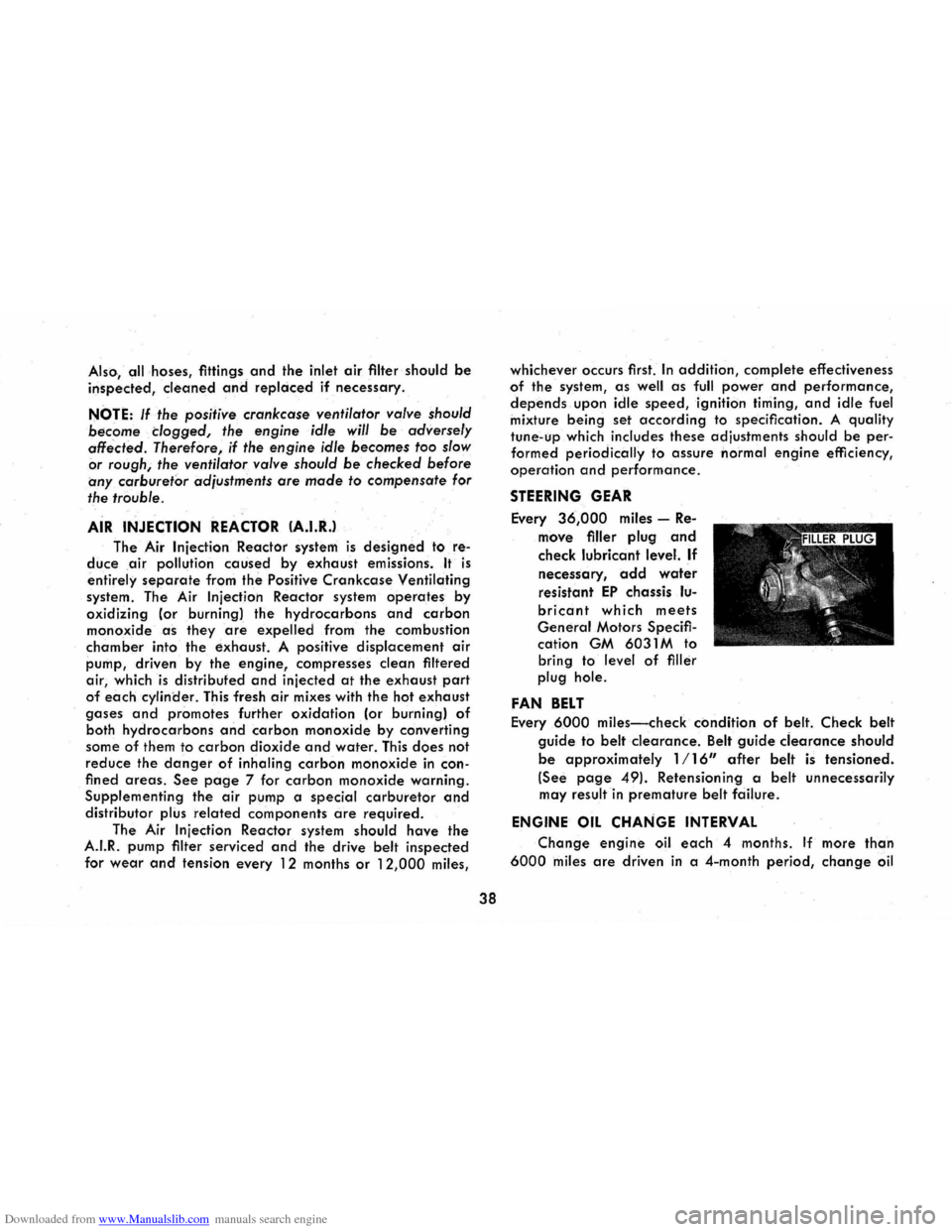
STEERING GEAR
Every 36,000 miles -Re
move frller plug and
check lubricant level. If
necessary, add water
resistant EP chassis lu
bricant which meets
General Motors Specifr
cation GM 6031 M to
bring to level
of frller
plug hole.
FAN BELT
Every 6000 miles-check condition of belt. Check belt
guide to belt clearance. Belt guide ciearance should
be approximately 1/16" after belt is tensioned.
(See page 49). Retensioning a belt unnecessarily
may result
in premature belt fciilure.
ENGINE OIL CHANGE INTERVAL
Change engine oil each 4 months. If more than
6000 miles are driven in a 4-month period, change oil
Page 45 of 56
Downloaded from www.Manualslib.com manuals search engine AIR CLEANER
CAUTION: In addition to its function of filtering air
drawn into
the engine through the carburetor, the air
cleaner also acts as
a flame arrester in the event the
engine backfires. Because backfiring
may cause fire in
the engine compartment, the air cleaner should be in
stalled at all times unless its removal is necessary for
repair or maintenance services.
Paper Element Type
The oil-wetted paper element is a long-life efficient air
cleaner and should not require replacement before
24,000 miles except under extreme adverse condi
tions .
Inspect air cleaner at 12,000 miles for dust leaks,
holes
or other damage, replace if necessary . If
condition is satisfactory, rotate element 1800 from
originally installed position. Replace
at 24,000 miles.
Under extreme
adverse conditions inspect every 6,000 miles.
Oil Bath Type
Every 12,000 miles-Inspect and clean if necessary.
Refill with SAE 50 engine oil when lowest anticipated
temperature is above freezing; use SAE 20 if below
freezing.
BATTERY (ENERGIZER)
Every 6,000 miles-Clean and oil battery terminals and
oil felt washer. Check fluid level frequently. Keep
filled with distilled water to level of split ring in
42
vent tube. The electrolyte level indicator in the cap
of one cell will glow if the fluid level is low. In this
case each cell should be checked.
CAUTION: Since normal battery or Energizer
chemical action generates hydrogen gas which
is highly explosive when mixed with air, never
expose the battery to an open flame or electric
spark. Also, avoid getting battery fluid, which
is a sulfuric acid solution, on skin, on clothing
or other fabrics, or on painted surfaces . Eye
protection should
be worn while working on the
battery for
any reason.
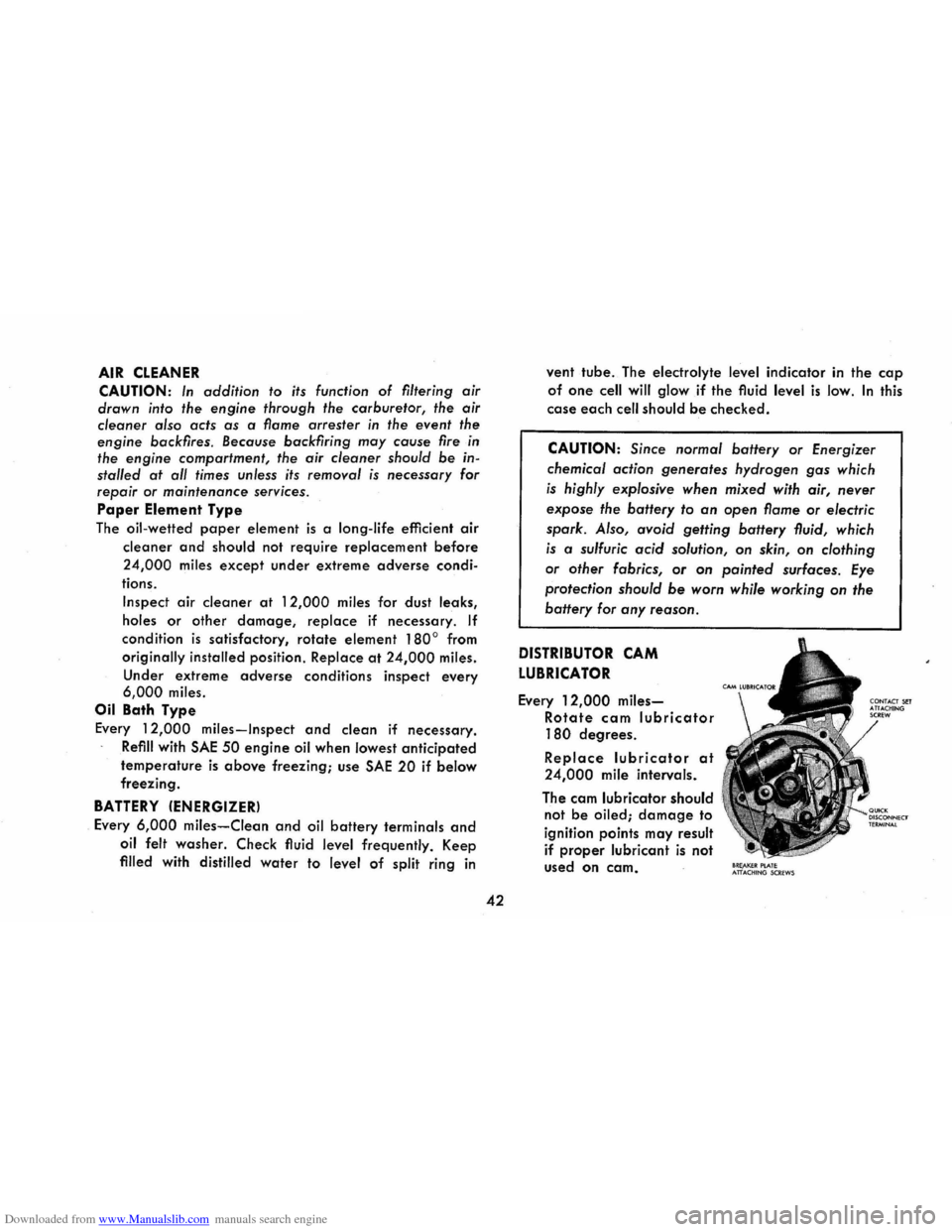
DISTRIBUTOR CAM
LUBRICATOR
Every 12,000 miles
Rotate cam lubricator
180 degrees.
Replace lubricator at
24,000 mile intervals.
The cam lubricator should
not
be oiled; damage to
ignition points may result
if
proper lubricant is not
used
on cam. 8RE,AKEIt PlATE ATTACHtNG SCREWS
Page 47 of 56
Downloaded from www.Manualslib.com manuals search engine SPECIFICATIONS
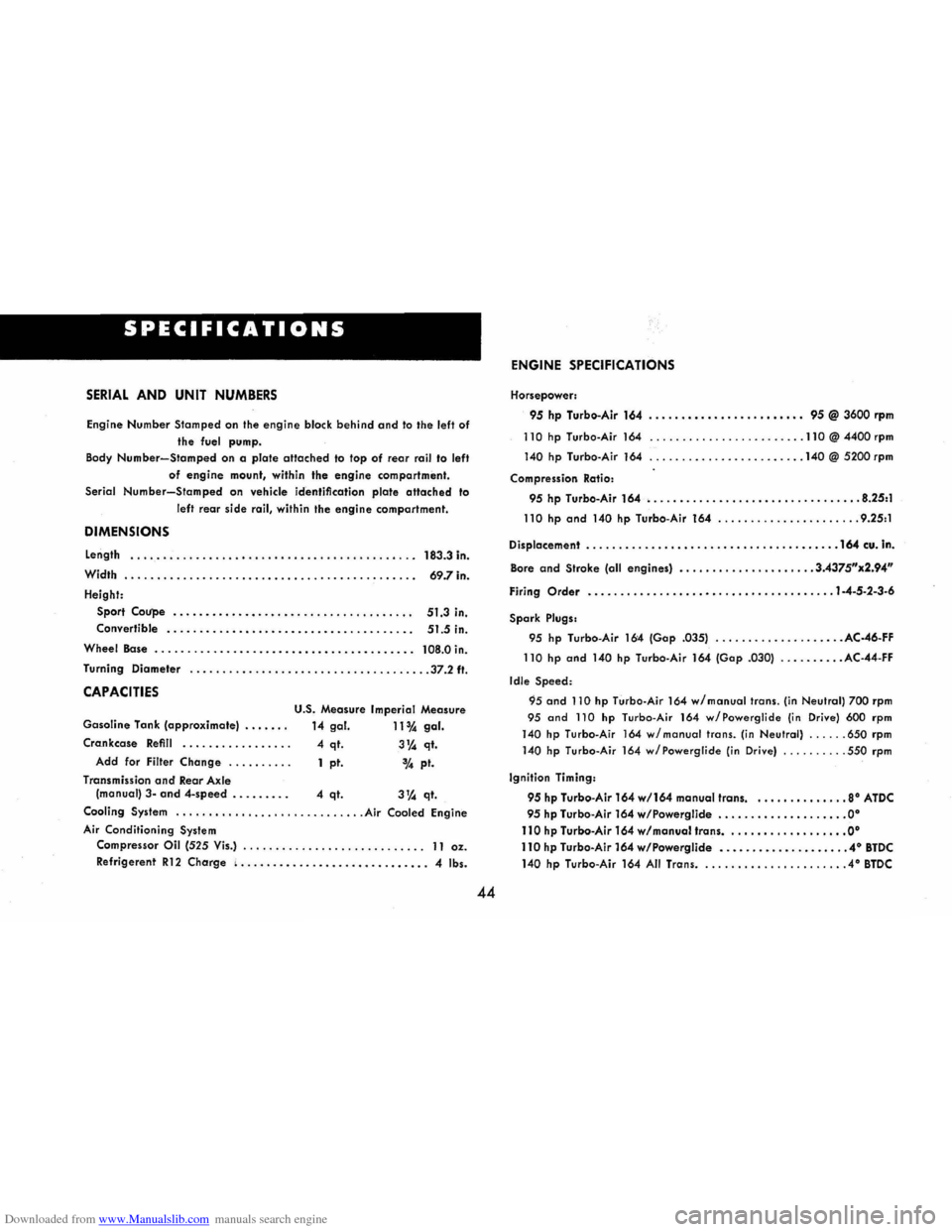
SERIAL AND UNIT NUMBERS
Engine Number Stamped on the engine block behind and to the left of
the fuel pump.
Body
Number-Stamped on a plate attached to top of rear rail to left
of engine mount, within the engine compartment .
Serial
Number-Stamped on vehicle identification plate attached to
left
rear side rail, within the engine compartment.
DIMENSIONS
Length .•...............•.•.•..................•... 183.3 in.
Width
.......•....•. . ....•..••......•.............• 69.7 in.
Height: Sport
Coupe ......•...••• ..•..••............•..•• 51.3 in.
Convertible
..........•.....••..•...•............. 51.5 in.
Wheel Base
...................•..•...•.... , ........ 108.0 in.
Turning Diameter .
.•..........•............... ........ 37.2 ft.
CAPACITIES
U.S. Measure Imperial Measure
Gasoline Tank (approximate) ...... .
14 gal. 11 % gal.
Crankcase Refill •....•..... ...... 4 qt. 3~ qt.
Add for Filter Change ......... . 1 pt. 3,4 pt.
Transmission
and Rear Axle
(manual) 3-and 4-speed ........ . 4 qt. 3~ qt.
Cooling System .....••...................... Air Cooled Engine
Air Conditioning System
Compressor Oil (525 Vis.) ...•............. ......... " 11 oz.
Refrigerent
R12 Charge ( •......•................•.... 4 Ibs.
44
ENGINE SPECIFICATIONS
Horsepower:
95 hp Turbo-Air 164 ......••.•.•........•.•• 95 @ 3600 rpm
110 hp Turbo-Air 164 ........................ 110 @ 4400 rpm
140 hp Turbo -Air 164 ........................ 140 @ 5200 rpm
Compression Ratio:
95 hp Turbo-Air 164 •...•........•.•.••••.•...••.•••. 8.25:1
110 hp and 140 hp Turbo-Air 164 ...................... 9.25:1
Displacement
......•....••••••..••••••...•..•.••\
•.•• 164 cu. In.
Bore and Stroke (all engines) ................. .... 3.4375"x2.94"
Firing Order •.........•..•••••••..•.•.••.•\
..••..•. 1-4-5-2-3·6
Spark Plugs.
95 hp Turbo-Air 164 (Gop .035)
.................... AC-46-FF
110
hp and 140 hp Turbo-Air 164 (Gop .030) .......... AC- 44-FF
Idle
Speed:
95 and 110 hp Turbo-Air 164 wi manual trans. (in Neutral) 700 rpm
95
and 110 hp Turbo-Air 164 w/Powerglide (in Drive) 600 rpm
140 hp Turbo-Air 164 wi manual trans. (in Neutral) ...... 650 rpm
140 hp Turbo-Air 164 w/Powerglide (in Drive) .......... 550 rpm
Ignition Timing:
95 hp Turbo-Air 164 wl164 manual trans •..•...•.•••.•. 8· ATDC
95 hp Turbo-Air 164 w/Powerglide ••.•..•••.••••..•••• 0·
110 hp Turbo-Air 164 wi manual Irons •....•..•..••....•. 0·
110 hp Turbo-Air 164 w/Powerglide •.••..•••.•..•••••.. 4· BTDC
140 hp Turbo-Air 164 All Trans ....................... 4° BTDC
Page 50 of 56
Downloaded from www.Manualslib.com manuals search engine MINOR TROUBLE SHOOTING PROCEDURES
The chart on the previous page, and the information on the pages
which follow, contains information designed to aid the average
driver to discover, and possibly correct, conditions resulting in minor
mechanical
difficulties in his car. The chart, designed to point out
possible solutions to
several of the most common automotive mal
functions
and point out a logical checking sequence, will lead step
by step to the most likely causes and corrective procedures. If, after
making the checks and adjustments suggested, the source of the
trouble
has not been found and corrected, it is strongly recom
mended
that an Authorized Chevrolet Dealer inspect the vehicle and
make whatever repairs or adjustments are necessary.
FUEL SYSTEM AND ENGINE
If the ignition switch will cause the engine to "turn over" or
"crank" but the car will not start, check Steps A through D below.
NOTE:
If continual "flooding" of the carburetor is evidenced by a
carburetor wet with fuel or black exhaust smoke, perform the
operation
suggested in paragraph 0 only .
(A) The first and most obvious,
and one of the most frequently
overlooked, items to check when
you
have- difficulty in starting your
car is the amount of fuel in the
tank.
Make it a habit to check the
FUEL GAUGE regularly and most
especially
at a time when the en
gine will "turn over" but will not
start.
(8)
If the fuel tank is not empty, Checking Fuel Flow
47
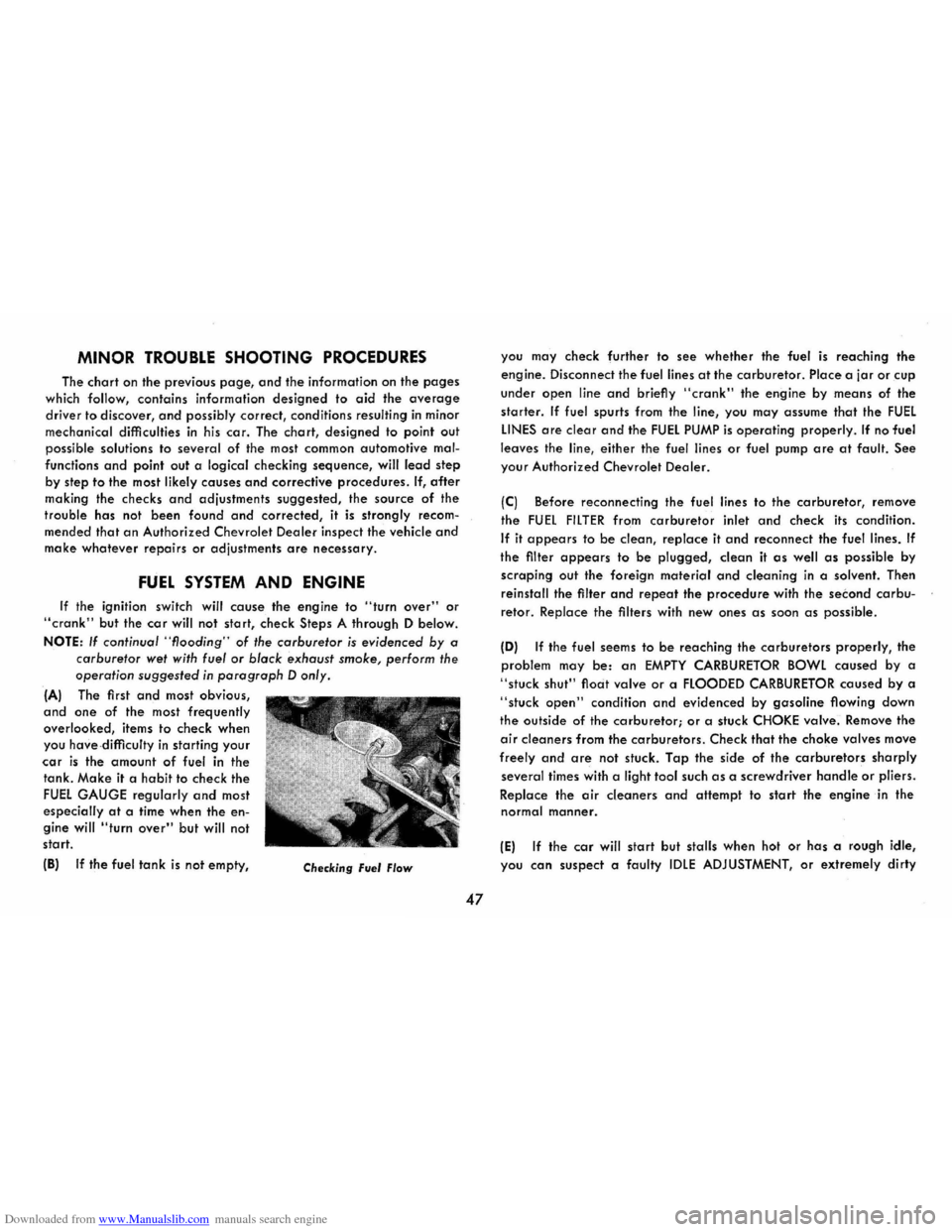
you may check further to see whether the fuel is reaching the
engine. Disconnect the fuel lines
at the carburetor. Place a jar or cup
under open line and briefly "crank" the engine by means of the
starter. If fuel spurts from the line, you may assume that the FUEL
LINES are clear and the FUEL PUMP is operating properly. If no fuel
leaves the line, either the fuel lines
or fuel pump are at fault. See
your Authorized Chevrolet Dealer.
(C) Before reconnecting the fuel lines to the carburetor, remove
the
FUel FilTER from carburetor inlet and check its condition.
If it appears to be clean, replace it and reconnect the fuel lines. If
the filter appears to be plugged, clean it as well as possible by
scraping out the foreign material and cleaning in a solvent. Then
reinstall the filter
and repeat the procedure with the second carbu
retor. Replace the filters with new ones as soon as possible .
(0) If the fuel seems to be reaching the carburetors properly, the
problem may
be: an EMPTY CARBURETOR BOWL caused by a
"stuck shut" float valve or a flOODED CARBURETOR caused by a
"stuck open" condition and evidenced by gasoline flowing down
the outside
of the carburetor; or a stuck CHOKE valve. Remove the
air cleaners from the carburetors. Check that the choke valves move
freely and are not stuck. Tap the side of the carburetors sharply
several times with a light tool such as a screwdriver handle or pliers.
Replace the
air deaners and attempt to start the engine in the
normal manner.
(E) If the car will start but stalls when hot or has a rough idle,
you
can suspect a faulty IDLE ADJUSTMENT, or extremely dirty
Page 51 of 56
Downloaded from www.Manualslib.com manuals search engine and blocked AIR CLEANER ELEMENTS. Replace the air cleaner ele
ments
if necessary. Idle adjustment should be performed by your
Chevrolet Dealer.
If the above Fuel System checks and the checks suggested under
the Electrical System following do not correct the malfunction, it is
recommended that you turn to your Authorized Chevrolet Dealer
for further checks, adjustments
or repairs.
ELECTRICAL SYSTEM
If, when the ignition key is turned to START, the engine will not
turn over, you have
good reason to suspect electrical trouble.
(F) When there is no response at all to attempts to start the car,
check the obvious-your AUTOMATIC TRANSMISSION SELECTOR
LEVER must be in neutral position before the engine can be started.
Turning the IGNITION SWITCH rapidly back and forth several
times
will sometimes correct a poor internal switch contact.
(G) The BATTERY may be discharged. If so, lights will be dim and
the horn will have a poor tone if it will blow at all.
Usually
a garage recharge will be necessary to return the battery
to operotion. Occasionally, however, a long drive will recharge
the battery.
NOTE:
If the battery is determined to be dead, and for no apparent
reason, have
your Authorized Chevrolet Dealer check the
battery, the GENERATOR and the
VOLTAGE REGULATOR.
GENERATOR trouble should already have been indicated
by
the indicator on the instrument panel. Never remove generator
"BAT" lead without first disconnecting battery ground cable.
48
POOR BATTERY CONNECTIONS may be suspected if the car has operated properly a short time before and now not even the horn
will operate. Check both ends of both battery cables. If the con
nections are corroded, a car may sometimes be restored to operation by removing all cable ends, scraping all contacting surfaces
clean with a pen knife, and reassembling. If the cables are broken,
they must be replaced. The power supply should now be restored
unless the battery is dead.
(H) If, however, the lights and horn work properly but the starter will still not turn over, check the STARTER connections. A "click" from the starter solenoid indicates that the wiring to the starter is properly installed. If the wiring seems to be clean and tightly installed, the trouble is probably in the starter itself and should be referred to your Authorized Chevrolet Dealer.
When the engine will "turn over" but will not start, the following
items may be checked along with Fuel System Checks listed previously.
(I) With a clean dry cloth wipe the ceramic portions of the spark plugs dry. In particularly damp or rainy weather dampness may be the cause of not sta rting, especially when the engine is cold.
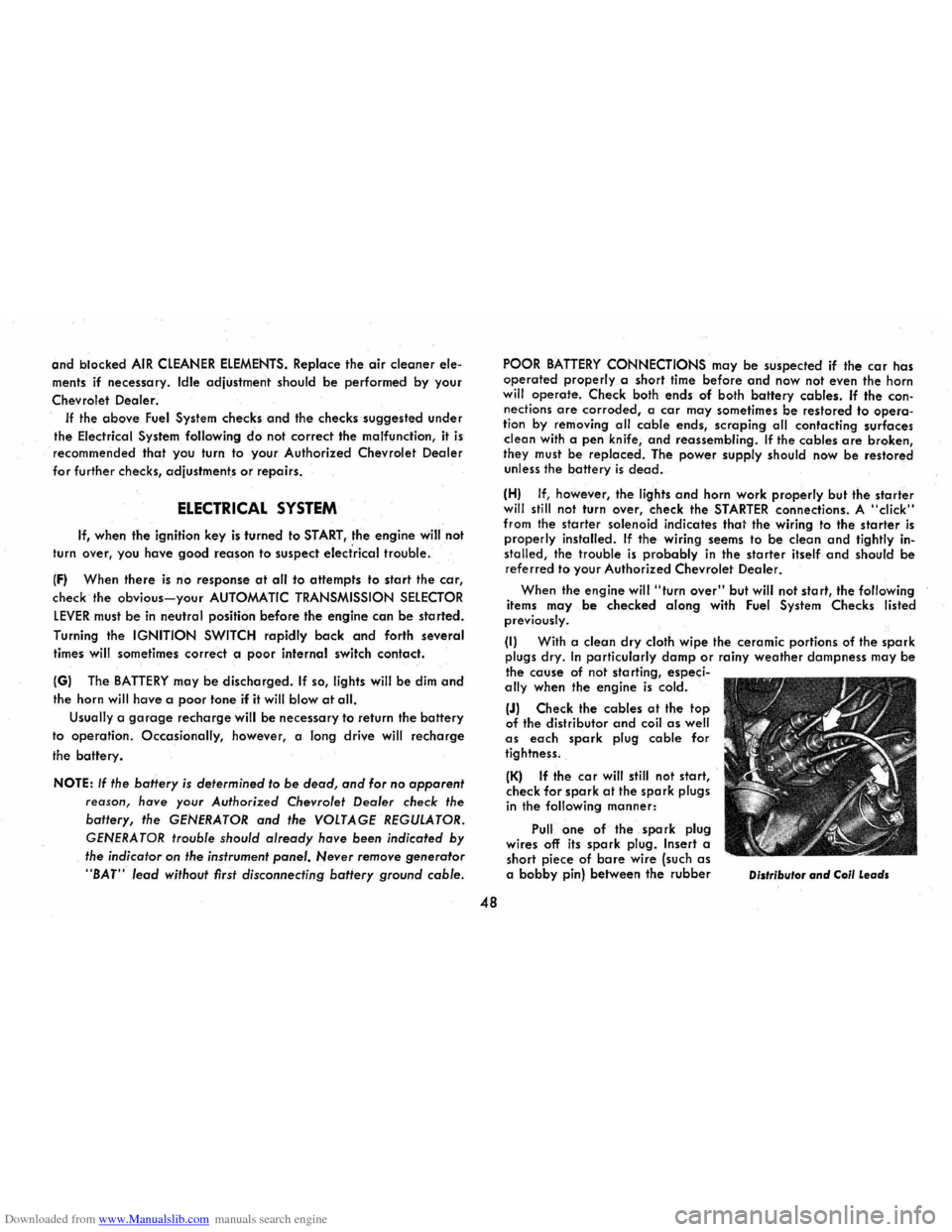
(J) Check the cables at the top of the distributor and coil as well as each spark plug cable for
tightness.
(K) If the car will still not start, check for spark at the spark plugs in the following manner:
Pull one of the spark plug
wires off its spark plug. Insert a
short piece of bare wire (such as a bobby pin) between the rubber Distributor and Coil Leads
Page 52 of 56
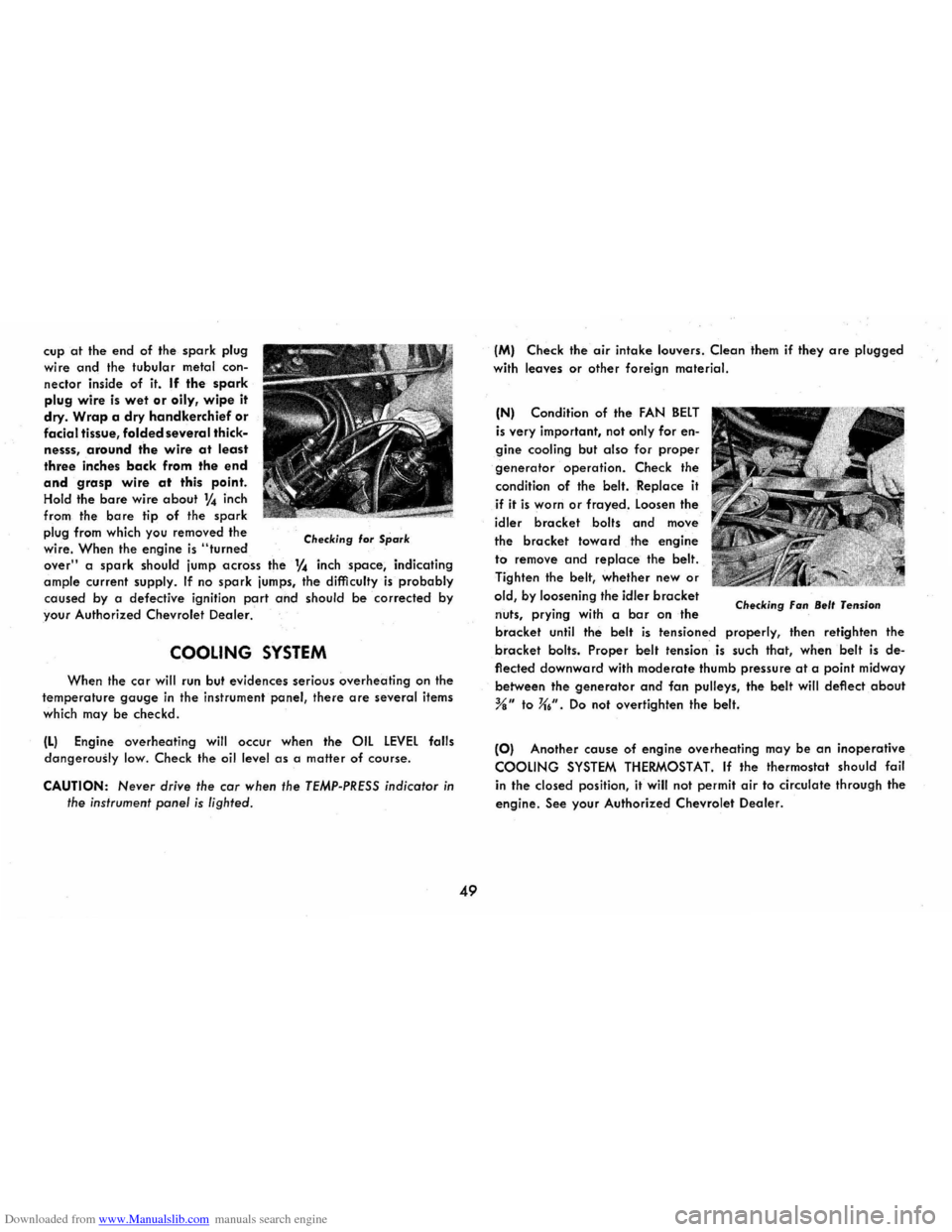
Downloaded from www.Manualslib.com manuals search engine cup at the end of the spark plug
wire
and the tubular metal con
nector inside of it. If the spark
plug wire is wet or oily, wipe it
dry.
Wrap a dry handkerchief or
facial tissue, folded several thick
nesss, around the wire at least
three inches back from the end
and grasp wire at this point.
Hold the
bare wire about V4 inch
from the bare tip of the spark
plug from which you removed the
wire. When the engine is "turned Checking for Spork
over" a spark should jump across the V4 inch space, indicating
ample current supply.
If no spark jumps, the difflcultyis probably
caused by a defective ignition part and should be corrected by
your Authorized
Chevrolet Dealer.
COOLING SYSTEM
When the car will run but evidences serious overheating on the
temperature
gauge in the instrument panel, there are several items
which may
be checkd.
(L) Engine overheating will occur when the OIL LEVEL falls
dangerously low.
Check the oil level as a matter of course.
CAUTION: Never drive the car when the TEMP-PRESS indicator in
the instrument panel is lighted.
49
1M) Check the air intake louvers. Clean them if they are plugged
with leaves
or other foreign material.
IN) Condition of the FAN BELT
is very important, not only for en
gine cooling but also for proper
generator operation. Check the
condition of the belt. Replace
it
if it is worn or frayed. Loosen the
idler
bracket bolts and move
the
bracket toward the engine
to remove and replace the belt.
Tighten the belt, whether new
or
old, by loosening the idler bracket
nuts, prying with a bar on the Checking Fan Be" Tension
bracket until the belt is tensioned properly, then retighten the
bracket bolts. Proper belt tension is such that, when belt is de
flected downward with moderate thumb pressure at a point midway
between the
generator and fan pulleys, the belt will deflect about
:Va" to K6". Do not overtighten the belt.
(0) Another cause of engine overheating may be an inoperative
COOLING SYSTEM THERMOSTAT. If the thermostat should fail
in the closed position, it will not permit air to circulate through the
engine.
See your Authorized Chevrolet Dealer.