steering CHEVROLET CORVETTE 1993 4.G User Guide
[x] Cancel search | Manufacturer: CHEVROLET, Model Year: 1993, Model line: CORVETTE, Model: CHEVROLET CORVETTE 1993 4.GPages: 370, PDF Size: 21.43 MB
Page 164 of 370
Downloaded from www.Manualslib.com manuals search engine R-
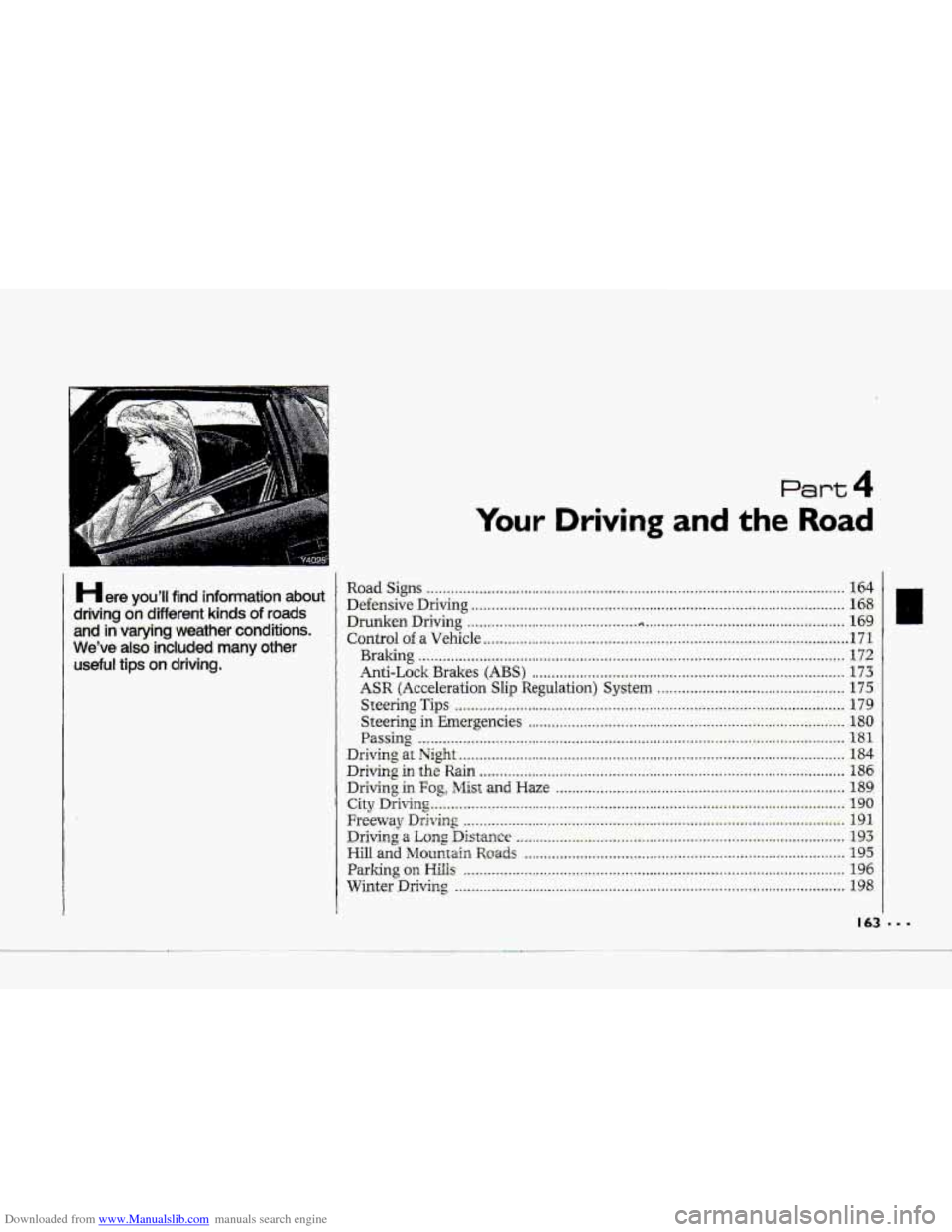
Here you'll find .information about
ddvmg on different kinds of ro.ads
and in varying weather conditions.
We've also included many other
useful tips on driving.
Part 4
Your Driving and the Road
Road Signs .. . ... . . . . .. ..... . . ,... . .. . . . .. . _. . . .. . . . . . .+. . . . . . ... . .. .. . . . . . . . . . . ... .. . . . . . . .. . . . . . . ... . .. . .... . . . . 164
Defensive Driving. . .... . . . . . . . .... . . .. . . . . &. . . . .. . ... . . . .. .. . . . . . , . . . . . . . +. . . , . , -. . . . . . . . . . . . . . . . . . . . .*. . .+ ... 168
Drunken Driving . . . . . . . . . -. . . . . . . . . . -. . . . . . . . . . . . . .I +, . , . . *. . . . . , , . . . . . . . . . , . . . . . . . . . . . . . . . . . . . ... . <.. . . . . . . . 169
Control.:of a Vehicle .. . . . . . . . . . .. . . . . . . . . . . . . . . . . . ... . . . . , . . , +. . .. . . . . . . _. . . . . . . *. . .. . . . . . . . . . . . . .. . . ... . .. . .. 17 1
Braking ........................................................................\
................................... 172
hti-Lock Brakes (ABS) ..................~.........,...........................................\
.. '.. 173
ASR (Acceleration Slip Regulation) System .............................................. 175
Steering Tips .. .. . . .. . . ... . . . . . . . . . .. . .. . . . . . . . . . . . . . . . . ._. . . . . . . . . . . . , . . ... . . . . , . . . *. . -, . , , . . . , , , , . . . ... . . , . . 179
Steering in Emergencies .... -. . . ?. . . . . , .. .. .. . . . . . . . . . . ... . . . . . . , . . . . , . . . ... . . .. .. . . . ..-. - ..... ..-. .. . . -180
Driviqp Mght ........................................................................\
......... .....,......... 184
Driving in the kin ..._....,....... .....+... +.... ......... + ................................................. 186
Driving-in Fog, Misl and Haze .... . . ._.._. . . . . . . . . . . . , . . , . . . . . . ... . . .+_. . . . . . . . . . .. . . . . . . . . . . . . . . . . . . 189
City Dnvi~i.lng _._..._.I.._._..__.___ _.___: ... ._ _.__. ............ ... . . ... .. .............. . .... . ........................ 190
-Freeway Dnvang __. . . . .. _._ ._. __. .__ . . . . -. . .. . __._ . . . . . . . . . . . . . . . ... . . . . . . -. . . . . . . . . . . . . . . . . . . . . .. . .. . .-. . ... . . 19 1
Driving a Long Distance ._ ._ _. __._ ._ _._ . . .. . . . . -. . . . . . . . . . . . . . . . . . . . . . . . -. .. . . . -.-._. . . ... . . _. . . . . . .. . . . ... . 193
Hill and hiloramai~ Rmds ........................................................................\
........ 195
Parking on Hills. I..X.1.........__.l.....I..............................................~\
...................... 196
Winter Driving __ ..._.._____... ._. ._ ._. ._. .. . ..... .. . . .. . ... . . . . . . . . . . . .... . . . . . . . . . . . , . , . . . . . . . . . . . . . .... . . . . 198
Passing *I*..* ..................................................................... -: ......... a. ..i;..i.r- .e... ;... 181 7,
2.. .
Page 179 of 370
Downloaded from www.Manualslib.com manuals search engine --
Your Driving and the Road
Brake Pedal Travel Brake Adjustment
See your dealer if the brake pedal does
not return to normal height, Qr if there
AS you make brake stops, your disc
couid be a sign of brake trouble
is
a rapid- increase in pedal travel. This
brakes automatically adjust .for wear. , .. .
178
Braking In Emergencies
Use your .anti-lock braking system when
you-need to. With,anti-lock, you can
steer and brake at the same time.. In
many.emagencies, steering can help
you more than even the very best
braking;.
Page 180 of 370
Downloaded from www.Manualslib.com manuals search engine r" i
'4
f
-/_
i
t-
i
Power Steering
If you lose power steering assist
because the engine stops
or the system
fails to function, you c-an steer but it
will take much more effort.
i.
steering Tips-Dtiving on Curves
It's important to tale curves at a
reasonable
speed.
A lot of the "driver lost control"
accidents mentioned
on. the news
happen on .curves. .Here's why:
Experienced driver
or beginner, each of
us is subject to the same laws of physics
when
driving on'curves; The.;traction of
the tixes against the road surface makes
it possible
for the vehicle to change its
path when you turn the front wheels. If
there's no traction, inertia will keep the
vehicle going in the same direction. If
yuu"ve mer tried to steer a vehicle on
wet ice> you:U understand this.
The traction you can get in a curve
depends on the condition of your tizies
and
the road surface, the angle at which
the-curve
is banked, and your speed,
While you're in
a curve, speed is the one
factor you can control.
Suppose you're steering through. a. sharp
a.xve. Then you suddenly acwlerate. If
excess wheel spin is detected, ASR will
reduce erigine torque to the wheels. Lf
your ASR system is off, those two
control systems-steering and
acceleration-can ovGrwhelm those
i places where-the tires meet the road and
~ make you lose control.
1 What should you do if this ever
happens? Let
up on the accelerator
pedal, steer
the vehicle the way you
want it to go, and slow down.
Page 181 of 370
Downloaded from www.Manualslib.com manuals search engine ..I
Your Driving and the Road
’I
Steering Tips-Driving on Curves
(CONT.)
Speed limit signs near curves warm that
you should adjust your speed.
Of
course, the posted speeds are based on
good weather and road conditions.
Under less favorable conditions you’ll
want to
go slower.
If you need to reduce your speed as you
approach
a curve, do it before you enter
the curve, while your hont wheels are
straight ahead.
Try
to adjust your speed so you can
Wive” through the curve. Maintain a
reasonable, steady speed. Wait to
accelerate until you are out
of the curve,
and then accelerate gently into the
straightaway.
When you drive into
a curve at night,
it’s harder to see the road ahead
of you
because it bends away
from the straight
beams
of your lights. This is one good
reason to drive slower.
I80
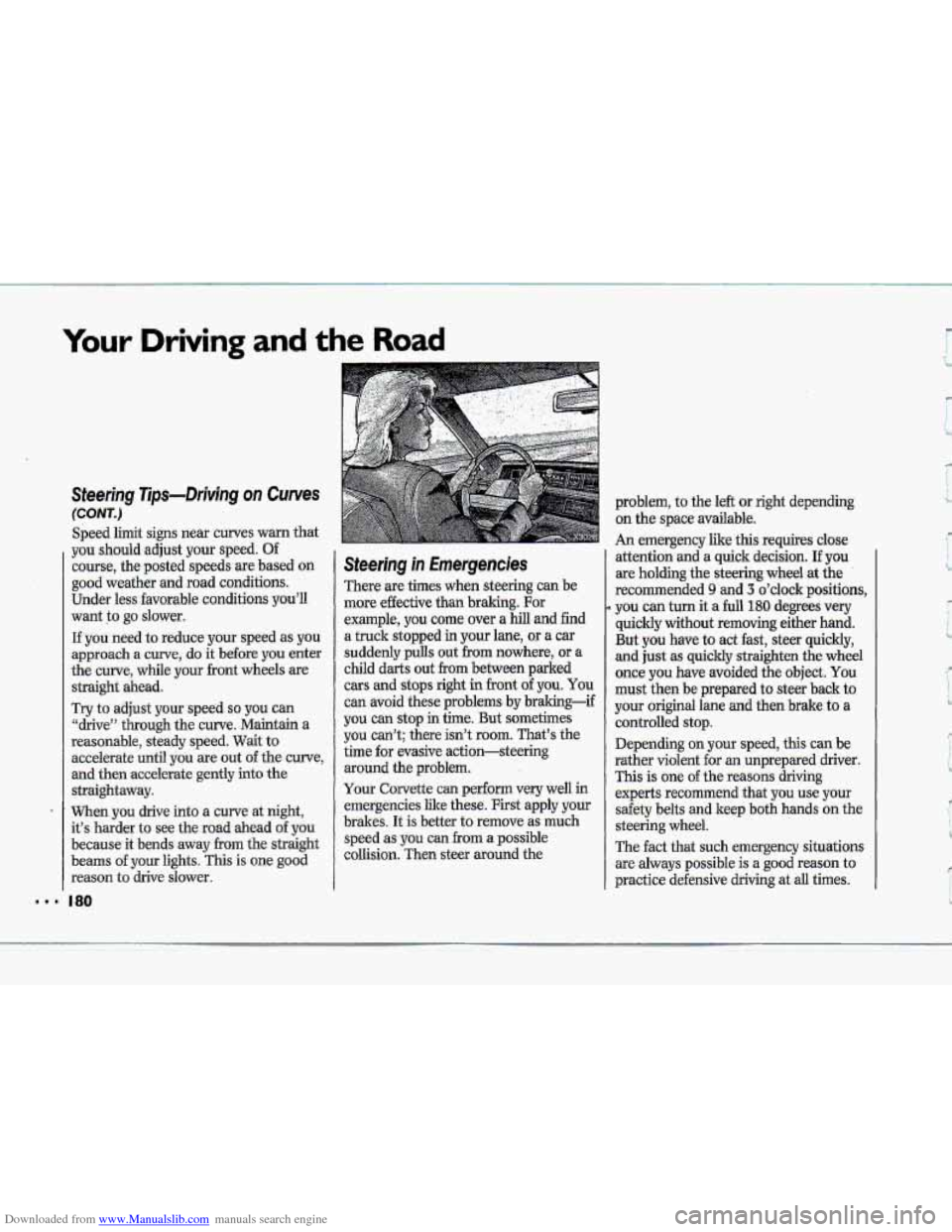
Steering in Emergencies
There are times when steering can be
more effective than braking. For
example,
you come over a hill and find
a truck stopped
in your lane, or a car
suddenly pulls out
€ram nowhere, or a
child darts out from between parked
cars and stops right in front of you. You
can avoid these problems by braking-if
you can stop in time. But sometimes
you can’t; there isn’t
room. That’s the
time for evasive action-steering
around the problem.
Your Corvette
can perform very well in
emergencies like these. First apply your
brakes. It is better
to remove as much
speed as you can
from a possible
collision. Then steer around the
9
problem, to the left or right depending
on the space available.
An emergency like this requires close
attention and a quick decision.
If you
are holding the steering wheel at the
recommended
9 and 3 o’clock positions,
you can turn it a full 180 degrees very
quickly without removing either hand.
But you have to act fast, steer quickly,
and just as quickly straighten the wheel
once
you have avoided the object. You
must then be prepared to steer back to
your original lane and then brake to a
controlled stop.
Depending on your speed, this can be
rather violent for an unprepared driver.
This is one of the reasons driving
experts recommend that you use your
safety belts and keep both hands
on the
steering wheel.
The fact that such emergency situations
are always possible is
a good reason to
practice defensive driving at
all times.
Page 182 of 370
Downloaded from www.Manualslib.com manuals search engine T
i
,+
I i
r.
!
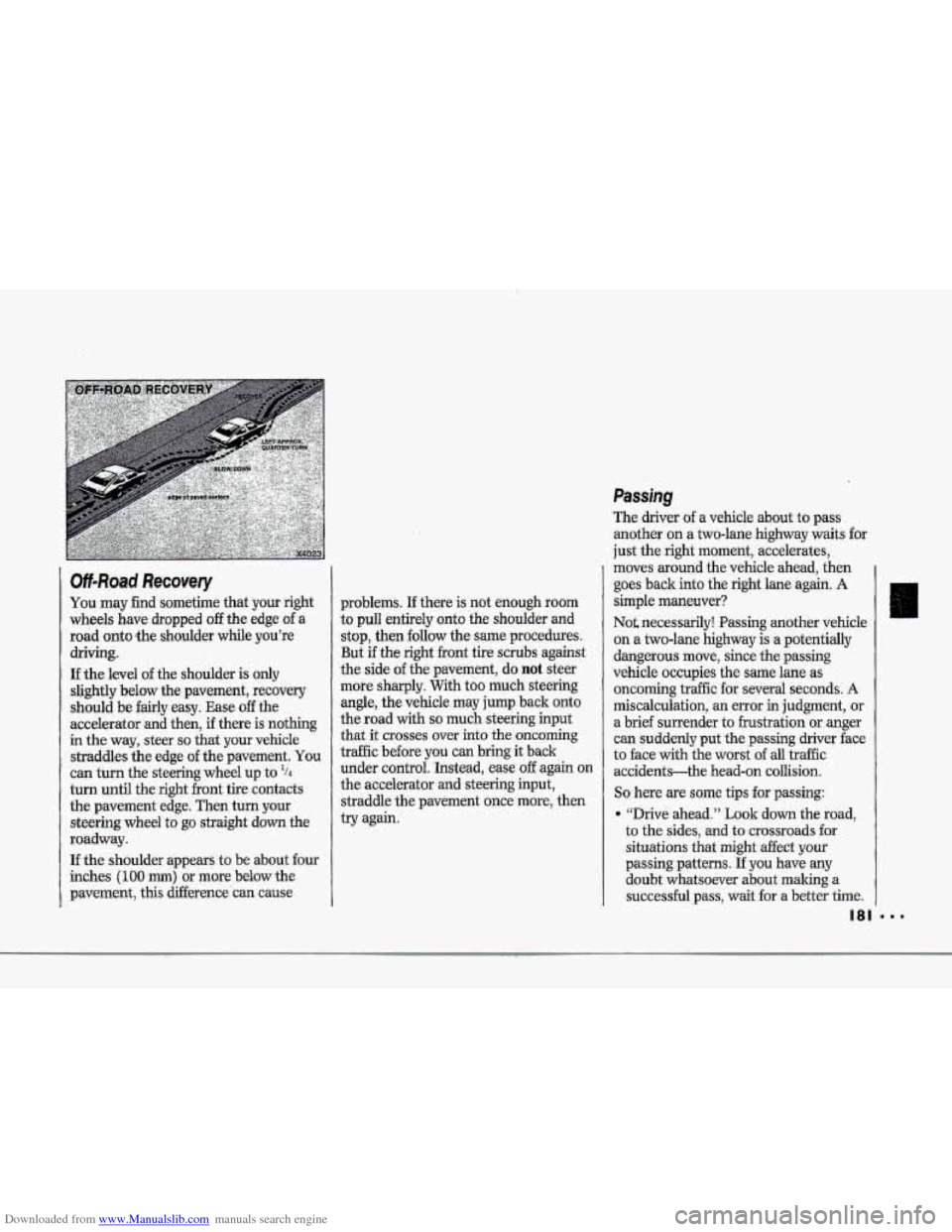
Ofl-Road .Recovery
You may hd sometime that your right
wheels bave dropped 08 the edge of-a
road mtwthe &odder while you’re
driving.
ff- the level of the shoulder is only
slightly below the pavement, recovery
should be fairly easy. Ease off the
accelerator and then, if there is nothing
in the way, steer so that. your%Wde
straddles the edge of. the pavement. You
can turn the steering wheel up to ‘h
turn until theight. front tire contacts
the pavement
edge. Then turn your
stetking wheel to go straight dm the
rcradway.
If the- shoulder appears to be about four
inches (100 mm) or more below the
pavement,. this difference.cm cause
problems. If there is not boough room
to pull entirely onto the shoulder and
stgp, then fdbw the same procedures.
But if the riglit €rant tire scrubs against
the side. af the pavement, do not skstr
more.sharplyy. With too much steering-
angle, the vehicle may jump back o~to
the road with so much steering input
that it-cmsses over into the oncoming
tr&c ,before you can bring it back
under control.. ;Instead, ease off again an
the? accelerator and steeping input,
straddle
the pavement once more, then
try again.
Page 184 of 370
Downloaded from www.Manualslib.com manuals search engine w-
Loss. of Control
Let’s review what- driving experts say
about what ha-ppens when the three
cuntrd systems
(brakes, steering and
acceleration) dodt have enough hictior
where the tires meet the road to do
what the driver has asked,
In any emergency, don’t give up. Keep
trying to- steer and constantly seek an
escape r.oute.oy area of less danger.
Page 200 of 370
Downloaded from www.Manualslib.com manuals search engine m-4.
Driving on Snow or Ice
Most of the time, those ,places where
y6ur tires meet the road pr:obably
have
good traction.
However,
if there is mow or ice
betwe.en
you^ tires and the road, you
can have a very slippery Situati-on.
You’ll have alot lcss traction Crr
“@p”and -will need t.Cbe very careful.
What’s the wors;t- time for this? “Wet
ice;” Very cold
mow or ice can be slick
and hard to drive on. But-wet. ice can be
even more trouble .because it-may offer
the least
traction .o% all. You c.an iet wet
ice-when -it% about freezing (WF, PC)
2nd heezing pain begins- to fall. Try to
avoid driving an wet ice until salt, and
sand crews ean get there.
Allow greaterfollowing distafice on
any slippery road.
Watch for slippery spots. The road
might be fine until you hit a- spot
that% covered with ke. On an
othehvise dear roadyice patches may
appear in shaded areas- whefe. the sun
can’t reach: around clumps crf trees,
behind buildings, or under bridges.
Sometimes-
the &dace of. a curve or
an overpass may remain icy’when. the
surrounding roads are dear. If you see
a patch of ic.e ahead of you, brake
befgre you are on it. Try not to, brakc
while you?e:actu.al€y on the ice, and.
avoid
sudden steering maneuvers,
Page 211 of 370
Downloaded from www.Manualslib.com manuals search engine Towhg Your Corvette (CONT.)
When your vehicle is being towed, have
the ignition key
off. The steering wheel
should-be.
clamp,ed in a straight-ahead
position, with a clamping device
designed fur towing s-ervice. DO not use
the vehicle's stewing column iock for
this. The transmission shoLild be in
N [Neutral), and the.parlepg brake
released.
Don't have your vehicle tqwed on the
rear wheels,. unless you must. If the
vehicle
must. be t0we.d on the rear
wheels, dan't go more than 3mph
I
(56 km/h) or farther than 50 miles
(80.h) or your transmission will be
-damaged. Go slow over rough ground,
and position one wheel at a time
(angled 450j if you have- to go over
eurbs.and
rises. .Wheels &the lifted end
should be-
at. least 4 inches (10 cm)
above the ground. If these limits must
be
exceeded, then the rear wheels have
to be supported .on-a dolly.
I
.,
A
A vehicle can faH~~~m~a:c~
carrier if ,it isn't propgilp '
secured., This can cause a.colii$ion,
serious. pelrsonal injury .and:.vehicle.
damage.
The vehicle..shou[d be
t-ightly secured with chains or--sted -'
cables before it is transported-'
Don't use substitutes '(ropes,
leather straps, canvas webbing,
etc:.) that- can be cut by sharp edges
underneath the t.owed vehicle,
Page 225 of 370
Downloaded from www.Manualslib.com manuals search engine Problems on the Road
lJu Tire Goes Flat
It’s unusual for a tire to “blow out”
while you’re driving, especially if-you
maintain
your tires properly. If air goes
out of a tire, it’s much more likely to
leak out
slowly. But if you should ever
have a “blowout,” here are a few tips-
about what to expect
and what to do:
If a front tire fails, the flat tire will
create a drag that pulls the vehicle
toward that side. Take yuur foot 08 the
accelerator pedal
and grip the steering
wheel firmly. Steer to maintain lane
p-osition, then gently brake to -a stop
well out of the. traffic lam.
A rear blowout, particularly on a curve,
acts much like a skid and may require
the
same corre&ion you’d use in a skid.
h any rear bhwout, remove yop foot
from the accelerator pedal. Get the
vehicle under control by steering the
way you want the vehicbto go. It may
be very bumpy and noisy, hut you can
still steer. Gently brake to B stop, well
off’ the road if posiible.
If your tire go& flat, the next section
shows how to use your jacking
equipment to change a flat tire sdely.
e
Page 238 of 370
Downloaded from www.Manualslib.com manuals search engine c
c-
If You’re Stuck: In Sand, Mud,
Ice or Snow
What you don’t want to do when your
vehicle is stuck is to spin your wheels.
The method
known as “rocking” can
rou must use caution. I help you get out when you’re stuck, but
CAUT/UN I
A: If :you let.your :tires. spin -at
high speed.when the ASR
, . ‘OFE warning light is on, or when
“the SERVICE ASR warning light is
‘on, your tires can explode and you
or others could be injured. And,
spinning your tires with either of
these lights on can cause the
automatic transmission
or other
parts of the vehicle to overheat.
That could cause an engine
compartment fire or other damage.
When you’re stuck, spin the wheels
as little as possible. Don’t spin the
wheels above 35 mph (56 M) as
shown on the speedometer.
Rocking Your Vehicle to Get It Out:
First, turn your steering wheel left and
right. That will clear the area around
your front wheels. You should turn your
ASR system off. Then, shift back and
forth between R (Reverse) and a
forward gear--or if you have a manual
transmission, between 1 or 2 and
R (Reverse)-spinning the wheels as
little as possible. Release the accelerator
pedal while
you shift, and press lightly
on the accelerator pedal when the
transmission is in gear.
If that doesn’t
get
you out after a few tries, you may
need to be towed out.
If you do need to
be towed
out, see the Index under
Towing Your Corvette and Acceleration
Slip Regulation (ASR) System.
237