warning light CHEVROLET CORVETTE 1994 4.G User Guide
[x] Cancel search | Manufacturer: CHEVROLET, Model Year: 1994, Model line: CORVETTE, Model: CHEVROLET CORVETTE 1994 4.GPages: 274, PDF Size: 15.61 MB
Page 126 of 274
Downloaded from www.Manualslib.com manuals search engine This is a mistake. Your brakes may not
have time to cool between hard stops.
Your brakes will wear out much faster if
you do a lot
of heavy braking. If you keep
pace with the traffic and allow realistic
following distances, you will eliminate a
lot of unnecessary braking. That means
better braking and longer brake life.
If your engine ever stops while you’re
driving, brake normally but don’t pump
your brakes. If you do, the pedal may get
harder to push down. If your engine stops,
you will still have some power brake
assist. But you will use it
when you brake.
Once the power assist is used up, it may
take longer to stop and the brake pedal
will be harder to push.
SERVICE
I
Anti-Lock Brakes (ABS)
Your Corvette has an advanced electronic
braking system that will help prevent
skidding.
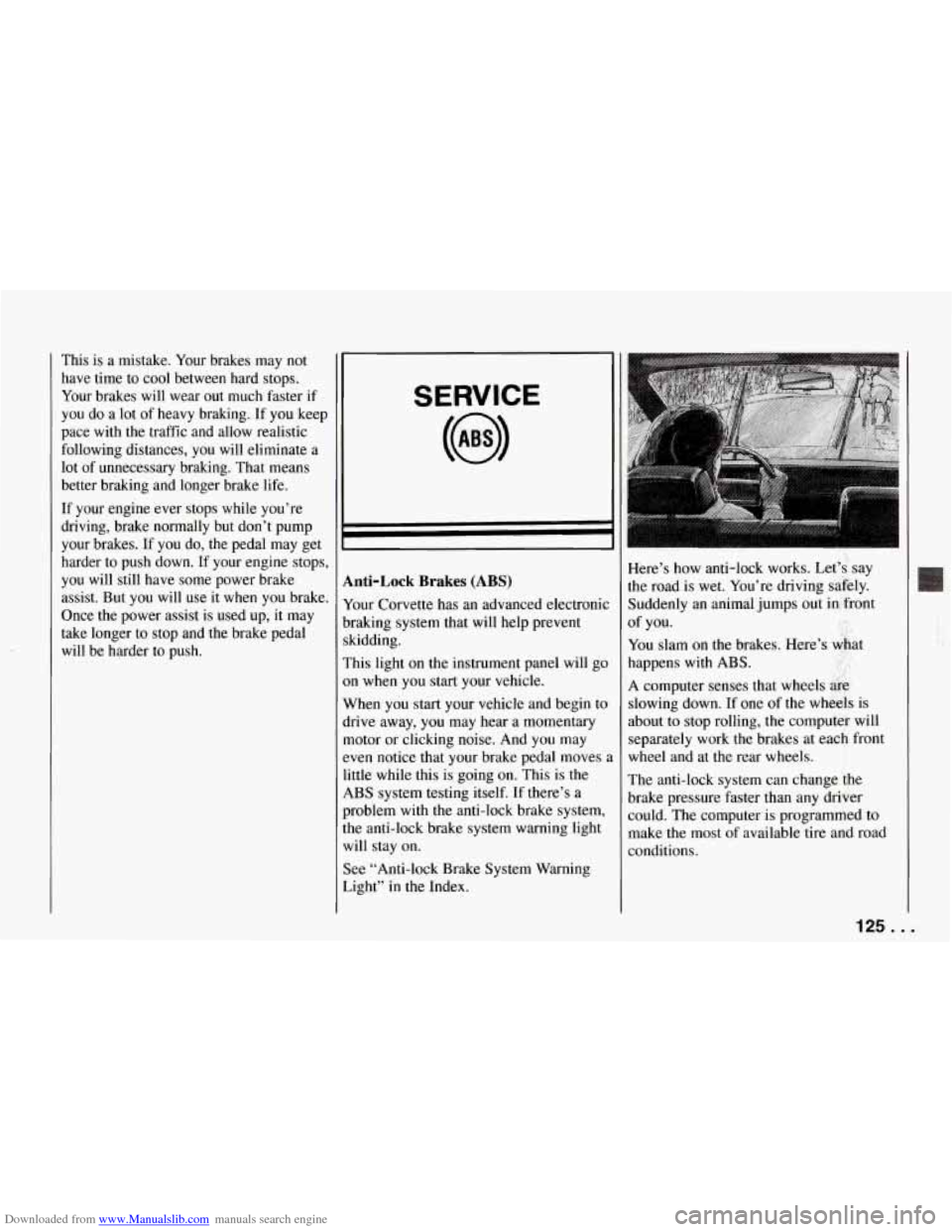
This light on the instrument panel will go
on when you start your vehicle.
When you start your vehicle and begin to
drive away, you may hear a momentary
motor or clicking noise. And you may
even notice that your brake pedal moves
,
little while this is going on. This is the
ABS system testing itself. If there’s a
problem with the anti-lock brake system,
the anti-lock brake system warning light
will stay on.
See “Anti-lock Brake System Warning
Light” in the Index. Here’s how anti-lock works. Let’s, say
the road
is wet. You’re driving safely.
Suddenly an animal jumps out in front
You slam on the brakes. Here’s &at
happens with
ABS. ..
A computer senses that wheels &g,
slowing down. If one of the wheels is
about to stop rolling, the computer will
separately work the brakes at each front
wheel and at the rear wheels.
The anti-lock system can change
the
brake pressure faster than any driver
could. The computer is programmed to
make the most of available tire and road
conditions. of
you.
125..,
Page 128 of 274
Downloaded from www.Manualslib.com manuals search engine The
comc
prob
Whe
will
drivi Systc
SERVICE
ASR
“SERVICE ASR“ warning light will
2 on
to let you know if there’s a
lem with the ASR system. See “ASR
:m Warning Light” in the Index.
n this warning light is on, the system
not limit wheel spin. Adjust your
ng accordingly. The
ASR system automatically comes on
whenever you start your vehicle. To limit
wheel spin, especially in slippery road
conditions, you should always leave the
system on. But you can turn the ASR
system off
if you ever need to. (You
should turn the system off if your vehicle
ever gets stuck
in sand, mud, ice or snow.
See “Rocking Your Vehicle” in the
Index.)
To
turn the system off, press the button
located above the headlight switch. The
“ASR
OFF’ light will come on and stay
on. If the ASR system is limiting wheel
spin when you press the button, the
system won’t turn off right away. It will
wait until there’s no longer a current
need
to limit wheel spin.
You can turn the system back on at any
time by pressing the button again. The
“ASR
OFF’ light should go off.
Braking in Emergencies
Use your anti-lock braking system when
you need to. With anti-lock, you can steer
and brakG at the same time. In many
emergencies, steering can help you more
than even the very best braking.
Steering
; .1
,.
Power Steering
If you lose power steering assist because
the engine stops or the system is not
functioning, you can steer but it will take
much more effort.
Steering Tips
Driving on Curves
It’s important to take curves at a
reasonable speed.
A lot
of the “driver lost control” accidents
mentioned
on the news happen on curves.
Here’s why:
Experienced driver or beginner, each
of
us is subject to the same laws of physics
when driving on curves. The traction of
127 ...
Page 132 of 274
Downloaded from www.Manualslib.com manuals search engine While driving on a surface with reduced
traction, try your best to avoid sudden steering, acceleration, or braking
(including engine braking by shifting to
a lower gear). Any sudden changes could
cause the tires to slide.
You may not
realize the surface is slippery until your vehicle is skidding. Learn to recognize
warning clues
- such as enough water,
ice or packed snow on the road to make a
“mirrored surface”
- and slow down
when you have any doubt.
Remember: Any anti-lock braking system (ABS) helps avoid only the braking skid.
I
1 Driving at Night
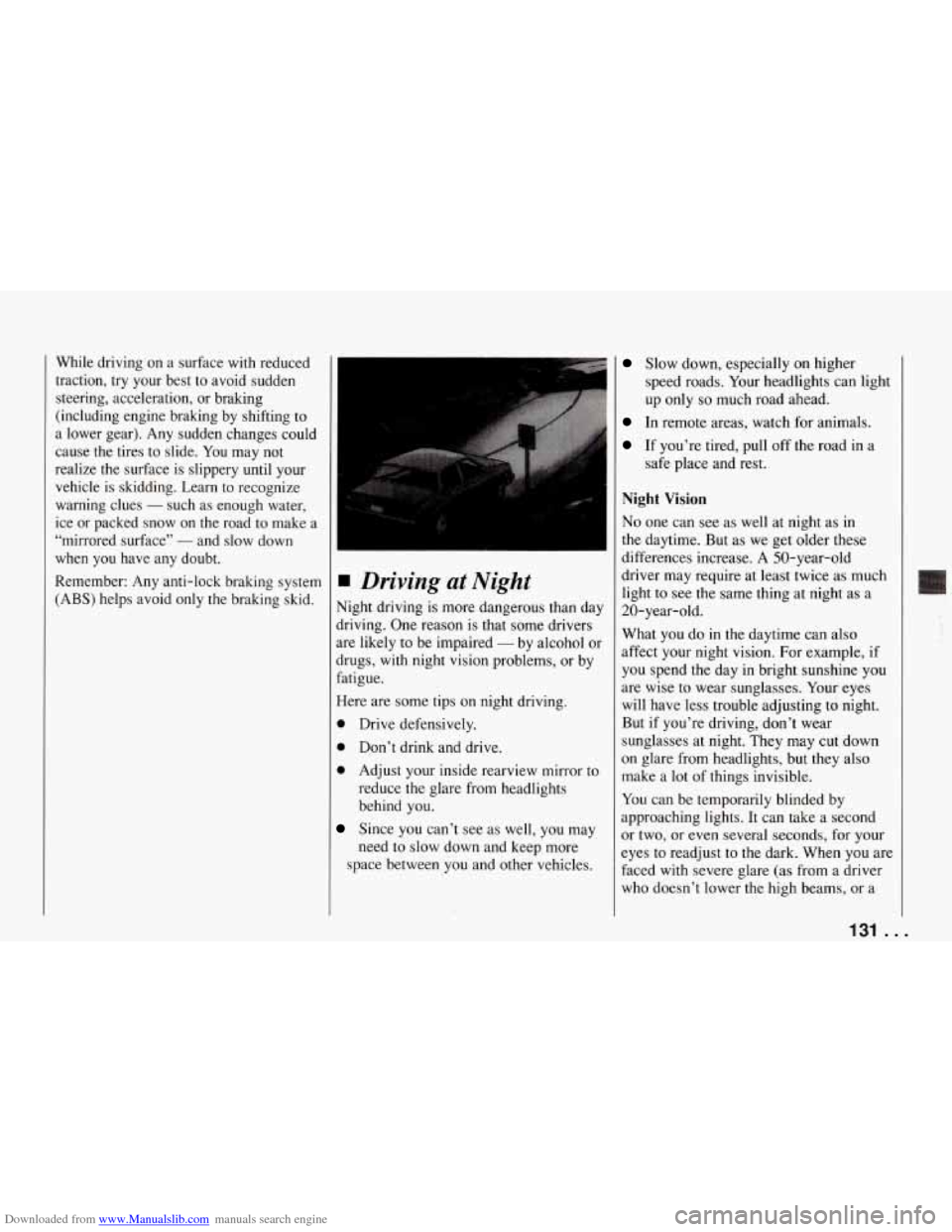
Night driving is more dangerous than day
driving. One reason is that some drivers
are likely to be impaired
- by alcohol or
drugs, with night vision problems, or by
fatigue.
Here are some tips on night driving.
0 Drive defensively.
0 Don’t drink and drive.
0 Adjust your inside rearview mirror to
reduce the glare from headlights
behind you.
Since you can’t see as well, you may
need to slow down and keep more
space between you and other vehicles.
Slow down, especially on higher
speed roads. Your headlights can light
up only
so much road ahead.
In remote areas, watch for animals.
If you’re tired, pull off the road in a
safe place and rest.
Night Vision
No one can see as well at night as in
the daytime. But as we get older these
differences increase.
A 50-year-old
driver may require at least twice as much
light to see the same thing at night as a
20-year-old.
What you do in the daytime can also
affect your night vision. For example, if
you spend the day in bright sunshine you
are wise to wear sunglasses. Your eyes
will have less trouble adjusting to night.
But if you’re driving, don’t wear
sunglasses at night. They may cut down
on glare from headlights, but they also
make a lot of things invisible.
You can be temporarily blinded by
approaching lights. It can take
a second
or two, or even several seconds, for your
eyes to readjust to the dark. When you are
faced with severe glare (as from a driver
who doesn’t lower the high beams, or a
131 ..
Page 135 of 274
Downloaded from www.Manualslib.com manuals search engine Your Driving and the Road
City Driving
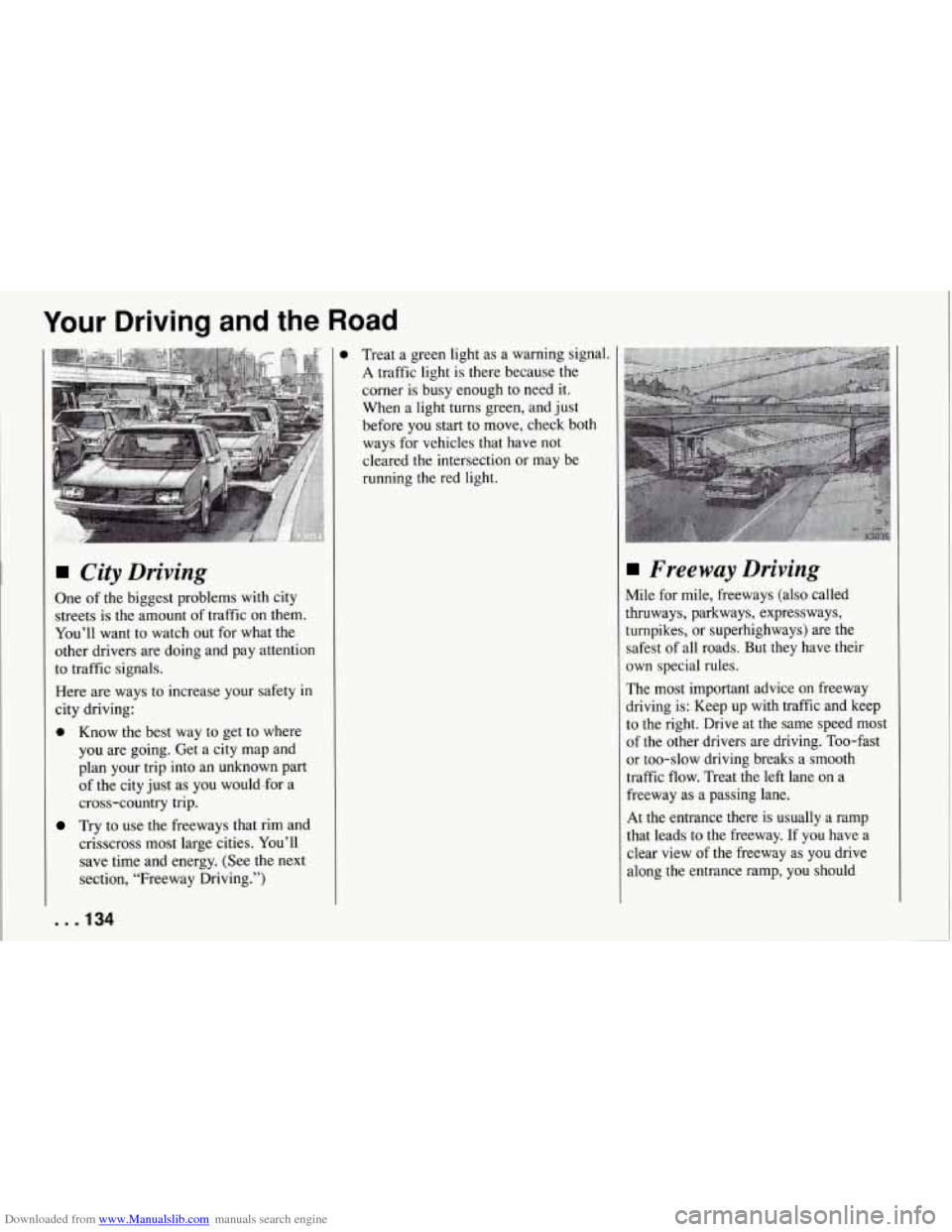
One of the biggest problems with city
streets is the amount of traffic on them.
You’ll want to watch out for what the
other drivers are doing and pay attention
to trafflc signals.
Here are ways to increase your safety in
city driving:
0 Know the best way to get to where
you are going. Get a city map and
plan your trip into an unknown part
of the city just as you would-for a
cross-country trip.
Try to use the freeways that rim and
crisscross most large cities. You’ll
save time and energy. (See the next
section, “Freeway Driving.”)
. . .I34
Treat a green light as a warning signal.
A traffic light is there because the
corner is busy enough to need it.
When a light turns green, and just
before
you start to move, check both
ways for vehicles that have not
cleared the intersection or may be
running the red light.
Freeway Driving
Mile for mile, freeways (also called
thruways, parkways, expressways,
turnpikes, or superhighways) are the
safest of all roads.
But they have their
own special rules.
The most important advice on freeway driving is: Keep up with traffic and keep
to the right. Drive at the same speed most
of the other drivers are driving. Too-fast
or too-slow driving breaks
a smooth
traffic flow. Treat the left lane
on a
freeway as a passing lane.
At the entrance there is usually a ramp
that leads to the freeway. If you have a
clear view of the freeway as you drive
along the entrance ramp, you should
Page 138 of 274
Downloaded from www.Manualslib.com manuals search engine 0
0
0
Stay in your own lane when driving
on two-lane roads. in hills or
mountains. Don't swing wide or cut
across the center of the road. Drive at speeds that let you stay in your own
lane.
As you go over the top of a hill, be
alert. There could be something in
your lane, like
a stalled car or an
accident.
You may see highway signs on
mountains
that warn of special
problems. Examples are long grades,
passing or no-passing zones, a falling
rocks area, or winding roads. Be alert
to these and take appropriate action.
0
0
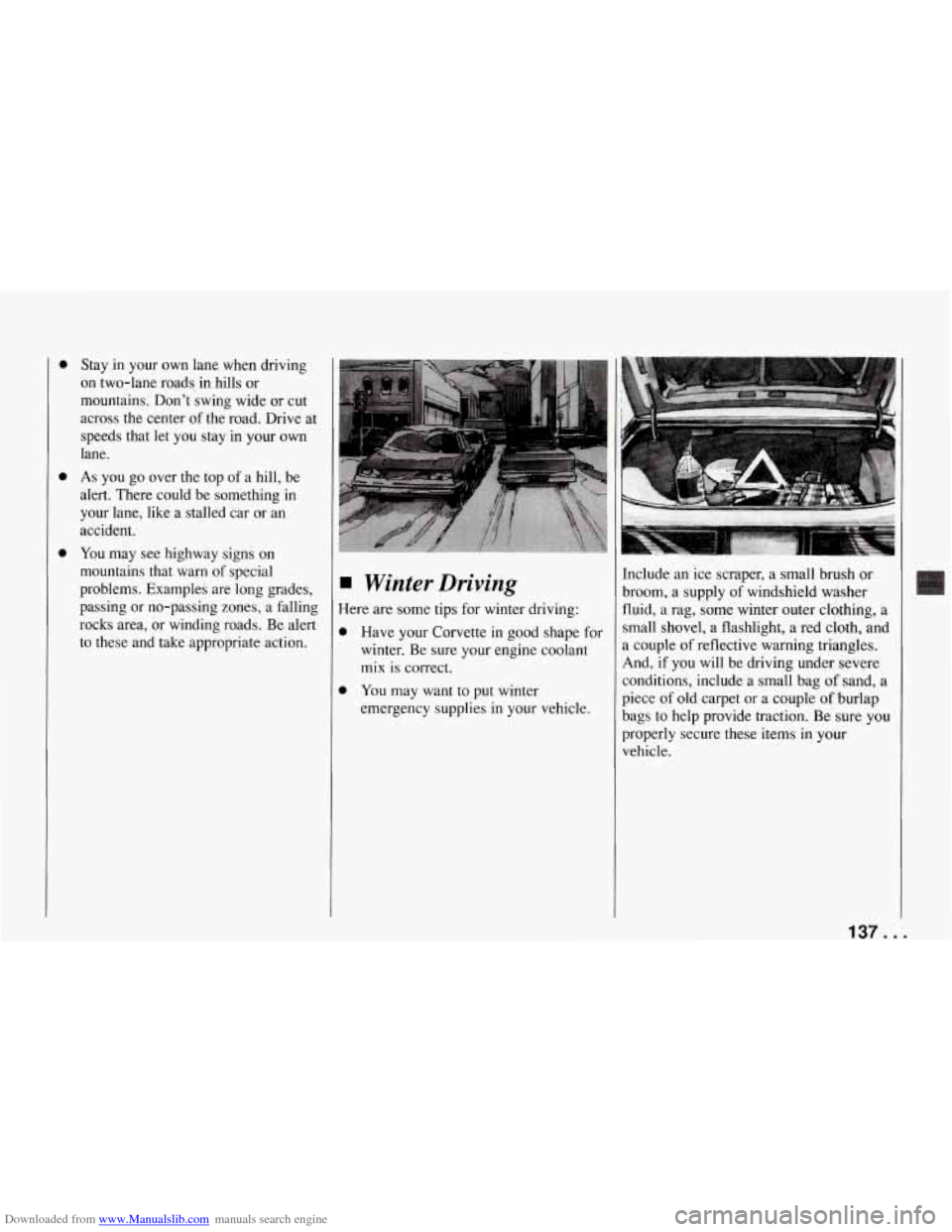
Winter Driving
Here are some tips for winter driving:
Have your Corvette in good shape for
winter. Be sure your engine coolant
mix
is correct.
You may want to put winter
emergency supplies in your vehicle.
I ,,;;. &_ $*>;.$ , x; ':. . , ;"!d i
Include an ice scraper, a small brush or
broom, a supply of windshield washer
fluid, a rag, some winter outer clothing, a
small shovel, a flashlight, a red cloth, and
a couple
of reflective warning triangles.
And,
if you will be driving under severe
conditions, include a small bag
of sand, a
piece of old carpet or a couple
of burlap
bags to help provide traction. Be sure you
properly secure these items
in your
vehicle.
137 ...
Page 143 of 274
Downloaded from www.Manualslib.com manuals search engine Problems on the Road
Hazard Warning
Flashers
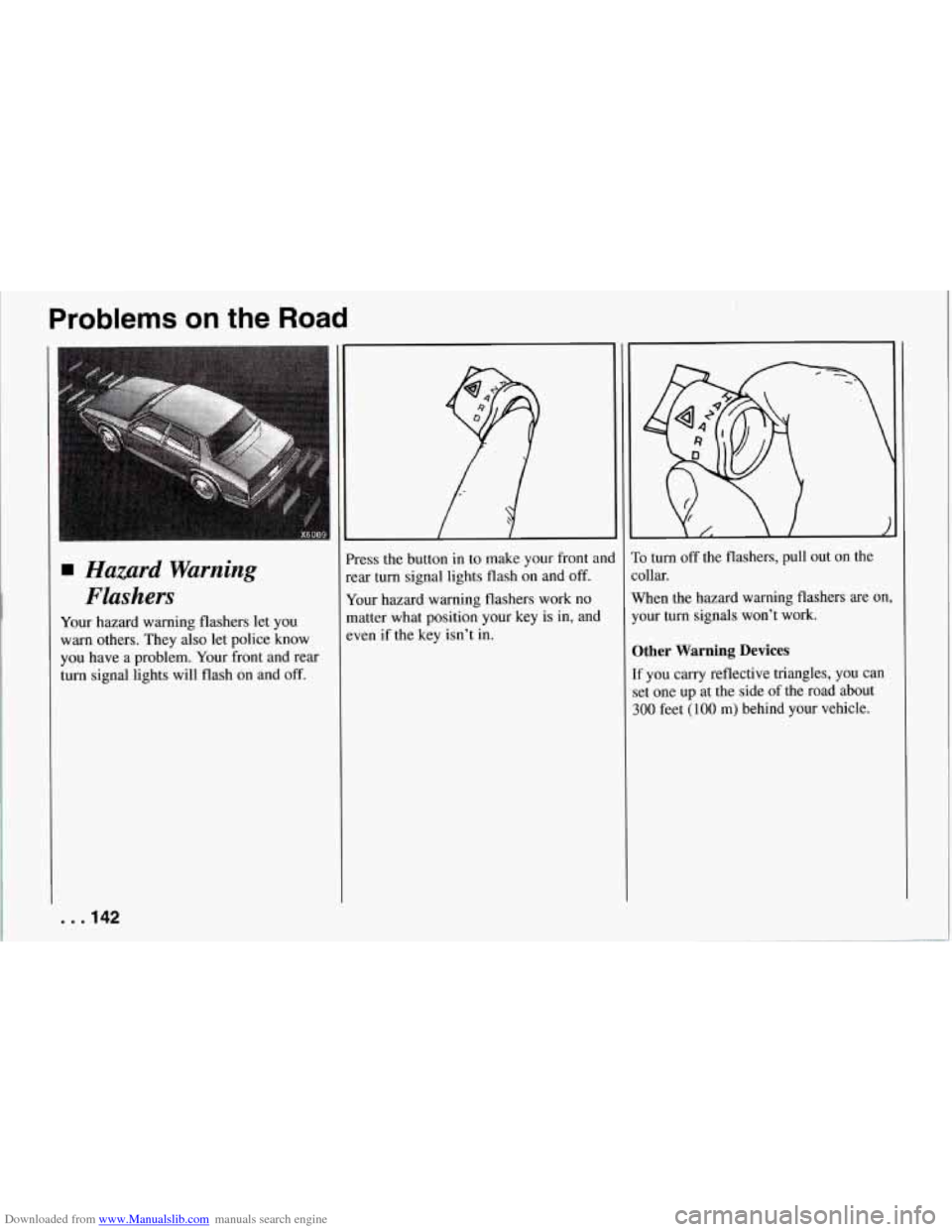
Your hazard warning flashers let you
warn others. They also let police know
you have a problem. Your front and rear
turn signal lights will flash on and off.
'ress the button in to make your front an(
:ar turn signal lights flash on and off.
lour hazard warning flashers work no
matter what position your
key is in, and
ven if the key isn't in.
'0 turn off the flashers, pull out on the
ollar.
Vhen the hazard warning flashers are
on,
'our turn signals won't work.
Ither Warning Devices
f you carry reflective triangles, you can
et one up at the side of the road about
100 feet (100 m) behind your vehicle.
. . .I42
Page 189 of 274
Downloaded from www.Manualslib.com manuals search engine Service and Appearance Care
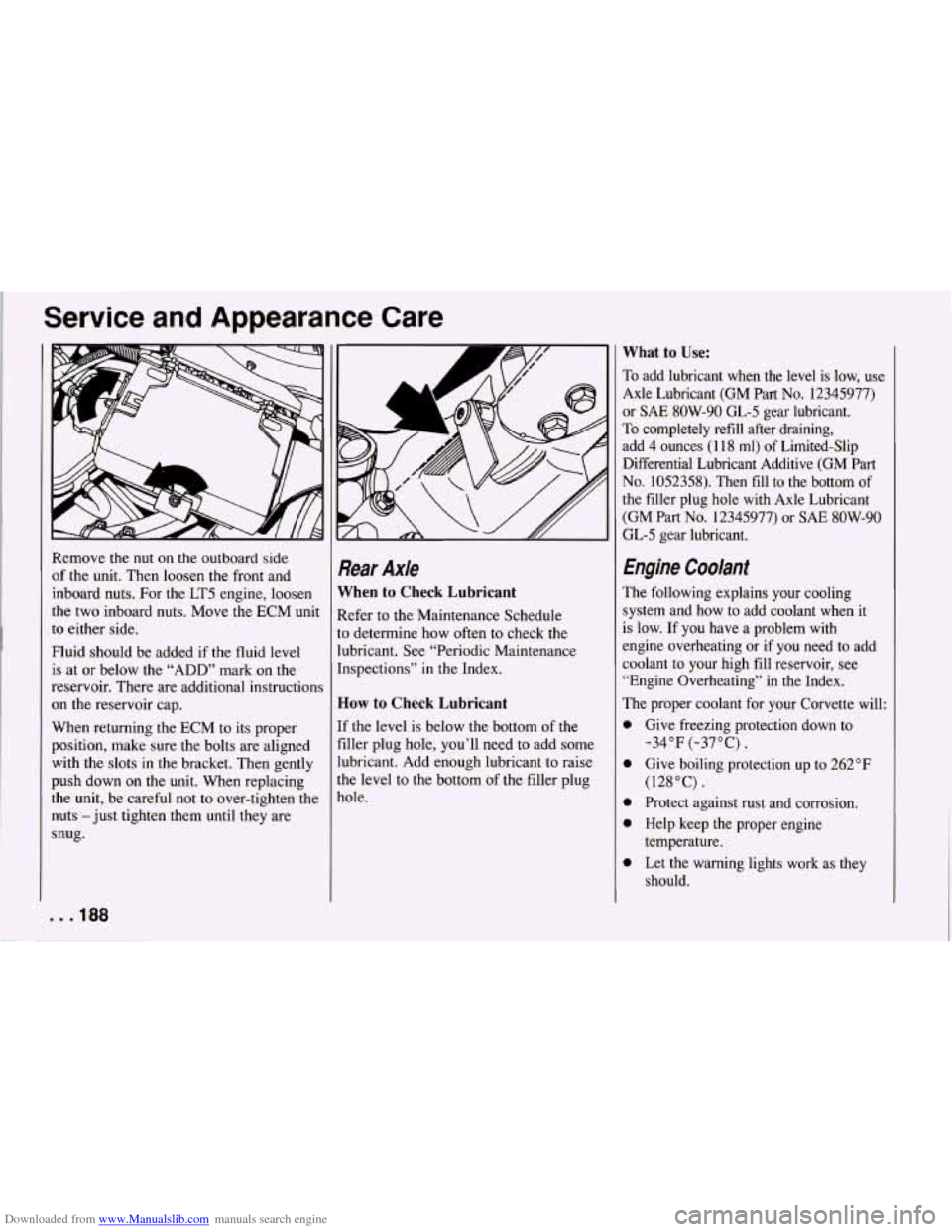
Remove the nut on the outboard side
of the unit. Then loosen the front and
inboard nuts. For the LT5 engine, loosen
the two inboard nuts. Move the ECM unit
to either side.
Fluid should be added if the fluid level
is at or below the “ADD” mark on the
reservoir. There are additional instructions
on the reservoir cap.
When returning the ECM to its proper
position, make sure the bolts are aligned
with the slots in the bracket. Then gently
push down on the unit. When replacing
the unit, be careful not to over-tighten the
nuts -just tighten them until they are
snug.
. . * 188
Rear Axle
When to Check Lubricant
Refer to the Maintenance Schedule
to determine how often to check the
lubricant. See “Periodic Maintenance
Inspections” in the Index.
How to Check Lubricant
If the level is below the bottom of the
filler plug hole, you’ll need to add some
lubricant. Add enough lubricant to raise
the level to the bottom of the filler plug
hole.
What to Use:
To add lubricant when the level is low, use
Axle Lubricant (GM Part
No. 12345977)
or
SAE 8OW-90 GL-5 gear lubricant.
To completely refill after draining,
add 4 ounces (1 18 ml) of Limited-Slip
Differential Lubricant Additive (GM Part
No. 1052358). Then fill to the bottom of
the filler plug hole with Axle Lubricant
(GM Part
No. 12345977) or SAE 8OW-90
GL-5 gear lubricant.
Engine Coolant
The following explains your cooling
system and how to add coolant when
it
is low. If you have a problem with
engine overheating or
if you need to add
coolant to your high fill reservoir, see
“Engine Overheating” in the Index.
The proper coolant for your Corvette will:
0
0
0
0
0
Give freezing protection down to -34°F (-37°C).
Give boiling protection up to 262°F
(128°C).
Protect against rust and corrosion.
Help keep the proper engine
temperature.
Let the warning lights work as they
should.
Page 194 of 274
Downloaded from www.Manualslib.com manuals search engine Brake Master Cylinder
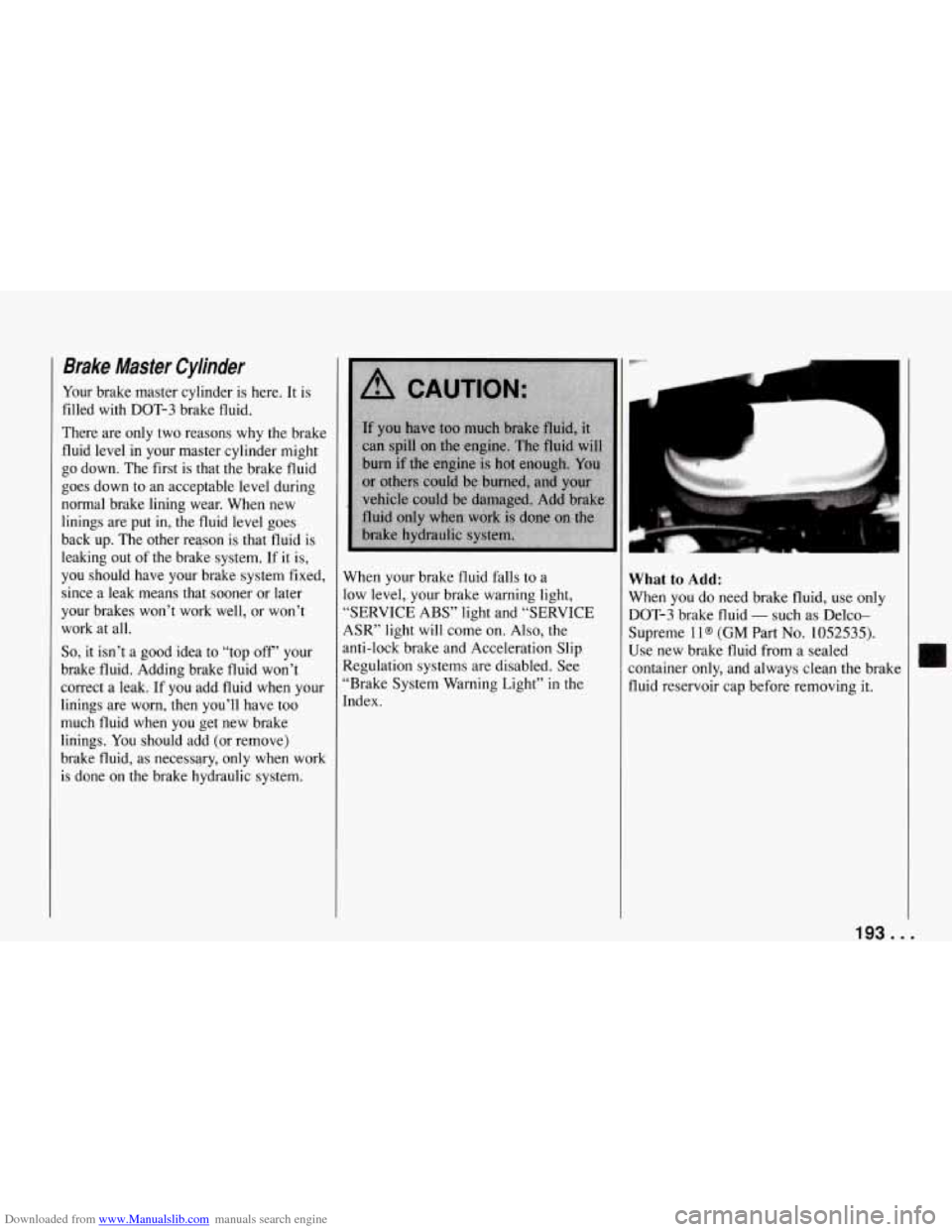
Your brake master cylinder is here. It is
filled with DOT-3 brake fluid.
There are only two reasons why the brake
fluid level in your master cylinder might
go down. The first is that the brake fluid
goes down to an acceptable level during
normal brake lining wear. When new
linings are put in, the fluid level goes
back up. The other reason is that fluid is
leaking out of the brake system.
If it is,
you should have your brake system fixed,
since a leak means that sooner or later
your brakes won’t work well, or won’t work at all.
So, it isn’t a good idea to “top off’ your
brake fluid. Adding brake fluid won’t
correct a leak. If you add fluid when your
linings are worn, then you’ll have too
much fluid when you get new brake
linings. You should add (or remove)
brake fluid, as necessary, only when work
is done on the brake hydraulic system. When your brake fluid falls to a
low level, your brake warning light,
“SERVICE ABS” light and “SERVICE
ASR” light will come on. Also, the
anti-lock brake and Acceleration Slip
Regulation systems are disabled. See
“Brake System Warning Light” in the
Index.
What to Add:
When you do need brake fluid, use only
DOT-3 brake fluid
- such as Delco-
Supreme
1 l@ (GM Part No. 1052535).
Use new brake fluid from a sealed
container only, and always clean the brak
fluid reservoir cap before removing it.
193 ...
Page 195 of 274
Downloaded from www.Manualslib.com manuals search engine Service and Appearance Care
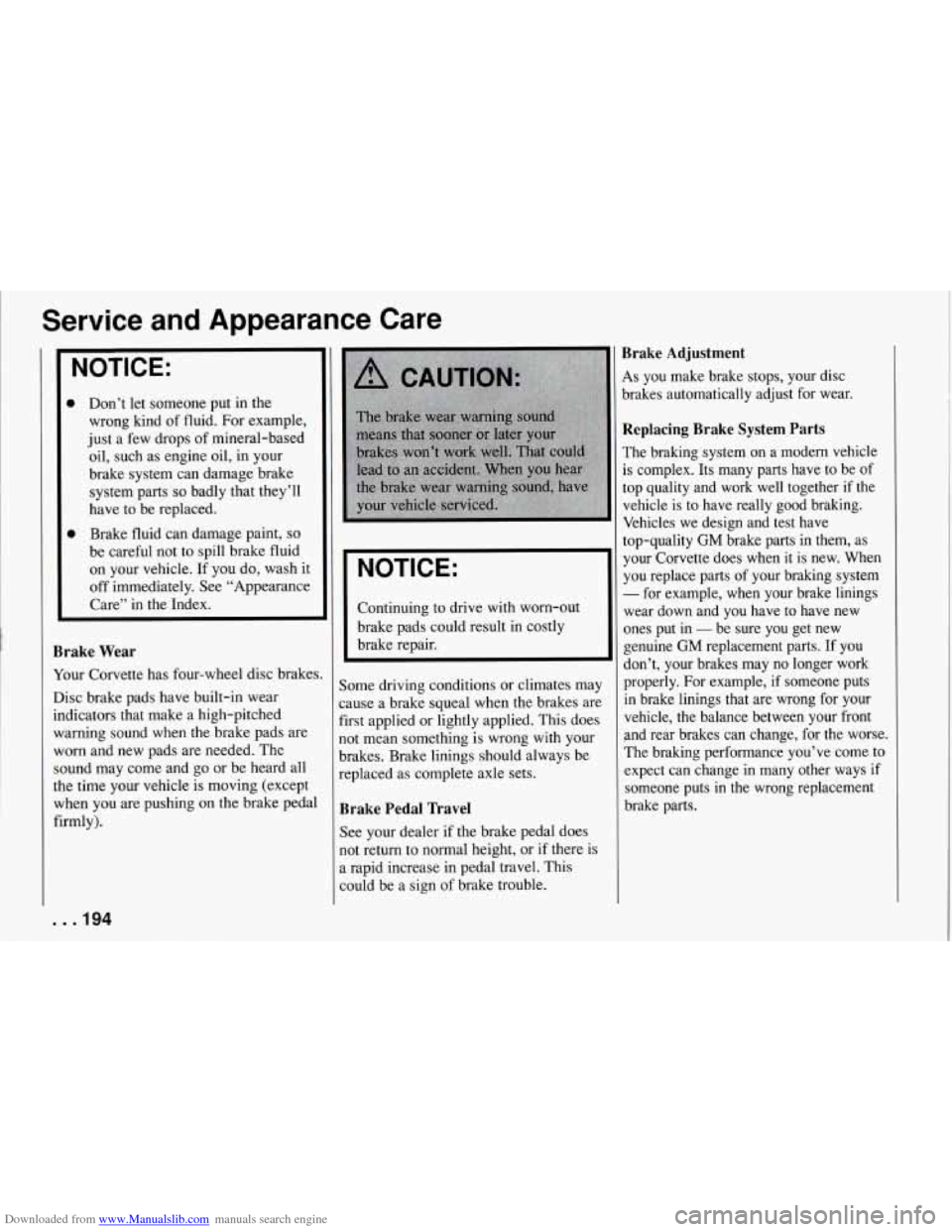
NOTICE:
Don’t let someone put in the
wrong kind of fluid. For example,
just a few drops of mineral-based
oil, such as engine oil, in your
brake system can damage brake
system parts
so badly that they’ll
have to be replaced.
Brake fluid can damage paint,
so
be careful not to spill brake fluid
on your vehicle. If you
do, wash it
off immediately. See “Appearance
Care” in the Index.
Brake Wear
Your Corvette has four-wheel disc brakes.
Disc brake pads have built-in wear
indicators that make a high-pitched
warning sound when the brake pads are
worn and new pads are needed. The
sound may come and go or be heard all
the time your vehicle is moving (except
when you are pushing
on the brake pedal
firmly).
I NOTICE:
I
Continuing to drive with worn-out
brake pads could result in costly brake repair.
Some driving conditions or climates may
cause a brake squeal when the brakes are
first applied or lightly applied. This does not mean something is wrong with your
brakes. Brake linings should always be
replaced as complete axle sets.
Brake Pedal Travel
See your dealer if the brake pedal does
not return to normal height, or if there is
a rapid increase in pedal travel. This
could be a sign of brake trouble.
Brake Adjustment
As you make brake stops, your disc
brakes automatically adjust for wear.
Replacing Brake System Parts
The braking system on a modern vehicle
is complex. Its many parts have to be of
top quality and work well together
if the
vehicle is to have really good braking.
Vehicles we design and test have
top-quality GM brake parts in them, as
your Corvette does when it is new. When
you replace parts of your braking system
- for example, when your brake linings
wear down and you have to have new
ones put in
- be sure you get new
genuine GM replacement parts. If you
don’t, your brakes may no longer work
properly. For example,
if someone puts
in brake linings that are wrong for your
vehicle, the balance between your front
and rear brakes can change, for the worse. The braking performance you’ve come to
expect can change in many other ways
if
someone puts in the wrong replacement
brake parts.
. . .I94
Page 206 of 274
Downloaded from www.Manualslib.com manuals search engine Extended Mobility Tires (omoiv)
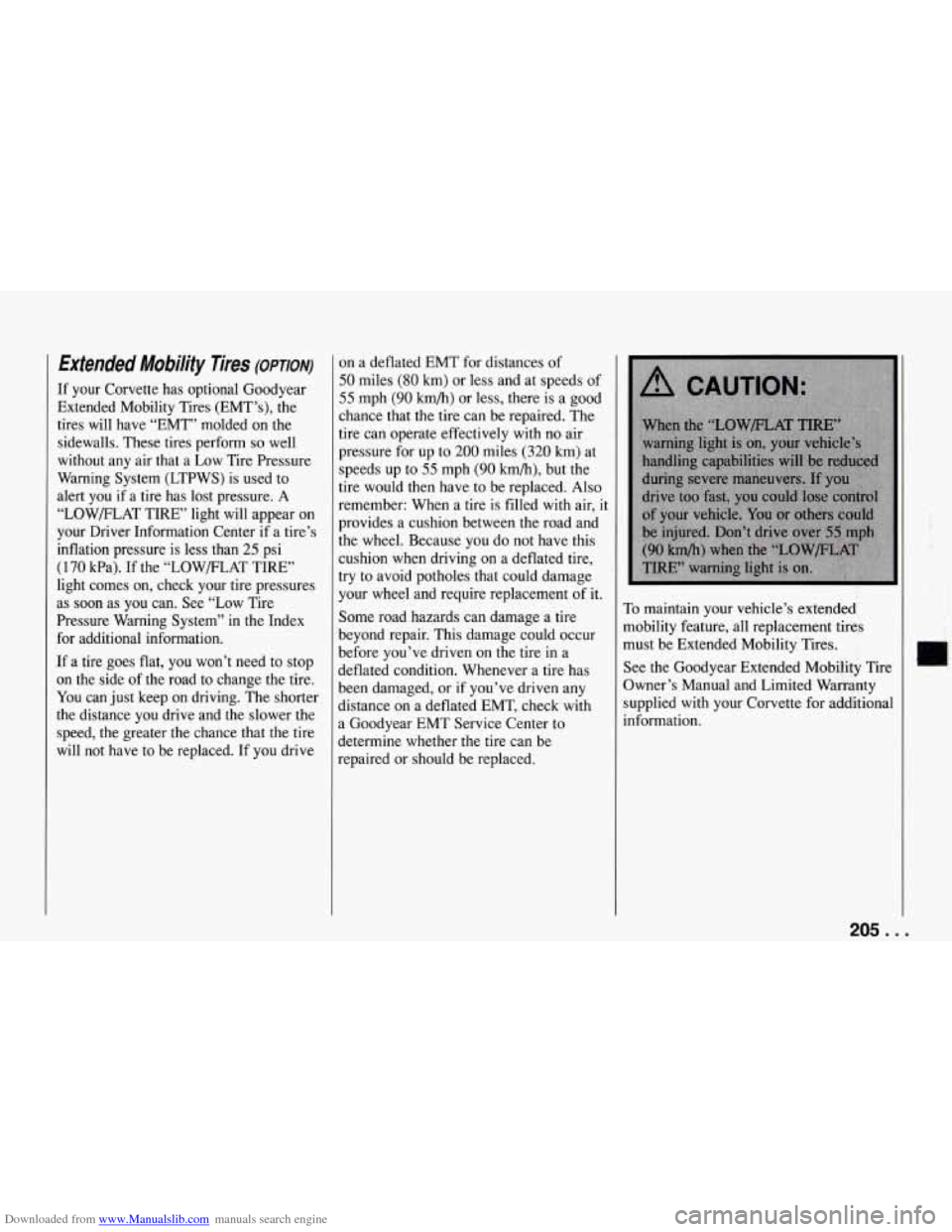
If your Corvette has optional Goodyear
Extended Mobility Tires (EMT’s), the tires will have “EMT” molded on the
sidewalls. These tires perform
so well
without any air that a Low Tire Pressure
Warning System (LTPWS)
is used to
alert you if a tire has lost pressure.
A
“LOWELAT TIRE” light will appear on
your Driver Information Center if a tire’s
inflation pressure is less than
25 psi
(1 70 kPa). If the “LOWELAT TIRE”
light comes on, check your tire pressures
as soon as you can. See “Low Tire
Pressure Warning System” in
the Index
for additional information.
If a tire goes flat, you won’t need to stop
on the side of the road to change the tire.
You can just keep on driving. The shorter
the distance you drive and the slower the
speed, the greater the chance that the tire
will not have to be replaced. If you drive on
a deflated EMT for distances
of
50 miles (80 km) or less and at speeds of
55 mph (90 km/h) or less, there is a good
chance that the tire can be repaired. The
tire can operate effectively with no air
pressure for up to
200 miles (320 km) at
speeds up to
55 mph (90 km/h), but the
tire would then have to be replaced. Also
remember: When a tire is filled with air, it
provides a cushion between the road and
the wheel. Because you do not have this
cushion when driving on a deflated tire,
try to avoid potholes that could damage
your wheel and require replacement of it.
Some road hazards can damage a tire
beyond repair. This damage could occur
before you’ve driven on the tire in a
deflated condition. Whenever a tire has
been damaged, or if you’ve driven any
distance on a deflated EMT, check with
a Goodyear EMT Service Center to
determine whether the tire can be
repaired or should be replaced. To
maintain your vehicle’s extended
mobility feature, all replacement tires
must be Extended Mobility Tires.
See the Goodyear Extended Mobility Tire
Owner’s Manual and Limited Warranty
supplied with your Corvette for additional
information.
205. .