tire size CHEVROLET CORVETTE 1994 4.G Owners Manual
[x] Cancel search | Manufacturer: CHEVROLET, Model Year: 1994, Model line: CORVETTE, Model: CHEVROLET CORVETTE 1994 4.GPages: 274, PDF Size: 15.61 MB
Page 170 of 274
Downloaded from www.Manualslib.com manuals search engine Compact Spare Tire
Although the compact spare was fully
inflated when your vehicle was new, it
can lose air after a time. Check the
inflation pressure regularly. It should be
60 psi (420 kPa). After installing the
compact spare on your vehicle, you
should stop as soon as possible and make
sure your spare tire is correctly inflated.
The compact spare is made to perform
well at posted speed limits for distances
up to
3,000 miles (5 000 km), so you can
finish your trip and have your full-size
tire repaired or replaced where you want.
Of course, it’s best to replace your spare
with a full-size tire as soon as you can.
Your spare will last longer and be in
good shape in case you need it again.
-
NOTICE:
Don’t take your compact spare
through an automatic car wash with
guide rails. The compact spare can
get caught on the rails. That can
damage the tire and wheel, and
maybe other parts
of your vehicle.
Don’t use your compact spare on some
other vehicle.
And don’t
mix your compact spare or
wheel with other wheels
or tires. They
won’t
fit. Keep your spare and its wheel
together.
NOTICE:
Tire chains won’t fit your compact
spare. Using them will damage
your vehicle and destroy the chains
too. Don’t use tire chains on your
compact spare.
If You’re Stuck: In
Sand, Mud, Ice or
Snow
What you don’t want to do when your
vehicle is stuck is to spin your wheels.
The method known as “rocking” can help
you get out when you’re stuck, but .you
must use caution.
169 ...
Page 203 of 274
Downloaded from www.Manualslib.com manuals search engine Service and Appearance Care
6. Rock the bulb back and forth while
pulling up to remove it.
7. Reverse the steps with a new bulb.
. . ,202
Windshield Wiper
Blades
It's a good idea to rotate the wiper blade
assembly
180" every six months. This
changes the wear pattern and makes the
wiper blade insert last longer.
To rotate 01
replace the wipers:
1.
2.
3.
Pull the wiper arm away from the
windshield.
You should be able to see part of a
spring near where the blade connects
to the arm. Press down on the spring
with a screwdriver and pull the wiper
blade
off.
Rotate the blade and push it back ontc
the arm.
TIRE-LOADING INFORMATION
FRT. CRT.
RR. TOTAL LBS KG 3 3 2 MAX. LOADING @ GVWR SAME AS VEHICLE a 1199 544
CAPACITY WEIGHT BBW OCCUPANTS VEHICLE CAP.
wi.
TIRE SIZE
60/410
3 9
INFORMATION 0 F
/
I Loading Your Vehicle
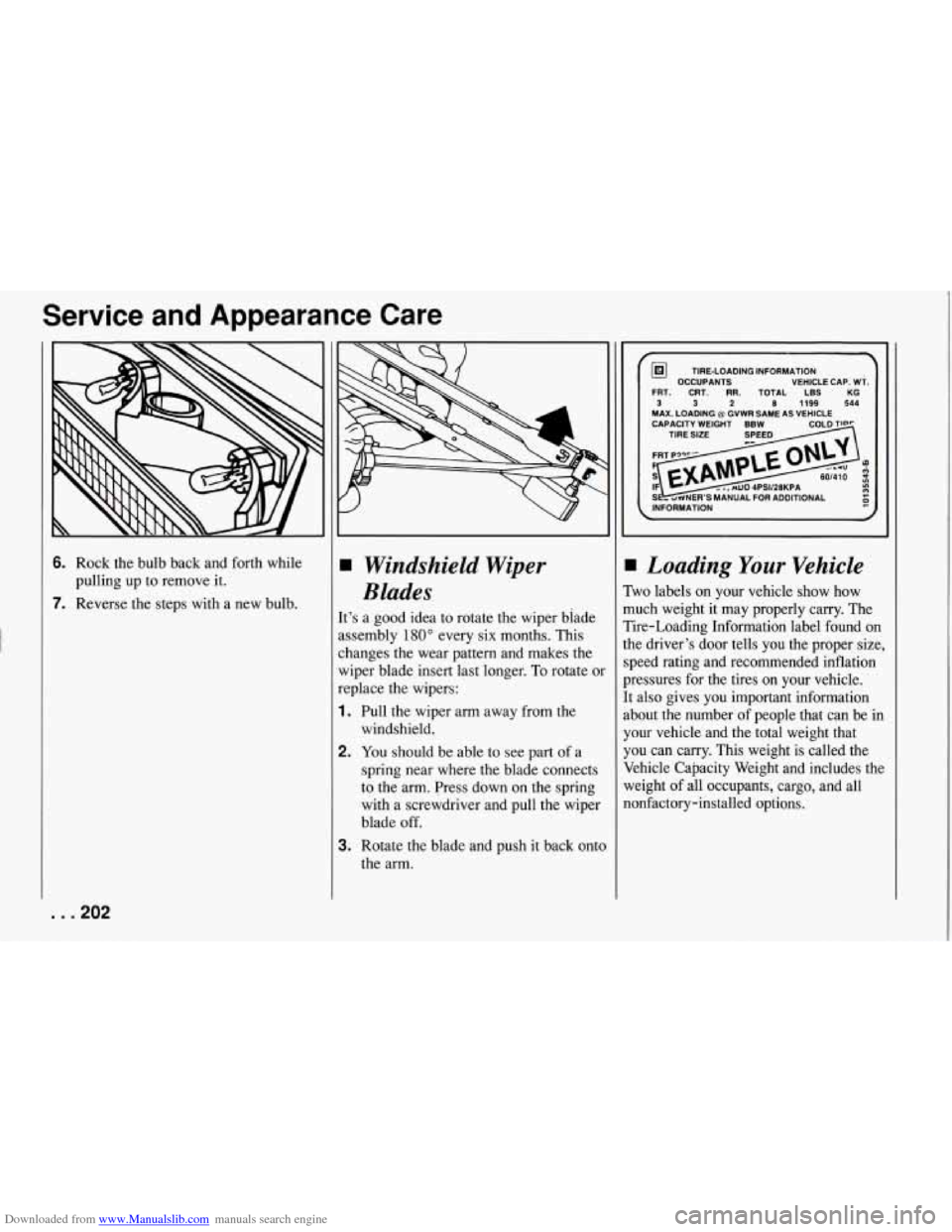
Two labels on your vehicle show how
nuch weight it may properly carry. The
rire-Loading Information label found on
he driver's door tells you the proper size,
'peed rating and recommended inflation
n-essures for the tires on your vehicle.
t also gives you important information
ibout the number
of people that can be in
Tour vehicle and the total weight that
TOU can carry. This weight is called the
iehicle Cabacity Weight and includes the
weight of all occupants, cargo, and all
lonfactory-installed options.
Page 207 of 274
Downloaded from www.Manualslib.com manuals search engine Service and Appearance Care
Inflation - Tire Pressure
The Tire-Loading Information label which is on the driver’s door shows the correct
inflation pressures for your tires, when they’re cold. “Cold” means your vehicle has
been sitting for at least three hours or driven no more than a mile.
For competitive driving or high-speed driving (over
150 mph or 240 krn/h), make
sure your tires are inflated to
35 psi (240 kPa). When you end this type of driving,
reduce the “cold” inflation pressures (if necessary) to those listed
on the
Tire-Loading Information label.
NOTICE:
Don’t let anyone tell you that underinflation or overinflation is all right. It’s not.
If your tires don’t have enough air (underinflation) you can get:
0 Too much flexing
0 Too much heat
0 Tire overloading
0 Bad wear
0 Bad handling
Bad fuel economy.
If your tires have too much air (overinflation), you can get:
Unusual wear
Bad handling
0 Rough ride
Needless damage from road hazards.
When to Check: Check your tires
mce
a month or more. Don’t forget
your compact spare tire. It should be at
50 psi (420 Wa).
How to Check: Use a good quality
pocket-type gauge to check tire
pressure. Simply looking at the tires
will not tell you the pressure,
=specially if you have radial tires
-
which may look properly inflated even
if they’re underinflated.
Lf your tires have valve caps, be sure to
put them back on. They help prevent
leaks by keeping out dirt and moisture.
Tire Rotation
I’he tires on your Corvette are
lirectional, asymmetrical, and are
different sizes front to rear. Due to this,
your tires should not be rotated. Each
tire and wheel should be used only in
the position it is in.
. . .206
Page 208 of 274
Downloaded from www.Manualslib.com manuals search engine I
When It’s Time for New Tires
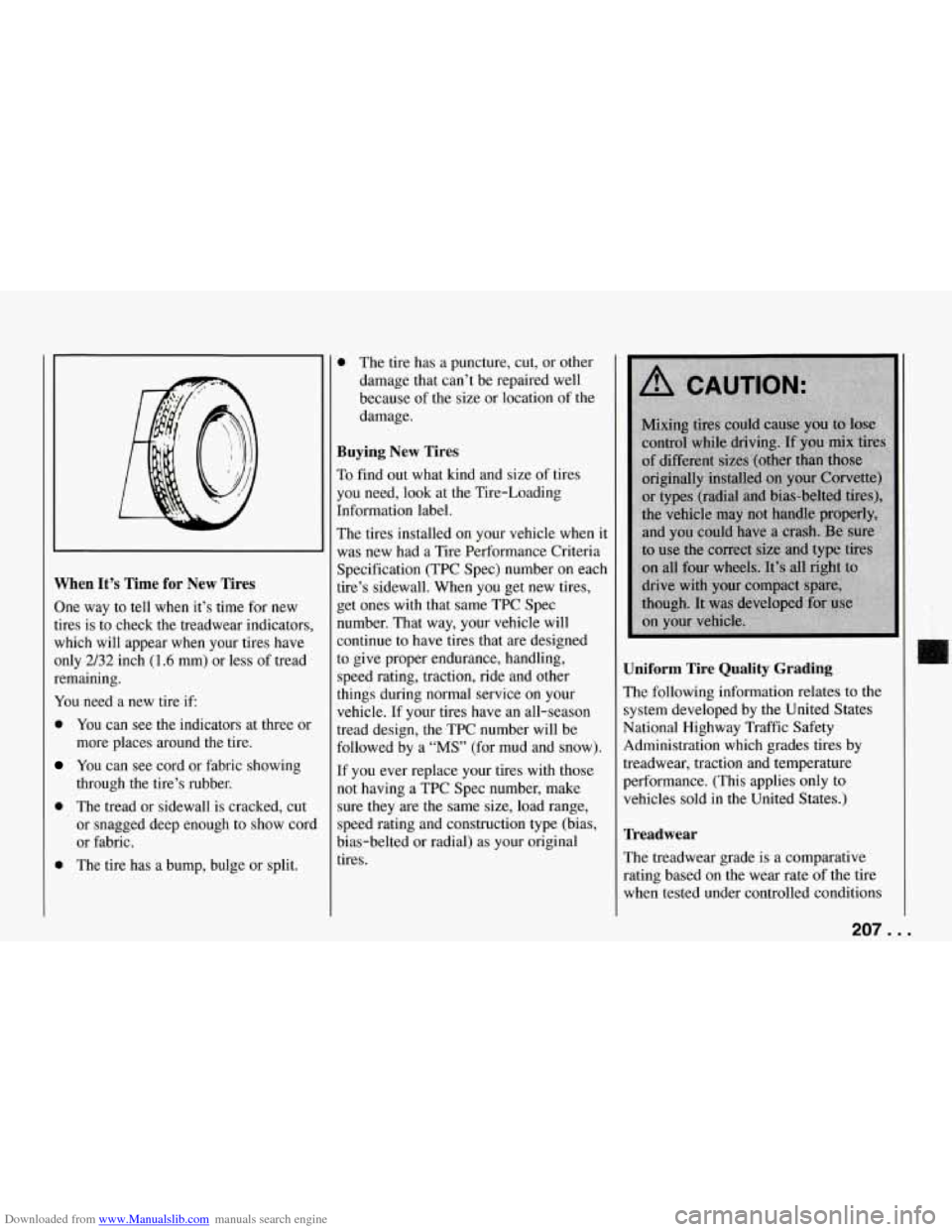
One way to tell when it’s time for new
tires is to check the treadwear indicators,
which
will appear when your tires have
only
2/32 inch (1.6 mm) or less of tread
remaining.
You need a new tire if
0 You can see the indicators at three or
You can see cord or fabric showing
0 The tread or sidewall is cracked, cut
more places around the
tire.
through the tire’s rubber.
or snagged deep enough to show cord
or fabric.
0 The tire has a bump, bulge or split.
0 The tire has a puncture, cut, or other
damage that can’t be repaired well
because of the size or location of the
damage.
Buying New Tires
To find out what kind and size of tires
you need, look at the Tire-Loading
Information label.
The tires installed on your vehicle when it
was new had a Tire Performance Criteria
Specification (TPC Spec) number on each
tire’s sidewall. When you get new tires,
get ones with that same TPC Spec
number. That way, yobr vehicle will
continue to have tires that are designed
to give proper endurance, handling,
speed rating, traction, ride and other
things during normal service on your
vehicle. If your tires have an all-season
tread design, the TPC number will be
followed by a
“MS” (for mud and snow).
If you ever replace your tires with those
not having a TPC Spec number, make
sure they are the same size, load range,
speed rating and construction type (bias,
bias-belted or radial) as your original
tires.
Uniform Tire Quality Grading
The following information relates to the
system developed by the United States
National Highway Traffic Safety
Administration which grades tires by
treadwear, traction and temperature
performance. (This applies only to
vehicles sold in the United States.)
Treadwear
The treadwear grade is a comparative
rating based on the wear rate of the tire
when tested under controlled conditions
207. . .