ESP CHEVROLET CORVETTE 1995 4.G User Guide
[x] Cancel search | Manufacturer: CHEVROLET, Model Year: 1995, Model line: CORVETTE, Model: CHEVROLET CORVETTE 1995 4.GPages: 386, PDF Size: 20.15 MB
Page 178 of 386
Downloaded from www.Manualslib.com manuals search engine Driving at Night
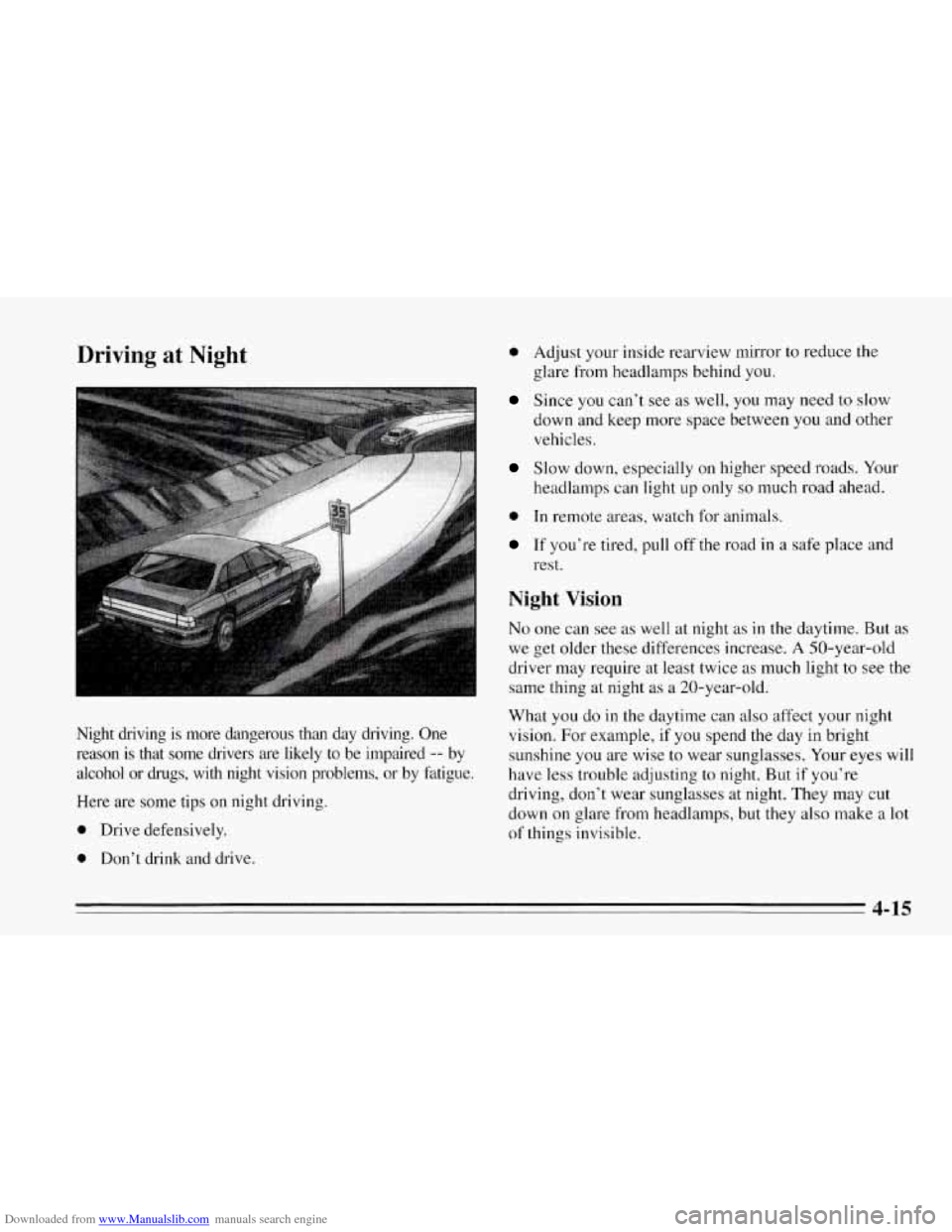
Night driving is more dangerous than day driving. One
reason is that some drivers are likely to be impaired
-- by
alcohol or drugs, with night vision problems,
or by fatigue.
Here are some tips on night driving.
0 Drive defensively.
0 Don’t drink and drive.
0
0
Adjust your inside rearview mirror to reduce the
glare from headlamps behind you.
Since
you can’t see as well, you may need to slow
down and keep more space between you and other
vehicles.
Slow down, especially on higher speed roads. Your
headlamps can light up only
so much road ahead.
In remote areas, watch for animals.
If you’re tired, pull off the road in a safe place and
rest.
Night Vision
No one can see as well at night as in the daytime. But as
we get older these differences increase.
A 50-year-old
driver may require at least twice as much light to see the
same thing at night as
a 20-year-old.
What you do
in the daytime can also affect your night
vision. For example, if you spend the day in bright
sunshine you are wise to wear sunglasses. Your eyes will
have less trouble adjusting to night. But if you’re
driving, don’t wear sunglasses at night. They may cut
down on glare from headlamps, but they also make a lot
of things invisible.
Page 181 of 386
Downloaded from www.Manualslib.com manuals search engine Hydroplaning
Hydroplaning is dangerous. So much water can build up
under your tires that they can actually ride on the water.
This can happen if the road is wet enough and you’re
going fast enough. When your vehicle is hydroplaning,
it
has little or no contact with the road.
Hydroplaning doesn’t happen often. But it can if your
tires haven’t much tread or if the pressure in one or
more is low. It can happen if a lot of water is standing on
the road.
If you can see reflections from trees, telephone
~ poles, or other vehicles, and raindrops “dimple” the
~ water’s surface, there could be hydroplaning.
! Hydroplaning usually happens at higher speeds. There
1 just isn’t a hard and fast rule about hydroplaning. The
best advice
is to slow down when it is raining.
Some Other Rainy Weather Tips
Turn on your low-beam headlamps -- not just your
parking lamps
-- to help make you more visible to
others.
Besides slowing down, allow some extra following
distance. And be especially careful when you pass
another vehicle. Allow yourself more clear room
ahead, and be prepared to have your view restricted
by road spray.
“Tires” in the Index.)
Have good tires with proper tread depth. (See
Page 219 of 386
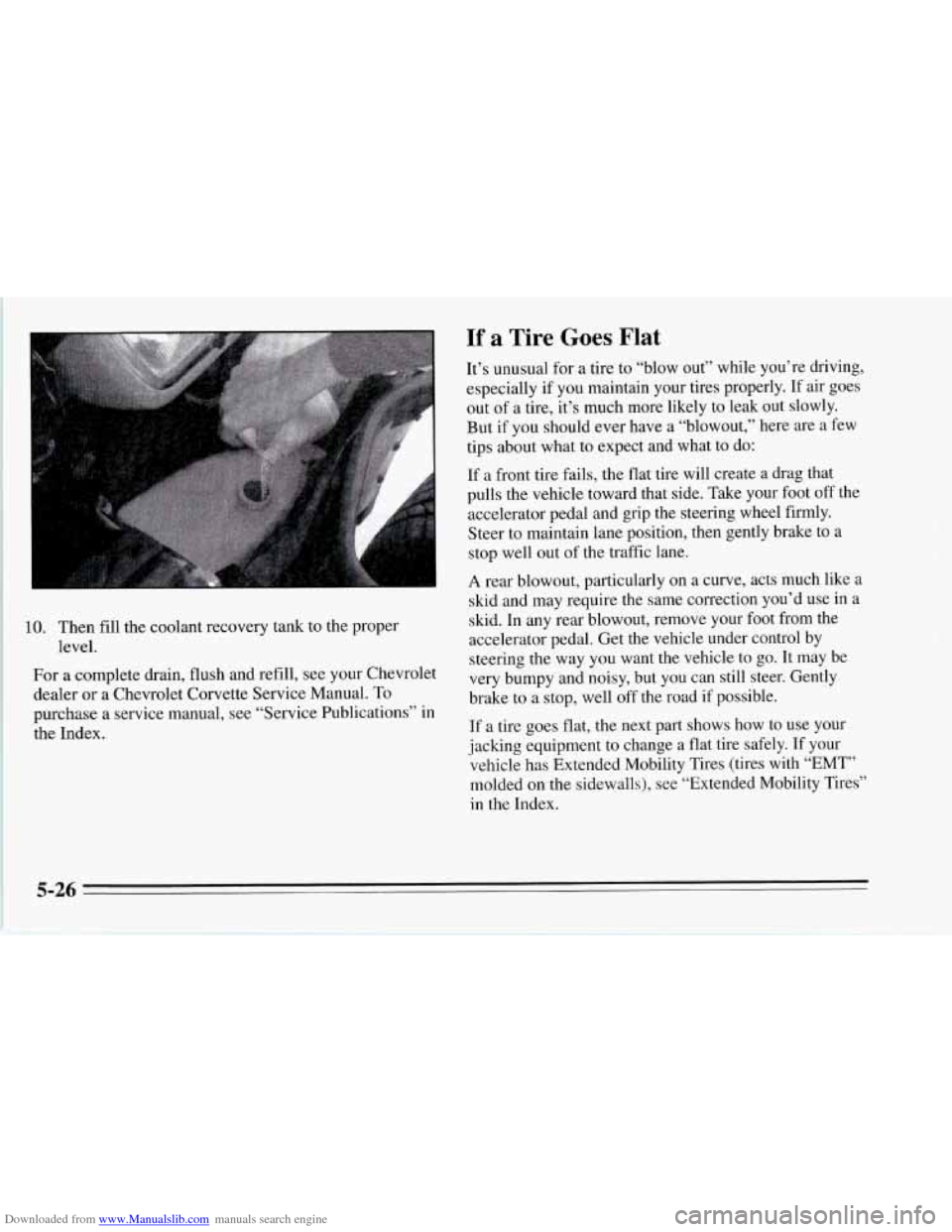
Downloaded from www.Manualslib.com manuals search engine 10. Then fill the coolant recovery tank
level. to the proper
For a complete drain, flush and refill, see your Chevrolet
dealer
or a Chevrolet Corvette Service Manual. To
purchase a service manual, see “Service Publications” in
the Index.
If a Tire Goes Flat
It’s unusual for a tire to “blow out” while you’re driving,
especially if you maintain your tires properly. If air goes
out of a tire, it’s much more likely to leak out slowly.
But if you should ever have
a “blowout,” here are a few
tips about what to expect and what
to do:
If a front tire fails, the flat tire will create a drag that
pulls the vehicle toward that side. Take your foot off the
accelerator pedal and grip the steering wheel firmly.
Steer to maintain lane position, then gently brake to a
stop well out of the traffic lane.
A rear blowout, particularly on a curve, acts much like a
skid and may require the same correction you’d use in a
skid. In any rear blowout, remove your foot from the
accelerator pedal. Get the vehicle under control by
steering the way you want the vehicle to
go. It may be
very bumpy and noisy, but you can still steer. Gently
brake to a stop, well off the road if possible.
If a tire goes flat, the next part shows how to use your
jacking equipment to change a flat tire safely. If your
vehicle has Extended Mobility Tires (tires with “EMT”
molded on the sidewalls), see “Extended Mobility Tires”
in the Index.
5-26
Page 239 of 386
Downloaded from www.Manualslib.com manuals search engine Gasolines for Cleaner Air
Your use of gasoline with deposit control additives will
help prevent deposits from forming in your engine and
fuel system. That helps keep your engine in tune and
your emission control system working properly. It’s
good for your vehicle, and you’ll be doing your part for
cleaner air.
Many gasolines
are now blended with oxygenates.
General Motors recommends that you use gasolines with
these blending materials, such as MTBE and ethanol. By
doing
so, you can help clean the air, especially in those
parts of the country that have high carbon monoxide
levels.
In addition, some gasoline suppliers are now producing
reformulated gasolines. These gasolines
are specially
designed to reduce vehicle emissions. General Motors
recommends that you use reformulated gasoline. By
doing
so, you can help clean the air, especially in those
parts of the country that have high ozone levels.
You should ask your service station operators if their
gasolines contain deposit control additives and
oxygenates, and if they have been reformulated to
reduce vehicle emissions.
5.7L LT1 (Code P) Engine
Use premium unleaded gasoline rated at 91 octane or
higher
for best performance. You may use middle grade
or regular unleaded gasolines, but your vehicle may not
accelerate as well. The gasoline you use should meet
specifications
ASTM D4814 in the United States and
CGSB
3.5-92 in Canada. These fuels should have the
proper additives,
so you should not have to add anything
to the fuel.
In the United States and Canada, it’s easy to be sure you
get the right kind of gasoline (unleaded). You’ll see
UNLEADED right on the pump. And only unleaded
nozzles will fit into your vehicle’s filler neck.
Be sure the posted octane for premium
is at least 91 (at
least
89 for middle grade and 87 for regular). If the
octane is less than
87, you may get a heavy knocking
noise when you drive. If it’s bad enough, it can damage
your engine.
If you’re using fuel rated at 91 octane or higher and you
still hear heavy knocking, your engine needs service.
But don’t worry if you hear a little pinging noise when
you’re accelerating or driving up a hill. That’s normal
and you don’t have to buy a higher octane fuel to get rid
of pinging. It’s the heavy, constant knock that means
you have a problem.
6-4
Page 256 of 386
Downloaded from www.Manualslib.com manuals search engine Wait at least 30 minutes before checking the
transmission fluid level if you have been driving:
When outside temperatures are above 90°F (32°C).
At high speed for quite a while.
In heavy traffic -- especially in hot weather.
To get the right reading, the fluid should be at normal
operating temperature, which is
1 80°F to 200°F (82 "C
to 93 " C).
To check transmission fluid hot: Get the vehicle
warmed up by driving about
15 miles (24 km) when
outside temperatures are above 50°F
(10°C). You may
have to drive longer to bring the fluid to 180°F to
200" F
(82°C to 93 "C) in colder outside temperatures. See
"Automatic Transmission Fluid Temperature Reading"
in the Index.
To check transmission fluid cold: A cold check is
made after the vehicle has been sitting for eight hours or
more with the engine off and is used only as a reference.
Let the engine run at idle for five minutes if outside
temperatures are
50°F (10°C) or more. If it's colder
than
50°F (IOOC), you may have to idle the engine
longer. Should the fluid level be low during a cold
check, you
must perform a hot check before adding
fluid. This will give you
a more accurate reading of the
fluid level.
To check the fluid hot or cold
Park your vehicle on a level place. Keep the engine
running.
in PARK (P).
With the parking brake applied, place the shift lever
With your foot on the brake pedal, move the shift
lever through each gear range, pausing for about
three seconds in each range. Then, position the shift
lever in PARK (P).
Let the engine run at idle for three minutes or more.
Then, without shutting off the engine, follow these steps:
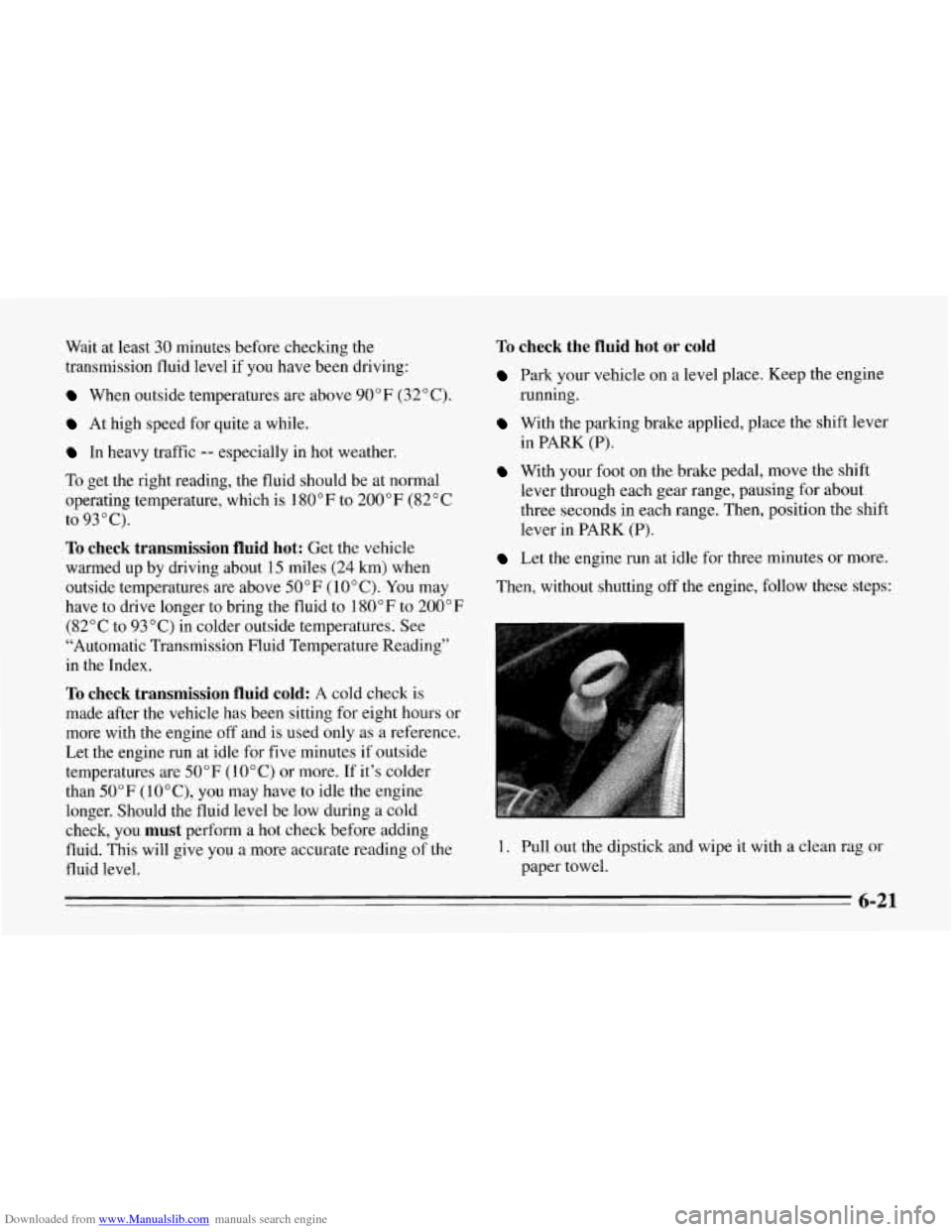
1. Pull out the dipstick and wipe it with a clean rag or
paper towel.
6-21
Page 257 of 386
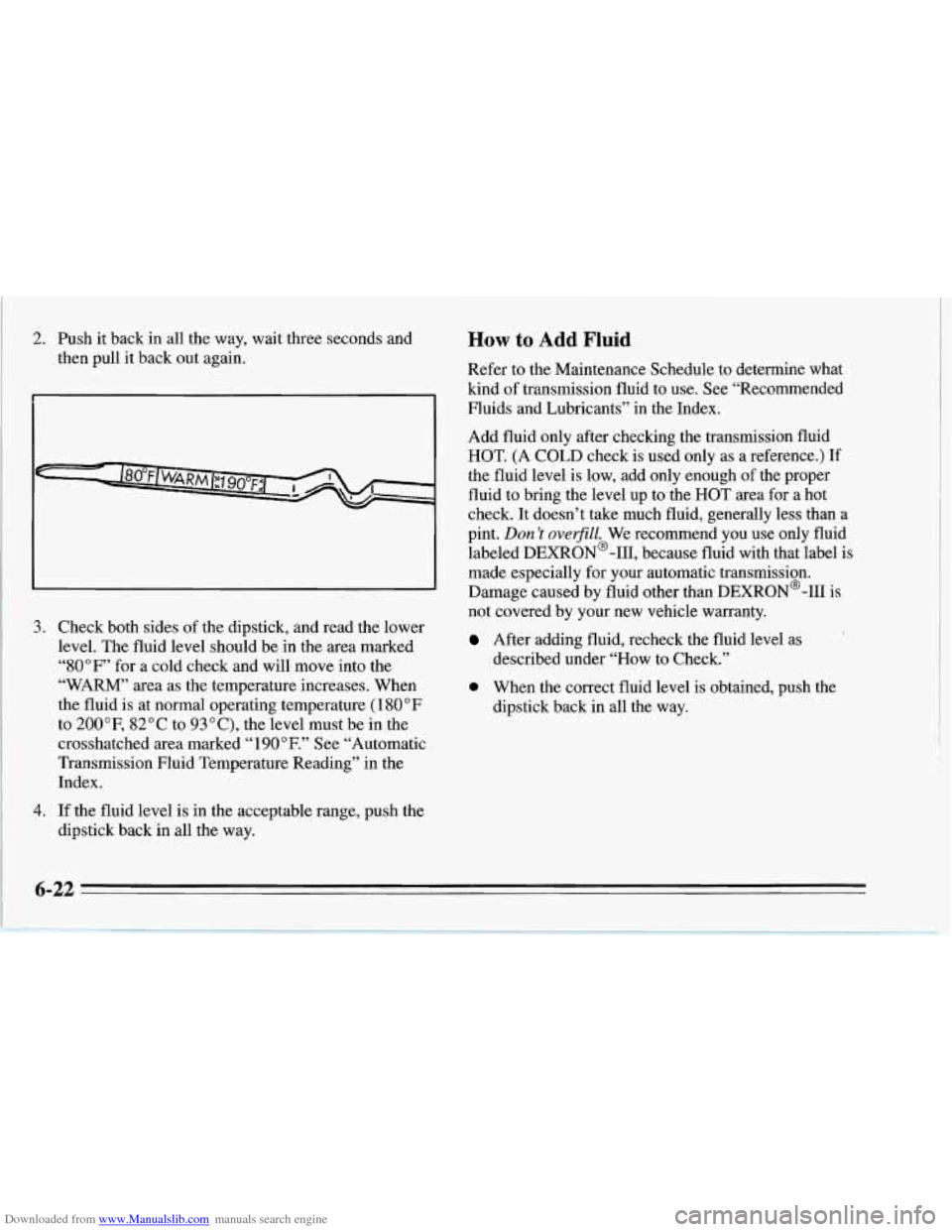
Downloaded from www.Manualslib.com manuals search engine 2. Push it back in all the way, wait three seconds and
then pull it back out again.
3.
4.
Check both sides of the dipstick, and read the lower
level. The fluid level should be in the area marked
“80°F” for a cold check and will move into the
“WARM”
area as the temperature increases. When
the fluid is at normal operating temperature
( 180 OF
to 200”F, 82°C to 93”C), the level must be in the
crosshatched area marked
“1 90°F.” See “Automatic
Transmission Fluid Temperature Reading” in the
Index.
If the fluid level is in the acceptable range, push the
dipstick back in all the way.
How to Add Fluid
Refer to the Maintenance Schedule to determine what
kind
of transmission fluid to use. See “Recommended
Fluids and Lubricants” in the Index.
Add fluid only after checking the transmission fluid
HOT.
(A COLD check is used only as a reference.) If
the fluid level is low, add only enough of the proper
fluid to bring the level up to the HOT area for a hot
check. It doesn’t take much fluid, generally less than a
pint.
Don ’t ove@ZZ. We recommend you use only fluid
labeled DEXRON@-111, because fluid with that label is
made especially for your automatic transmission.
Damage caused by fluid other than DEXRON@-I11 is
not covered by your new vehicle warranty.
After adding fluid, recheck the fluid level as
described under “How to Check.”
a When the correct fluid level is obtained, push the
dipstick back in all the way.
6-22
Page 285 of 386

Downloaded from www.Manualslib.com manuals search engine Inflation - Tire Pressure
The Tire-Loading Information label which is on the
driver’s door shows the correct inflation pressures for
your tires, when they’re cold. “Cold” means your
vehicle has been sitting for at least three hours or driven
no more than a mile.
For competitive driving or high-speed driving (over
150 mph or 240 km/h), make sure your tires are inflated
to
35 psi (240 Wa). When you end this type of driving,
reduce the “cold” inflation pressures
(if necessary) to
those listed on the Tire-Loading Information label.
I
I NOTICE:
Don’t let anyone tell you that underinflation or
overidation is
all right. It’s not. If your tires don’t
have enough
air (underinflation) you can get:
Too much flexing
0 Too much heat
Tire overloading
Bad wear
0 Bad handling
0 Bad fuel economy.
(Continued)
I I
I NOTICE: (Continued)
If your tires have too much air (overinflation),
you can get:
0 Unusual wear
0 Bad handling
0 Rough ride
0 Needless damage from road hazards.
1
When to Check
Check your tires once a month or more.
Don’t forget your compact spare tire. It should be at
60 psi (420 Wa).
How to Check
Use a good quality pocket-type gage to check tire
pressure. Simply looking at the tires will not tell you the
pressure, especially if you have radial tires
-- which
may look properly inflated even if they’re underinflated.
If your tires have valve caps, be sure to put them back
on. They help prevent leaks by keeping out dirt and
moisture.
6-50
Page 288 of 386
Downloaded from www.Manualslib.com manuals search engine example, a tire graded 150 would wear one and a half
(1 1/2) times as well on the government course as a tire
graded
100. The relative performance of tires depends
upon the actual conditions of their use, however, and
may depart significantly from the norm due to variations
in driving habits, service practices and differences in
road characteristics and climate.
Traction - A, B, C
The traction grades, from highest to lowest are: A, B,
and C. They represent the tire’s ability to stop on wet
pavement as measured under controlled conditions on
specified government test surfaces of asphalt and
concrete.
A tire marked C may have poor traction
performance.
Warning: The traction grade assigned to this tire is based
on braking (straight-ahead) traction tests and does not
include cornering (turning) traction.
Temperature - A, B, C
The temperature grades are A (the highest), B, and C,
representing the tire’s resistance to the generation of
heat and its ability to dissipate heat when tested under
controlled conditions on a specified indoor laboratory
test wheel. Sustained high temperature can cause the
material of the tire to degenerate and reduce tire life, and excessive
temperature can lead to sudden tire failure.
The grade
C corresponds to a level of performance
which all passenger car tires must meet under the
Federal Motor Vehicle Safety Standard
No. 109. Grades
B and A represent higher levels of performance on the
laboratory test wheel than the minimum required by law.
Warning: The temperature grade for this tire is
established for a tire that is properly inflated and not
overloaded. Excessive speed, underinflation, or
excessive loading, either separately or in combination,
can cause heat buildup and possible tire failure.
These grades are molded on the sidewalls of passenger
car tires.
While the tires available as standard or optional
equipment on General Motors vehicles may vary with
respect to these grades, all such tires meet General
Motors performance standards and have been approved
for use on General Motors vehicles. All passenger type
(P Metric) tires must conform to Federal safety
requirements in addition to these grades.
6-53
Page 366 of 386
Downloaded from www.Manualslib.com manuals search engine e Section 8 Customer Assistance Information
I -
Here you will find out how to contact Chevrolet if you
need assistance. This section also tells you how to obtain
service publications and how to report any safety defects.
This section includes information on: The Customer
Satisfaction Procedure, Customer Assistance for
Hearing or Speech Impaired, The Corvette Action
Center,
BBB Auto Line - Alternative Dispute
Resolution Program, Reporting Safety Defects,
Roadside Assistance, and Service and Owner
Publications.
Customer Satisfaction Procedure
Your satisfaction and goodwill are important to your
dealer and Chevrolet. Normally, any concern with the
sales transaction or the operation
of your vehicle will be
resolved by your dealer’s Sales or Service Departments.
Sometimes, however, despite the best intentions of all
concerned, misunderstandings can occur.
If your
concern has not been resolved to your satisfdction, the
following steps should be taken:
STEP ONE -- Discuss your concern with a member
of dealership management. Normally, concerns can be
quickly resolved at that level.
If the matter has already been
reviewed with the Sales, Service, or
Parts Manager, contact
the owner of the dealership or the General Manager.
STEP TWO -- If after contacting a member of
dealership management, it appears your concern cannot
be resolved by the dealer without further help, contact
the Chevrolet Customer Assistance Center by calling
1-800-222-1020.
In Canada, contact GM of Canada
Customer Assistance Center
in Oshawa by calling
1-800-263-3777 (English) or 1-800-263-7854 (French).
In Mexico, call (525) 254-3777. In Puerto Rico, call
1-800-496-9992 (English) or 1-800-496-9993
(Spanish).
In the U.S. Virgin Islands, call
1-800-496-9994.
In other overseas locations, contact
GM North American Export Sales in Canada by calling
1-905-644-4112.
8-1
Page 377 of 386
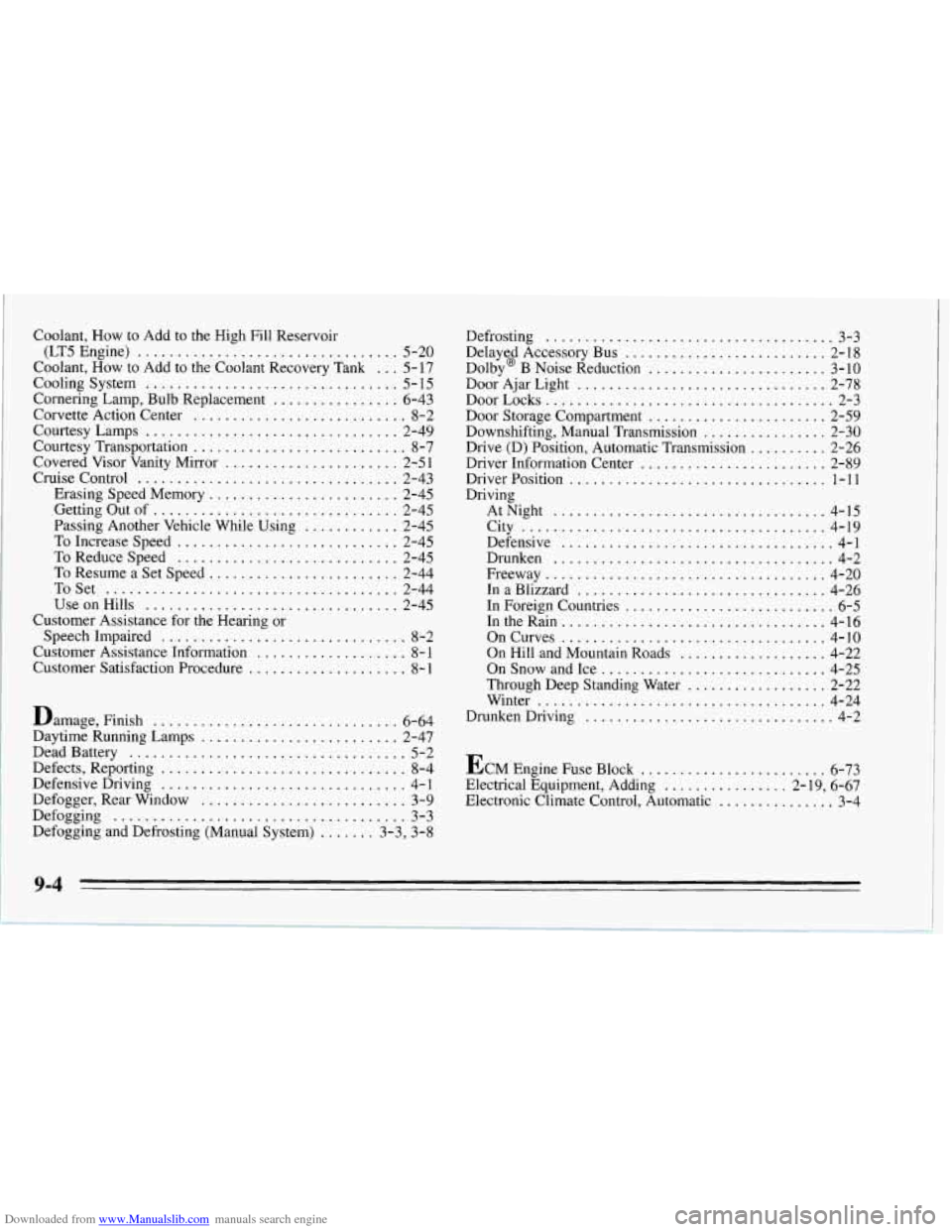
Downloaded from www.Manualslib.com manuals search engine Coolant. How to Add to the High Fill Reservoir
(LT5Engine)
................................. 5-20
Coolant. How to Add to the Coolant Recovery Tank
... 5-17
Cooling System
................................ 5-15
Cornering Lamp. Bulb Replacement
................ 6-43
Corvette Action Center
........................... 8-2
Courtesy Lamps
................................ 2-49
Courtesy Transportation
........................... 8-7
Covered Visor Vanity Mirror
...................... 2-5 1
Cruise Control
................................. 2-43
Erasing Speed Memory
........................ 2-45
Getting Out of
............................... 2-45
Passing Another Vehicle While Using
............ 2-45
To Increase Speed
............................ 2-45
To Resume a Set Speed
........................ 2-44
ToReduceSpeed
............................ 2-45
ToSet
..................................... 2-44
UseonHills
................................ 2-45
SpeechImpaired
............................... 8-2
Customer Assistance
for the Hearing or
Customer Assistance Information
................... 8- 1
Customer Satisfaction Procedure
.................... 8- 1
Damage. Finish
............................... 6-64
Daytime Running Lamps
......................... 2-47
Dead Battery
................................... 5-2
Defects. Reporting
............................... 8-4
Defensive Driving
............................... 4- 1
Defogger. Rear Window
.......................... 3-9
Defogging
..................................... 3-3
Defogging and Defrosting (Manual System)
..... 3.3. 3.8 Defrosting
..................................... 3-3
Delay%d Accessory Bus
.......................... 2-18
Dolby B Noise Reduction
....................... 3-10
Door Ajar Light
................................ 2-78
Door Storage Compartment
....................... 2-59
Downshifting, Manual Transmission
................ 2-30
Drive (D) Position, Automatic Transmission
.......... 2-26
Driver Information Center
........................ 2-89
Driver Position
................................. 1-11
DoorLocks
..................................... 2-3
Driving AtNight
................................... 4-15
City
....................................... 4-19
Defensive
................................... 4-1
Drunken
.................................... 4-2
Freeway
.................................... 4-20
In a Blizzard
................................ 4-26
In Foreign Countries
........................... 6-5
In the Rain
.................................. 4-16
OnCurves
.................................. 4-10
On Hill and Mountain Roads
................... 4-22
On Snow and Ice
............................. 4-25
Through Deep Standing Water
.................. 2-22
Drunken Driving
................................ 4-2
Winter ..................................... 4-24
ECM Engine
Fuse Block ........................ 6-73
Electrical Equipment, Adding
................ 2- 19, 6-67
Electronic Climate Control, Automatic
............... 3-4