brakes CHEVROLET CORVETTE 1995 4.G User Guide
[x] Cancel search | Manufacturer: CHEVROLET, Model Year: 1995, Model line: CORVETTE, Model: CHEVROLET CORVETTE 1995 4.GPages: 386, PDF Size: 20.15 MB
Page 180 of 386
Downloaded from www.Manualslib.com manuals search engine The heavier the rain, the harder it is to see. Even if your
windshield wiper blades are in good shape, a heavy rain
can make it harder to see road signs and traffic signals,
pavement markings, the edge of the road, and even
people walking.
It’s wise to keep your wiping equipment in good shape
and keep your windshield washer tank filled. Replace
your windshield wiper inserts when they show signs of
streaking or missing areas on the windshield, or when
strips of rubber start to separate from the inserts. Driving too fast
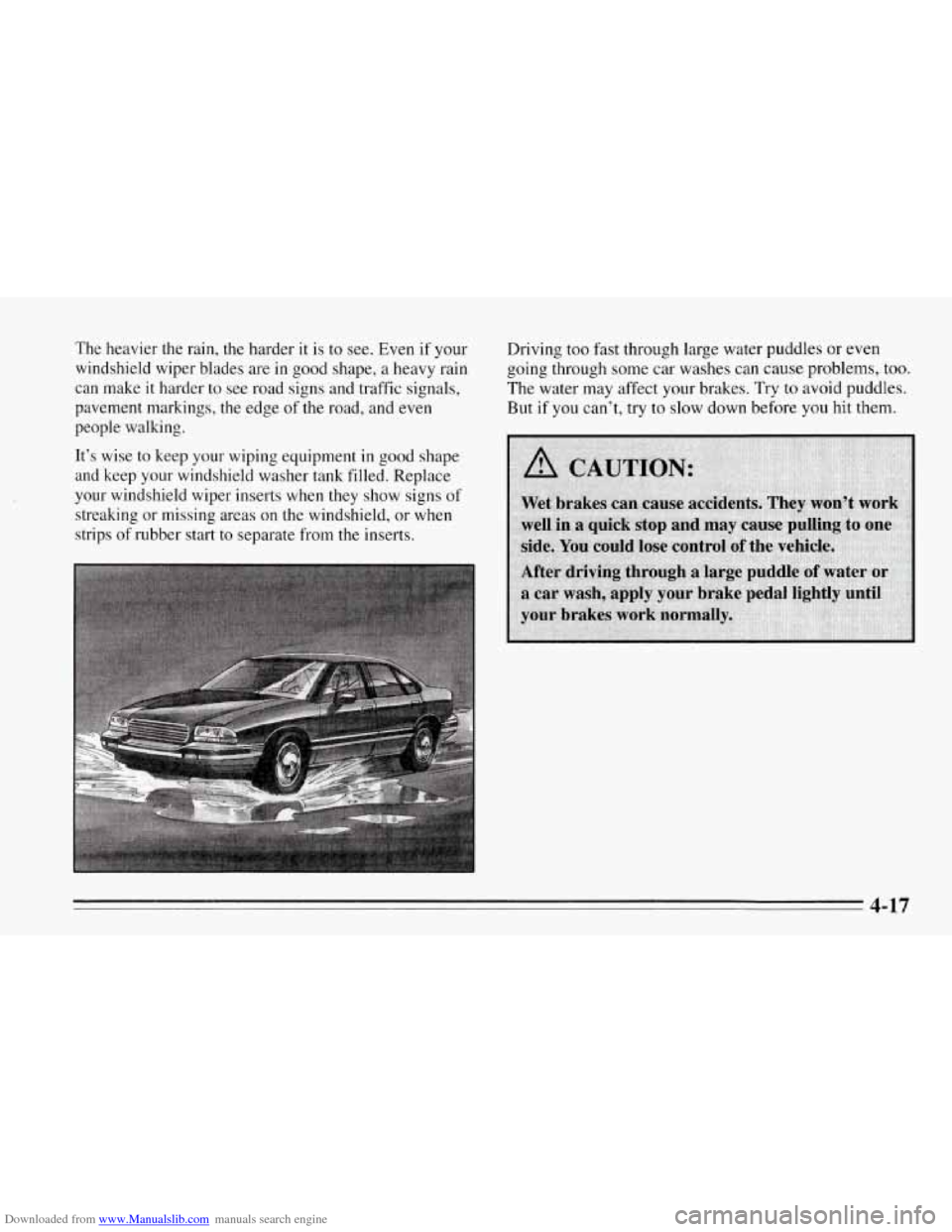
through large water puddles or even
going through some car washes can cause problems, too.
The water may affect your brakes. Try to avoid puddles.
But if you can’t, try to slow down before
you hit them.
4-17
Page 186 of 386
Downloaded from www.Manualslib.com manuals search engine If you drive regularly in steep country, or if you’re
planning to visit there, here are some tips that can make
your trips safer and more enjoyable.
0 Keep your vehicle in good shape. Check all fluid
levels and also the brakes, tires, cooling system and
transmission. These parts can work hard on
mountain roads.
0 Know how to go down hills. The most important
thing
to know is this: let your engine do some of the
slowing down. Shift
to a lower gear when you go
down a steep or long hill. 0 Know how to go uphill. You may want to shift down
0
0
0
to a lower gear. The lower gears help cool your engine
and transmission, and you can climb the hill better.
Stay in your own lane when driving on two-lane
roads
in hills or mountains. Don’t swing wide or cut
across the center of the road. Drive at speeds that let
you stay in your own lane.
As you go over the top of a hill, be alert. There could
be something in your lane, like a stalled car
or an
accident.
You may
see highway signs on mountains that warn of
special problems. Examples are long grades, passing
or
no-passing zones, a falling rocks area, or winding
roads. Be alert to these
and take appropriate action.
4-23
Page 188 of 386
Downloaded from www.Manualslib.com manuals search engine Driving on Snow or Ice
Most of the time, those places where your tires meet the
road probably have good traction.
However, if there is snow or ice between your tires and the
road, you can have a very slippery situation. You’ll have a
lot less traction or
“grip” and will need to be very careful.
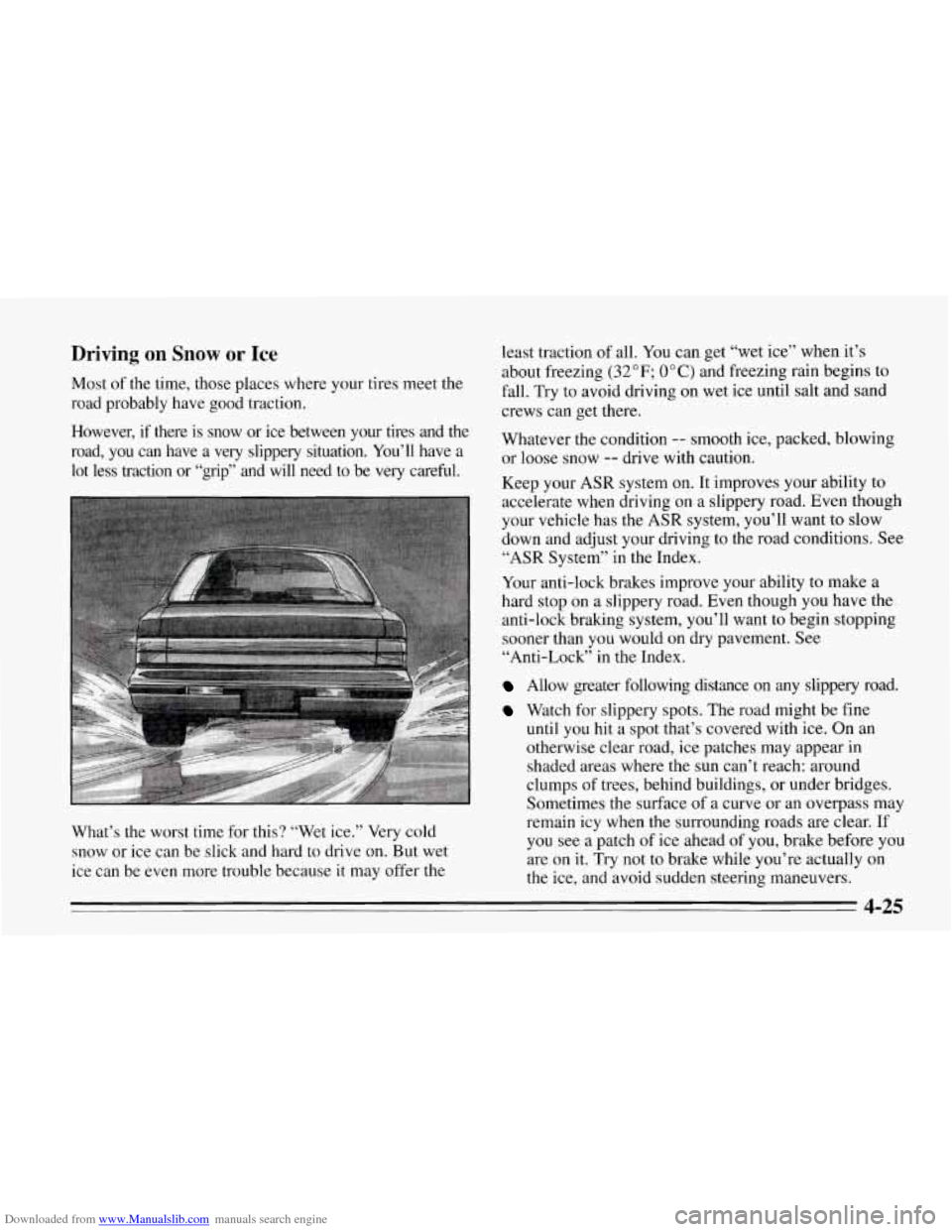
What’s the worst time for this? “Wet ice.” Very cold
snow or ice can be slick and hard to drive on. But wet
ice can be even more trouble because it may offer the least traction
of all. You can get “wet ice” when it’s
about freezing
(32°F; 0°C) and freezing rain begins to
fall. Try to avoid driving on wet ice until salt and sand
crews can get there.
Whatever the condition
-- smooth ice, packed, blowing
or loose snow
-- drive with caution.
Keep your ASR system on. It improves your ability to
accelerate when driving on a slippery road. Even though
your vehicle has the ASR system, you’ll want
to slow
down and adjust your driving to the road conditions. See
“ASR System’’ in the Index.
Your anti-lock brakes improve your ability to make a
hard stop on a slippery road. Even though you have the
anti-lock braking system, you’ll want to begin stopping
sooner than you would on dry pavement. See
“Anti-Lock” in the Index.
Allow greater following distance on any slippery road.
Watch for slippery spots. The road might be fine
until you hit a spot that’s covered with ice. On an
otherwise clear road, ice patches may appear in
shaded areas where the sun can’t reach: around
clumps of trees, behind buildings, or under bridges.
Sometimes the surface of a curve or an overpass may
remain icy when the surrounding roads
are clear. If
you see a patch of ice ahead of
you, brake before you
are on it. Try not to brake while you’re actually on
the ice, and avoid sudden steering maneuvers.
4-25
Page 267 of 386
Downloaded from www.Manualslib.com manuals search engine NOTICE:
When using concentrated washer fluid,
follow the manufacturer’s instructions for
adding water.
Don’t mix water with ready-to-use washer
fluid. Water can cause the solution to freeze
and damage your washer fluid tank and
other parts of the washer system. Also,
water doesn’t clean as well
as washer fluid.
0 Fill your washer fluid tank only 3/4 full
when it’s very cold. This allows for
expansion, which could damage the tank if
it is completely full.
windshield washer.
It can damage your
washer system and paint.
Don’t use radiator antifreeze in your
Brakes
Brake Master Cylinder
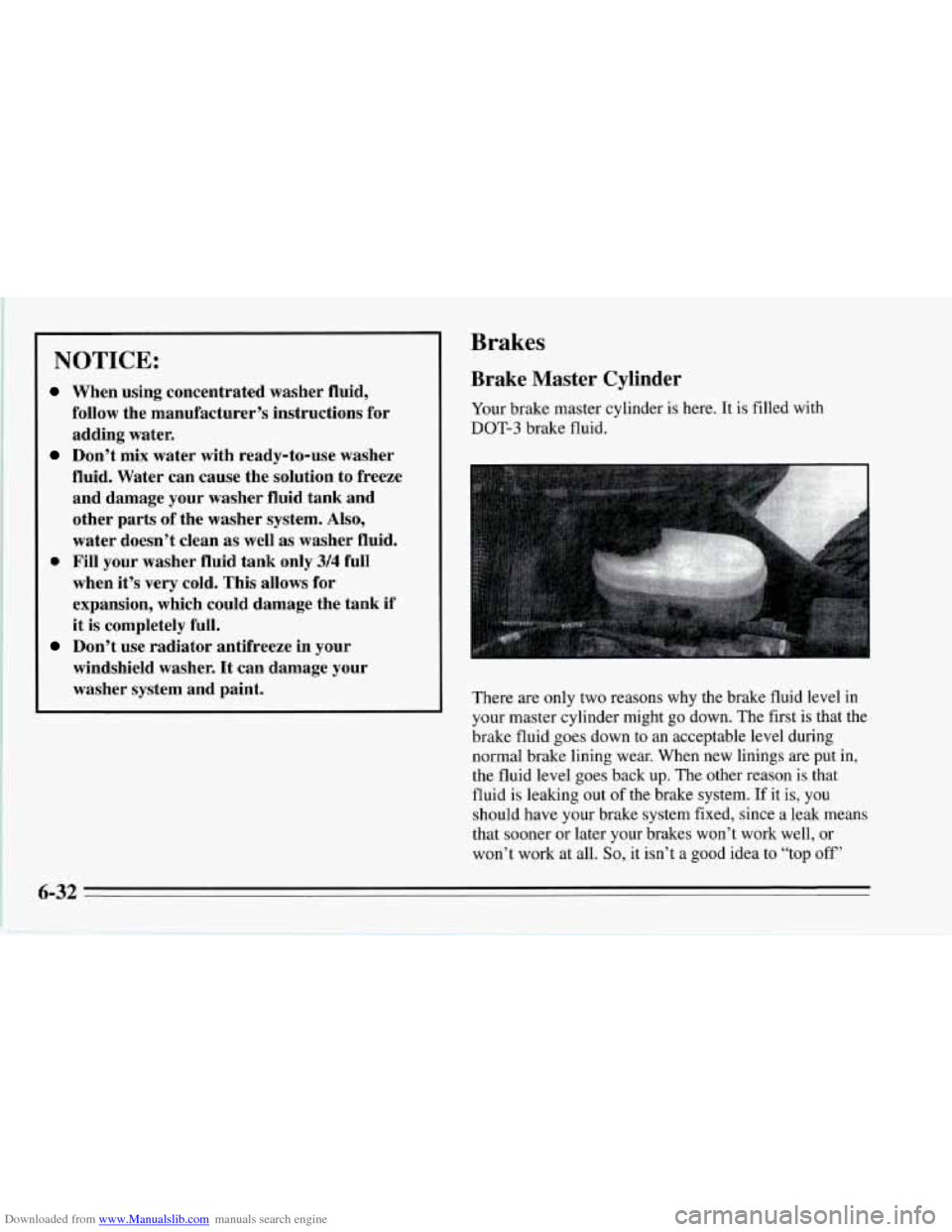
Your brake master cylinder is here. It is filled with
DOT-3 brake fluid.
There are only two reasons why the brake fluid level in
your master cylinder might go down. The first is that the
brake fluid goes down to an acceptable level during
normal brake lining wear. When new linings are put in,
the fluid level goes back up. The other reason is that
fluid is leaking out
of the brake system. If it is, you
should have your brake system fixed, since a leak means
that sooner
or later your brakes won’t work well, or
won’t work at all.
So, it isn’t a good idea to “top off’
6-32
Page 269 of 386
Downloaded from www.Manualslib.com manuals search engine What to Add
When you do need brake fluid, use only DOT-3 brake
fluid
-- such as Delco Supreme ll@ (GM Part
No. 1052535). Use new brake fluid from a sealed
container only, and always clean the brake fluid
reservoir cap before removing it.
NOTICE:
0 Don’t let someone put in the wrong kind of
fluid. For example, just
a few drops of
mineral-based oil, such as engine oil, in
your brake system can damage brake
system parts
so badly that they’ll have to be
replaced.
Brake fluid can damage paint, so be careful
not to spill brake fluid on your vehicle.
If
you do, wash it off immediately. See
“Appearance Care” in the Index.
Brake Wear
Your Corvette has four-wheel disc brakes.
Disc brake pads have built-in wear indicators that make
a
high-pitched warning sound when the brake pads are
worn and new pads are needed. The sound may come
and
go or be heard all the time your vehicle is moving (except
when you are pushing
on the brake pedal firmly).
6-34
Page 270 of 386
Downloaded from www.Manualslib.com manuals search engine NOTICE:
Replacing Brake System Parts
The braking system on a modem vehicle is complex. Its
I
Continuing to drive with worn-out brake pads
could result in costly brake repair.
I
Some driving conditions or climates may cause a brake
squeal when the brakes are first applied or lightly
applied. This does not mean something is wrong with
your brakes.
Brake linings should always be replaced as complete
axle sets.
Brake Pedal Travel
See your dealer if the brake pedal does not return to
normal height, or if there is a rapid increase in pedal
travel. This could be
a sign of brake trouble.
Brake Adjustment
As you make brake stops, your disc brakes
automatically adjust for wear. many
parts have to be
of top quality and work well
together if the vehicle is to have really good braking.
Vehicles we design and test have top-quality
GM brake
parts in them, as your Corvette does when
it is new.
When you replace parts of your braking system
-- for
example, when your brake linings wear down and you
have to have new ones put in
-- be sure you get new
genuine
GM replacement parts. If you don’t, your
brakes may no longer work properly. For example, if
someone puts in brake linings that are wrong for your
vehicle, the balance between your front and rear brakes
can change
-- for the worse. The braking performance
you’ve come to expect can change
in many other ways if
someone puts
in the wrong replacement brake parts.
Battery
Every new Corvette has a Delco Freedom@ battery. You
never have to add water to one of these. When it’s time
for a new battery, we recommend a Delco Freedom@
battery. Get one that has the replacement number shown
on the original battery’s label. For battery replacement,
see your dealer or the Corvette Service Manual.
To
purchase a service manual, see “Service Publications” in
the Index.
6-35
Page 308 of 386
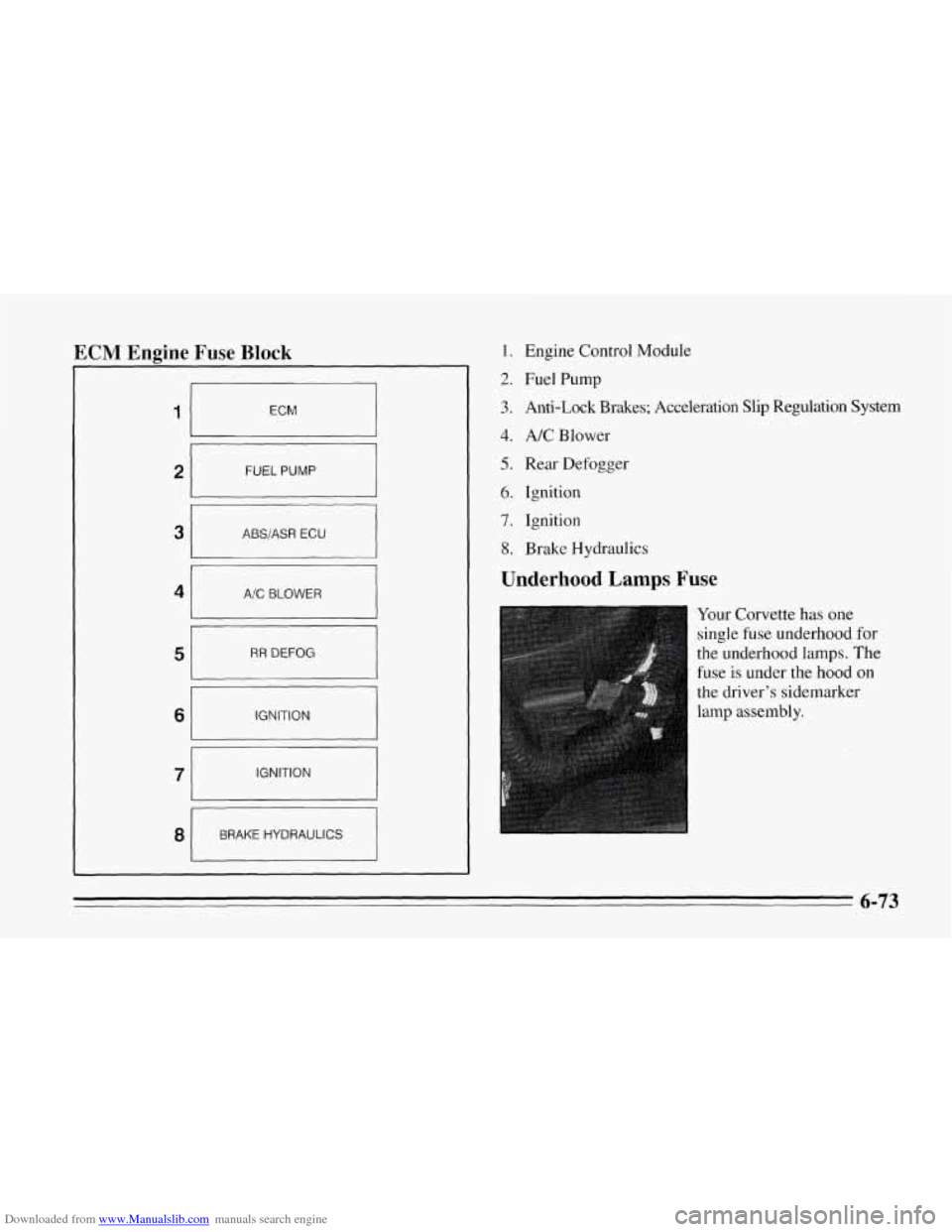
Downloaded from www.Manualslib.com manuals search engine ECM Engine Fuse Block v
FUEL PUMP
ABWASR ECU
A/C BLOWER
RR DEFOG
IGNITION
IGNITION
BRAKE HYDRAULICS
1.
2.
3.
4.
5.
6.
7.
8.
Engine Control Module
Fuel
Pump
Anti-Lock Brakes; Acceleration Slip Regulation System
A/C Blower
Rear Defogger
Ignition
Ignition
Brake Hydraulics
Underhood Lamps Fuse
Your Corvette has one
single fuse underhood for
the underhood
lamps. The
fuse is under the hood
on
the driver’s sidemarker
lamp assembly.
6-73
Page 358 of 386
Downloaded from www.Manualslib.com manuals search engine 2. Firmly apply the parking brake (see “Parking Brake”
in the Index if necessary).
Parking Brake and Automatic Transmission PARK
(P) Mechanism Check
3.
NOTE: Be ready to apply the regular brake
immediately if the vehicle begins to move.
With the engine off, turn the key
to the RUN
position, but don’t start the engine. Without applying
the regular brake, try to move the shift lever out
of
PARK (P) with normal effort. If the shift lever
moves out of PARK (P), your vehicle’s BTSI needs
service.
Steering Column Lock
While parked, and with the parking brake set, try to turn
the key to LOCK in each shift lever position.
With an automatic transmission, the key should turn
to LOCK only when the shift lever is in PARK
(P).
0 With a manual transmission, the key should turn to
LOCK only when the shift lever is in REVERSE (R).
On vehicles with
a key release button, try to turn the key
to LOCK without pressing the button. The key should
turn to LOCK only with the key button depressed.
On all vehicles, the key should come out only in LOCK. Park on a fairly
steep hill, with the vehicle facing
downhill. Keeping your foot on the regular brake, set the
parking brake.
To check the parking brake: With the engine running
and transmission in NEUTRAL
(N), slowly remove
foot pressure from the regular brake pedal.
Do this
until the vehicle is held by the parking brake only.
To check the PARK (P) mechanism’s holding ability:
Shift to PARK (P). Then release all brakes.
Underbody Flushing
At least every spring, use plain water to flush any corrosive
materials from the underbody. Take care to clean thoroughly any areas where mud and other debris can collect.
7-43
Page 359 of 386
Downloaded from www.Manualslib.com manuals search engine Part C: Periodic Maintenance
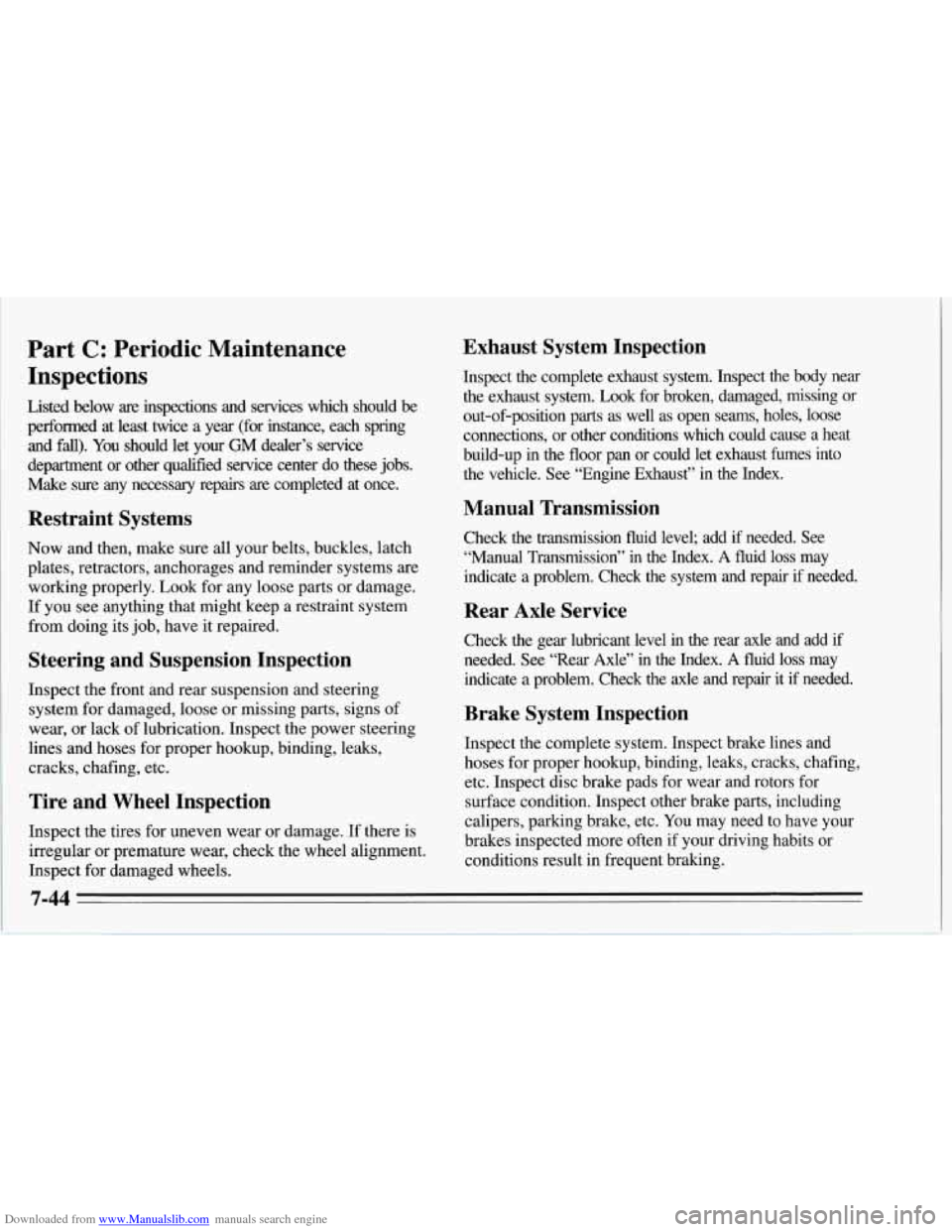
Inspections
Listed below are inspections and services which should be
performed at least twice a year (for instance, each spring
and fall). You should let your GM dealer’s service
department or other qualified service center do these jobs.
Make sure any necessary repairs
are completed at once.
Restraint Systems
Now and then, make sure all your belts, buckles, latch
plates, retractors, anchorages and reminder systems are
working properly. Look for any loose parts or damage.
If you see anything that might keep a restraint system
from doing its job, have it repaired.
Steering and Suspension Inspection
Inspect the front and rear suspension and steering
system for damaged, loose or missing parts, signs of
wear,
or lack of lubrication. Inspect the power steering
lines and hoses for proper hookup, binding, leaks,
cracks, chafing, etc.
Tire and Wheel Inspection
Inspect the tires for uneven wear or damage. If there is
irregular or premature wear, check the wheel alignment.
Inspect for damaged wheels.
Exhaust System Inspection
Inspect the complete exhaust system. Inspect the body near
the exhaust system. Look for broken, damaged, missing or
out-of-position parts as well as open seams, holes, loose
connections, or other conditions which could cause a heat
build-up in the floor pan or could let exhaust fumes into
the vehicle. See “Engine Exhaust” in the Index.
Manual Transmission
Check the transmission fluid level; add if needed. See
“Manual Transmission” in the Index.
A fluid loss may
indicate a problem. Check the system and repair
if needed.
Rear Axle Service
Check the gear lubricant level in the rear axle and add if
needed. See “Rear Axle” in the Index. A fluid loss may
indicate a problem. Check the axle and repair it if needed.
Brake System Inspection
Inspect the complete system. Inspect brake lines and
hoses for proper hookup, binding, leaks, cracks, chafing,
etc. Inspect disc brake pads for wear and rotors for
surface condition. Inspect other brake parts, including
calipers, parking brake, etc.
You may need to have your
brakes inspected more often if your driving habits or
conditions result in frequent braking.
7-44
Page 374 of 386
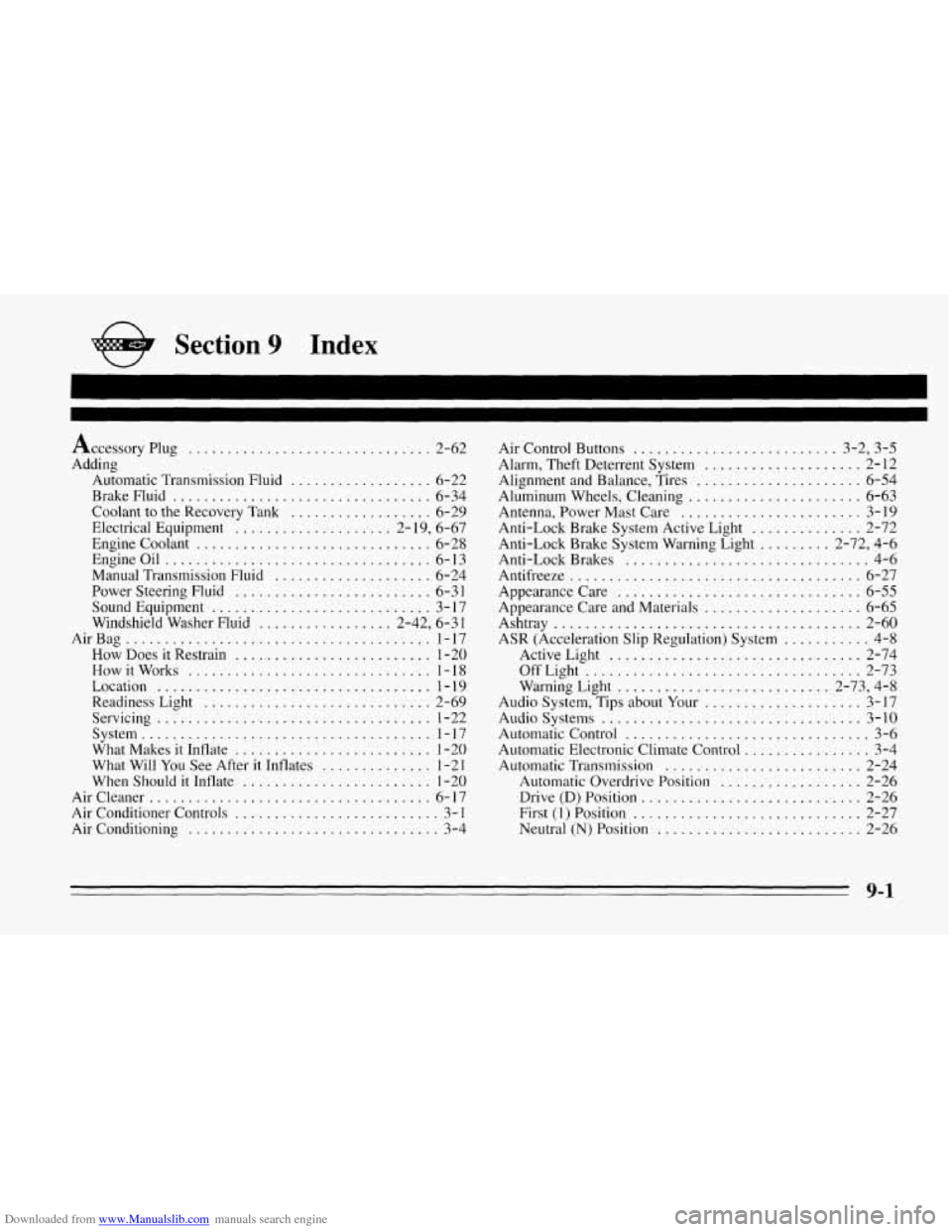
Downloaded from www.Manualslib.com manuals search engine Index
Accessory Plug ............. ............. 2-62
Adding Automatic Transmission Fluid
................ 6-22
Brake Fluid
...................... ...... 6-34
Coolant to the Recovery Tank
....... ........ 6-29
Electrical Equipment .................... 2- 19. 6-67
Engine Coolant
.............................. 6-28
Engineoil
.................................. 6-13
Manual Transmission Fluid
.................... 6-24
Power Steering Fluid
......................... 6-3 1
SoundEquipment ............................ 3-17
Windshield Washer Fluid
................. 2-42. 6-3 1
AirBag ....................................... 1-17
How Does it Restrain ......................... 1-20
How it Works ............................... 1 - I8
Location
................................... 1-19
Readiness Light
............................. 2-69
Servicing ................................... 1-22
System
..................................... 1-17
What Makes
it Inflate ......................... 1-20
What Will
You See After it Inflates .............. 1-2 1
When Should it Inflate ........................ 1-20
Air Cleaner
.................................... 6- 17
Air Conditioner Controls .......................... 3- 1
Air Conditioning ................................ 3-4 Air Control
Buttons
.......................... 3.2. 3.5
Alignment and Balance. Tires ..................... 6-54
Antenna. Power Mast Care
....................... 3-19
Anti-Lock Brake System Active Light
.............. 2-72
Anti-Lock Brake System Warning Light
......... 2.72. 4.6
Anti-Lock Brakes
............................... 4-6
Antifreeze ..................................... 6-27
Appearance Care
............................... 6-55
Appearance Care and Materials
.................... 6-65
Ashtray
....................................... 2-60
ASR (Acceleration Slip Regulation) System
........... 4-8
Active Light
................................ 2-74
OffLight
................................... 2-73
Warning Light
........................... 2.73. 4.8
Audio System. Tips about Your .................... 3-17
Audio Systems
................................. 3- IO
Automatic Control ............................... 3-6
Automatic Electronic Climate Control ................ 3-4
Automatic Transmission
......................... 2-24
Automatic Overdrive Position
.................. 2-26
Drive
(D) Position ............................ 2-26
First
(1) Position ............................. 2-27
Neutral
(N) Position .......................... 2-26
Alarm. Theft Deterrent
System
.................... 2-12
Aluminum Wheels. Cleaning
...................... 6-63
9-1