engine coolant CHEVROLET CORVETTE 1995 4.G User Guide
[x] Cancel search | Manufacturer: CHEVROLET, Model Year: 1995, Model line: CORVETTE, Model: CHEVROLET CORVETTE 1995 4.GPages: 386, PDF Size: 20.15 MB
Page 132 of 386
Downloaded from www.Manualslib.com manuals search engine Driver Information Center
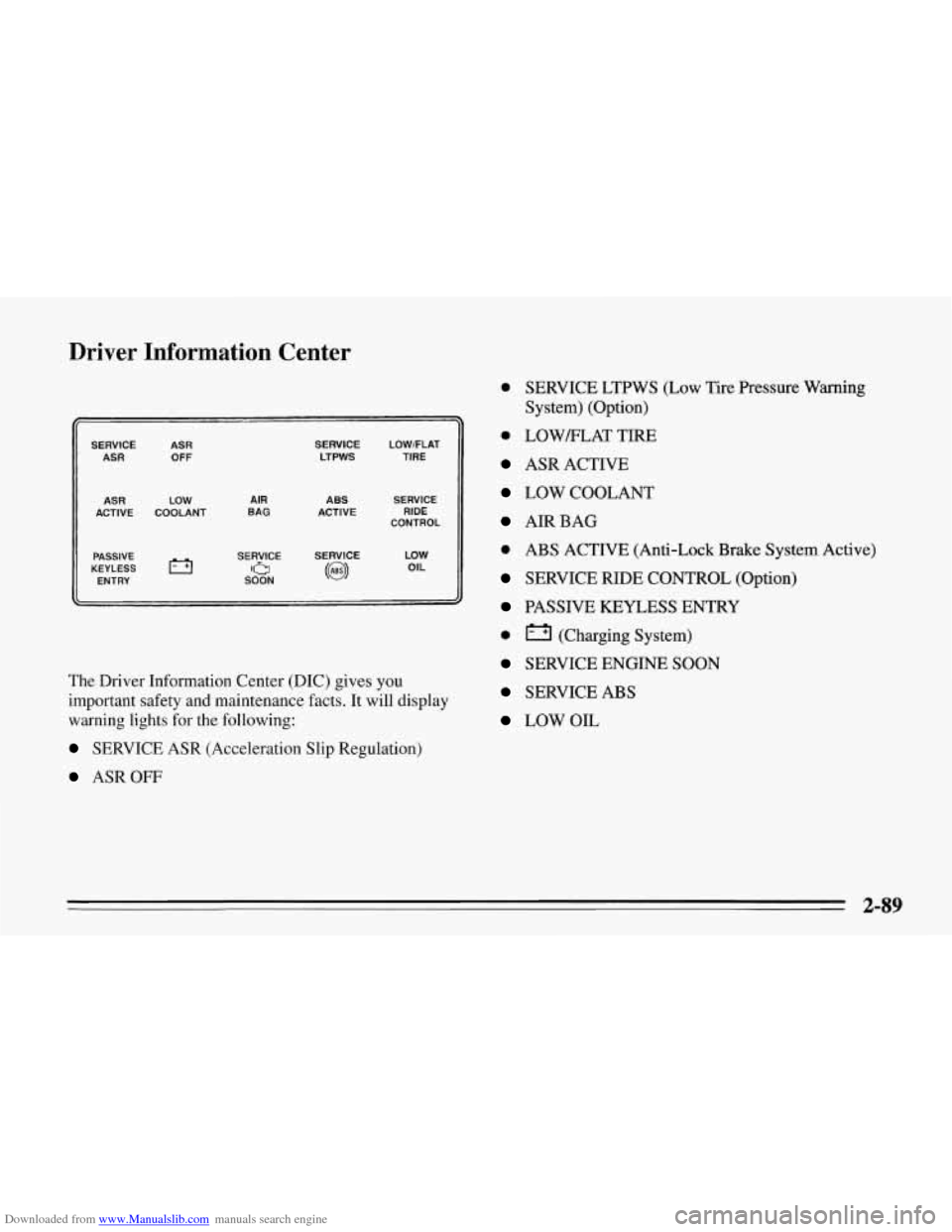
SERVICE ASR ASR OFF
ASR LOW
ACTIVE COOLANT
PASSIVE
KEYLESS
ENTRY AIR
BAG
SERVICE
115- SOON
SERVICE LTPWS ABS
ACTIVE
SERVICE
(@I
LOWlFLAT TIRE
SERVICE RIDE
CONTROL
LOW OIL
The Driver Information Center (DIC) gives you
important safety and maintenance facts.
It will display
warning lights for the following:
SERVICE ASR (Acceleration Slip Regulation)
ASROFF
0 SERVICE LTPWS (Low Tire Pressure Warning
System) (Option)
0 LOWELAT TIRE
ASR ACTIVE
LOW COOLANT
AIRBAG
0 ABS ACTIVE (Anti-Lock Brake System Active)
SERVICE RIDE CONTROL (Option)
PASSIVE KEYLESS ENTRY
0 (Charging System)
SERVICE ENGINE SOON
SERVICE ABS
LOW OIL
2-89
Page 146 of 386
Downloaded from www.Manualslib.com manuals search engine If your vehicle has an engine coolant heater and you use
it in cold weather,
0 “F (- 18 “C) or lower, your heating
system can provide heat more quickly because the
engine coolant is already warmed. See “Engine Coolant
Heater” in the Index.
Bi-Level
You may want to use BI-LEVEL on cool, but sunny
days. This setting directs outside air through the
instrument panel vents and the floor ducts.
Press BI-LEVEL and FAN UP, then slide the
temperature control lever to a comfortable setting.
Ventilation
For mild outside temperatures, when little heating or
cooling is needed, you can still direct outside air through
your vehicle.
Press VENT and FAN UP, then slide the temperature
control lever to a comfortable setting.
Defogging and Defrosting Windows
Your vehicle has several settings for clearing your
windows. The air conditioner compressor will run to
help remove moisture from the air.
To defrost the windshield quickly, press
DEFROST and
FAN UP, then slide the temperature control lever all the
way to the right or to the FULL
HOT position.
To defrost the side windows quickly, press BI-LEVEL
and FAN UP. Then slide the temperature control lever
all the way to the right. Direct airflow through the air
conditioning outlets closest to the side windows.
3-3
Page 149 of 386
Downloaded from www.Manualslib.com manuals search engine Temperature Sensors
Sunload:
This sensor is on top of the instrument panel.
When the inside temperature
is increased by sunlight,
the system will lower the inside temperature up to
5°F
(3 “C) below the setting on the display.
Outside Temperature: This sensor is on the right side
of the upper radiator support in the grille opening. This
is what you usually see on the display.
If the outside temperature goes up, the displayed
temperature will not change until:
a Vehicle speed is above 25 mph (40 km/h) for at least
0 Vehicle speed is above 45 mph (72 km/h) for
This delay helps prevent a false reading. If vehicle speed
remains above
25 mph (40 km/h) or the temperature
goes down, the display is updated immediately.
If your vehicle has been off for more than three hours,
the current outside temperature will be stored in the
system when you start the vehicle.
Inside temperature: This sensor is in the center air
outlet
on the passenger side.
If you block or cover either interior sensor, the system
will give a false reading.
3 minutes, or
1 1/2 minutes.
Automatic Control
The system will adjust to maintain the temperature you
set. It will select the best fan speed and aifflow setting to
keep you comfortable with the least amount of noise.
Press the arrows on the TEMP SET switch’to set a
comfortable temperature. Then press AUTO
and the fan
speed will adjust automatically unless you press the
arrows on the switch.
Manual Heating
The heater works best if you keep your windows closed
while using it.
Press the arrows on the TEMP SET switch to set a
comfortable temperature. Then press HEATER and, if
you don’t like the automatic setting, press the arrows on
the fan speed switch.
In AUTO FAN on cold days, the
fan will stay off until the coolant warms up enough to
heat your vehicle.
If your vehicle has an engine coolant heater and you use
it in cold weather,
0 OF (- 18 O C) or lower, your heating
system can provide heat more quickly because the
engine coolant is already warmed. See “Engine Coolant
Heater” in the Index.
3-6
Page 187 of 386
Downloaded from www.Manualslib.com manuals search engine Winter Driving
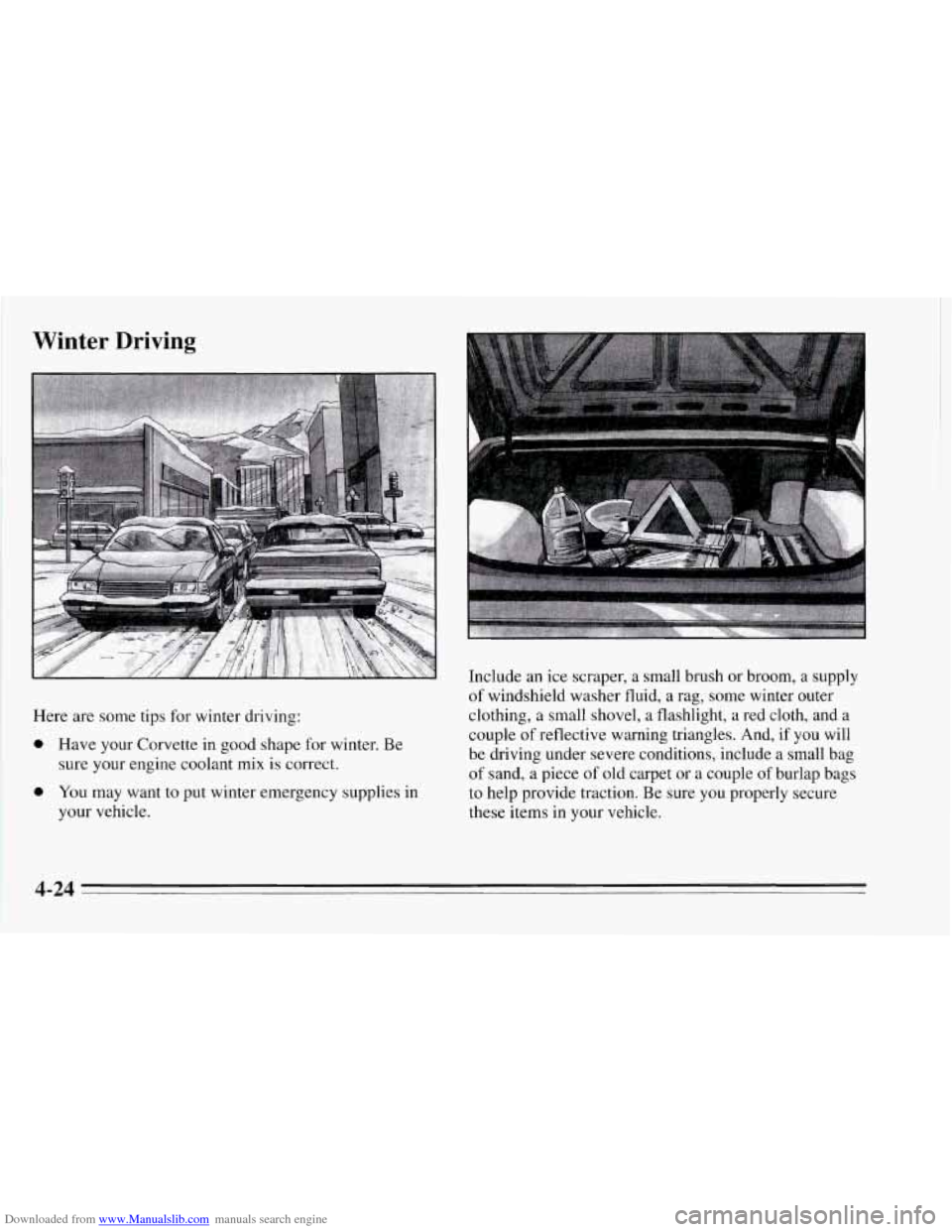
Here are some tips for winter driving:
0 Have your Corvette in good shape for winter. Be
sure your engine coolant mix is correct.
0 You may want to put winter emergency supplies in
your vehicle. Include an
ice scraper,
a small brush or broom, a supply
of windshield washer fluid, a rag, some winter outer
clothing, a small shovel, a flashlight, a red cloth, and a
couple
of reflective warning triangles. And, if you will
be driving under severe conditions, include a small bag
of sand, a piece of old carpet or a couple of burlap bags
to help provide traction. Be sure
you properly secure
these items in your vehicle.
4-24
Page 206 of 386
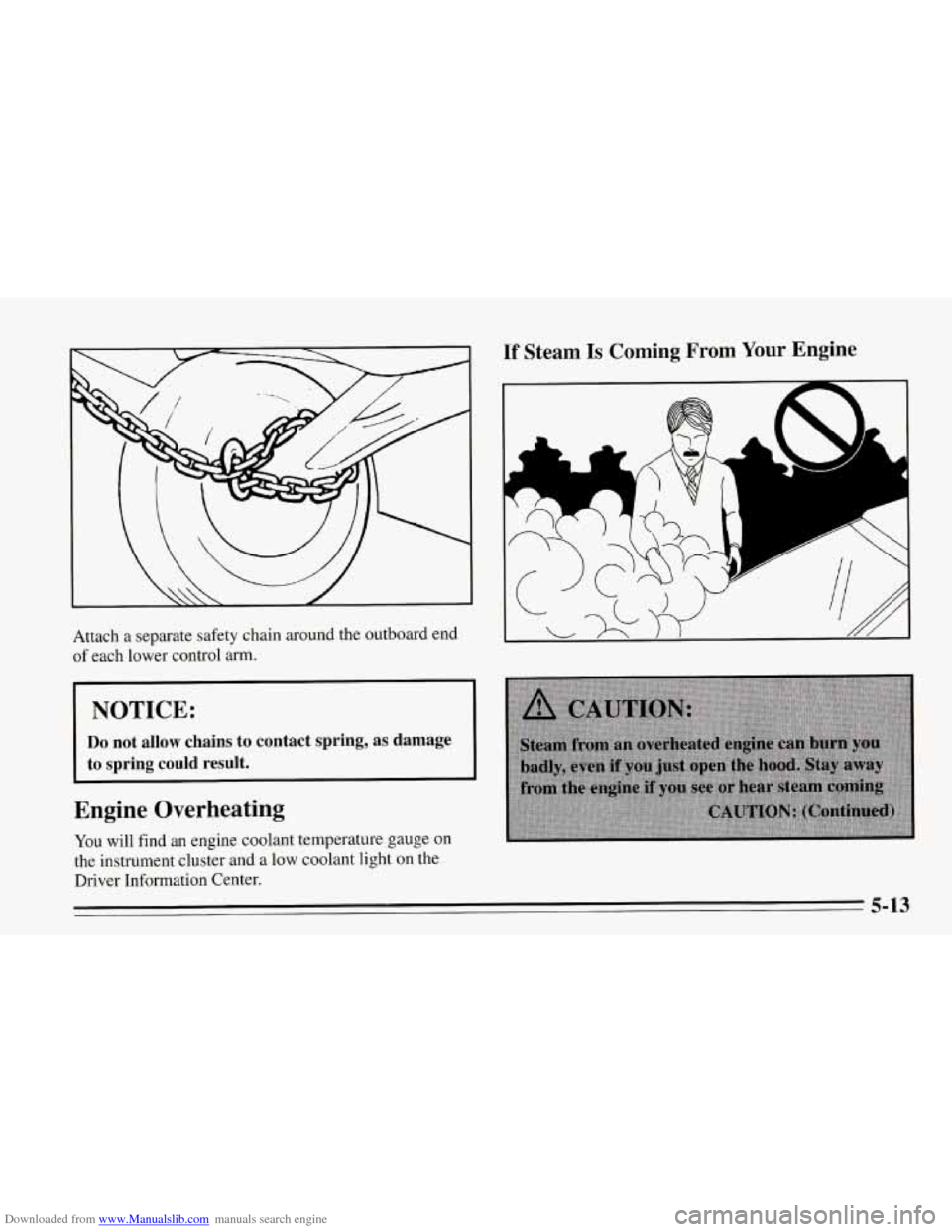
Downloaded from www.Manualslib.com manuals search engine Attach a separate safety chain around the outboard end
of each lower control arm.
I I
I NOTICE:
Do not allow chains to contact spring, as damage
to spring could result.
Engine Overheating
You will find an engine coolant temperature gauge on
the instrument cluster and a low coolant light on the
Driver Information Center.
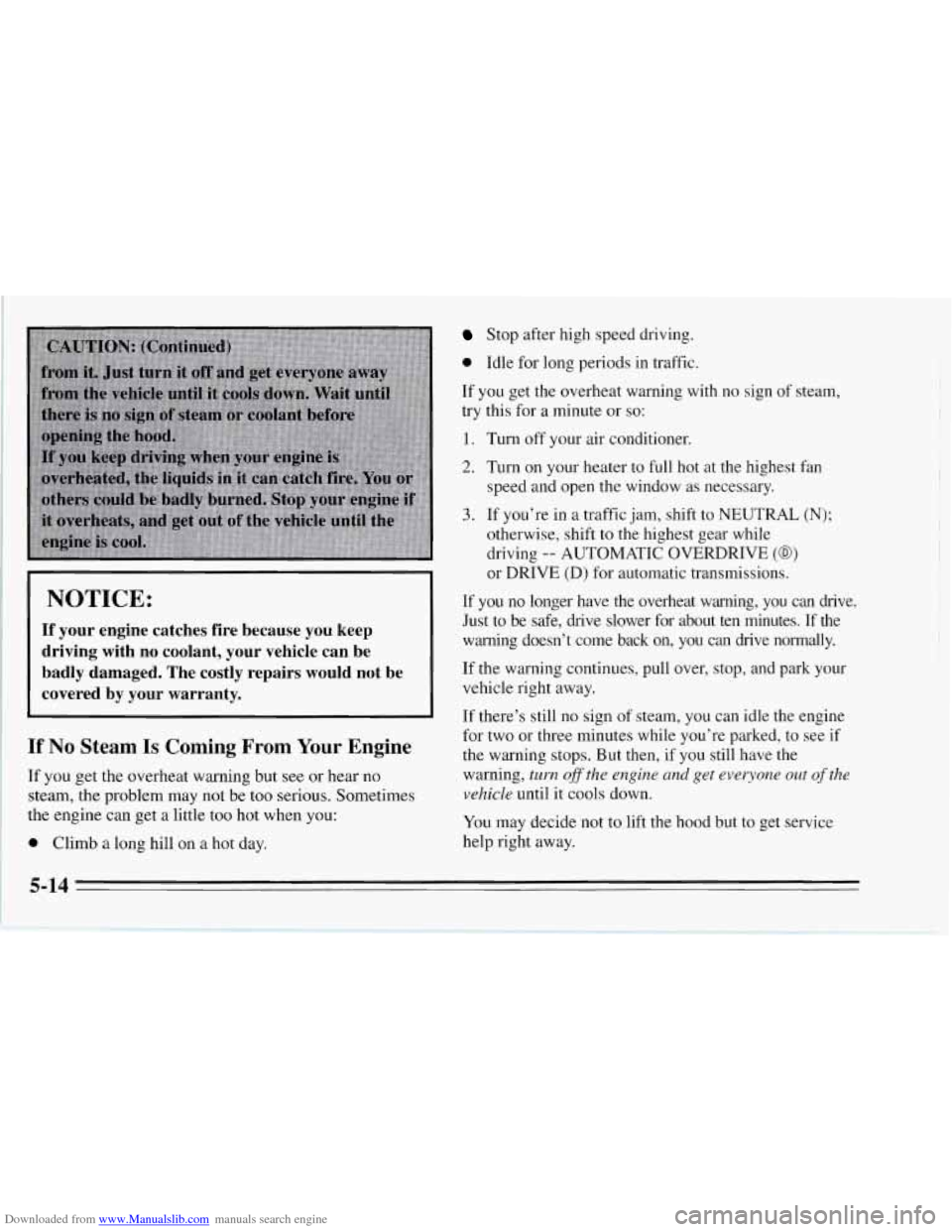
If Steam Is Coming From Your Engine
'I
c
a
5-13
Page 207 of 386
Downloaded from www.Manualslib.com manuals search engine 1 NOTICE:
I
If’ your engine catches fire because you keep
driving with no coolant, your vehicle can be
badly damaged. The costly repairs would
not be
covered by your warranty.
If No Steam Is Coming From Your Engine
If you get the overheat warning but see or hear no
steam, the problem may not be
too serious. Sometimes
the engine can get a little too hot when you:
0 Climb a long hill on a hot day.
Stop after high speed driving.
0 Idle for long periods in traffic.
If you get the overheat warning with no sign
of steam,
try this for a minute or
so:
1. Turn off your air conditioner.
2. Turn on your heater to full hot at the highest fan
speed and open the window as necessary.
3. If you’re in a traffic jam, shift to NEUTRAL (N);
otherwise, shift to the highest gear while
driving
-- AUTOMATIC OVERDRIVE (a)
or DRIVE (D) for automatic transmissions.
If you
no longer have the overheat warning, you can drive.
Just to be safe, drive slower for about ten minutes. If the
warning doesn’t come back on, you
can drive normally.
If the warning continues, pull over, stop, and park your
vehicle right away.
If there’s still no sign of steam, you can idle the engine
for two or three minutes while you’re parked,
to see if
the warning stops. But then, if you still have the
warning,
turn off the engine and get everyone out of the
vehicle
until it cools down.
You may decide not to lift the hood but to get service
help right away.
I
5-14
Page 208 of 386
Downloaded from www.Manualslib.com manuals search engine Cooling System
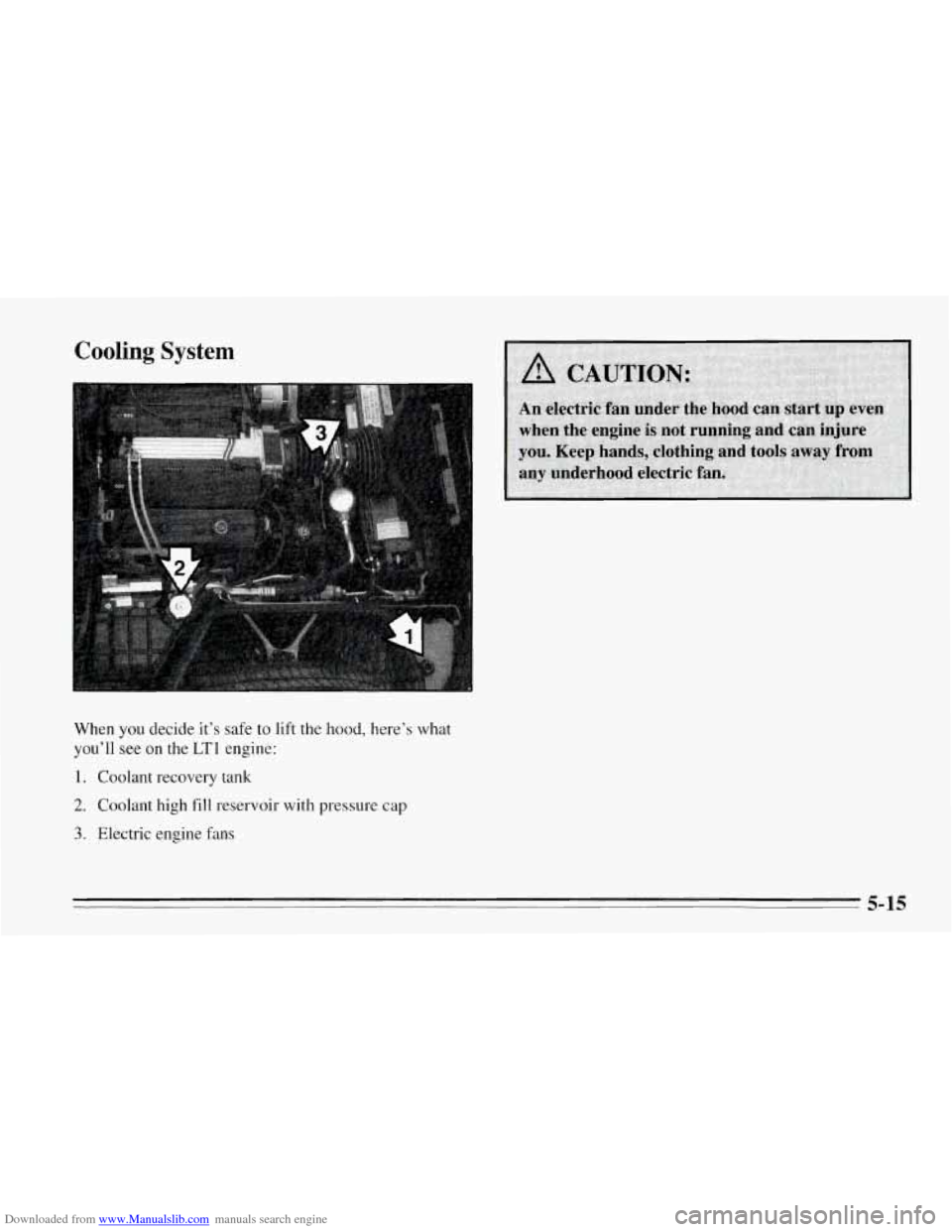
When you decide it’s safe to lift the hood, here’s what
you’ll see on the
LT1 engine:
1. Coolant recovery tank
2. Coolant high fill reservoir with pressure cap
3. Electric engine fans
5-15
Page 209 of 386
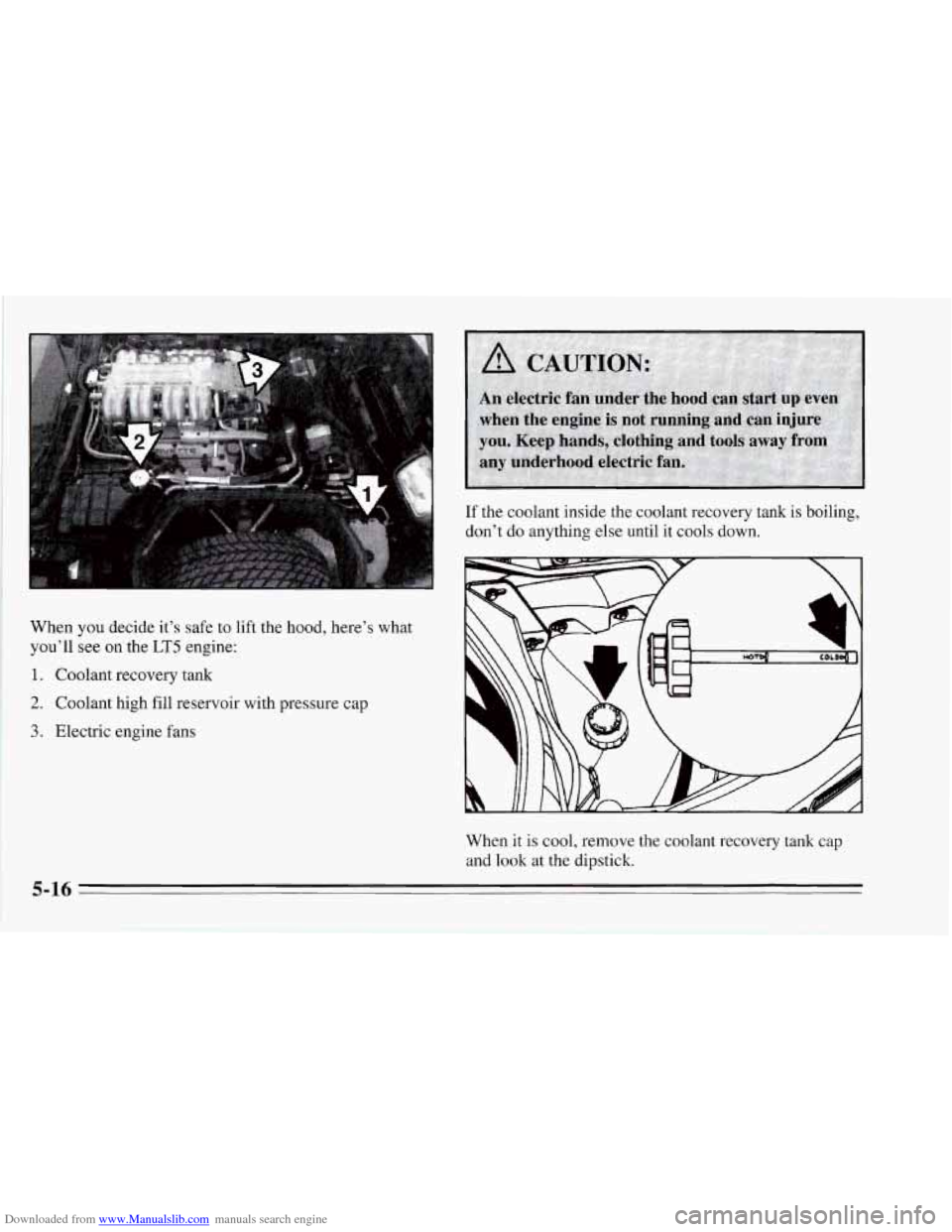
Downloaded from www.Manualslib.com manuals search engine If the coolant inside the coolant recovery tank is boiling,
don’t do anything else until it cools down.
When you decide it’s safe to lift the hood, here’s what
you’ll see on the LT5 engine:
1. Coolant recovery tank
2. Coolant high fill reservoir with pressure cap
3. Electric engine fans
When it
is cool, remove the coolant recovery tank cap
and
look at the dipstick.
5-16
Page 210 of 386
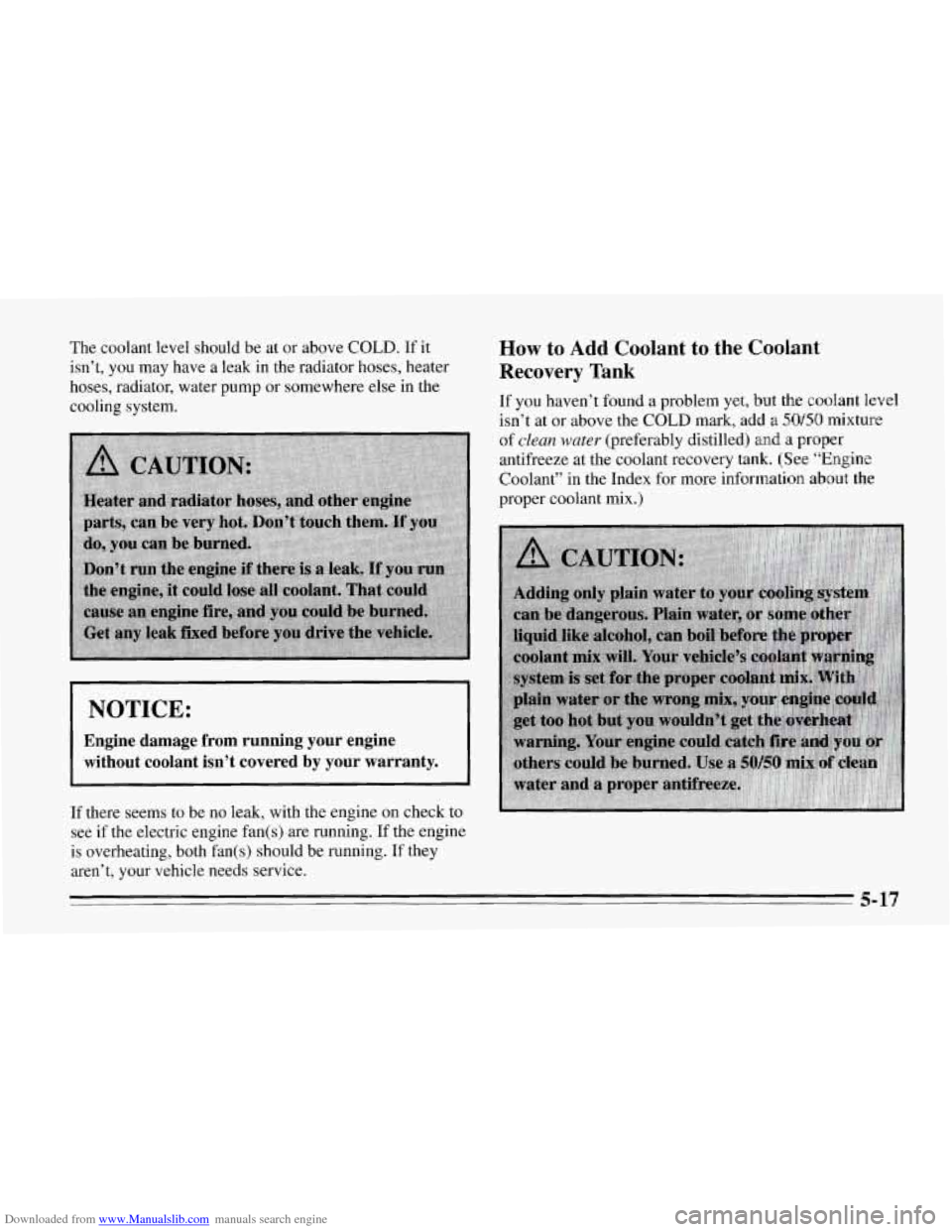
Downloaded from www.Manualslib.com manuals search engine The coolant level should be at or above COLD. If it
isn’t, you may have a leak in the radiator hoses, heater
hoses, radiator, water pump or somewhere else in the
cooling system.
NOTICE:
Engine damage from running your engine
without coolant isn’t covered by your warranty.
If there seems to be no leak, with the engine on check to
see if the electric engine fan(s) are running.
If the engine
is overheating, both fan(s) should be running. If they
aren’t, your vehicle needs service.
How to Add Coolant to the Coolant
Recovery Tank
If you haven’t found a problem yet, but the ,coo,lant level
isn’t at or above the COLD mark, add
a 50MI mixture
of clean water (preferably distilled) and a proper
antifreeze at the coolant recovery tank. (%e “Engine
Coolant” in the Index for more information about the
proper coolant mix.)
5-17
Page 211 of 386
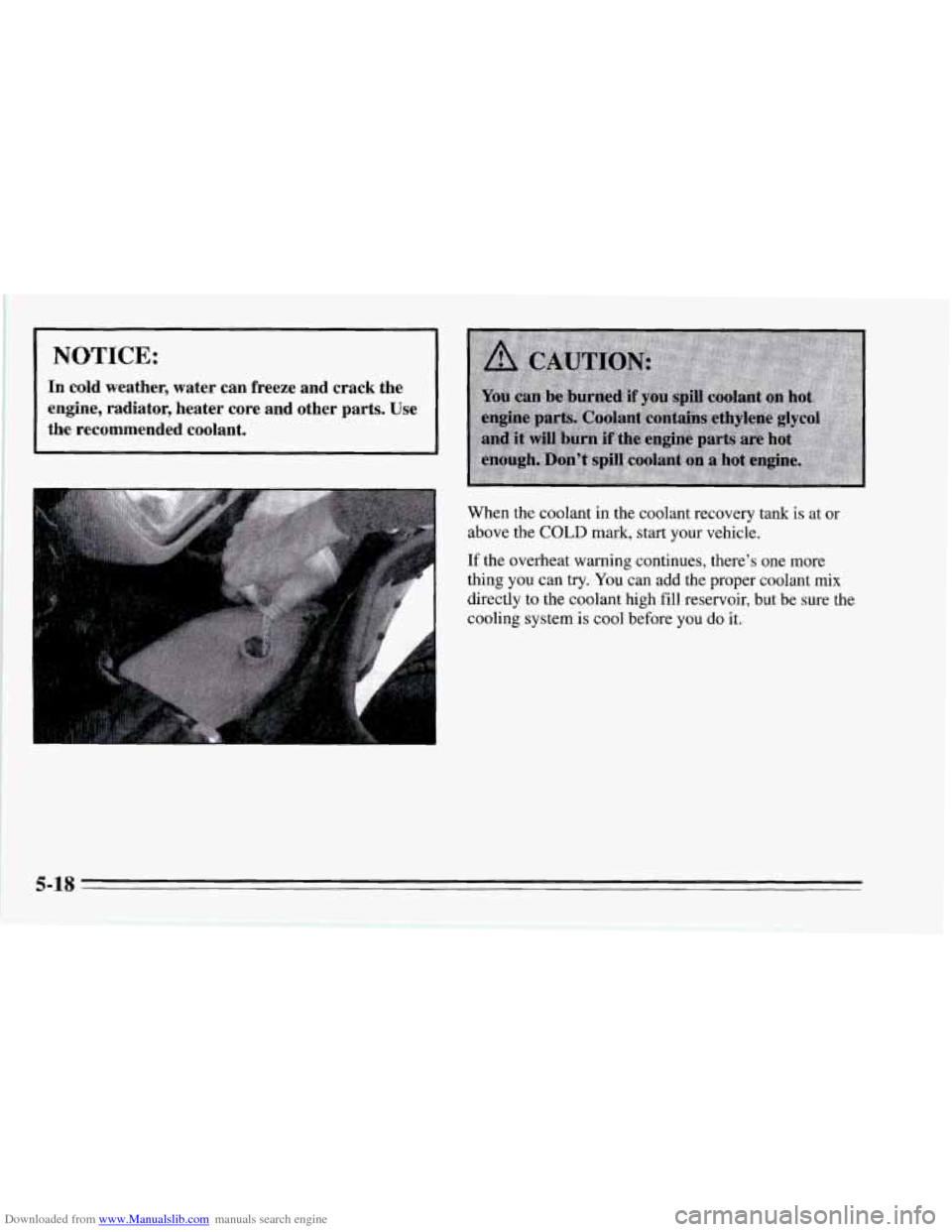
Downloaded from www.Manualslib.com manuals search engine In cold weather, water can freeze and crack the
engine, radiator, heater core and other parts. Use
the recommended coolant.
When the coolant in the coolant recovery tank is at or
above the
COLD mark, start your vehicle.
If the overheat warning continues, there's one more
thing you can try.
You can add the proper coolant mix
directly to the coolant high fill reservoir, but be sure the
cooling system
is cool before you do it.