engine coolant CHEVROLET CORVETTE 1995 4.G Owner's Manual
[x] Cancel search | Manufacturer: CHEVROLET, Model Year: 1995, Model line: CORVETTE, Model: CHEVROLET CORVETTE 1995 4.GPages: 386, PDF Size: 20.15 MB
Page 213 of 386
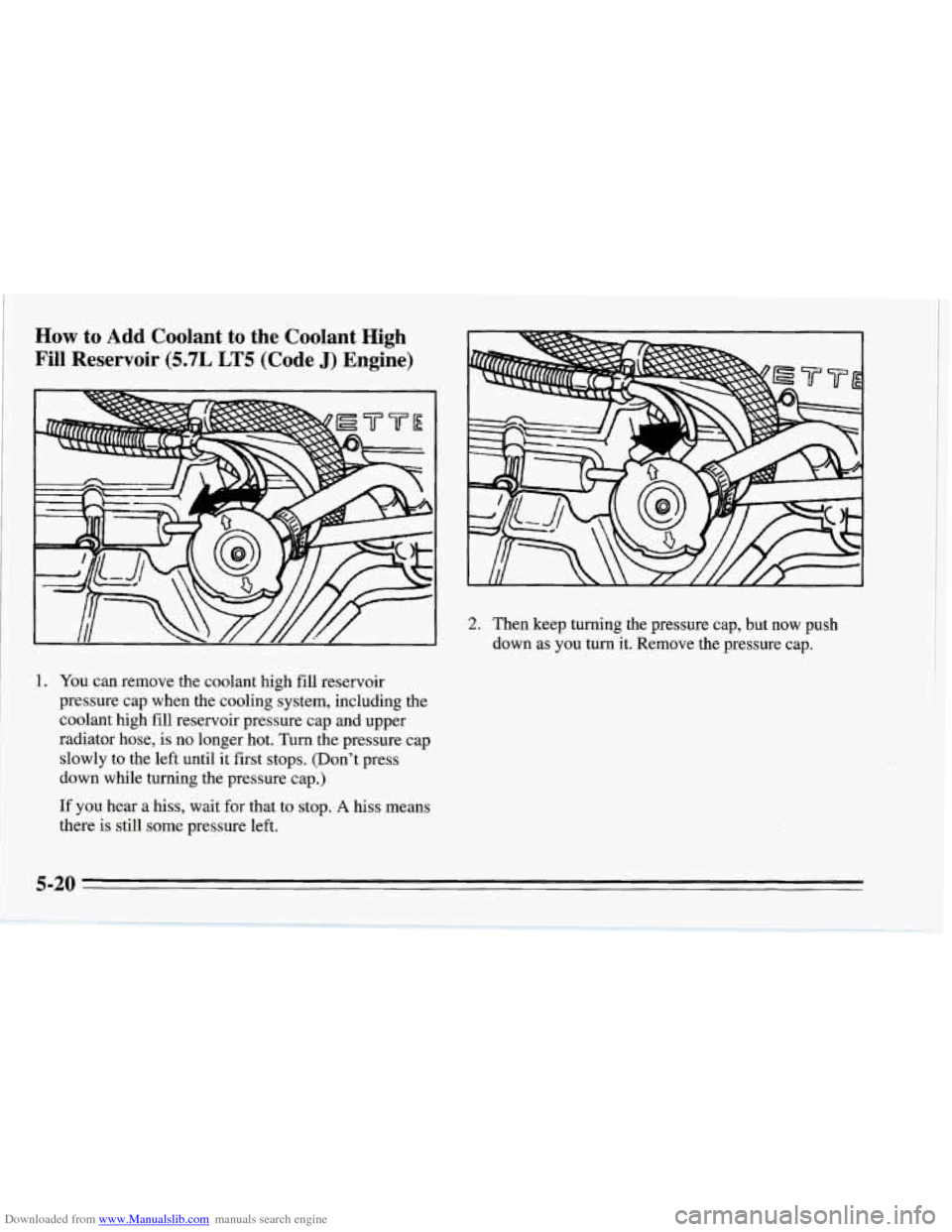
Downloaded from www.Manualslib.com manuals search engine How to Add Coolant to the Coolant High
Fill Reservoir
(5.7L LT5 (Code J) Engine)
2. Then keep turning the pressure cap, but now push
down as you turn it. Remove the pressure cap.
1. You can remove the coolant high fill reservoir
pressure cap when the cooling system, including the
coolant high fill reservoir pressure cap and upper
radiator hose, is no longer hot. Turn the pressure cap
slowly to the left until it first stops. (Don’t press
down while turning the pressure cap.)
If you hear a
hiss, wait for that to stop. A hiss means
there is still
some pressure left.
5-20
Page 214 of 386
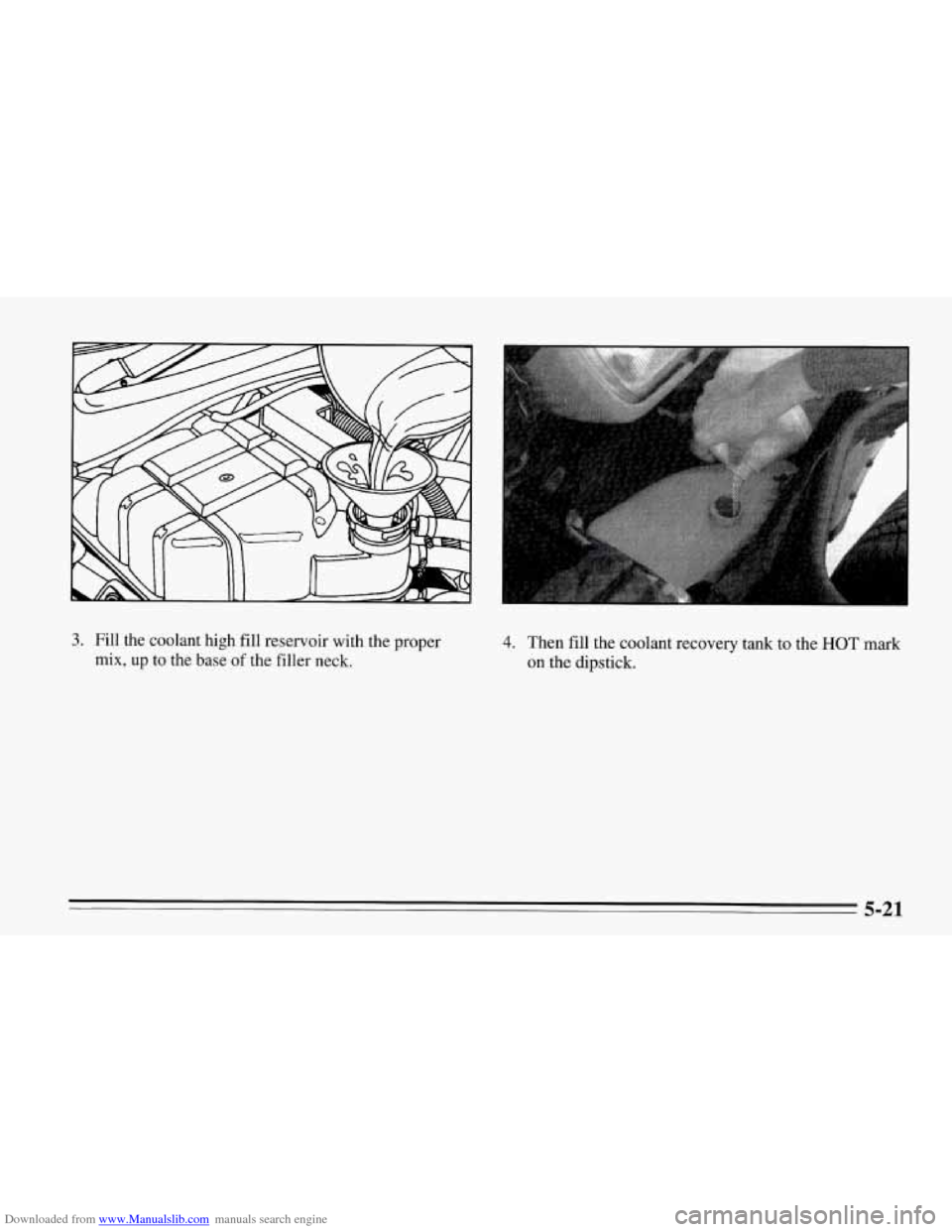
Downloaded from www.Manualslib.com manuals search engine 3. Fill the coolant high fill reservoir with the proper
mix,
up to the base of the filler neck.
4. Then fill the coolant recovery tank to the HOT mark
on the dipstick.
5-21
Page 215 of 386
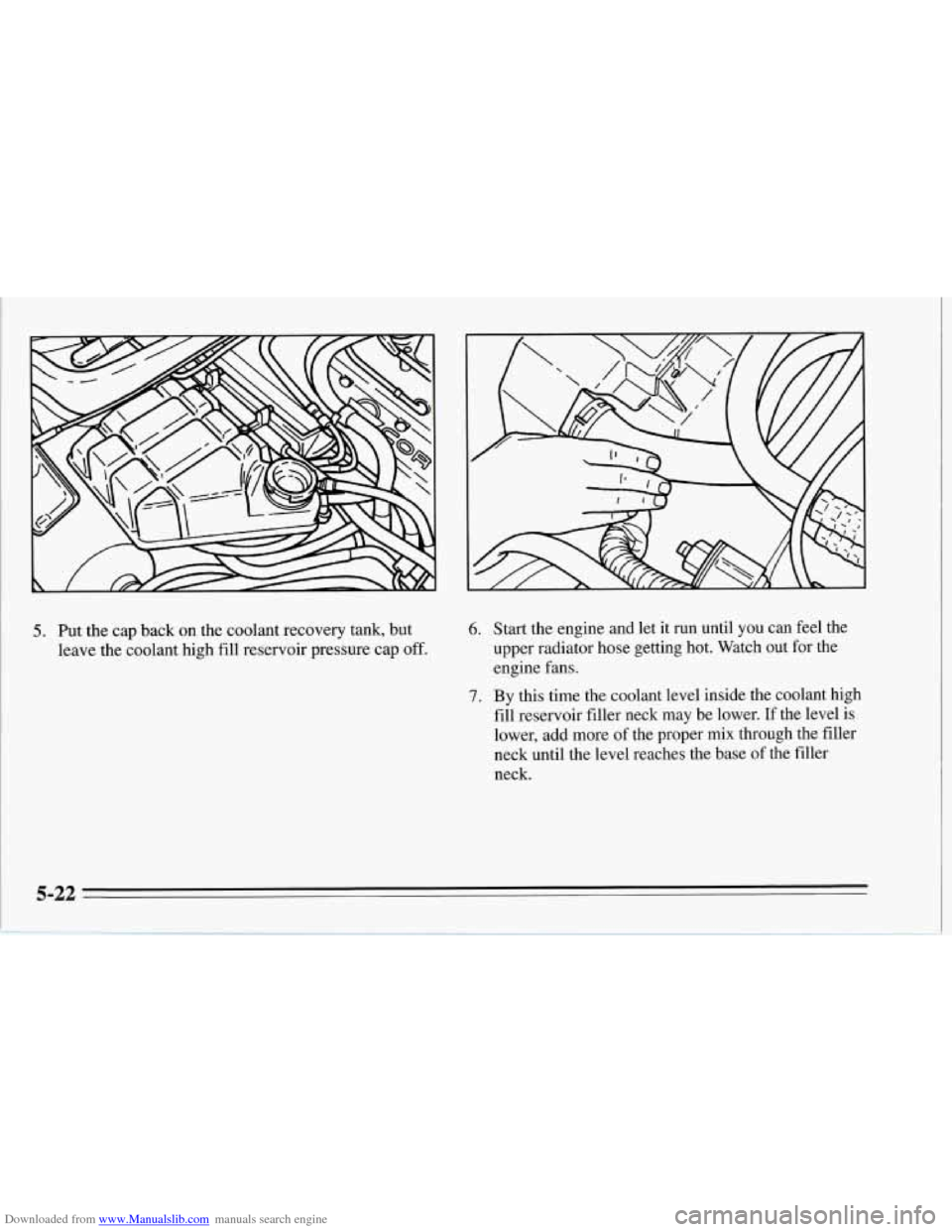
Downloaded from www.Manualslib.com manuals search engine 5. Put the cap back on the coolant recovery tank, but
leave the coolant high fill reservoir pressure cap off. 6.
7.
Start the engine and let it run until you can feel the
upper radiator hose getting hot. Watch out for the
engine fans.
By this time the coolant level inside the coolant high
fill reservoir filler neck
may be lower. If the level is
lower, add more
of the proper mix through the filler
neck until the level reaches the base of the filler
neck.
5-22
Page 216 of 386
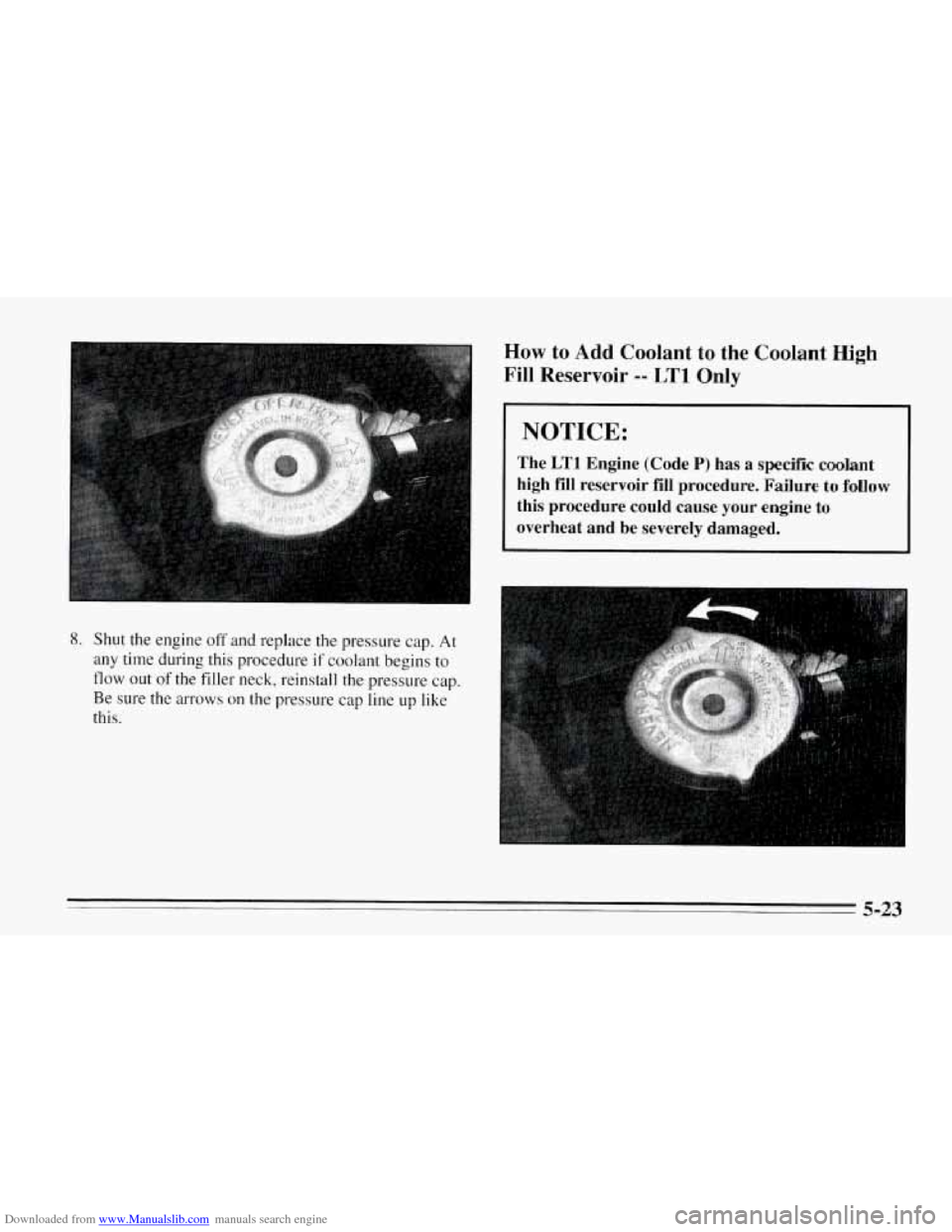
Downloaded from www.Manualslib.com manuals search engine 8. Shut the engine off and replace the pressure cap. At
any time during this procedure if coolant begins to
flow out of the filler neck, reinstall the pressure cap.
Be sure the arrows on the pressure cap line up like
this.
How to Add Coolant to the Coolant High
Fill Reservoir -- LTl Only
NOTICE:
The LT1 Engine (Code P) has a specific coolant
high fill reservoir fill procedure. Failure t,o follow
this procedure could cause your engine to
overheat and be severely damaged.
5-23
Page 217 of 386
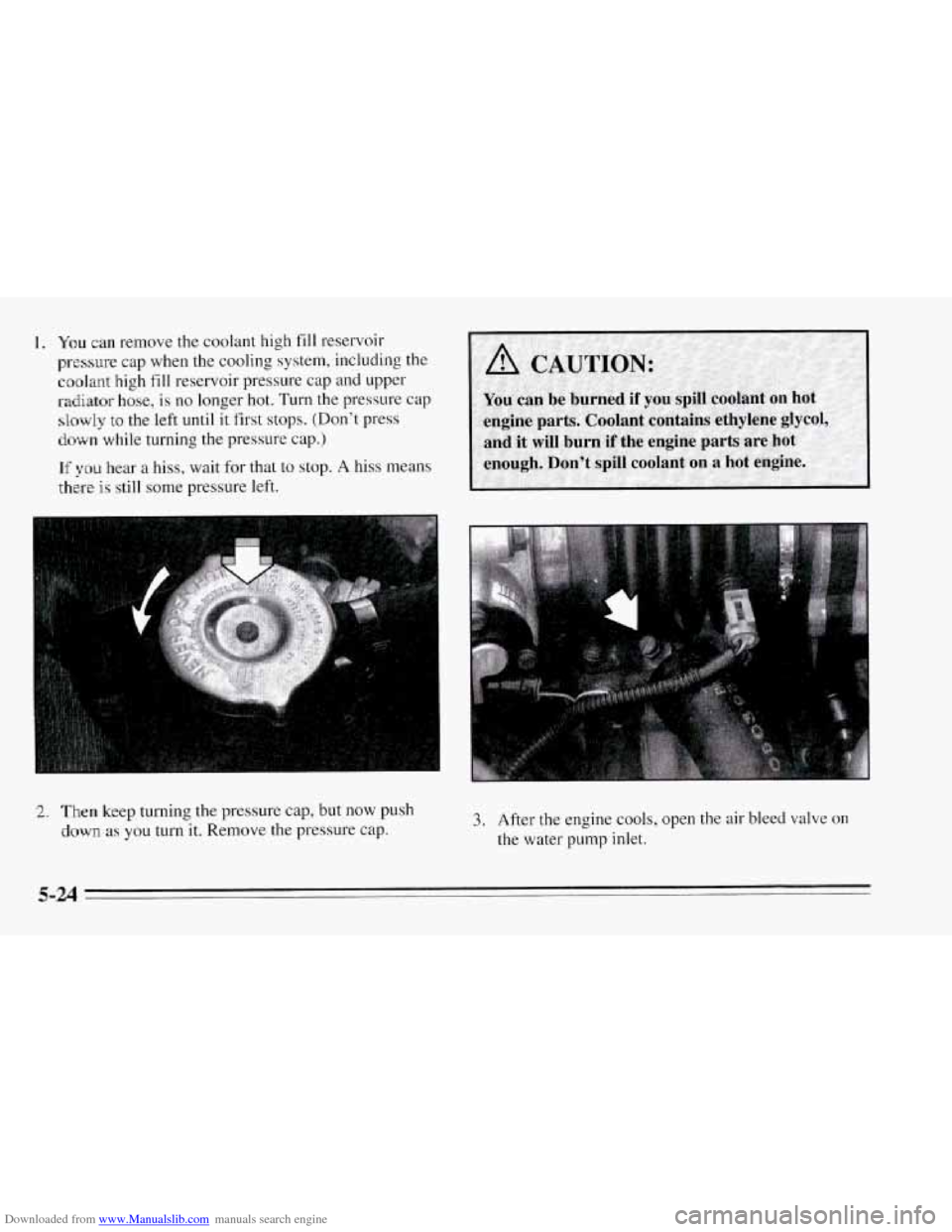
Downloaded from www.Manualslib.com manuals search engine 1. You can remove the coolant high fill reservoir
pressure cap when the cooling system, including the
coolant high fill reservoir pressure cap and upper
radiator hose, is no longer hot. Turn the pressure cap
slowly to the left until it first stops. (Don’t press
down while turning the pressure cap.)
If
you hear a hiss, wait for that to stop. A hiss means
there
is still some pressure left.
2.. Then keep turning the pressure cap, but now push
down as you turn it. Remove the pressure cap. 3. After the engine cools, open the air bleed valve on
the water pump inlet.
5-24
Page 218 of 386
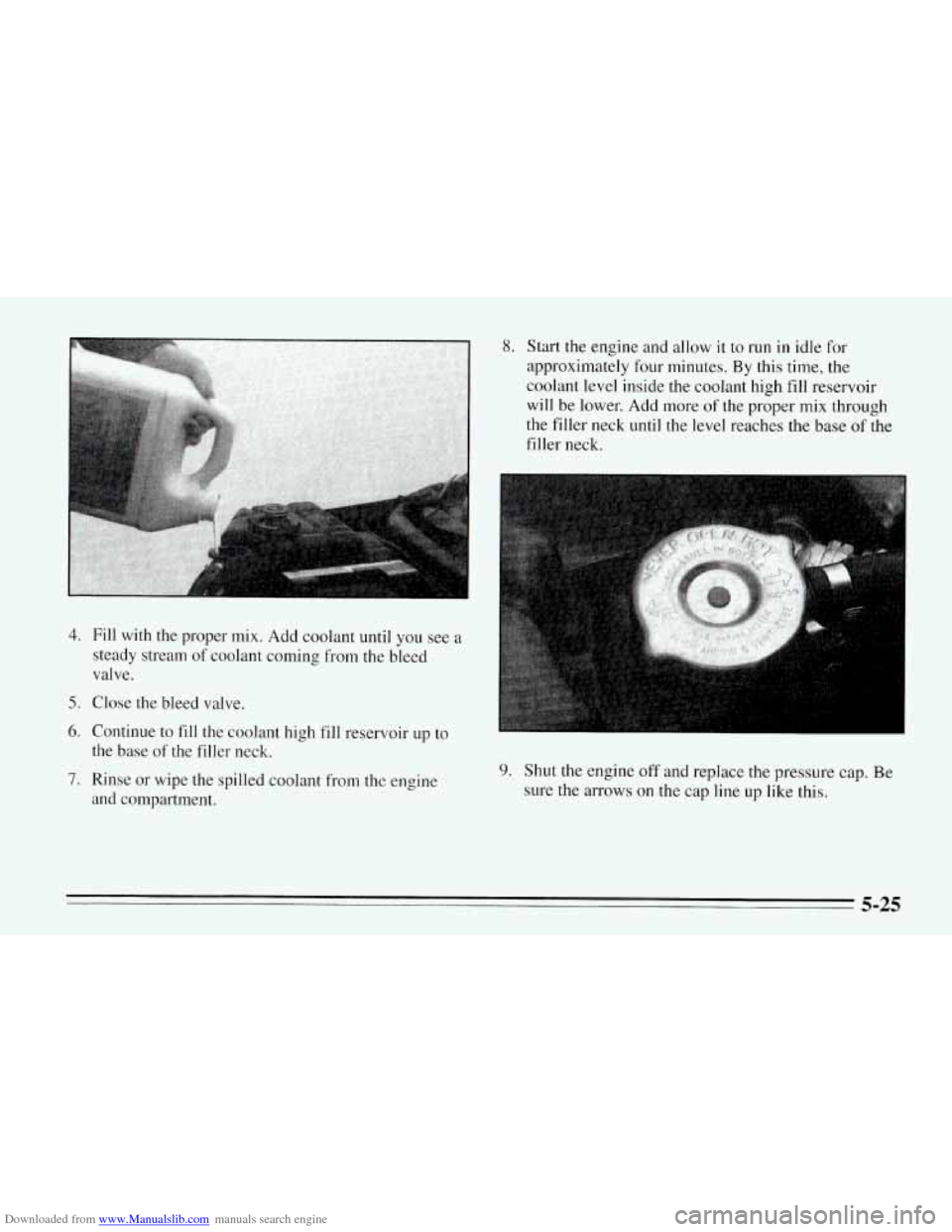
Downloaded from www.Manualslib.com manuals search engine 4. Fill with the proper mix. Add coolant until you see a
steady stream of coolant coming from the bleed
valve.
5. Close the bleed valve.
6. Continue to fill the coolant high fill reservoir up to
the base of the filler neck.
7. Rinse or wipe the spilled coolant from the engine
and compartment.
8. Start the engine and allow it to run in idle for
approximately four minutes.
By this time, the
coolant level inside the coolant high fill reservoir
will be lower. Add more
of the proper mix through
the filler neck
until the level reaches the base of the
filler neck.
9. Shut the engine off and replace the pressure cap. Be
sure the arrows
on the cap line up like this.
5-25
Page 219 of 386
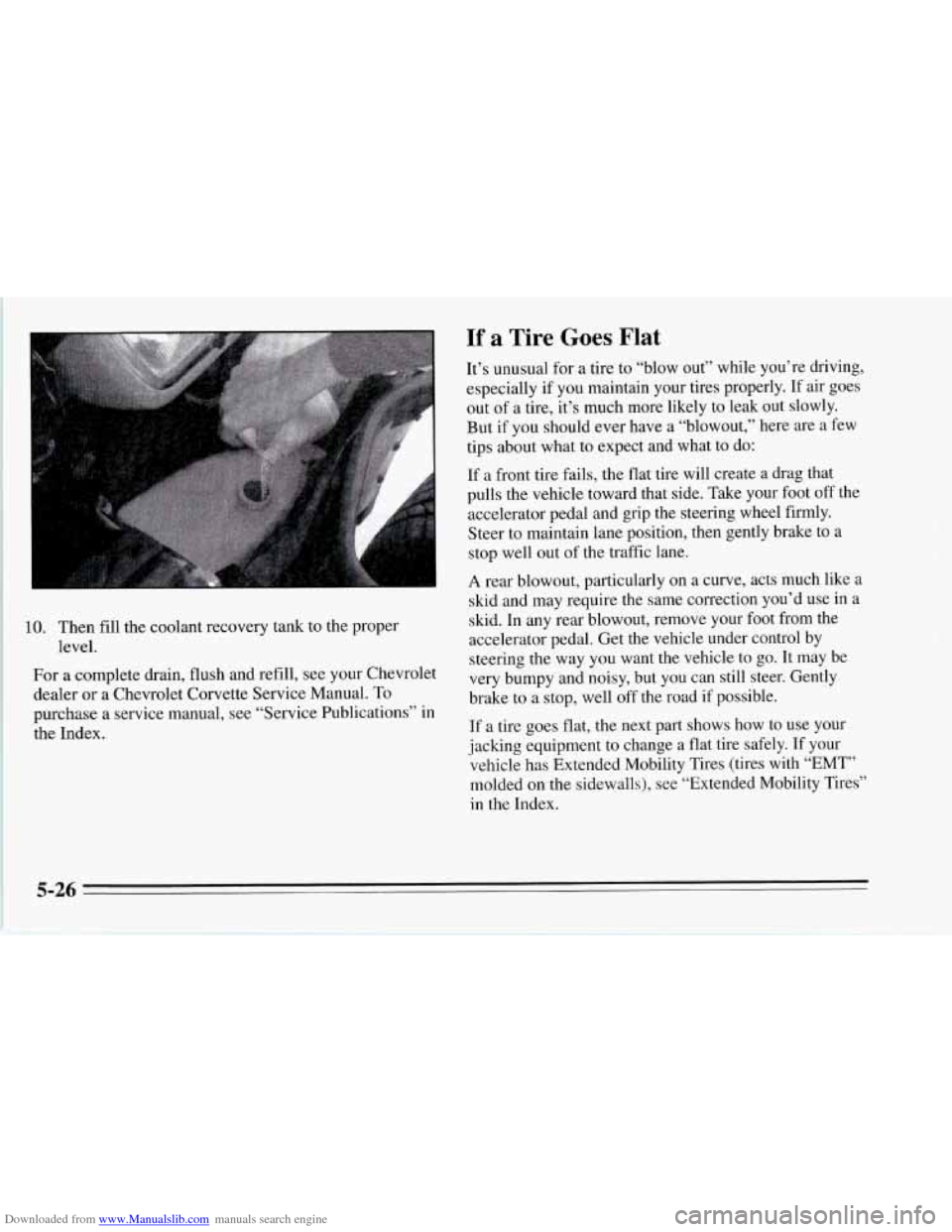
Downloaded from www.Manualslib.com manuals search engine 10. Then fill the coolant recovery tank
level. to the proper
For a complete drain, flush and refill, see your Chevrolet
dealer
or a Chevrolet Corvette Service Manual. To
purchase a service manual, see “Service Publications” in
the Index.
If a Tire Goes Flat
It’s unusual for a tire to “blow out” while you’re driving,
especially if you maintain your tires properly. If air goes
out of a tire, it’s much more likely to leak out slowly.
But if you should ever have
a “blowout,” here are a few
tips about what to expect and what
to do:
If a front tire fails, the flat tire will create a drag that
pulls the vehicle toward that side. Take your foot off the
accelerator pedal and grip the steering wheel firmly.
Steer to maintain lane position, then gently brake to a
stop well out of the traffic lane.
A rear blowout, particularly on a curve, acts much like a
skid and may require the same correction you’d use in a
skid. In any rear blowout, remove your foot from the
accelerator pedal. Get the vehicle under control by
steering the way you want the vehicle to
go. It may be
very bumpy and noisy, but you can still steer. Gently
brake to a stop, well off the road if possible.
If a tire goes flat, the next part shows how to use your
jacking equipment to change a flat tire safely. If your
vehicle has Extended Mobility Tires (tires with “EMT”
molded on the sidewalls), see “Extended Mobility Tires”
in the Index.
5-26
Page 244 of 386
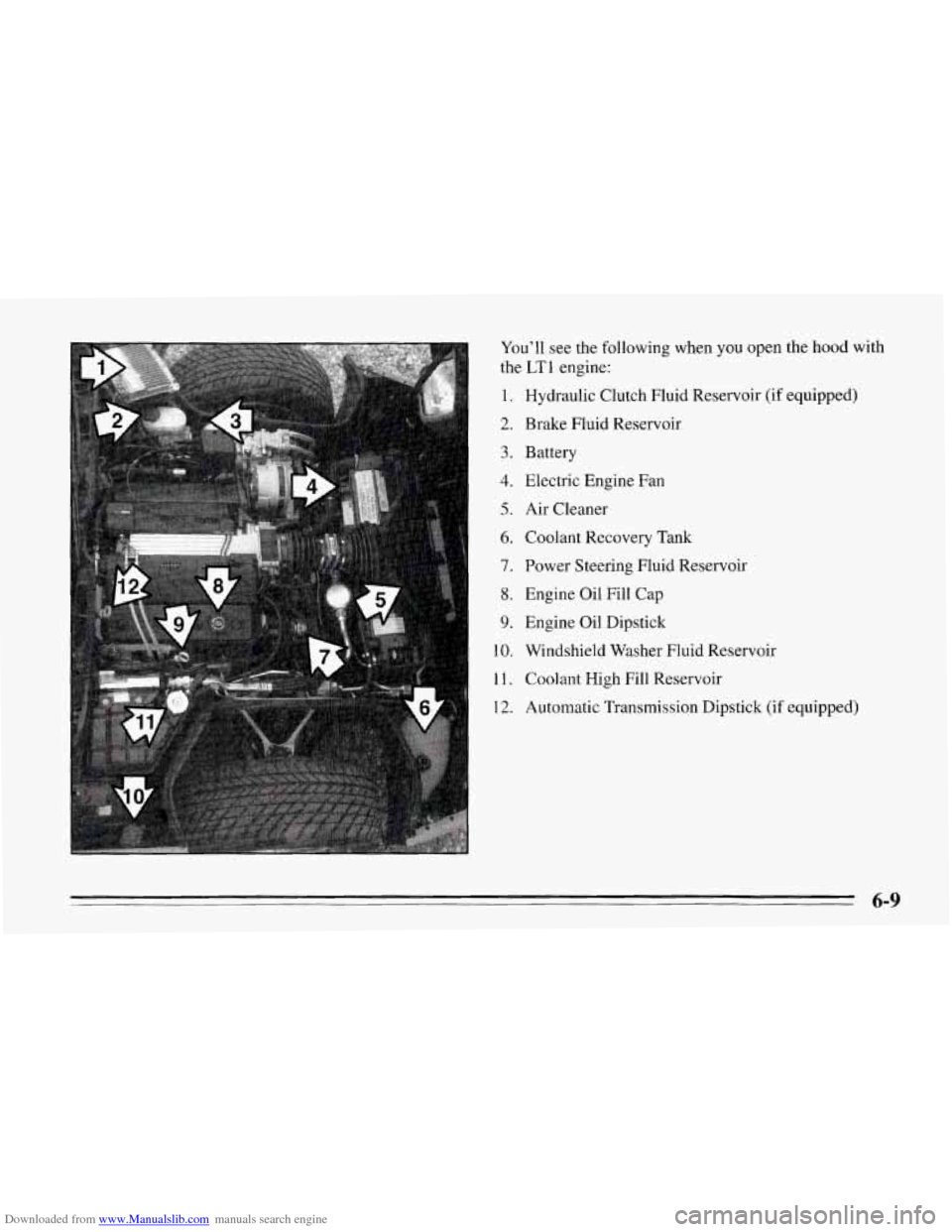
Downloaded from www.Manualslib.com manuals search engine You’ll see the following when you open the hood with
the
LTl engine:
1.
2.
3.
4.
5.
6.
7.
8.
9.
10.
11.
12.
Hydraulic Clutch Fluid Reservoir (if equipped)
Brake Fluid Reservoir
Battery
Electric Engine Fan
Air Cleaner
Coolant Recovery Tank Power Steering Fluid Reservoir
Engine Oil Fill Cap
Engine Oil Dipstick Windshield Washer Fluid Reservoir
Coolant High
Fill Reservoir
Automatic Transmission Dipstick (if equipped)
6-9
Page 246 of 386
Downloaded from www.Manualslib.com manuals search engine 5.
6.
7.
8.
9.
10.
11.
Air Cleaner Coolant Recovery Tank
Power Steering Fluid Reservoir
Engine Oil Fill Cap
Engine Oil Dipstick
Windshield Washer Fluid Reservoir
Coolant High Fill Reservoir
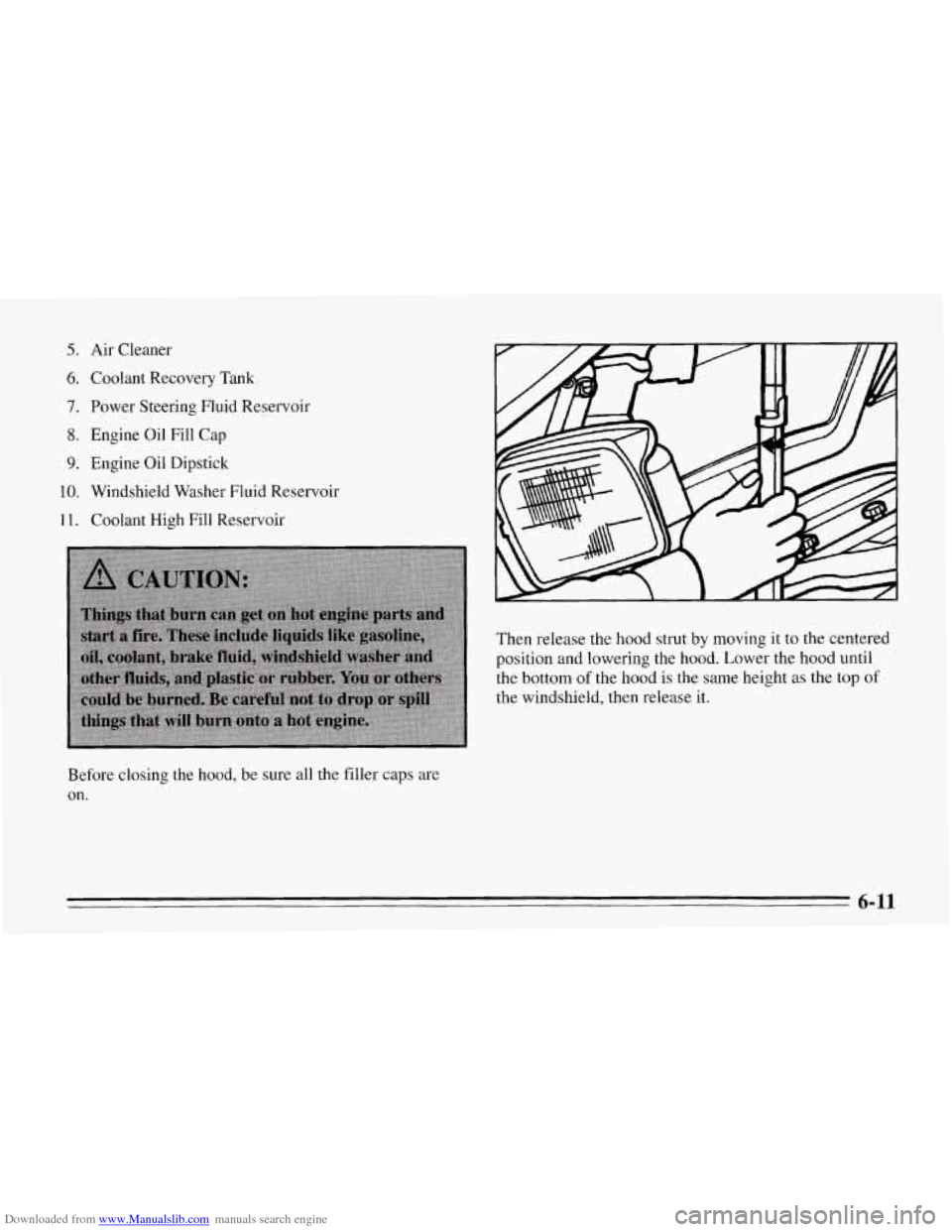
Then release the hood strut by moving it
to the centered
position and lowering the hood. Lower the hood until
the bottom of the hood is the same height as the top of
the windshield, then release it.
Before closing the hood, be sure all the filler caps are
on,
6-11
Page 251 of 386
Downloaded from www.Manualslib.com manuals search engine You should look for this on the oil container, and use
only those oils that are identified as meeting GM
Standard
4718M and have the “Starburst” symbol on the
front of the oil container.
Your Corvette engine is filled at the factory with a
Mobil
1 @ synthetic oil, which meets all requirements for
your vehicle.
Substitute Oil (LTl Only): When adding oil to
maintain engine oil level, oil meeting GM Standard
GM47
18M may not be available. You can add substitute
oil designated
SAE 5W-30 with the “Starburst” symbol
or API Service SH at all temperatures. If temperatures
are above
0” F (- 18 O C), you may substitute SAE
1OW-30 with the “Starburst” symbol or API Service
SH
oil. This oil should not be used for an oil change.
Substitute Oil (LT5 Only): When adding oil to
maintain engine oil level,
if an oil meeting GM Standard
GM47
18M is not available, you can use oil designated
SAE 1OW-30 with the “Starburst” symbol or API
~ Service SH at all temperatures. This oil should not be
used for
an oil change.
Engine Oil Additives
Don’t add anything to your oil. Your Chevrolet dealer is
ready to advise if you think something should be added.
When to Change Engine Oil
See if any one of these is true for you:
0 Most trips are less than 5 to 10 miles (8 to 16 km).
This is particularly important when outside
temperatures are below freezing.
Most trips include extensive idling (such as frequent
driving in stop and
go traffic).
Most trips are through dusty areas.
If any one of these is true for your vehicle, you need to
change your oil and filter every 3,000 miles
(5 000 km)
or 3 months -- whichever comes first. (See “Engine Oil
Life Monitor” in the Index.)
If none of them is true, change the oil and filter every
7,500 miles (12 500 km) or 12 months -- whichever
comes first. (See “Engine Oil Life Monitor” in the
Index.)
Engine Coolant Heater
An engine coolant heater can be a big help if you have
to
park outside in very cold weather, 0” F (- 1 8 O C) or
colder. If your vehicle has this feature, see “Engine
Coolant Heater” in the Index.
6-16