maintenance CHEVROLET CORVETTE 1995 4.G User Guide
[x] Cancel search | Manufacturer: CHEVROLET, Model Year: 1995, Model line: CORVETTE, Model: CHEVROLET CORVETTE 1995 4.GPages: 386, PDF Size: 20.15 MB
Page 259 of 386
Downloaded from www.Manualslib.com manuals search engine How to Add Fluid
Here’s how to add fluid. Refer to the Maintenance
Schedule to determine what kind of fluid to use. See
“Recommended Fluids and Lubricants” in the Index.
1. Remove the filler plug.
2. Add fluid at the filler plug hole. Add only enough
fluid to bring the fluid level up to the bottom
of the
filler plug hole.
3. Install the filler plug. Be sure the plug is fully seated.
Hydraulic Clutch
The clutch linkage in your vehicle is self-adjusting. The
clutch master cylinder reservoir is filled with hydraulic
clutch fluid.
It isn’t a good idea to “top
off’ your clutch fluid. Adding
fluid won’t correct a leak.
A fluid
loss in this system could indicate a problem.
Have
the system inspected and repaired.
When to Check and What to Use
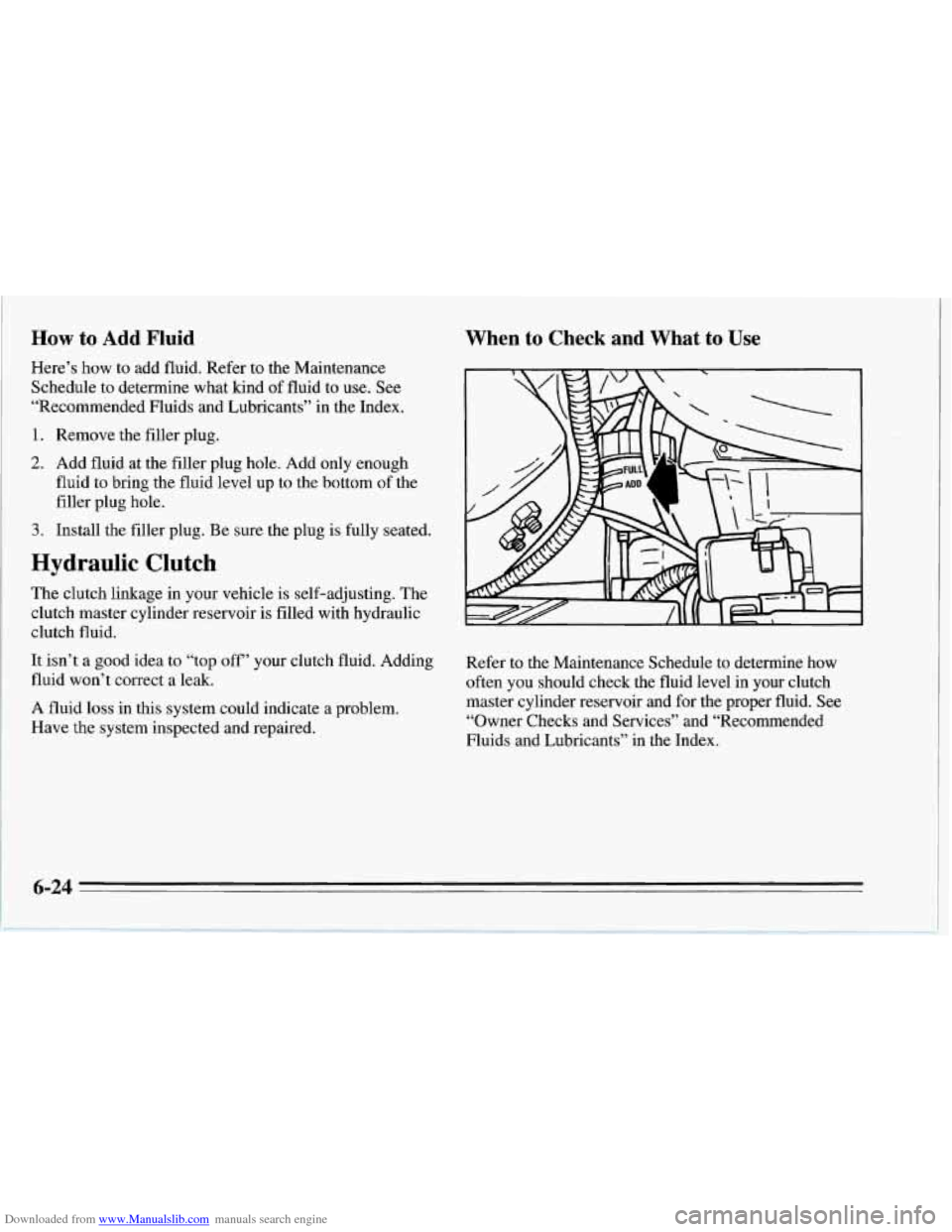
Refer to the Maintenance Schedule to determine how
often you should check the fluid level in
your clutch
master cylinder reservoir and for the proper fluid. See
“Owner Checks and Services” and “Recommended
Fluids and Lubricants” in the Index.
6-24
Page 261 of 386
Downloaded from www.Manualslib.com manuals search engine Rear Axle
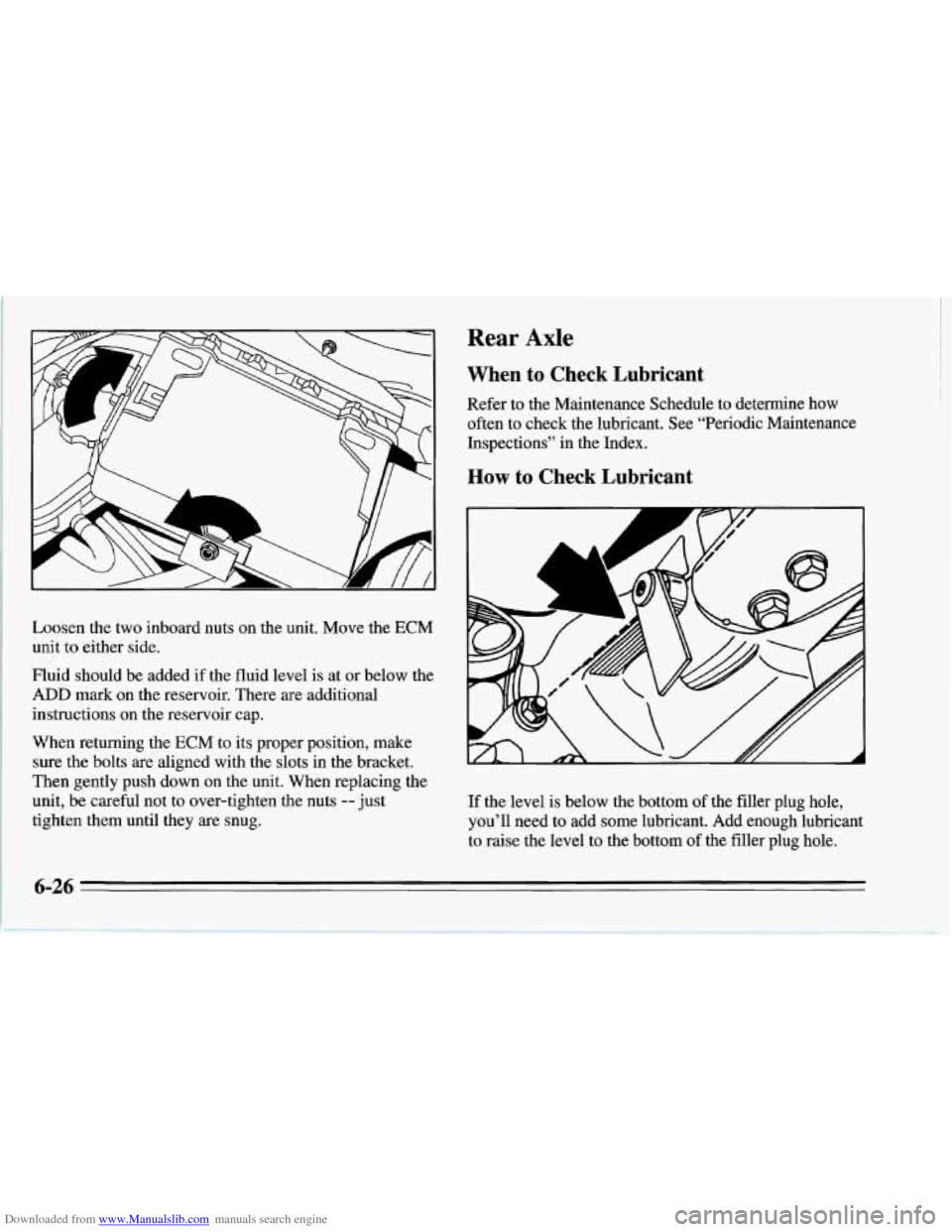
Loosen the two inboard nuts on the unit. Move the ECM
unit to either side.
Fluid should be added if the fluid level is at or below the
ADD mark on the reservoir. There are additional
instructions on the reservoir cap.
When returning the
ECM to its proper position, make
sure the bolts are aligned with the slots in the bracket.
Then gently push down on the unit. When replacing the
unit, be careful not to over-tighten the nuts --just
tighten them until they are snug.
When to Check Lubricant
Refer to the Maintenance Schedule to determine how
often to check the lubricant. See “Periodic Maintenance
Inspections” in the Index.
How to Check Lubricant
If the level is below the bottom of the filler plug hole,
you’ll need to add some lubricant. Add enough lubricant
to raise the level to the bottom of the filler
plug hole.
6-26
Page 266 of 386
Downloaded from www.Manualslib.com manuals search engine What to Add
Refer to the Maintenance Schedule to determine what
kind of fluid to use. See “Recommended Fluids
and
Lubricants” in the Index.
NOTICE:
When adding power steering fluid or making a
complete fluid change, always use the proper
fluid. Failure to use the proper fluid can cause
leaks and damage hoses and seals.
Windshield Washer Fluid
What to Use
When you need windshield washer fluid, be sure to read
the manufacturer’s instructions before use. If you will be
operating your vehicle
in an area where the temperature
may fall below freezing, use a fluid that has sufficient
protection against freezing.
To Add
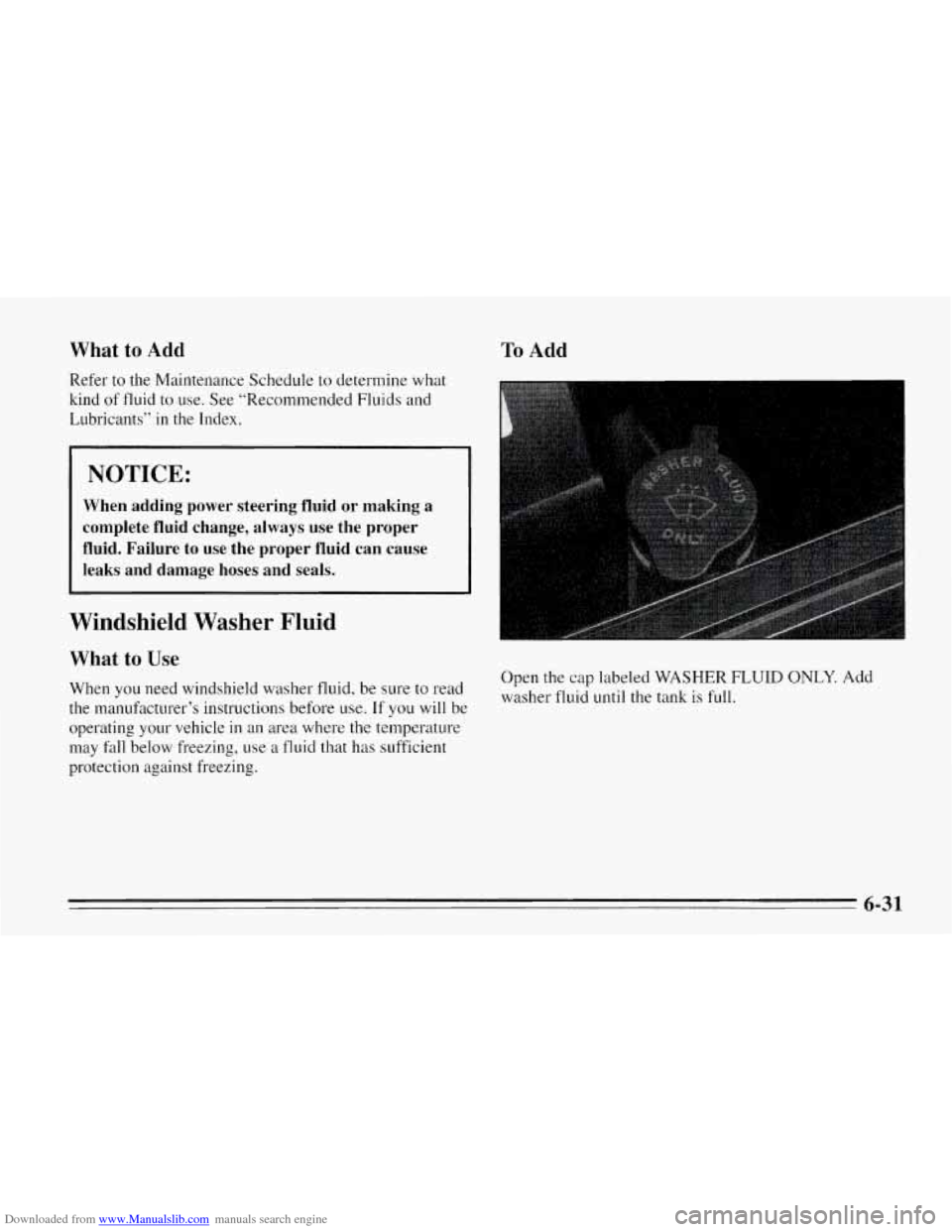
Open the cap labeled WASHER FLUID ONLY. Add
washer fluid until the tank is full.
6-31
Page 268 of 386
Downloaded from www.Manualslib.com manuals search engine your brake fluid. Adding brake fluid won’t correct a
leak. If you add fluid when your linings
are worn, then
you’ll have too much fluid when
you get new brake
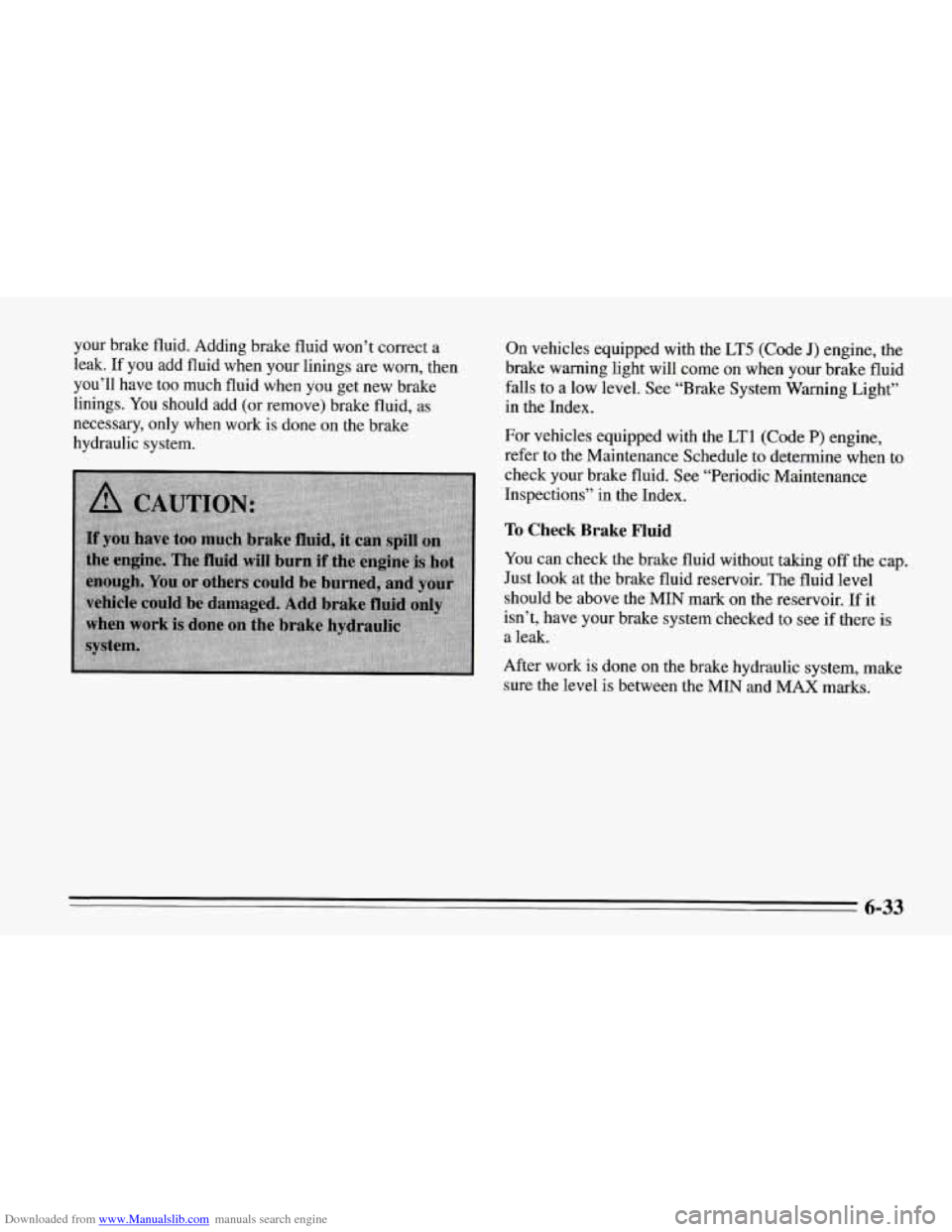
linings. You should add (or remove) brake fluid, as
necessary, only when work is done on the brake
hydraulic system. On
vehicles equipped with the
LT5 (Code J) engine, the
brake warning light will come on when your brake fluid
falls to a low level. See “Brake System Warning Light”
in the Index.
For vehicles equipped with the
LT1 (Code P) engine,
refer to the Maintenance Schedule to determine when to
check your brake fluid. See “Periodic Maintenance
Inspections” in the Index.
To Check Brake Fluid
You can check the brake fluid without taking off the cap.
Just look at the brake fluid reservoir.
The fluid level
should be above the MIN mark on the reservoir. If it
isn’t, have your brake system checked to see
if there is
a leak.
After work is done on the brake hydraulic system, make
sure the level is between the MIN and MAX
marks.
6-33
Page 299 of 386
Downloaded from www.Manualslib.com manuals search engine Finish Damage
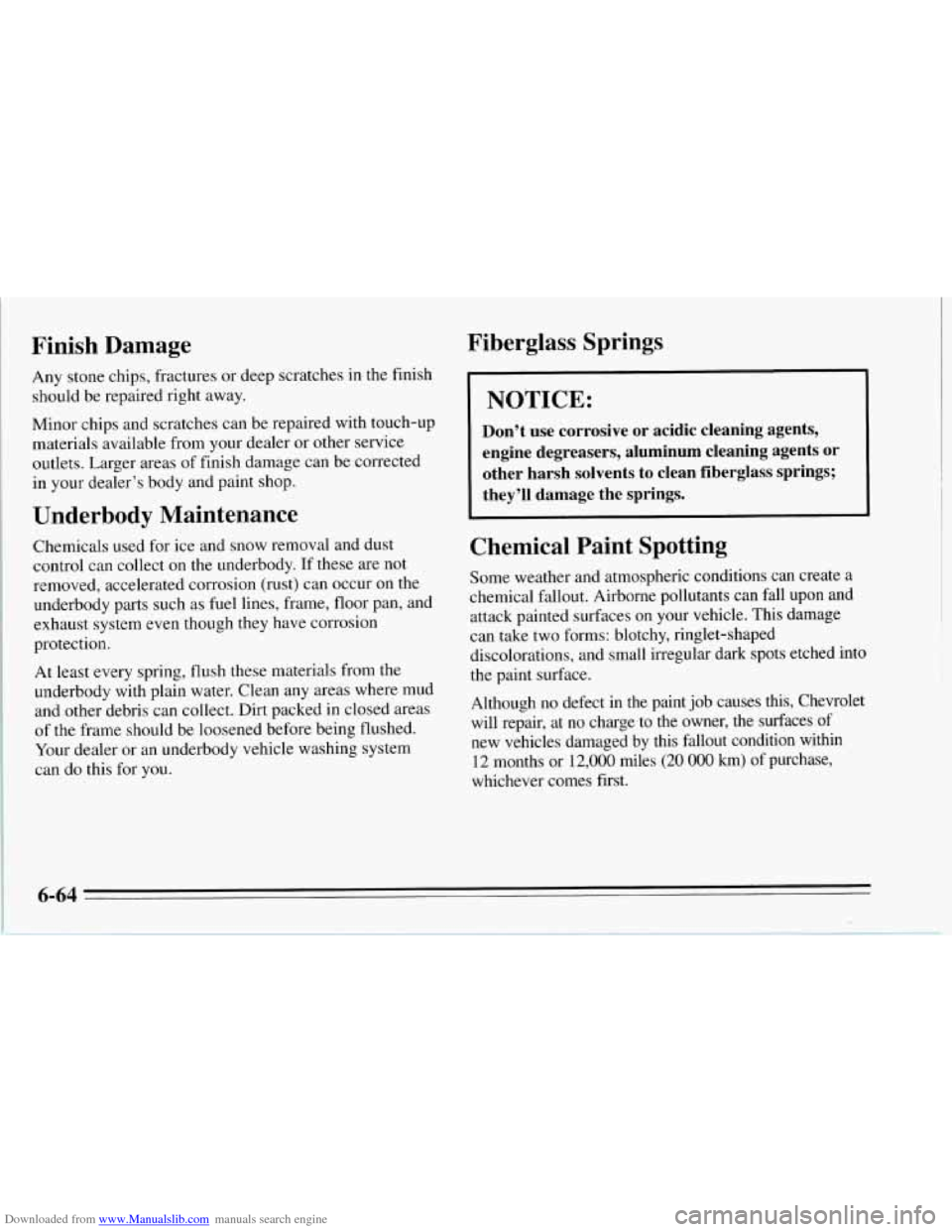
Any stone chips, fractures or deep scratches in- the finish
should be repaired right away.
Minor chips and scratches can be repaired with touch-up
materials available from your dealer or other service
outlets. Larger areas of finish damage can
be corrected
in your dealer’s body and paint shop.
Underbody Maintenance
Chemicals used for ice and snow removal and dust
control can collect on the underbody.
If these are not
removed, accelerated corrosion (rust) can occur on the
underbody parts such as fuel lines, frame, floor pan, and
exhaust system even though they have corrosion
protection.
At least every spring, flush these materials from the
underbody with plain water. Clean any areas where mud
and other debris can collect. Dirt packed in closed areas
of the frame should be loosened before being flushed.
Your dealer or an underbody vehicle washing system
can do this for you.
Fiberglass Springs
NOTICE:
Don’t use corrosive or acidic cleaning agents, engine degreasers, aluminum cleaning agents or
other harsh solvents to clean fiberglass springs; they’ll damage the springs.
Chemical Paint Spotting
Some weather and atmospheric conditions can create a
chemical fallout. Airborne pollutants can fall upon and
attack painted surfaces on your vehicle. This damage
can take two forms: blotchy, ringlet-shaped
discolorations, and small irregular dark spots etched into
the paint surface.
Although
no defect in the paint job causes this, Chevrolet
will repair, at no charge to the owner, the surfaces
of
new vehicles damaged by this fallout condition within
1 2 months or 12,000 miles (20 000 km) of purchase,
whichever comes first.
6-64
Page 300 of 386
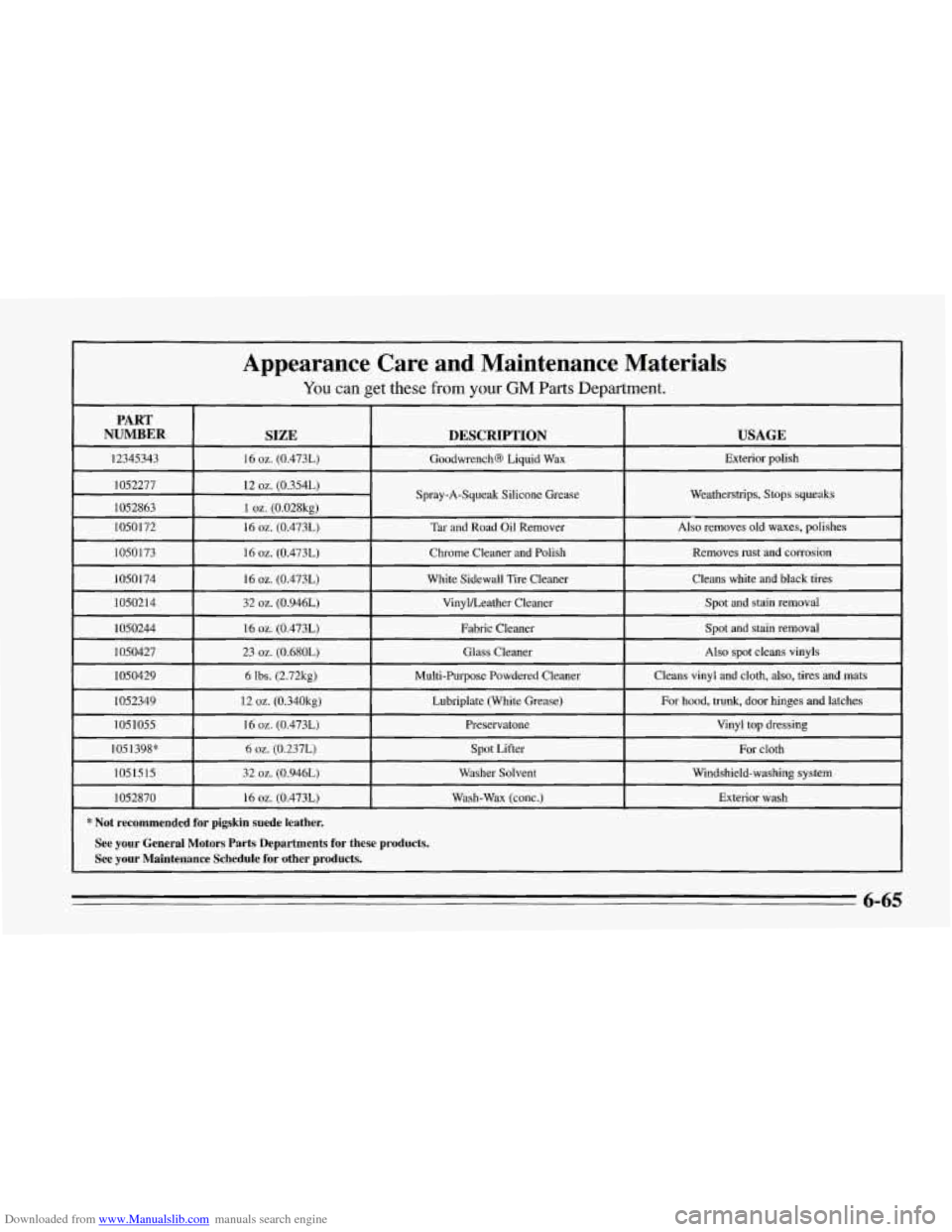
Downloaded from www.Manualslib.com manuals search engine Appearance Care and Maintenance Materials
You can get these from your GM Parts Department.
PART
NUMBER
DESCRIPTION
SIZE
USAGE
12345343
Exterior polish
GoodwrenchB Liquid
Wax
16 oz. (0.473L)
I052277
1052863 12
02. (0.354L)
Also removes old waxes, polishes Tar and Road Oil Remover
1050172 16 oz. (0.473L)
1
oz. (0.028kg)
Spray-A-Squeak Silicone Grease
Weatherstrips, Stops squeaks
1050173 Chrome Cleaner and Polish
16
oz. (0.473L)
VinyVLeather Cleaner
32
02. (0.946L)
1050214 Cleans white and black tires White Sidewall Tire Cleaner
16
oz. (0.473L)
10501 74 Removes rust and corrosion
~~
Spot and stain removal
1050244
Also spot cleans vinyls Glass Cleaner
23 oz. (0.680L)
1050427 Spot
and stain removal Fabric Cleaner
16
02. (0.473L)
1050429
6 lbs. (2.72kg) Multi-Purpose Powdered Cleaner
Lubriplate (White Grease)
12
oz. (0.340kg)
1052349 Cleans vinyl and
cloth,
also, tires and mats
Spot Lifter
6
oz. (0.237L)
1051398" Vinyl top dressing Preservatone
16
oz. (0.4731) 1051055
For hood, trunk, door hinges and latches
For cloth
1051515
Exterior wash
Wash-Wax (conc.)
16
oz. (0.4731)
1052870 Windshield-washing system
Washer Solvent
32
oz. (0.946L)
~ ~~
* Not recommended for pigskin suede leather.
See your General Motors Parts Departments for these products.
See your Maintenance Schedule for other products.
6-65
Page 316 of 386
Downloaded from www.Manualslib.com manuals search engine e Section 7 Maintenance Schedule
IMPORTANT:
KEEP ENGINE OIL
AT THE PROPER
LEVEL AND CHANGE AS
RECOMMENDED
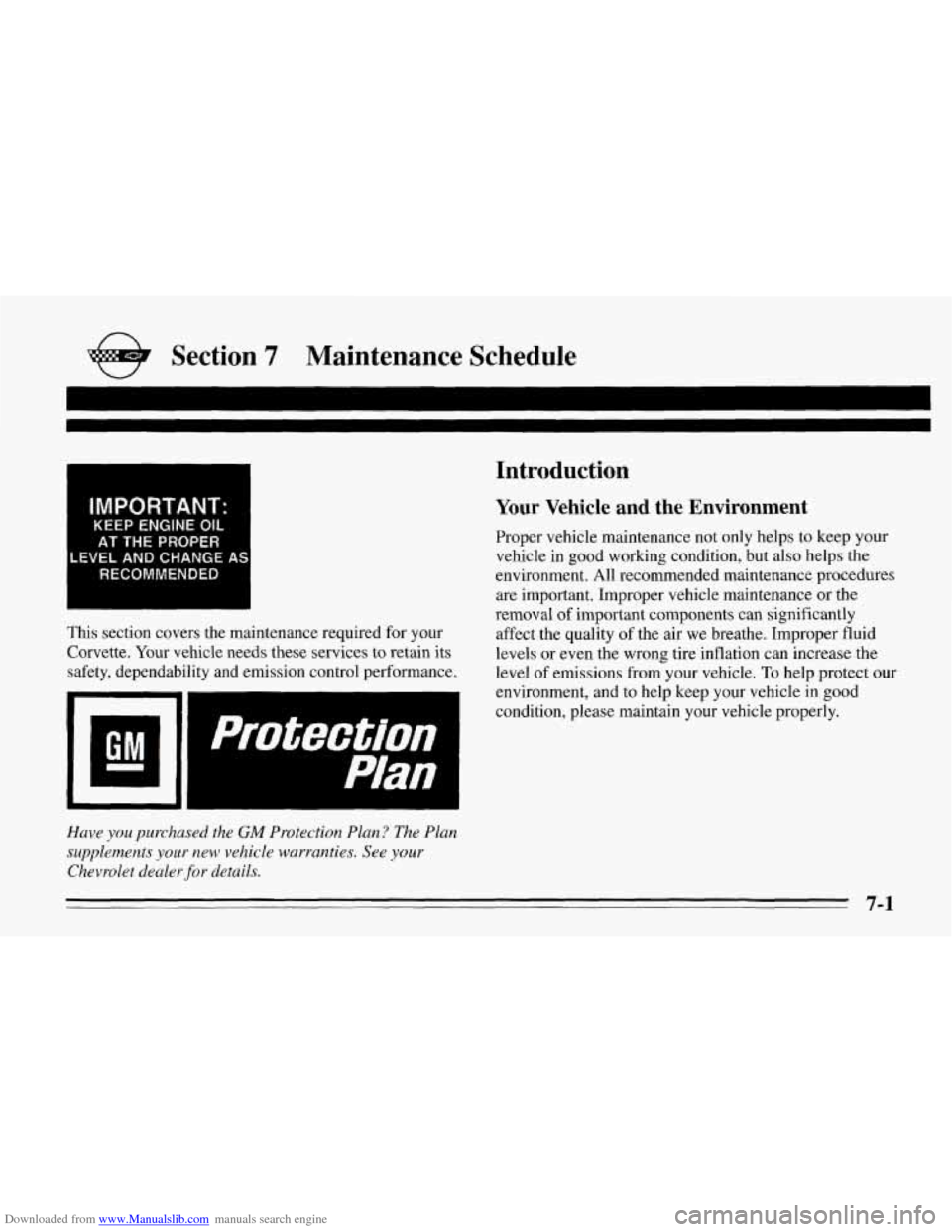
This section covers the maintenance required for your
Corvette. Your vehicle needs these services to retain its
safety, dependability and emission control performance.
protection
m-
Plan
Introduction
Your Vehicle and the Environment
Proper vehicle maintenance not only helps to keep your
vehicle in good working condition, but also helps the
environment. All recommended maintenance procedures
are important. Improper vehicle maintenance or the
removal
of important components can significantly
affect the quality
of the air we breathe. Improper fluid
levels
or even the wrong tire inflation can increase the
level of emissions from your vehicle.
To help protect our
environment, and to help keep your vehicle in good
condition, please maintain your vehicle properly.
Have you purchased the GM Protection Plan ? The Plan
supplements your new vehicle warranties. See
your
Chevrolet dealer for details.
7-1
Page 317 of 386
Downloaded from www.Manualslib.com manuals search engine I
1 How This Section is Organized
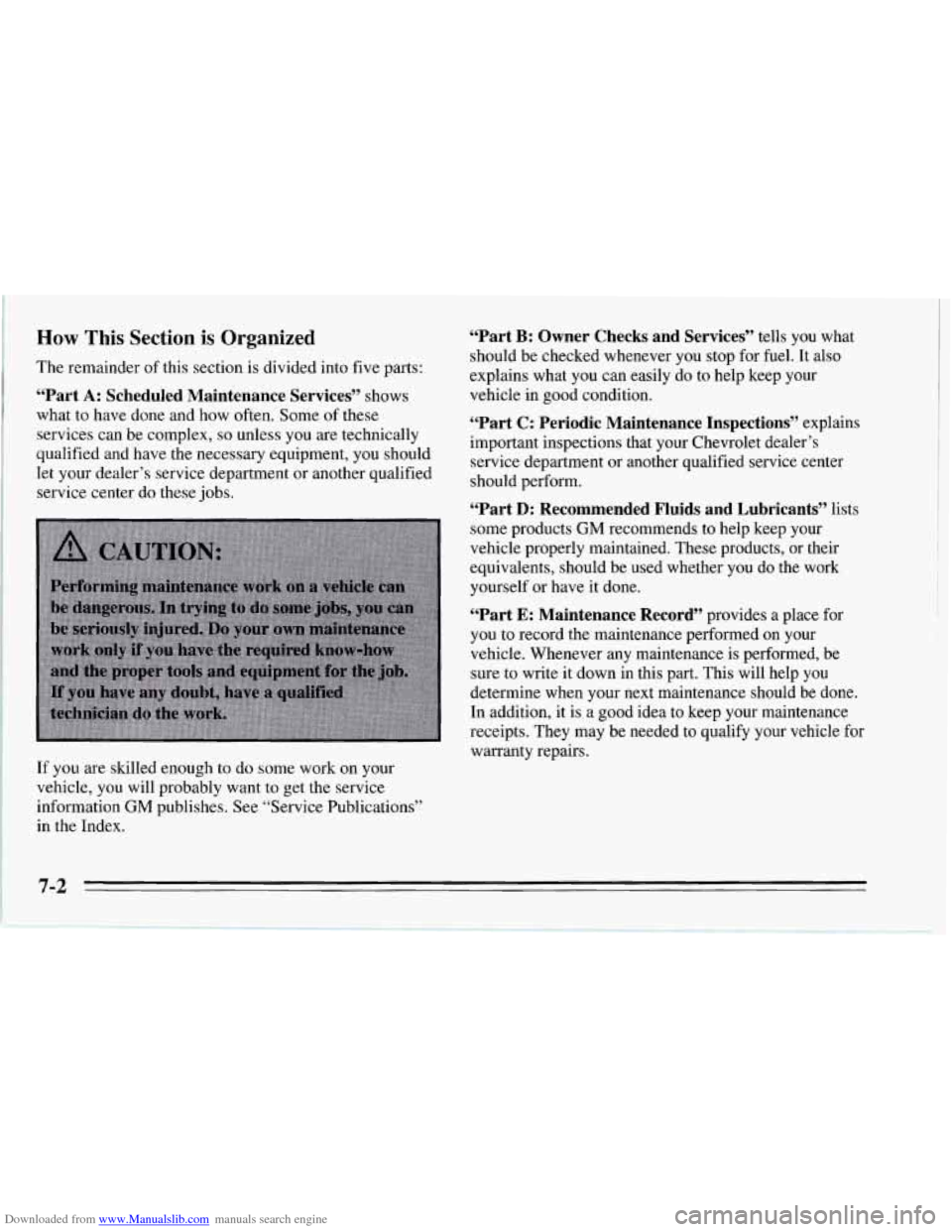
The remainder of this section is divided into five parts:
“Part A: Scheduled Maintenance Services” shows
what
to have done and how often. Some of these
services can be complex,
so unless you are technically
qualified and have the necessary equipment, you should
let your dealer’s service department
or another qualified
service center do these jobs.
If you are skilled enough to do some work on your
i vehicle, you will probably want to get the service
1
information GM publishes. See “Service Publications”
in the Index.
3
“Part B: Owner Checks and Services” tells you what
should be checked whenever you stop for fuel. It also
explains what you can easily do to help keep your
vehicle in good condition.
“Part C: Periodic Maintenance Inspections” explains
important inspections that your Chevrolet dealer’s
service department or another qualified service center
should perform.
“Part D: Recommended Fluids and Lubricants” lists
some products
GM recommends to help keep your
vehicle properly maintained. These products, or their
equivalents, should be used whether you do the work
yourself or have it done.
“Part E: Maintenance Record’’ provides a place for
you to record the maintenance performed on your
vehicle. Whenever any maintenance is performed, be
sure to write it down
in this part. This will help you
determine when your next maintenance should be done.
In addition, it is a good idea to keep your maintenance
receipts. They may be needed to qualify your vehicle for
warranty repairs.
7-2
Page 318 of 386
Downloaded from www.Manualslib.com manuals search engine Part A: Scheduled Maintenance
Services
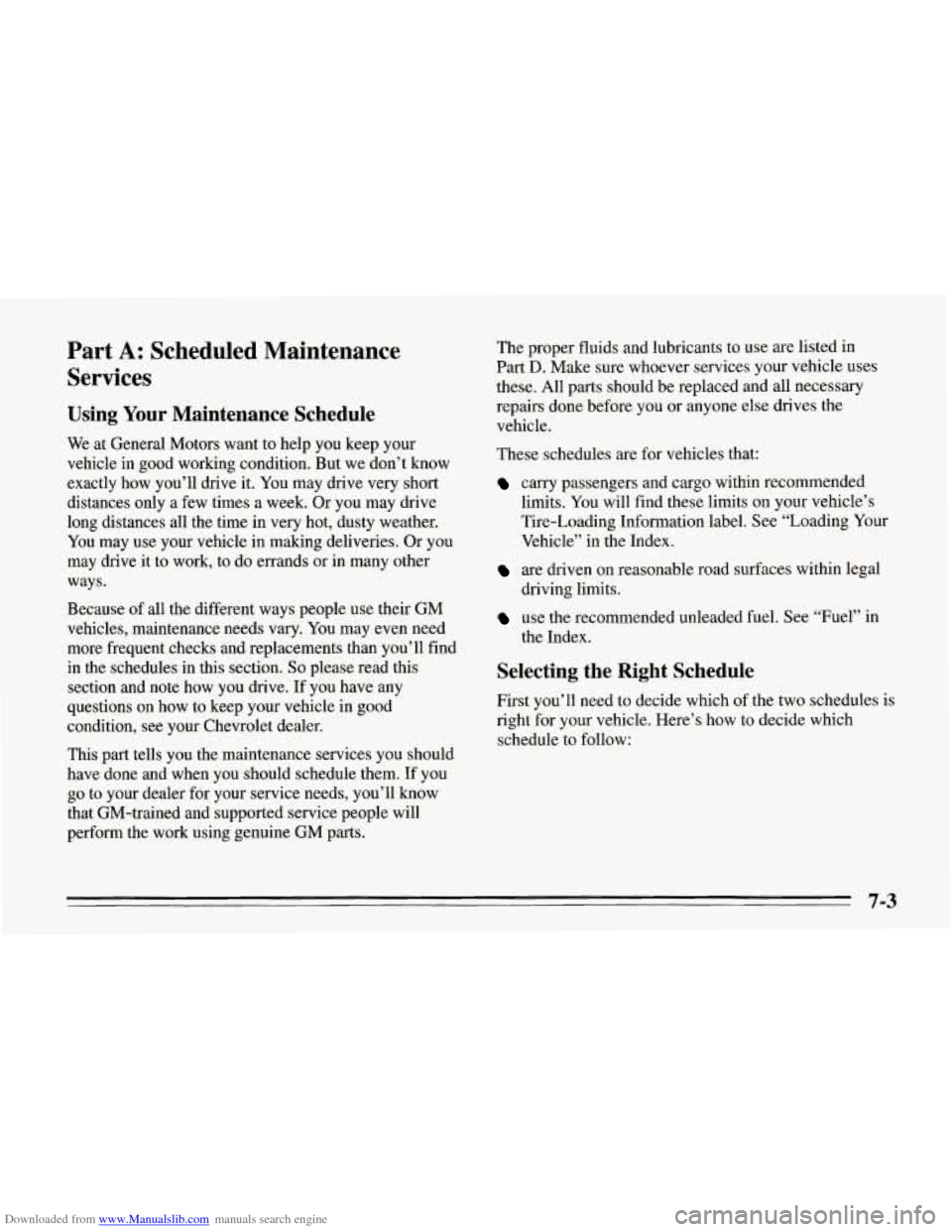
Using Your Maintenance Schedule
We at General Motors want to help you keep your
vehicle in good working condition. But we don’t know
exactly how you’ll drive it. You may drive very short
distances only a few times a week. Or you may drive
long distances all the time in very hot, dusty weather.
You may use your vehicle in making deliveries. Or you
may drive it to work, to do errands or
in many other
ways.
Because of all the different ways people use their GM
vehicles, maintenance needs vary. You may even need
more frequent checks and replacements than you’ll find
in the schedules in this section.
So please read this
section and note how
you drive. If you have any
questions on how to keep your vehicle in good
condition, see your Chevrolet dealer.
This part tells you the maintenance services you should
have done and when you should schedule them. If you
go to your dealer for your service needs, you’ll know
that GM-trained and supported service people will
perform the work using genuine GM parts. The proper
fluids and lubricants to use are listed in
Part D. Make sure whoever services your vehicle uses
these. All parts should be replaced and all necessary
repairs done before you or anyone else drives the
vehicle.
These schedules are for vehicles that:
carry passengers and cargo within recommended
limits. You will find these limits on your vehicle’s
Tire-Loading Information label. See “Loading Your
Vehicle” in the Index.
are driven on reasonable road surfaces within legal
driving limits.
use the recommended unleaded fuel. See “Fuel” in
the Index.
Selecting the Right Schedule
First you’ll need to decide which of the two schedules is
right for your vehicle. Here’s how to decide which
schedule to follow:
7-3
Page 319 of 386
Downloaded from www.Manualslib.com manuals search engine Maintenance Schedule
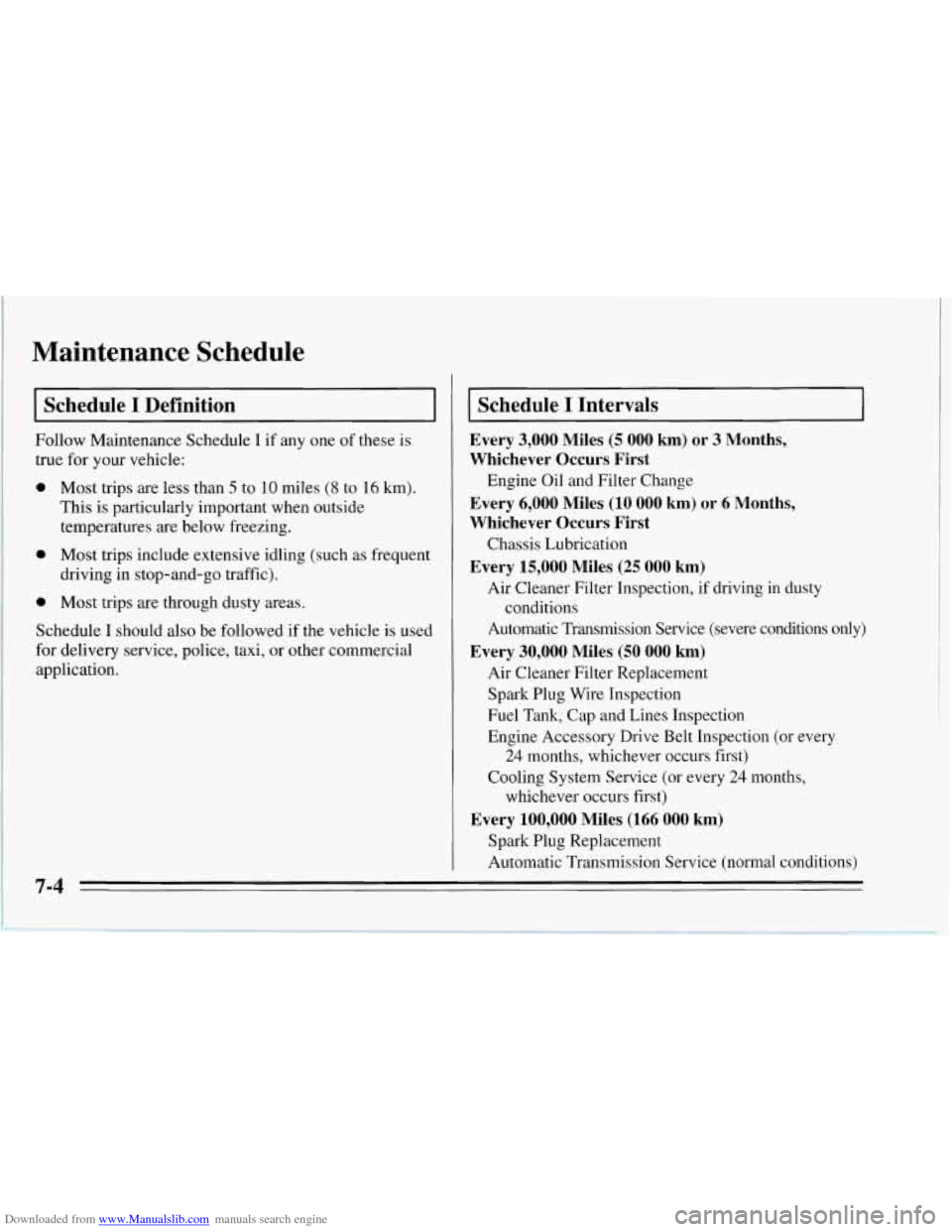
I Schedule I Definition I
Follow Maintenance Schedule I if any one of these is
true for your vehicle:
0 Most trips are less than 5 to 10 miles (8 to 16 km).
This is particularly important when outside
temperatures are below freezing.
0 Most trips include extensive idling (such as frequent
driving in stop-and-go traffic).
0 Most trips are through dusty areas.
Schedule
I should also be followed if the vehicle is used
for delivery service, police, taxi, or other commercial
application.
Schedule I Intervals
Every 3,000 Miles (5 000 km) or 3 Months,
Whichever Occurs First
Every 6,000 Miles
(10 000 km) or 6 Months,
Whichever Occurs First
Chassis Lubrication
Every 15,000 Miles (25 000 km)
Air Cleaner Filter Inspection, if driving in dusty
Automatic Transmission Service (severe conditions only)
Every 30,000 Miles (50 000 km)
Air Cleaner Filter Replacement
Spark Plug Wire Inspection
Fuel Tank, Cap and Lines Inspection
Engine Accessory Drive Belt Inspection (or every
24 months, whichever occurs first)
Cooling System Service (or every
24 months,
whichever occurs first)
Spark Plug Replacement
Automatic Transmission Service (normal conditions)
Engine Oil and Filter Change
conditions
Every 100,000 Miles (166 000 km)
7-4