warning light CHEVROLET CORVETTE 1995 4.G User Guide
[x] Cancel search | Manufacturer: CHEVROLET, Model Year: 1995, Model line: CORVETTE, Model: CHEVROLET CORVETTE 1995 4.GPages: 386, PDF Size: 20.15 MB
Page 132 of 386
Downloaded from www.Manualslib.com manuals search engine Driver Information Center
SERVICE ASR ASR OFF
ASR LOW
ACTIVE COOLANT
PASSIVE
KEYLESS
ENTRY AIR
BAG
SERVICE
115- SOON
SERVICE LTPWS ABS
ACTIVE
SERVICE
(@I
LOWlFLAT TIRE
SERVICE RIDE
CONTROL
LOW OIL
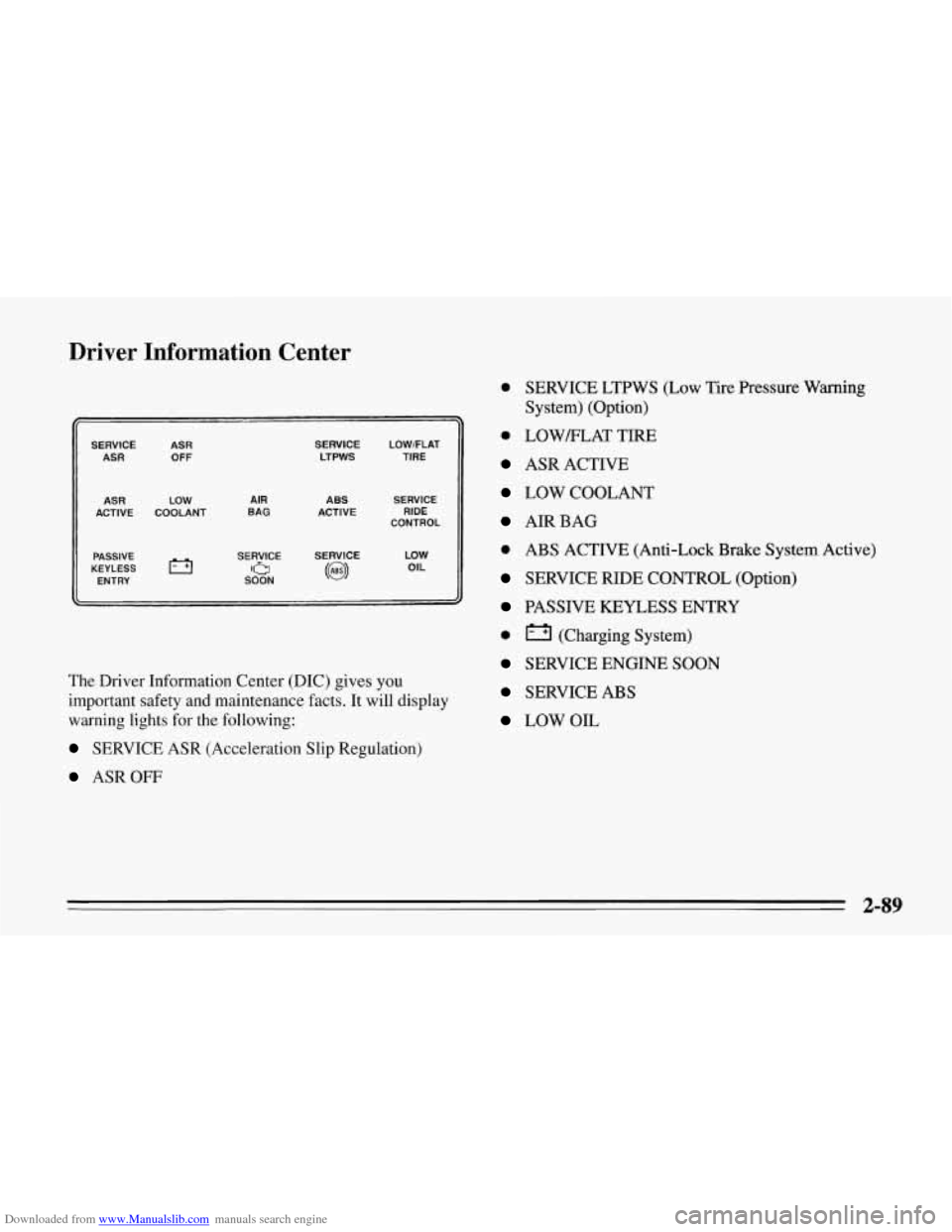
The Driver Information Center (DIC) gives you
important safety and maintenance facts.
It will display
warning lights for the following:
SERVICE ASR (Acceleration Slip Regulation)
ASROFF
0 SERVICE LTPWS (Low Tire Pressure Warning
System) (Option)
0 LOWELAT TIRE
ASR ACTIVE
LOW COOLANT
AIRBAG
0 ABS ACTIVE (Anti-Lock Brake System Active)
SERVICE RIDE CONTROL (Option)
PASSIVE KEYLESS ENTRY
0 (Charging System)
SERVICE ENGINE SOON
SERVICE ABS
LOW OIL
2-89
Page 169 of 386
Downloaded from www.Manualslib.com manuals search engine Avoid needless heavy braking. Some people drive
in spurts
-- heavy acceleration followed by heavy
braking
-- rather than keeping pace with traffic. This
is
a mistake. Your brakes may not have time to cool
between hard stops. Your brakes will wear out much
faster if you do a lot of heavy braking. If you keep pace
with the traffic and allow realistic following distances,
you will eliminate a lot of unnecessary braking. That
means better braking and longer brake life.
If your engine ever stops while you’re driving, brake
normally but don’t pump your brakes. If
you do, the
pedal may get harder to push down.
If your engine
stops, you will still have some power brake assist. But
you will use it when you brake. Once the power assist is
used up, it may take longer to stop and the brake pedal
will be harder to push.
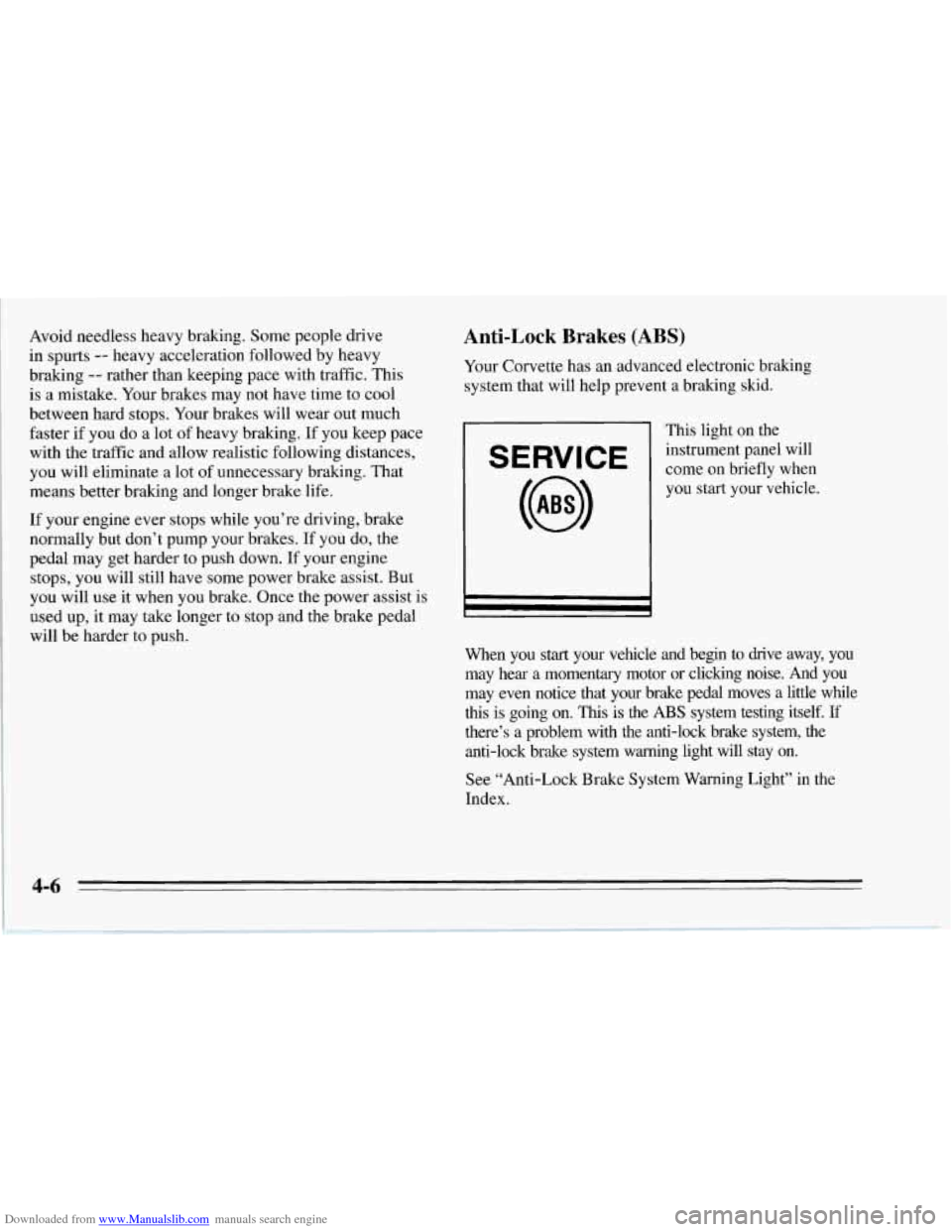
Anti-Lock Brakes (ABS)
Your Corvette has an advanced electronic braking
system that will help prevent a braking skid.
This light on the
E RVI E come on briefly when
instrument
panel will
you start your vehicle.
I r I
When you start your vehicle and begin to drive away, you
may hear a momentary motor or clicking noise. And you
may even notice that your brake pedal moves a little while
this is going on.
This is the ABS system testing itself. If
there’s a problem with the anti-lock brake system, the
anti-lock brake system warning light will stay on.
See “Anti-Lock Brake System Warning Light” in the
Index.
Page 171 of 386
Downloaded from www.Manualslib.com manuals search engine Remember: Anti-lock doesn’t change the time you need
to get your foot up
to the brake pedal. If you get too
close to the vehicle in front of you, you won’t have time
to apply your brakes if that vehicle suddenly slows or
stops. Always leave enough room up ahead to stop, even
though you have anti-lock brakes.
To Use Anti-Lock
Don’t pump the brakes. Just hold the brake pedal down
and let anti-lock work for you. You may hear a motor or
clicking noise and feel the brake pedal move a little
during a hard stop, but this
is normal. When your
anti-lock system is adjusting brake pressure
to help
avoid a braking skid, the ABS ACTIVE light will come
on. See “Anti-Lock Brake System Active Light” in the
Index.
ASR (Acceleration Slip Regulation) System
Your vehicle has a traction control system called ASR
that limits wheel spin. This is especially useful in
slippery road conditions. The system operates only if it
senses that the rear wheels are spinning too much or are
beginning to lose traction. When, this happens, the
system works the rear brakes and reduces engine power
(by closing the throttle and managing engine spark) to
limit wheel spin. ‘The ASR
ACTIVE light will come on when the ASR
system
is limiting wheel spin. See “ASR System Active
Light” in the Index. You may feel the system working,
or you may notice some noise, but this is normal.
If your vehicle is in cruise control when the ASR system
begins to limit wheel spin, the cruise control will
automatically disengage. When road conditions allow
you to safely use it again,
you may re-engage the cruise
control. (See “Cruise Control” in the Index.)
SERVICE
ASR
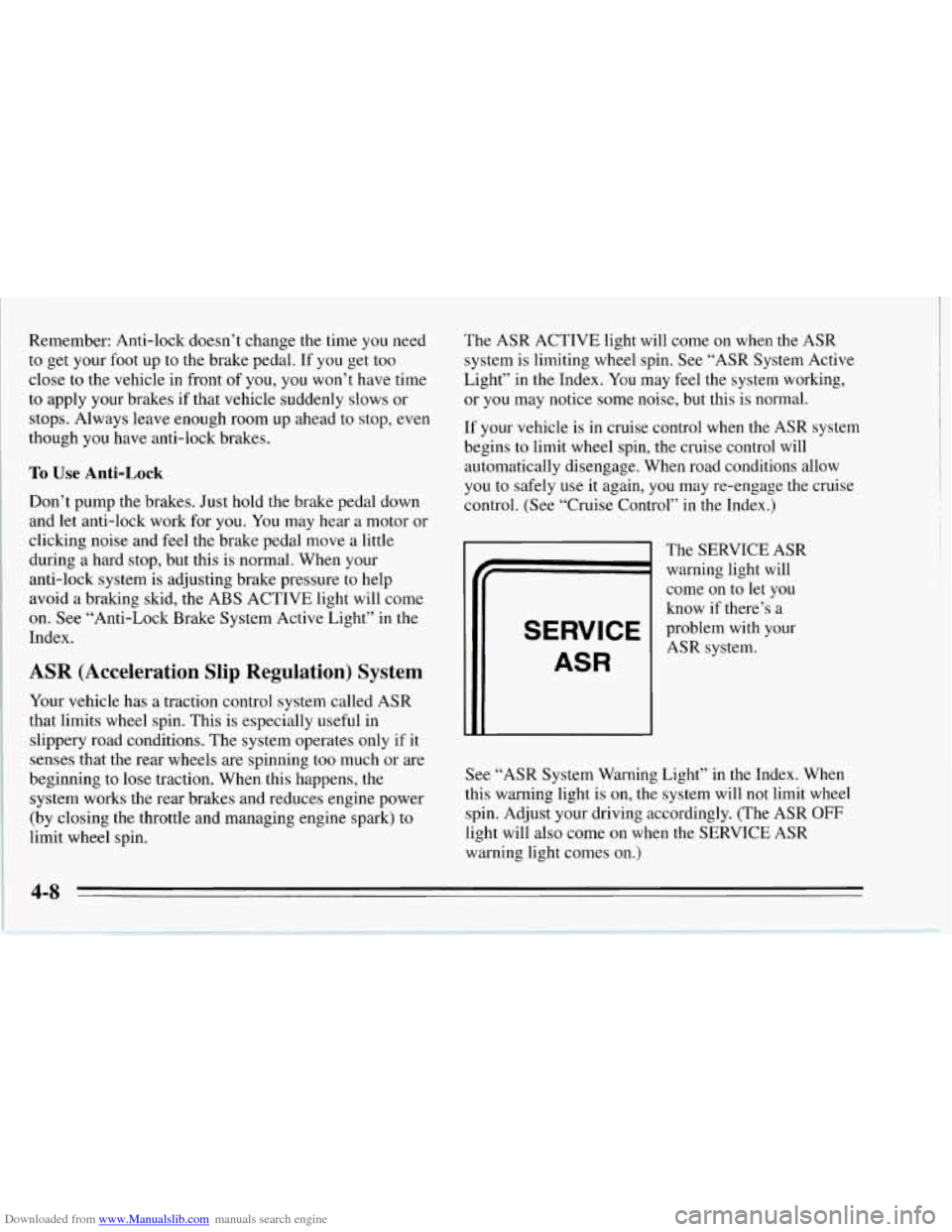
The SERVICE ASR
warning light will
come on to
let you
know if there’s a
problem with your
ASR system.
See “ASR System Warning Light’’ in the Index. When
this warning light
is on, the system will not limit wheel
spin. Adjust your driving accordingly. (The ASR
OFF
light will also come on when the SERVICE ASR
warning light comes on.)
4-8
Page 182 of 386
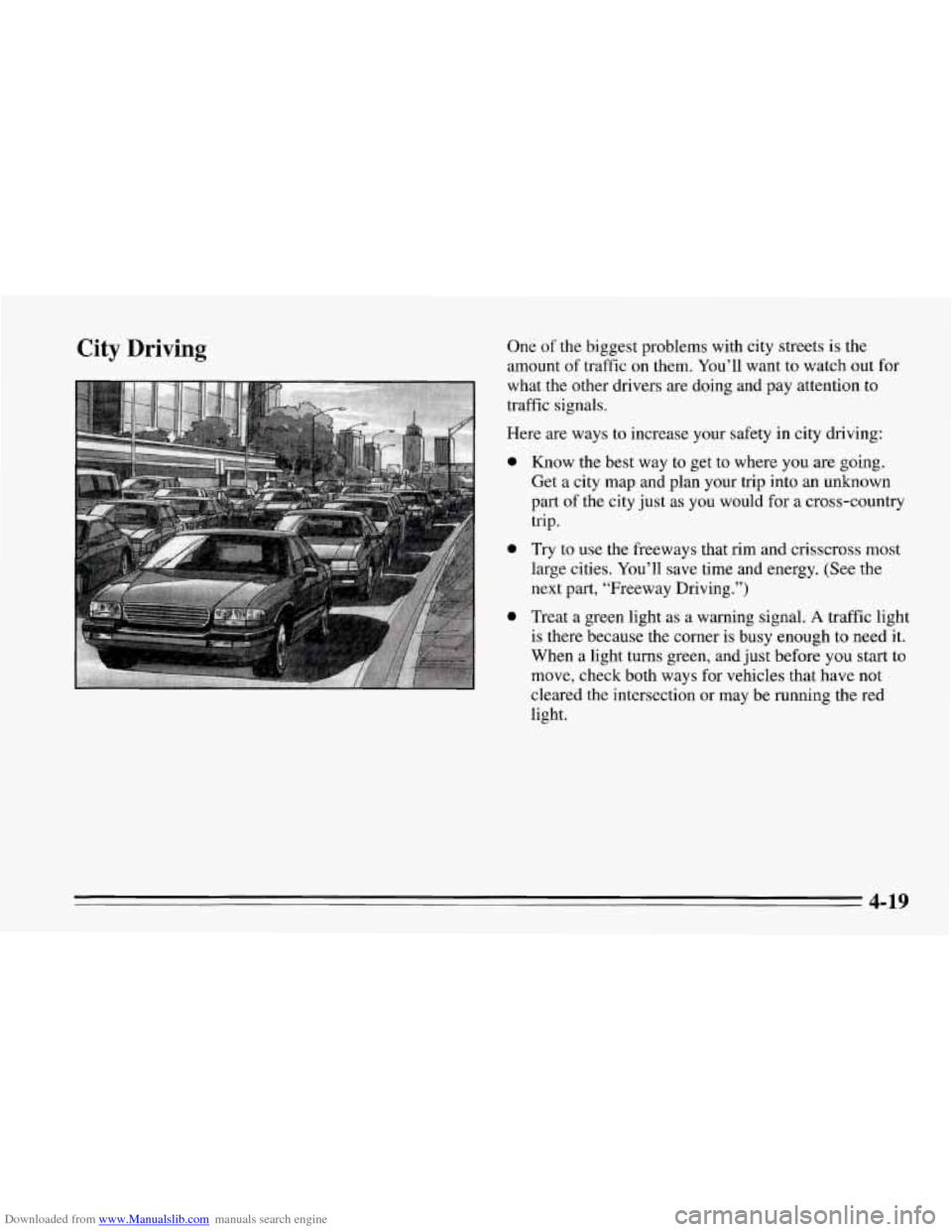
Downloaded from www.Manualslib.com manuals search engine City Driving One of the biggest problems with city streets is the
amount of traffic on them. You’ll want to watch out for
what the other drivers are doing and pay attention to
traffic signals.
Here are ways to increase your safety in city driving:
0 Know the best way to get to where you are going.
Get a city map and plan your trip into an unknown
part
of the city just as you would for a cross-country
trip.
0 Try to use the freeways that rim and crisscross most
large cities.
You’ll save time and energy. (See the
next part, “Freeway Driving.”)
0 Treat a green light as a warning signal. A traffic light
is there because the corner is busy enough to need it.
When a light turns green, and just before
you start to
move, check both ways for vehicles that have not
cleared the intersection or may be running the red
light.
4-19
Page 187 of 386
Downloaded from www.Manualslib.com manuals search engine Winter Driving
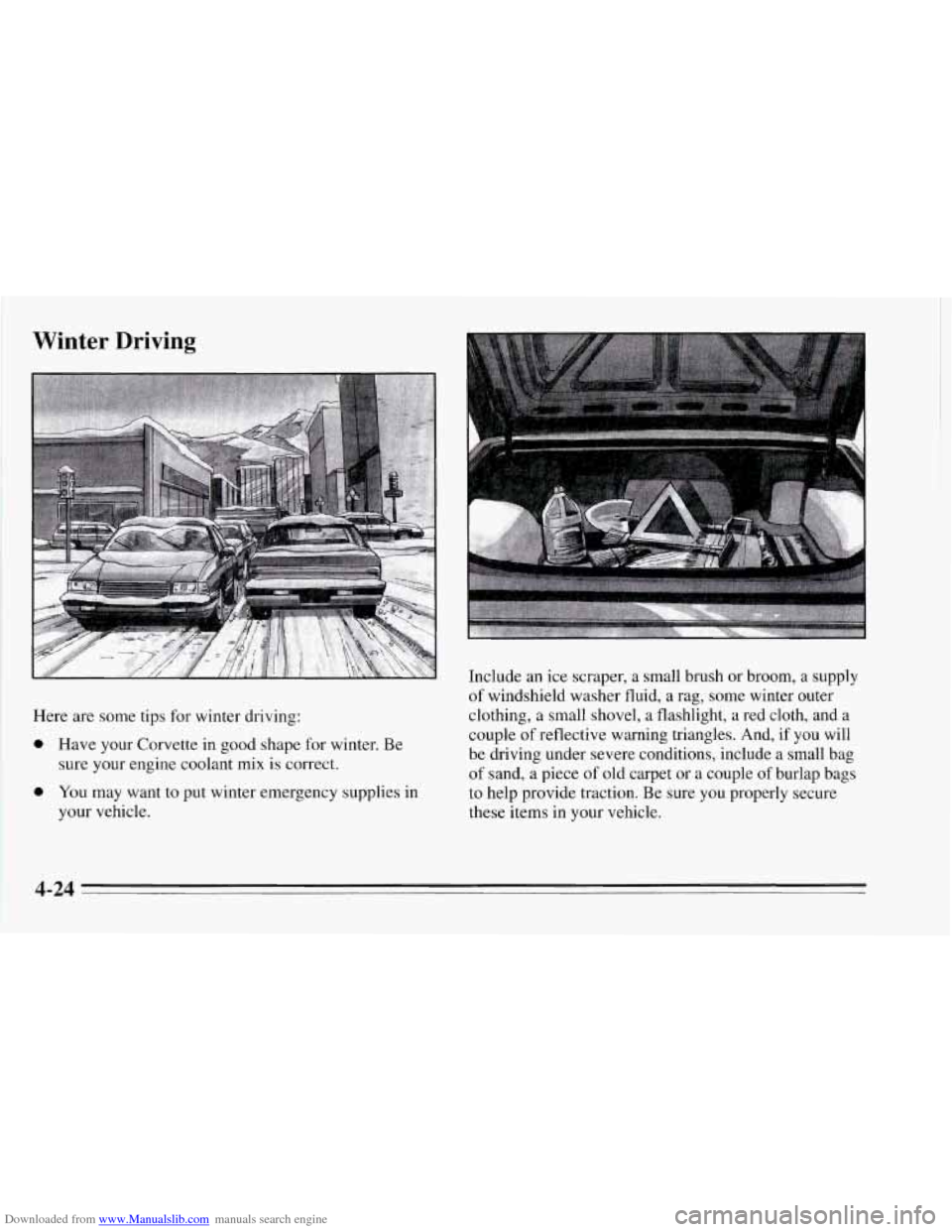
Here are some tips for winter driving:
0 Have your Corvette in good shape for winter. Be
sure your engine coolant mix is correct.
0 You may want to put winter emergency supplies in
your vehicle. Include an
ice scraper,
a small brush or broom, a supply
of windshield washer fluid, a rag, some winter outer
clothing, a small shovel, a flashlight, a red cloth, and a
couple
of reflective warning triangles. And, if you will
be driving under severe conditions, include a small bag
of sand, a piece of old carpet or a couple of burlap bags
to help provide traction. Be sure
you properly secure
these items in your vehicle.
4-24
Page 262 of 386

Downloaded from www.Manualslib.com manuals search engine What to Use What to Use
To add lubricant when the level is low, use Axle
Lubricant (GM Part
No. 12345977) or SAE SOW-90
GL-5 gear lubricant.
To completely refill after draining,
add
4 ounces (1 18 ml) of Limited-Slip Differential
Lubricant Additive (GM Part
No. 1052358). Then fill to
the bottom of the filler plug hole with Axle Lubricant
(GM Part
No. 12345977) or SAE 8OW-90 GL-5 gear
lubricant.
Engine Coolant
The following explains your cooling system and how to
add coolant when it is low.
If you have a problem with
engine overheating or if you need to add coolant to your
high fill reservoir, see “Engine Overheating” in the
Index.
The proper coolant for your Corvette will:
Give freezing protection down to -34°F (-37°C).
Give boiling protection up to 262 “F (128 ” C).
Protect against rust and corrosion.
Help keep the proper engine temperature.
Let the warning lights work as they should. Use a mixture
of one-half
clean water (preferably
distilled) and one-half antifreeze that meets
“GM
Specification 1825M,” which won’t damage aluminum
parts.
You can also use a recycled coolant conforming to
GM Specification 1825M with a complete coolant flush
and refill. Use GM Engine Coolant Supplement (sealer)
with any complete coolant flush and refill. If
you use
this mixture, you don’t need to add anything else.
6-27
Page 268 of 386
Downloaded from www.Manualslib.com manuals search engine your brake fluid. Adding brake fluid won’t correct a
leak. If you add fluid when your linings
are worn, then
you’ll have too much fluid when
you get new brake
linings. You should add (or remove) brake fluid, as
necessary, only when work is done on the brake
hydraulic system. On
vehicles equipped with the
LT5 (Code J) engine, the
brake warning light will come on when your brake fluid
falls to a low level. See “Brake System Warning Light”
in the Index.
For vehicles equipped with the
LT1 (Code P) engine,
refer to the Maintenance Schedule to determine when to
check your brake fluid. See “Periodic Maintenance
Inspections” in the Index.
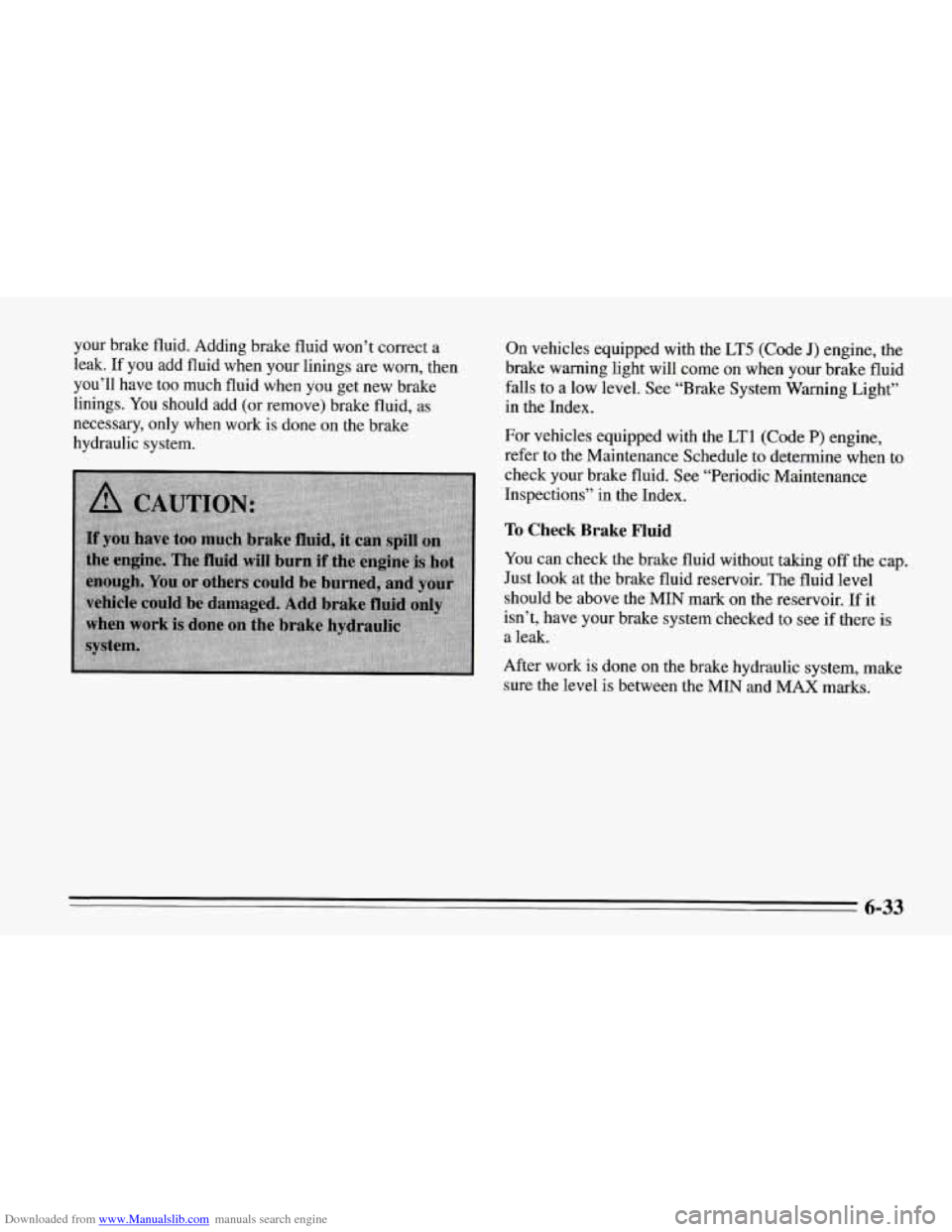
To Check Brake Fluid
You can check the brake fluid without taking off the cap.
Just look at the brake fluid reservoir.
The fluid level
should be above the MIN mark on the reservoir. If it
isn’t, have your brake system checked to see
if there is
a leak.
After work is done on the brake hydraulic system, make
sure the level is between the MIN and MAX
marks.
6-33
Page 284 of 386
Downloaded from www.Manualslib.com manuals search engine Extended Mobility Tires (Option)
If your Corvette has optional Goodyear Extended
Mobility Tires (EMT’s), the tires will have “EMT”
molded on the sidewalls. Your vehicle may also have a
spare tire delete option. With the spare tire delete option,
there’s no spare tire, no tire changing equipment and no
place to store a tire in the vehicle. Extended Mobility
Tires perform
so well without any air that a Low Tire
Pressure Warning System (LTPWS) is used to alert you if
a tire has lost pressure.
A LOWELAT TIRE light will
appear on your Driver Information Center
if a tire’s
inflation pressure is less than
25 psi (170 kPa). If the
LOW/FLAT
TIRE light comes on, check your tire
pressures as soon as you can. See “Low Tire Pressure
Warning System” in the Index for additional information. If a
tire goes flat,
you won’t need to stop on the side of
the road to change the tire. You can just keep on driving.
The shorter the distance
you drive and the slower the
speed, the greater the chance that the tire will not have
to be replaced. If
you drive on a deflated EMT for
distances
of 50 miles (80 km) or less and at speeds of
55 mph (90 km/h) or less, there is a good chance that the
tire can be repaired. The tire can operate effectively with
no air pressure for up to 200 miles (320 km) at speeds
up to
55 mph (90 kmk), but the tire would then have to
be replaced. Also remember: When a tire is filled with
air, it provides a cushion between the road and the
wheel. Because you do not have this cushion when
driving on a deflated tire, try to avoid potholes that
could damage your wheel and require replacement of it.
Some road hazards can damage a tire beyond repair. This
damage could occur before you’ve driven on the tire
in a
deflated condition. Whenever a tire has been damaged, or
if you’ve driven any distance on a deflated EMT, check
with a Goodyear EMT Service Center to determine
whether
the tire can be repaired or should be replaced.
To maintain your vehicle’s extended mobility feature,
all replacement tires must be Extended Mobility Tires.
See the Goodyear Extended Mobility Tire Owner’s
Manual and Limited Warranty supplied with your
Corvette for additional information.
6-49
Page 306 of 386
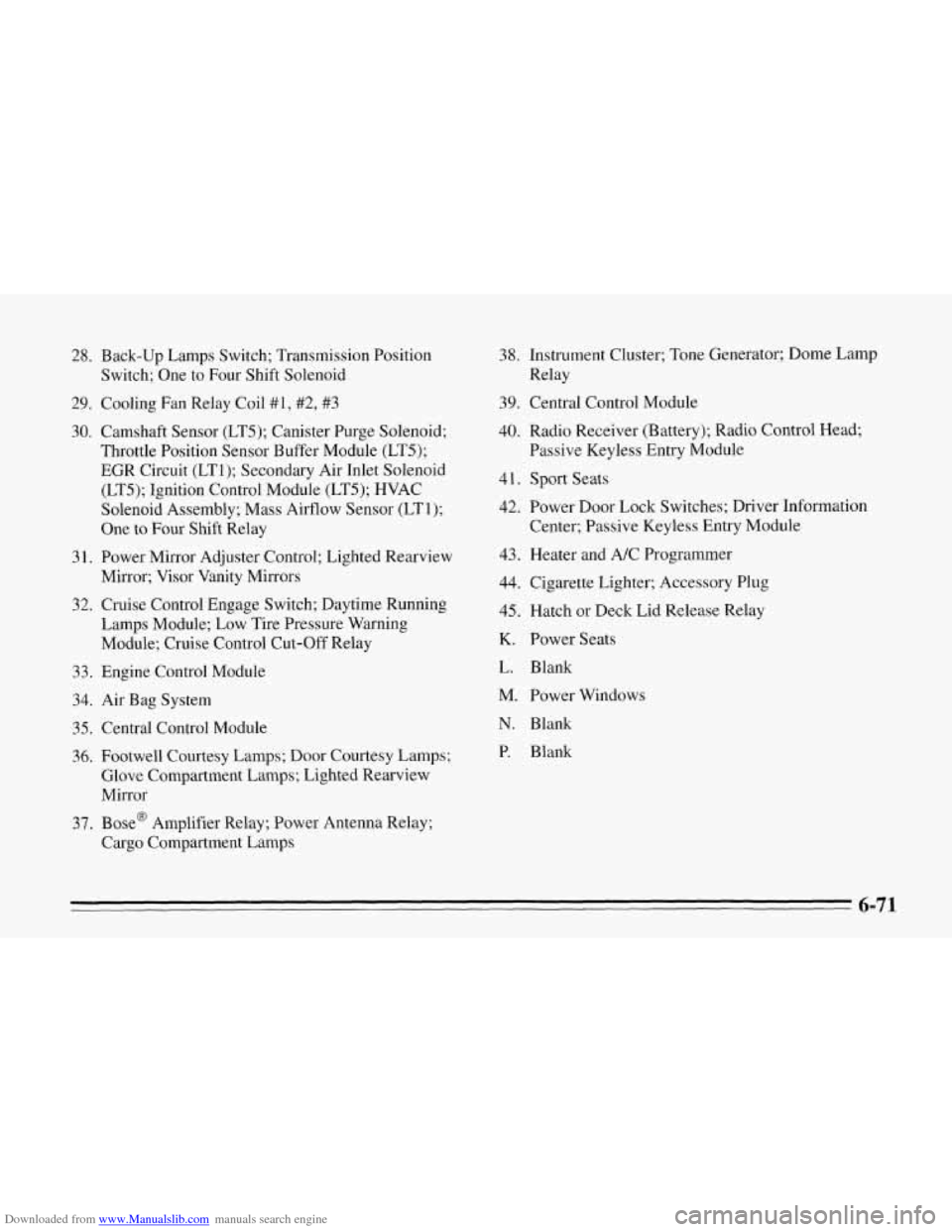
Downloaded from www.Manualslib.com manuals search engine 28. Back-up Lamps Switch; Transmission Position
Switch; One to Four Shift Solenoid
29. Cooling Fan Relay Coil
#I, #2, #3
30. Camshaft Sensor (LT5); Canister Purge Solenoid;
Throttle Position Sensor Buffer Module (LT5);
EGR Circuit (LT1); Secondary Air Inlet Solenoid
(LT5); Ignition Control Module (LT5); HVAC
Solenoid Assembly; Mass Airflow Sensor (LT 1);
One
to Four Shift Relay
3 1. Power Mirror Adjuster Control; Lighted Rearview
Mirror; Visor Vanity Mirrors
32. Cruise Control Engage Switch; Daytime Running
Lamps Module; Low Tire Pressure Warning
Module; Cruise Control Cut-Off Relay
33. Engine Control Module
34. Air Bag System
35. Central Control Module
36. Footwell Courtesy Lamps; Door Courtesy Lamps;
Glove Compartment Lamps; Lighted Rearview
Mirror
37, Bose@ Amplifier Relay; Power Antenna Relay;
Cargo Compartment Lamps
38. Instrument Cluster; Tone Generator; Dome Lamp
Relay
39. Central Control Module
40, Radio Receiver (Battery); Radio Control Head;
Passive Keyless Entry Module
41. Sport Seats
42. Power Door Lock Switches; Driver Information
Center; Passive Keyless Entry Module
43. Heater and A/C Programmer
44. Cigarette Lighter; Accessory Plug
45. Hatch or Deck Lid Release Relay
K. Power Seats
L. Blank
M. Power Windows
N. Blank
P. Blank
6-71
Page 374 of 386
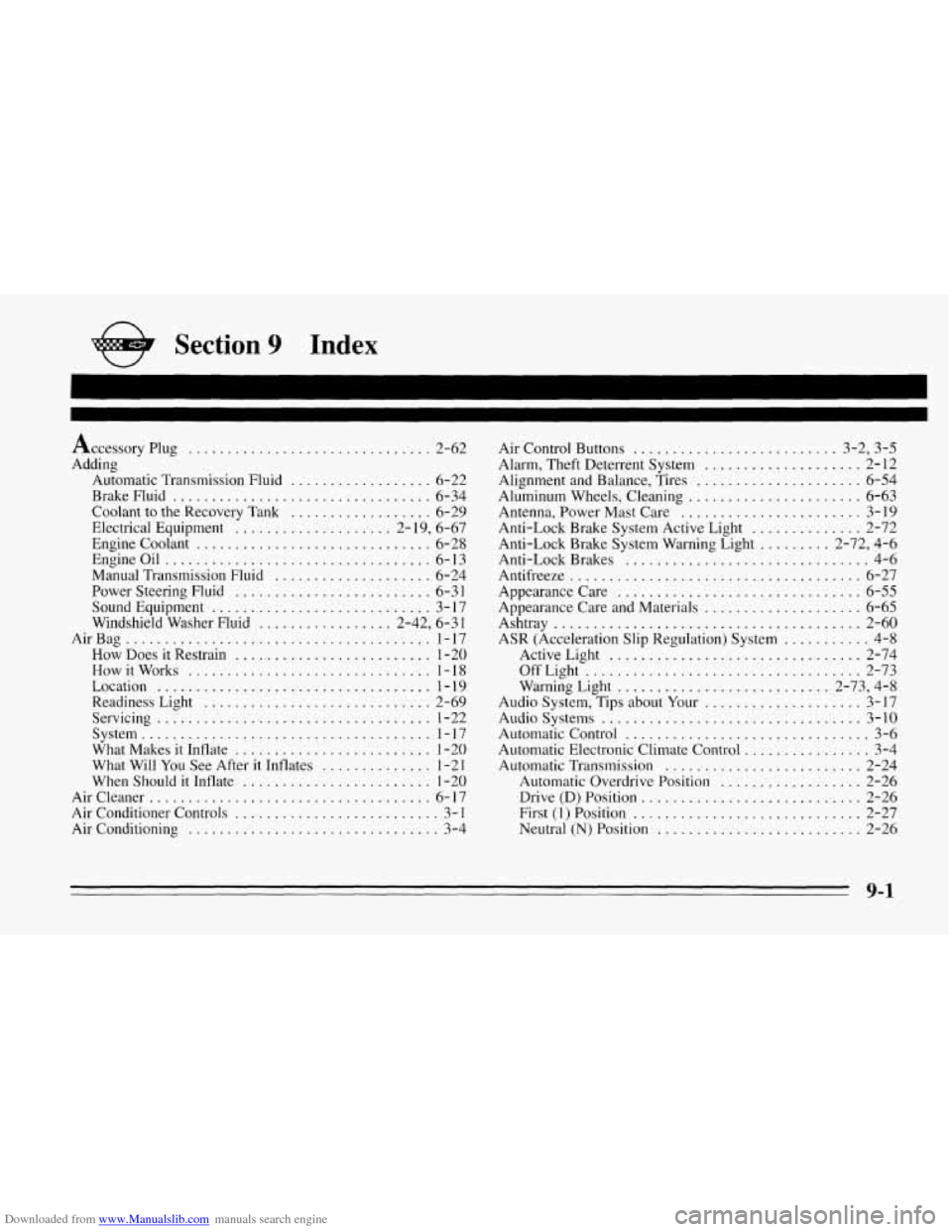
Downloaded from www.Manualslib.com manuals search engine Index
Accessory Plug ............. ............. 2-62
Adding Automatic Transmission Fluid
................ 6-22
Brake Fluid
...................... ...... 6-34
Coolant to the Recovery Tank
....... ........ 6-29
Electrical Equipment .................... 2- 19. 6-67
Engine Coolant
.............................. 6-28
Engineoil
.................................. 6-13
Manual Transmission Fluid
.................... 6-24
Power Steering Fluid
......................... 6-3 1
SoundEquipment ............................ 3-17
Windshield Washer Fluid
................. 2-42. 6-3 1
AirBag ....................................... 1-17
How Does it Restrain ......................... 1-20
How it Works ............................... 1 - I8
Location
................................... 1-19
Readiness Light
............................. 2-69
Servicing ................................... 1-22
System
..................................... 1-17
What Makes
it Inflate ......................... 1-20
What Will
You See After it Inflates .............. 1-2 1
When Should it Inflate ........................ 1-20
Air Cleaner
.................................... 6- 17
Air Conditioner Controls .......................... 3- 1
Air Conditioning ................................ 3-4 Air Control
Buttons
.......................... 3.2. 3.5
Alignment and Balance. Tires ..................... 6-54
Antenna. Power Mast Care
....................... 3-19
Anti-Lock Brake System Active Light
.............. 2-72
Anti-Lock Brake System Warning Light
......... 2.72. 4.6
Anti-Lock Brakes
............................... 4-6
Antifreeze ..................................... 6-27
Appearance Care
............................... 6-55
Appearance Care and Materials
.................... 6-65
Ashtray
....................................... 2-60
ASR (Acceleration Slip Regulation) System
........... 4-8
Active Light
................................ 2-74
OffLight
................................... 2-73
Warning Light
........................... 2.73. 4.8
Audio System. Tips about Your .................... 3-17
Audio Systems
................................. 3- IO
Automatic Control ............................... 3-6
Automatic Electronic Climate Control ................ 3-4
Automatic Transmission
......................... 2-24
Automatic Overdrive Position
.................. 2-26
Drive
(D) Position ............................ 2-26
First
(1) Position ............................. 2-27
Neutral
(N) Position .......................... 2-26
Alarm. Theft Deterrent
System
.................... 2-12
Aluminum Wheels. Cleaning
...................... 6-63
9-1