heat CHEVROLET CORVETTE 1995 4.G Owners Manual
[x] Cancel search | Manufacturer: CHEVROLET, Model Year: 1995, Model line: CORVETTE, Model: CHEVROLET CORVETTE 1995 4.GPages: 386, PDF Size: 20.15 MB
Page 2 of 386
Downloaded from www.Manualslib.com manuals search engine n
The -1995 Corvette Owner’s Manual
Seats and Restraint Systems .............................................................. 1-1
This section tells you how to use your seats and safety belts properly. It also explains the “SIR’
(Air Bag) System.
This section explains how to start and operate your Corvette.
This section tells you how to adjust the ventilation and comfort controls and how
to operate your
sound system.
YourDrivingandtheRoad ..............................................................
Here you’ll find helpful information and tips about the road and how to drive under different conditions.
This section tells you what to do if
you have a problem while driving, such as a flat tire or engine
overheating, etc.
Here the manual tells
you how to keep your Corvette running properly and looking good.
Maintenanceschedule ..................................................................
This section tells you when to perform vehicle maintenance and what fluids and lubricants to use.
Customer Assistance Information ........................................................
This section tells you how to contact Chevrolet for assistance and how to get service publications. It also
gives you information on “Reporting Safety Defects” on page
8-4.
FeaturesandControls ..................................................................
Comfort Controls and Audio Systems .....................................................
ProblemsontheRoad ..................................................................
ServiceandAppearanceCare ............................................................
2-1
3-1
4-1
5-1
6- 1
7-1
8-1
Index ........................................................................\
......... 9-1
Here’s an alphabetical listing of almost every subject in this manual. You can use it to quickly find
something you want to read.
i
Page 62 of 386
Downloaded from www.Manualslib.com manuals search engine NOTICE:
Holding your key in START for longer than
15 seconds at a time will cause your battery to be
drained much sooner. And the excessive heat can
damage your starter motor.
2. If it doesn’t start within 3 seconds, push the
accelerator pedal about one-third of the way down,
while you hold the ignition key in START. When the
engine starts, let go
of the key and let up on the
accelerator pedal. Wait about
15 seconds between
each try to help avoid draining your battery.
When starting your engine in very cold weather (below
0°F or -18”C), do this:
1. With your foot off the accelerator pedal, turn the
ignition key to START and hold it there. After two
seconds, push the accelerator pedal down just a little.
When the engine starts, let go
of the key. Use the
accelerator pedal to maintain engine speed,
if you
have to, until your engine has run for a while.
2. If your engine still won’t start (or starts but then
stops), it could be flooded with too much gasoline.
Try pushing your accelerator pedal all the way to the
floor and holding it there as you hold the key
in
START for about three seconds. If the vehicle starts
briefly but then stops again, do the same thing, but
this time keep the pedal down for five or six seconds.
This clears the extra gasoline from the engine.
NOTICE:
Your engine is designed to work with the
electronics in your vehicle.
If you add electrical
parts or accessories, you could change the
way
the fuel injection system operates. Before adding
electrical equipment, check with your dealer.
If
you don’t, your engine might not perform
properly.
If you ever have to have your vehicle towed, see
the part of this manual that tells how to do
it
without damaging your vehicle. See “Towing
Your Vehicle” in the Index.
2-19
Page 63 of 386
Downloaded from www.Manualslib.com manuals search engine To start your 5.7 Liter LTl engine:
1. Without pushing the accelerator pedal, turn the
ignition key to START. When the engine starts, let
go of the key. The idle speed will go down as your
engine gets warm.
I 1
I NOTICE:
Holding your key in START for longer than
15 seconds at a time will cause your battery to be
drained much sooner. And the excessive heat can
damage your starter motor.
2.
If it doesn’t start within 10 seconds, push the
accelerator pedal all the way to the floor, while you
hold the ignition key in START. When the engine
starts, let go of the key and let up on the accelerator
pedal. Wait about
15 seconds between each try to
help avoid draining your battery.
When starting your engine
in very cold weather (below
0°F or -18”C), do this:
1. With your foot off the accelerator pedal, turn the
ignition key to START and hold it there. When the
engine starts, let go of the key. Use the accelerator pedal
to maintain engine speed, if you have to, until
your engine has run for a while.
stops), it could be flooded with too much gasoline.
Try pushing your accelerator pedal all the
way to the
floor and holding it there as you hold the key in
START for about three seconds. If the vehicle starts
briefly but then stops again, do the same thing, but
this time keep the pedal down for five or six seconds.
This clears the extra gasoline from the engine.
2. If your engine still won’t start (or starts but then
I NOTICE:
Your engine is designed to work with the
electronics in your vehicle.
If you add electrical
parts
or accessories, you could change the way
the fuel injection system operates. Before adding
electrical equipment, check with your dealer.
If
you don’t, your engine might not perform
properly.
If you ever have to have your vehicle towed, see
the part of this manual that tells how to
do it
without damaging your vehicle. See “Towing
Your Vehicle” in the Index.
2-20
Page 66 of 386
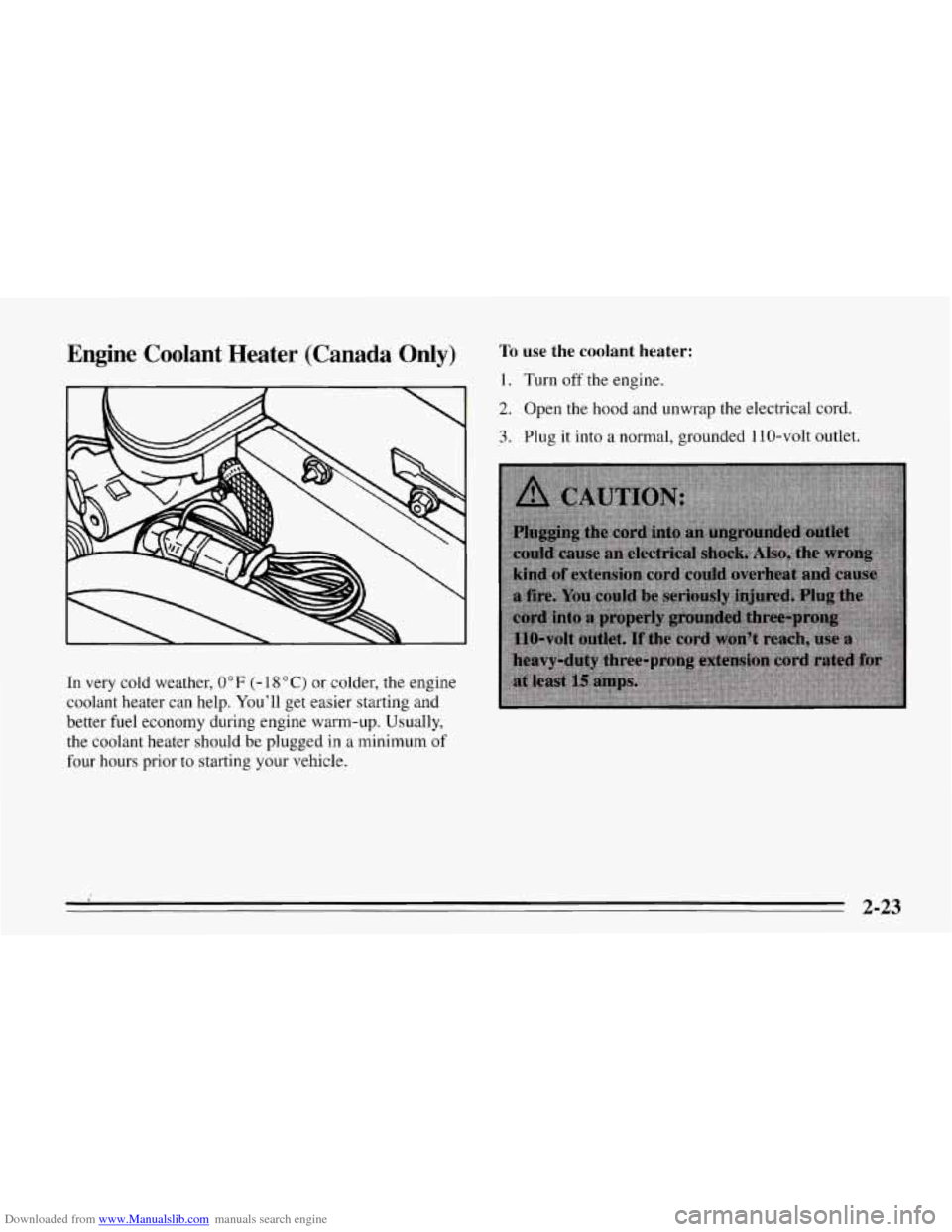
Downloaded from www.Manualslib.com manuals search engine Engine Coolant Heater (Canada Only)
In very cold weather, 0°F (- 18 "C) or colder, the engine
coolant heater can help. You'll get easier starting and
better fuel economy during engine warm-up. Usually,
the coolant heater should be plugged
in a minimum of
four hours prior to starting your vehicle.
To use the coolant heater:
1. Turn off the engine.
2. Open the hood and unwrap the electrical cord.
3. Plug it into a normal, grounded 1 10-volt outlet.
8 2-23
Page 67 of 386
Downloaded from www.Manualslib.com manuals search engine I NOTICE:
After you’ve used the coolant heater, be sure to store the cord
as it was before to keep it away
from moving engine parts. If you don’t, it could
be damaged.
How long should you keep the coolant heater plugged
in? The answer depends on the weather, the kind
of oil
you have, and some other things. Instead
of trying to list
everything here, we ask that you contact your Chevrolet
dealer in the area where you’ll be parking your vehicle.
The dealer can give you the best advice for that
particular area.
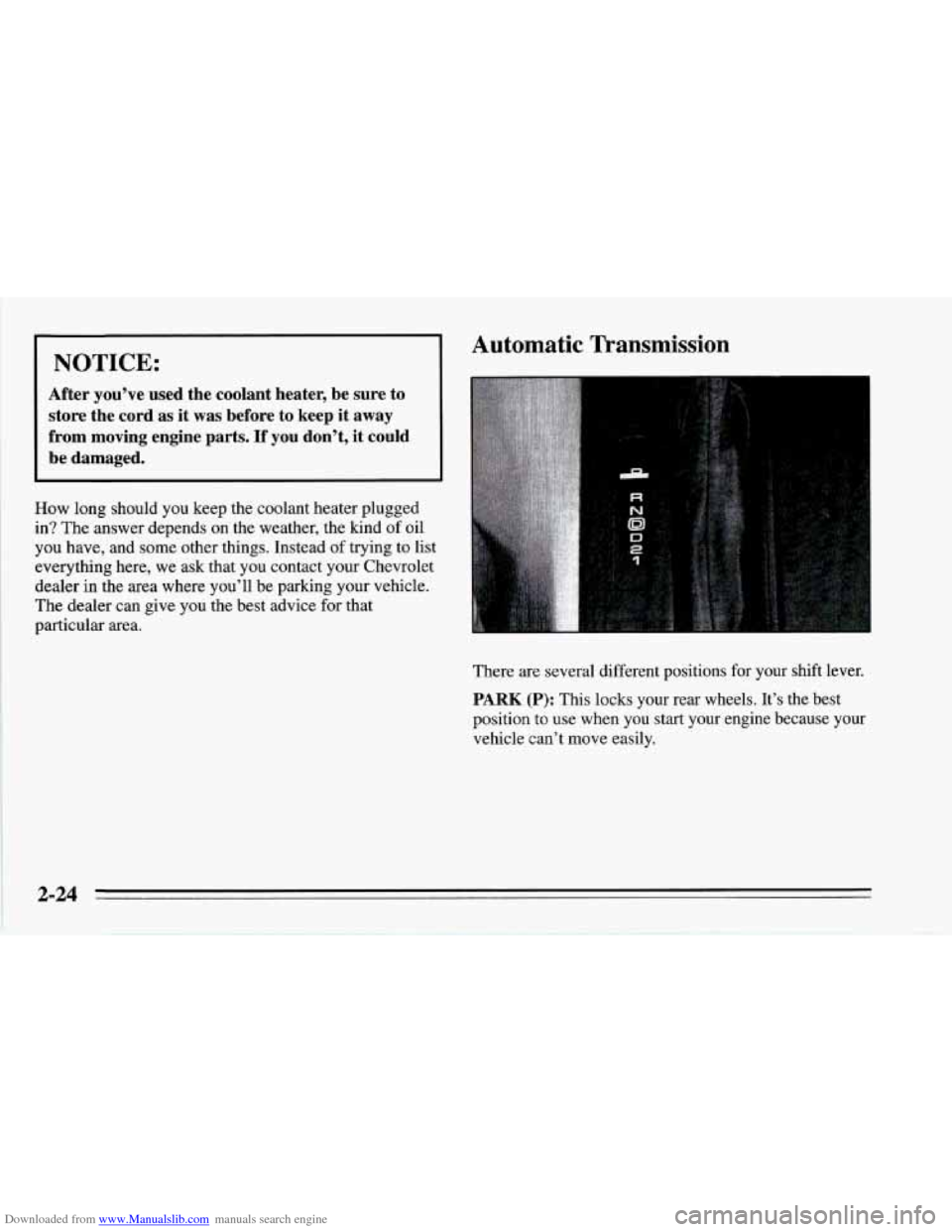
Automatic Transmission
There are several different positions for your shift lever.
PARK (P): This locks your rear wheels. It’s the best
position
to use when you start your engine because your
vehicle can’t move easily.
2-24
Page 70 of 386
Downloaded from www.Manualslib.com manuals search engine SECOND (2): This position gives you more power but
lower fuel economy. You can use SECOND
(2) on hills.
It can help control your speed as you go down steep
mountain roads, but then you would also want to use
your brakes off and on.
FIRST (1): This position gives you even more power
(but lower fuel economy) than SECOND
(2). You can
use
it on very steep hills, or in deep snow or mud. If the
selector lever is put in FIRST
(l), the transmission
won’t shift into first gear until the vehicle
is going
slowly enough.
NOTICE:
If your rear wheels can’t rotate, don’t try to
drive. This might happen if you were stuck in
very deep sand or mud or were up against
a solid
object. You could damage your transmission.
Also, if you stop when going uphill, don’t hold
your vehicle there with only the accelerator
pedal. This could overheat and damage the
transmission. Use your brakes or shift into
PARK
(P) to hold your vehicle in position on a
hill.
Maximum engine speed is limited to protect driveline
components from improper operation.
2-27
Page 75 of 386
Downloaded from www.Manualslib.com manuals search engine Parking Brake
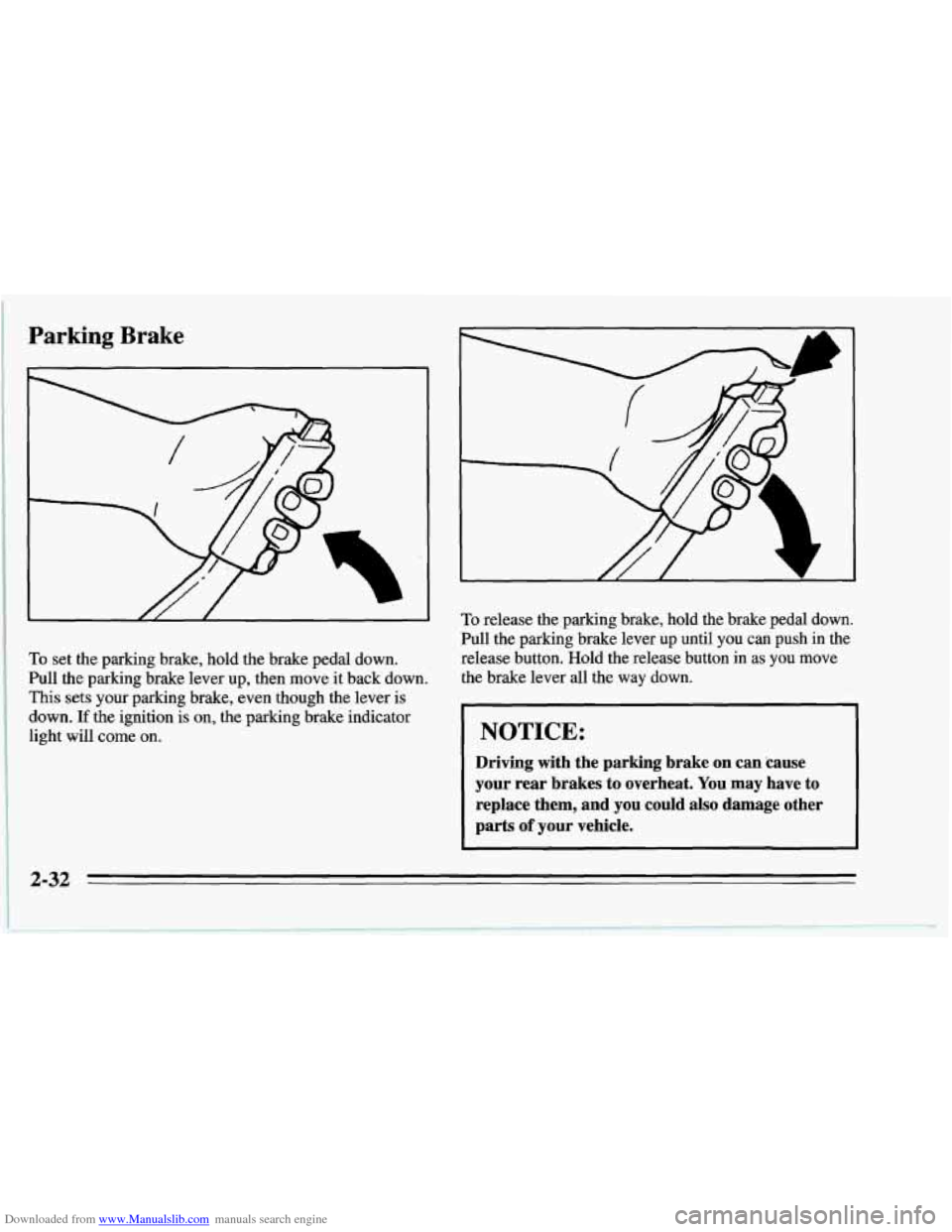
To set the parking brake, hold the brake pedal down.
Pull the parking brake lever up, then move it back down.
This sets your parking brake, even though the lever is
down.
If the ignition is on, the parking brake indicator
light will come on.
To release the parking brake, hold the brake pedal down.
Pull the parking brake lever up until you can push in the
release button. Hold the release button in
as you move
the brake lever all the way down.
NOTICE:
Driving with the parking brake on can 'cause
your rear brakes to overheat. You may have to
replace them, and you could also damage other
parts
of your vehicle.
2-32
Page 104 of 386
Downloaded from www.Manualslib.com manuals search engine NOTICE:
Don’t put papers and other things that burn into
your ashtray.
If you do, cigarettes or other
smoking materials could set them on fire, causing
damage.
You can remove the ashtray and use the space as a
second cupholder. When
you put the ashtray back, be
sure to use the rear opening.
NOTICE:
Loose objects (such as paper clips) can lodge
behind and beneath the ashtray lid and prevent
movement of the lid. Avoid putting small loose
objects near the ashtray.
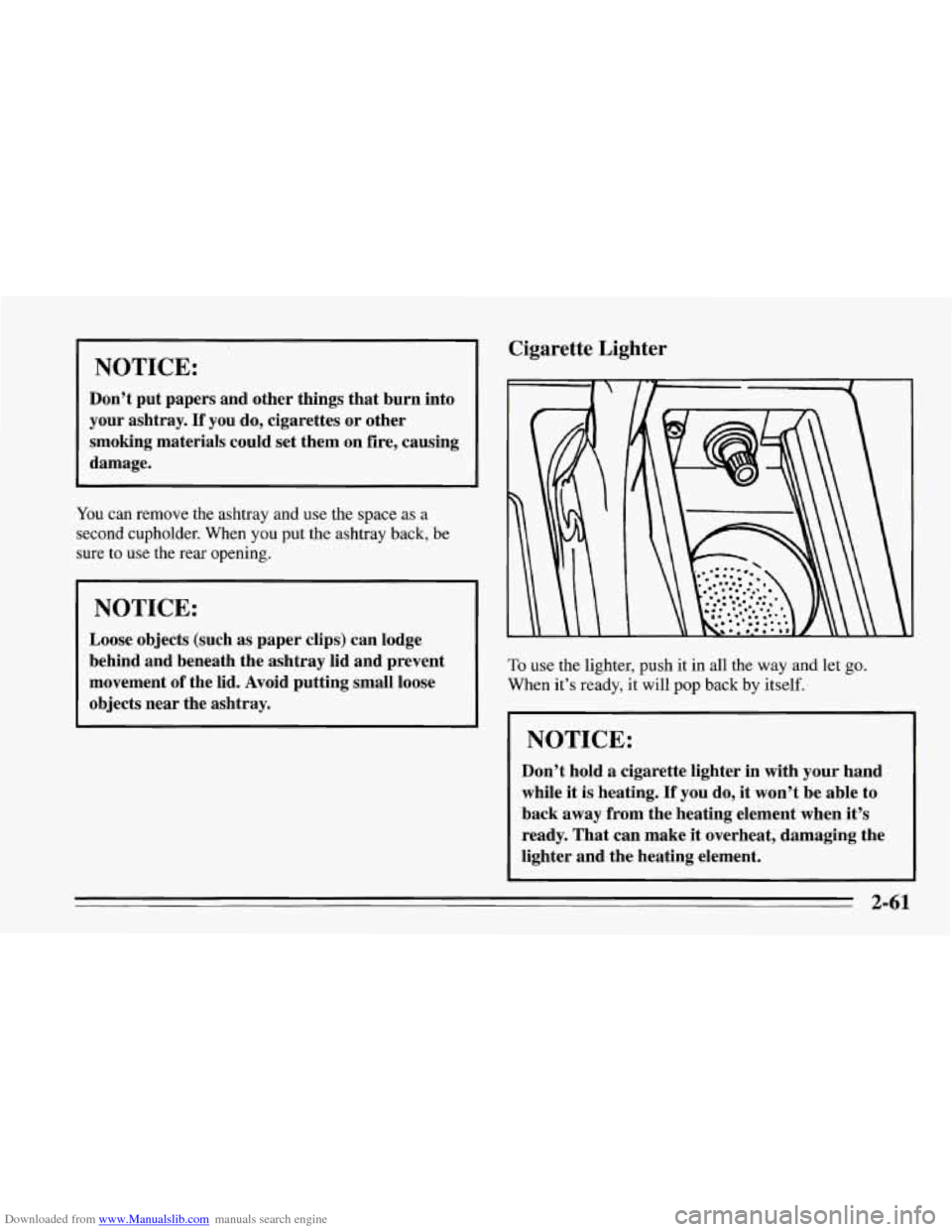
Cigarette Lighter
I I‘ 17
To use the lighter, push it in all the way and let go.
When it’s ready, it will pop back by itself.
I NOTICE:
Don’t hold a cigarette lighter in with your hand
while it is heating.
If you do, it won’t be able to
back
away from the heating element when it’s
ready. That can make it overheat, damaging the
lighter and the heating element.
2-61
Page 117 of 386
Downloaded from www.Manualslib.com manuals search engine ASR (Acceleration Slip Regulation) System
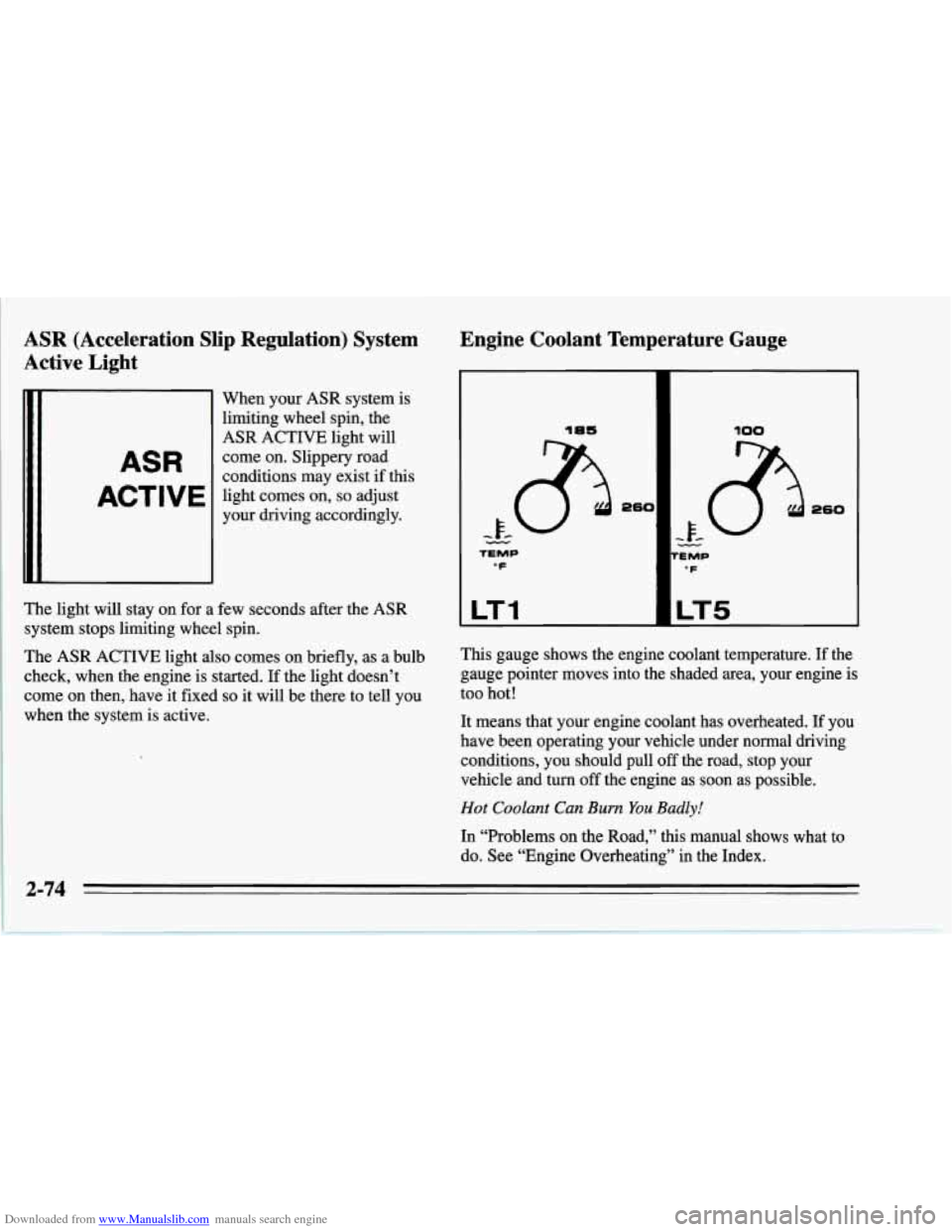
Active Light
ASR
ACTIVE
When your ASR system is
limiting wheel spin, the
ASR ACTIVE light will
come on. Slippery road
conditions may exist
if this
light comes on,
so adjust
your driving accordingly.
The light will stay on for a few seconds after the ASR
system stops limiting wheel spin.
The ASR ACTIVE light also comes on briefly, as a bulb
check, when the engine is started. If the light doesn’t
come on then, have it fixed
so it will be there to tell you
when the system is active.
Engine Coolant Temperature Gauge
18s
TEMP
“F
LT1
100
uv
’E MP
‘F
LT5
This gauge shows the engine coolant temperature. If the
gauge pointer moves into the shaded area, your engine is
too hot!
It means that your engine coolant has overheated. If you
have been operating your vehicle under normal driving
conditions, you should pull
off the road, stop your
vehicle and turn
off the engine as soon as possible.
Hot Coolant Can Bum You Badly!
In “Problems on the Road,” this manual shows what to
do. See “Engine Overheating” in the Index.
2-74
Page 118 of 386
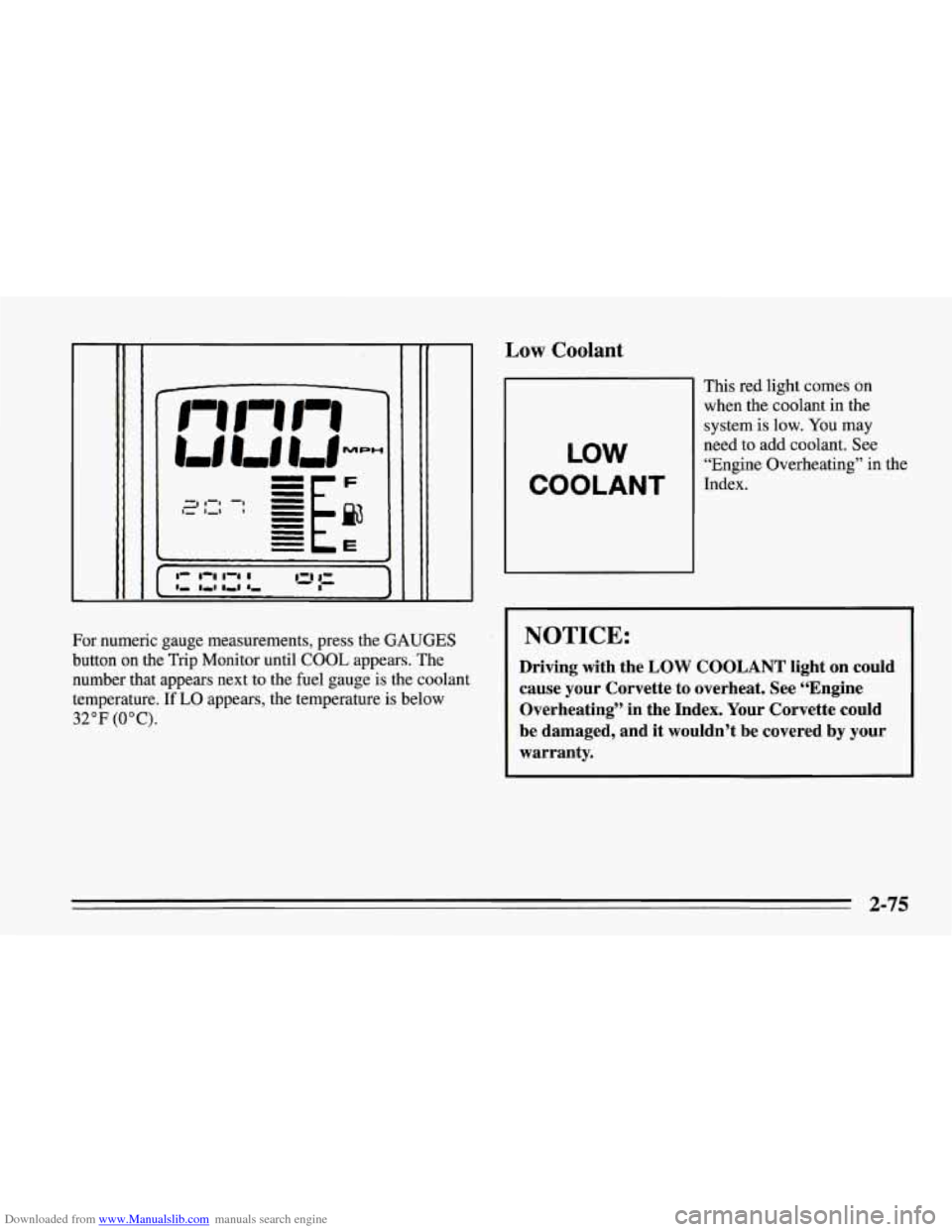
Downloaded from www.Manualslib.com manuals search engine For numeric gauge measurements, press the GAUGES
button on the Trip Monitor until COOL appears. The
number that appears next to the fuel gauge is the coolant
temperature. If
LO appears, the temperature is below
32°F (OOC).
,ow Coolant
1
This red light comes on
when the coolant in the
system is
low. You may
LOW
need to add coolant. See
“Engine Overheating” in the
COOLANT Index-
NOTICE:
Driving with the LOW COOLANT light on could
cause your Corvette
to overheat. See “Engine
Overheating” in the Index. Your Corvette could
be damaged, and it wouldn’t be covered by your warranty.
2-75