ECU CHEVROLET CORVETTE 1996 4.G User Guide
[x] Cancel search | Manufacturer: CHEVROLET, Model Year: 1996, Model line: CORVETTE, Model: CHEVROLET CORVETTE 1996 4.GPages: 386, PDF Size: 20.12 MB
Page 93 of 386
Downloaded from www.Manualslib.com manuals search engine NOTICE:
Your Corvette’s radio receiver is in the rear
storage compartment.
To help avoid damage to
the receiver:
Securely store the jack (if equipped) in the
Store any other objects under the storage
Do not store items such as liquids or sharp
foam container
after use.
tray carefully.
objects that could puncture or cut the radio
receiver or wiring.
Also, to reduce the potential for radio receiver
interference, do not install any other electronic
module under the storage tray.
Ashtray and Cigarette Lighter
To use the ashtray, push on the right side of the door
next to the shift lever.
To remove it, lift up on the
snuffer.
NOTICE:
Don’t put papers and other things that burn into
your ashtray. If you do, cigarettes
or other
smoking materials could set them on fire, causing
damage.
You can remove the ashtray and use the space as a
second cupholder. When you put the ashtray back, first
put the ashtray into the rubber isolator, then be sure to
put the ashtray and isolator into the forward opening.
NOTICE:
Loose objects (such as paper clips) can lodge
behind and beneath the ashtray lid and prevent
movement of the lid. Avoid putting small loose
objects near the ashtray.
To use the lighter, push it in all the way and let go.
When it’s ready,
it will pop back by itself.
2-50
Page 98 of 386
Downloaded from www.Manualslib.com manuals search engine St--in- the Roof Panel
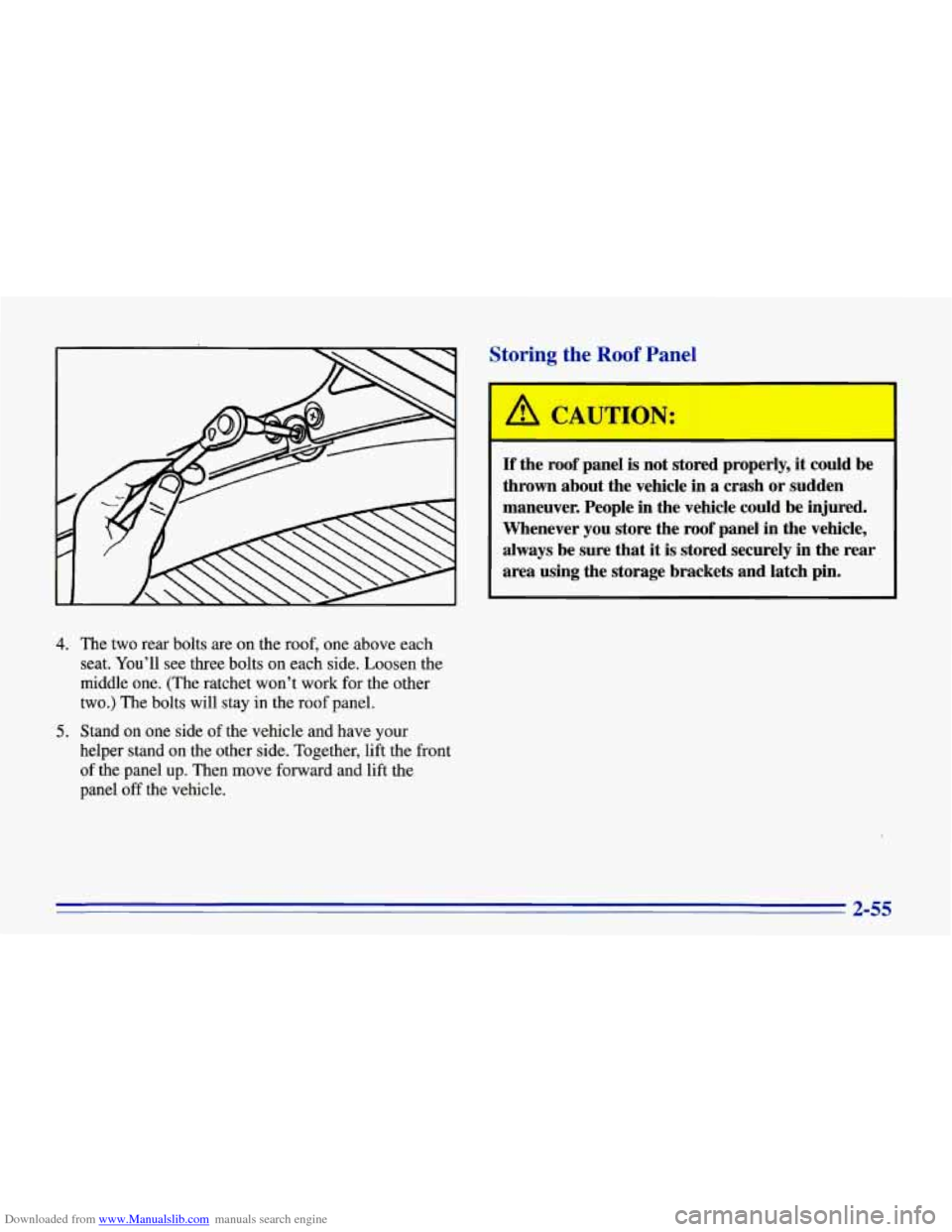
4. The two rear bolts are on the roof, one above each
seat. You’ll see three bolts on each side. Loosen the
middle one. (The ratchet won’t work for the other
two.) The bolts will stay in the roof panel.
5. Stand on one side of the vehicle and have your
helper stand on the other side. Together, lift the front
of the panel up. Then move forward and lift the
panel
off the vehicle.
If the roof panel is not stored properly, it could be
thrown about the vehicle in a crash or sudden
maneuver. People in the vehicle could be injured.
Whenever you store the roof panel in the vehicle,
always be sure that it is stored securely in the rear
area using the storage brackets and latch pin.
2-55
Page 101 of 386
Downloaded from www.Manualslib.com manuals search engine 3. Lower the roof panel onto the vehicle, rear edge first,
and place the rear guide pins into the holes in the
roof opening.
4. Lower the front of the roof panel, and align the front
guide pins.
5. Tighten the rear bolts part way.
NOTICE:
If you tighten bolts that are improperly started,
the threads can become stripped. Be sure all bolts
are properly started before you tighten them.
6. Use the ratchet to start the front bolts. If the bolts are
hard to start, tighten the rear bolts some more.
Holding down the panel on the outside will also
help.
7. Fully tighten the rear bolts, then the front bolts.
If you hear a popping noise when you drive, the
bolts may not be tight enough. Be sure to tighten
them securely.
Convertible Top (Option)
The following procedures explain the proper operation
of your convertible top.
Lowering Your Convertible Top
NOTICE:
Don’t leave your convertible out with the top
down for any long periods of time. The sun and
the rain can damage your seat material and other
things inside your vehicle.
1. Park on a level surface, set the parking brake firmly
and shift an automatic transmission into
PARK (P).
Shift a manual transmission into REVERSE (R).
Lower both windows and sunshades and turn the
ignition
key to LOCK.
Page 106 of 386
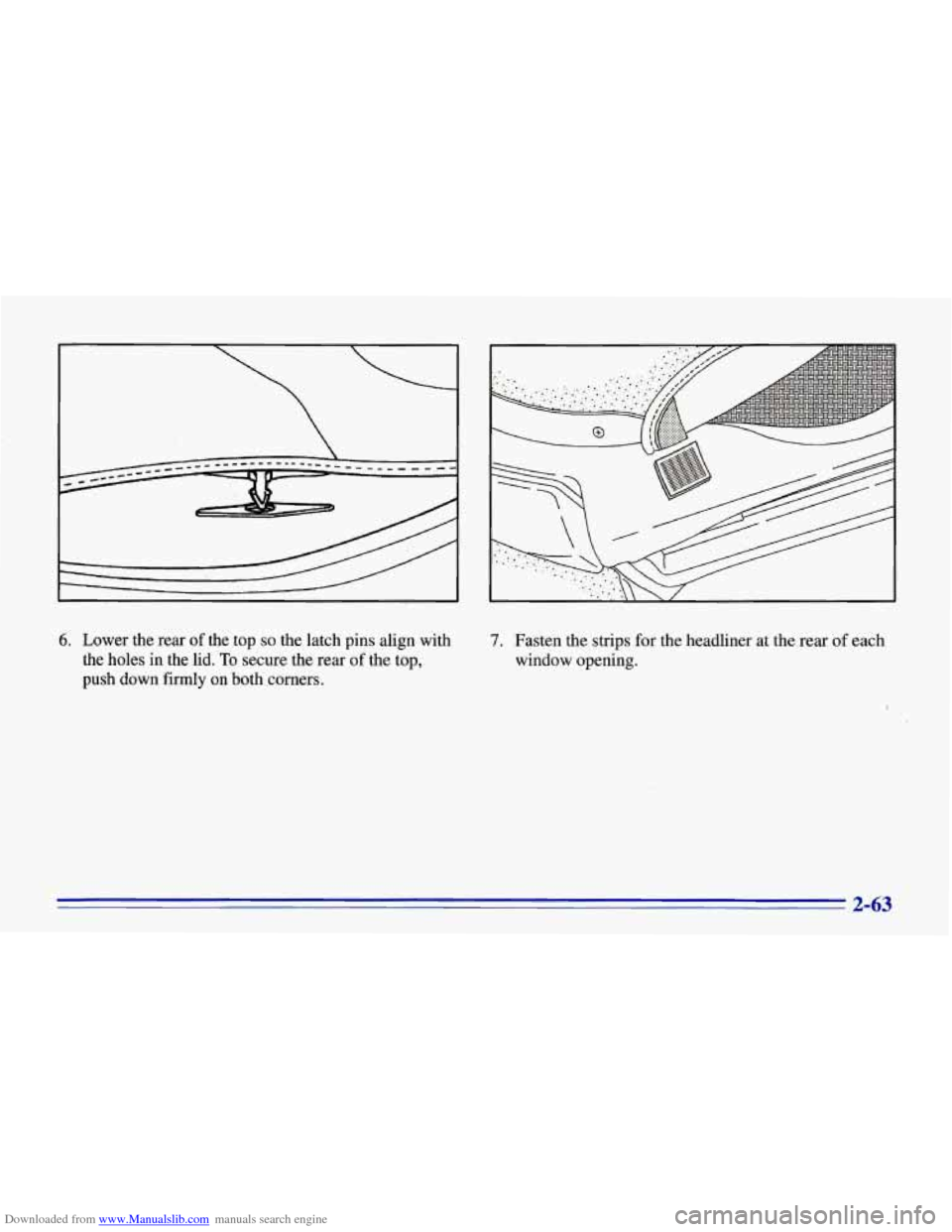
Downloaded from www.Manualslib.com manuals search engine 6. Lower the rear of the top so the latch pins align with
the
holes in the lid. To secure the rear of the top,
push down firmly on
both corners.
7. Fasten the strips for the headliner at the rear of each
window opening.
2-63
Page 112 of 386
Downloaded from www.Manualslib.com manuals search engine 7.
8.
9.
Insert the two upper bolts into both receiver
brackets. You may have to lift the hardtop slightly
to install the lock pillar bracket.
If the hardtop hasn’t lowered into position, pull the
release lever behind the driver’s seat (located under the storage compartment lid).
Secure but don’t tighten the rear corner bracket
bolts using the ratchet.
10. Tighten the front bolts using the wrench.
11. Insert the lower bolt into the bottom flange of the
lock pillar brackets and tighten. Install and tighten
the remaining bolts into the lock pillar brackets.
12. Using the ratchet, tighten the rear corner bracket
bolts.
Do not over-tighten these bolts.
13. Slide the rear trim panel in place.
If the hardtop isn’t secure, it can’t give as much
protection in a crash.
A loose hardtop could fly
off the vehicle in an accident or sudden
maneuver. You or others could be injured. Don’t
drive your vehicle until all the hardtop fasteners
are tight.
14. Remove the HATCH (45) fuse. Store it in the center
console while the convertible hardtop is in use.
(This will prevent accidental unlatching of the
storage compartment lid.)
2-69
Page 136 of 386
Downloaded from www.Manualslib.com manuals search engine Security Light Check Gauges Light
SECURITY
This light comes on to
remind you to
arm your
theft-deterrent system. If it
comes on and stays on when
your ignition is on, there
may be a problem with your
theft-deterrent system.
CHECK
GAUGES
This light will come on
briefly when you are
starting the engine.
If the
light comes on and stays on
while you are driving, check
your gauges to see if they
are in the warning areas.
See “Universal Theft-Deterrent” and “PASS-Key
System” in the Index.
System Problems Light
If SYS flashes on the display near your fuel gauge, there
may be a problem with your Corvette’s electrical
system. If the
SECURITY light flashes at the same time,
there is
a problem with your theft-deterrent system.
Have your vehicle checked by your dealer
if SYS keeps
appearing. This
light can come on for:
0 High Engine Oil Temperature or Low oil Pressure
High Coolant Temperature
High or Low Battery Voltage
0 Low Fuel Level
0 High Automatic Transmission Fluid Temperature
2-93
Page 185 of 386
Downloaded from www.Manualslib.com manuals search engine Winter Driving
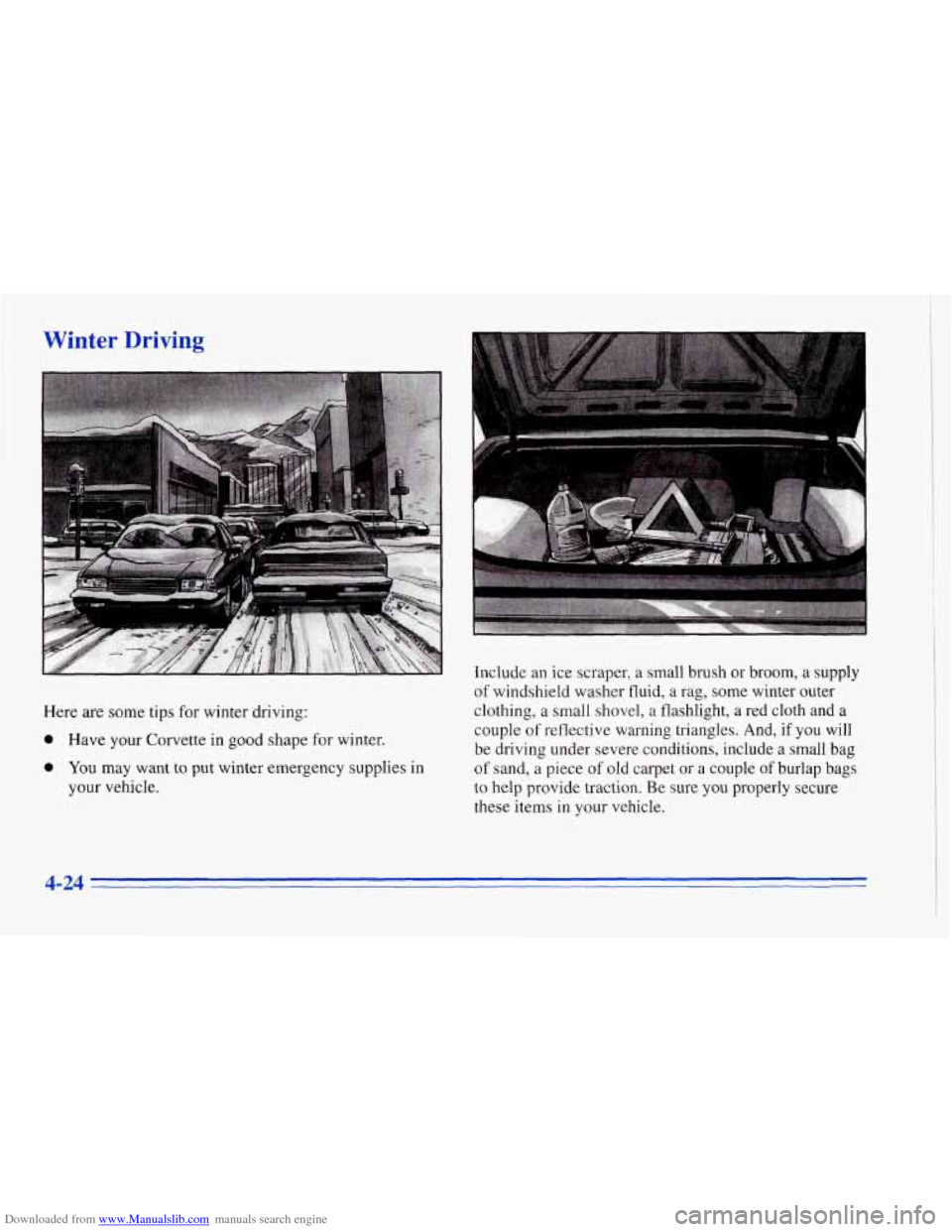
Here are some tips for winter driving:
0 Have your Corvette in good shape for winter.
0 You may want to put winter emergency supplies in
your vehicle. Include
an ice scraper, a small brush or broom,
a supply
of windshield washer
fluid, a rag, some winter outer
clothing, a small shovel, a flashlight, a red cloth and a
couple of reflective warning triangles. And,
if you will
be driving under severe conditions, include a small bag
of sand, a piece of old carpet or a couple of burlap bags
to help provide traction. Be sure you properly secure
these items in your vehicle.
4-24
Page 190 of 386
Downloaded from www.Manualslib.com manuals search engine A CAUTION:
Do not load your vehicle any heavier than the
GVWR, or either the maximum front or rear
GAWR.
If you do, parts on your vehicle can break,
or it can change the way your vehicle handles.
These could cause you
to lose control. Also,
overloading can shorten the life
of your vehicle.
NOTICE:
Your warranty does not cover parts or
components that fail because
of overloading.
If you put things inside your vehicle -- like suitcases?
tools, packages or anything else
-- they will go as fast as
the vehicle goes.
If you have to stop or turn quickly, or
if there is a crash, they’ll keep going.
A CAUTION:
-
Things you put inside your vehicle can strike
and injure people in
a sudden stop or turn, or in
a crash.
Put things in the rear area of your vehicle.
Try to spread the weight evenly.
Never stack heavier things, like suitcases,
inside the vehicle
so that some of them are
above the tops
of the seats.
Don’t leave an unsecured child restraint in
your vehicle.
When, you carry something inside the
vehicle, secure it whenever you can.
Towing A Trailer
Your Corvette is neither designed nor intended to tow
a trailer.
4-29
Page 198 of 386
Downloaded from www.Manualslib.com manuals search engine A CAUTION:
To help avoid injury to you or others:
Never let passengers ride in a vehicle that is
0 Never tow faster than safe or posted speeds.
0 Never tow with damaged parts not
fully secured.
0 Never get under your vehicle after it has
been lifted by the tow truck.
0 Always secure the vehicle on each side with
separate safety chains when towing it.
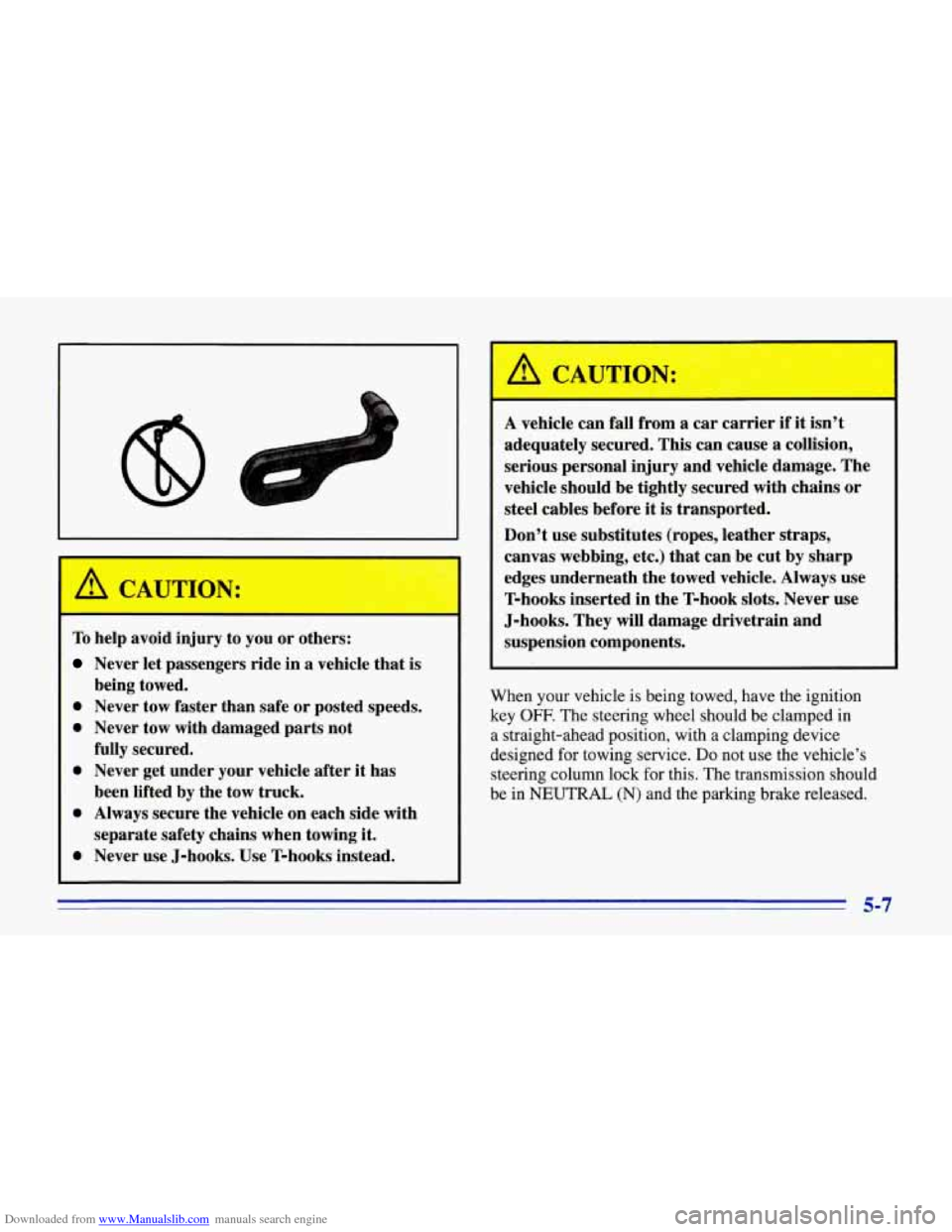
0 Never use J-hooks. Use T-hooks instead.
being towed.
A vehicle
can fall from a car carrier if it isn’t
adequately secured. This can cause a collision,
serious personal injury and vehicle damage. The
vehicle should be tightly secured with chains or
steel cables before
it is transported.
Don’t use substitutes (ropes, leather straps,
canvas webbing, etc.) that can be cut by sharp
edges underneath the towed vehicle. Always use
T-hooks inserted in the T-hook slots. Never use
J-hooks. They will damage drivetrain and
suspension components.
When your vehicle is being towed, have the ignition
key
OFF. The steering wheel should be clamped in
a straight-ahead position, with a clamping device
designed for towing service.
Do not use the vehicle’s
steering column lock for this. The transmission should
be in
NEUTRAL (N) and the parking brake released.
5-7
Page 199 of 386
Downloaded from www.Manualslib.com manuals search engine Front Towing
Tow Limits -- 35 mph (56 km/h), 50 miles (80 km)
Don't have your vehicle towed on the rear wheels unless
you must. If the vehicle must be towed on the rear
wheels, don't exceed the above limits or your
transmission will be damaged.
Go slow over rough
ground, and position one wheel at a time (angled
45 ") if
you have to go over curbs and rises. Wheels at the lifted
end should be at least
4 inches (100 mm) above the
ground. If these limits must be exceeded, then the rear
wheels have to be supported on a dolly.
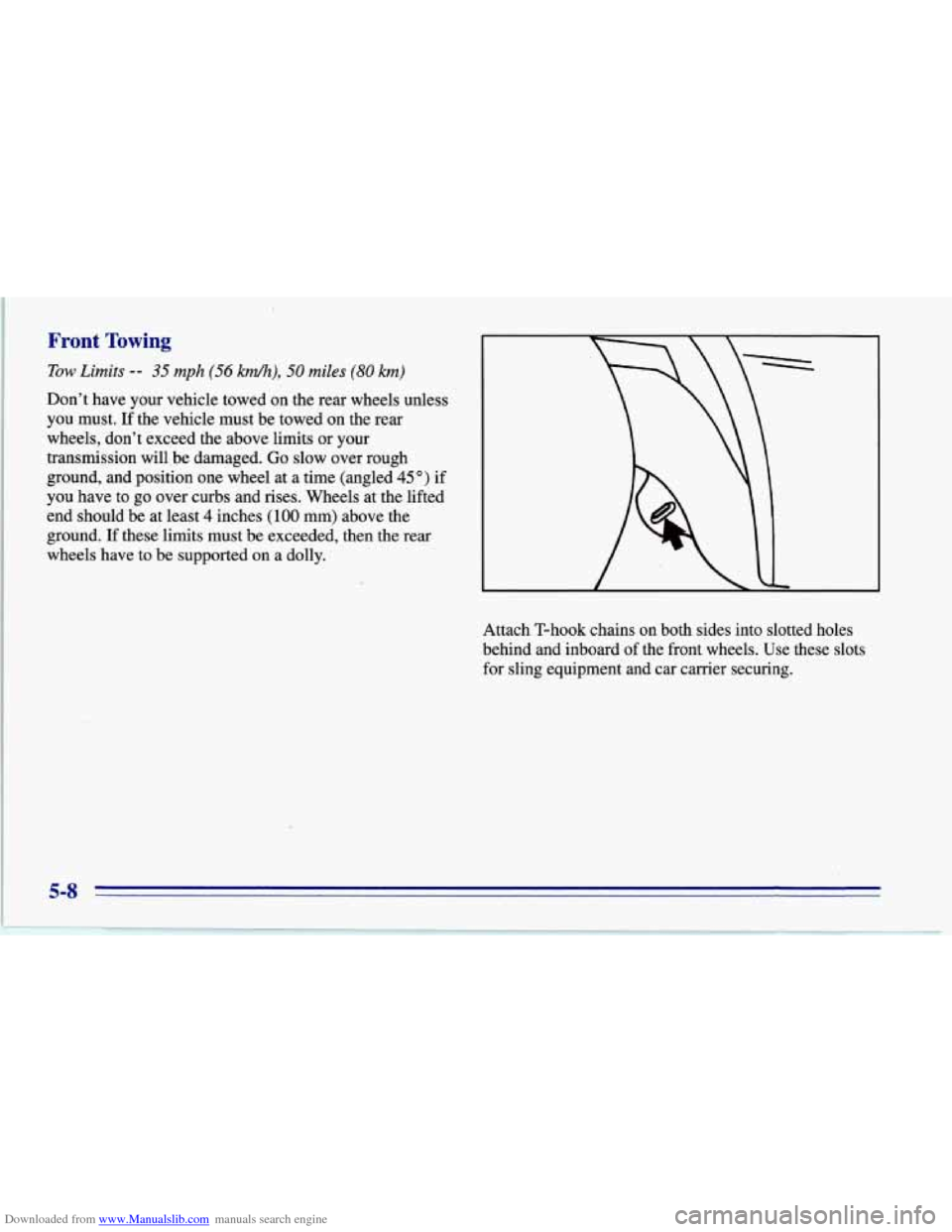
Attach T-hook chains on both sides into slotted holes
behind and inboard of the front wheels. Use these slots
for sling equipment and car carrier securing.