warning light CHEVROLET CORVETTE 1996 4.G Owners Manual
[x] Cancel search | Manufacturer: CHEVROLET, Model Year: 1996, Model line: CORVETTE, Model: CHEVROLET CORVETTE 1996 4.GPages: 386, PDF Size: 20.12 MB
Page 11 of 386
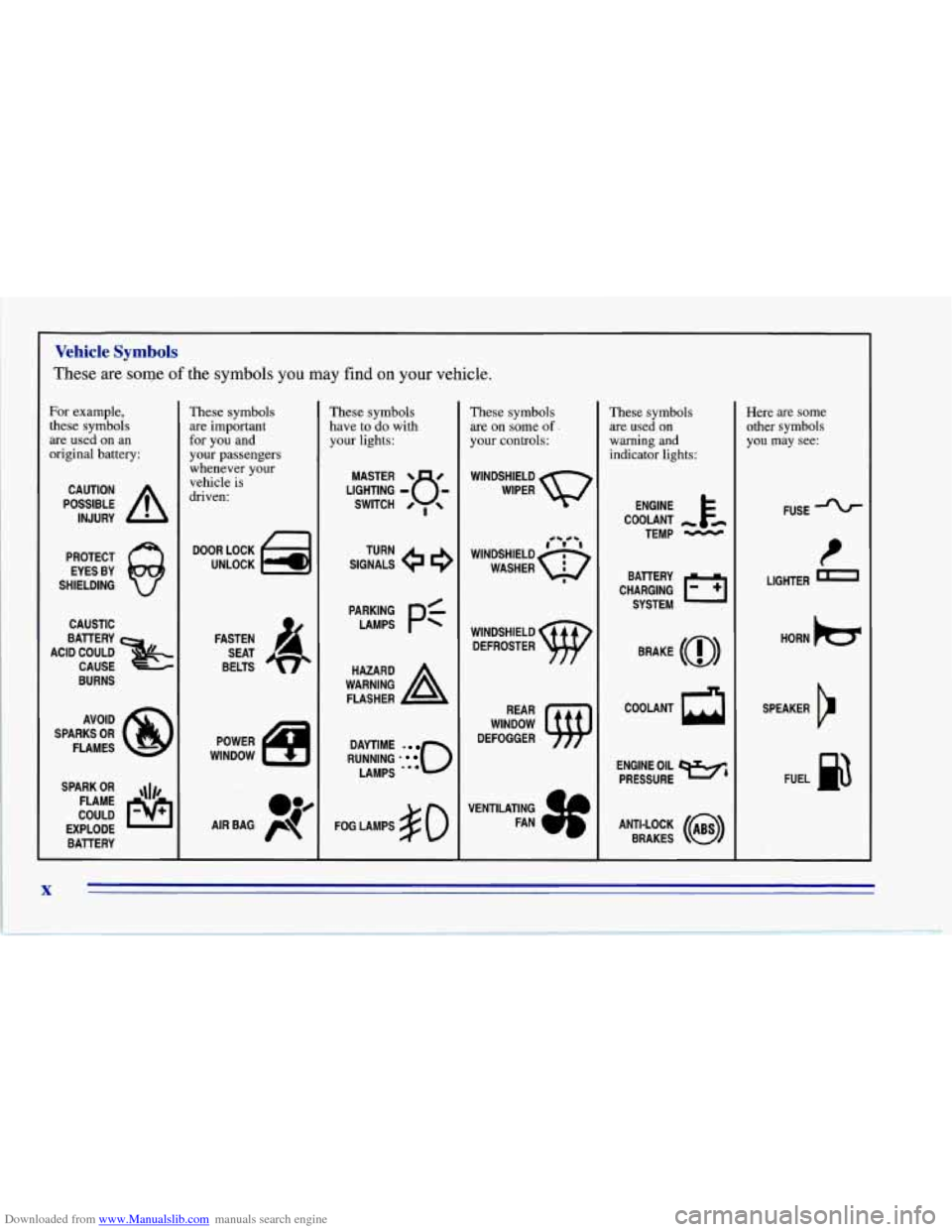
Downloaded from www.Manualslib.com manuals search engine Vehicle Symbols
These are some of the symbols you may find on your vehicle.
For example,
these symbols
are used on an
original battery:
POSSIBLE A
CAUTION
INJURY
PROTECT EYES BY
SHIELDING
Q
CAUSTIC
ACID COULD BATTERY
CAUSE
BURNS
AVOID
SPARKS
OR
FLAMES
SPARK
OR ,\I/,
COULD FLAME
EXPLODE BAllERY
These symbols
are important
for you and
your passengers
whenever your
vehicle is
driven:
UNLOCK El
FASTEN
SEAT
BELTS
POWER
WINDOW
These symbols
have to
do with
your lights:
SIGNALS e e
TURN
RUNNING
* 0
DAYTIME *
LAMPS -**
FOG LAMPS $0
These symbols
are on some of.
your controls:
WINDSHIELD
DEFROSTER
VENTILATING FAN
These symbols
are used on
warning and
indicator lights:
COOLANT -,F-
TEMP -
ENGINE
BRAKE
(0)
ENGINE OIL w,
PRESSURE
ANTI-LOCK
(a)
BRAKES
1
Here are some
other symbols
you may see:
FUSE +
LIGHTER -
HORN )cr
SPEAKER
b
FUEL p3
X
Page 59 of 386
Downloaded from www.Manualslib.com manuals search engine Ignition Positions
C
I
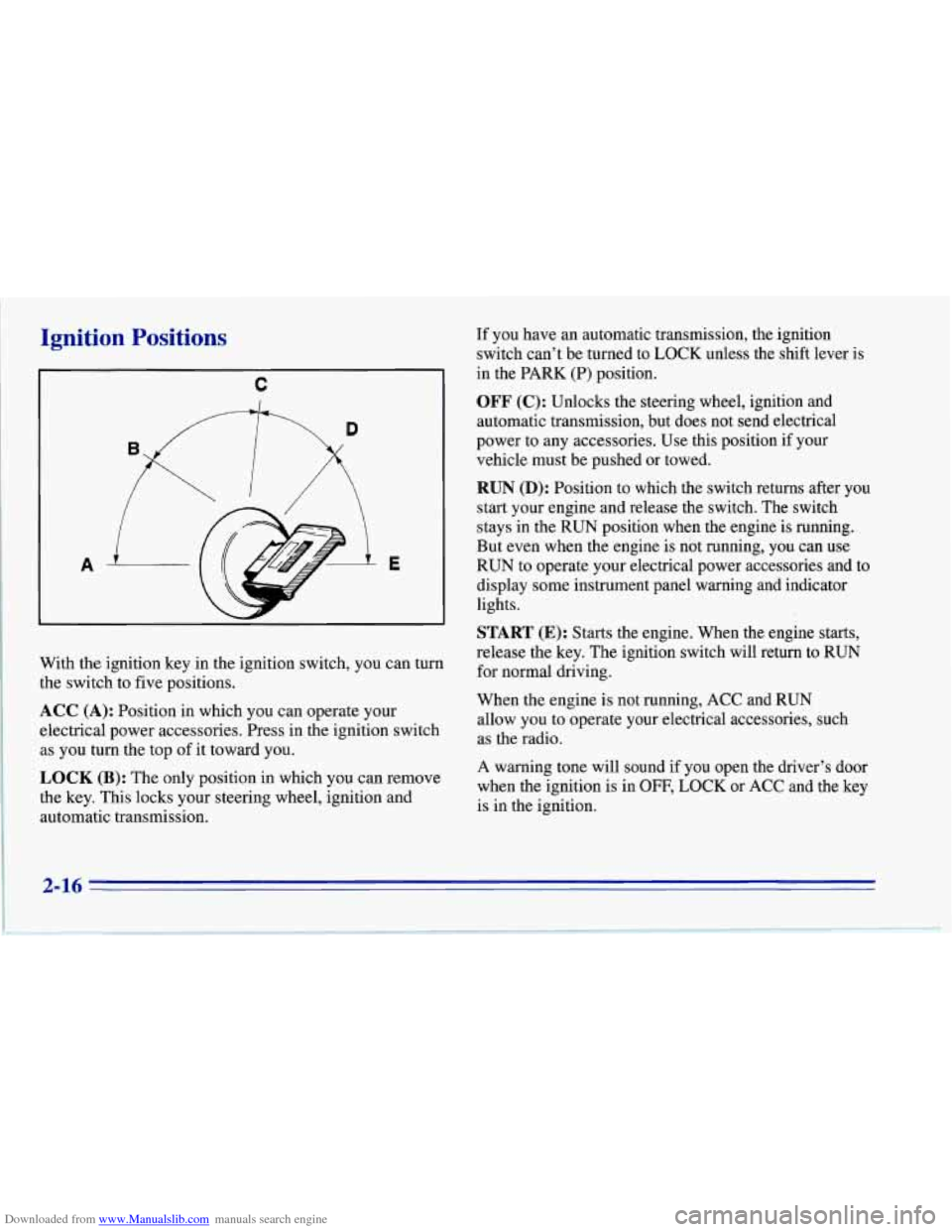
With the ignition key in the ignition switch, you can turn
the switch to five positions.
ACC (A): Position in which you can operate your
electrical power accessories. Press in the ignition switch
as you turn the top of it toward you.
OCK (B): The only position in which you can remove
the key. This locks your steering wheel, ignition and
automatic transmission. If you
have an automatic transmission, the ignition
switch can't be turned to LOCK unless the shift lever is
in the PARK (P) position.
OFF (C): Unlocks the steering wheel, ignition and
automatic transmission, but does not send electrical
power to any accessories. Use this position if your
vehicle must be pushed or towed.
RUN (D): Position to which the switch returns after you
start your engine and release the switch. The switch
stays in the RUN position when the engine is running.
But even when the engine is not running, you can use
RUN to operate your electrical power accessories and to
display some instrument panel warning and indicator
lights.
START (E): Starts the engine. When the engine starts,
release the key. The ignition switch will return to RUN
for normal driving.
When the engine is not running, ACC and RUN
allow you to operate your electrical accessories, such
as the radio.
A warning tone will sound
if you open the driver's door
when the ignition is in
OFF, LOCK or ACC and the key
is in the ignition.
2-16
Page 117 of 386
Downloaded from www.Manualslib.com manuals search engine Speedometer and Odometer
Your speedometer lets you see your speed in either miles Tachometer
per hour (mph) or kilometers p& how: (km/h). Your
odometer shows how far your vehicle has been driven, in The
tachometer displays the engine speed in thousands
either miles or kilometers. Press the
ENG MET button on of
revolutions per minute (rpm).
the trip monitor to switch the display between English
units (miles) and metric units (kilometers).
Your Corvette’s odometer is tamper-resistant. It will
read
OD0 ERR if someone has tampered with it.
If a new odometer is installed, it will automatically reset to
the correct reading.
If an electrical or other problem makes
setting the odometer correctly impossible, then it’s set at
zero, but
a label on the driver’s door must show the old
reading and when the new one was installed.
Trip Odometer
The trip odometer can tell you how far your Corvette has
been driven since you last set the trip odometer to zero.
To display the trip odometer, press TRIP
OD0 on the
Trip Monitor.
To reset it, press and hold RESET TRIP
for two seconds. Fuel
will shut
off at about 6400 rpm for the LT4 (Code 5)
engine and at about 5850 rpm for the LT1 (Code P)
engine.
If you continue to drive your Corvette
at the fuel shut
off rpm, you could damage your engine. Be sure to
operate your Corvette below the fuel shut
off rpm or
reduce your rpm quickly when the fuel shuts
off.
Warning Lights, Gauges and
Indicators
This part describes the warning lights and gauges that may
be on your vehicle. The pictures will help you locate them.
Warning lights and gauges can signal
that something is
wrong before it becomes serious enough to cause an
expensive repair or replacement. Paying attention to
your warning lights and gauges could also save you or
others from injury.
Page 118 of 386
Downloaded from www.Manualslib.com manuals search engine Warning lights come on when there may be or is a
problem with one of your vehicle’s functions.
As you will
see in the details on the next few pages, some warning
lights come on briefly when you
start the engine just to let
you know they’re working.
If you are farniliar with this
section, you should not be alarmed when this happens.
Gauges can indicate when there may be or
is a problem
with one of your vehicle’s functions. Often gauges and
warning lights work together to let
you know when
there’s a problem with your vehicle.
When one of the warning lights comes on and stays
on
when you are driving, or when one of the gauges shows
there may be a problem, check the section that tells you
what to do about it. Please follow this manual’s advice.
Waiting to do repairs can be costly
-- and even
dangerous.
So please get to know your warning lights
and gauges. They’re a big help.
Your vehicle also has a Driver Information Center that
works along with the warning lights and gauges. See
“Driver Information Center” in the Index.
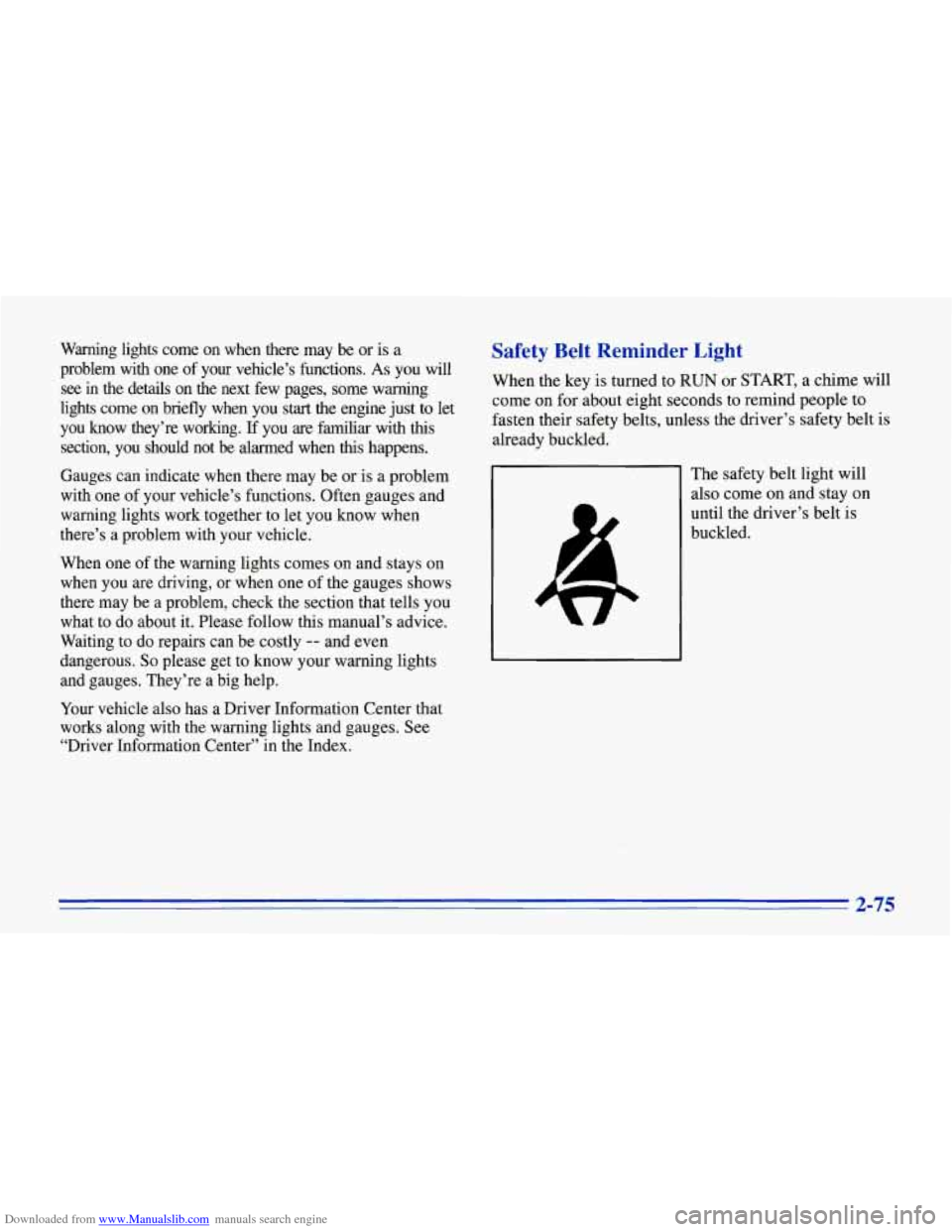
Safety Belt Reminder Light
When the key is turned to RUN or START, a chime will
come on for about eight seconds to remind people to
fasten their safety belts, unless the driver’s safety belt is
already buckled.
The safety belt light will
also come on and stay on
until the driver’s belt is
buckled.
2-75
Page 121 of 386
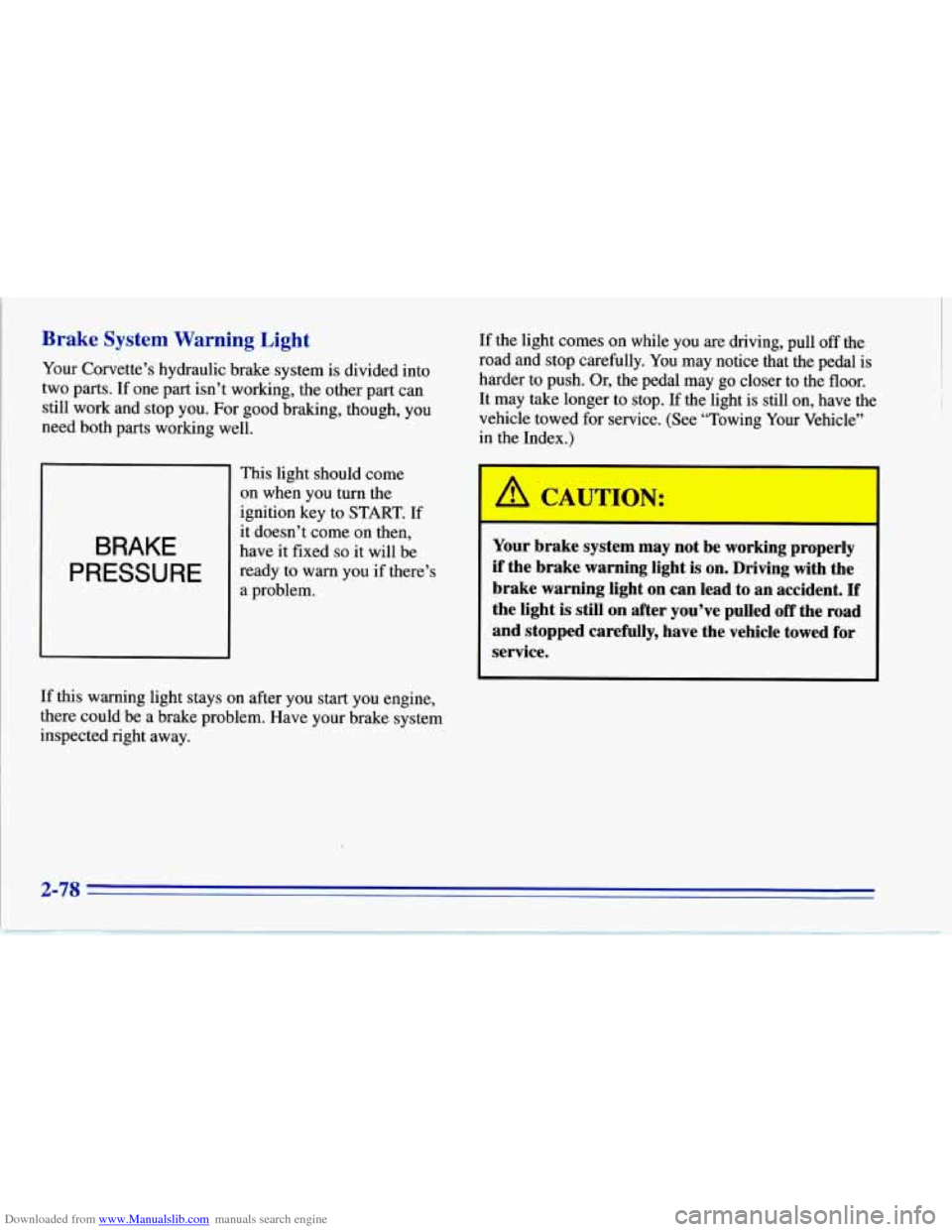
Downloaded from www.Manualslib.com manuals search engine Brake System Warning Light
Your Corvette’s hydraulic brake system is divided into
two parts. If one part isn’t working, the other part can
still work and stop you. For good braking, though, you
need both parts working well.
BRAKE
PRESSURE
This light should come
on when you turn the
ignition key to START.
If
it doesn’t come on then,
have it fixed
so it will be
ready to warn you if there’s
a problem. If
the light comes on while you are driving, pull
off the
road and stop carefully. You may notice that the pedal is
harder to push. Or, the pedal may go closer to the floor.
It may take longer to stop. If the light is still on, have the
vehicle towed for service. (See “Towing Your Vehicle”
in the Index.)
A TT-T~=T
vce. Your brake system may not be working properly
if the brake warning light
is on. Driving with the
brake warning light
on can lead to an accident. If
the light is still on after you’ve pulled off the road
and stopped carefully, have the vehicle towed for
If this warning light stays on after you start you engine,
there could be a brake problem. Have your brake system
inspected right away.
Page 122 of 386
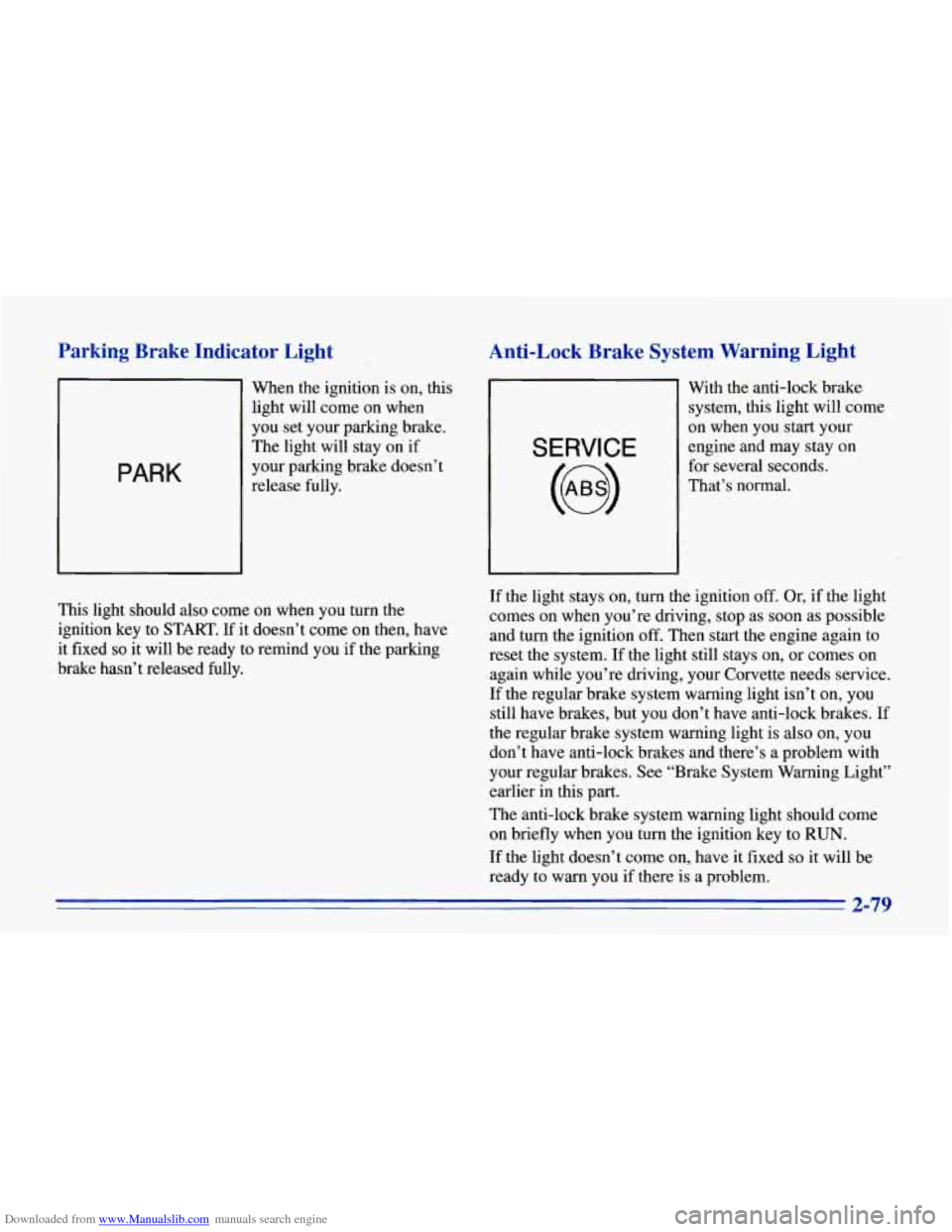
Downloaded from www.Manualslib.com manuals search engine Parking Brake Indicator Light
PARK
When the ignition is on, this
light will come on when
you set your parking brake.
The light will stay on if
your parking brake doesn’t
release fully.
Anti-Lock Brake System Warning Light
SERVICE
With the anti-lock brake
system, this light will come
on when you start your
engine and may stay on
for several seconds.
That’s normal.
I
This light should also come on when you turn the
ignition key to START. If it doesn’t come on then, have
it fixed
so it will be ready to remind you if the parking
brake hasn’t released fully. If
the light stays on, turn the ignition
off. Or, if the light
comes on when you’re driving, stop as soon as possible
and turn the ignition off. Then start the engine again to
reset the system.
If the light still stays on, or comes on
again while you’re driving, your Corvette needs service.
If the regular brake system warning light isn’t on, you
still have brakes, but you don’t have anti-lock brakes.
If
the regular brake system warning light is also on, you
don’t have anti-lock brakes and there’s a problem with
your regular brakes. See “Brake System Warning Light”
earlier in this part.
The anti-lock brake system warning light should come
on briefly when you turn the ignition key to
RUN.
If the light doesn’t come on, have it fixed so it will be
ready to warn you if there is a problem.
2-79
Page 123 of 386
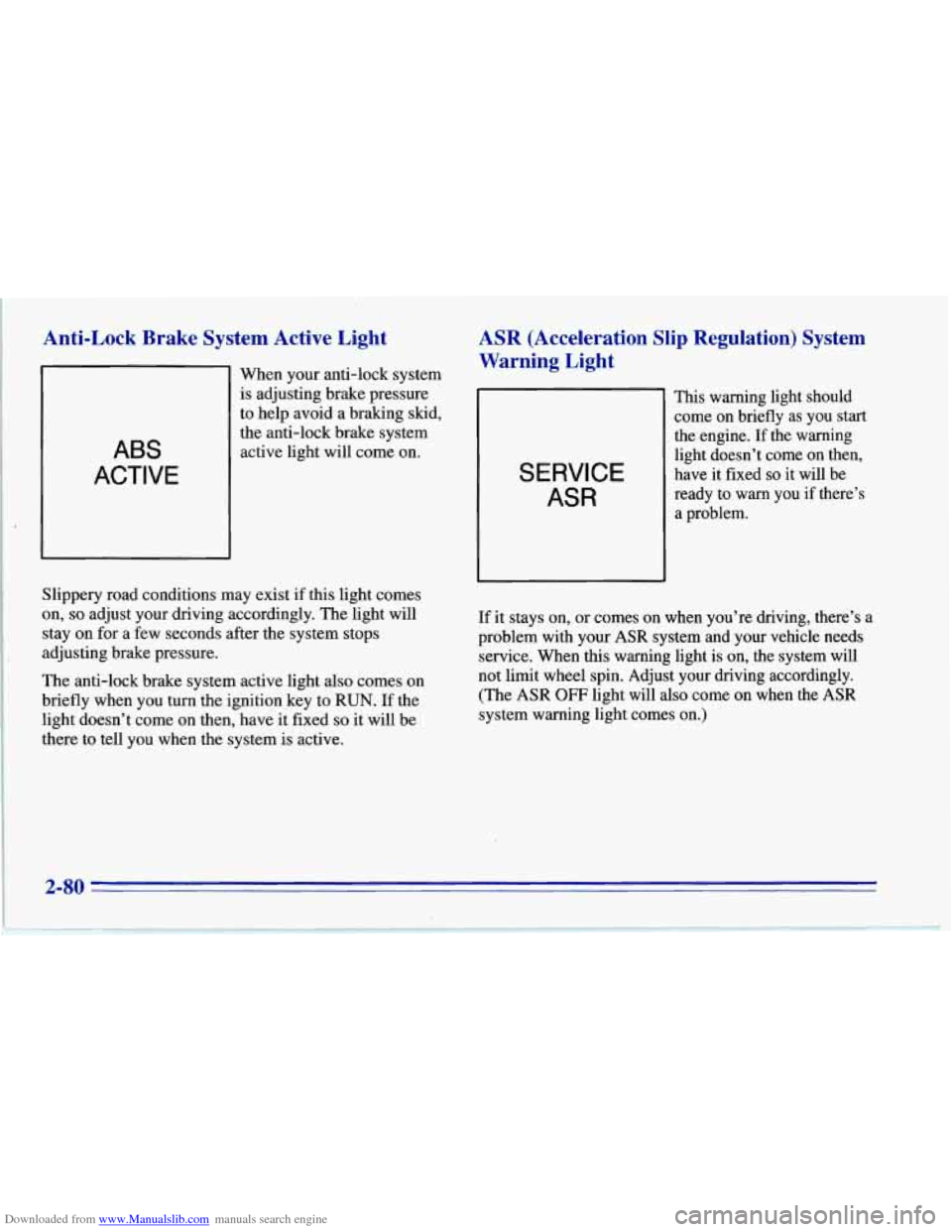
Downloaded from www.Manualslib.com manuals search engine Anti-Lock Brake System Active Light
ABS
ACTIVE
When your anti-lock system
is adjusting brake pressure
to help avoid a braking skid,
the anti-lock brake system
active light will come on.
ASR (Acceleration Slip Regulation) System
Warning Light
SERVICE
ASR
This warning light should
come on briefly as you start
the engine. If the warning
light doesn’t come on then,
have it fixed
so it-will be
ready to
warn you if there’s
a problem.
Slippery road conditions may exist if this light comes
on, so adjust your driving accordingly. The light will
stay on for a few seconds after the system stops
adjusting brake pressure.
The anti-lock brake system active light
also comes on
briefly when you turn the ignition key to
RUN. If the
light doesn’t come on then, have it fixed
so it will be
there to tell you when the system is active. If it
stays on, or comes on when you’re driving, there’s a
problem with your
ASR system and your vehicle needs
service. When this warning light is on, the system will
not limit wheel spin. Adjust your driving accordingly.
(The
ASR OFF light will also come on when the ASR
system warning light comes on.)
2-80
Page 126 of 386
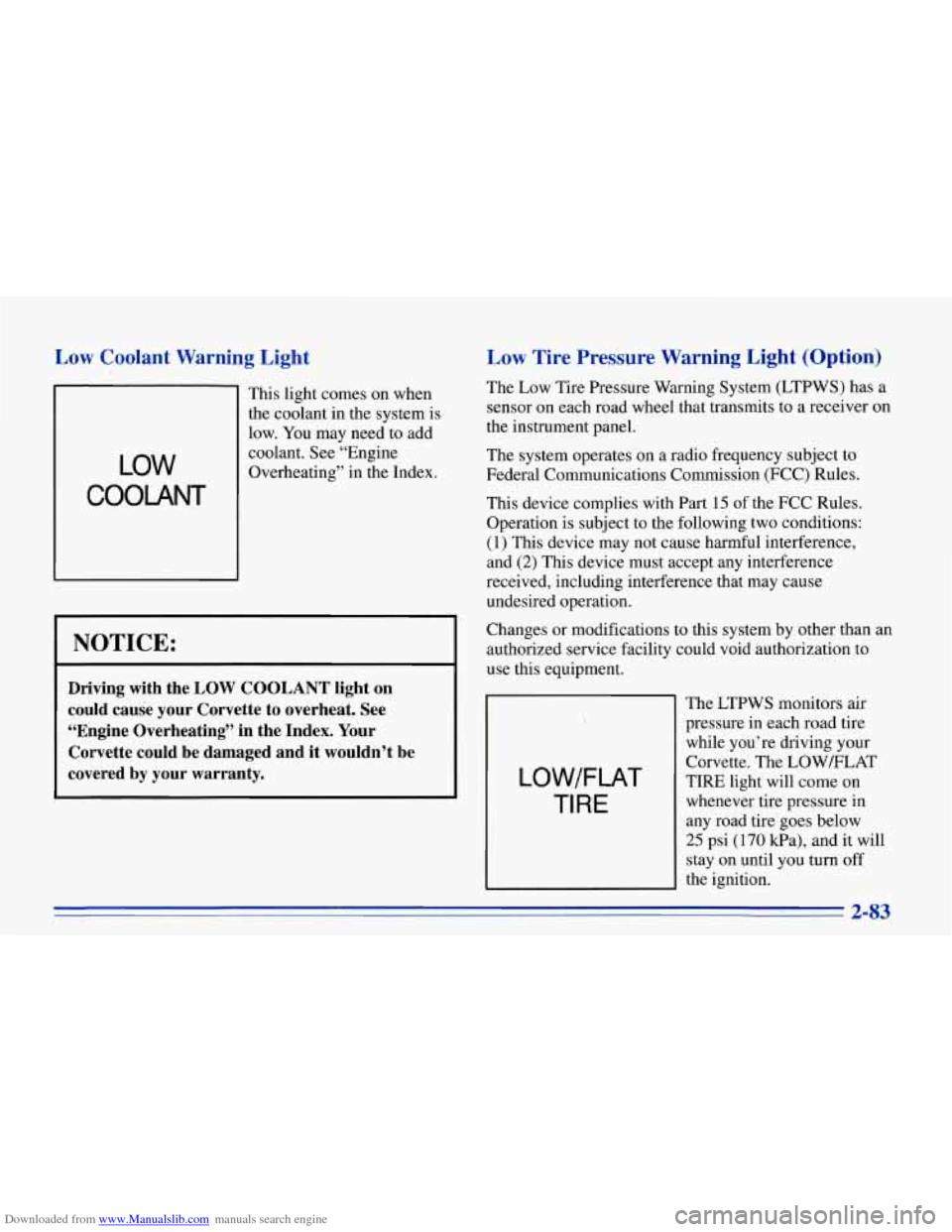
Downloaded from www.Manualslib.com manuals search engine Low Coolant Warning Light
LOW
COOLANT
This light comes on when
the coolant in the system is
~ low. You may need to add
~ coolant. See “Engine
~ Overheating” in the Index.
I NOTICE:
Driving with the LOW COOLANT light on
could cause your Corvette to overheat. See
“Engine Overheating” in the Index. Your
Corvette could be damaged and it wouldn’t be
covered by your warranty.
Low Tire Pressure Warning Light (Option)
The Low Tire Pressure Warning System (LTPWS) has a
sensor on each road wheel that transmits to a receiver on
the instrument panel.
The system operates
on a radio frequency subject to
Federal Communications Commission (FCC) Rules.
This device complies with Part
15 of the FCC Rules.
Operation is subject to the following two conditions:
(1) This device may not cause harmful interference,
and
(2) This device must accept any interference
received, including interference that may cause
undesired operation.
Changes or modifications to this system by other than an
authorized service facility could void authorization to
use this equipment.
LOW/FLAT
TI RE
The LTPWS monitors air
pressure in each road tire
while you’re driving your
Corvette. The LOWELAT
TIRE light will come on
whenever tire pressure in
any road tire goes below
25 psi (170 kPa), and it will
stay on until
you turn off
the ignition.
2-83
Page 127 of 386
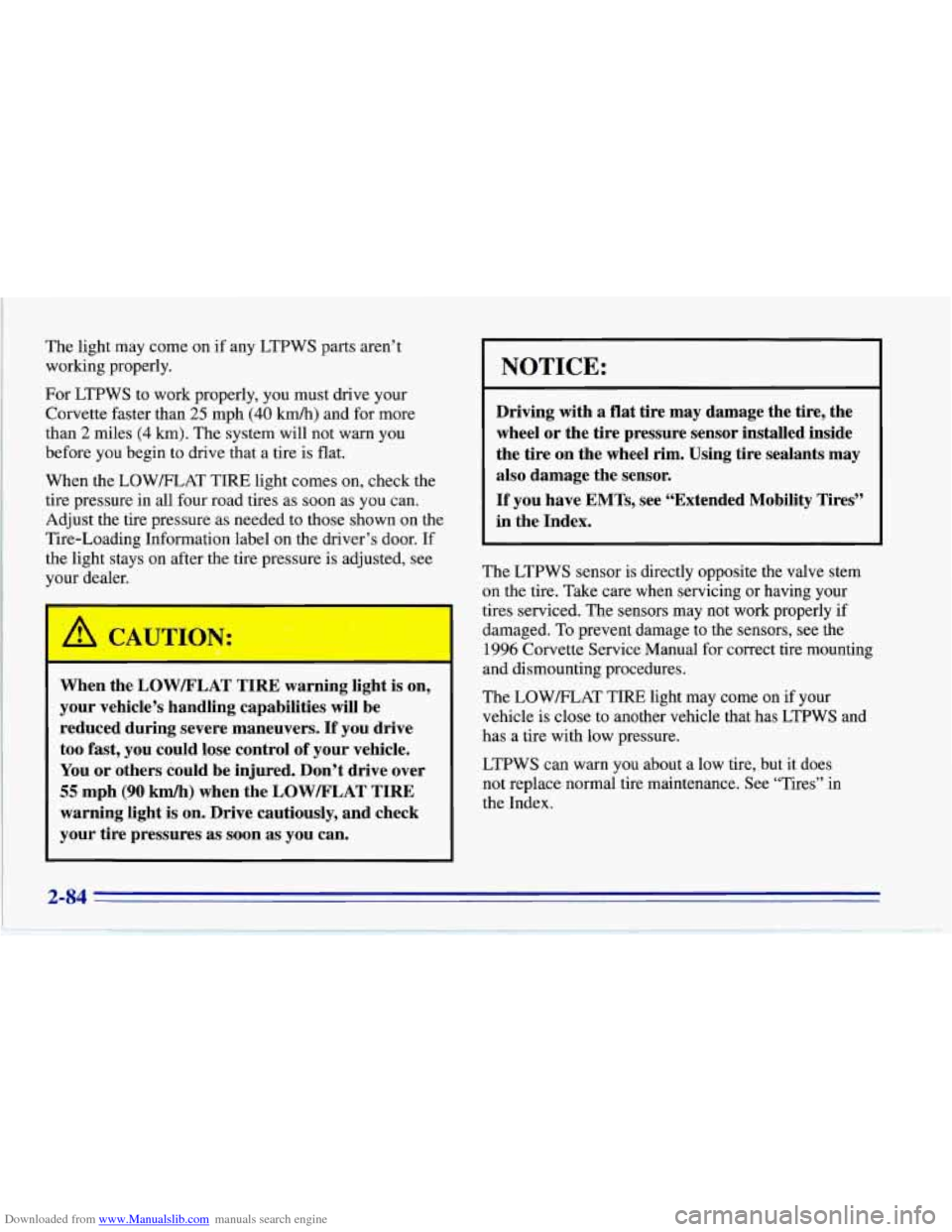
Downloaded from www.Manualslib.com manuals search engine The light may come on if any LTPWS parts aren’t
working properly.
For LTPWS to work properly, you must drive your
Corvette faster than
25 mph (40 km/h) and for more
than
2 miles (4 km). The system will not warn you
before you begin to drive that a tire
is flat.
When the LOWELAT TIRE light comes on, check the
tire pressure in all four road tires as soon
as you can.
Adjust the tire pressure as needed to those shown on the
Tire-Loading Information label on the driver’s door. If
the light stays on after the tire pressure is adjusted, see
your dealer.
I
When the LOWELAT TIRE warning light is on,
your vehicle’s handling capabilities will be
reduced during severe maneuvers.
If you drive
too fast, you could lose control of your vehicle.
You or others could be injured. Don”t drive over
55 mph (90 km/h) when the LOWWLAT TIRE
warning light is on. Drive cautiously, and check
your tire pressures as soon
as you can.
NOTICE:
Driving with a flat tire may damage the tire, the
wheel or the tire pressure sensor installed inside
the tire
on the wheel rim. Using tire sealants may
also damage the sensor.
If you have EMTs, see “Extended Mobility Tires”
in the Index.
The LTPWS sensor is directly opposite the valve stem
on the tire. Take care when servicing or having your
tires serviced. The sensors may not work properly
if
damaged. To prevent damage to the sensors, see the
1996 Corvette Service Manual for correct tire mounting
and dismounting procedures.
The LOW/FLAT TIRE light may come on if your
vehicle
is close to another vehicle that has LTPWS and
has a tire with low pressure.
LTPWS can warn you about a low tire, but it does
not replace normal tire maintenance. See “Tires” in
the Index.
Page 136 of 386
Downloaded from www.Manualslib.com manuals search engine Security Light Check Gauges Light
SECURITY
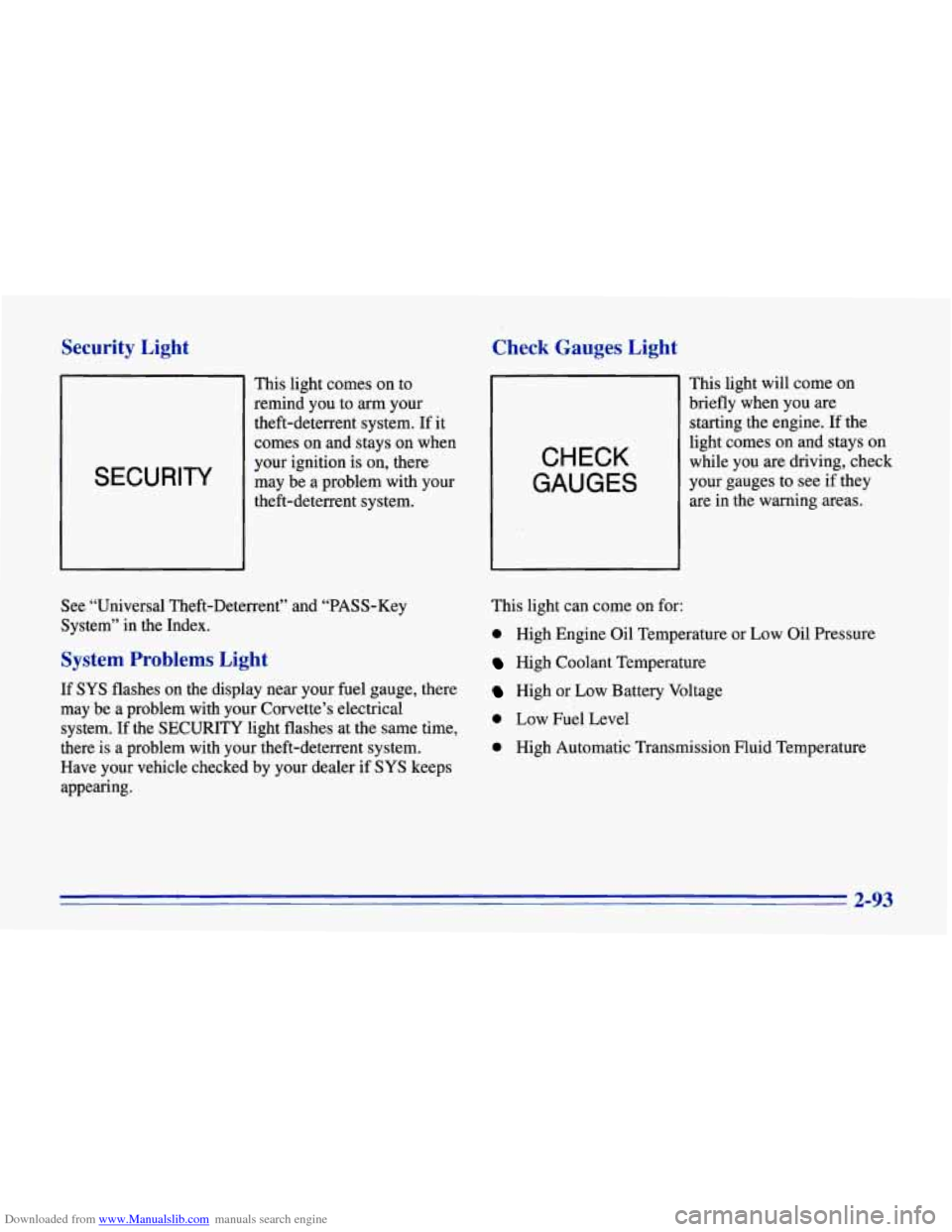
This light comes on to
remind you to
arm your
theft-deterrent system. If it
comes on and stays on when
your ignition is on, there
may be a problem with your
theft-deterrent system.
CHECK
GAUGES
This light will come on
briefly when you are
starting the engine.
If the
light comes on and stays on
while you are driving, check
your gauges to see if they
are in the warning areas.
See “Universal Theft-Deterrent” and “PASS-Key
System” in the Index.
System Problems Light
If SYS flashes on the display near your fuel gauge, there
may be a problem with your Corvette’s electrical
system. If the
SECURITY light flashes at the same time,
there is
a problem with your theft-deterrent system.
Have your vehicle checked by your dealer
if SYS keeps
appearing. This
light can come on for:
0 High Engine Oil Temperature or Low oil Pressure
High Coolant Temperature
High or Low Battery Voltage
0 Low Fuel Level
0 High Automatic Transmission Fluid Temperature
2-93