Fluid CHEVROLET CORVETTE 1996 4.G Owner's Manual
[x] Cancel search | Manufacturer: CHEVROLET, Model Year: 1996, Model line: CORVETTE, Model: CHEVROLET CORVETTE 1996 4.GPages: 386, PDF Size: 20.12 MB
Page 261 of 386
Downloaded from www.Manualslib.com manuals search engine How To Check Power Steering Fluid
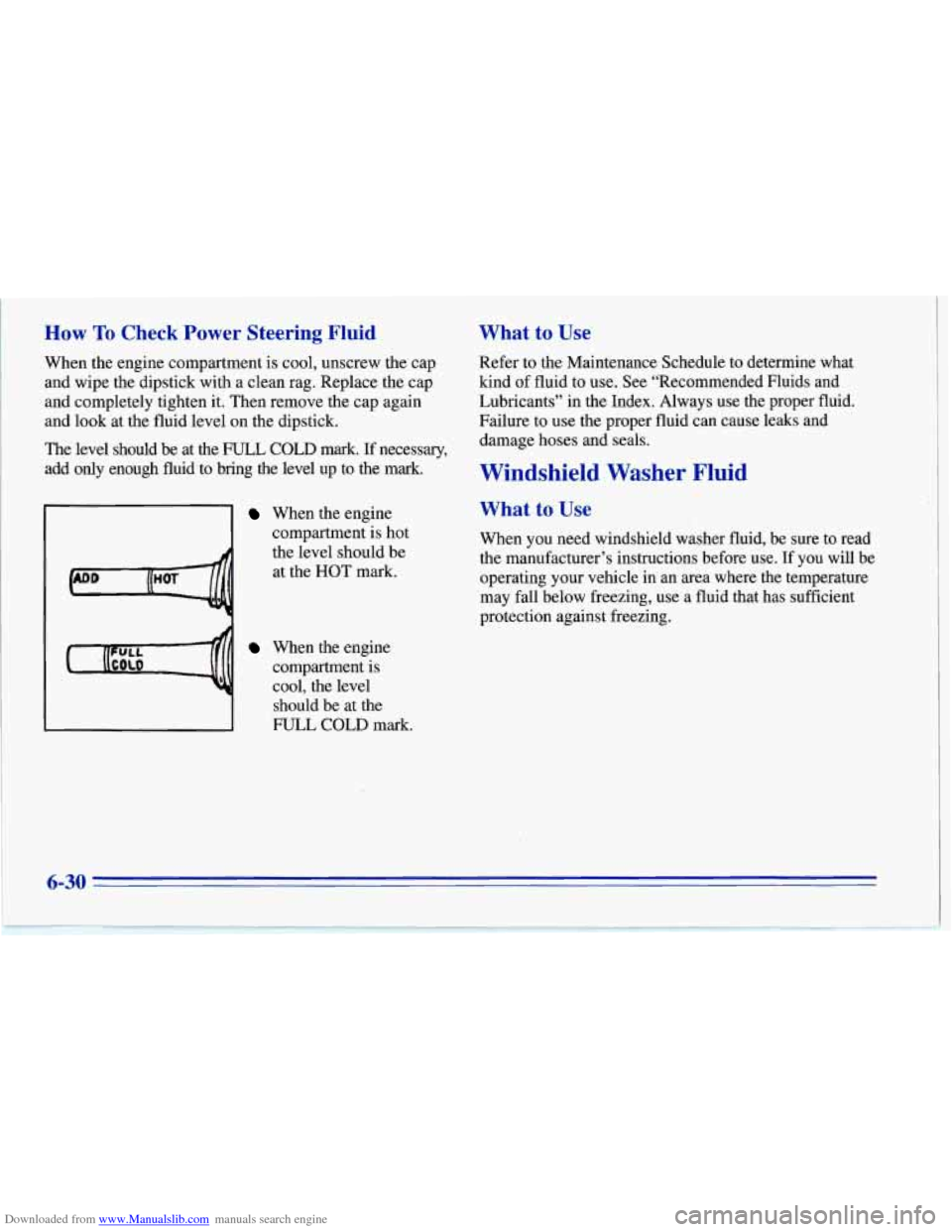
When the engine compartment is cool, unscrew the cap
and wipe the dipstick with a clean rag. Replace the cap
and completely tighten it. Then remove the cap again
and look at the fluid level on the dipstick.
The level should
be at the FULL COLD mark. If necessary,
add
only enough fluid to bring the level up to the mark.
When the engine
compartment is hot
the kvel should be
at the
HOT mark.
[rfl
When the engine
compartment is
cool, the level
should be at
the
FULL COLD mark.
What to Use
Refer to the Maintenance Schedule to determine what
kind of fluid to use. See “Recommended Fluids and
Lubricants” in the Index. Always use the proper fluid.
Failure to use the proper fluid can cause leaks and
damage hoses and seals.
Windshield Washer Fluid
What to Use
When you need windshield washer fluid,.be sure to read
the manufacturer’s instructions before use.
If you will be
operating your vehicle in an area where the temperature
may fall below freezing, use a fluid that has sufficient
protection against freezing.
Page 262 of 386
Downloaded from www.Manualslib.com manuals search engine Ai g Washer Fluid
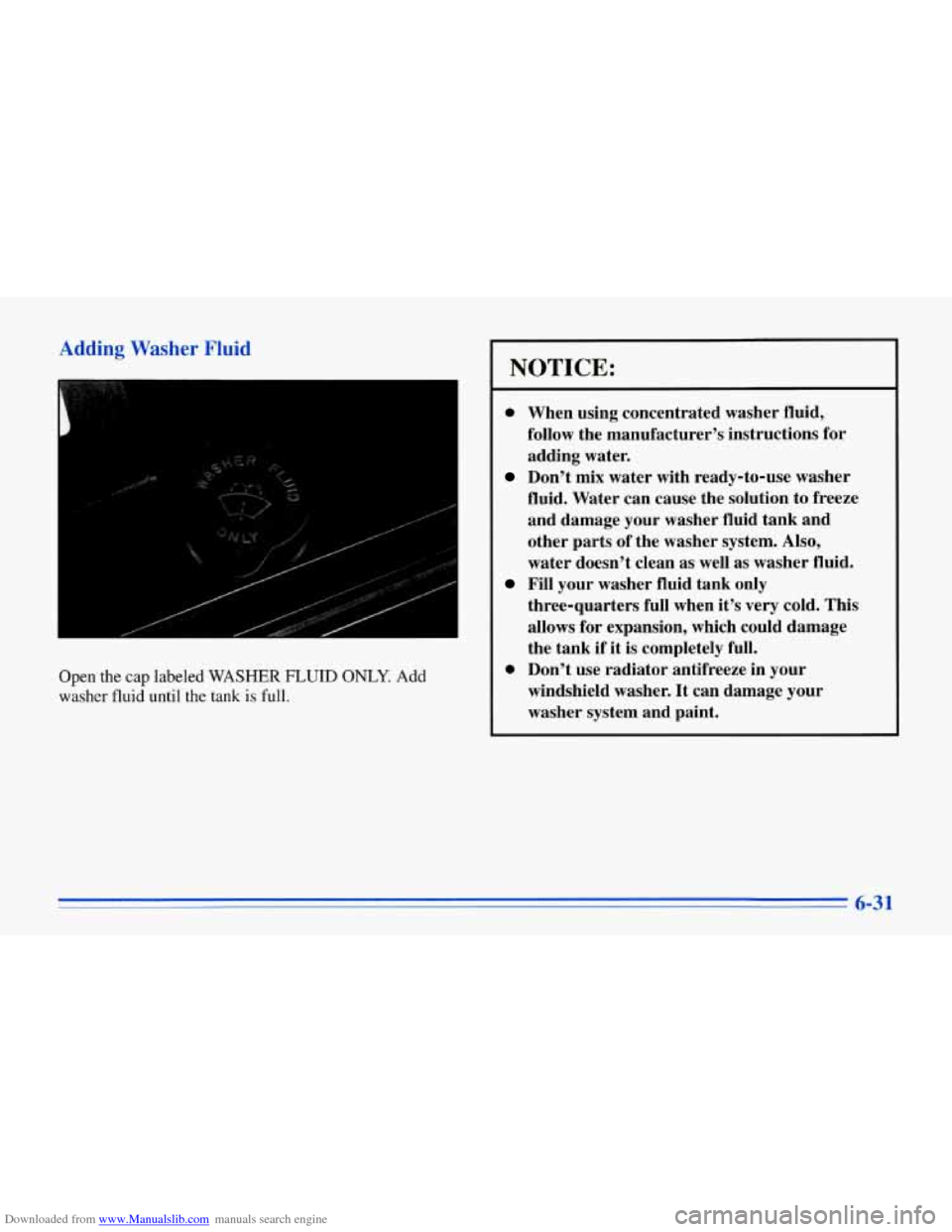
Open the cap labeled WASHER FLUID ONLY. Add
washer fluid until the tank is full.
L
NOTICE:
0 When using concentrated washer fluid,
follow the manufacturer’s instructions for
adding water.
Don’t mix water with ready-to-use washer
fluid. Water can cause the solution to freeze and damage your washer fluid tank and
other parts of the washer system. Also,
water doesn’t clean
as well as washer fluid.
three-quarters full when it’s
very cold. This
allows for expansion, which could damage
the tank if it is completely full.
windshield washer. It can damage your
washer system and paint.
Fill your washer fluid tank only
0 Don’t use radiator antifreeze in your
6-31
Page 263 of 386
Downloaded from www.Manualslib.com manuals search engine Brakes
Brake Fluid
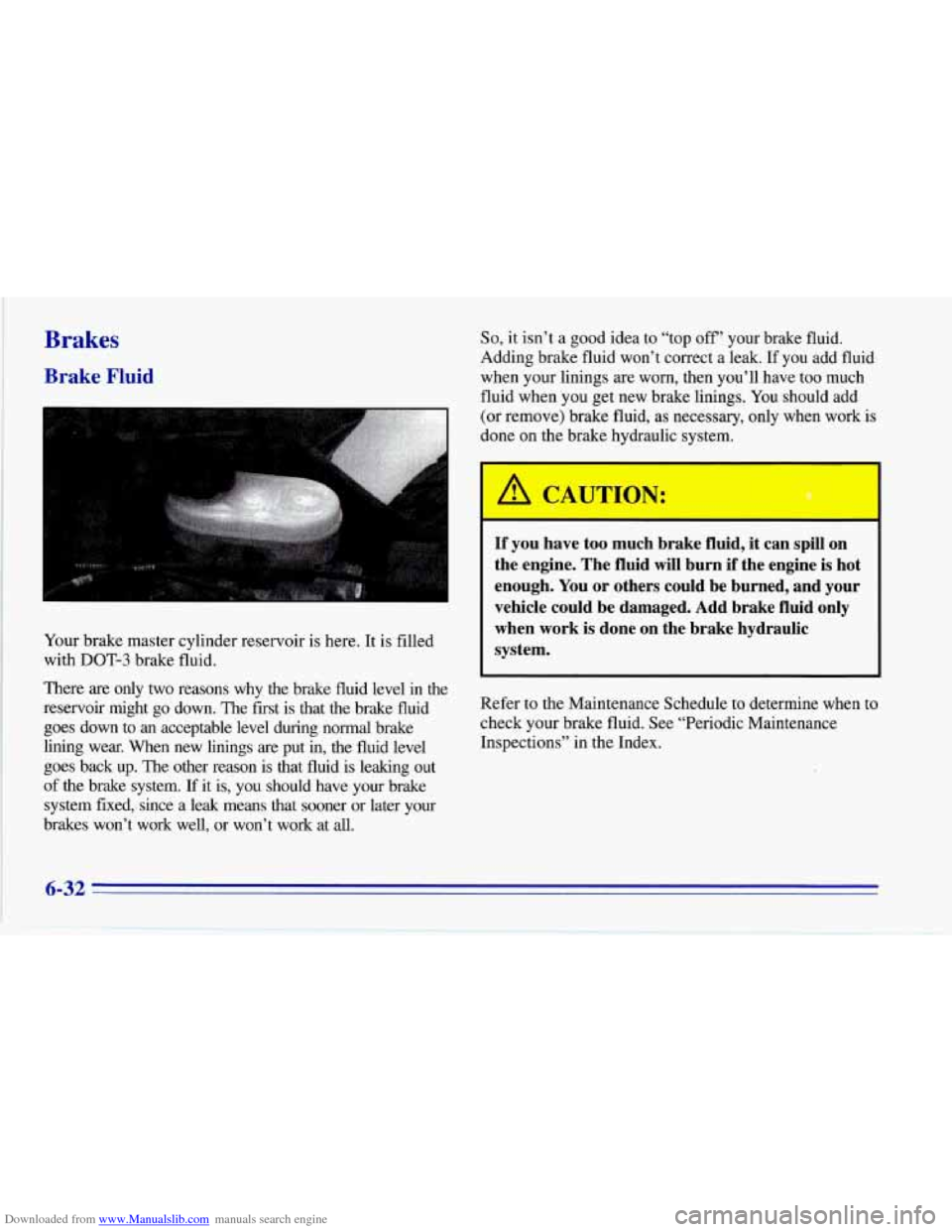
Your brake master cylinder reservoir is here. It is filled
with
DOT-3 brake fluid.
There
are only two reasons why the brake fluid level in the
reservoir might go down. The first is that the brake fluid
goes down to an acceptable level during
normal brake
lining wear. When new linings are put in, the fluid level
goes back up. The other reason is that fluid
is leaking out
of the brake system. If it is, you should have your brake
system fixed, since a leak means that sooner or later your
brakes won’t work well, or won’t work at
all.
So, it isn’t a good idea to “top off’ your brake fluid,
Adding brake fluid won’t correct a leak. If you add fluid
when your linings are worn, then you’ll have too much
fluid when you get new brake linings.
You should add
(or remove) brake fluid, as necessary, only when work
is
done on the brake hydraulic system.
--
A CAUTION: 3
-
If you have too much brake fluid, it can spill on
the engine. The fluid will burn if the engine is hot
enough.
You or others could be burned, and your
vehicle could be damaged. Add brake fluid only
when work
is done on the brake hydraulic
system.
Refer to the Maintenance Schedule to determine when to
check your brake fluid. See “Periodic Maintenance
Inspections” in the Index.
6-32
Page 264 of 386
Downloaded from www.Manualslib.com manuals search engine Checking Brake Fluid
You can check the brake fluid without taking off the cap.
Just look at the brake fluid reservoir. The fluid level
should be above the MIN mark on the reservoir. If it
isn’t, have your brake system checked to see if there
is a
leak.
After work is done
on the brake hydraulic system, make
sure the level is between the MIN and MAX marks.
What to Add
When you
do need brake fluid, use only DOT-3 brake
fluid
-- such as Delco Supreme 11 @ (GM Part
No. 1052535). Use new brake fluid from a sealed
container
only, and always clean the brake fluid
reservoir cap before removing it.
1
With the wrong kind of fluid in your brake
system, your brakes may not work well, or they
may not even work
at all. This could cause a
crash. Always use the proper brake fluid.
NOTICE:
0 Using the wrong fluid can badly damage
brake system parts. For example, just
a few
drops
of mineral-based oil, such as engine
oil, in your brake system can damage brake
system parts
so badly that they’ll have to be
replaced. Don’t let someone put in the
wrong kind of fluid.
If you spill brake fluid on your vehicle’s
painted surfaces, the paint finish can be
damaged. Be careful not to spill brake fluid
on your vehicle.
If you do, wash it off
immediately. See “Appearance Care” in the
Index.
6-33
Page 288 of 386
Downloaded from www.Manualslib.com manuals search engine Cleaning the Outside of the
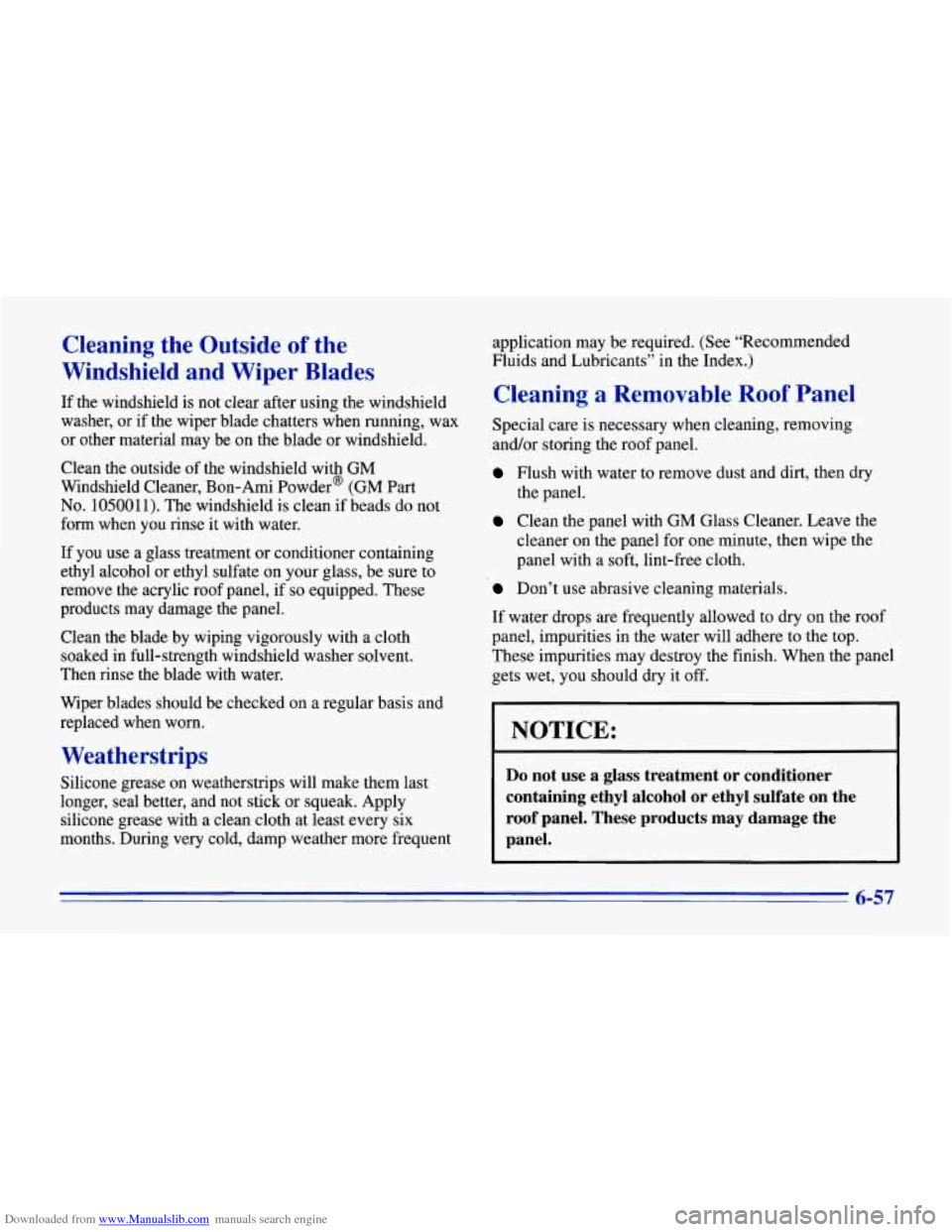
Windshield and Wiper Blades
If the windshield is not clear after using the windshield
washer, or if the wiper blade chatters when running, wax
or other material may be on the blade or windshield.
Clean the outside of the windshield with GM
Windshield Cleaner, Bon-Ami Powder@ (GM Part
No. 1050011). The windshield is clean if beads do not
form when you rinse
it with water.
If you use a glass treatment or conditioner containing
ethyl alcohol or ethyl sulfate on your glass, be sure to
remove the acrylic roof panel,
if so equipped. These
products may damage the panel.
Clean the blade by wiping vigorously with a cloth
soaked in full-strength windshield washer solvent.
Then rinse the blade with water.
Wiper blades should be checked on a regular basis and
replaced when worn.
Weatherstrips
Silicone grease on weatherstrips will make them last
longer, seal better, and not stick
or squeak. Apply
silicone grease with a clean cloth at least every six
months. During very cold, damp weather more frequent application
may be required. (See “Recommended
Fluids and Lubricants” in the Index.)
Cleaning a Removable Roof Panel
Special care is necessary when cleaning, removing
and/or storing the roof panel.
Flush with water to remove dust and dirt, then dry
the panel.
Clean the panel with GM Glass Cleaner. Leave the
cleaner on the panel for one minute, then wipe the
panel with a soft, lint-free cloth.
Don’t use abrasive cleaning materials.
If water drops are frequently allowed to dry on the roof
panel, impurities in the water will adhere
to the top.
These impurities may destroy the finish. When the panel
gets wet, you should dry it
off.
I NOTICE:
Do not use a glass treatment or conditioner
containing ethyl alcohol or ethyl sulfate on the
roof panel. These products may damage the
panel.
6-57
Page 307 of 386
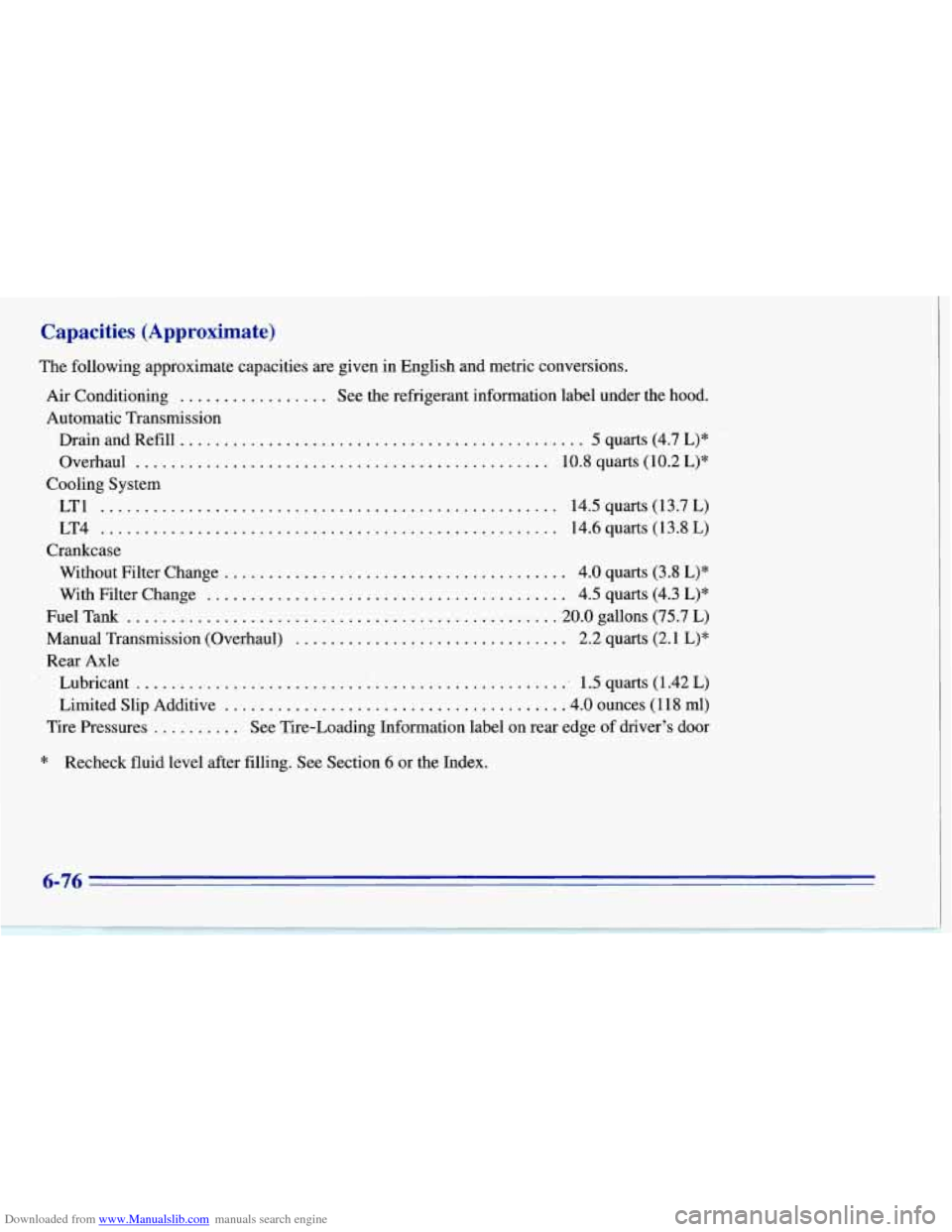
Downloaded from www.Manualslib.com manuals search engine Capacities (Approximate)
The following approximate capacities are given in English and metric conversions.
Air Conditioning ................. See the refrigerant information label under the hood.
Automatic Transmission
Drain and Refill
.............................................. 5 quarts (4.7 L)*
Overhaul
............................................. 10.8 quarts (10.2 L)*
LT1 ........... ................................... 14.5 quarts (13.7 L)
LT4
.................................................... 14.6quarts(13.8L)
Without Filter Change
....................................... 4.0 quarts (3.8 L)*
With Filter Change ......................................... 4.5 quarts (4.3 L)*
FuelTank ................................ ............. 20.0 gallons (75.7 L)
Manual Transmission (Overhaul)
............................. 2.2 quarts (2.1 L)*
Rear Axle
Lubricant
.................................................. 1.5 quarts (1.42 L)
Limited Slip Additive
...................................... .4.0 ounces (1 18 ml)
Tire Pressures
.......... See Tire-Loading Information label on rear edge of driver’s door
Cooling System
Crankcase
* Recheck fluid level after filling. See Section 6 or the Index.
6-76
Page 312 of 386
Downloaded from www.Manualslib.com manuals search engine e Section 7 Maintenance Schedule
I
IMPORTANT.
KEEP ENGINE OIL
AT THE PROPER
LEVEL AND CHANGE AS
RECOMMENDED
This section covers the maintenance required for your
Corvette. Your vehicle needs these services to retain its
safety, dependability and emission control performance.
I Protection
Plan
Have you purchased the GM Protection Plan? The Plan
supplements
your new vehicle warranties. See your
Warranty and Owner Assistance booklet, or your
Corvette dealer
for details.
Introduction
Your Vehicle and the Environment
Proper vehicle maintenance not only helps to keep your
vehicle in good working condition, but also helps the
environment. All recommended maintenance procedures
are important. Improper vehicle maintenance can even
affect the quality
of the air we breathe. Improper fluid
levels or the wrong tire inflation can increase the level
of emissions from your vehicle.
To help protect our
environment, and to keep your vehicle in good
condition, please maintain your vehicle properly.
7-1
Page 313 of 386
Downloaded from www.Manualslib.com manuals search engine How This Section is Organized
The remainder of this section is divided into five parts:
“Part A: Scheduled Maintenance Services” shows
what to have done and how often. Some of these
services can be complex,
so unless you are technically
qualified and have the necessary equipment, you should
let your dealer’s service department or another qualified
service center do these jobs.
Performing maintenance work on a vehicle can
be dangerous. In trying to do some jobs, you can
be seriously injured.
Do your own maintenance
work only
if you have the required know-how
and the proper tools and.equipment for the job.
If you have any doubt, have a qualified
technician do the work. “Part
B: Owner
Checks and Services’’ tells you what
should be checked whenever you stop for fuel. It also
explains what you can easily do to help keep your
vehicle in good condition.
“Part C: Periodic Maintenance Inspections”
explains important inspections that your Corvette
dealer’s service department or another qualified service
center should perform.
“Part D: Recommended Fluids and Lubricants”
lists some products GM recommends to help keep your
vehicle properly maintained. These products, or their
equivalents, should be used whether you do the work
yourself
or have it done.
“Part E: Maintenance Record’’ provides a place
for you to record the maintenance performed
on your
vehicle. Whenever any maintenance is performed, be
sure to write it down in this part.
This will help you
determine when your next maintenance should be done.
In addition, it is a good idea to keep your maintenance
receipts. They may be needed to qualify your vehicle for
warranty repairs.
If you are skilled enough to do some work on your
vehicle, you will probably want to get the service
information
GM publishes. See “Service and Owner
Publications” in the Index.
7-2
Page 314 of 386
Downloaded from www.Manualslib.com manuals search engine Part A: Scheduled Maintenance
Services
Using Your Maintenance Schedule
We at General Motors want to help you keep your
vehicle in good working condition. But we don’t know
exactly how you’ll drive it. You may drive
very short
distances only a few times a week. Or you may drive
long distances all the time in very hot, dusty weather.
You may use your vehicle in making deliveries. Or
you may drive it to work,
to do errands or in many
other ways.
Because of all the different ways people use their
GM
vehicles, maintenance needs vary. You may even need
more frequent checks and replacements than you’ll find
in the schedules in this section.
So please read this
section and note how you drive. If you have any
questions
on how to keep your vehicle in good
condition, see your Corvette dealer.
This part tells you the maintenance services you should
have done and when you should schedule them. If you
go to your dealer for your service needs, you’ll know
that GM-trained and supported service people will
perform the work using genuine
GM parts. The
proper fluids and lubricants to use are listed in
Part D. Make sure whoever services your vehicle
uses these. All parts should be replaced and all
necessary repairs done before you or anyone else
drives the vehicle.
These schedules are for vehicles that:
carry passengers and cargo within recommended
limits. You will find these limits on your vehicle’s
Tire-Loading Information label. See “Loading Your
Vehicle’’ in the Index.
are driven on reasonable road surfaces within legal
driving limits.
use the recommended fuel. See “Fuel” in the Index.
Selecting the Right Schedule
First you’ll need to decide which of the two schedules is
right for your vehicle. Here’s how to decide which
schedule to follow:
7-3
Page 320 of 386
Downloaded from www.Manualslib.com manuals search engine I Short Trip/City Maintenance Schedule I
15,000 Miles (25 000 km)
0 Change engine oil and filter (or every
3 months, whichever occurs first).
An Emission Control Service. *
0 Inspect air cleaner filter if you are driving
in dusty conditions. Replace filter if
necessary.
An Emission Control Service.
0 Change automatic transmission fluid and
filter if the vehicle is mainly driven under
one or more of these conditions:
- In heavy city traffic where the outside
temperature regularly reaches
90°F
(32°C) or higher.
- In hilly or mountainous terrain.
- Uses such as found in taxi, police or
If you do not use your vehicle under any of
these conditions, change the fluid and filter
at 100,000 miles (166 000 km).
delivery service.
Manual transmission fluid doesn’t require change.
DATE
SERVICED BY: ACTUAL MILEAGE
7-9