engine coolant CHEVROLET CORVETTE 1996 4.G Owner's Manual
[x] Cancel search | Manufacturer: CHEVROLET, Model Year: 1996, Model line: CORVETTE, Model: CHEVROLET CORVETTE 1996 4.GPages: 386, PDF Size: 20.12 MB
Page 239 of 386
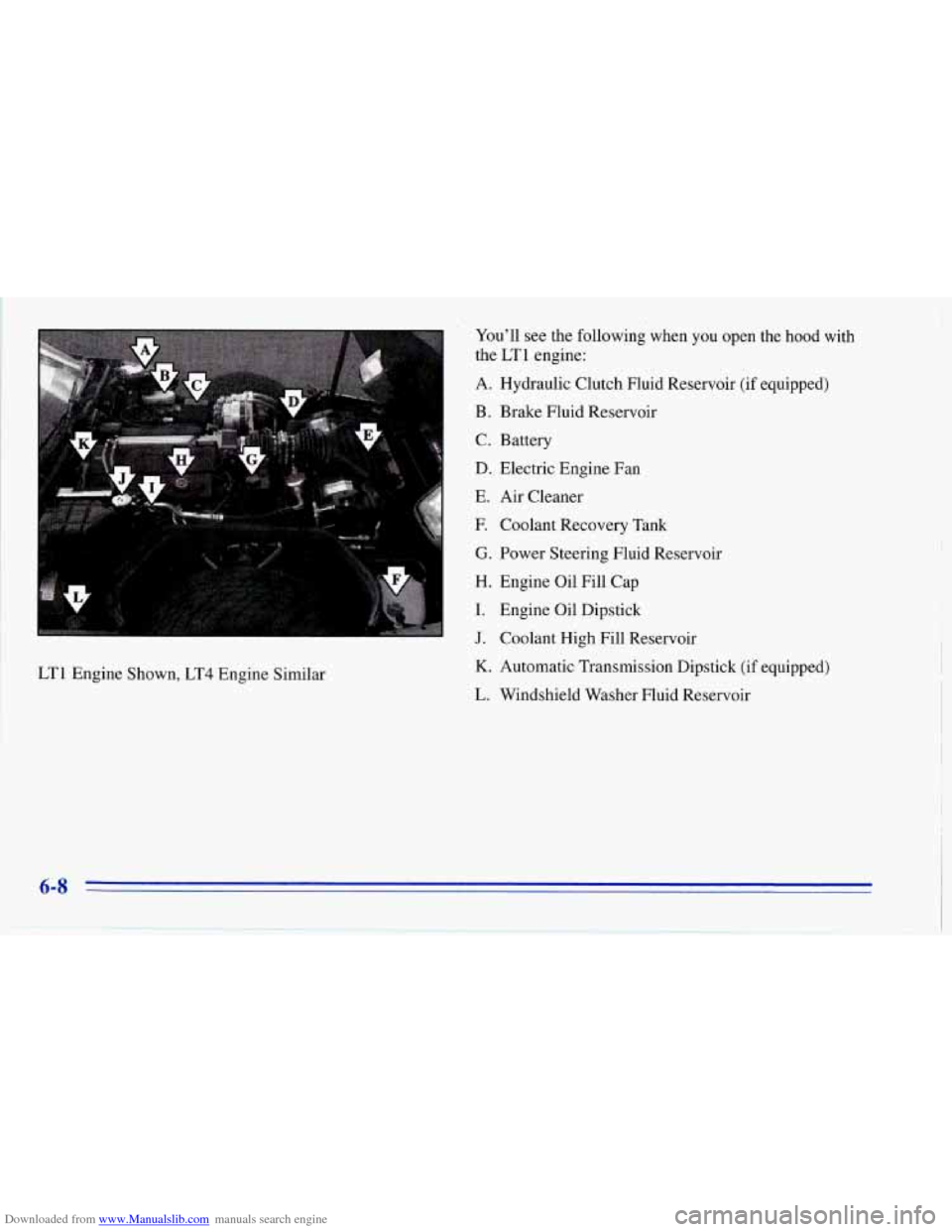
Downloaded from www.Manualslib.com manuals search engine LT1 Engine Shown, LT4 Engine Similar You’ll
see the following when you open the hood with
the
LT1 engine:
A. Hydraulic Clutch Fluid Reservoir
(if equipped)
B. Brake Fluid Reservoir
C. Battery
D. Electric Engine Fan
E. Air Cleaner
E Coolant Recovery Tank
G. Power Steering Fluid Reservoir
H. Engine Oil Fill Cap
I. Engine Oil Dipstick
J. Coolant High Fill Reservoir
K. Automatic Transmission Dipstick (if equipped)
L. Windshield Washer Fluid Reservoir
6-8
Page 240 of 386
Downloaded from www.Manualslib.com manuals search engine I
An electric fan under the hood can start up and
injure you even when the engine is not running.
Keep hands, clothing and tools away from any
underhood electric fan.
Things that burn can get on hot engine parts and
start a fire. These include liquids like gasoline,
oil, coolant, brake fluid, windshield washer and
other fluids, and plastic or rubber. You or others
could be burned. Be careful not to drop or spill
things that will burn onto
a hot engine.
Before closing the hood, be sure all the filler caps are
on.
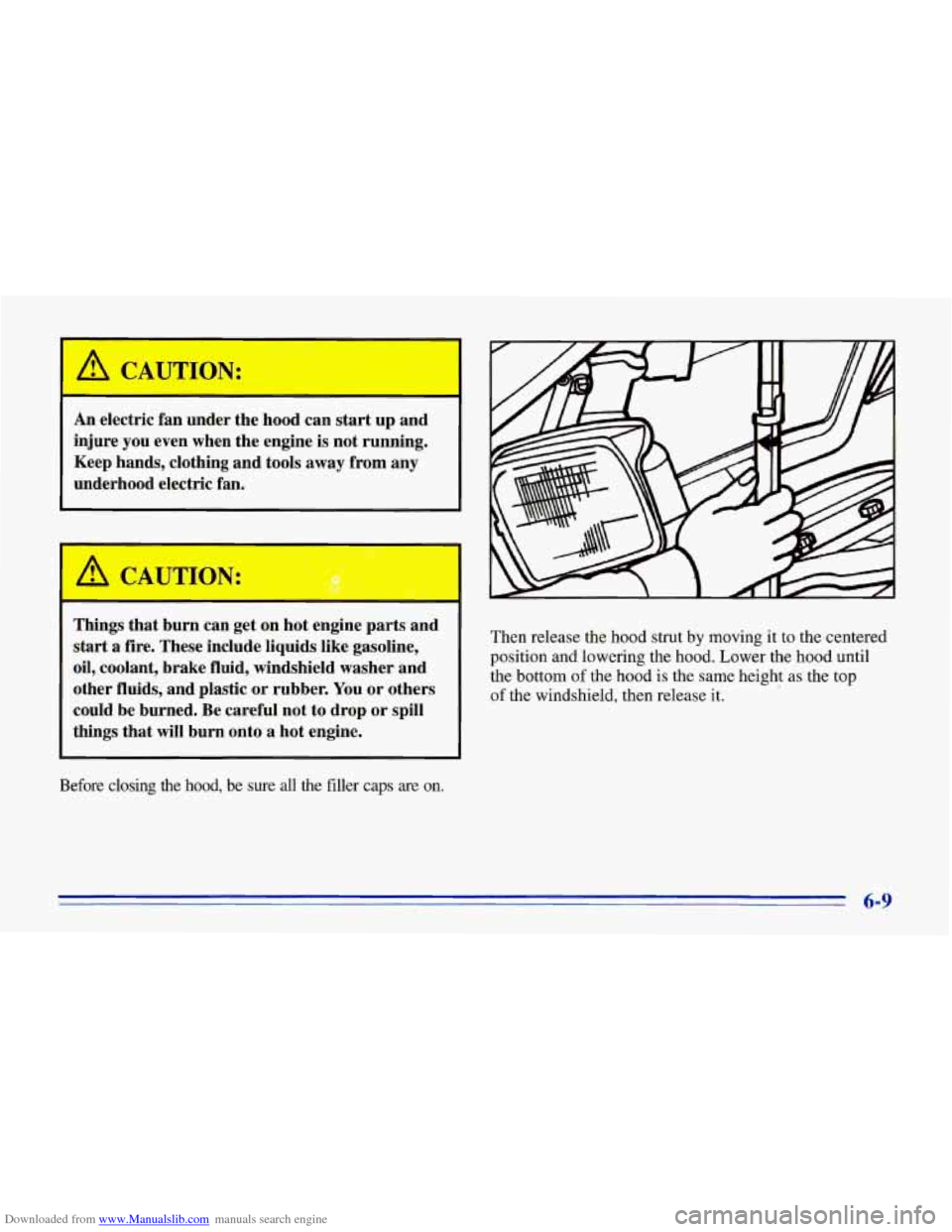
Then release the hood strut by moving it to the centered
position and lowering the hood. Lower the hood until
the bottom
of the hood is the same height as the top
of the windshield, then release it.
6-9
Page 241 of 386
Downloaded from www.Manualslib.com manuals search engine Engine Oil
It’s a good idea to check your engine oil level every time
you get fuel. In order to get an accurate reading, the oil
must be warm and the vehicle must be on level ground.
The engine oil dipstick is
next to the coolant high fill
reservoir. The dipstick
handle is a round, yellow
loop.
Turn
off the engine and give the oil a few minutes to
drain back into the oil pan. If you don’t, the oil dipstick
might not show the actual level.
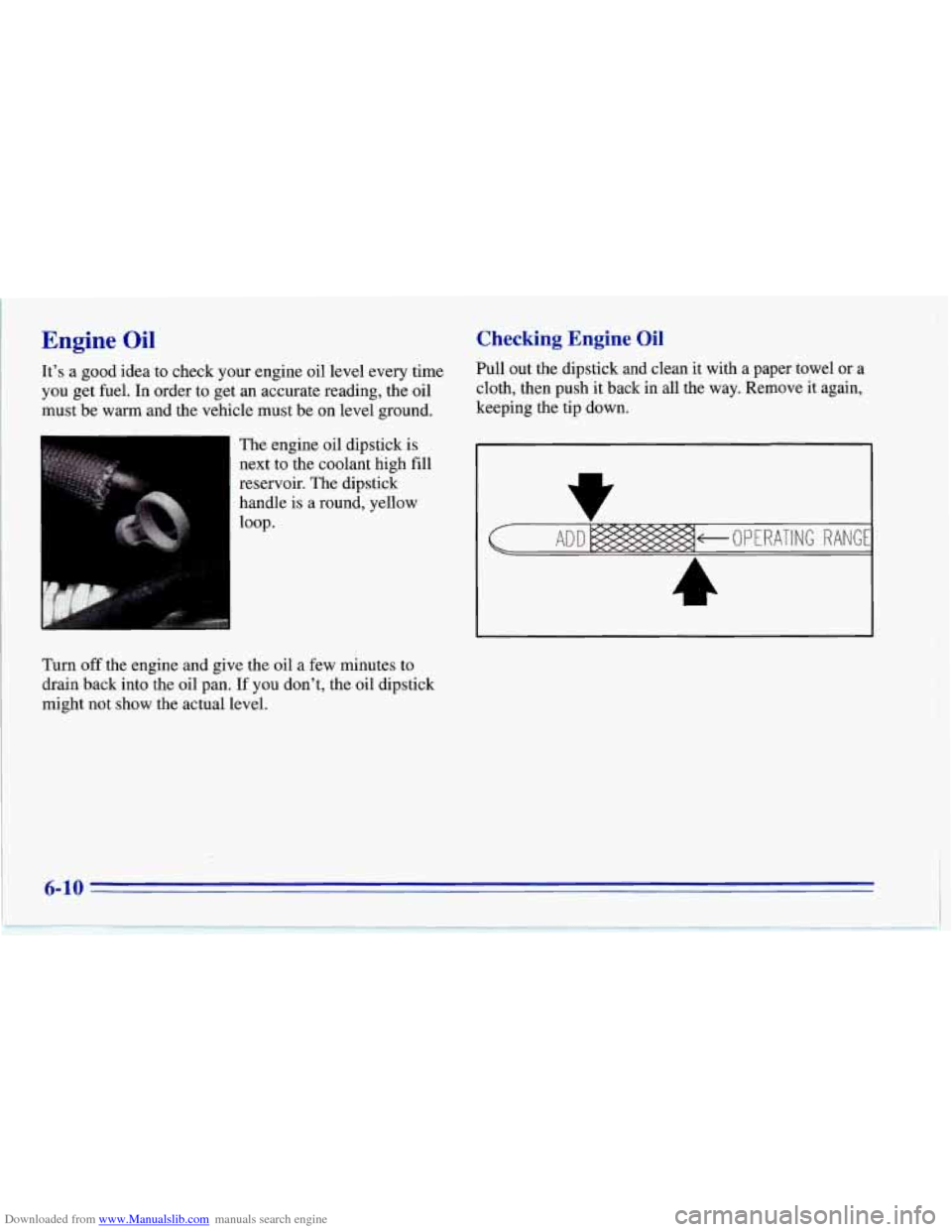
Checking Engine Oil
Pull out the dipstick and clean it with a paper towel or a
cloth, then push it back in all the way. Remove it again,
keeping the tip down.
6-10
Page 256 of 386
Downloaded from www.Manualslib.com manuals search engine What to Use
To add lubricant when the level is low, use Axle
Lubricant (GM
Part No. 12345977) or SAE SOW-90
GL-5 gear lubricant.
To completely refill after draining,
add 4 ounces
(1 18 ml) of Limited-Slip Differential
Lubricant Additive (GM Part
No. 1052358). Then fill to
the bottom
of the filler plug hole with Axle Lubricant
(GM
Part No. 12345977) or SAE SOW-90 GL-5 gear
lubricant.
Engine Coolant
The cooling system in your vehicle is filled with new
DEX-COOL (orange-colored, silicate-free) engine
coolant. This coolant is designed
to remain in your
vehicle for
5 years or 100,000 miles (166 000 km),
whichever occurs first.
The following explains your cooling system and how
to
add coolant when it is low. If you have a problem with
engine overheating or
if you need to add coolant to
your high fill reservoir, see “Engine Overheating”
in the Index.
A 50/50 mixture of water and the proper coolant for
your Corvette will:
0 Give freezing protection down to -34°F (-37°C).
0 Give boiling protection up to 265 OF ( 129 O C).
Protect against rust and corrosion.
Help keep the proper engine temperature.
0 Let the warning lights and gauges work as they should.
NOTICE:
When adding coolant it is important that you use
DEX-COOL (orange-colored, silicate-free)
coolant meeting GM Specification 6277M.
If
silicated coolant is added to the system,
premature engine, heater core or radiator
corrosion may result. In addition, the engine
coolant will require change sooner
-- at
30,000 miles (50 000 km) or 24 months,
whichever occurs first.
6-25
Page 257 of 386
Downloaded from www.Manualslib.com manuals search engine What to Use
Use a mixture of one-half clean water (preferably
distilled) and one-half
DEX-COOL TM (orange-colored,
silicate-free) antifreeze that meets GM Specification
6277M, which won’t damage aluminum parts. Use
GM Engine Coolant Supplement (sealer) (GM
Part
No. 3634621) with any complete coolant change. If you
use this mixture, you don’t need to add anything else.
Adding only plain water to your cooling system
can be dangerous. Plain
water, or some other
liquid like alcohol, can boil before the proper
coolant mix will. Your vehicle’s coolant warning
system is set for the proper coolant mix. With
plain water or the wrong mix, your engine could
get too hot but you wouldn’t get the overheat
warning. Your engine could catch fire and
you or
others could be burned. Use
a 50/50 mix of clean
water and
DEX-COOL TM (orange-colored.
silicate-free) antifreeze.
NOTICE:
If you use an improper coolant mix, your engine
could overheat and be badly damaged. The
repair cost wouldn’t be covered by your
warranty. Too much water in the
mix can freeze
and crack the engine, radiator, heater core and
other parts.
If you have to add coolant more than four times a year,
have your dealer check your cooling system.
NOTICE:
If you use the proper coolant, you don’t have to
add extra inhibitors or additives which claim to
improve the system. These can be harmful.
.
Page 258 of 386
Downloaded from www.Manualslib.com manuals search engine Checking Coolant
LOW
COOLANT
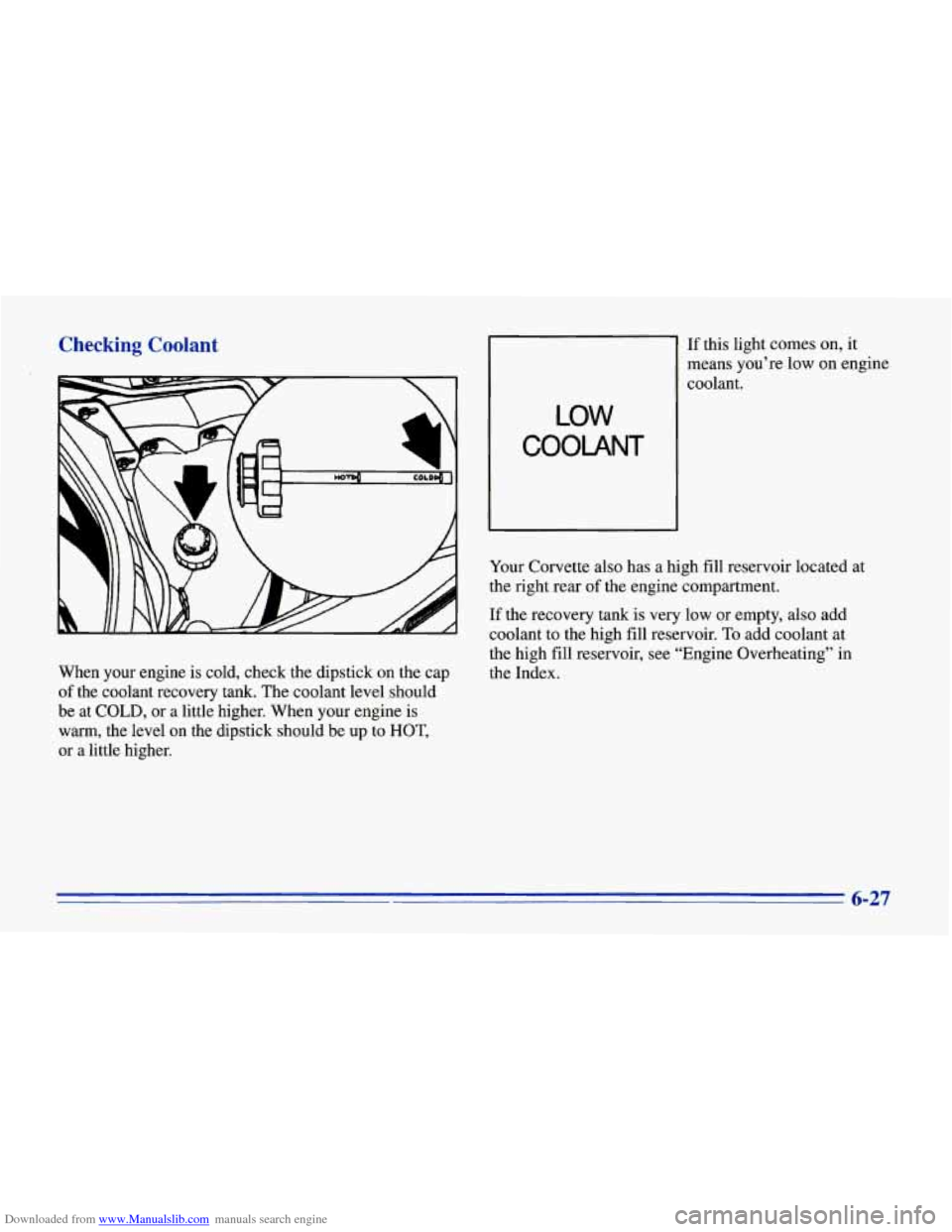
When your engine is cold, check the dipstick on the cap
of the coolant recovery tank. The coolant level should
be at COLD, or a little higher. When your engine is
warm, the level on the dipstick should be up to HOT,
or a little higher. If this
light comes on, it
means you’re
low on engine
coolant.
Your Corvette also has a high fill reservoir located at
the right rear
of the engine compartment.
If the recovery tank is very low or empty, also add
coolant to the high fill reservoir.
To add coolant at
the high fill reservoir, see “Engine Overheating” in
the Index.
6-27
Page 259 of 386
Downloaded from www.Manualslib.com manuals search engine Adding Coolant to the Recovery Tank
If you need more coolant, add the proper mix at the
coolant recovery tank, but only when your engine is
cool. If the tank is
very low or empty, also add coolant
to the coolant high fill reservoir. See “Engine
Overheating” in the Index for information.
.JTION:
r
Turning the coolant high fill reservoir pressure cap
when the engine and radiator are hot
can allow
steam and scalding liquids to blow out and burn
you badly. Never
turn the pressure cap -- even a
little
-- when the engine and radiator are hot.
Add coolant mix at the recovery tank, but be careful not
to spill it.
I
CAUTION:
You can be burned if you spill coolant on hot
engine
parts. Coolant contains ethylene glycol.
and
it will burn if the engine parts are hot
enough. Don’t spill coolant on a hot engine.
For complete drain, flush and refill of the engine,
contact your Chevrolet dealer or the procedure may be
found in a Chevrolet Corvette Service Manual.
To
purchase a service manual, see “Service and Owner
Publications” in the Index.
6-28
Page 260 of 386
Downloaded from www.Manualslib.com manuals search engine Coolant High Fill Reservoir Cap
NOTICE:
Your coolant high fill reservoir cap is a 15 psi
(105 kPa) pressure-type cap and must be tightly
installed to prevent coolant loss
and possible
engine damage from overheating. Be sure the
arrows on the cap line up with the overflow tube.
Thermostat
Engine coolant temperature is controlled by a thermostat
in the engine coolant system. The thermostat stops the
flow of coolant through the radiator until the coolant
reaches a pre-set temperature.
Power Steering Fluid
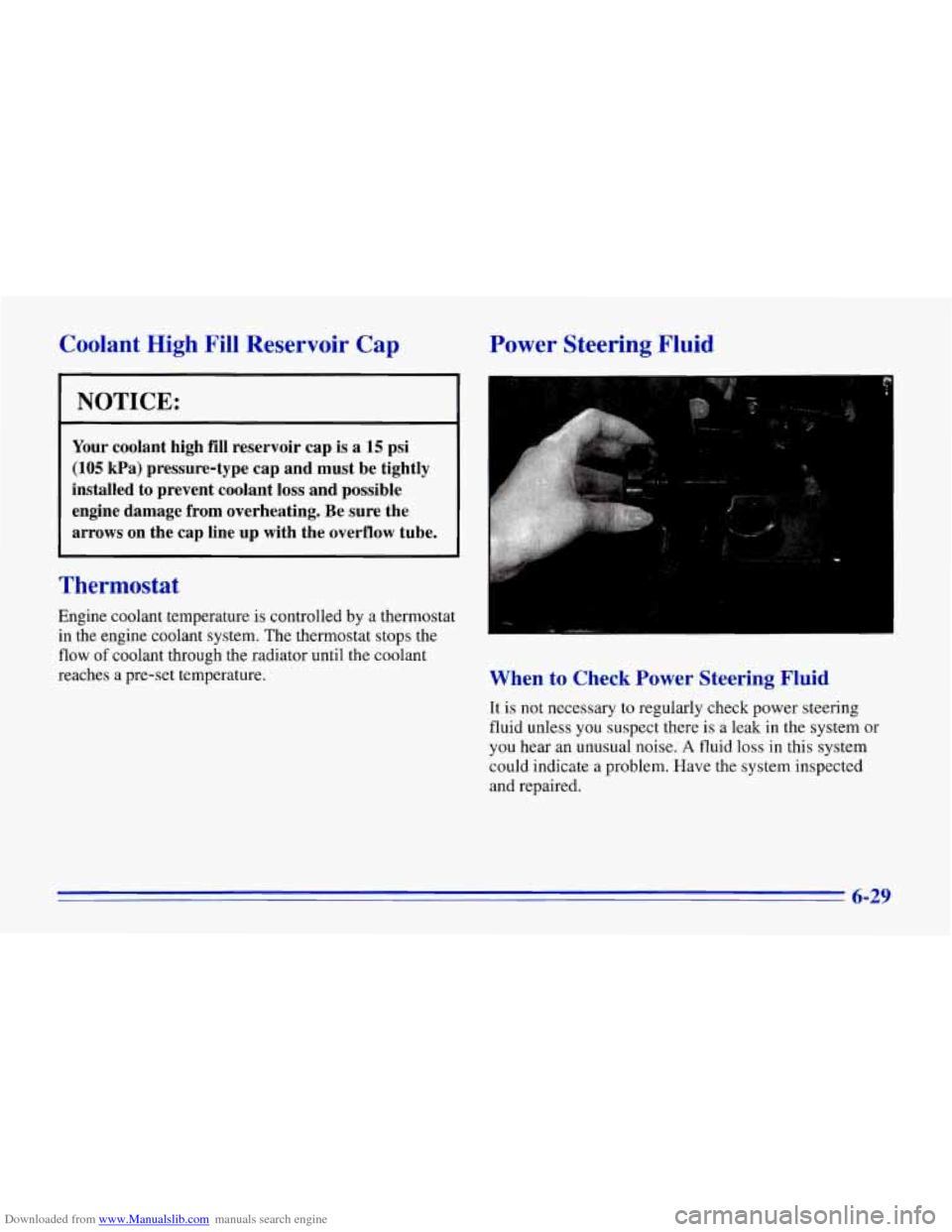
When to Check Power Steering Fluid
It is not necessary to regularly check power steering
fluid unless you suspect there is a leak in the system or
you hear an unusual noise.
A fluid loss in this system
could indicate a problem. Have the system inspected
and repaired.
6-29
Page 306 of 386
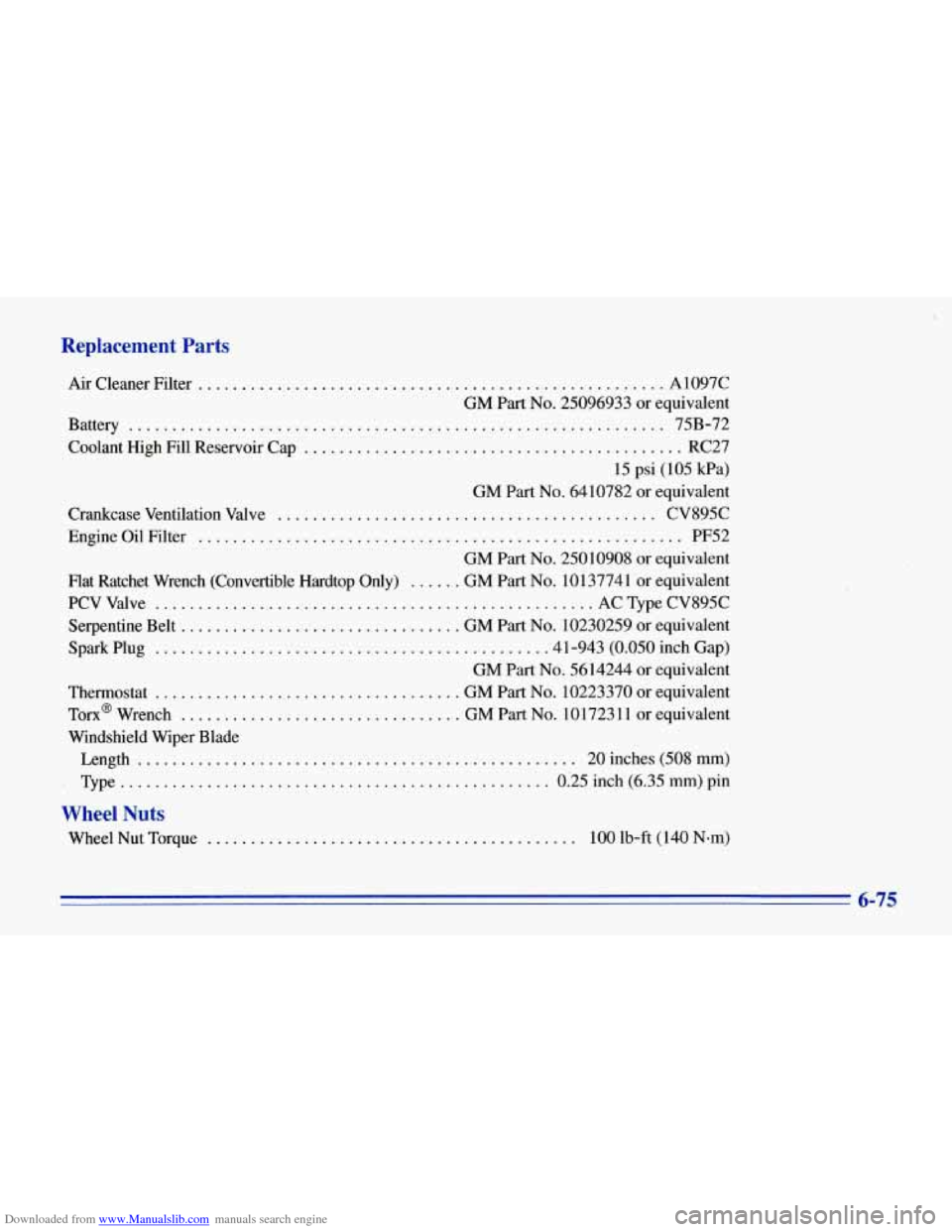
Downloaded from www.Manualslib.com manuals search engine Replacement Parts
Air Cleaner Filter ..................................................... A 1097C
GM Part
No. 25096933 or equivalent
Battery
.............................................................. 75B-72
Coolant High Fill Reservoir Cap
........................................... RC27
15 psi (105 kPa)
GM Part
No. 6410782 or equivalent
Crankcase Ventilation Valve
........................................... CV895C
Engine Oil Filter
....................................................... PF52
GM Part
No. 25010908 or equivalent
Flat Ratchet Wrench (Convertible Hardtop
Only) ...... GM Part No. 101 37741 or equivalent
PCV Valve
.................................................. AC Type CV895C
Serpentine Belt
................................ GM Part No. 10230259 or equivalent
Spark Plug
............................................ .4 1-943 (0.050 inch Gap)
GM Part
No. 5614244 or equivalent
Thermostat
................................... GM Part No. 10223370 or equivalent
Tom@ Wrench
................................ GM Part No. 1017231 1 or equivalent
Windshield Wiper Blade Length
...................... .......................... 20 inches (508 mm)
Type ................................................. 0.'25 inch (6.35 mm) pin
Wheel Nuts
Wheel Nut Torque .......... ......... ................... 100 lb-ft (140 N-m)
6-75
Page 349 of 386
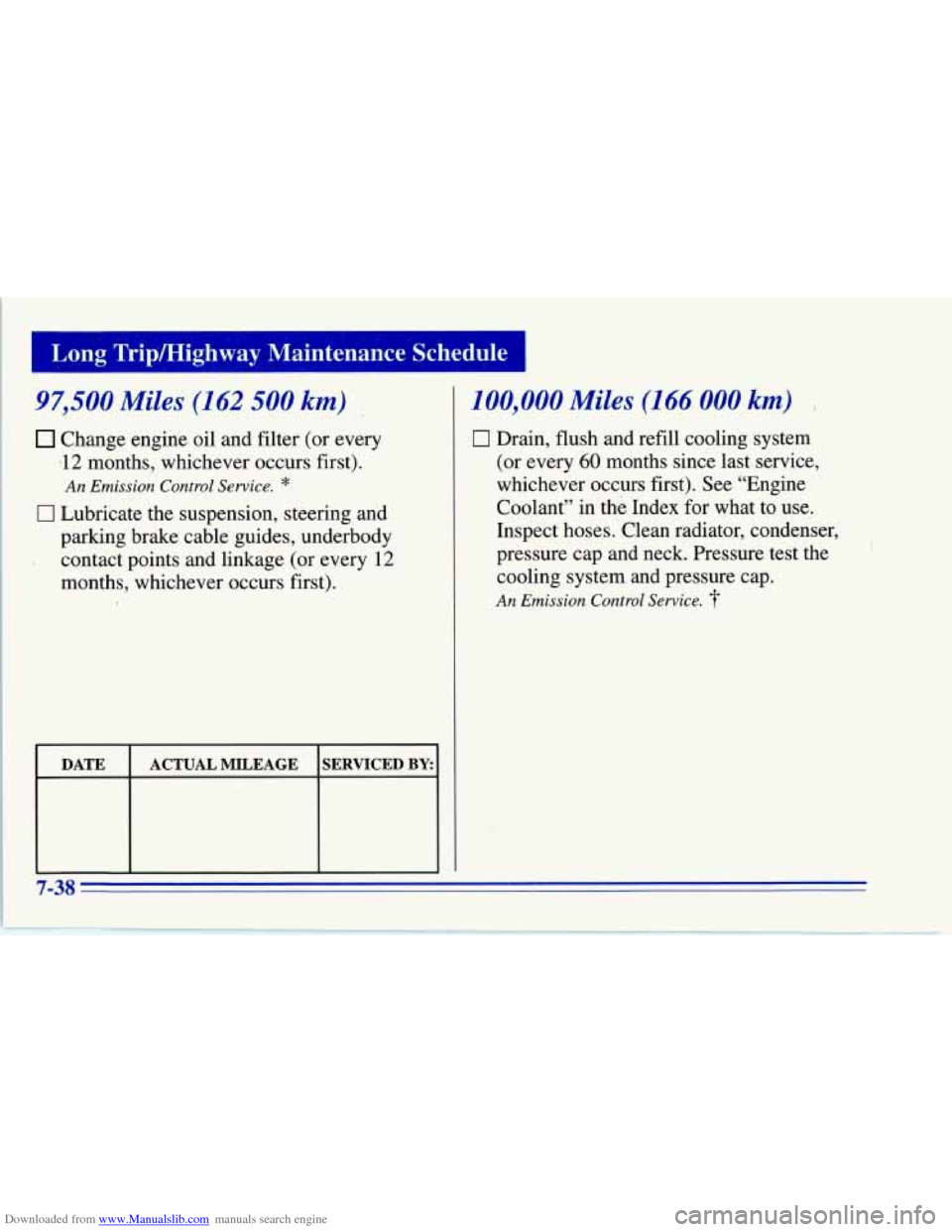
Downloaded from www.Manualslib.com manuals search engine Long Trip/Highway Maintenance Schedule
97,50~ Miles (~OL 300 km)
Change engine oil and filter (or every
I2 months, whichever occurs first).
An Emission Control Service. *
I7 Lubricate the suspension, steering and
parking brake cable guides, underbody
contact points and linkage (or every
12
months, whichever occurs first).
DATE ACTUAL MILEAGE SERVICED BY:
I
luu,OOO Miles (166 000 km)
0 Drain, flush and refill cooling system
(or every
60 months since last service,
whichever occurs first). See “Engine
Coolant’’ in the Index for what to use.
Inspect hoses. Clean radiator, condenser,
pressure cap and neck. Pressure test the
cooling system and pressure cap.
An Emission Control Service.