service CHEVROLET CORVETTE 1996 4.G Service Manual
[x] Cancel search | Manufacturer: CHEVROLET, Model Year: 1996, Model line: CORVETTE, Model: CHEVROLET CORVETTE 1996 4.GPages: 386, PDF Size: 20.12 MB
Page 234 of 386
Downloaded from www.Manualslib.com manuals search engine Fuel
If you have the 5.7L Code 5 engine, use premium
unleaded gasoline rated at
91 octane or higher.
If you have the 5.7L Code
P engine, use premium
unleaded gasoline rated at 91 octane or higher for best
performance. You may use middle grade
or regular
unleaded gasolines, but your vehicle may not accelerate
as well.
At a minimum, the gasoline you use should meet
specifications ASTM D4814 in the United States and
CGSB 3.5-M93
in Canada. Improved gasoline
specifications have been developed by the American
Automobile Manufacturers Association (AAMA) for
better vehicle performance and engine protection.
Gasolines meeting the AAMA specification could
provide improved driveability and emission control
system protection compared to other gasolines.
Be sure the posted octane for premium is at least 91
(at least 89 for middle grade and
87 for regular). If the
octane is less than 87, you may get a heavy knocking
noise when you drive. If it’s bad enough, it can damage
your engine.
If you’re using fuel rated at the recommended octane or
higher and you still hear heavy knocking, your engine
needs service. But don’t worry if you hear
a little
pinging noise when you’re accelerating or driving up a
hill. That’s normal, and you don’t have to buy a higher
octane fuel to get rid of pinging, It’s the heavy, constant
knock that means you have a problem.
If your vehicle
is certified to meet California Emission
Standards (indicated on the underhood tune-up label),
it
is designed to operate on fuels that meet California
specifications. If such fuels are not available in states
adopting California emissions standards, your vehicle
will operate satisfactorily on fuels meeting federal
specifications, but emission control system performance
may be affected. The malfunction indicator lamp on
your instrument panel may turn on and/or your vehicle
may fail a smog-check test. If this occurs, return to your
authorized Corvette dealer for diagnosis to determine
the cause of failure. In the event it is determined that the
cause of the condition is the type of fuels used, repairs
may not be covered by your warranty.
6-3
Page 235 of 386
Downloaded from www.Manualslib.com manuals search engine In Canada, some gasolines contain an octane enhancing
additive called MMT.
If you use such fuels, your
emission control system performance may deteriorate
and the malfunction indicator lamp on your instrument
panel may also turn on. If this happens, return to your
authorized Corvette dealer for service.
To pfovide cleaner air, all gasolines are now required to
contain additives that will help prevent deposits from
forming
in your engine and fuel system, ailowing your
emission control system to function properly. Therefore,
you should not have to add anything to the fuel.
In
addition, gasolines containing oxygenates, such as ethers
and ethanol, and reformulated gasolines may be
available in your area to help clean the air. General
Motors recommends that you use these gasolines
if they
comply with the specifications described earlier.
I NOTICE:
Your vehicle was not designed for fuel that
contains methanol. Don’t use it. It can corrode
metal parts in your fuel system and also damage plastic and rubber parts. That damage wouldn’t
be covered under your warranty.
Fuels in Foreign Countries
If you plan on driving in another country outside the
United States or Canada, the proper fuel may be hard to
find. Never use leaded gasoline or any other fuel not
recommended in
the previous text on fuel. Costly repairs
caused by use of improper fuel wouldn’t be covered by
your warranty.
To check on fuel availability, ask an auto club, or
contact a major oil company that does business in the
country where you’ll be driving.
You can also write us at the following address for
advice. Just tell us where you’re going and give your
Vehicle Identification Number
(VIN).
General Motors Overseas Distribution Corporation,
North American Export Sales (NAES)
1908 Colonel Sam Drive
Oshawa, Ontario
L1H 8P7
LA
Page 245 of 386
Downloaded from www.Manualslib.com manuals search engine . When to Change Engine Oil
If any one of these is true for you, use the short tripkity
maintenance schedule:
Most trips are less than 5 to 10 miles (8 to 16 km).
This is particularly important when outside
temperatures are below freezing.
Most trips include extensive idling (such as frequent
driving in stop-and-go traffic).
Most trips are through dusty areas.
Driving under these conditions causes engine oil to break
down sooner.
If any one of these is true for your vehicle,
you need to change your oil and filter every
3,000 miles
(5 OOO km) or 3 months -- whichever occurs first.
If none of them is true, use the long triphighway
maintenance schedule. Change the oil and filter every
7,500 miles (12 500 km) or 12 months -- whichever
occurs first. Driving a vehicle with a fully warmed
engine under highway conditions causes engine oil to
break down slower.
Your Corvette has an Oil Life Monitor. This featwe will
let you know when to change your
oil and filter -- usually
between
3,000 miles (5 O00 krn) and 7,500 miles
(12
500 km) since your last oil change. Under severe
conditions, the indicator may come on before
3,000 miles
(5 000 km). Never drive your vehicle more than
7,500 miles (12 500 km) or 12 months (whichever
occurs first) without
an oil change.
The system won’t detect dust in the oil.
So, if you
drive in a dusty area, be sure to change your oil every
3,000 miles
(5 000 km) or sooner if the CHANGE OIL
light comes on. Remember to reset the monitor when the
oil has been changed. For more information, see
“Engine Oil Life Monitor”
in the Index.
What to Do with Used Oil
Did you know that used engine oil contains certain
elements that may
be unhealthy for your skin and could
even cause cancer? Don’t let used oil stay on your
skin for
very long. Clean your skin and nails with soap and water,
or a good hand cleaner. Wash or throw away clothing or
rags containing used engine
oil. (See the manufacturer’s
warnings about the use and disposal of oil products.)
Used oil can be a real threat to the environment. If you
change your own oil, be sure to
drain all free-flowing oil
from the filter before disposal. Don’t ever dispose of oil by
putting it in the trash, pouring it on the ground, into
sewers, or into
streams or bodies of water. Instead, recycle
it by taking it to a place that collects used oil.
If you have
a problem properly disposing of your used oil, ask your dealer, a service station or a local recycling center for help\
.
6-14
Page 246 of 386
Downloaded from www.Manualslib.com manuals search engine Air Cleaner
.. n
I
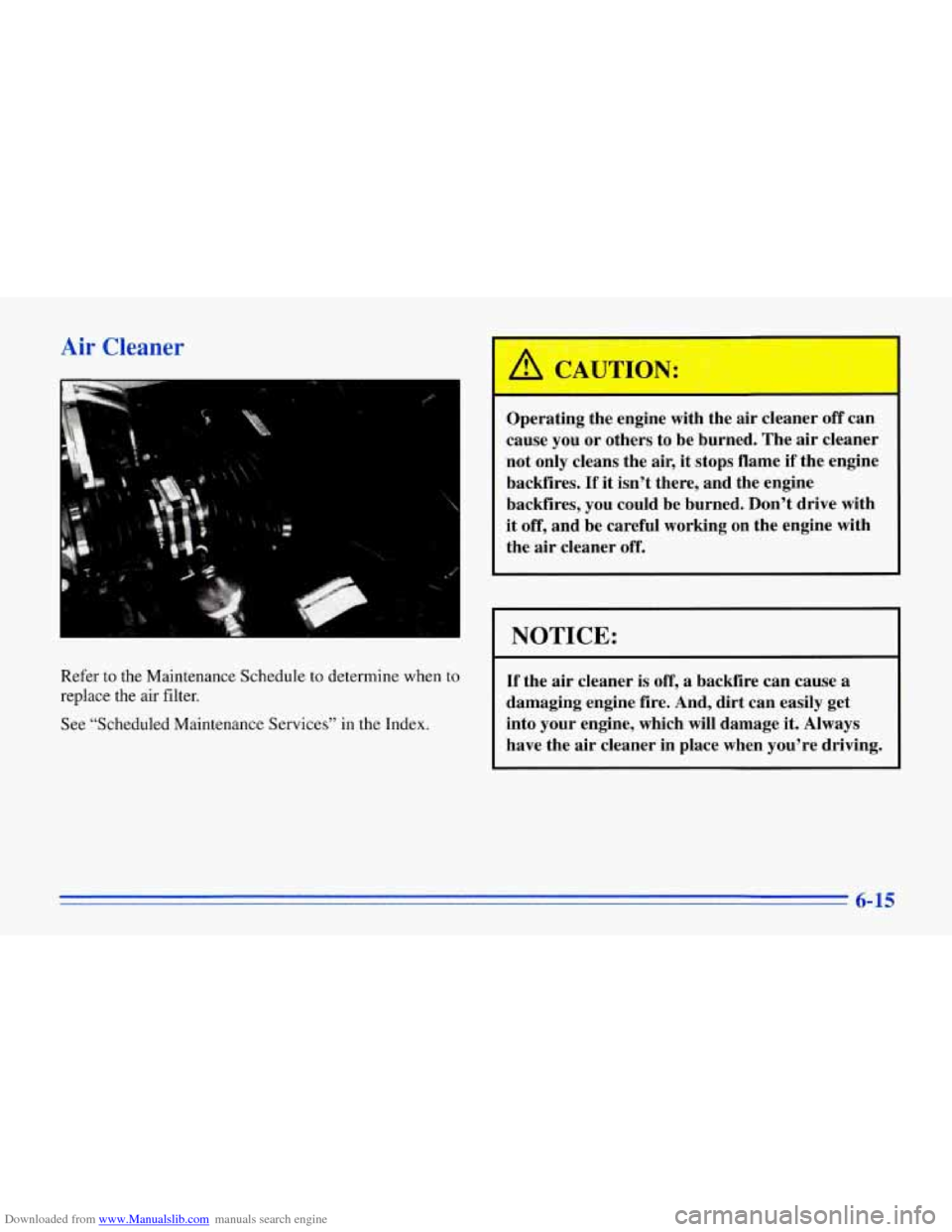
Refer to the Maintenance Schedule to determine when to
replace the air filter.
See "Scheduled Maintenance Services" in the Index.
A CAUTION:
Operating the engine with the air cleaner off can
cause you
or others to be burned. The air cleaner
not only cleans the air, it stops flame if the engine
backfires.
If it isn't there, and the engine
backfires, you could be burned. Don't drive with
it off, and be careful working on the engine with
the air cleaner
off.
NOTICE:
If the air cleaner is off, a backfire can cause a
damaging engine fire. And, dirt can easily get
into your engine, which will damage it. Always
have the air cleaner in place when you're driving.
6-15
Page 249 of 386
Downloaded from www.Manualslib.com manuals search engine Automatic Transmission Fluid
When to Check and Change
A good time to check your automatic transmission fluid
level is when the engine oil is changed.
Change both the fluid and filter every
15,000 miles
(25 000 km) if the vehicle is mainly driven under one or
more of these conditions:
In heavy city traffic where the outside temperature
In hilly or mountainous terrain.
Uses such as found in taxi, police or delivery service.
If you do not use your vehicle under any of these
conditions, change the fluid and filter at
100,000 miles
(166 000 km).
See “Scheduled Maintenance Services” in the Index.
How to Check
Because this operation can be a little difficult, you
may choose to have this done at your Corvette
dealership Service Department.
regularly
reaches 90
OF (32 O C) or higher.
If you do it yourself, be sure to follow all the instructions
here, or you could get
a false reading on the dipstick.
I NOTICE:
Too much or too little fluid can damage your
transmission.
Too much can mean that some of
the fluid could come out and fall on hot engine
parts or exhaust system parts, starting a fire. Be
sure to get an accurate reading if you check your
transmission fluid.
Wait at least 30 minutes before checking the
transmission fluid level if you have been driving:
0 When outside temperatures are above 90°F (32°C).
0 At high speed for quite a while.
In heavy traffic -- especially in hot weather.
To get the right reading, the fluid should be at normal
operating temperature, which is
180°F to 200°F
(82°C to 93°C).
Page 252 of 386
Downloaded from www.Manualslib.com manuals search engine How to Add Fluid
Refer to the Maintenance Schedule to determine what
kind of transmission fluid to use. See “Recommended
Fluids and Lubricants” in the Index.
Add fluid only after checking the transmission fluid
HOT.
(A COLD check is used only as a reference.) If
the fluid level is low, add only enough of the proper
fluid to bring the level up to the
HOT area for a hot
check. It doesn’t take much fluid, generally less than a
pint
(0.5 L). Don’t overfill. We recommend you use only
fluid labeled DEXRON@-111, because fluid with that
label is made especially for your automatic transmission.
Damage caused by fluid other than DEXRON-I11 is not
covered by your new vehicle warranty.
0 After adding fluid, recheck the fluid level as
described under “How to Check.”
When the correct fluid level is obtained, push the
dipstick back in all the way.
Manual Transmission Fluid
When to Check
A good time to have it checked is when the engine oil is
changed. However, the fluid in your manual
transmission doesn’t require changing.
How to Check
Because this operation can be difficult, you may
choose to have
this done at your Corvette dealership
Service Department.
If you do it yourself, be sure to follow all the
instructions here, or you could get a false reading.
NOTICE:
Too much or too little fluid can damage your
transmission.
Too much can mean that some of
the fluid could come out and fall on hot engine
parts or exhaust system parts, starting a fire. Be
sure to get an accurate reading
if you check your
transmission fluid.
Check the fluid level only when your engine is off, the
vehicle is parked on a level place and the transmission
is
cool enough for you to rest your fingers on the
transmission case.
6-21
Page 254 of 386
Downloaded from www.Manualslib.com manuals search engine When to Check and What to Use How To Check and Add Fluid
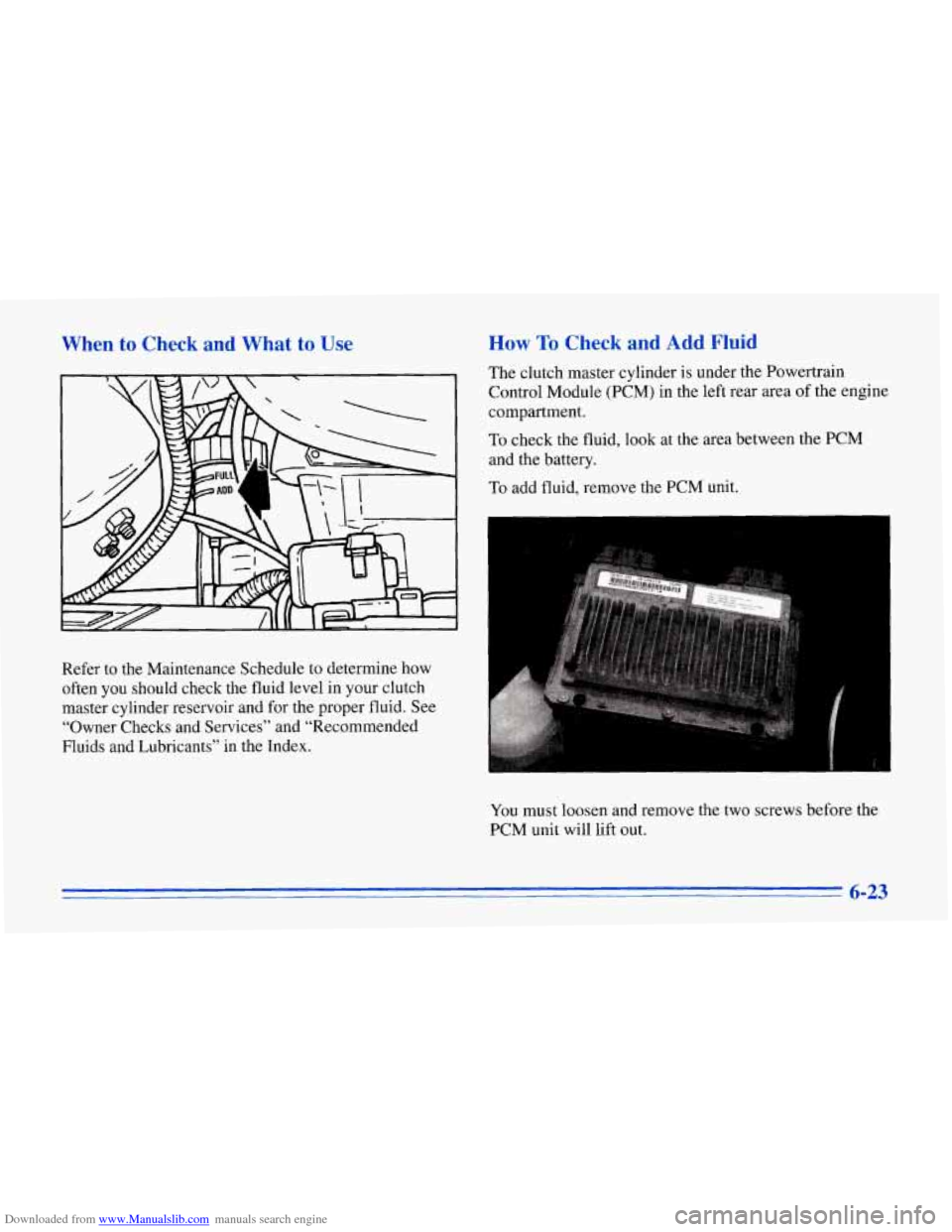
The clutch master cylinder is under the Powertrain
Control Module (PCM) in the left rear area of the engine
compartment.
To check the fluid, look at the area between the PCM
and the battery.
To add fluid, remove the PCM unit.
I
1
Refer to the Maintenance Schedule to determine how
often you should check the fluid level in your clutch
master cylinder reservoir and for the proper fluid. See
“Owner Checks and Services” and “Recommended
Fluids and Lubricants” in the Index.
You must loosen and remove the two screws before the
PCM unit will lift out.
6-23
Page 259 of 386
Downloaded from www.Manualslib.com manuals search engine Adding Coolant to the Recovery Tank
If you need more coolant, add the proper mix at the
coolant recovery tank, but only when your engine is
cool. If the tank is
very low or empty, also add coolant
to the coolant high fill reservoir. See “Engine
Overheating” in the Index for information.
.JTION:
r
Turning the coolant high fill reservoir pressure cap
when the engine and radiator are hot
can allow
steam and scalding liquids to blow out and burn
you badly. Never
turn the pressure cap -- even a
little
-- when the engine and radiator are hot.
Add coolant mix at the recovery tank, but be careful not
to spill it.
I
CAUTION:
You can be burned if you spill coolant on hot
engine
parts. Coolant contains ethylene glycol.
and
it will burn if the engine parts are hot
enough. Don’t spill coolant on a hot engine.
For complete drain, flush and refill of the engine,
contact your Chevrolet dealer or the procedure may be
found in a Chevrolet Corvette Service Manual.
To
purchase a service manual, see “Service and Owner
Publications” in the Index.
6-28
Page 265 of 386
Downloaded from www.Manualslib.com manuals search engine Brake Wear
Your Corvette has four-wheel disc brakes.
Disc brake pads have built-in wear indicators that make
a high-pitched warning sound when the brake pads
are
worn and new pads are needed. The sound may come
and go or be heard all the time your vehicle is moving
(except when you
are pushing on the brake pedal
firmly).
I A CAUTION:
The brake wear warning sound means that
sooner or later your brakes won’t work well.
That could lead to an accident. When you hear
-.he brake wear warning sound, have your vehicle
I serviced*
NOTICE:
Continuing to drive with worn-out brake pads
could result in costly brake repair.
Some driving conditions or climates may cause a brake
squeal when the brakes are first applied or lightly
applied. This does not mean something is wrong with
your brakes.
Brake linings should always be replaced as complete
axle sets.
Brake Pedal Travel
See your dealer if the brake pedal does not return to
normal height, or
if there is a rapid increase in pedal
travel. This could be a sign of brake trouble.
Brake Adjustment
As you make brake stops, your disc brakes
automatically adjust for wear.
6-34
Page 266 of 386
Downloaded from www.Manualslib.com manuals search engine Replacing Brake System Parts
The braking system on a modern vehicle is complex.
Its many parts have to be of top quality and work well
together if the vehicle is to have really good braking.
Vehicles we design and test have top-quality GM brake
parts in them, as your Corvette does when it
is new.
When you replace parts of your braking system
-- for
example, when your brake linings wear down and you
have to have new ones put in
-- be sure you get new
genuine GM replacement parts. If you don’t, your
brakes may no longer work properly. For example, if
someone puts in brake linings that are wrong for your
vehicle, the balance between your front and rear brakes
can change
-- for the worse. The braking performance
you’ve come to expect can change in many other ways if
someone puts in the wrong replacement brake parts.
Battery
Every new Corvette has a Delco Freedom’ battery. You
never have to add water to one of these. When it’s time
for a new battery, we recommend a Delco Freedom
battery. Get one that has the replacement number shown
on the original battery’s label. For battery replacement,
see your dealer
or the Corvette Service Manual. To
purchase a service manual, see “Service and Owner
Publications” in the Index.
Vehicle Storage
If you’re not going to drive your vehicle for 25 days
or more, take
off the black, negative (-) cable from
the battery. This will help keep your battery from
running down.
Batteries have acid that can burn you and gas
that can explode. You can be badly hurt if
you
aren’t careful. See “Jump Starting” in the Index
for tips on working around a battery without getting hurt.
Contact your dealer to learn how to prepare your vehicle
for longer storage periods.