Door CHEVROLET CORVETTE 1996 4.G Owners Manual
[x] Cancel search | Manufacturer: CHEVROLET, Model Year: 1996, Model line: CORVETTE, Model: CHEVROLET CORVETTE 1996 4.GPages: 386, PDF Size: 20.12 MB
Page 8 of 386
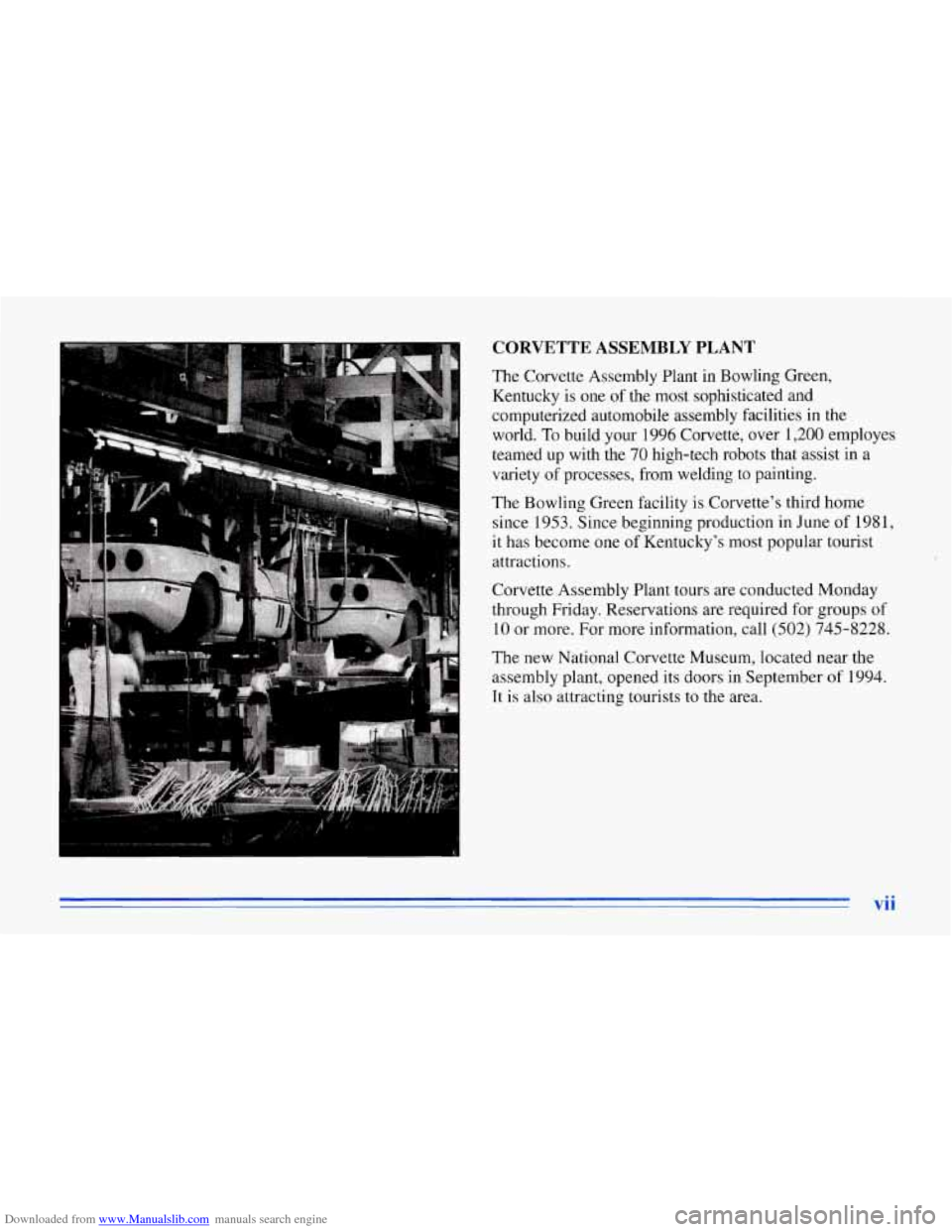
Downloaded from www.Manualslib.com manuals search engine CORVETTE ASSEMBLY PLANT
The Corvette Assembly Plant in Bowling Green, Kentucky is one of the most sophisticated and
computerized automobile assembly facilities in the
world.
To build your 1996 Corvette, over 1,200 employes
teamed up with the 70 high-tech robots that assist in
a
variety of processes, from welding to painting.
The Bowling Green facility is Corvette’s third home
since 1953. Since beginning production in June
of 1981,
it has become one of Kentucky’s most popular tourist
attractions.
Corvette Assembly Plant tours are conducted Monday
through Friday. Reservations are required for groups
of
10 or more. For more information, call (502) 745-8228.
The new National Corvette Museum, located near the
assembly plant, opened its doors in September
of 1994.
It is also attracting tourists to the area.
vii
Page 22 of 386
Downloaded from www.Manualslib.com manuals search engine How to Wear Safety Belts Properly
Adults
This part is only for people of adult size.
Be aware that there are special things to know about
safety belts and children. And there are different rules
for smaller children and babies. If a child will be riding
in your Corvette, see the part of this manual called
“Children.” Follow those rules for everyone’s
protection.
First, you’ll want to know which restraint systems your
vehicle has.
We’ll start with the driver position.
Driver Position
This part describes the driver’s restraint system.
Lap-Shoulder Belt
The driver has a lap-shoulder belt. Here’s how to wear it
properly.
1. Close and lock the door.
2. Adjust the seat (to see how, see “Seats” in the Index)
so you can sit up straight.
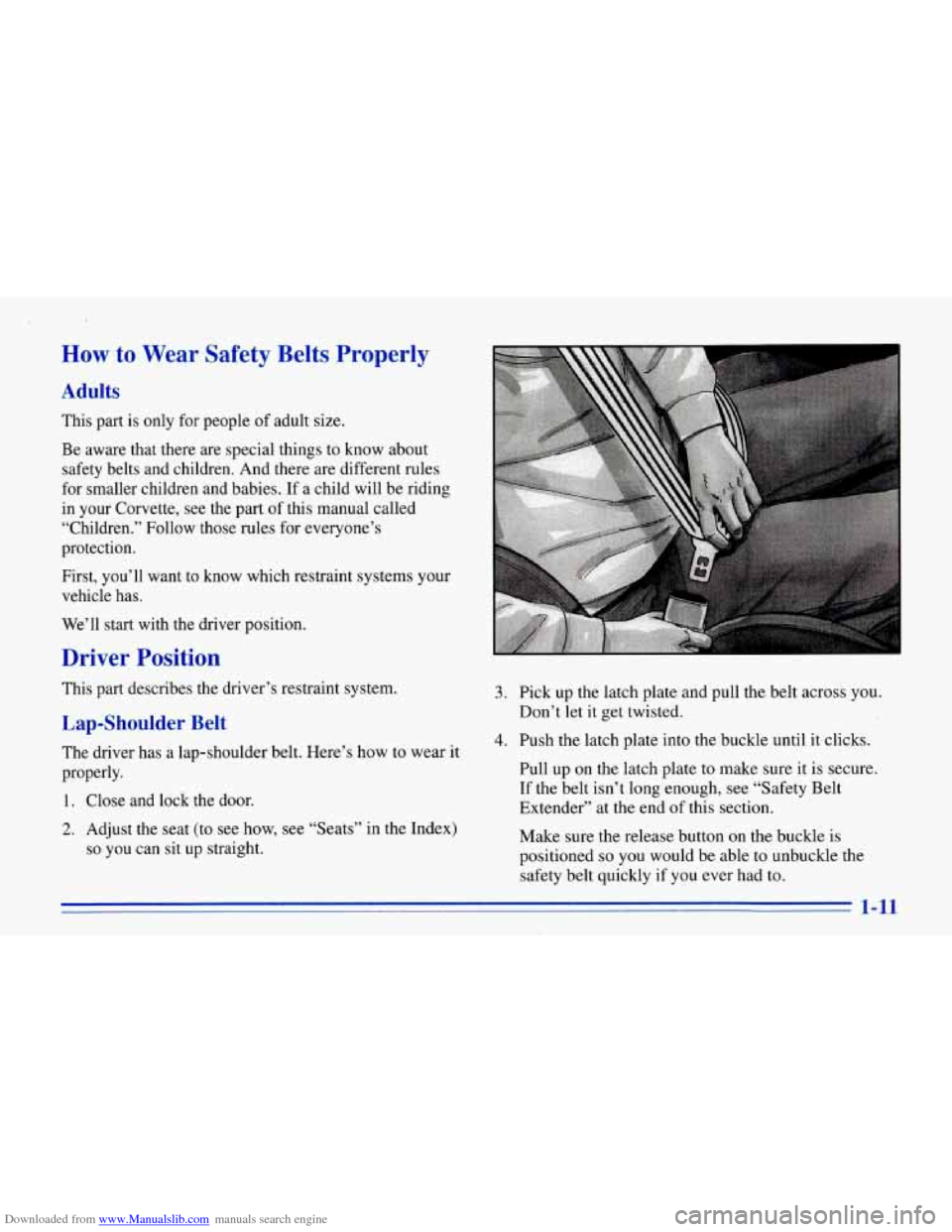
3. Pick up the latch plate and pull the belt across you.
Don’t let it get twisted.
4. Push the latch plate into the buckle until it clicks.
Pull up on the latch plate to make sure it is secure.
If the belt isn’t long enough, see “Safety Belt
Extender” at the end
of this section.
Make sure the release button on the buckle is
positioned
so you would be able to unbuckle the
safety belt quickly if you ever had to.
1-11
Page 28 of 386
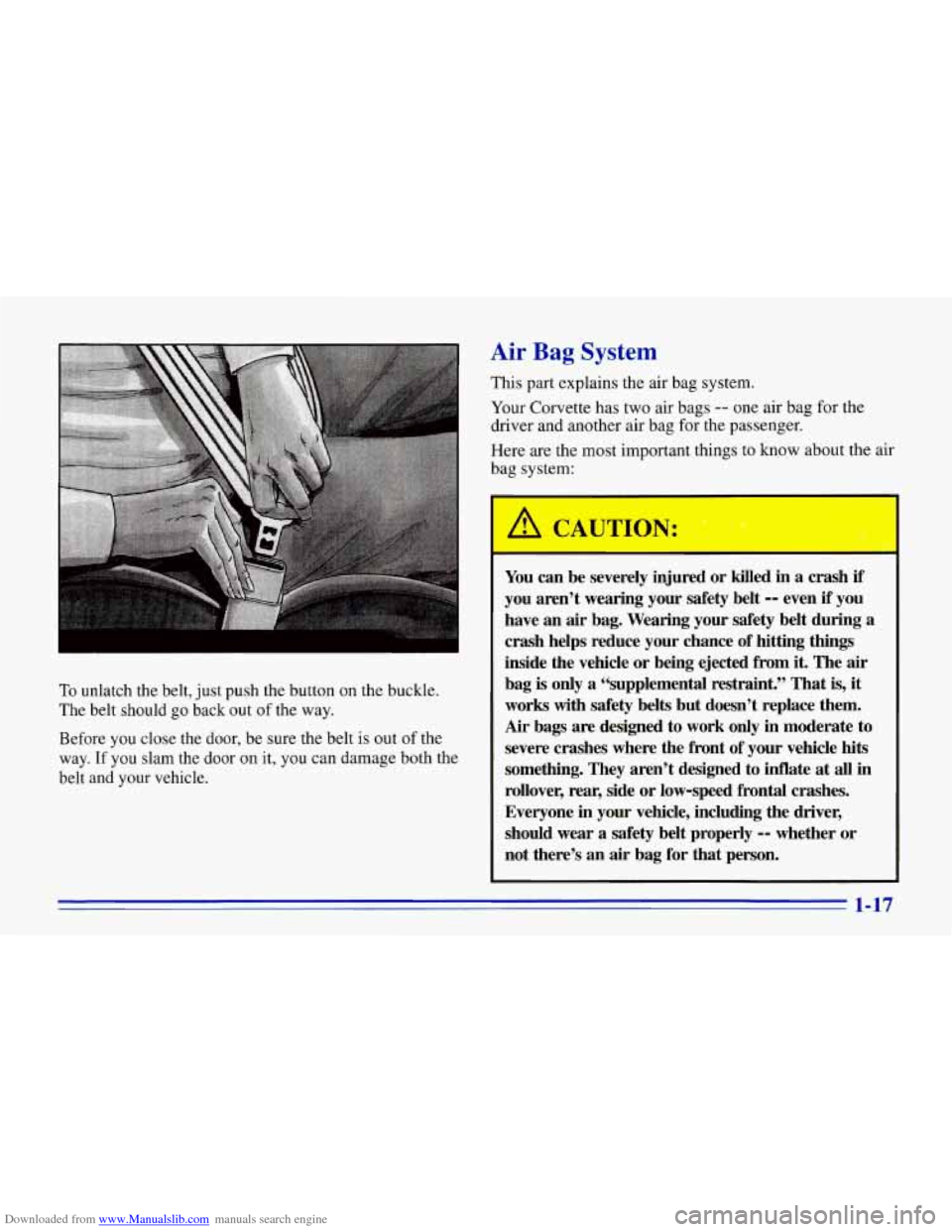
Downloaded from www.Manualslib.com manuals search engine To unlatch the belt, just push the button on the buckle.
The belt should go back out
of the way.
Before you close the door, be sure the belt is out
of the
way.
If you slam the door on it, you can damage both the
belt and your vehicle.
Air Bag System
This part explains the air bag system.
Your Corvette has two air bags
-- one air bag for the
driver and another air bag for the passenger.
Here
are the most important things to know about the air
1
You can be severely injured or killed in a crash if
you aren’t wearing your safety belt -- even if you
have
an air bag. Wearing your safety belt during a
crash helps reduce your chance of hitting things
inside the vehicle or being ejected from it. The
air
bag is only a “supplemental restraint.” That is, it
works with safety belts but doesn’t replace them.
Air bags are designed to work only in moderate to
severe crashes where the front of your vehicle
hits
something. They aren’t designed to inflate at all in
rollover, rear, side or low-speed frontal crashes.
Everyone in your vehicle, including the driver,
should wear a safety belt properly
-- whether or
not there’s an air bag for that person.
1-17
Page 32 of 386
Downloaded from www.Manualslib.com manuals search engine How does an air bag restrain?
In moderate to severe frontal or near-frontal collisions,
even belted occupants can contact the steering wheel or
the instrument panel. The air bag supplements the
protection provided by safety belts. Air bags distribute
the force of the impact more evenly over the occupant’s
upper body, stopping the occupant more gradually. But air bags would not help you in many types
of collisions,
including rollovers, rear impacts and side impacts,
primarily because
an occupant’s motion is not toward the
air bag. Air bags should never be regarded as anything
more than a supplement to safety belts, and then only in
moderate to severe frontal or near-frontal collisions.
What will you see after an air bag inflates?
After the air bag inflates, it quickly deflates. This occurs
so quickly that some people may not even realize the air
bag inflated. Some components of the air bag module in
the steering wheel hub for the driver’s air bag, or the
instrument panel for the passenger’s bag, will be hot
for a short time. The part of the bag that comes into
contact with you may be warm, but it will never be
too hot to touch. There will be some smoke and dust
coming from vents
in the deflated air bags. Air bag
inflation will not prevent the driver from seeing or from
being able to steer the vehicle, nor will it stop people
from leaving the vehicle.
When an air bag inflates, there is dust in the air.
This dust could cause breathing problems for
people with a history
of asthma or other
breathing trouble. To avoid this, everyone in the
vehicle should get out
as soon as it is safe to do so.
If you have breathing problems but can’t get out
of the vehicle after an air bag inflates, then get
fresh air by opening a window or door.
n many crashes severe enough to inflate an air bag,
windshields are broken by vehicle deformation.
Additional windshield breakage may also occur from the
passenger air bag.
0 The air bags are designed to inflate only once. After
they inflate, you’ll need some new parts for your air
bag system. If
you don’t get them, the air bag system
won’t be there to help protect you in another crash.
A new system will include air bag modules and
possibly other parts. The service manual for your
vehicle covers the need to replace other parts.
1-21
Page 45 of 386
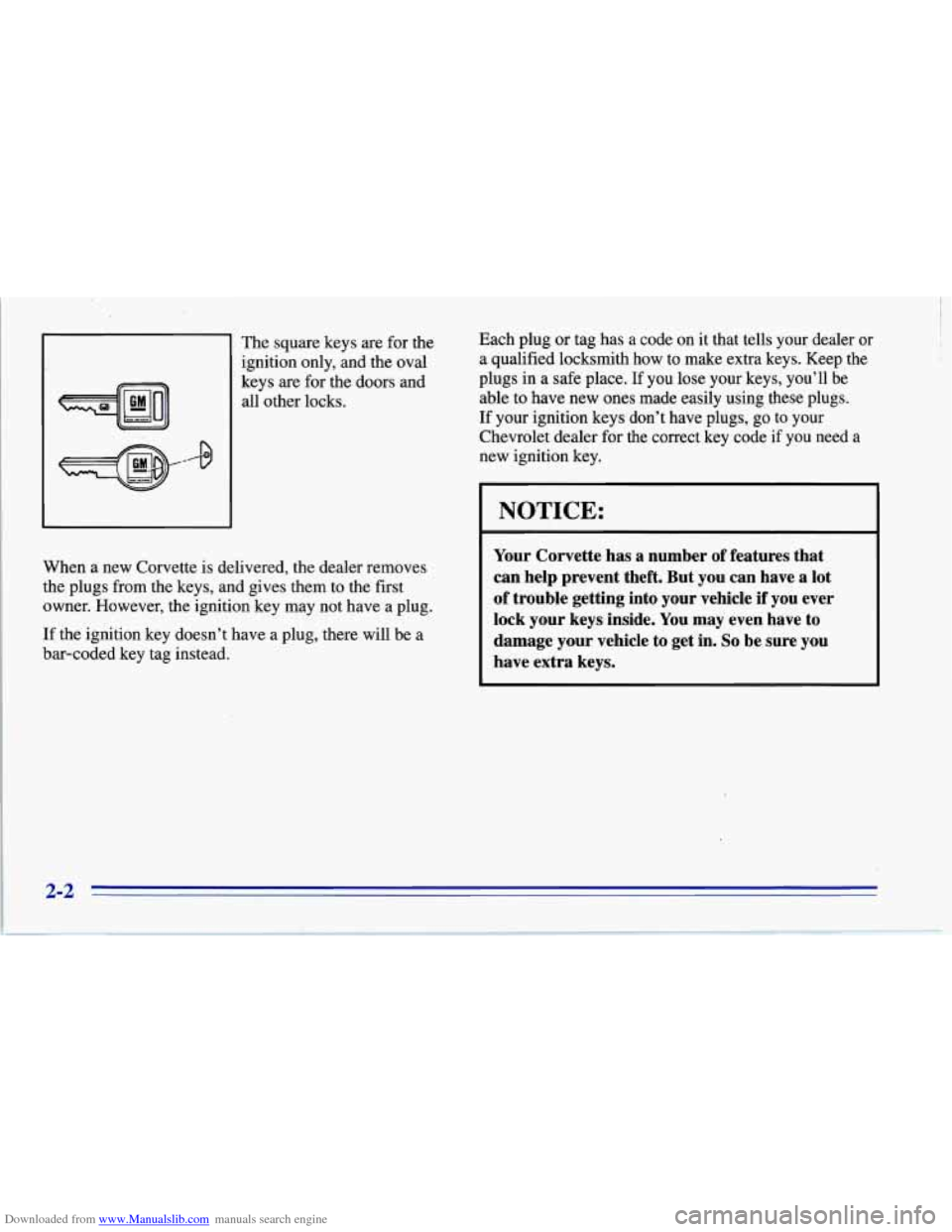
Downloaded from www.Manualslib.com manuals search engine The square keys are for the
ignition only, and the oval
keys are for the doors and all other locks. Each plug, or tag has a code on it that tells your dealer or
a qualified locksmith how to make extra keys. Keep the
plugs in a safe place. If you lose your keys, you’ll be
able to have new ones made easily using these plugs.
If your ignition keys don’t have plugs, go to your
Chevrolet dealer for the correct key code if you need a
new ignition key.
When a new Corvette is delivered, the dealer removes the plugs from the keys, and gives them to the first owner. However, the ignition key may not have a plug.
If the ignition key doesn’t have a plug, there will be a
bar-coded key tag instead.
I NOTICE:
Your Corvette has a number of features that
can help prevent theft. But you can have a lot
of trouble getting into your vehicle if you ever
lock your keys inside.
You may even have to
damage your vehicle to get in.
So be sure you
have extra keys.
2-2
~
Page 46 of 386
Downloaded from www.Manualslib.com manuals search engine Door Locks
Unlocked doors can bc ,angerow.
Passengers
-- especially children -- can easily
open the doors and fall out. When a door is
locked, the inside handle won’t open it.
Outsiders can easily enter through an unlocked
door when you slow down or stop your vehicle.
This may not be
so obvious: You increase the
chance of being thrown out of the vehicle in a
crash
if the doors aren’t locked. Wear safety belts
properly, lock your doors, and you will be far
better off whenever you drive your vehicle.
There are several ways to lock and unlock your vehicle.
From the outside,
use your door key or the Passive
Keyless Entry transmitter.
If your theft-deterrent system is armed, unlock the doors
only with the key or the transmitter to avoid setting
off
the alarm. See “Universal Theft-Deterrent” in the Index.
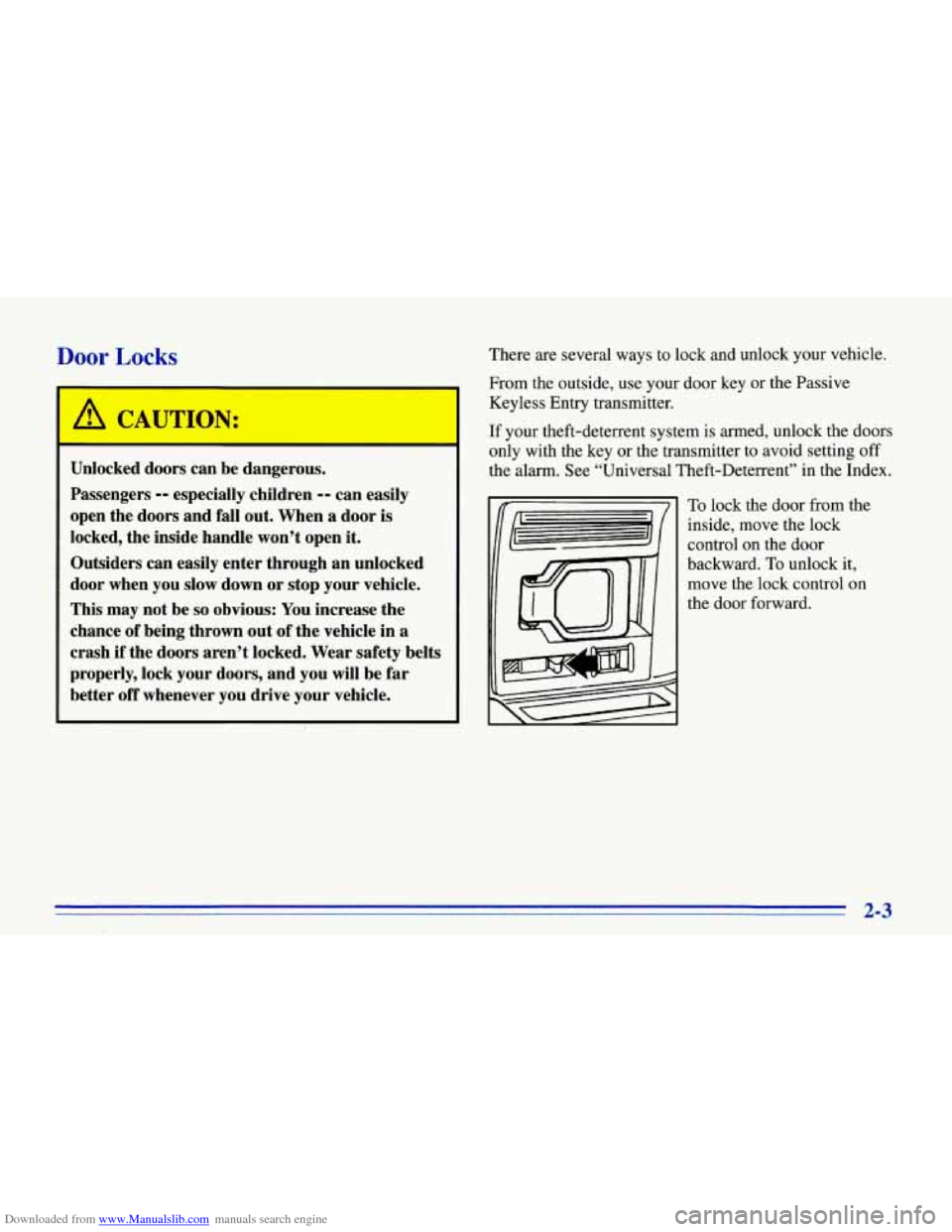
I I To lock the door from the
inside, move the lock
control on the door
backward.
To unlock it,
move the lock control on
the door forward.
2-3
Page 47 of 386
Downloaded from www.Manualslib.com manuals search engine Power Door Locks
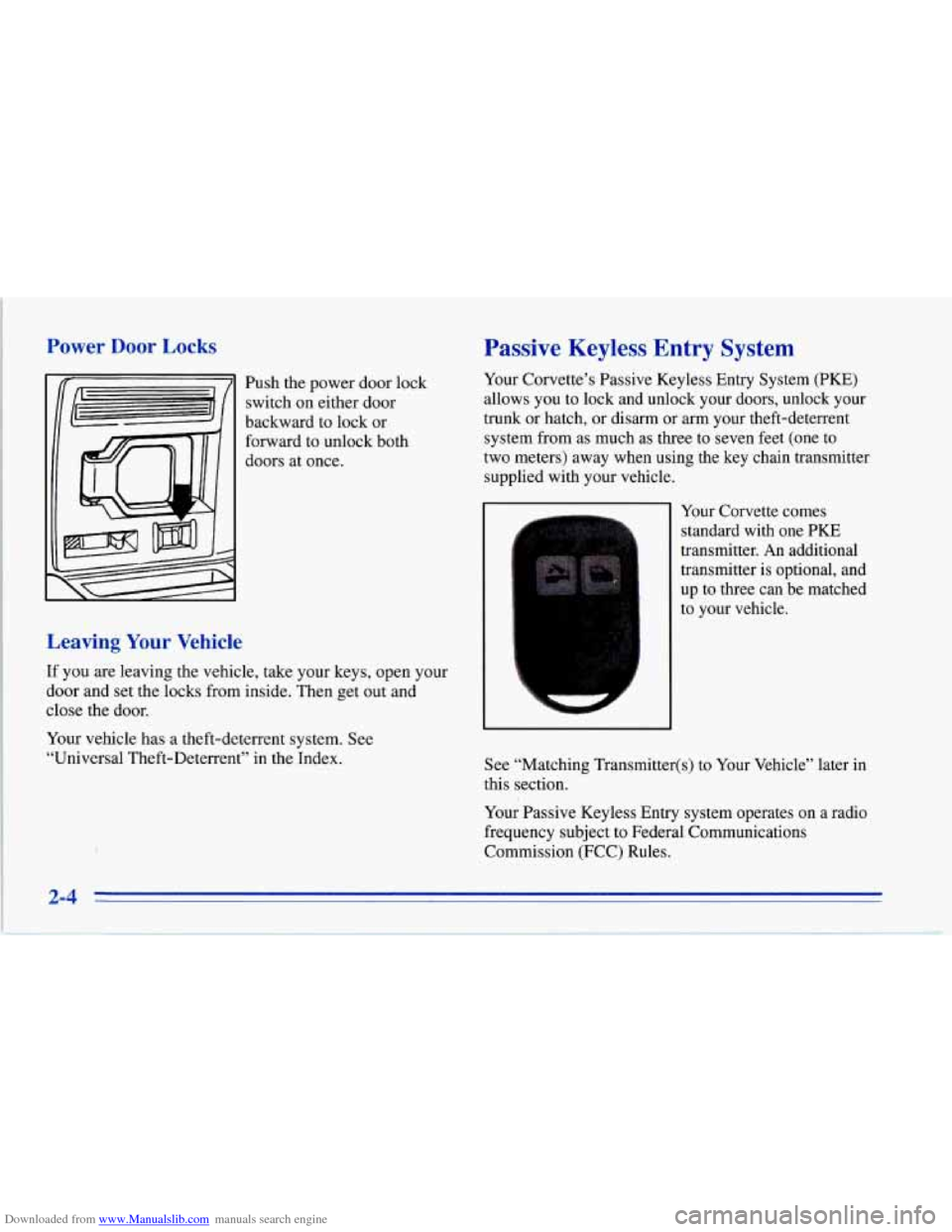
Push the power door lock
switch on either door
backward to lock or
forward to unlock both
doors at once.
Leaving Your Vehicle
If you are leaving the vehicle, take your keys, open your
door and set the locks from inside. Then get out and
close the door.
Your vehicle has
a theft-deterrent system. See
“Universal Theft-Deterrent” in the Index.
Passive Keyless Entry System
Your Corvette’s Passive Keyless Entry System (PKE)
allows you to lock and unlock your doors, unlock your
trunk or hatch, or disarm
or arm your theft-deterrent
system from as much as three to seven feet (one to
two meters) away when using the key chain transmitter
supplied with your vehicle.
Your Corvette comes
standard with one
PKE
transmitter. An additional
transmitter is optional, and
up to three can be matched
to your vehicle.
See “Matching Transmitter(s) to Your Vehicle” later in
this section.
Your Passive Keyless Entry system operates
on a radio
frequency subject to Federal Communications
Commission (FCC) Rules.
Page 48 of 386
Downloaded from www.Manualslib.com manuals search engine This device complies with Part 15 of the FCC Rules.
Operation is subject to the following two conditions:
(1) This device may not cause harmful interference, and
(2) This device must accept any interference received,
including interference that may cause undesired
operation.
Should interference to this system occur, try this:
0 Check to determine if battery replacement is
necessary. See the instructions on battery
replacement.
Check the distance. You may be too far from your
vehicle. This product has a maximum range.
Chkck the location. Other vehicles or objects may be
blocking the signal.
See your Chevrolet dealer or a qualified technician
for service.
Changes or modifications to this system by anyone other
than an authorized service facility could void
authorization to use this equipment.
Operation
You don’t have to do anything for PKE to work when
the passive feature is on. Just move toward your
vehicle with the
PKE transmitter, and the system will
automatically disarm your theft-deterrent system and
unlock the doors. If it’s dark enough outside, your
interior lamps will come on.
If you move out of range, the
PKE system will:
1. Lock the doors after five seconds.
2. Arm the theft-deterrent system.
3. Sound the horn to let you know the doors are locked.
4. Turn off the interior lamps.
You can also use the buttons on the transmitter. Press
DOOR to open the passenger’s door or HATCH to open
the hatch. The HATCH button will only work when the
ignition is off.
The system has a feature that makes it difficult for you
to lock your keys
in your vehicle. If you leave your keys
in the ignition and lock the doors,
the system will unlock
the doors as soon as they are closed. If you leave the
keys in the ignition-and move away with the transmitter,
the doors still will not lock. You should notice that the
horn doesn’t sound and return to get your keys.
Page 49 of 386
Downloaded from www.Manualslib.com manuals search engine The system will allow you to lock your keys in the
vehicle if you didn’t leave them in the ignition. You
should, however, be able to use the transmitter to get
them out. After
26 seconds of no motion, the transmitter
shuts down to save the battery. Wait about
30 seconds,
then rock the vehicle. The transmitter should “wake up”
and unlock the doors.
This system can’t guarantee that you’ll never be locked
out of your vehicle. If the battery is low or if the
transmitter is
in a place where the signal can’t get to the
antenna, it won’t unlock the doors. Always remember to
take your keys with you.
PKE Settings
You can use the system for both doors or just the
driver’s door, or you can turn the system off.
Changing the Door Settings
1. Put the ignition key in the ignition, but don’t turn it
on.
2. Press DOOR on the transmitter until the door locks
cycle (about two seconds).
II’urning the System Off
1. Take the ignition key out of the ignition.
2. Press DOOR on the transmitter until the door locks
cycle (about two seconds).
To turn the system back on,
just repeat the steps.
To check that the system is off, turn on the ignition. The
PASSIVE KEYLESS ENTRY light on the Driver
Information Center should not come on. If the light does
come on for a second or two, then the PKE system
is
still on.
You can also check whether the system is on or
off by
closing the door and moving away from the vehicle
with the keys and transmitter.
If the doors lock, the
system is on.
If you are working around your vehicle and keeping
your keys with you, you might want to turn the
PKE
system off. If you don’t, the transmitter will keep
locking and unlocking your doors.
2-6
~
Page 50 of 386
Downloaded from www.Manualslib.com manuals search engine TYPICAL RANGE
1 I
WA
( 1-1 'hm)
fl (1 'I2 5'-7' - 2m)
Transmitter Range
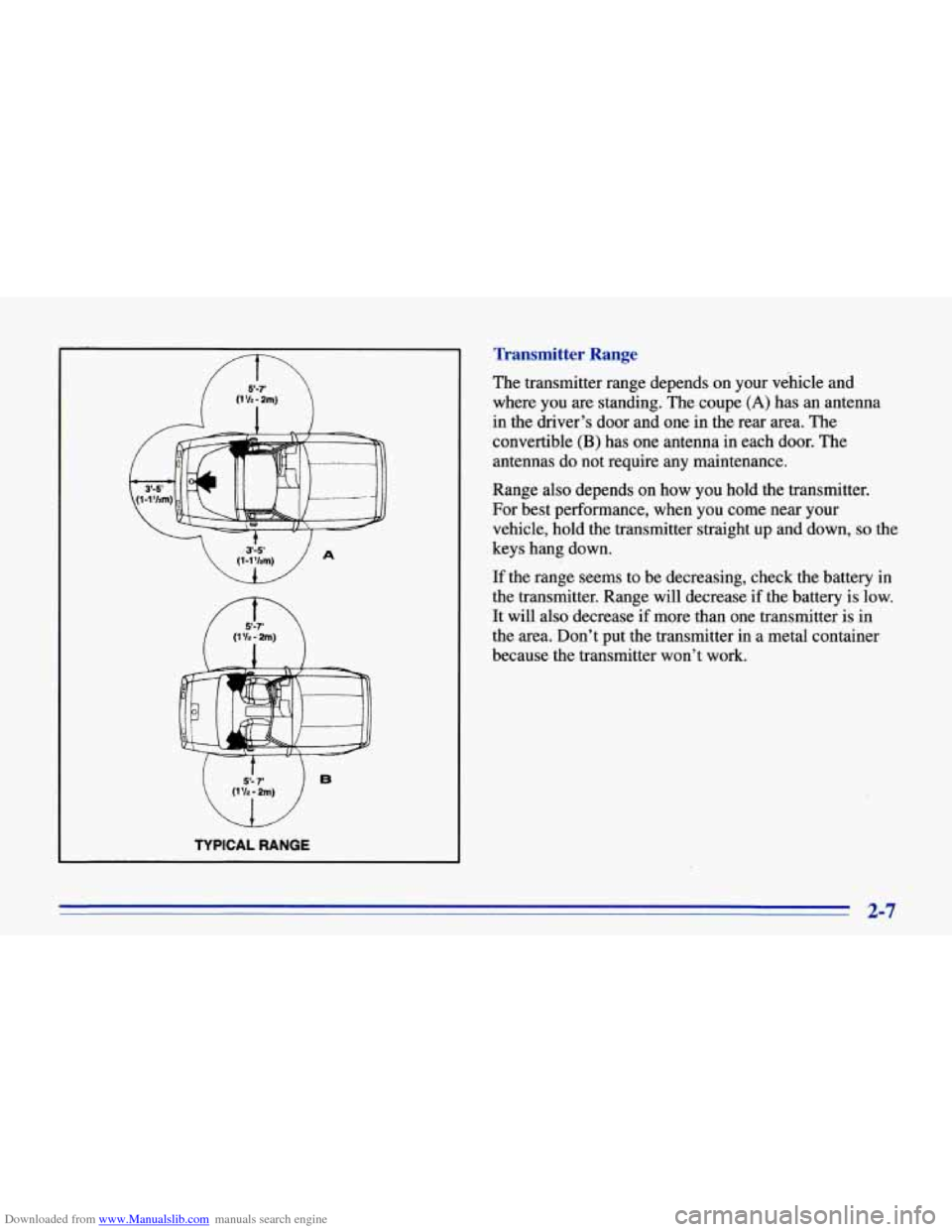
The transmitter range depends on your vehicle and where you are standing. The coupe
(A) has an antenna
in the driver's door and one in the rear area. The
convertible
(B) has one antenna in each door. The
antennas do not require any maintenance.
Range also depends on how you hold the transmitter.
For best performance, when you come near your vehicle, hold the transmitter straight up and down,
so the
keys hang down.
If the range seems to be decreasing, check the battery in
the transmitter. Range will decrease if the battery is low.
It will also decrease
if more than one transmitter is in
the area. Don't put the transmitter
in a metal container
because the transmitter won't work.
2-7