Door CHEVROLET CORVETTE 1996 4.G User Guide
[x] Cancel search | Manufacturer: CHEVROLET, Model Year: 1996, Model line: CORVETTE, Model: CHEVROLET CORVETTE 1996 4.GPages: 386, PDF Size: 20.12 MB
Page 53 of 386
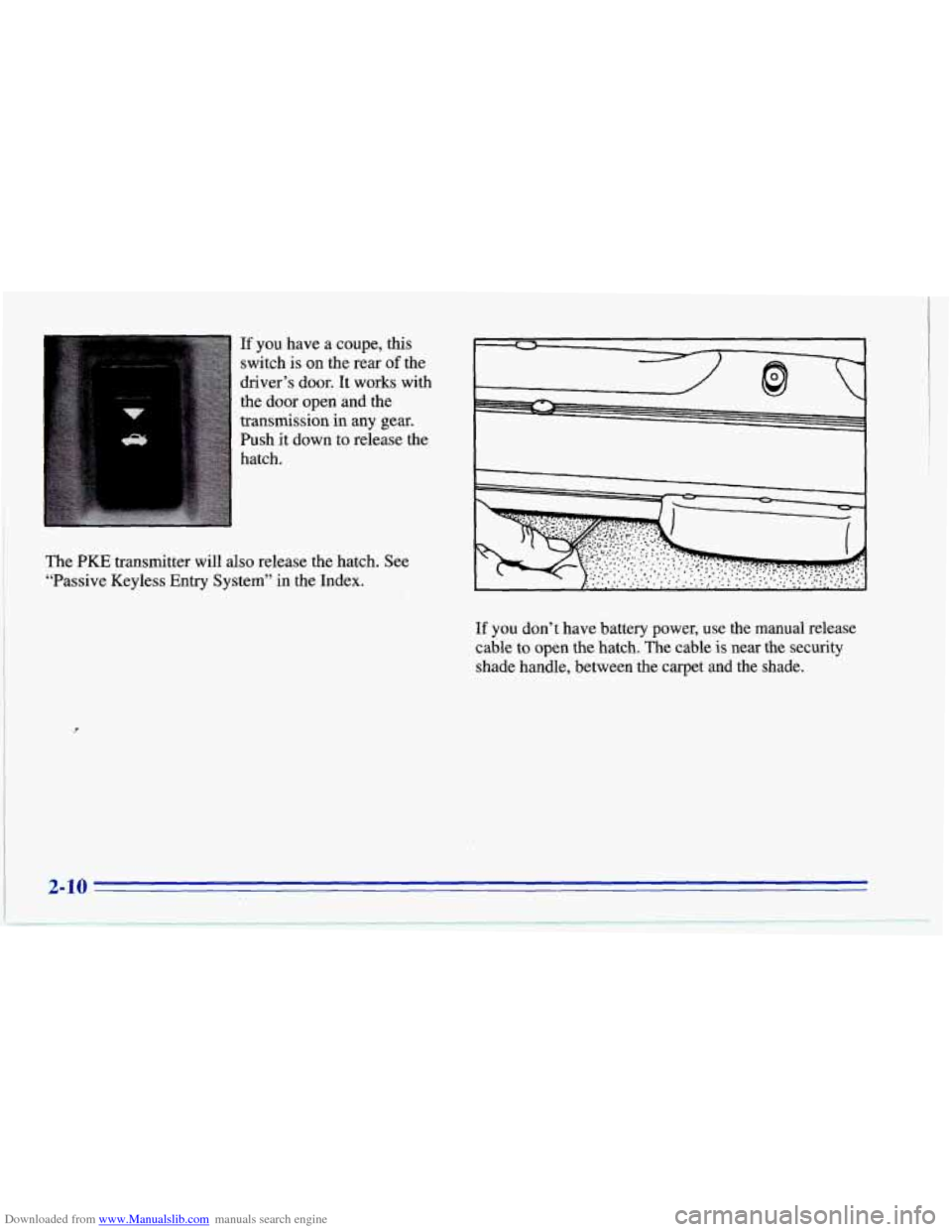
Downloaded from www.Manualslib.com manuals search engine If you have a coupe, this
switch is on the rear
of the
driver’s door. It works with
the door open and the
transmission in any gear.
Push it down to release the
hatch.
The
PKE transmitter will also release the hatch. See
“Passive Keyless Entry System’’ in the Index.
8
I , .. .
If you don’t have battery power, use the manual release
cable to open the hatch. The cable
is near the security
shade handle, between the carpet and the shade.
2-10
Page 55 of 386
Downloaded from www.Manualslib.com manuals search engine Theft
Vehicle theft is big business, especially in some cities.
1 Although your Corvette has a number of theft-deterrent
features, we,know that nothing we put on it can make it
impossible to steal. However, there
are ways you can
help.
Key in the Ignition
If you leave your vehicle with the keys inside, it’s an
easy target for joy riders or professional thieves
-- so
don’t do it.
. When you park your Corvette and open the driver’s
door, you’ll hear a tone reminding you to remove your
key from the ignition and take it with you. Always do
this. Your steering wheel will be locked, and
so will
your ignition.
If you have an automatic transmission,
taking your key out also locks your transmission. And
’ remember to lock the doors.
Parking at Night
Park in a lighted spot, close all windows and lock your
vehicle. Remember to keep your valuables out of sight.
Put them in a storage area, or take them with you.
Parking Lots
If you park in a lot where someone will be watching
your vehicle, it’s best to lock it up and take your keys.
But what
if you have to leave your ignition key? What if
you have to leave something valuable in your vehicle?
Put your valuables in a storage area, like your rear
storage compartment
or center console.
Lock the rear storage compartment and center
console.
Lock all the doors except the driver’s.
Then take the door key with you.
2-12
Page 56 of 386
Downloaded from www.Manualslib.com manuals search engine Universal Theft-Deterrent System
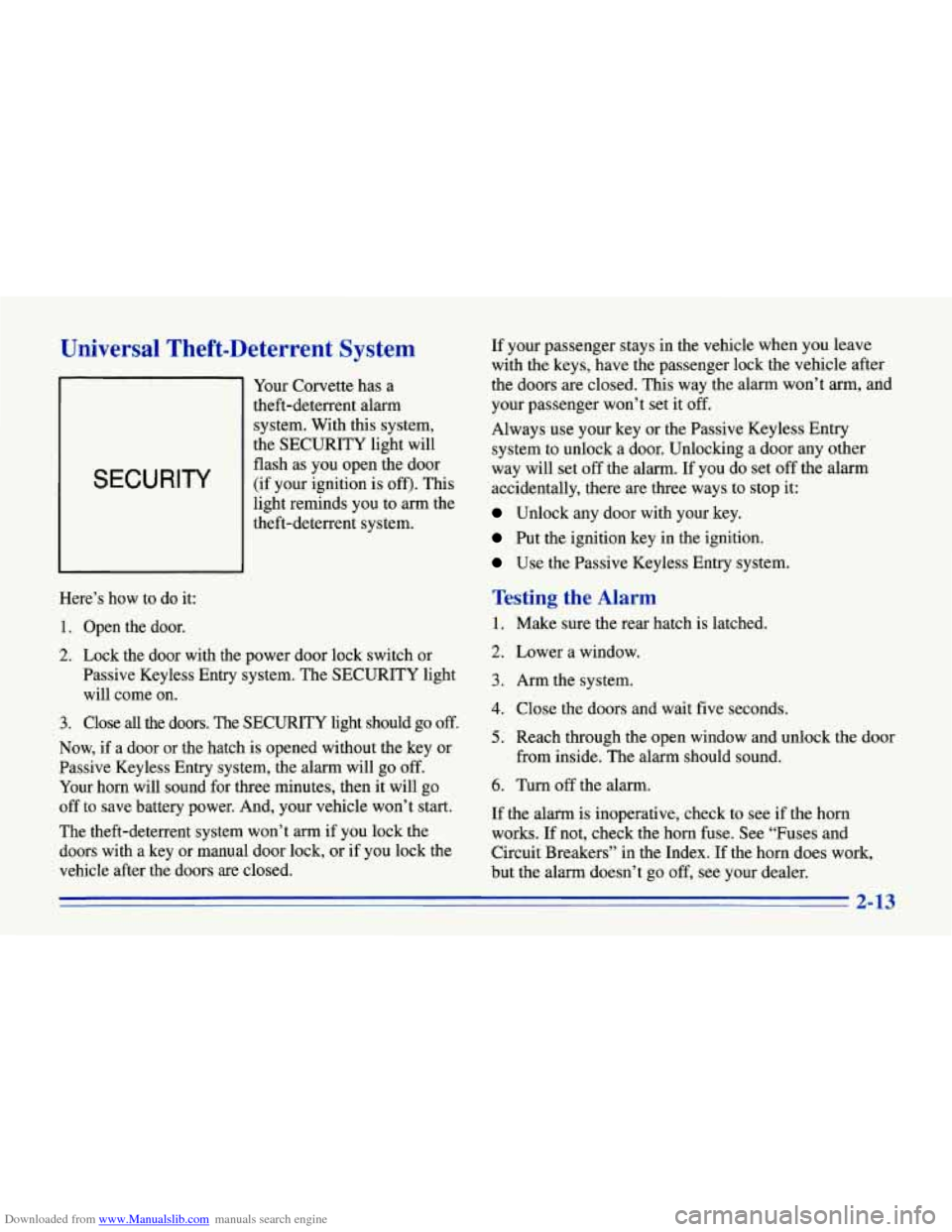
SECURITY
Your Corvette has a
theft-deterrent alarm system. With this system,
the SECURITY light will
flash as you open the door
(if your ignition is off). This
light reminds you to arm the
theft-deterrent system.
Here’s how to do it:
1. Open the door.
2. Lock the door with the power door lock switch or
Passive Keyless Entry system. The SECURITY light
will come
on.
3. Close all the doors. The SECURITY light should go off.
Now, if a door or the hatch is opened without the key or
Passive Keyless Entry system, the alarm will
go off.
Your horn will sound for three minutes, then it will go
off to save battery power. And, your vehicle won’t start.
The theft-deterrent system won’t arm
if you lock the
doors with a key or manual door lock, or
if you lock the
vehicle after the doors are closed. If
your passenger stays in the vehcle when you leave
with the keys, have the passenger lock
the vehicle after
the doors
are closed. This way the alarm won’t arm, and
your passenger won’t set it off.
Always use your key
or the Passive Keyless Entry
system to unlock a door. Unlocking a door any other
way will set
off the alarm. If you do set off the alarm
accidentally, there
are three ways to stop it:
Unlock any door with your key.
Put the ignition key in the ignition.
Use the Passive Keyless Entry system.
Testing the Alarm
1.
2.
3.
4.
5.
6.
Make sure the rear hatch is latched.
Lower a window.
Arm the system.
Close the doors and wait five seconds.
Reach through the open window and unlock the door
from inside. The alarm should sound.
Turn
off the alarm.
If the alam is inoperative, check to see if the horn
works. If not, check the horn fuse. See “Fuses and
Circuit Breakers” in the Index. If the horn does work,
but the alarm doesn’t
go off, see your dealer.
2-13
Page 59 of 386
Downloaded from www.Manualslib.com manuals search engine Ignition Positions
C
I
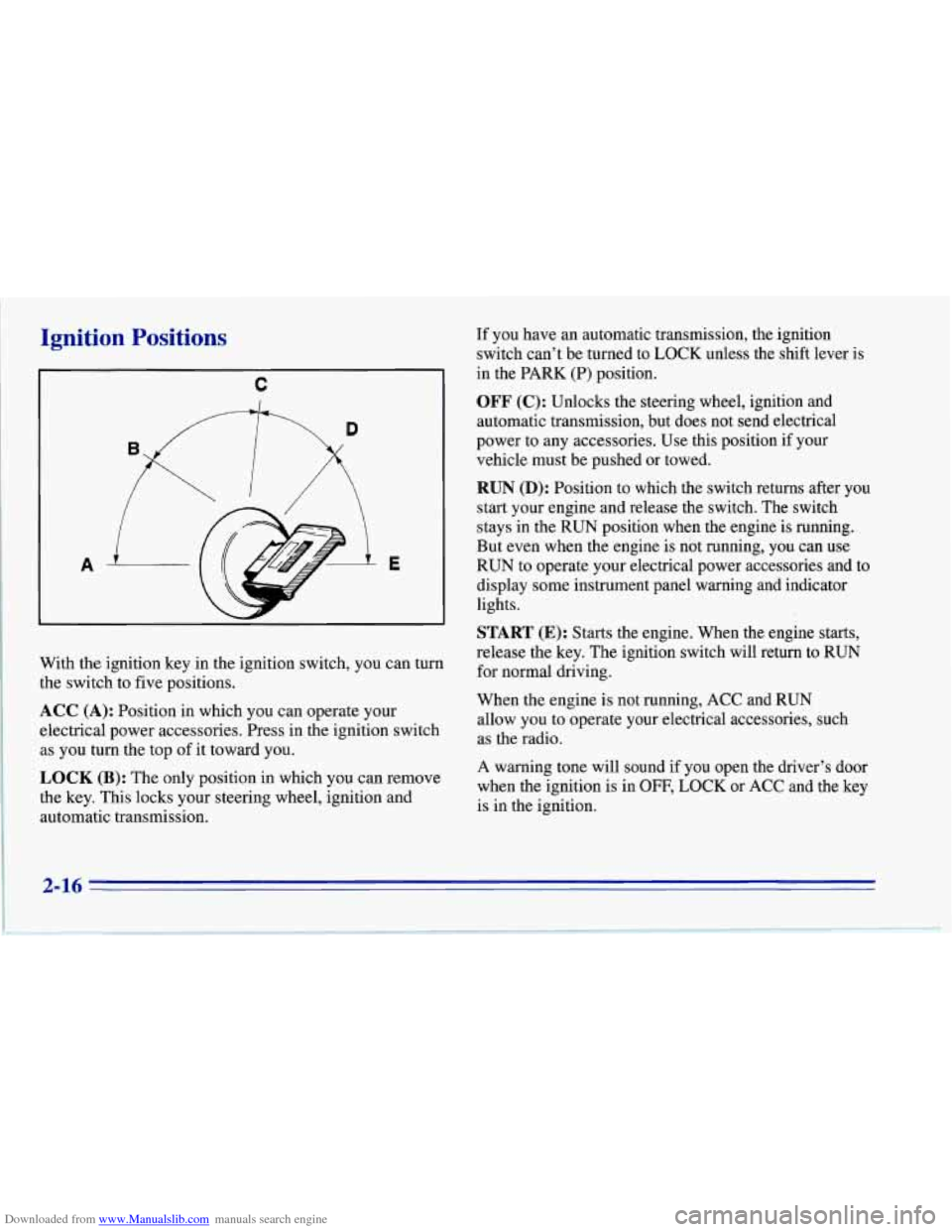
With the ignition key in the ignition switch, you can turn
the switch to five positions.
ACC (A): Position in which you can operate your
electrical power accessories. Press in the ignition switch
as you turn the top of it toward you.
OCK (B): The only position in which you can remove
the key. This locks your steering wheel, ignition and
automatic transmission. If you
have an automatic transmission, the ignition
switch can't be turned to LOCK unless the shift lever is
in the PARK (P) position.
OFF (C): Unlocks the steering wheel, ignition and
automatic transmission, but does not send electrical
power to any accessories. Use this position if your
vehicle must be pushed or towed.
RUN (D): Position to which the switch returns after you
start your engine and release the switch. The switch
stays in the RUN position when the engine is running.
But even when the engine is not running, you can use
RUN to operate your electrical power accessories and to
display some instrument panel warning and indicator
lights.
START (E): Starts the engine. When the engine starts,
release the key. The ignition switch will return to RUN
for normal driving.
When the engine is not running, ACC and RUN
allow you to operate your electrical accessories, such
as the radio.
A warning tone will sound
if you open the driver's door
when the ignition is in
OFF, LOCK or ACC and the key
is in the ignition.
2-16
Page 60 of 386
Downloaded from www.Manualslib.com manuals search engine Key Release Button
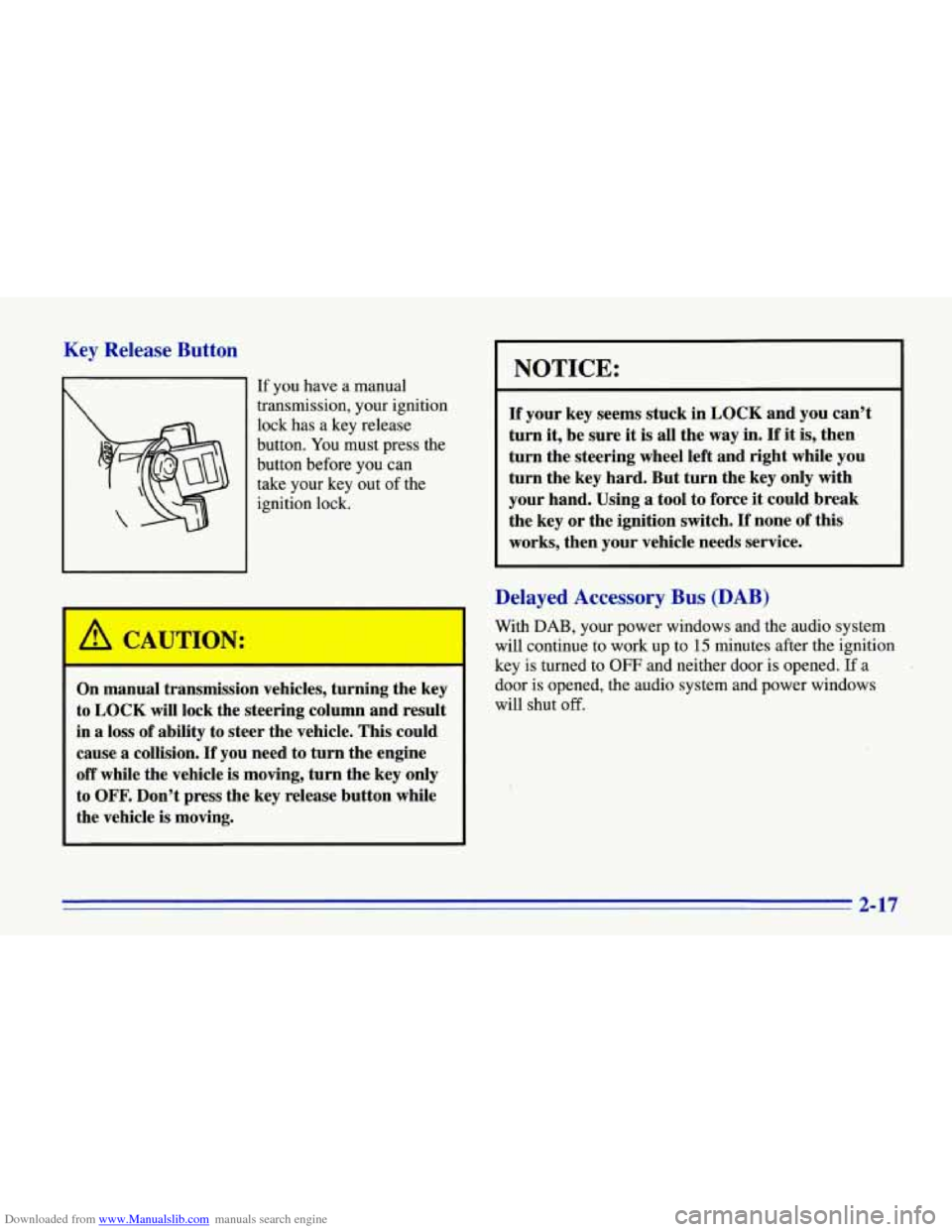
If you have a manual
transmission, your ignition
lock has a key release
button. You must press the
button before you can
take your key out
of the
ignition lock.
CAUTION:
On manual transmission vehicles, turning the key
to LOCK will lock the steering column and result
in a loss of ability to steer the vehicle. This could
cause a colIision.
If you need to turn the engine
off while the vehicle is moving, turn the key only
to
OFF. Don’t press the key release button while
the vehicle
is moving.
I NOTICE:
If your key seems stuck in LOCK and you can’t
turn
it, be sure it is all the way in. If it is, then
turn the steering wheel left and right while you
turn the key hard. But turn the key only with
your hand. Using
a tool to force it could break
the key or the ignition switch.
If none of this
works, then your vehicle needs service.
Delayed Accessory Bus (DAB)
With DAB, your power windows and the audio system
will continue to work up to
15 minutes after the ignition
key is turned to
OFF and neither door is opened. If a
door is opened, the audio system and power windows
will shut
off.
Y
2-17
Page 77 of 386
Downloaded from www.Manualslib.com manuals search engine Windows
Power Windows
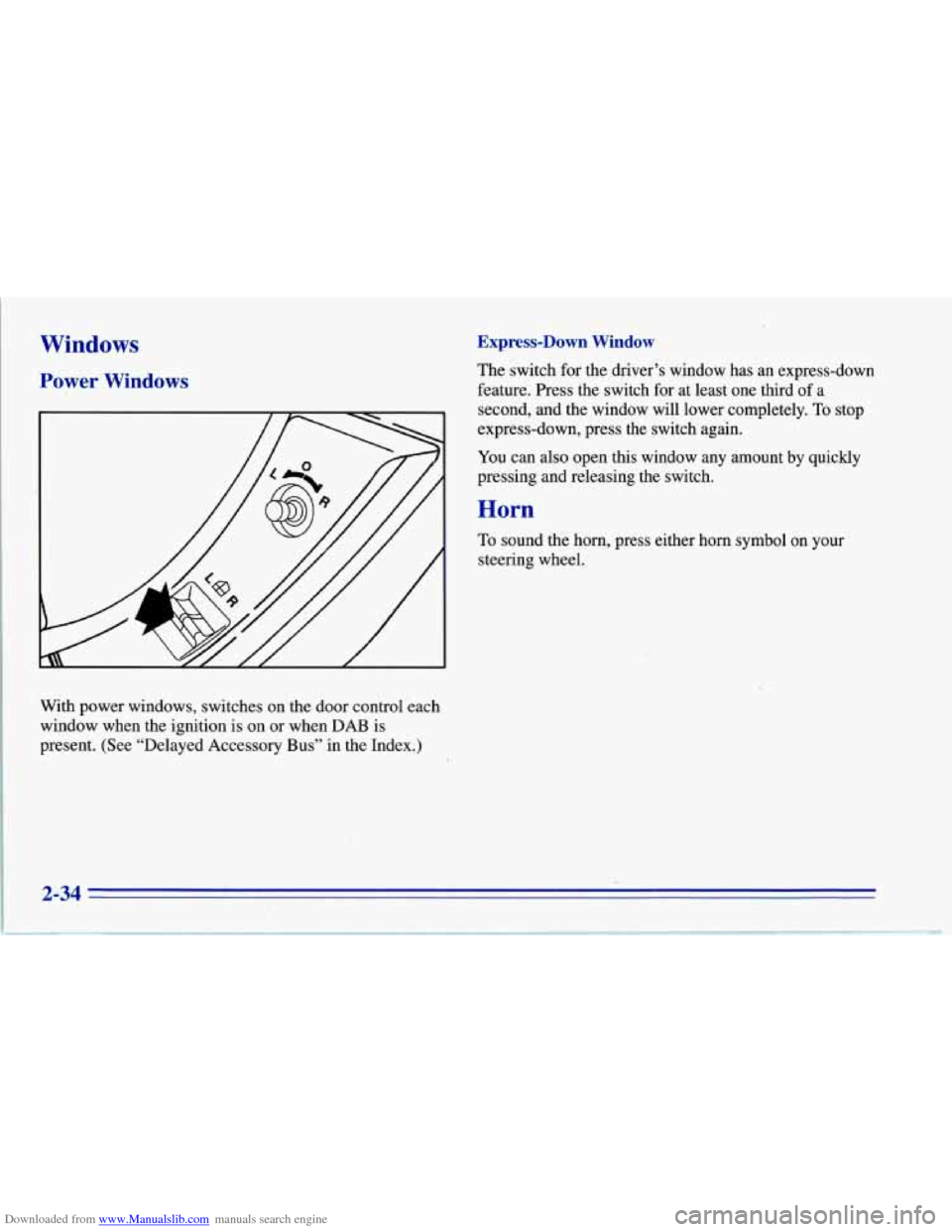
With power windows, switches on the door control each
window when the ignition is on or when DAB is
present. (See “Delayed Accessory
Bus” in the Index.)
Express-Down Window
The switch for the driver’s window has an express-down
feature. Press the switch for at least one third of
a
second, and the window will lower completely. To stop
express-down, press the switch again.
You can also open this window any amount by quickly
pressing and releasing the switch.
Horn
To sound the horn, press either horn symbol on your
steering wheel.
Page 86 of 386
Downloaded from www.Manualslib.com manuals search engine Headlamp Doors
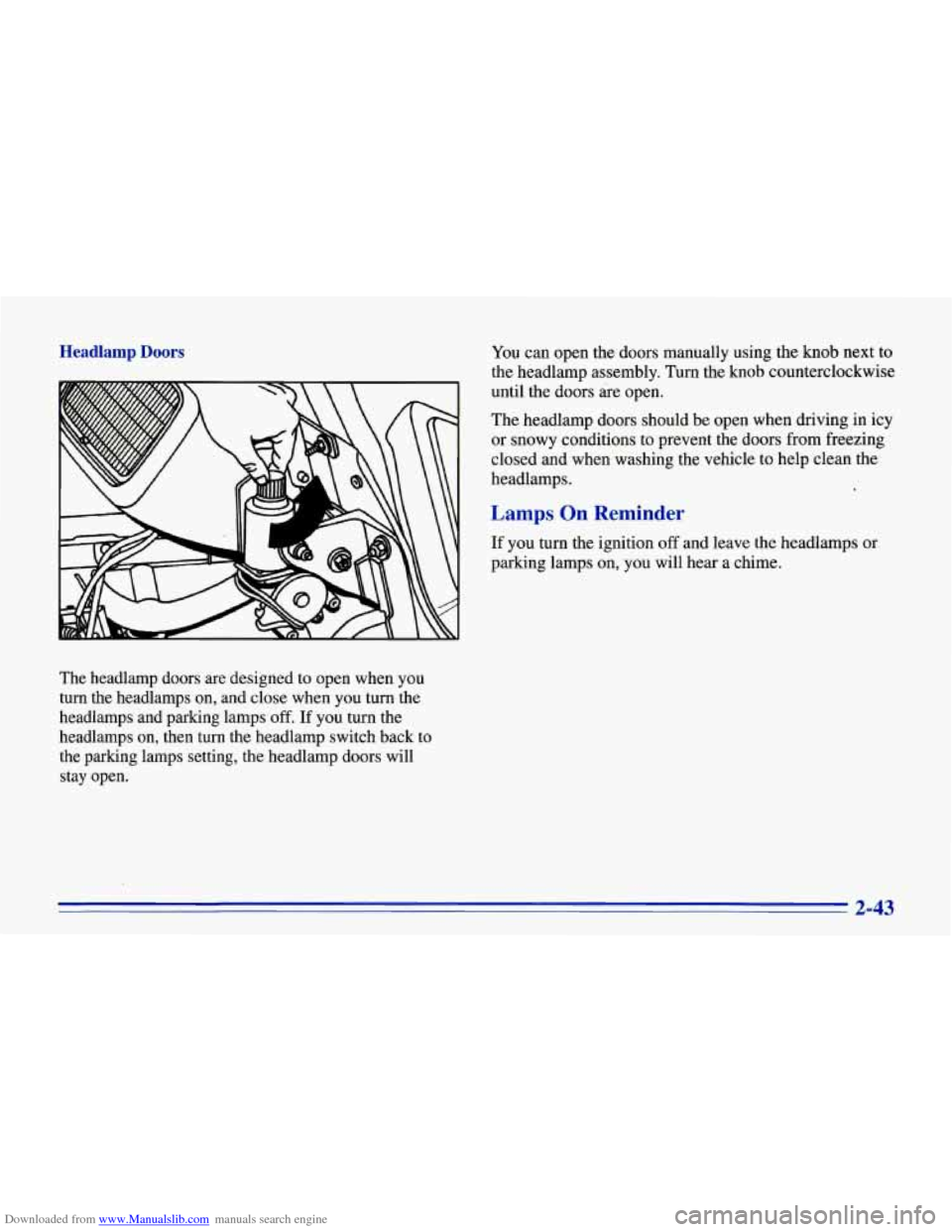
The headlamp doors are designed to open when you
turn the headlamps on, and close when you turn the
headlamps and parking lamps off.
If you turn the
headlamps on, then turn the headlamp switch back to
the parking lamps setting, the headlamp doors will
stay open. You
can open the doors manually using the knob next to
the headlamp assembly. Turn the knob counterclockwise
until the doors are open.
The headlamp doors should be open when driving in icy
or snowy conditions to prevent the doors from freezing
closed and when washing the vehicle to help clean the
headlamps
.
Lamps On Reminder
If you turn the ignition off and leave the headlamps or
parking lamps on, you will hear a chime.
2-43
Page 88 of 386
Downloaded from www.Manualslib.com manuals search engine Interior Lamps
Instrument Panel Brightness Control
The DIMMER switch controls the brightness of your
instrument panel lights when your headlamps or parking
lamps are on. Move the switch up or down to brighten
or dim the lamps.
If you turn the switch all the way up,
your courtesy, reading, map and cargo area lamps will
come on. Be sure to turn
off the lamps when you leave
your vehicle.
Courtesy Lamps
When any door or the hatch is opened, the interior
lamps will go on (unless it's bright outside). The lamps
will stay on for about
30 seconds or until you turn on
the ignition.
Door Flood Lamps
There are flood lamps located above the door handle
on each door which come on with the headlamps or
parking lamps.
Front Map Lamps
.. .. .. .. . '
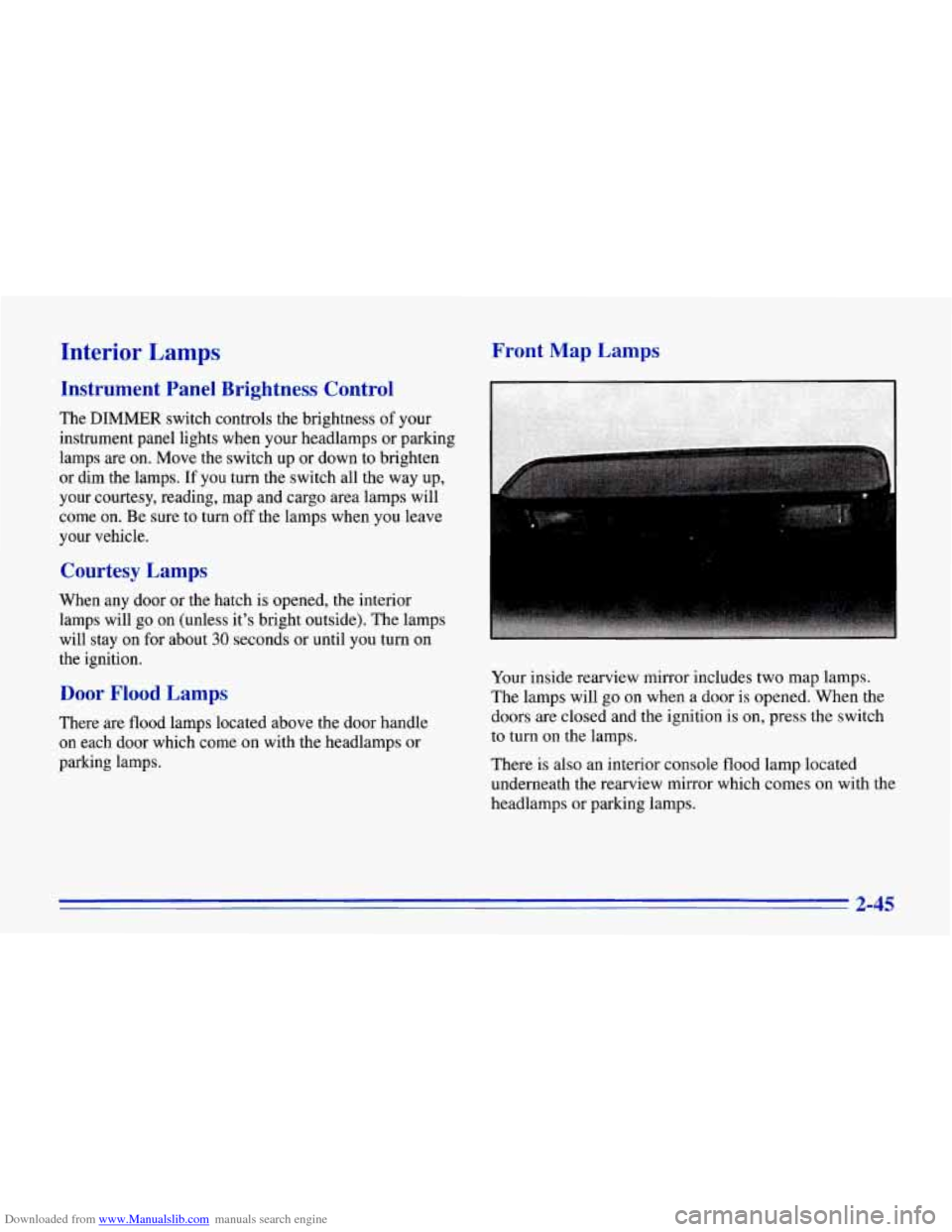
Your inside rearview mirror includes two map lamps.
The lamps will go on when a door
is opened. When the
doors are closed and the ignition is on, press the switch
to turn
on the lamps.
There is also an interior console flood lamp located
underneath the rearview mirror which comes on with the
headlamps or parking lamps.
2-45
Page 89 of 386
Downloaded from www.Manualslib.com manuals search engine Mirrors
Inside Daymight Rearview Mirror
An inside rearview mirror is attached above your
windshield. The mirror has pivots
so that you can
adjust it.
You can adjust the mirror for day or night driving. Pull
the tab for night driving to reduce glare. Push the tab for
daytime driving.
Power Remote Control Mirrors
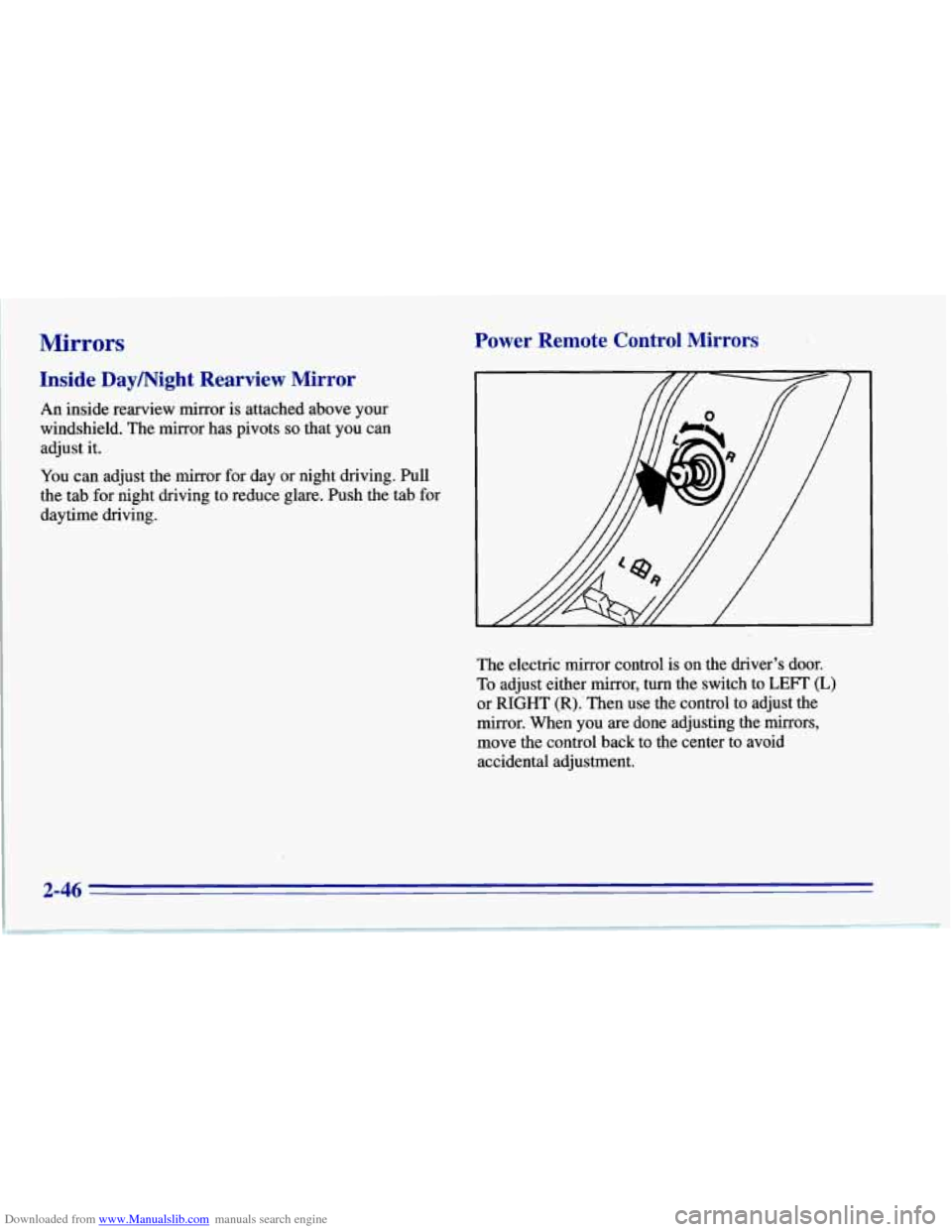
The electric mirror control is on the driver's door.
To adjust either mirror, turn the switch to LEFT (L)
or RIGHT (R).'Then use the control to adjust the
mirror. When you
are done adjusting the mirrors,
move the control back to the center to avoid
accidental adjustment.
2-46
Page 90 of 386
Downloaded from www.Manualslib.com manuals search engine Convex Outside Mirror
Your passenger’s side mirror is convex. A convex
mirror’s surface is curved
so you can see more from the
driver’s seat.
A CAUTION:
A convex mirror can make things (like other
vehicles) look farther away than they really are.
If you cut
too sharply into the right lane, you
could hit a vehicle on your right. Check your
inside mirror or glance over your shoulder before
changing lanes.
Each door has a storage compartment below the armrest
which can be accessed
by lifting up on the armrest.
2-47