change wheel CHEVROLET CORVETTE 1996 4.G Owners Manual
[x] Cancel search | Manufacturer: CHEVROLET, Model Year: 1996, Model line: CORVETTE, Model: CHEVROLET CORVETTE 1996 4.GPages: 386, PDF Size: 20.12 MB
Page 71 of 386
Downloaded from www.Manualslib.com manuals search engine TOUR: Use for city and highway driving. Provides a
smooth, soft ride. Parking Brake
SPORE Use where road conditions or personal
preference demand more control. Provides more “feel,”
or response to the road conditions.
PERF’: Use for performance driving. Provides a tight,
firm ride and precise response to road conditions.
You can select a setting at any time. Based on road
conditions and your vehicle speed, the system
automatically adjusts to provide the best ride and
handling. Select a new setting whenever driving
conditions change.
The SERVICE RIDE CONTROL light monitors the
system. Refer to “Service Ride Control Light” in
the Index.
Limited-Slip Rear Axle
Your rear axle can give you additional traction on snow,
mud, ice, sand
or gravel. It works like a standard axle
most
of the time, but when one of the rear wheels has no
traction and the other does, the limited-slip feature will
allow the wheel with traction to move the vehicle. To
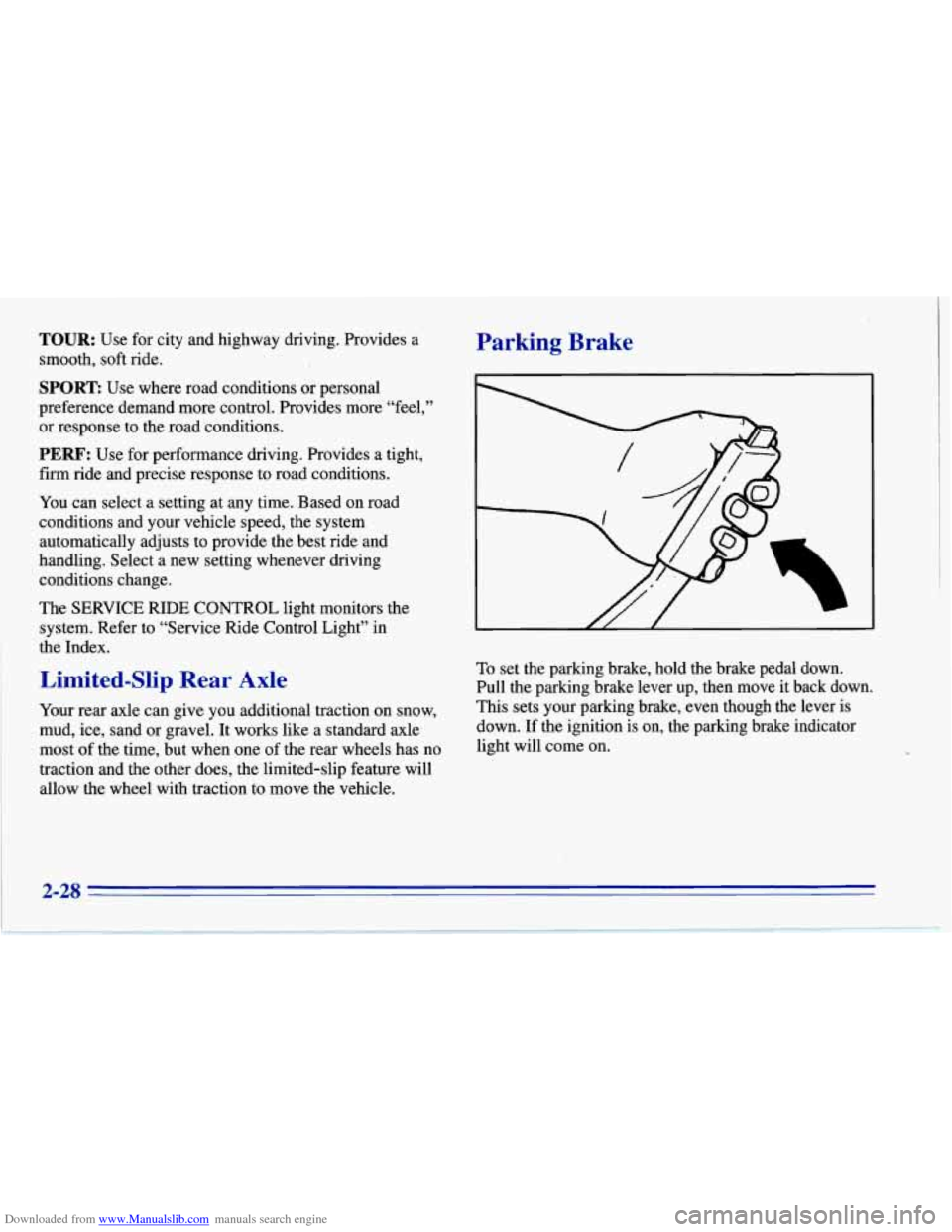
set the parking brake, hold the brake pedal down.
Pull the parking brake lever up, then move it back down.
This sets your parking brake, even though the lever is
down. If the ignition is on, the parking brake indicator
light will come on.
2-28
Page 78 of 386
Downloaded from www.Manualslib.com manuals search engine Tilt Wheel
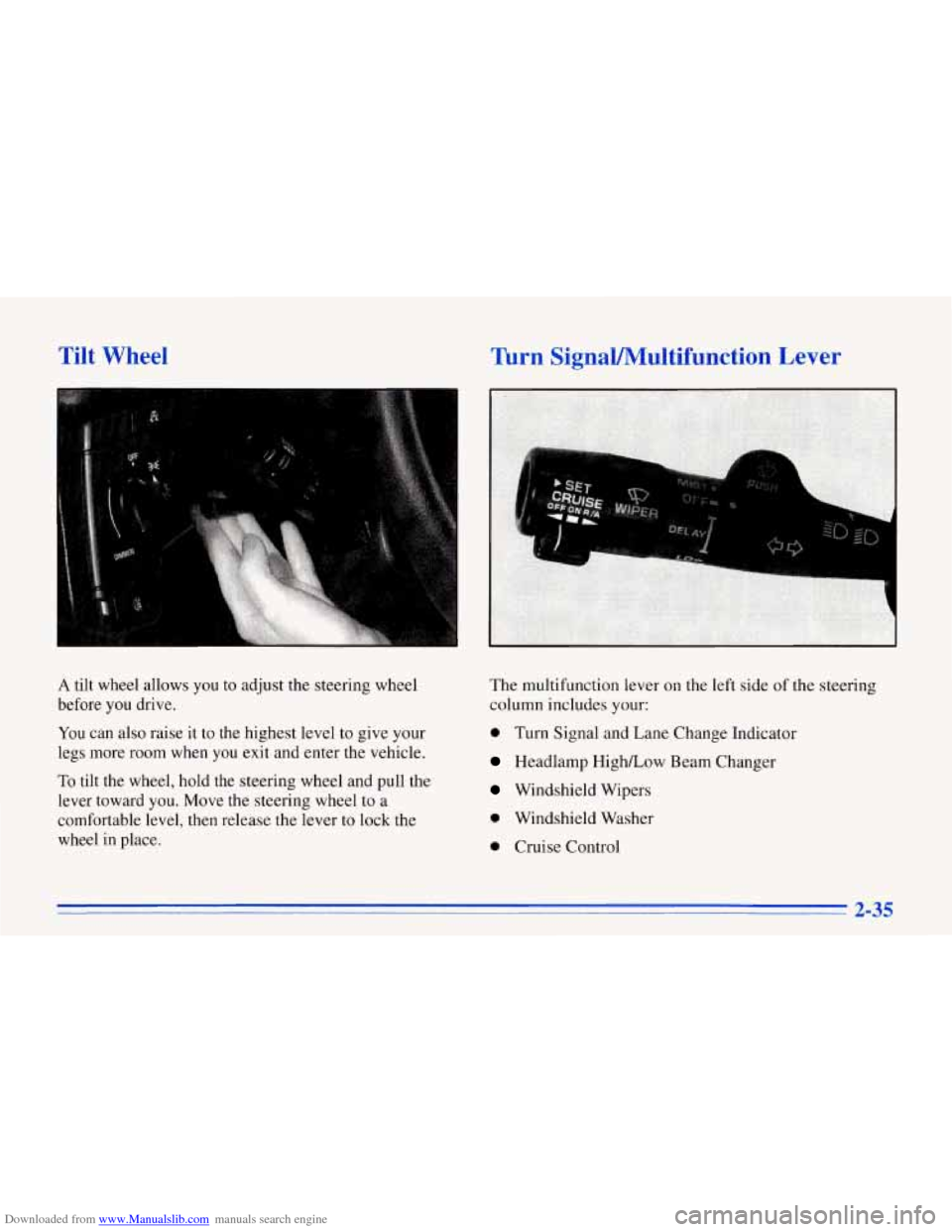
A tilt wheel allows you to adjust the steering wheel
before you drive.
You can also raise it to the highest level to give your
legs more
room when you exit and enter the vehicle,
To tilt the wheel, hold the steering wheel and pull the
lever toward you. Move the steering wheel to a
comfortable level, then release the lever to lock the
wheel in place.
Turn SignaYMultifunction Lever
The multifunction lever on the left side of the steering
column includes your:
0 Turn Signal and Lane Change Indicator
Headlamp HighLow Beam Changer
Windshield Wipers
0 Windshield Washer
0 Cruise Control
2-35
Page 82 of 386
Downloaded from www.Manualslib.com manuals search engine 1
I A CAUTION:
Cruise control can be dangerous where you
can’t drive safely at
a steady speed. So,
don’t use your cruise control on winding
roads or in heavy traffic.
slippery roads. On such roads, fast changes
in tire traction can cause needless wheel
spinning, and you could lose control. Don’t
use cruise control on slippery roads.
0 Cruise control can be dangerous on
If your vehicle is in cruise control when the ASR system
begins
to limit wheel spin, the cruise control will
automatically disengage. (See
“ASR System” in the
Index.) When road conditions allow you to safely use it
again, you may turn the cruise control back on.
Setting Cruise Contra1
If you leave your cruise control switch on when
you’re not using cruise,
you might hit a button and
go
into cruise when you don’t want to. You could
be startled and even lose control. Keep the cruise
control switch
OFF until you want to use it.
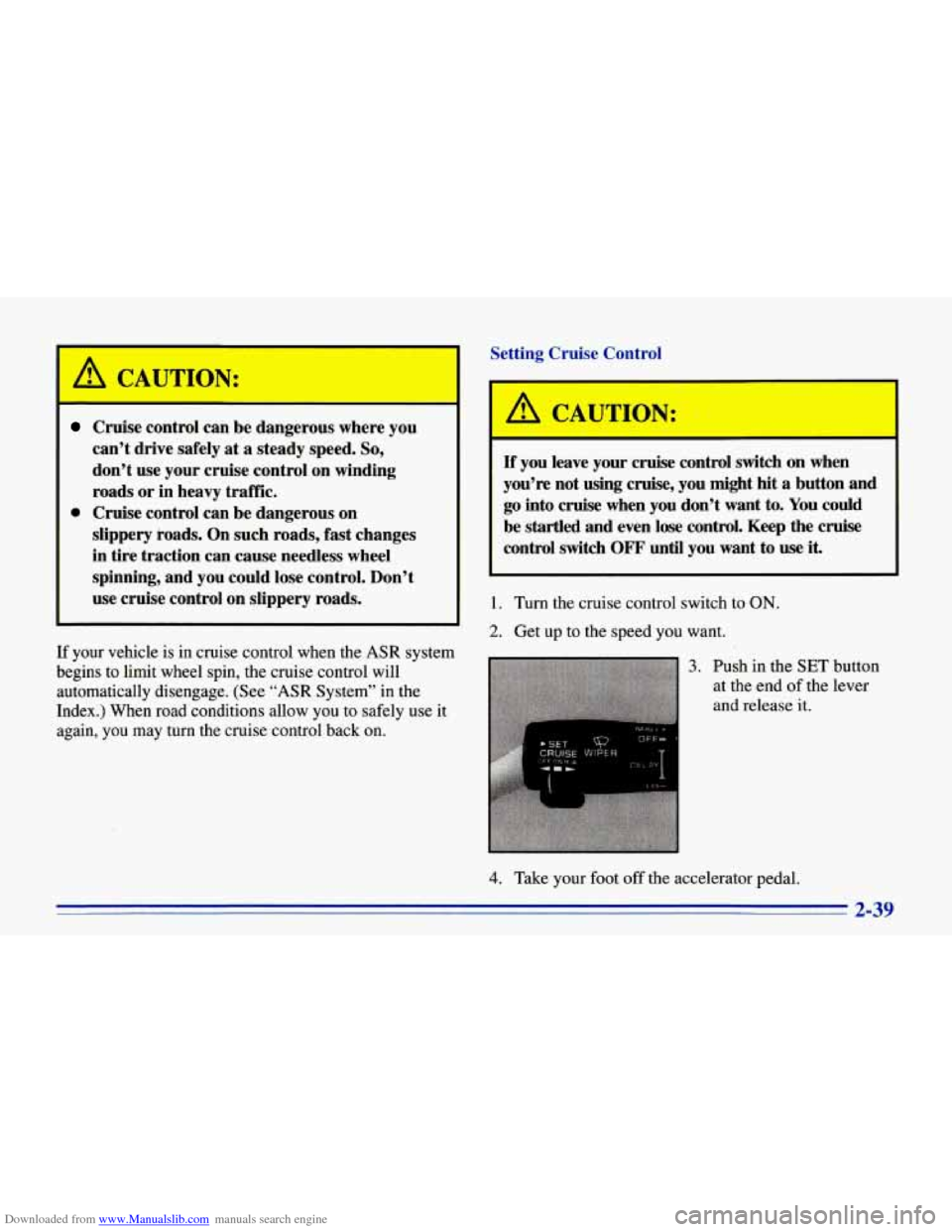
1. Turn the cruise control switch to ON.
2. Get up to the speed you want.
3. Push in the SET button
at the end
of the lever
and release
it.
4. Take your foot off the accelerator pedal.
2-39
Page 126 of 386
Downloaded from www.Manualslib.com manuals search engine Low Coolant Warning Light
LOW
COOLANT
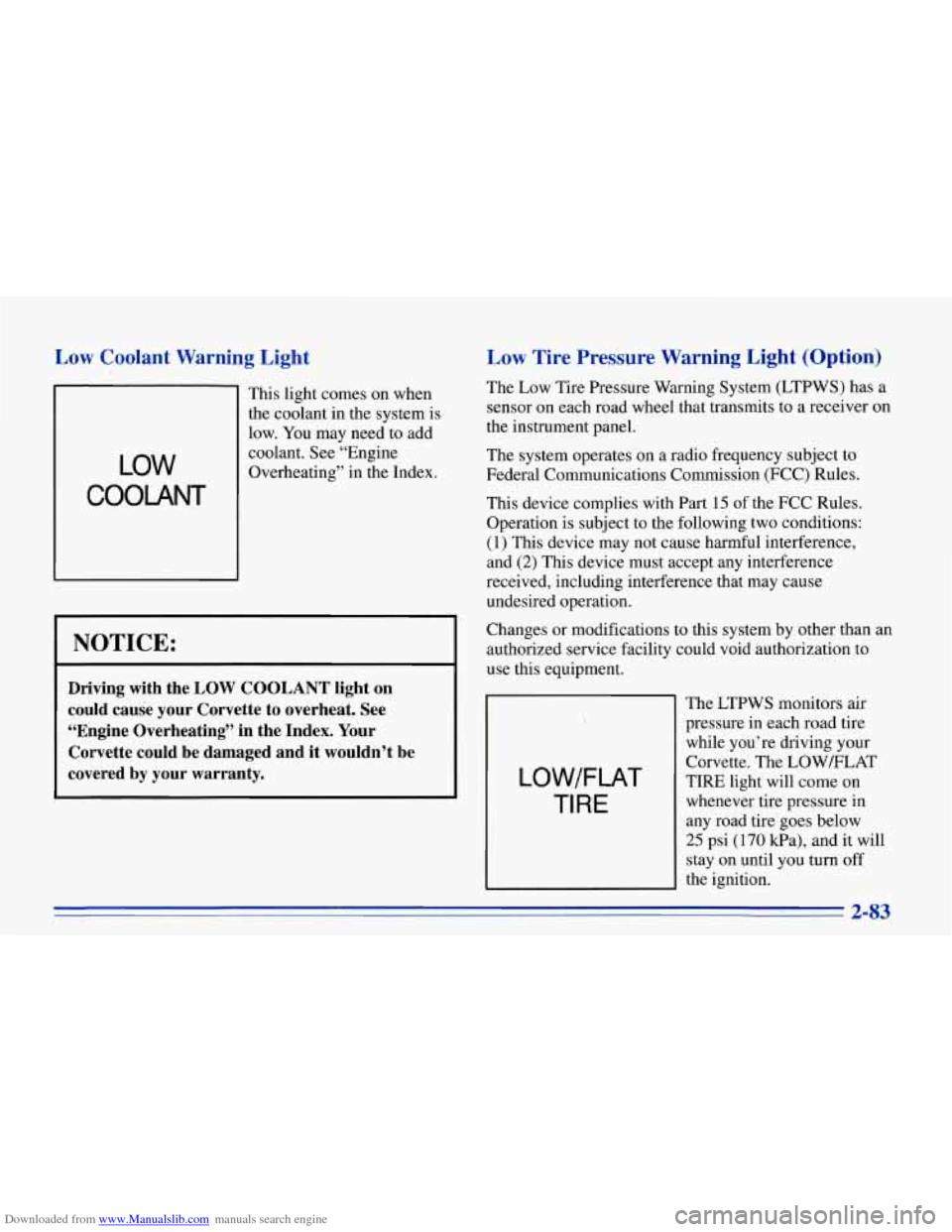
This light comes on when
the coolant in the system is
~ low. You may need to add
~ coolant. See “Engine
~ Overheating” in the Index.
I NOTICE:
Driving with the LOW COOLANT light on
could cause your Corvette to overheat. See
“Engine Overheating” in the Index. Your
Corvette could be damaged and it wouldn’t be
covered by your warranty.
Low Tire Pressure Warning Light (Option)
The Low Tire Pressure Warning System (LTPWS) has a
sensor on each road wheel that transmits to a receiver on
the instrument panel.
The system operates
on a radio frequency subject to
Federal Communications Commission (FCC) Rules.
This device complies with Part
15 of the FCC Rules.
Operation is subject to the following two conditions:
(1) This device may not cause harmful interference,
and
(2) This device must accept any interference
received, including interference that may cause
undesired operation.
Changes or modifications to this system by other than an
authorized service facility could void authorization to
use this equipment.
LOW/FLAT
TI RE
The LTPWS monitors air
pressure in each road tire
while you’re driving your
Corvette. The LOWELAT
TIRE light will come on
whenever tire pressure in
any road tire goes below
25 psi (170 kPa), and it will
stay on until
you turn off
the ignition.
2-83
Page 168 of 386
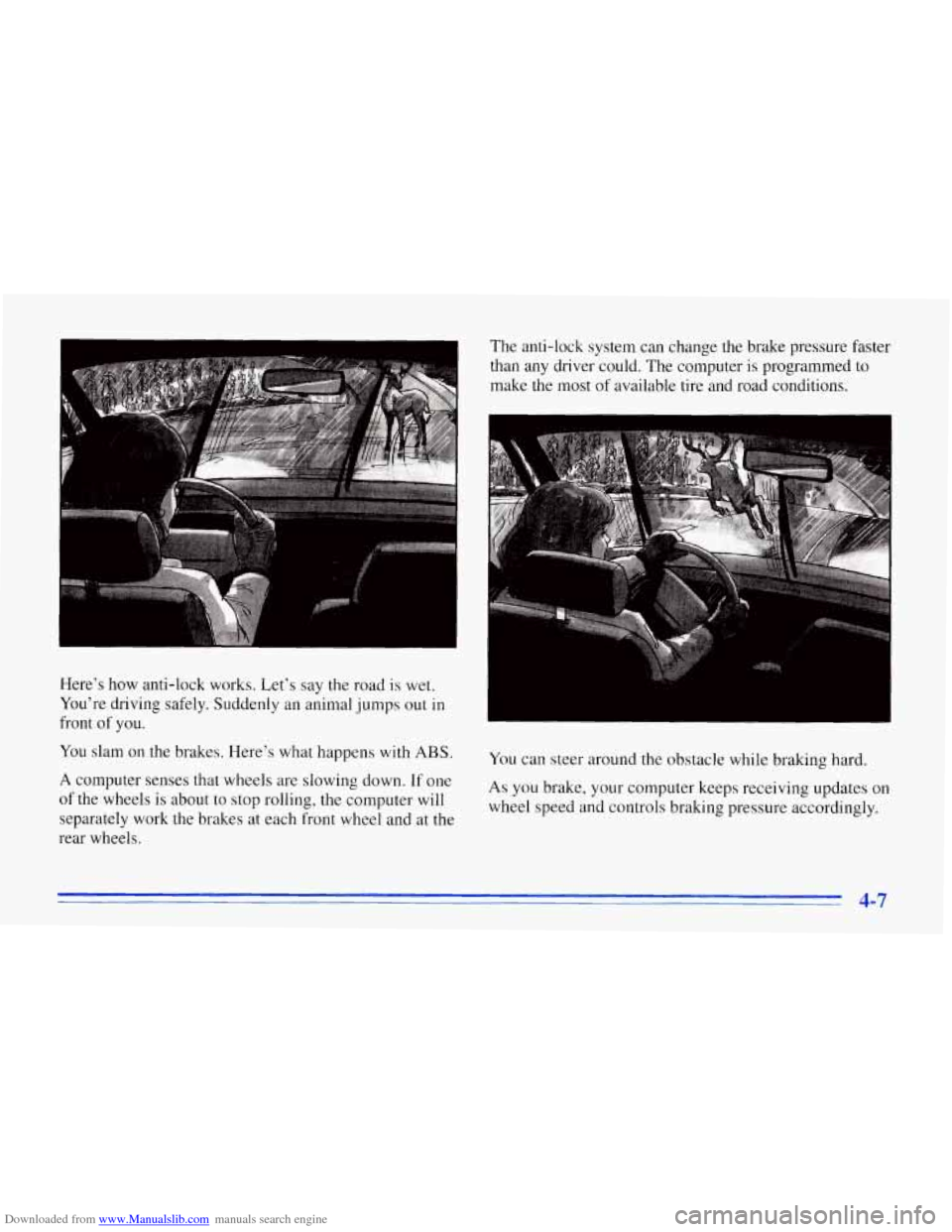
Downloaded from www.Manualslib.com manuals search engine Here’s how anti-lock works. Let’s say the road is wet. You’re driving safely. Suddenly an animal jumps out in
front
of you.
You slam on the brakes. Here’s what happens with ABS.
A computer senses that wheels are slowing down. If one
of the wheels is about to stop rolling, the computer will
separately work the brakes at each front wheel and at the
rear wheels. The anti-lock system can change the brake pressure faster
than any driver could. The computer is programmed to
make the most of available tire and road conditions.
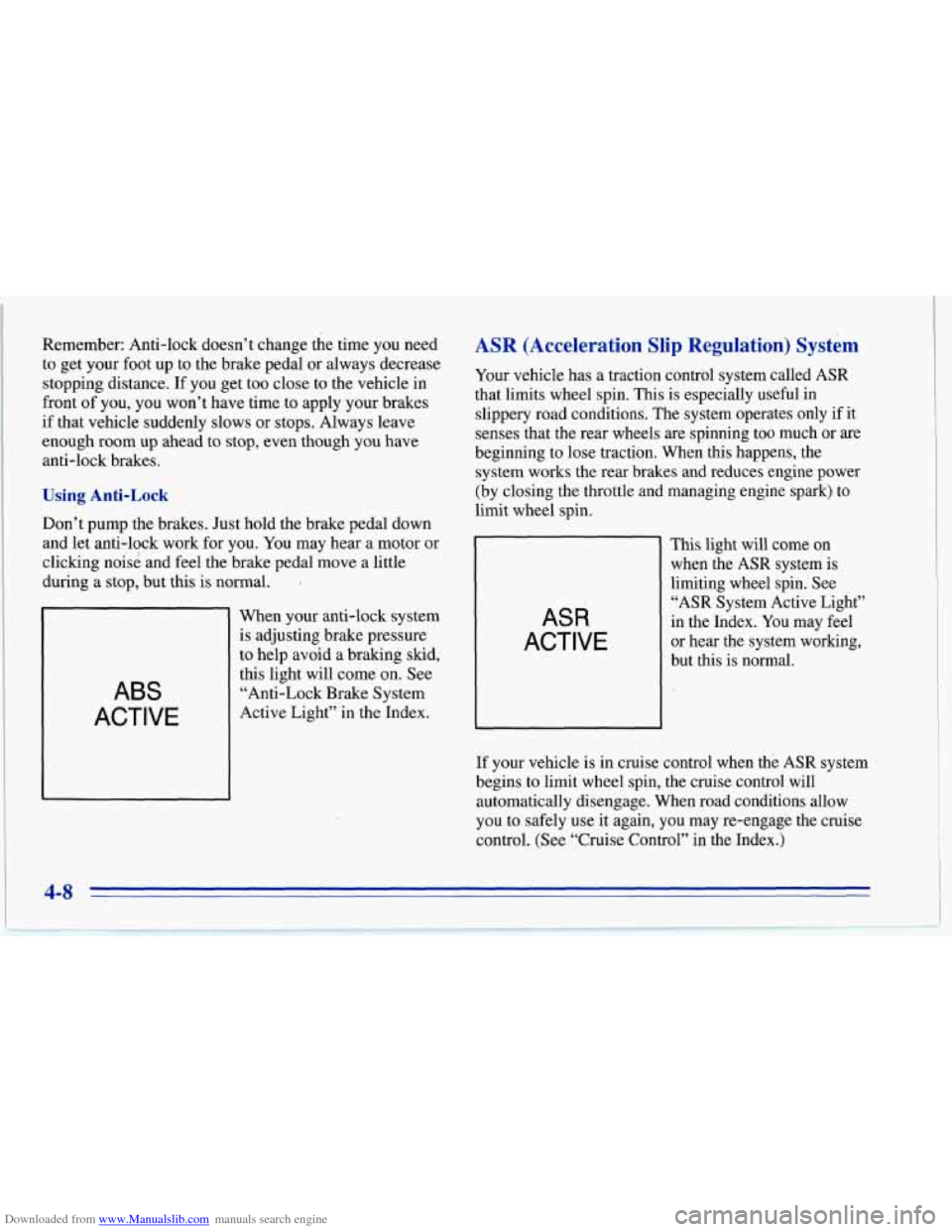
You can steer around the obstacle while braking hard. As you brake, your computer keeps receiving updates on
wheel speed and controls braking pressure accordingly.
- 4-7
Page 169 of 386
Downloaded from www.Manualslib.com manuals search engine Remember: Anti-lock doesn’t change the time you need
to get your foot up to the brake pedal or always decrease
stopping distance. If you get too close to the vehicle in
front of you, you won’t have time to apply your brakes
if that vehicle suddenly slows or stops. Always leave
enough room up ahead to stop, even though you have
anti-lock brakes.
Using Anti-Lock
Don’t pump the brakes. Just hold the brake pedal down
and let anti-lock work for you. You may hear a motor or
clicking noid and feel the brake pedal move a little
during
a stop, but this is normal.
ABS
ACTIVE
When your anti-lock system
is adjusting brake pressure
to help avoid a braking skid,
this light will come on. See
“Anti-Lock Brake System
Active Light” in the Index.
ASR (Acceleration Slip Regulation) System
Your vehicle has a traction control system called ASR
that limits wheel spin. This is especially useful in
slippery road conditions’. The system operates only if it
senses that the rear wheels
are spinning too much or are
beginning to lose traction. When this happens, the
system works the rear brakes and reduces engine power
(by closing the throttle and managing engine spark) to
limit wheel spin.
ASR
ACTIVE
This light will come on
when the ASR system is
limiting wheel spin. See
“ASR System Active Light”
in the Index. You may feel
or hear the system working,
but this is normal.
If your vehicle is in cruise control when the ASR system
begins to limit wheel spin, the cruise control will
automatically disengage. When road conditions allow
you to safely use it again, you may re-engage the cruise
control. (See “Cruise Control” in the Index.)
J
Page 171 of 386
Downloaded from www.Manualslib.com manuals search engine Steering
Power Steering
If you lose power steering assist because the engine
stops or the system is not functioning, you can steer but
it will take much more effort.
Steering Tips
Driving qn Curves
It’s important to take curves at a reasonable speed.
A lot
of the “driver lost control” accidents mentioned on
the news happen on curves. Here’s why:
Experienced driver or beginner, each
of us is subject to
the same laws
of physics when driving on curves. The
traction
of the tires against the road surface makes it
possible for the vehicle to change its path when you
turn
the front wheels. If there’s no traction, inertia will keep
the vehicle going in the same direction.
If you’ve ever
tried to steer a vehicle on wet ice, you’ll understand this.
The traction you can get in a curve depends on the
condition of your tires and the road surface, the angle at
which the curve is banked, and your speed. While you’re
in a curve, speed is the one factor you can control. Suppose
you’re steering through
a sharp curve. Then you
suddenly accelerate. Both control systems
-- steering and
acceleration -- have to do their work where the tires meet
the road. Unless your
ASR system is on, adding the
sudden acceleration can demand too much
of those
places. You can lose control.
What should you do if this ever happens? Ease up on the
accelerator pedal, steer the vehicle the way you want it
to go, and slow down.
Speed limit signs near curves warn that you should
adjust your speed.
Of course, the posted speeds are
based on good weather and road conditions. Under less
favorable conditions you’ll want to go slower.
If you need to reduce your speed as you approach a
curve, do it before you enter the curve, while your front
wheels are straight ahead.
Try to adjust your speed so you can “drive” through the
curve. Maintain a reasonable, steady speed. Wait to
accelerate until you are out
of the curve, and then
accelerate gently into the straightaway.
Page 175 of 386
Downloaded from www.Manualslib.com manuals search engine Loss of Control
Let’s review what driving experts say about what
happens when the three control systems (brakes, steering
and acceleration) don’t have enough friction where the
tires meet the road to ,do what the driver has asked.
In any emergency, don’t give up. Keep trying to
steer and constantly seek an escape route or area of
less danger.
Skidding
In a skid, a driver can lose control of the vehicle.
Defensive drivers avoid most skids by taking reasonable
care suited to existing conditions, and by not “overdriving”\
those conditions. But skids
are always possible.
The three types of skids correspond to your Corvette’s
three control systems. In the braking skid, your wheels
aren’t rolling. In the steering or cornering skid, too
much speed or steering in a curve causes tires to slip and
lose cornering force. And in the acceleration skid, too
much throttle causes the driving wheels to spin.
A cornering skid is best handled by easing your foot off
the accelerator pedal.
Remember: Any
ASR system helps avoid only the
acceleration skid. If
your
ASR system is off, then an acceleration skid
is also best handled by easing your foot
off the
accelerator pedal.
If your vehicle starts to slide, ease your foot off the
accelerator pedal and quickly steer the way you want the
vehicle to go.
If you start steering quickly enough, your
vehicle may straighten out. Always be ready for a
second skid
if it occurs.
Of course, traction is reduced when water, snow, ice,
gravel or other material is on the road. For safety, you’ll
want to slow down and adjust your driving to these
conditions. It is important to slow down on slippery
surfaces because stopping distance will be longer and
vehicle control more limited.
While driving on a surface with reduced traction,
try your
best to avoid sudden steering, acceleration or braking (including engine braking by shifting to a lower gear).
Any sudden changes could cause the tires to slide.
You
may not realize the surface is slippery until your vehicle
is skidding. Learn to recognize warning clues
-- such as
enough water, ice or packed snow on the road to make a
“mirrored surface”
-- and slow down when you have
any doubt.
Remember: Any anti-lock brake system (ABS) helps
avoid only the braking skid.
4-14
Page 197 of 386
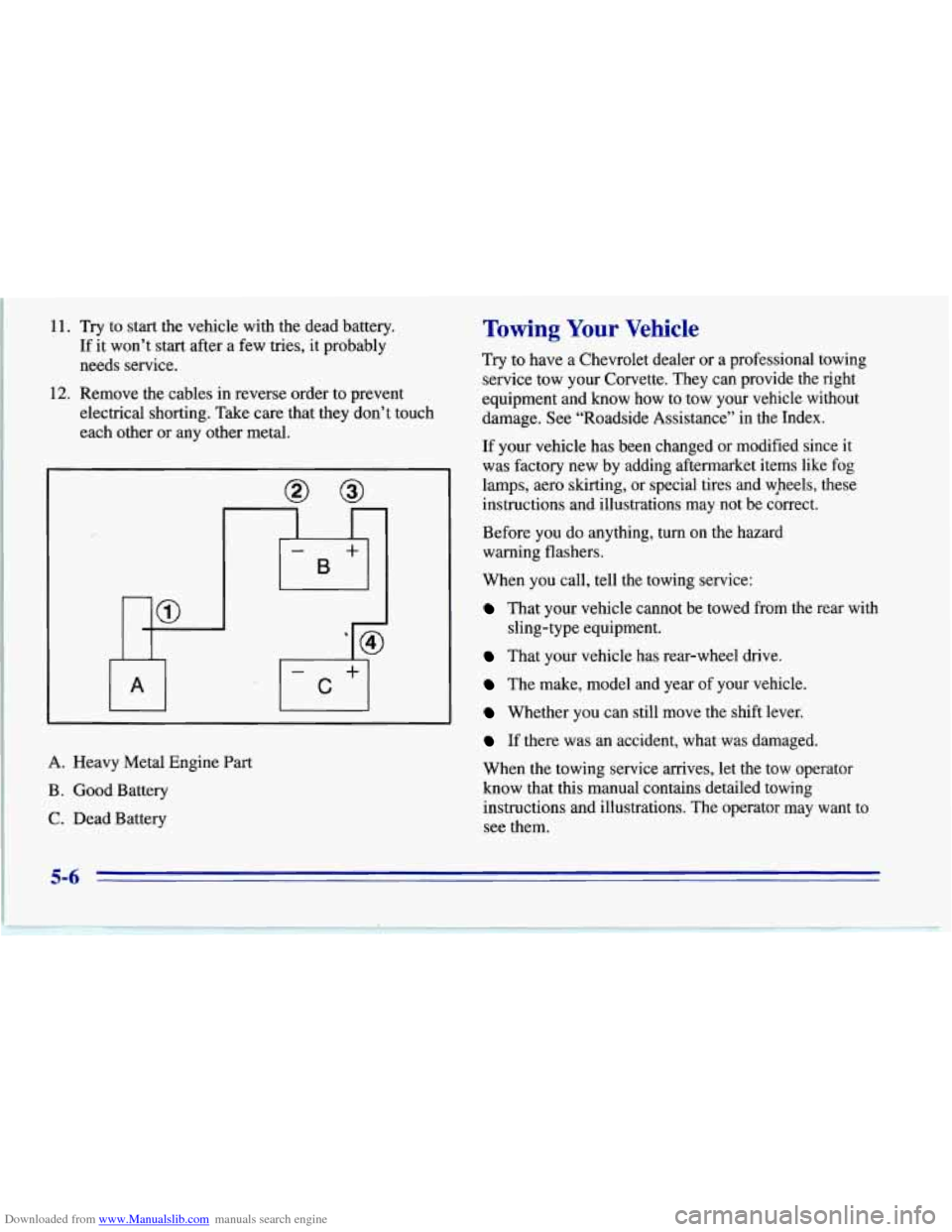
Downloaded from www.Manualslib.com manuals search engine 11. Try to start the vehicle with the dead battery.
If it won’t start after a few tries, it probably
needs service.
12. Remove the cables in reverse order to prevent
electrical shorting. Take care that they don’t touch
each other or any other metal.
I
AI
A. Heavy Metal Engine Part
B. Good Battery
C. Dead Battery
Towing Your Vehicle
Try to have a Chevrolet dealer or a professional towing
service tow your Corvette. They can provide the right
equipment and know how to tow your vehicle without
damage. See “Roadside Assistance” in the Index.
If your vehicle has been changed or modified since it
was factory new by adding aftermarket items like fog
lamps, aero skirting, or special tires and wbeels, these
instructions and illustrations may not be cbrrect.
Before you do anything, turn on the hazard
warning flashers.
When you call, tell the towing service:
That your vehicle cannot be towed from the rear with
That your vehicle has rear-wheel drive.
The make, model and year of your vehicle.
Whether you can still move the shift lever.
If there was an accident, what was damaged.
When the towing service arrives, let the tow operator
know that this manual contains detailed towing
instructions and illustrations. The operator may want to
see them.
sling-type equipment.
5-6
Page 213 of 386
Downloaded from www.Manualslib.com manuals search engine If a Tire Goes Flat
It’s unusual for a tire to “blow out’’ while you’re driving,
especially if you maintain your tires properly. If air goes
out of a tire, it’s much more likely to leak out slowly.
But if you should ever have a “blowout,” here are a few
tips about what to expect and what to do:
If a front tire fails, the flat tire will create a drag that
pulls the vehicle toward that side. Take your foot
off
the accelerator pedal and grip the steering wheel firmly.
Steer to maintain lane position, and then gently brake
to
a stop well out of the traffic lane.
A rear blowout, particularly on a curve, acts much like a
skid and may require the same correction you’d use in a
skid. In any rear blowout, remove your foot from the
accelerator pedal. Get
the vehicle under control by
steering the way you want the vehicle to go. It may be
very bumpy and noisy, but you can still steer. Gently
brake to a stop
-- well off the road if possible.
If
a tire goes flat, the next part shows how to use your
jacking equipment to change a flat tire safely. If your
vehicle has Extended Mobility Tires (tires with
“EMT”
molded on the sidewalls), see “Extended Mobility Tires”
in the Index.
.Changing a Flat Tire
If a tire goes flat, avoid further tire and wheel damage
by driving slowly to a level place. Turn on your hazard
warning flashers.
A CAUTION:
3
Changing a tire can cause an injury. The vehicle
can slip off the jack and roll over you or other
people. You and they could be badly injured.
Find
a level place to change your tire. To help
prevent the vehicle from moving:
1. Set the parking brake firmly.
2. Put an automatic transmission shift lever in
PARK (P), or shift a manual transmission
to
FIRST (1) or REVERSE (R).
3. lbrn off the engine.
To
be even more certain the vehicle won’t move,
you can put blocks at the front and rear of the
tire farthest away from the one being changed.
That would be the tire on the other side of the
vehicle, at the opposite end.