power steering CHEVROLET CORVETTE 1996 4.G Owners Manual
[x] Cancel search | Manufacturer: CHEVROLET, Model Year: 1996, Model line: CORVETTE, Model: CHEVROLET CORVETTE 1996 4.GPages: 386, PDF Size: 20.12 MB
Page 59 of 386
Downloaded from www.Manualslib.com manuals search engine Ignition Positions
C
I
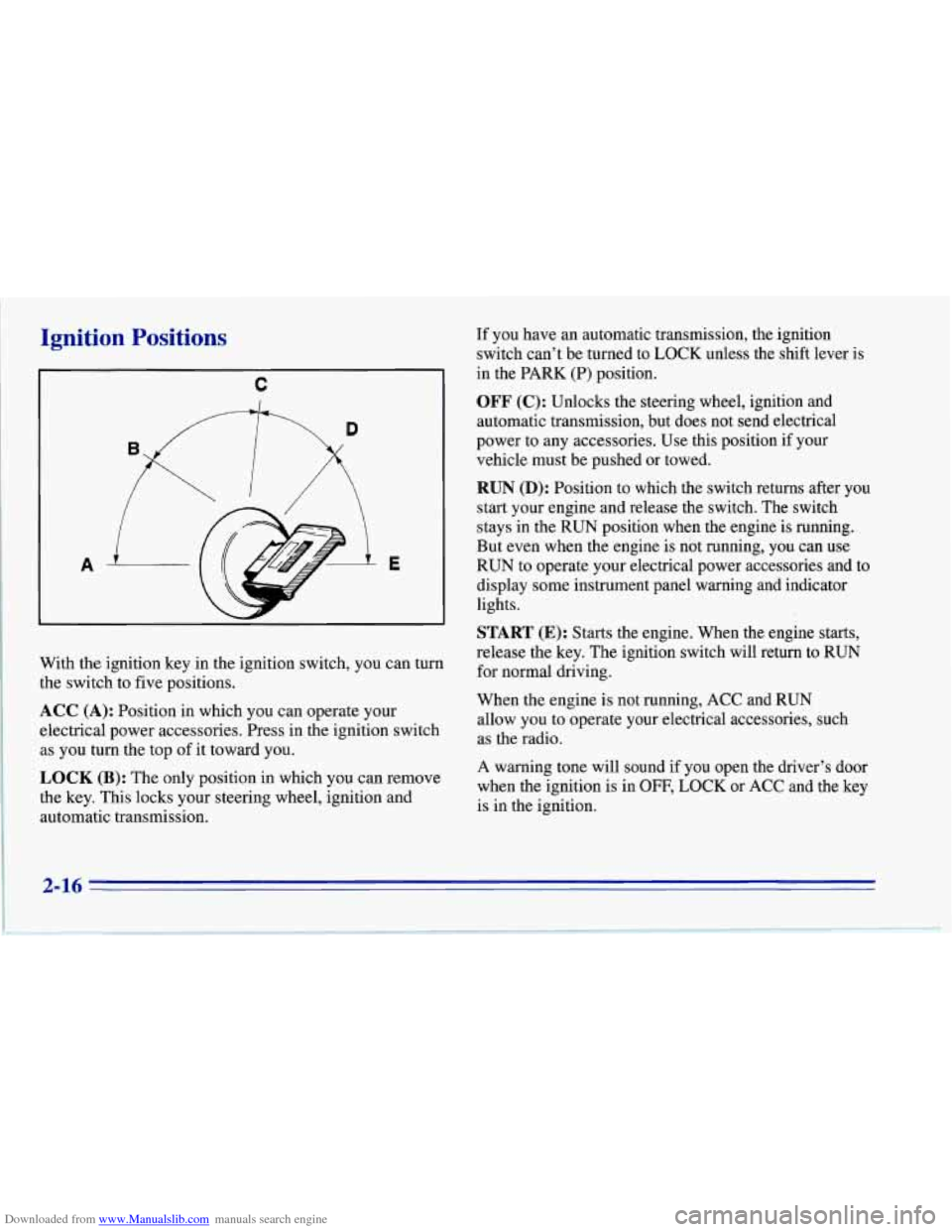
With the ignition key in the ignition switch, you can turn
the switch to five positions.
ACC (A): Position in which you can operate your
electrical power accessories. Press in the ignition switch
as you turn the top of it toward you.
OCK (B): The only position in which you can remove
the key. This locks your steering wheel, ignition and
automatic transmission. If you
have an automatic transmission, the ignition
switch can't be turned to LOCK unless the shift lever is
in the PARK (P) position.
OFF (C): Unlocks the steering wheel, ignition and
automatic transmission, but does not send electrical
power to any accessories. Use this position if your
vehicle must be pushed or towed.
RUN (D): Position to which the switch returns after you
start your engine and release the switch. The switch
stays in the RUN position when the engine is running.
But even when the engine is not running, you can use
RUN to operate your electrical power accessories and to
display some instrument panel warning and indicator
lights.
START (E): Starts the engine. When the engine starts,
release the key. The ignition switch will return to RUN
for normal driving.
When the engine is not running, ACC and RUN
allow you to operate your electrical accessories, such
as the radio.
A warning tone will sound
if you open the driver's door
when the ignition is in
OFF, LOCK or ACC and the key
is in the ignition.
2-16
Page 60 of 386
Downloaded from www.Manualslib.com manuals search engine Key Release Button
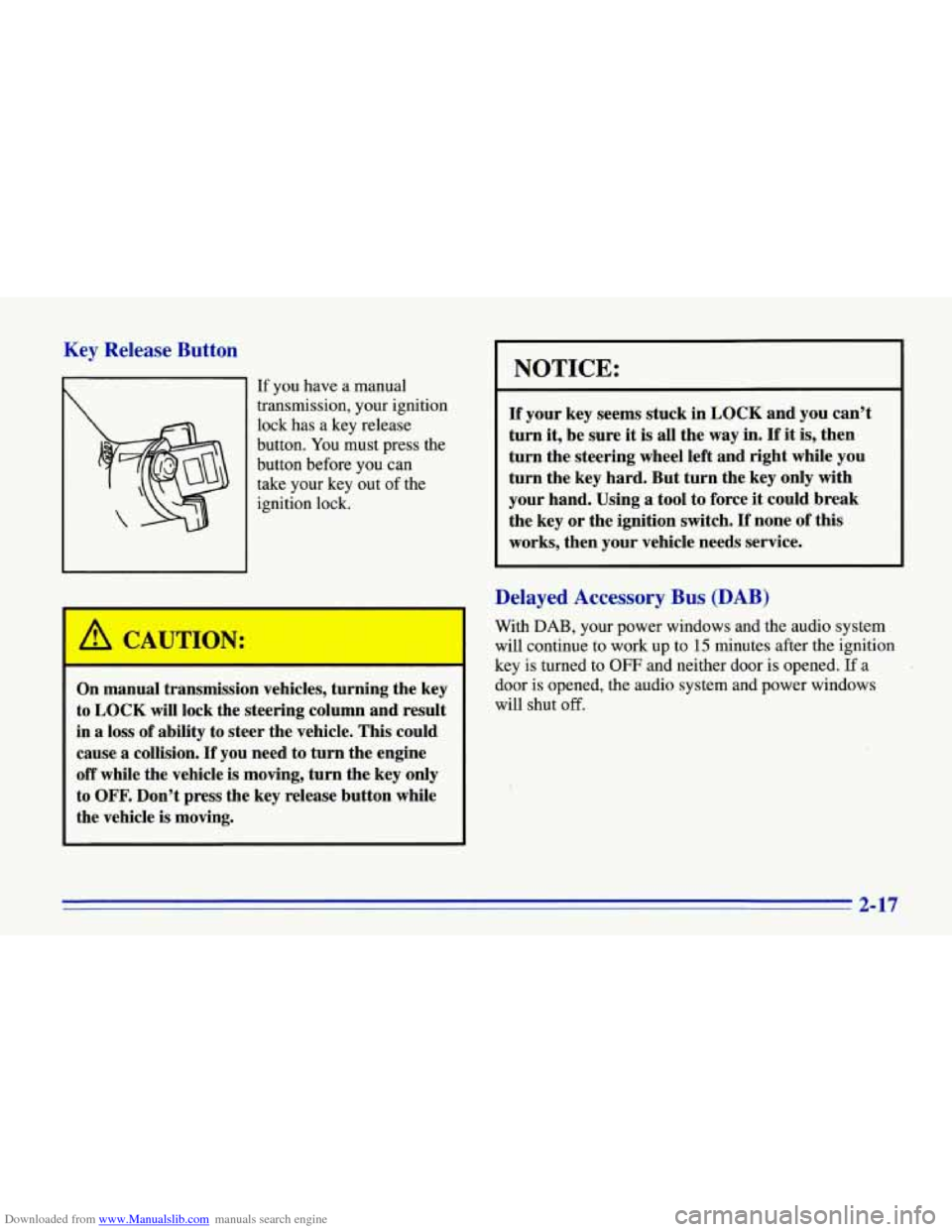
If you have a manual
transmission, your ignition
lock has a key release
button. You must press the
button before you can
take your key out
of the
ignition lock.
CAUTION:
On manual transmission vehicles, turning the key
to LOCK will lock the steering column and result
in a loss of ability to steer the vehicle. This could
cause a colIision.
If you need to turn the engine
off while the vehicle is moving, turn the key only
to
OFF. Don’t press the key release button while
the vehicle
is moving.
I NOTICE:
If your key seems stuck in LOCK and you can’t
turn
it, be sure it is all the way in. If it is, then
turn the steering wheel left and right while you
turn the key hard. But turn the key only with
your hand. Using
a tool to force it could break
the key or the ignition switch.
If none of this
works, then your vehicle needs service.
Delayed Accessory Bus (DAB)
With DAB, your power windows and the audio system
will continue to work up to
15 minutes after the ignition
key is turned to
OFF and neither door is opened. If a
door is opened, the audio system and power windows
will shut
off.
Y
2-17
Page 77 of 386
Downloaded from www.Manualslib.com manuals search engine Windows
Power Windows
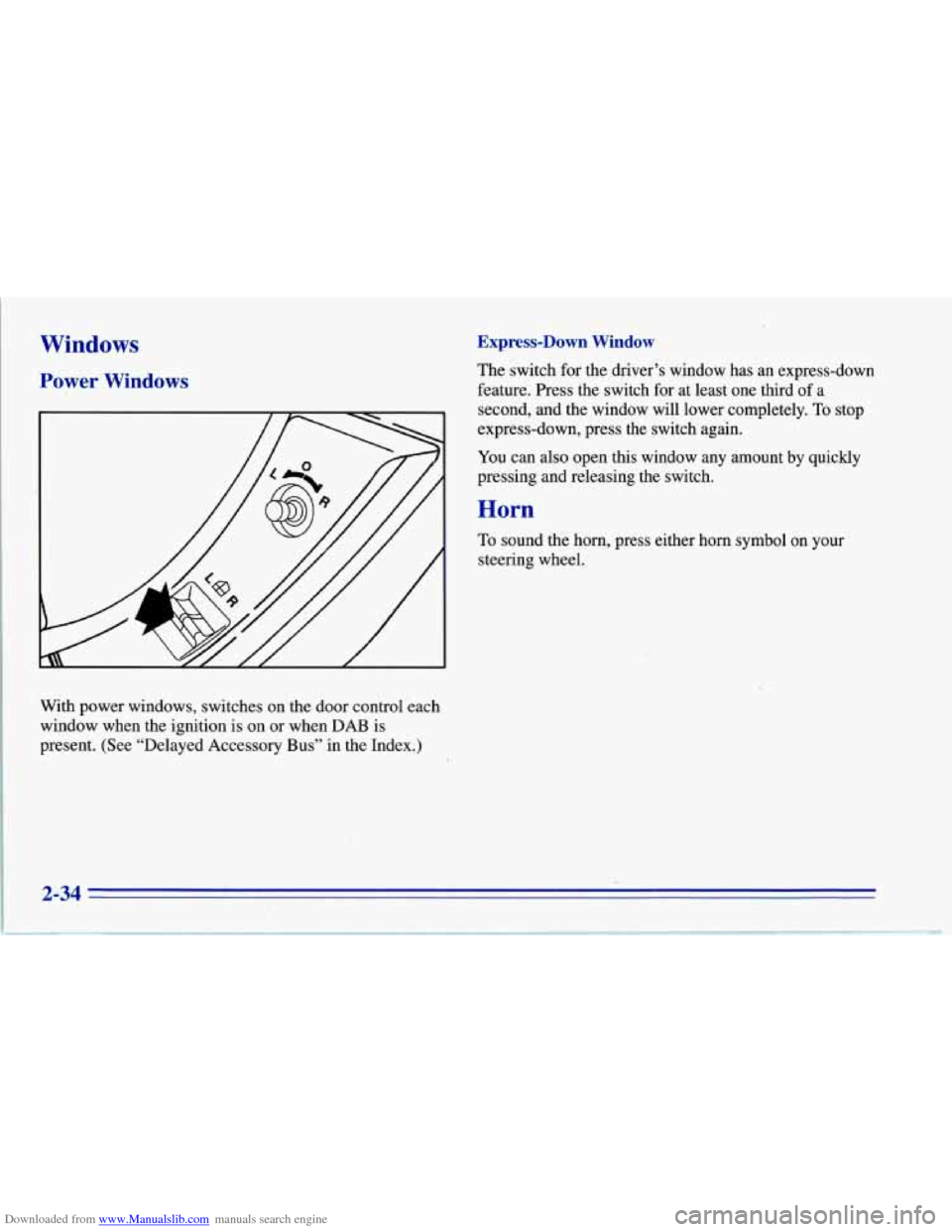
With power windows, switches on the door control each
window when the ignition is on or when DAB is
present. (See “Delayed Accessory
Bus” in the Index.)
Express-Down Window
The switch for the driver’s window has an express-down
feature. Press the switch for at least one third of
a
second, and the window will lower completely. To stop
express-down, press the switch again.
You can also open this window any amount by quickly
pressing and releasing the switch.
Horn
To sound the horn, press either horn symbol on your
steering wheel.
Page 171 of 386
Downloaded from www.Manualslib.com manuals search engine Steering
Power Steering
If you lose power steering assist because the engine
stops or the system is not functioning, you can steer but
it will take much more effort.
Steering Tips
Driving qn Curves
It’s important to take curves at a reasonable speed.
A lot
of the “driver lost control” accidents mentioned on
the news happen on curves. Here’s why:
Experienced driver or beginner, each
of us is subject to
the same laws
of physics when driving on curves. The
traction
of the tires against the road surface makes it
possible for the vehicle to change its path when you
turn
the front wheels. If there’s no traction, inertia will keep
the vehicle going in the same direction.
If you’ve ever
tried to steer a vehicle on wet ice, you’ll understand this.
The traction you can get in a curve depends on the
condition of your tires and the road surface, the angle at
which the curve is banked, and your speed. While you’re
in a curve, speed is the one factor you can control. Suppose
you’re steering through
a sharp curve. Then you
suddenly accelerate. Both control systems
-- steering and
acceleration -- have to do their work where the tires meet
the road. Unless your
ASR system is on, adding the
sudden acceleration can demand too much
of those
places. You can lose control.
What should you do if this ever happens? Ease up on the
accelerator pedal, steer the vehicle the way you want it
to go, and slow down.
Speed limit signs near curves warn that you should
adjust your speed.
Of course, the posted speeds are
based on good weather and road conditions. Under less
favorable conditions you’ll want to go slower.
If you need to reduce your speed as you approach a
curve, do it before you enter the curve, while your front
wheels are straight ahead.
Try to adjust your speed so you can “drive” through the
curve. Maintain a reasonable, steady speed. Wait to
accelerate until you are out
of the curve, and then
accelerate gently into the straightaway.
Page 239 of 386
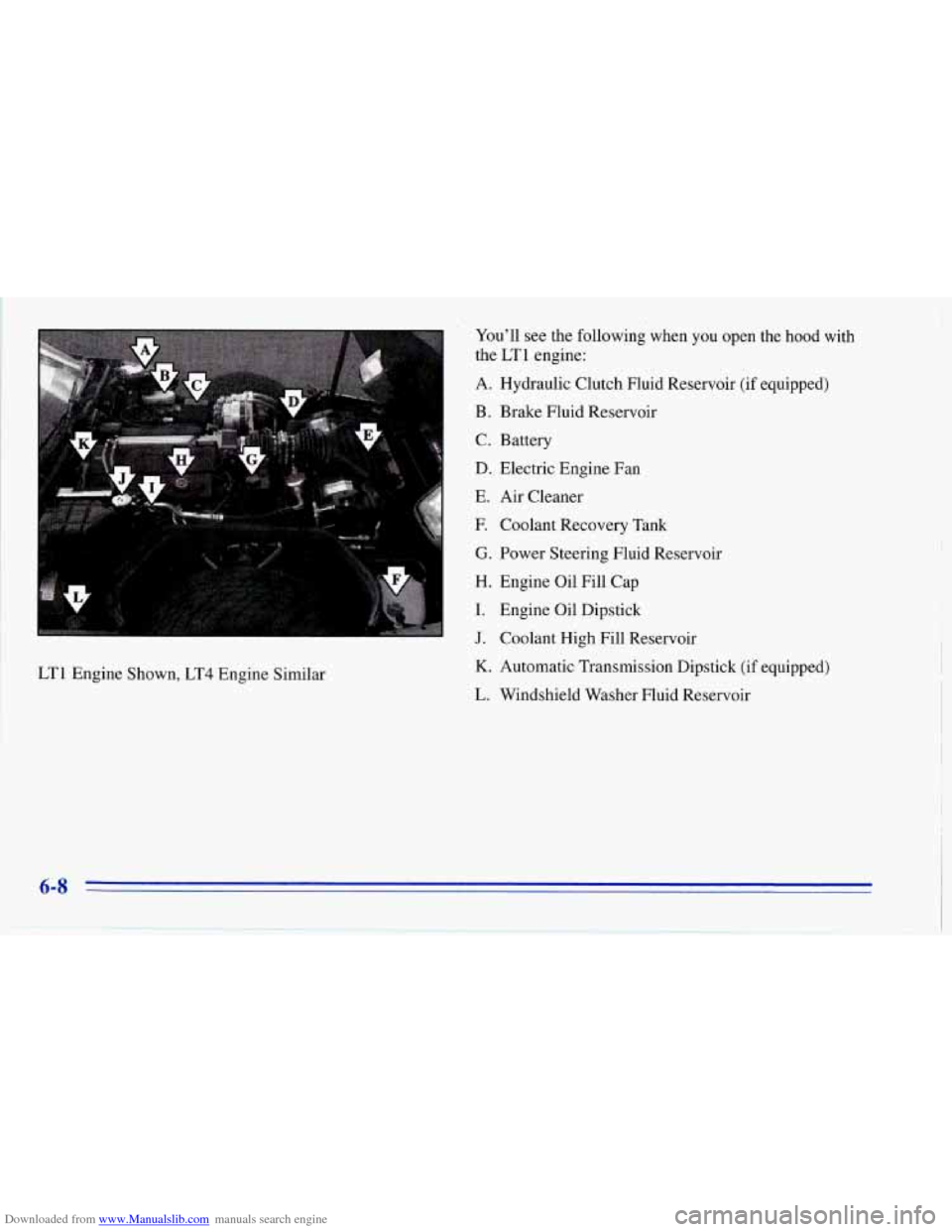
Downloaded from www.Manualslib.com manuals search engine LT1 Engine Shown, LT4 Engine Similar You’ll
see the following when you open the hood with
the
LT1 engine:
A. Hydraulic Clutch Fluid Reservoir
(if equipped)
B. Brake Fluid Reservoir
C. Battery
D. Electric Engine Fan
E. Air Cleaner
E Coolant Recovery Tank
G. Power Steering Fluid Reservoir
H. Engine Oil Fill Cap
I. Engine Oil Dipstick
J. Coolant High Fill Reservoir
K. Automatic Transmission Dipstick (if equipped)
L. Windshield Washer Fluid Reservoir
6-8
Page 260 of 386
Downloaded from www.Manualslib.com manuals search engine Coolant High Fill Reservoir Cap
NOTICE:
Your coolant high fill reservoir cap is a 15 psi
(105 kPa) pressure-type cap and must be tightly
installed to prevent coolant loss
and possible
engine damage from overheating. Be sure the
arrows on the cap line up with the overflow tube.
Thermostat
Engine coolant temperature is controlled by a thermostat
in the engine coolant system. The thermostat stops the
flow of coolant through the radiator until the coolant
reaches a pre-set temperature.
Power Steering Fluid
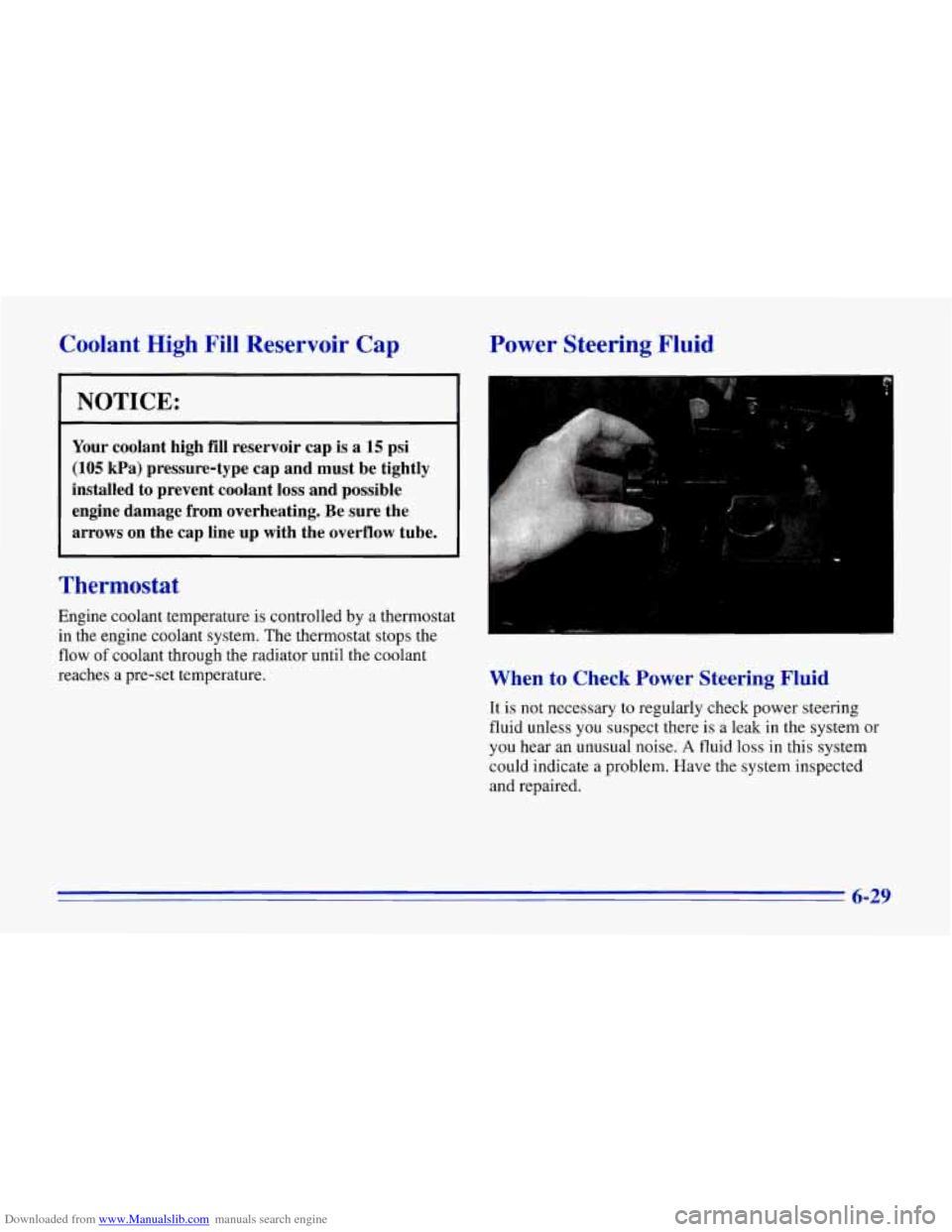
When to Check Power Steering Fluid
It is not necessary to regularly check power steering
fluid unless you suspect there is a leak in the system or
you hear an unusual noise.
A fluid loss in this system
could indicate a problem. Have the system inspected
and repaired.
6-29
Page 261 of 386
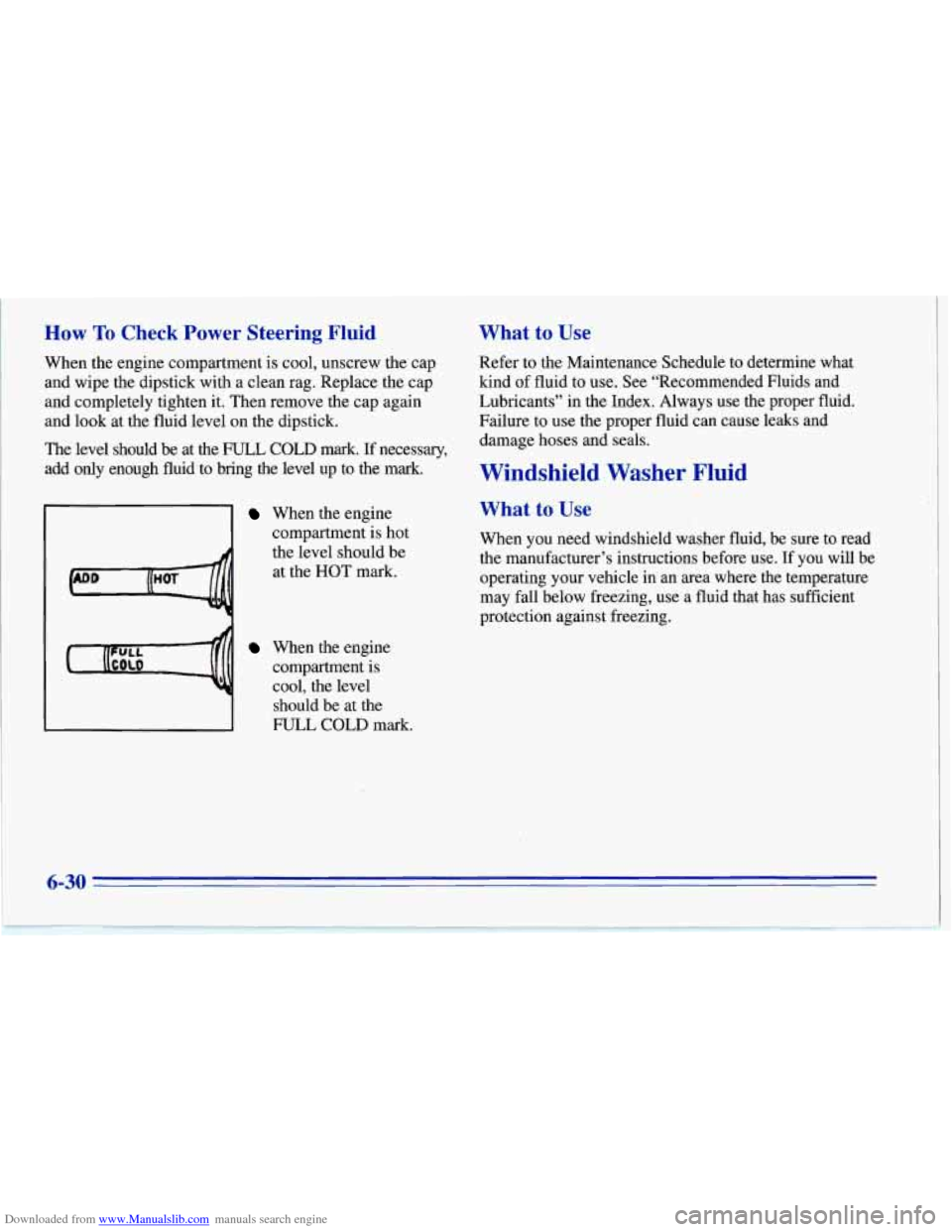
Downloaded from www.Manualslib.com manuals search engine How To Check Power Steering Fluid
When the engine compartment is cool, unscrew the cap
and wipe the dipstick with a clean rag. Replace the cap
and completely tighten it. Then remove the cap again
and look at the fluid level on the dipstick.
The level should
be at the FULL COLD mark. If necessary,
add
only enough fluid to bring the level up to the mark.
When the engine
compartment is hot
the kvel should be
at the
HOT mark.
[rfl
When the engine
compartment is
cool, the level
should be at
the
FULL COLD mark.
What to Use
Refer to the Maintenance Schedule to determine what
kind of fluid to use. See “Recommended Fluids and
Lubricants” in the Index. Always use the proper fluid.
Failure to use the proper fluid can cause leaks and
damage hoses and seals.
Windshield Washer Fluid
What to Use
When you need windshield washer fluid,.be sure to read
the manufacturer’s instructions before use.
If you will be
operating your vehicle in an area where the temperature
may fall below freezing, use a fluid that has sufficient
protection against freezing.
Page 355 of 386
Downloaded from www.Manualslib.com manuals search engine Part C: Periodic Maintenance
Inspections
Listed below are inspections and services which should
be performed at least twice a year (for instance, each
spring and fall). You should let your GM dealer’s
service department or other qualified service center do
these jobs. Make sure any necessary repairs are
completed at once.
Proper procedures to perform these services may be
found in a Corvette service manual. See “Service and
Owner Publications” in the Index.
.
Steering and Suspension Inspection
Inspect the front and rear suspension and steering
system for damaged, loose or missing
parts, signs of
wear, or lack
of lubrication. Inspect the power steering
lines and hoses for proper hook-up, binding, leaks,
cracks, chafing, etc.
Tire and Wheel Inspection
Inspect the tires for uneven wear or damage. If there is
irregular or premature wear, check the wheel alignment.
Inspect for damaged wheels.
7-44
Page 358 of 386
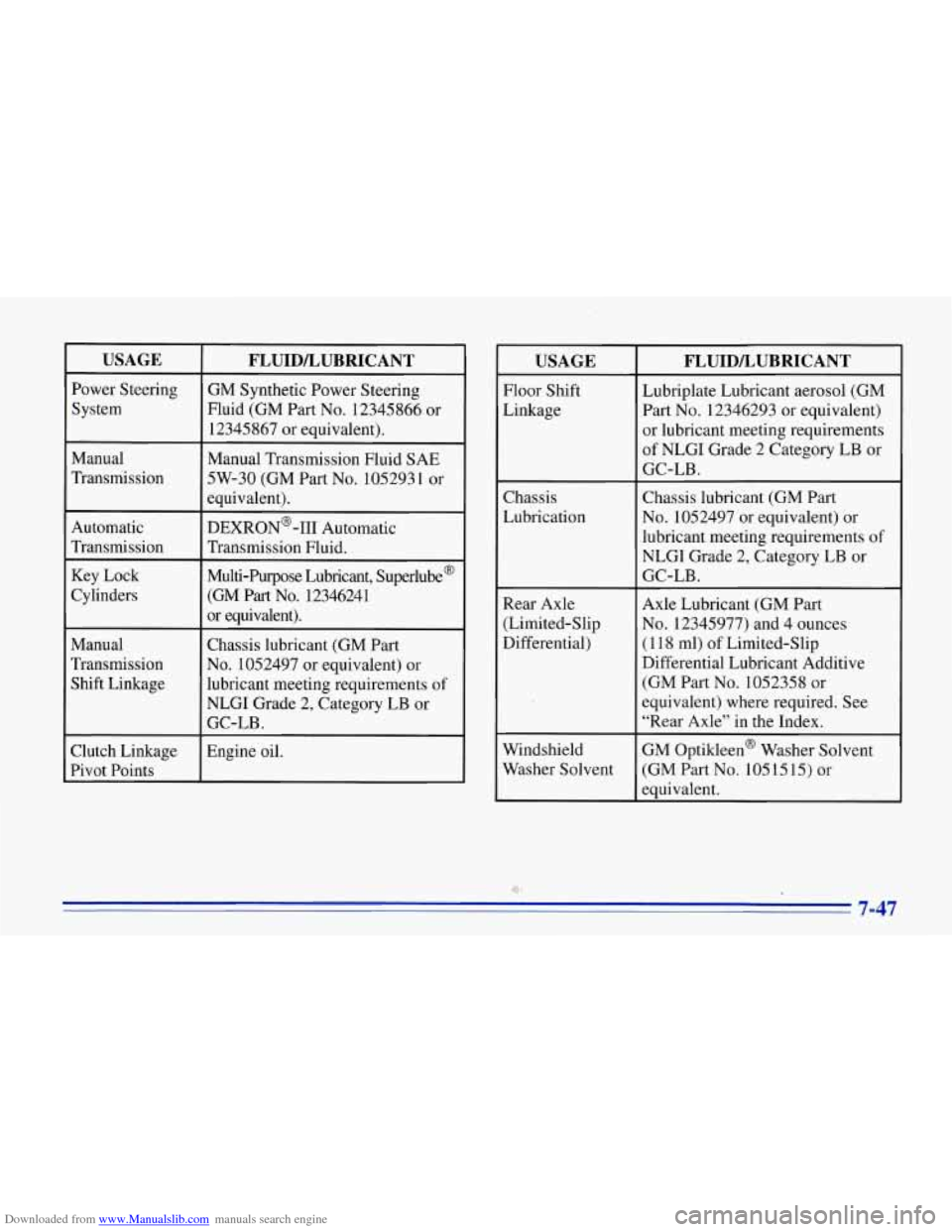
Downloaded from www.Manualslib.com manuals search engine USAGE
Power Steering System
Manual
Transmission
Automatic
Transmission
Key Lock
Cylinders
Manual
Transmission
Shift Linkage
Clutch Linkage
Pivot Points
FLUIDLUBRICANT
GM Synthetic Power Steering
Fluid (GM Part
No. 12345866 or
12345867 or equivalent).
Manual Transmission Fluid SAE
5W-30 (GM Part No. 1052931 or
equivalent).
DEXRON@-111 Automatic
Transmission Fluid.
Multi-Purpose Lubricant, Superlube@
(GM Part No. 12346241
or equivalent).
Chassis lubricant (GM Part
No. 1052497 or equivalent) or
lubricant meeting requirements
of
NLGI Grade 2, Category LB or
GC-LB.
Engine oil.
USAGE
Floor Shift
Linkage
Chassis
Lubrication
Rear Axle (Limited-Slip
Differential)
Windshield
Washer Solvent
FLUID/LUBRICANT
Lubriplate Lubricant aerosol (GM
Part No. 12346293 or equivalent)
or lubricant meeting requirements
of NLGI Grade 2 Category LB or
GC-LB.
Chassis lubricant (GM Part
No. 1052497 or equivalent) or
lubricant meeting requirements of
NLGI Grade 2, Category
LB or
GC-LB.
Axle Lubricant (GM Part
No. 12345977) and
4 ounces
(1 18 ml)
of Limited-Slip
Differential Lubricant Additive
(GM Part No. 1052358 or
equivalent) where required. See
“Rear Axle” in the Index.
GM Optikleen@ Washer Solvent
(GM Part No. 1051515) or
eauivalent.
f&.
7-47
Page 380 of 386
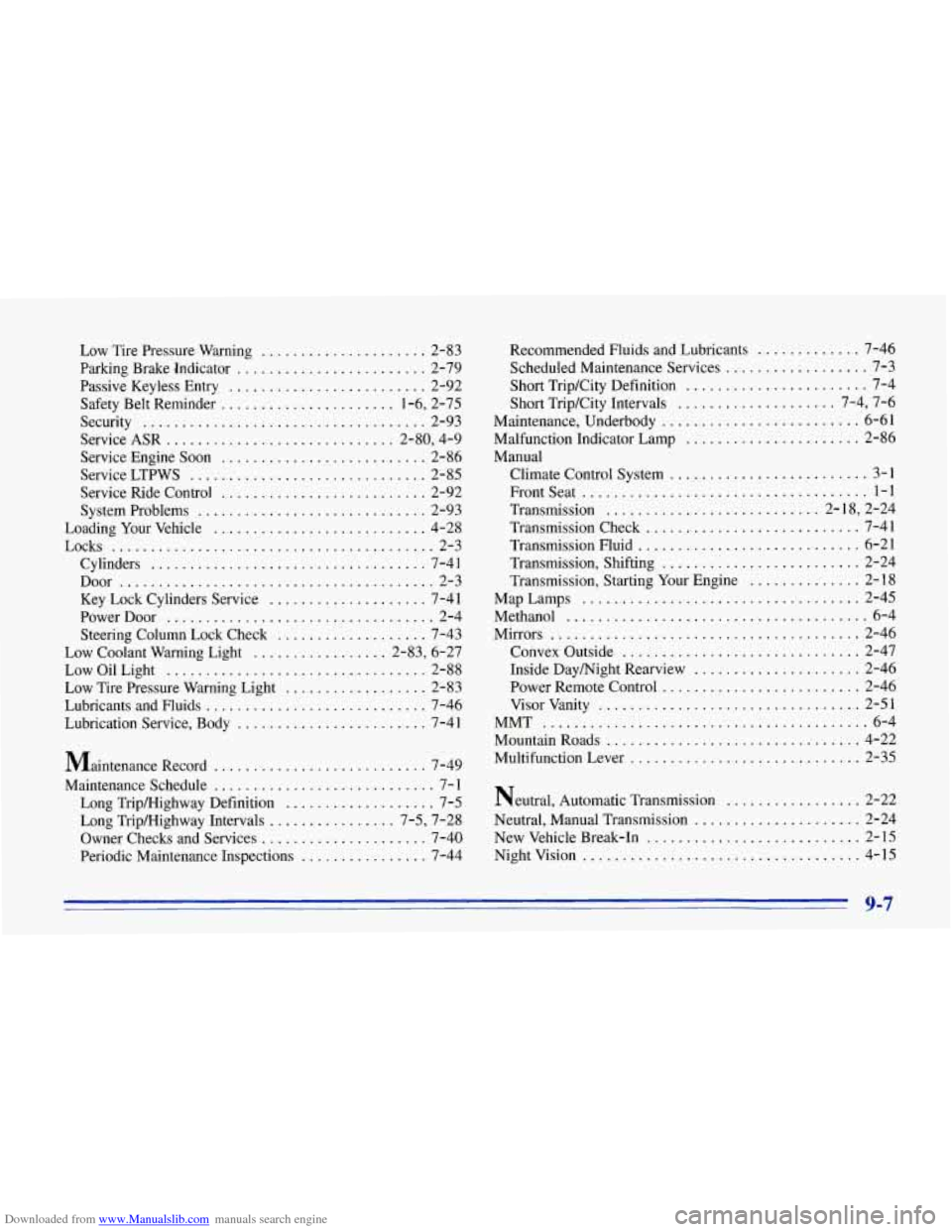
Downloaded from www.Manualslib.com manuals search engine Low Tire Pressure Warning ..................... 2-83
Parking Brake Indicator
........................ 2-79
Passive Keyless Entry
......................... 2-92
Safety Belt Reminder
...................... 1-6. 2.75
Service ASR
............................. 2-80, 4-9
Service Engine Soon
.......................... 2-86
ServiceLTPWS
.............................. 2-85
Service Ride Control
.......................... 2-92
System Problems
............................. 2-93
Loading Your Vehicle
........................... 4-28
Locks
......................................... 2-3
Cylinders
................................... 7-41
Door
........................................ 2-3
Key Lock Cylinders Service .................... 7-41
PowerDoor
.................................. 2-4
Steering Column Lock Check
................... 7-43
Low Coolant Warning Light
................. 2-83, 6-27
Low Oil Light
................................. 2-88
Low Tire Pressure Warning Light .................. 2-83
Lubricants and Fluids ............................ 7-46
Lubrication Service, Body
........................ 7-4 1
Security
.................................... 2-93
Maintenance Record
........................... 7-49
Maintenance Schedule
............................ 7- 1
Long Tripmighway Definition ................... 7-5
Long Triphlighway Intervals
................ 7.5. 7.28
Owner Checks and Services
..................... 7-40
Periodic Maintenance Inspections
................ 7-44 Recommended
Fluids and Lubricants
............. 7-46
Scheduled Maintenance Services
.................. 7-3
Short TripKity Definition
....................... 7-4
Short TripKity Intervals
. .................. 7.4. 7.6
Maintenance. Underbody
......................... 6-61
Malfunction Indicator Lamp
...................... 2-86
Manual
Climate Control System
......................... 3-1
Frontseat
.................................... 1-1
Transmission ........................... 2- 18. 2.24
Transmission Check
........................... 7-41
Transmission Fluid
............................ 6-21
Transmission. 'Shifting
......................... 2-24
Transmission. Starting Your Engine
.............. 2-18
MapLamps ................................... 2-45
Methanol
...................................... 6-4
Mirrors
. : ..................................... 2-46
Convex Outside
.............................. 2-47
Inside Daymight Rearview
..................... 2-46
Power Remote Control
......................... 2-46
Visor Vanity
................................. 2-51
MMT ......................................... 6-4
MountainRoads
................................ 4-22
Multifunction Lever
............................. 2-35
Neutral. Automatic Transmission
................. 2-22
Neutral. Manual Transmission
..................... 2-24
New Vehicle Break-In
........................... 2-15
Nightvision
................................... 4-15
9-7