light CHEVROLET CORVETTE 1997 5.G User Guide
[x] Cancel search | Manufacturer: CHEVROLET, Model Year: 1997, Model line: CORVETTE, Model: CHEVROLET CORVETTE 1997 5.GPages: 356, PDF Size: 18.43 MB
Page 79 of 356
Downloaded from www.Manualslib.com manuals search engine ' Shift Speeds (Manual Transmission)
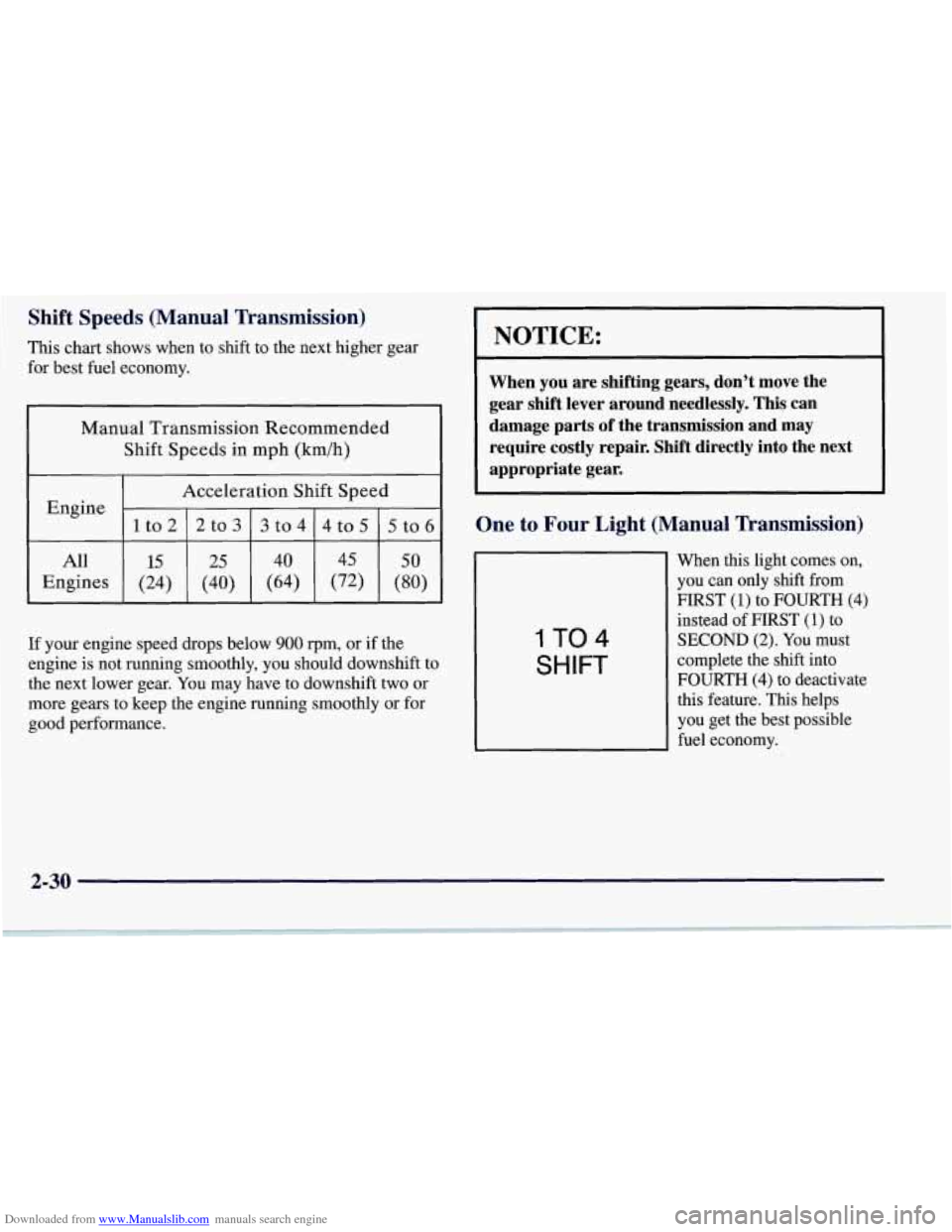
This chart shows when to shift to the next higher gear
for best fuel economy. Manual Transmission Recommended
Shift Speeds in
mph (km/h)
Acceleration Shift Speed
1to2 5to6 4to5
3to4 2to3
Engine
All
(80) (72) (64) (40) (24) Engines
50 45 40 25 15
If your engine speed drops below 900 rpm, or if the
engine is not running smoothly, you should downshift to
the next lower gear.
You may have to downshift two or
more gears to keep the engine running smoothly
or for
good performance.
NOTICE:
When you are shifting gears, don't move the
gear shift lever around needlessly. This can
damage parts
of the transmission and may
require costly repair. Shift directly into the next
appropriate gear.
One to Four Light (Manual Transmission)
IT04
SHIFT
When this light comes on, you can only shift from
FIRST
(1) to FOURTH (4)
instead of FIRST (1) to
SECOND (2). You must
complete the shift into
FOURTH
(4) to deactivate
this feature. This helps
you get the best possible
fuel economy.
2-30
Page 80 of 356
Downloaded from www.Manualslib.com manuals search engine After shifting to FOURTH (4), you may downshift to a
lower gear if you prefer.
b I
NOTICE:
~~
Do not try to force the shift lever into SECOND
(2) or THIRD (3) when the ONE TO FOUR light
comes on.
Do not try to re-engage FIRST (1)
after starting to shift into FOURTH (4). You
will damage your transmission. Shift only
from FIRST
(1) to FOURTH (4) when the light
comes on.
This light will come on when:
0 The engine coolant temperature is higher than
0 You are going 15 to 19 mph (24 to 31 km/h) and
You are at 21 percent throttle or less.
120°F (49"C), and
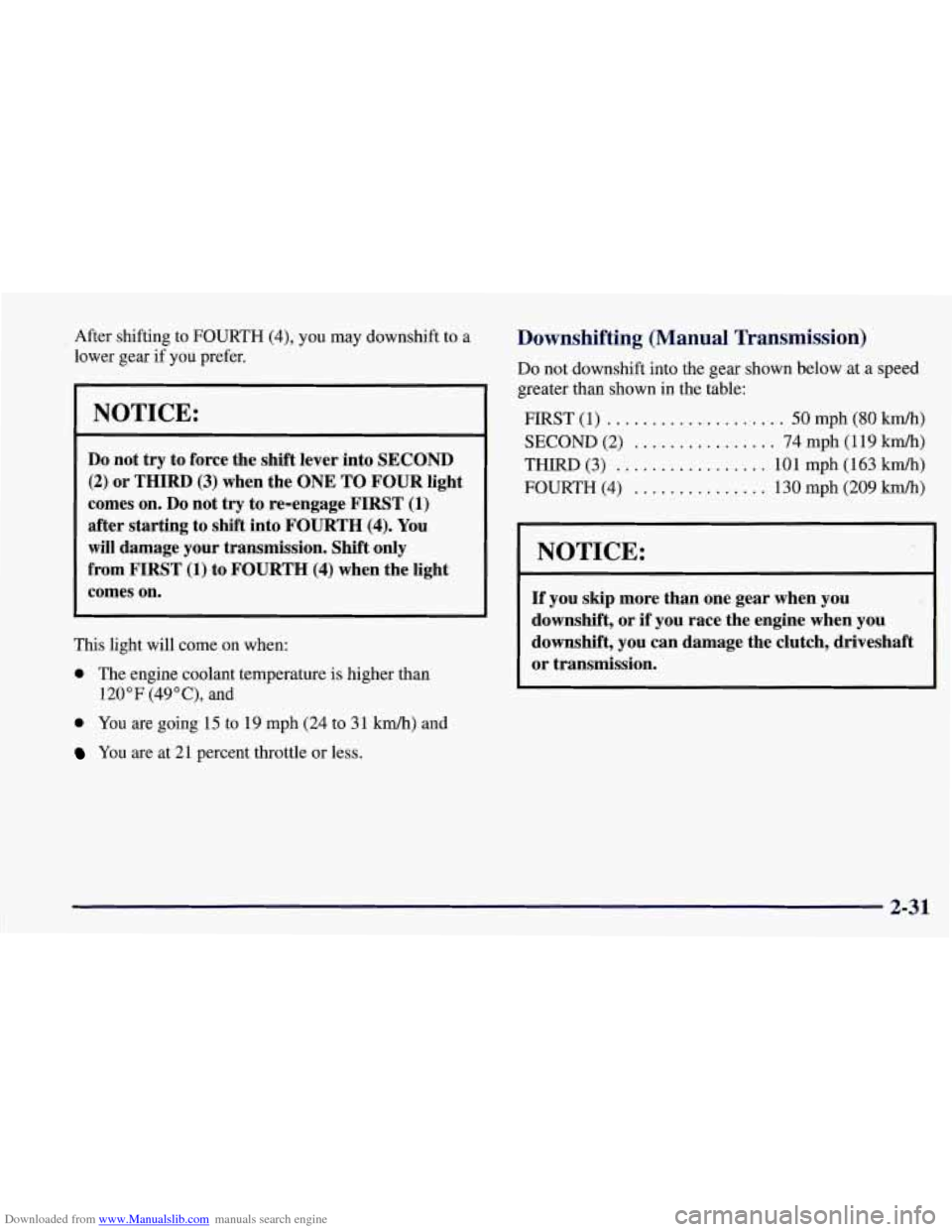
Downshifting (Manual Transmission)
Do not downshift into the gear shown below at a speed
greater than shown in the table:
FIRST
(1) .................... 50 mph (80 km/h)
SECOND (2) ................ 74 mph (119 km/h)
THIRD (3) ................. 101 mph (163 km/h)
FOURTH (4) ............... 130 mph (209 km/h)
[ NOTICE:
If you skip more than one gear when you
downshift,
or if you race the engine when you
downshift, you can damage the clutch, driveshaft
or transmission.
2-31
Page 81 of 356
Downloaded from www.Manualslib.com manuals search engine The six-speed transmission has a spring that centers the
shift lever near THIRD
(3) and FOURTH (4). This
spring helps you know which gear you are in when you
are shifting. Be careful when shifting from FIRST
(1)
to SECOND (2) or downshifting from SIXTH (6) to
FIFTH (5). The springs will try to pull the gearshift
lever toward FOURTH
(4) and THIRD (3). Make sure
you move the lever into SECOND
(2) or FIFTH (5).
If you let the lever move in the direction of the
pulling, you may end up shifting from FIRST
(1) to
FOURTH (4) or from SIXTH (6) to THIRD (3).
~~
If you skip more than one gear when you
downshift, you could lose control of your vehicle.
And
you could injure yourself or others. Don’t
shift from SIXTH
(6) to THIRD (3), FIFTH (5)
to SECOND (2) or FOURTH (4) to FIRST (1).
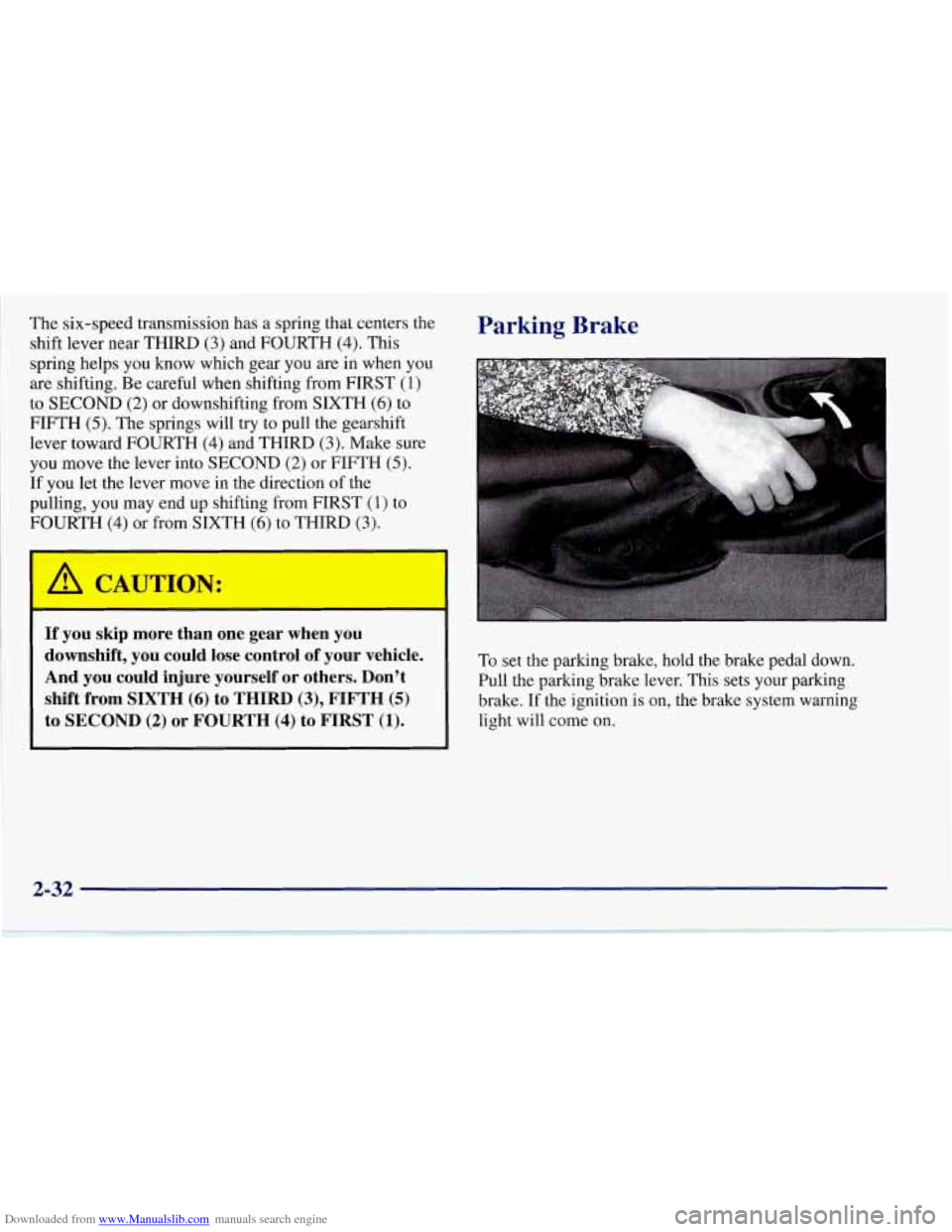
Parking Brake
To set the parking brake, hold the brake pedal down.
Pull the parking brake lever. This sets your parking
brake. If the ignition is on, the brake system warning
light will come on.
Page 82 of 356
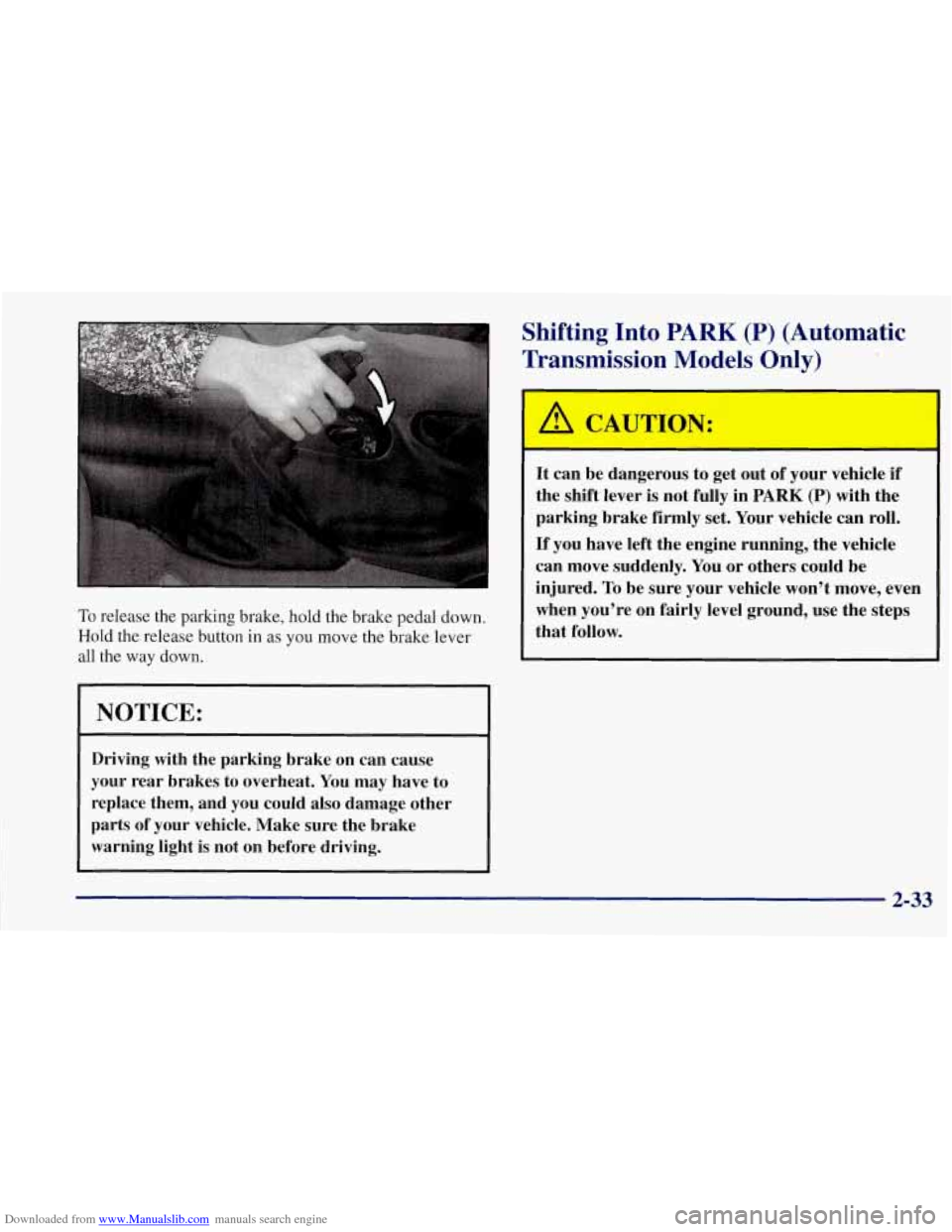
Downloaded from www.Manualslib.com manuals search engine To release the parking brake, hold the brake pedal down.
Hold the release button in as you move the brake lever
all the way down.
(NOTICE:
Driving with the parking brake on can cause
your rear brakes
to overheat. You may have to
replace them, and you could also damage other
parts of your vehicle. Make sure the brake
warning light
is not on before driving.
Shifting Into PARK (P) (Automatic
Transmission
Models Only)
CAUTION:
-
It can be dangerous to get out of your vehicle if
the shift lever is not fully in
PARK (P) with the
parking brake firmly set. Your vehicle can roll.
If you have left the engine running, the vehicle
can move suddenly. You or others could be
injured.
To be sure your vehicle won’t move, even
when you’re on fairly level ground, use the steps
that follow.
Page 94 of 356
Downloaded from www.Manualslib.com manuals search engine Headlamp HigWLow Beam Changer
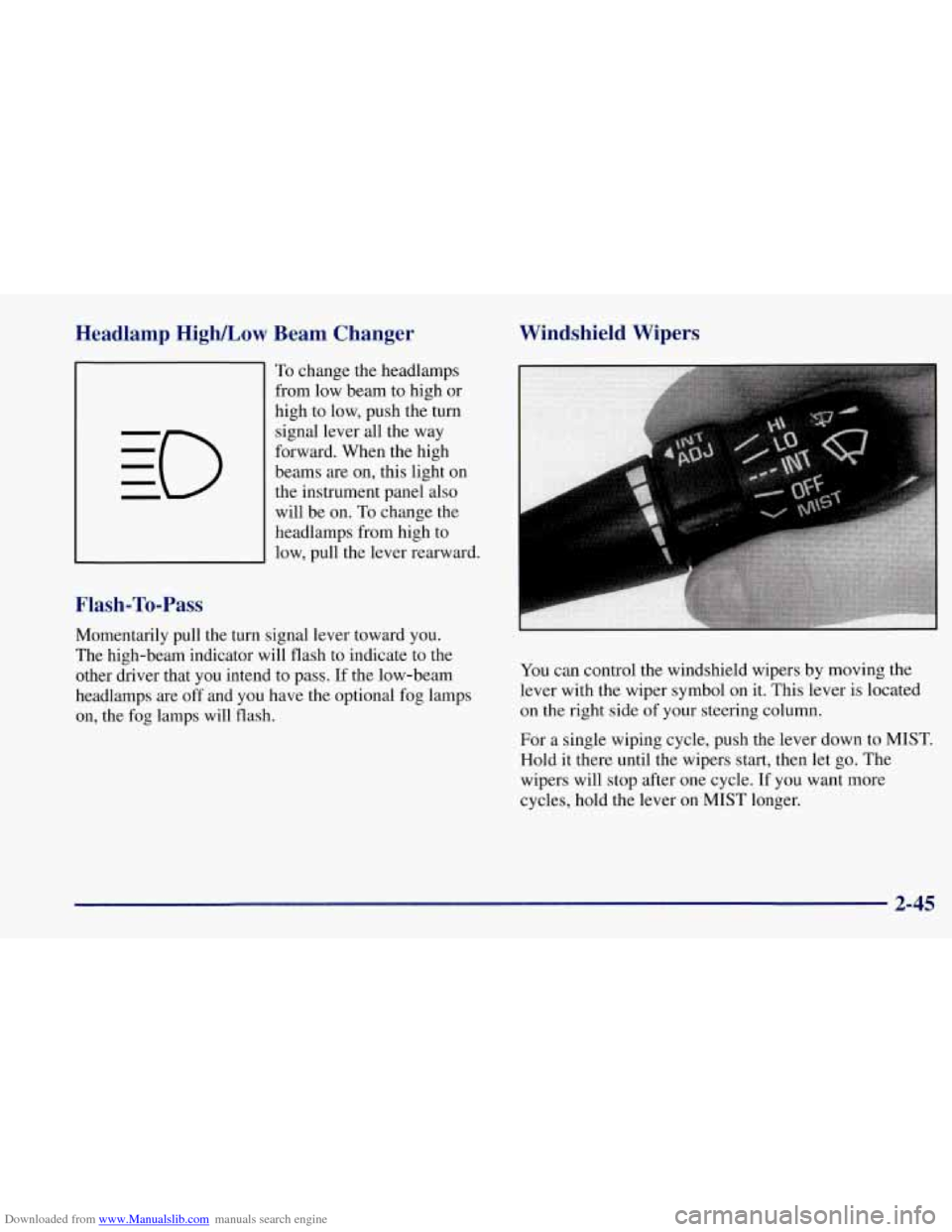
To change the headlamps
from low beam to high or
high to low, push the turn
signal lever all the way
forward. When the high
beams are on, this light on
the instrument panel also
will be on. To change the
headlamps from high to
low, pull the lever rearward.
Flash-To-Pass
Momentarily pull the turn signal lever toward you.
The high-beam indicator will flash to indicate to the
other driver that you intend to pass. If the low-beam
headlamps are off and you have the optional fog lamps
on, the fog lamps will flash.
Windshield Wipers
You can control the windshield wipers by moving the
lever with the wiper symbol on it. This lever
is located
on the right side of your steering column.
For a single wiping cycle, push the lever down to MIST.
Hold it there until the wipers start, then let go. The
wipers will stop after one cycle. If you want more
cycles, hold the lever on MIST longer.
2-45
Page 95 of 356
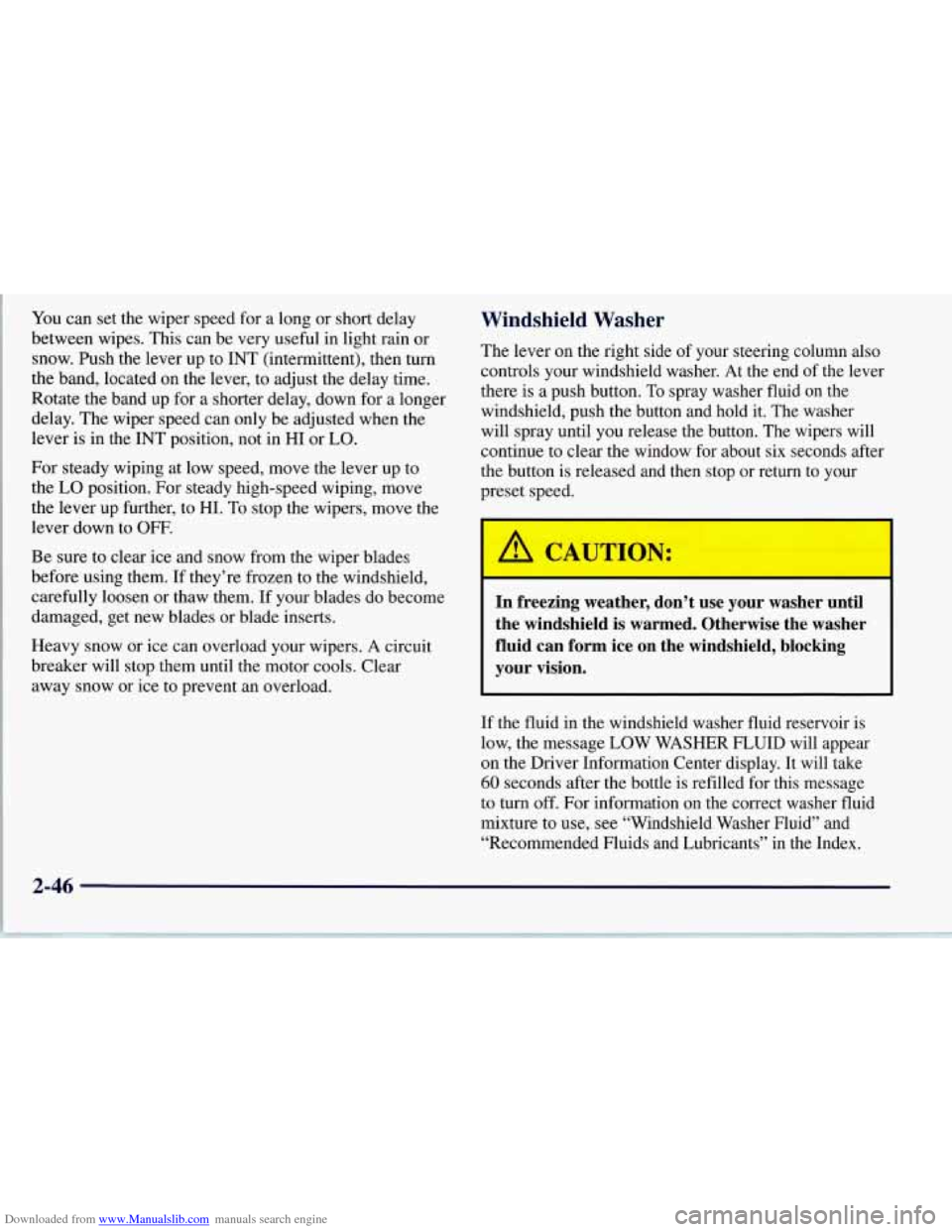
Downloaded from www.Manualslib.com manuals search engine You can set the wiper speed for a long or short delay
between wipes. This can be very useful in light rain or
snow. Push the lever up to INT (intermittent), then turn
the band, located on the lever, to adjust the delay time.
Rotate the band up for
a shorter delay, down for a longer
delay. The wiper speed can only be adjusted when the
lever is
in the INT position, not in HI or LO.
For steady wiping at low speed, move the lever up to
the
LO position. For steady high-speed wiping, move
the lever up further, to HI. To stop the wipers, move the
lever down to
OFF.
Be sure to clear ice and snow from the wiper blades
before using them.
If they’re frozen to the windshield,
carefully loosen or thaw them.
If your blades do become
damaged, get new blades or blade inserts.
Heavy snow or ice can overload your wipers.
A circuit
breaker will stop them until the motor cools. Clear
away snow or ice
to prevent an overload.
Windshield Washer
The lever on the right side of your steering column also
controls your windshield washer. At the end of the lever
there is a push button.
To spray washer fluid on the
windshield, push the button and hold it. The washer
will spray until you release the button. The wipers will
continue to clear the window for about six seconds after
the button is released and then stop or return to your
preset speed.
A CAUTION:
In freezing weather, don’t use your washer until
the windshield is warmed. Otherwise the washer
fluid can form ice on the windshield, blocking
your vision.
If the fluid in the windshield washer fluid reservoir is
low, the message
LOW WASHER FLUID will appear
on the Driver Information Center display. It will take
60 seconds after the bottle is refilled for this message
to turn
off. For information on the correct washer fluid
mixture to use, see “Windshield Washer Fluid” and
“Recommended Fluids and Lubricants’’ in the Index.
2-46
Page 99 of 356
Downloaded from www.Manualslib.com manuals search engine Reducing Speed While Using Cruise Control
There are two ways to reduce your speed while using
cruise control:
Push in the button at the end of the lever until you
reach the lower speed you want, then release it.
The DIC will display the cruise set speed.
To slow down in very small amounts, push the
button for less than half a second. Each time you
do this, you’ll go
1 mph (1.6 km/h) slower.
The DIC will display the cruise set speed.
Passing Another Vehicle While Using Cruise Control
Use the accelerator pedal to increase your speed. When
you take your foot off the pedal, your vehicle will slow
down to the cruise control speed you set earlier.
Using Cruise Control on Hills
How well your cruise control will work on hills depends
upon
your speed, load and the steepness of the hills.
When going downhill, you may have to brake or shift to
a lower gear to keep your speed down. Of course,
applying the brake takes you out of cruise control. Many
drivers find this to be too much trouble and don’t use
cruise control on steep hills.
Getting Out of Cruise Control
There are two ways to turn off the cruise control:
Step lightly on the brake pedal or push the clutch
Move the cruise switch to OFF.
pedal, if you have a manual transmission vehicle; or
The DIC will display the message “CRUISE
DISENGAGED.’’
Erasing Speed Memory
When you turn off the cruise control or the ignition,
your cruise control set speed memory is erased.
Exterior Lamps
Daytime Running Lamps
Daytime Running Lamps (DRL) can make it easier
for others to see the front of your vehicle during the
day. DRL can be helpful in many different driving
conditions, but they can be especially helpful in the
short periods after dawn and before sunset.
The DRL system will make your front turn signal
come on when:
0 the ignition is on,
the headlamp switch is off and
the parking brake is released. lamps
2-50
Page 100 of 356
Downloaded from www.Manualslib.com manuals search engine When the DRL are on, only your front turn signal lamps
will be on. The taillamps, sidemarker and other lamps
will not be on.
When you turn on your headlamps, your front turn
signal lamps (DRL) will go out. The other lamps that
come on with your headlamps will also come on.
On vehicles built for Canada, when it’s dark enough
outside, your front turn signal lamps will automatically
go out and your headlamps will come
on. The other
lamps that come on with your headlamps will also come
on. When it’s bright enough outside, the headlamps
will go off, and your front turn signal lamps (DRL)
will come ,on.
Also on Canadian vehicles, there is a light sensor in the
defroster grille, at the base of the windshield and the
instrument panel. This sensor makes the DRL work
automatically, so be sure it isn’t covered.
As with any vehicle, you should turn on the regular
headlamp system when you need it.
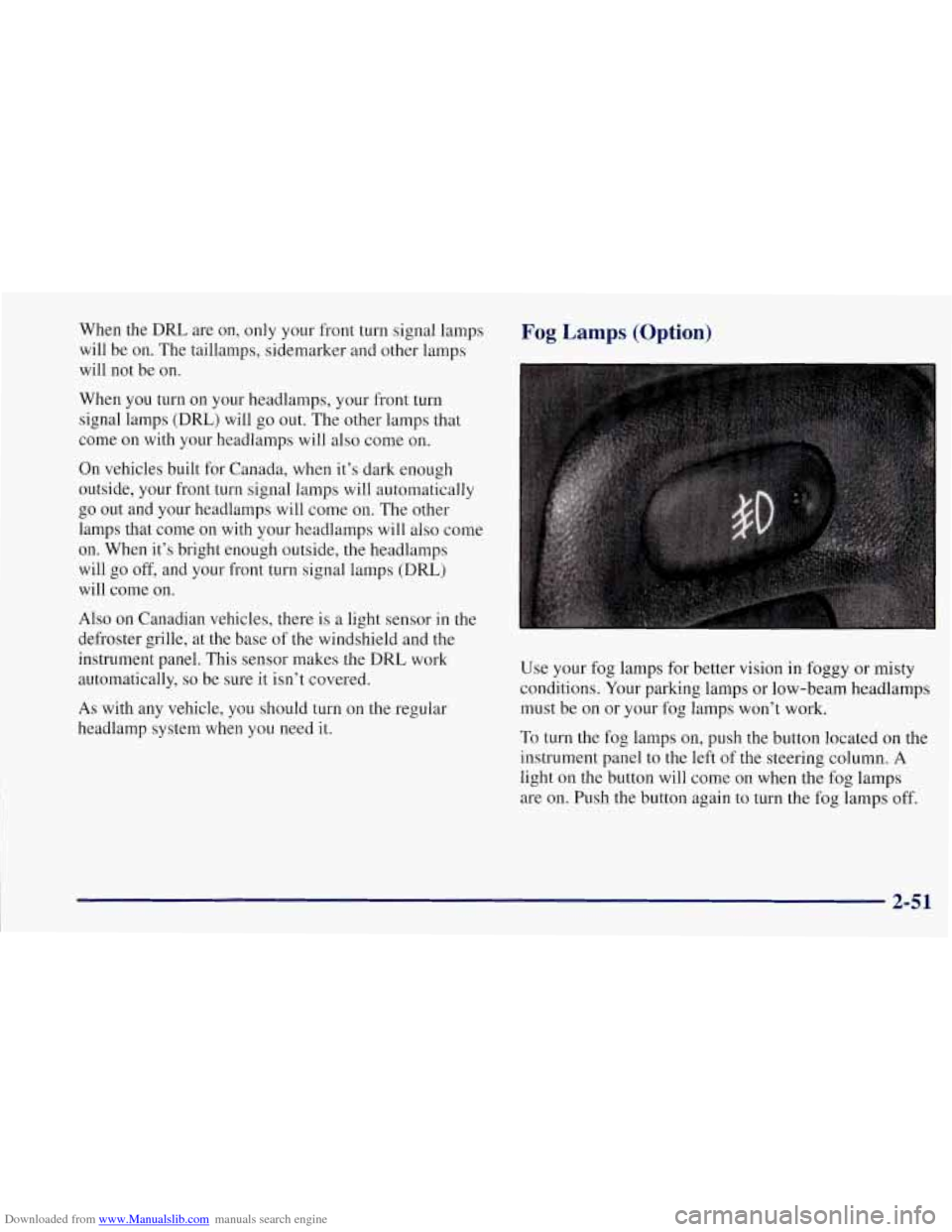
Fog Lamps (Option)
Use your fog lamps for better vision in foggy or misty
conditions. Your parking lamps or low-beam headlamps
must be on or your fog lamps won’t work.
To turn the fog lamps on, push the button located on the
instrument panel to the left of the steering column.
A
light on the button will come on when the fog lamps
are on. Push the button again to turn the fog lamps off.
2-51
Page 101 of 356
Downloaded from www.Manualslib.com manuals search engine Interior Lamps
Instrument Panel Brightness Control
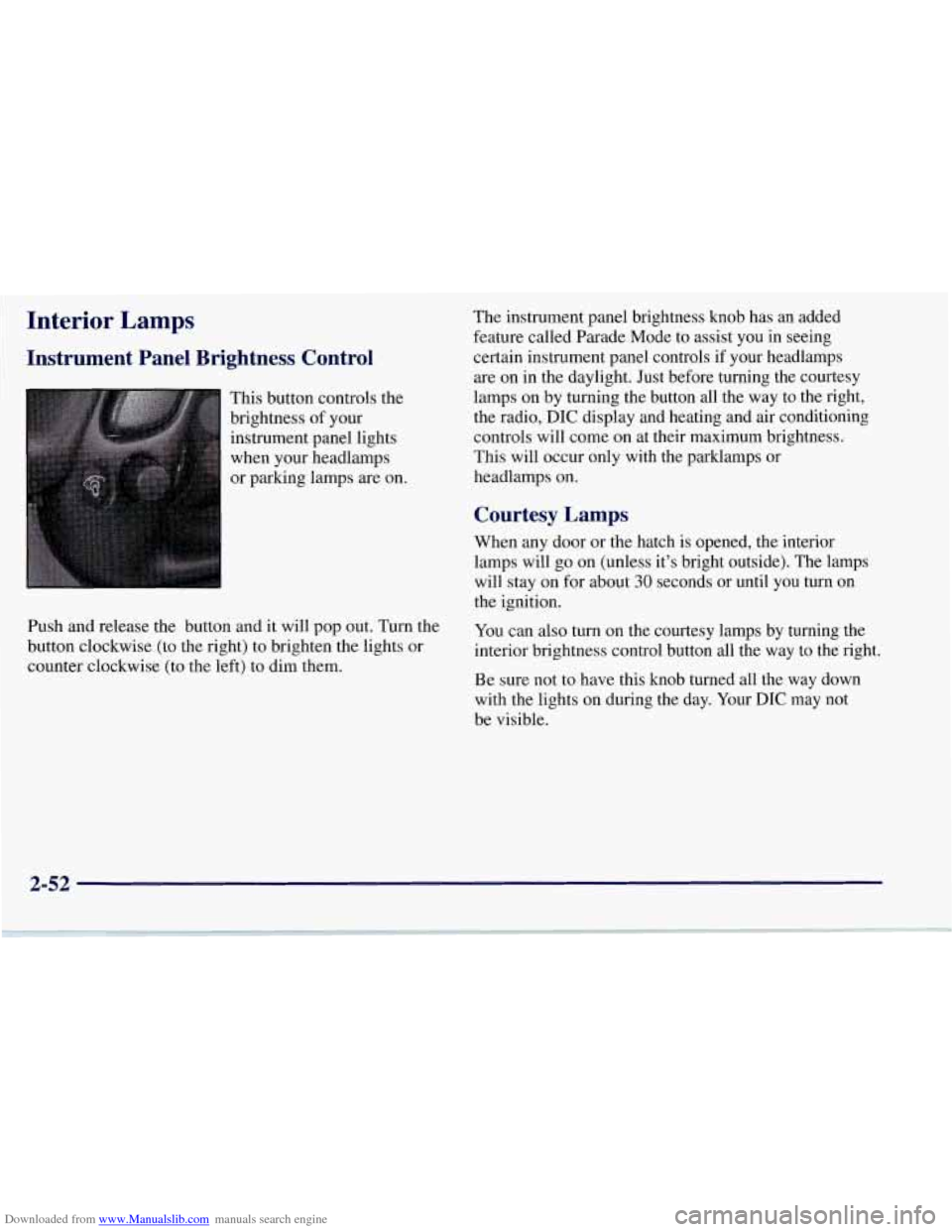
This button controls the
brightness of your
instrument panel lights
when your headlamps
or parking lamps are on.
Push and release the button and it will pop out. Turn the
button clockwise (to the right) to brighten the lights or
counter clockwise (to the left) to dim them. The
instrument panel brightness knob has an added
feature called Parade Mode to assist you in seeing
certain instrument panel controls if your headlamps
are on in the daylight. Just before turning the courtesy
lamps on by turning the button all the way to the right,
the radio,
DIC display and heating and air conditioning
controls will come on at their maximum brightness..
This will occur only with the parklamps or
headlamps on.
Courtesy Lamps
When any door or the hatch is opened, the interior
lamps will go on (unless it’s bright outside). The lamps
will stay on for about
30 seconds or until you turn on
the ignition.
You can also turn on the courtesy lamps by turning the
interior brightness control button all the way to the right.
Be sure not to have this knob turned all the way down
with the lights on during the day. Your
DIC may not
be visible.
2-52
Page 103 of 356
Downloaded from www.Manualslib.com manuals search engine Power Remote Control Mirrors
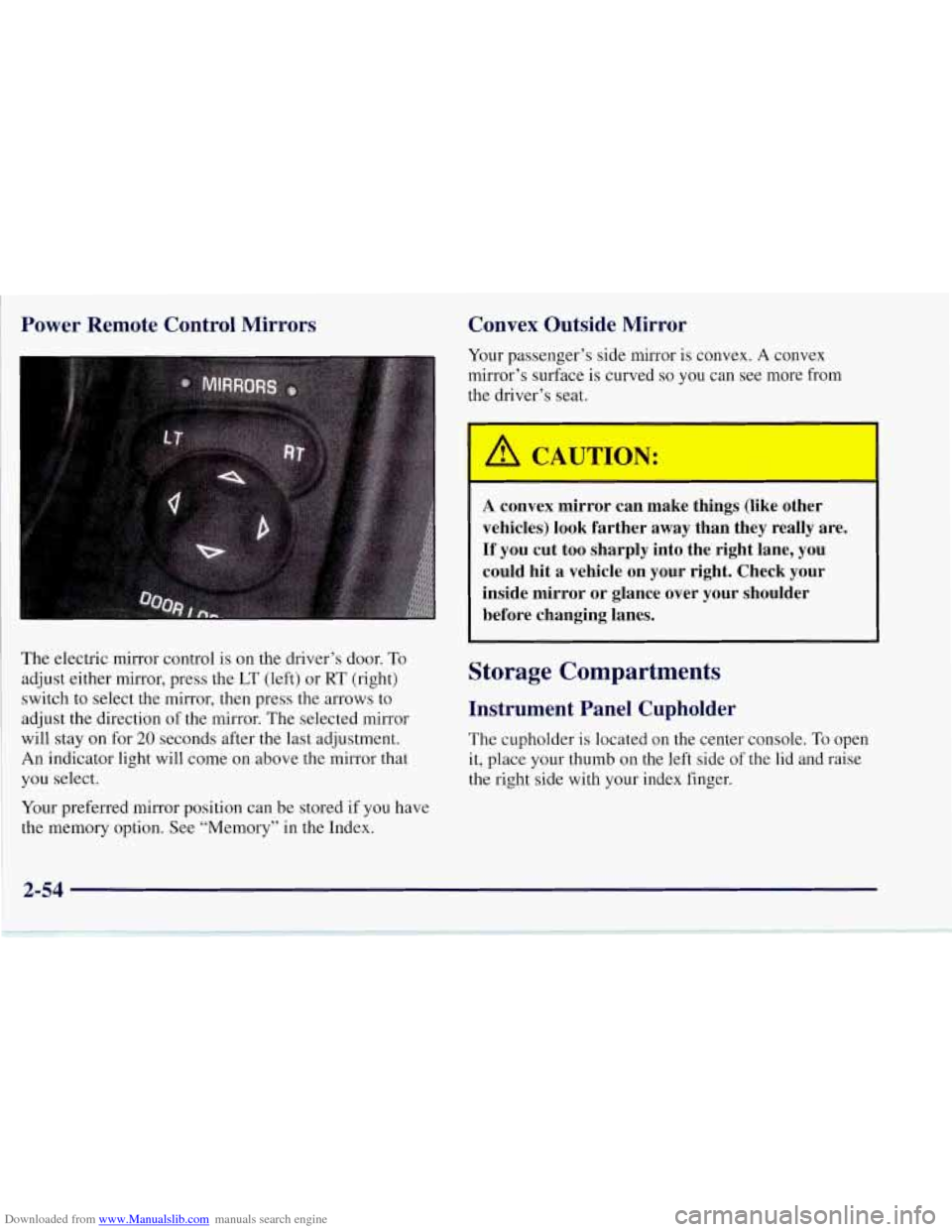
The electric mirror control is on the driver’s door. To
adjust either mirror, press the LT (left) or RT (right)
switch to select the mirror, then press the arrows to
adjust the direction of the mirror. The selected mirror
will stay
on for 20 seconds after the last adjustment.
An indicator light will come on above the mirror that
you select.
Your preferred mirror position can be stored if you have
the memory option. See “Memory” in the Index.
Convex Outside Mirror
Your passenger’s side mirror is convex. A convex
mirror’s surface is curved
so you can see more from
the driver’s seat.
A CAUTION:
I
A convex mirror can make things (like other
vehicles) look farther away than they really are. If you cut too sharply into the right lane, you
could hit a vehicle on your right. Check your
inside mirror or glance over your shoulder before changing lanes.
Storage Compartments
Instrument Panel Cupholder
The cupholder is located on the center console. To open
it, place your thumb
on the left side of the lid and raise
the right side with your index finger.