engine braking CHEVROLET CORVETTE 1998 5.G User Guide
[x] Cancel search | Manufacturer: CHEVROLET, Model Year: 1998, Model line: CORVETTE, Model: CHEVROLET CORVETTE 1998 5.GPages: 378, PDF Size: 19.91 MB
Page 214 of 378
Downloaded from www.Manualslib.com manuals search engine If you drive regularly in steep country, or if you’re
planning to visit there, here
are some tips that can make
your trips safer and more enjoyable.
0
0
Keep your vehicle in good shape. Check all fluid
levels and also the brakes, tires, cooling system and
transmission. These
parts can work hard on
mountain roads.
Know how to
go down hills. The most important
thing to know is this: let your engine do some of the
slowing down. Shft to a lower gear when you
go
down a steep or long hill.
If you don’t shift down, your brakes could get so
hot that they wouldn’t work well. You would then
have poor braking
or even none going down a hill.
You could crash. Shift down to let your engine
assist your brakes on
a steep downhill slope.
I li
’ A CAUTION:
II
r
Coasting downhill in NEUTRAL (N) or with the
ignition
off is dangerous. Your brakes will have
to do all the work
of slowing down. They could
get
so hot that they wouldn’t work well. You
would then have poor braking or even none going
down a hill. You could crash. Always have your
engine running and your vehicle in gear when
you go downhill.
e
e
e
Know how to go uphill. You may want to shift down
to a lower gear. The lower gears help cool your engine
and transmission, and you can climb the hill better.
Stay in your own lane when driving on two-lane
roads in hills or mountains. Don’t swing wide or cut
across the center of the road. Drive at speeds that let
you stay in your own lane.
As you go over the top of a hill, be alert. There
could be something in your lane, like a stalled
car
or an accident.
4-23
Page 217 of 378
Downloaded from www.Manualslib.com manuals search engine Your anti-lock brakes improve your vehicle’s stability when you make a hard stop on a slippery road. Even
though you have the anti-lock braking system, you’ll
want to begin stopping sooner than you would on
dry
pavement. See “Anti-Lock” in the Index.
Allow greater following distance on any
slippery road.
Watch for slippery spots. The road might be fine
until you hit
a spot that’s covered with ice. On an
otherwise clear road, ice patches may appear in
shaded areas where the sun can’t reach: around
clumps
of trees, behind buildings or under bridges.
Sometimes the surface
of a curve or an overpass may
remain icy when the surrounding roads are clear.
If
you see a patch of ice ahead of you, brake before you
are on it. Try not to brake while you’re actually on
the ice, and avoid sudden steering maneuvers.
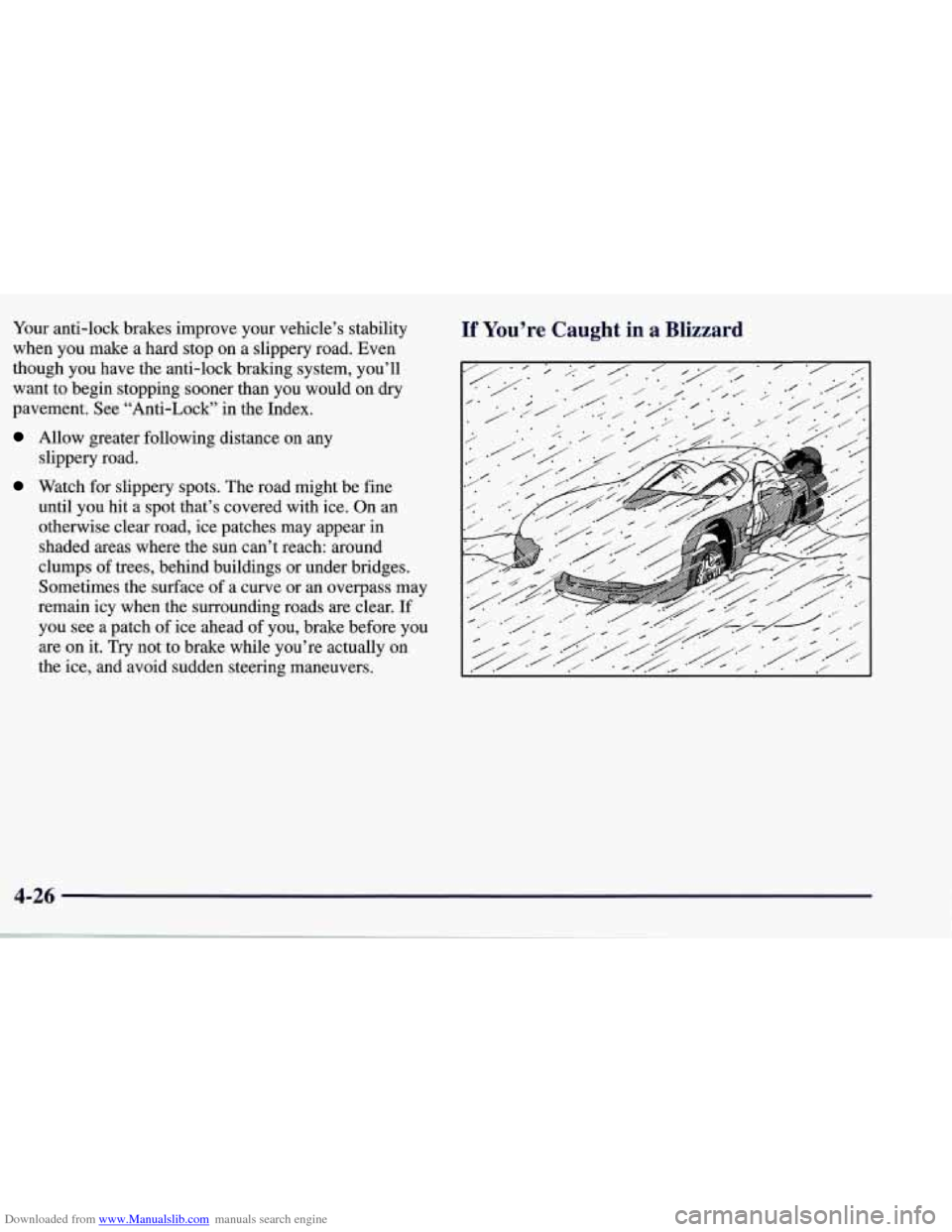
If You’re Caught in a Blizzard
Page 277 of 378
Downloaded from www.Manualslib.com manuals search engine Replacing Brake System Parts
The braking system on a modern vehicle is complex. Its
many parts have to be of top quality and work well
together
if the vehicle is to have really good braking.
Your vehicle was designed and tested with top-quality
GM brake parts. When you replace parts of your braking
system
-- for example, when your brake linings wear
down and you have to have new ones put in
-- be sure
you get new approved GM replacement parts. If you
don’t, your brakes may no longer work properly. For example,
if someone puts in brake linings that are wrong
for your vehicle, the balance between your front and
rear brakes can change
-- for the worse. The braking
performance you’ve come to expect can change
in many
other ways if someone puts in the wrong replacement
brake parts.
Battery
Every new Corvette has a Delco Freedom@ battery. You
never have to add water to one of these. When it’s time f\
or
a new battery, we recommend a Delco Freedom battery.
Get one that has the replacement number shown on the original battery’s label. For battery replacement, see your
dealer or the Corvette Service Manual.
To purchase a
service manual,
see “Service and Owner Publications”
in the Index. After the battery has been
replaced, refer to the “Remote Function Actuation System”
in the Index to resynchronize your transmitter(s).
Vehicle Storage
If you’re not going to drive your vehicle for 25 days
or more, remove the black, negative
(-) cable from
the battery. This will help keep your battery from
running down.
Batteries have acid that can burn you and gas
that can explode.
You can be badly hurt if you
aren’t careful. See “Jump Starting” in the Index
for tips
on working around a battery without
getting hurt.
Contact your dealer to learn how to prepare your vehicle
for longer storage periods.
Also, for your audio system, see “Theft-Deterrent
Feature” in the Index.
6-32
Page 292 of 378
Downloaded from www.Manualslib.com manuals search engine Uniform Tire Quality Grading
The following information relates to the system
developed by the United States National Highway
Traffic Safety Administration, which grades tires by
treadwear, traction and temperature performance. (This
applies only to vehicles sold in the United States.) The
grades are molded on the sidewalls of most passenger
car tires. The Uniform Tire Quality Grading system does
not apply to deep tread, winter-type snow tires,
space-saver or temporary use spare tires, tires with
nominal rim diameters of 10 to 12 inches (25 to
30 cm),
or to some limited-production tires.
While the tires available on General Motors passenger
cars and light trucks may vary with respect to these
grades, they must also conform to Federal safety
requirements and additional General Motors Tire
Performance Criteria (TPC) standards.
Treadwear
The treadwear grade is a comparative rating based on
the wear rate of the tire when tested under controlled
conditions on a specified government test course. For
example, a tire graded 150 would wear one and a half
(1 1/2) times as well on the government course as a tire
graded
100. The relative performance of tires depends
upon the actual conditions of their use, however, and
may depart significantly from the norm due to variations
in driving habits, service practices and differences in
road characteristics and climate.
Traction -- A, B, C
The traction grades, from highest to lowest, are A, B, and
C, and they represent the tire’s ability to stop on wet
pavement as measured under controlled conditions on
specified government test surfaces of asphalt and concrete.
A tire marked C may have poor traction performance.
Warning: The traction grade assigned to this tire is based
on braking (straight ahead) traction tests and does not
include cornering (turning) traction.
6-47
Page 294 of 378
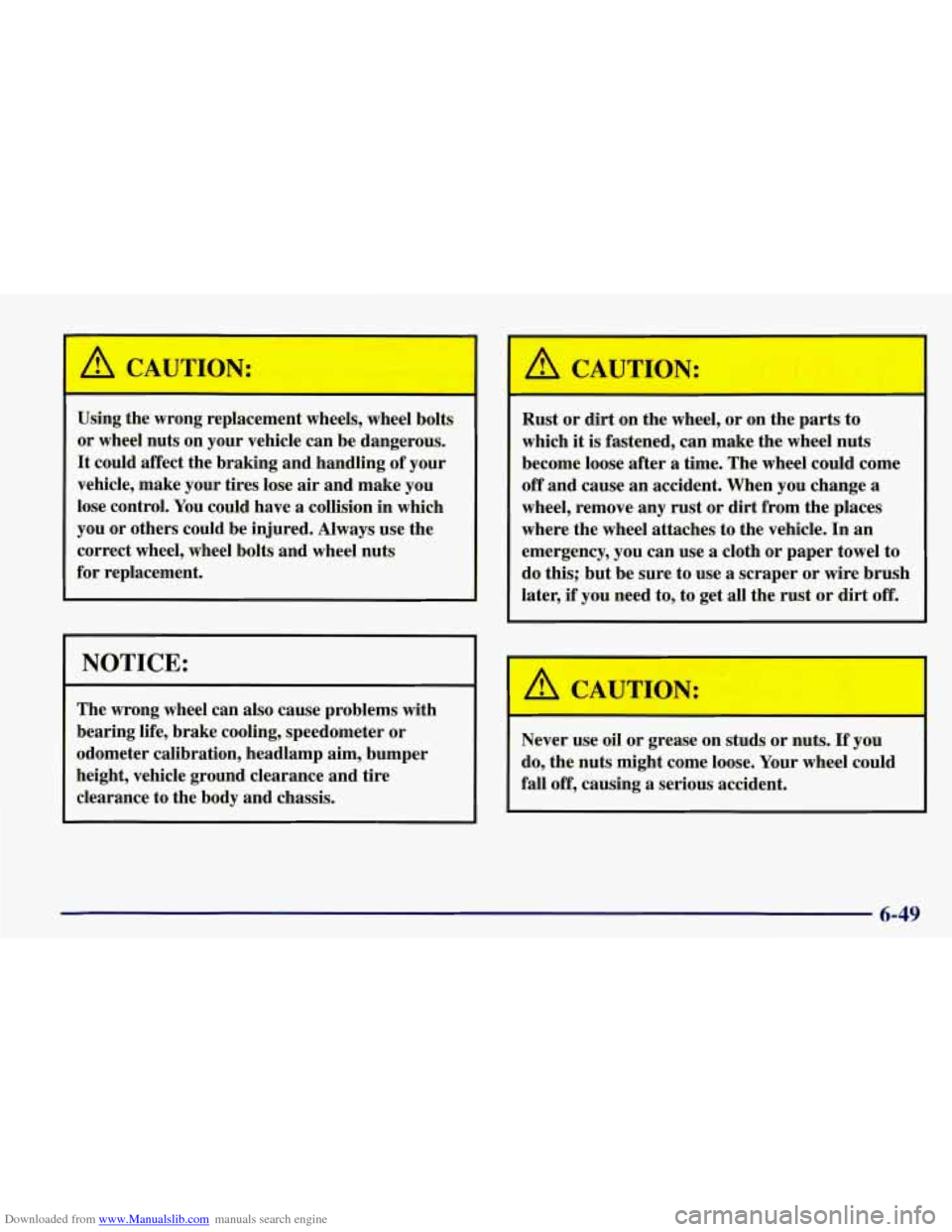
Downloaded from www.Manualslib.com manuals search engine A CAUTION:
Using the wrong replacement wheels, wheel bolts
or wheel nuts on your vehicle can be dangerous.
It could affect the braking and handling of your
vehicle, make your tires lose air and make you
lose control. You could have a collision in which
you or others could be injured. Always use the
correct wheel, wheel bolts and wheel nuts
for replacement.
I NOTICE:
The wrong wheel can also cause problems with
bearing life, brake cooling, speedometer or
odometer calibration, headlamp aim, bumper
height, vehicle ground clearance and tire
clearance to the body and chassis.
A CAUTION:
Rust or dirt on the wheel, or on the parts to
which
it is fastened, can make the wheel nuts
become loose after a time. The wheel could come
off and cause an accident. When you change a
wheel, remove any rust or dirt from the places
where the wheel attaches to the vehicle. In an
emergency, you can use a cloth or paper towel to
do this; but be sure to use a scraper or wire brush
later,
if you need to, to get all the rust or dirt off.
I A CAUTION:
I
Never use oil or grease on studs or nuts. If you
do, the nuts might come loose. Your wheel could
fall off, causing a serious accident.
6-49
Page 334 of 378
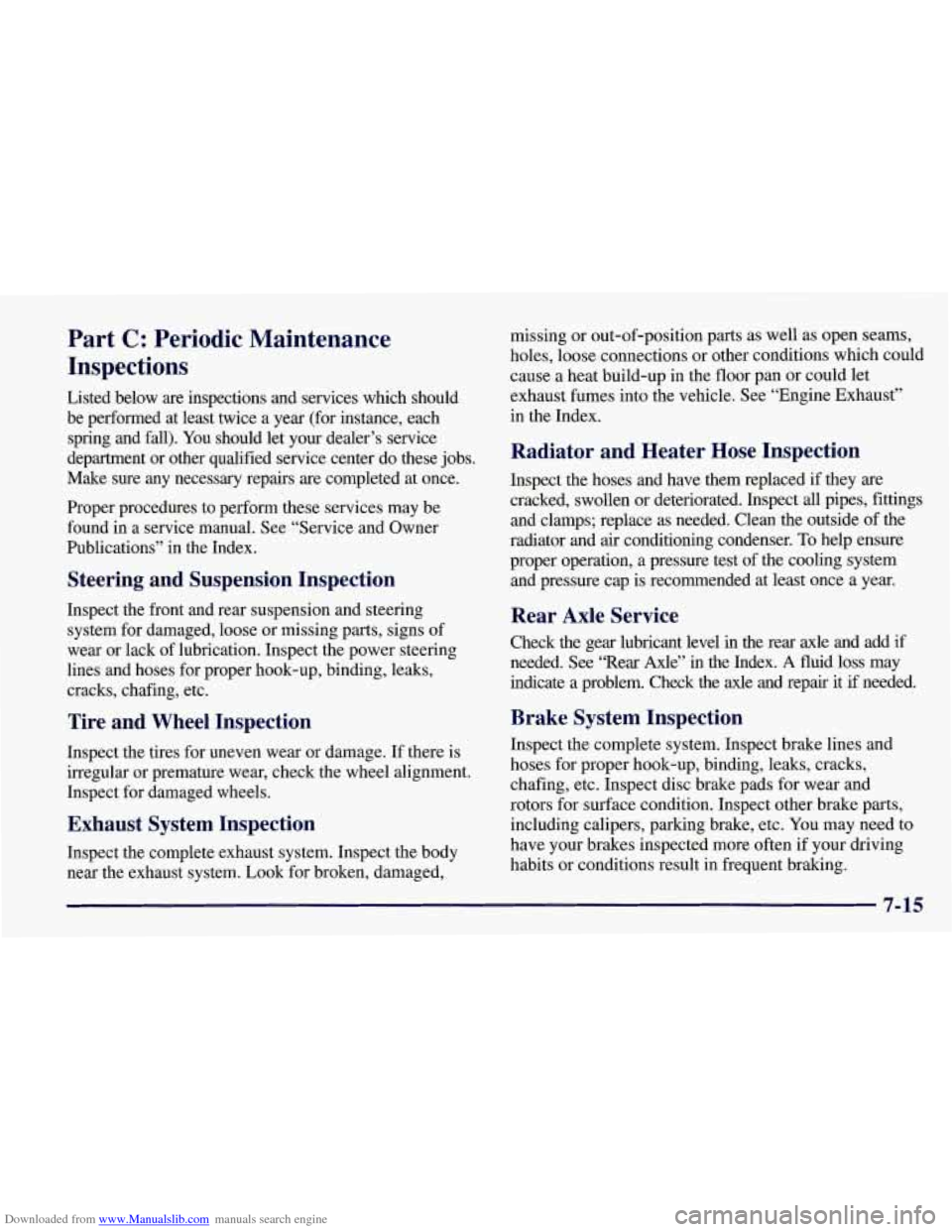
Downloaded from www.Manualslib.com manuals search engine Part C: Periodic Maintenance
Inspections
Listed below are inspections and services which should
be performed at least twice a year (for instance, each spring and fall).
You should let your dealer’s service
department or other qualified service center do these jobs.
Make sure any necessary repairs are completed at once.
Proper procedures to perform these services may be
found in a service manual. See “Service and Owner
Publications” in the Index.
Steering and Suspension Inspection
Inspect the front and rear suspension and steering
system for damaged, loose or missing parts, signs of
wear or lack of lubrication. Inspect the power steering
lines and hoses for proper hook-up, binding, leaks,
cracks, chafing, etc.
Tire and Wheel Inspection
Inspect the tires for uneven wear or damage. If there is
irregular or premature wear, check the wheel alignment.
Inspect for damaged wheels.
Exhaust System Inspection
Inspect the complete exhaust system. Inspect the body
near the exhaust system. Look for broken, damaged, missing
or out-of-position parts as well as open seams,
holes, loose connections or other conditions which could
cause a heat build-up in the floor pan or could let
exhaust fumes into the vehicle. See “Engine Exhaust”
in the Index.
Radiator and Heater Hose Inspection
Inspect the hoses and have them replaced if they are
cracked, swollen or deteriorated. Inspect all pipes, fittings
and clamps; replace as needed. Clean the outside of the
radiator and air conditioning condenser.
To help ensure
proper operation, a pressure test of the cooling system
and pressure cap is recommended at least once a year.
Rear Axle Service
Check the gear lubricant level in the rear axle and add if
needed. See “Rear Axle” in the Index.
A fluid loss may
indicate a problem. Check the axle and repair it
if needed.
Brake System Inspection
Inspect the complete system. Inspect brake lines and
hoses for proper hook-up, binding, leaks, cracks,
chafing, etc. Inspect disc brake pads for wear and
rotors for surface condition. Inspect other brake parts,
including calipers, parlung brake, etc. You may need to
have your brakes inspected more often if your driving
habits or conditions result in frequent braking.
7-15
Page 357 of 378
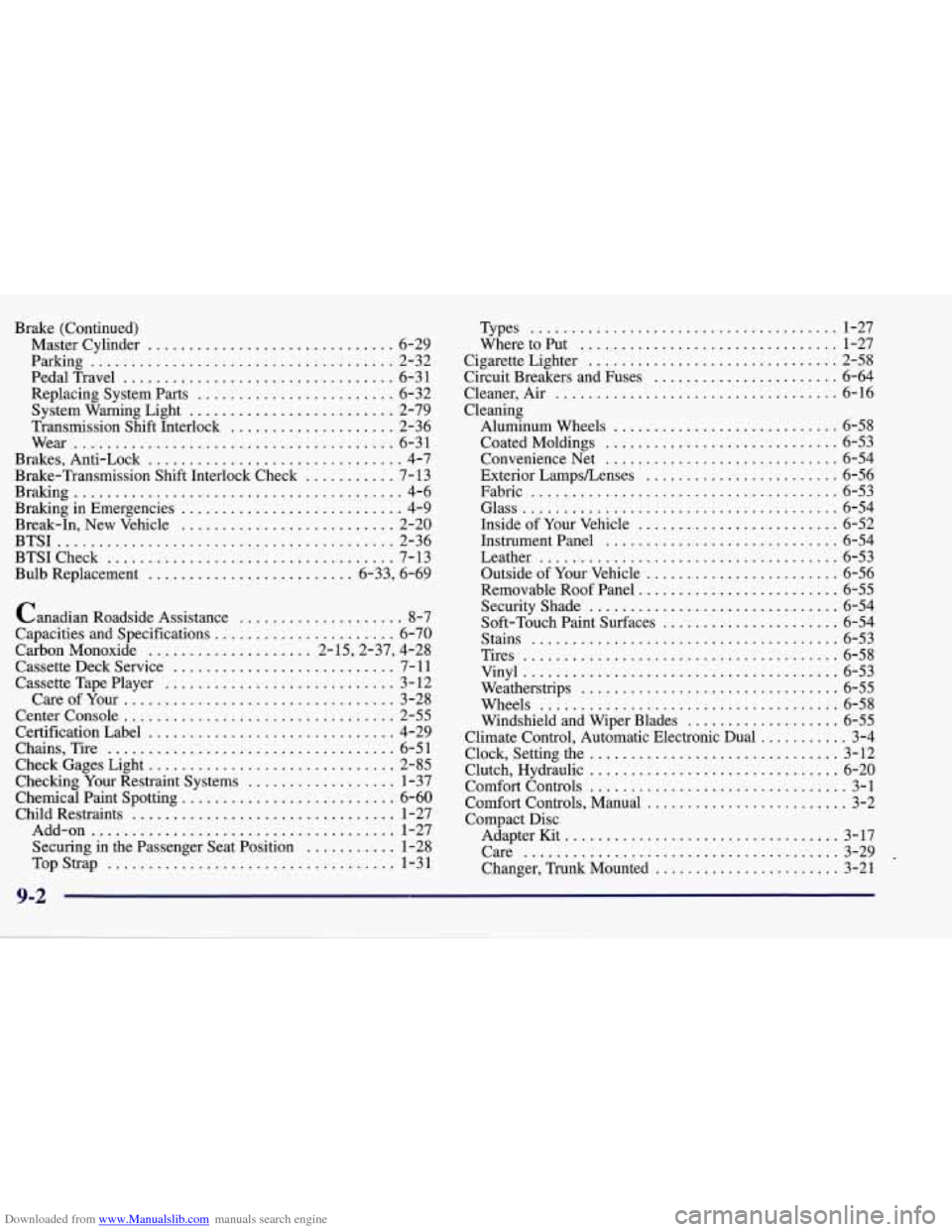
Downloaded from www.Manualslib.com manuals search engine Brake (Continued) Master Cylinder
.............................. 6-29
Parking
..................................... 2-32
PedalTravel
................................. 6-31
Replacing System Parts
........................ 6-32
System Warning Light
......................... 2-79
Transmission Shift Interlock
.................... 2-36
Wear
....................................... 6-31
Brakes. Anti-Lock
............................... 4-7
Brake-Transmission Shift Interlock Check
........... 7- 13
Braking
........................................ 4-6
Braking in Emergencies
........................... 4-9
Break.In. New Vehicle
.......................... 2-20
BTSI
......................................... 2-36
BTSICheck
................................... 7-13
Bulb Replacement
......................... 6.33. 6.69
Canadian Roadside Assistance
.................... 8-7
Capacities and Specifications
...................... 6-70
Carbon Monoxide
.................... 2.15.2.37. 4.28
Cassette Deck Service
........................... 7- 11
Cassette Tape Player ............................ 3-12
CareofYour
................................. 3-28
Center Console
................................. 2-55
Certification Label
.............................. 4-29
Chains. Tire
................................... 6-51
Check Gages Light
.............................. 2-85
Checking Your Restraint Systems
.................. 1-37
Chemical Paint Spotting
.......................... 6-60
Child Restraints
................................ 1-27
Add-on
..................................... 1-27
Securing in the Passenger Seat Position
........... 1-28
Top Strap
.................................... 1-3 1
Types ...................................... 1-27
WheretoPut
................................ 1-27
Cigarette Lighter
............................... 2-58
Circuit Breakers and Fuses
....................... 6-64
Cleaner. Air
................................... 6-16
Cleaning Aluminum Wheels
............................ 6-58
Coated Moldings
............................. 6-53
ConvenienceNet
............................. 6-54
Exterior LampsLenses
........................ 6-56
Fabric
...................................... 6-53
Glass
....................................... 6-54
Inside of Your Vehicle
......................... 6-52
Instrument Panel
............................. 6-54
Leather
..................................... 6-53
Outside of Your Vehicle
........................ 6-56
Removable Roof Panel
......................... 6-55
Security Shade
............................... 6-54
Soft-Touch Paint Surfaces
...................... 6-54
Stains
...................................... 6-53
Tires
....................................... 6-58
Vinyl
....................................... 6-53
Weatherstrips
................................ 6-55
Wheels
..................................... 6-58
Windshield and Wiper Blades
................... 6-55
Climate Control. Automatic Electronic Dual
........... 3-4
Clock. Setting the
............................... 3-12
Clutch. Hydraulic
............................... 6-20
Comfort Controls
................................ 3-1
Comfort Controls. Manual
......................... 3-2
Compact Disc
AdapterKit
.................................. 3-17
Care
....................................... 3-29 .
Changer. TmnkMounted ....................... 3-21
9-2