check engine CHEVROLET CORVETTE 1998 5.G Repair Manual
[x] Cancel search | Manufacturer: CHEVROLET, Model Year: 1998, Model line: CORVETTE, Model: CHEVROLET CORVETTE 1998 5.GPages: 378, PDF Size: 19.91 MB
Page 285 of 378
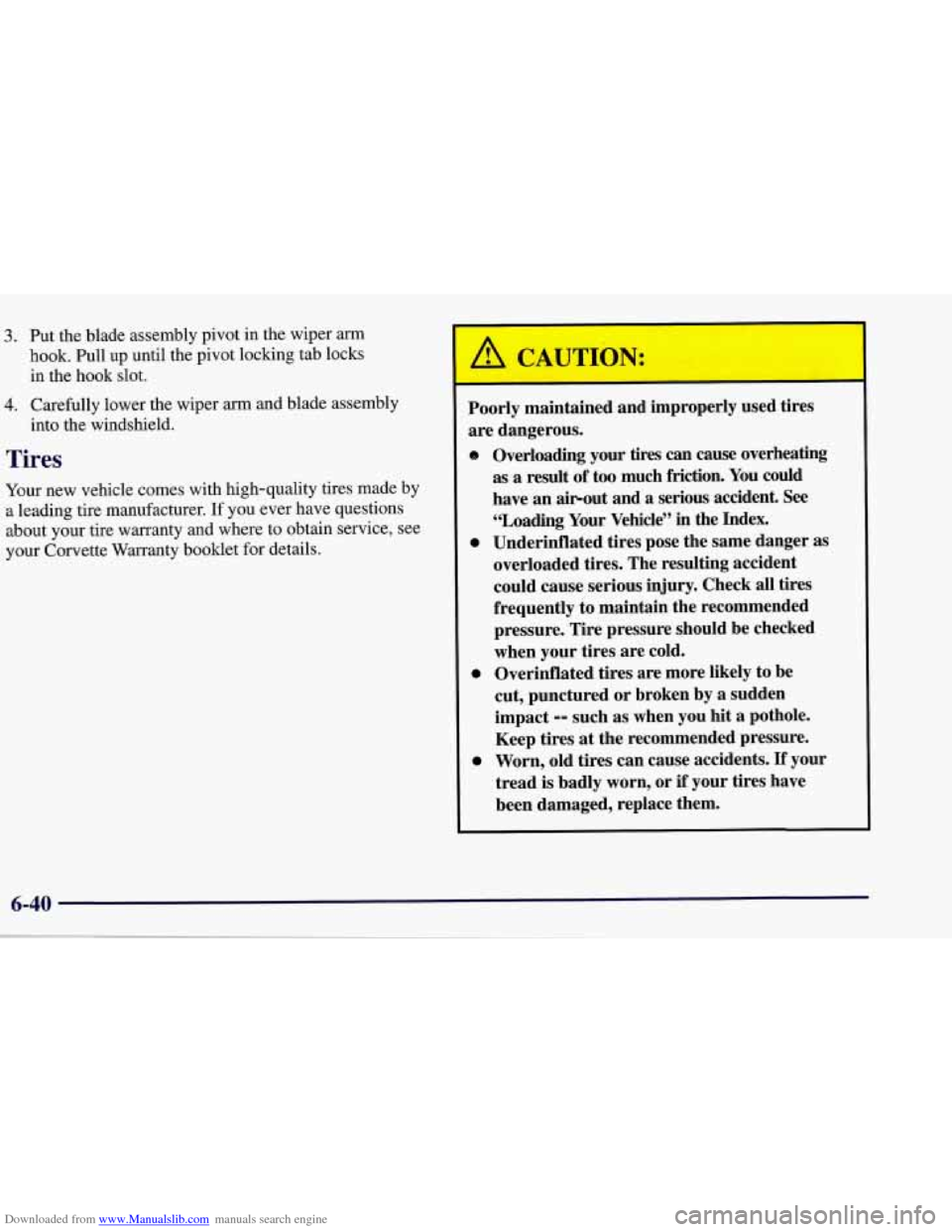
Downloaded from www.Manualslib.com manuals search engine 3. Put the blade assembly pivot in the wiper arm
hook. Pull up until the pivot locking tab locks
in the hook slot.
4. Carefully lower the wiper arm and blade assembly
into the windshield.
Tires
Your new vehicle comes with high-quality tires made by
a leading tire manufacturer. If you ever have questions
about your tire warranty and where to obtain service, see
your Corvette Warranty booklet for details.
A CAUTION:
Poorly maintained and improperly used tires
are dangerous.
0
0
0
Overloading your tires can cause overheating
as a result of too much friction. You could
have an airout and a serious accident.
See
‘Zoading Your Vehicle” in the Index.
Underinflated tires pose the same danger as
overloaded tires. The resulting accident
could cause serious injury. Check all tires
frequently to maintain the recommended
pressure. Tire pressure should be checked
when your tires are cold.
Overinflated tires are more likely to be
cut, punctured or broken by a sudden
impact
-- such as when you hit a pothole.
Keep tires at the recommended pressure.
Worn, old tires can cause accidents.
If your
tread is badly worn, or if your tires have
been damaged, replace them.
Page 286 of 378
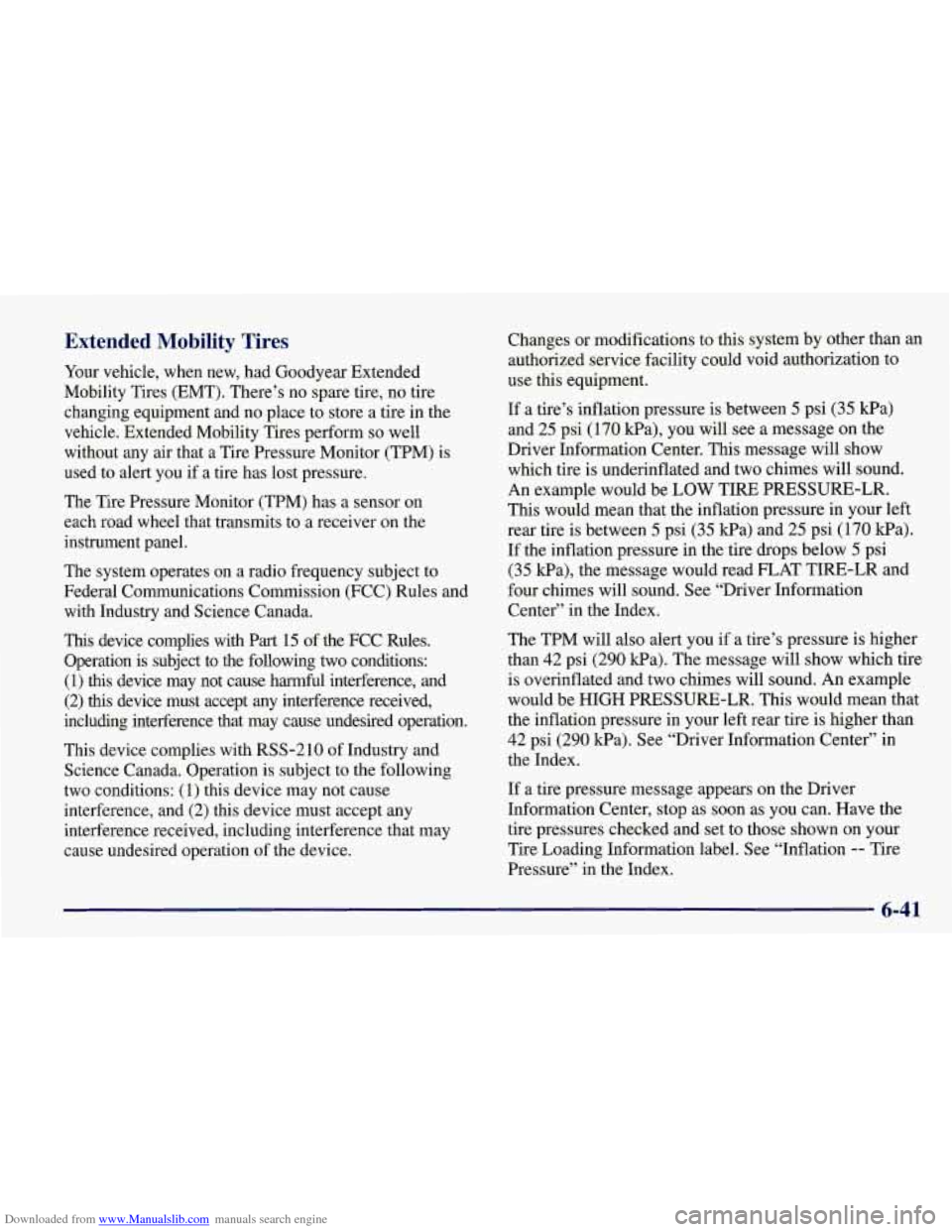
Downloaded from www.Manualslib.com manuals search engine Extended Mobility Tires
Your vehicle, when new, had Goodyear Extended
Mobility Tires (EMT). There’s no spare tire, no tire
changing equipment and no place to store a tire in the
vehicle. Extended Mobility Tires perform
so well
without any air that a Tire Pressure Monitor (TPM) is
used to alert you if a tire has lost pressure.
The Tire Pressure Monitor (TPM) has a sensor on
each road wheel that transmits to a receiver on the
instrument panel.
The system operates on a radio frequency subject to
Federal Communications Commission (FCC) Rules and
with Industry and Science Canada.
This device complies with Part 15 of the FCC Rules.
Operation is subject to the following two conditions: (1) this device may not cause harmful interference, and
(2)
this device must accept any interference received,
including interference that may cause undesired operation.
This device complies with RSS-210 of Industry and
Science Canada. Operation is subject to the following
two conditions: (1) this device may not cause
interference, and (2) this device must accept any
interference received, including interference that may
cause undesired operation of the device. Changes or modifications
to this system
by other than an
authorized service facility could void authorization to
use this equipment.
If a tire’s inflation pressure is between
5 psi (35 kPa)
and 25 psi (170 kPa), you will see a message on the
Driver Information Center. This message will show
which tire is underinflated and two chimes will sound.
An example would
be LOW TIRE PRESSURE-LR.
This would mean that the inflation pressure in your left
rear tire is between 5 psi (35 Pa) and 25 psi (170 Pa).
If the inflation pressure in the tire drops below
5 psi
(35 Ea), the message would read FLAT TIRE-LR and
four chimes will sound.
See “Driver Information
Center” in the Index.
The TPM will also alert you if a tire’s pressure is higher
than
42 psi (290 Wa). The message will show which tire
is overinflated and two chimes will sound. An example
would be HIGH PRESSURE-LR. This would mean that
the inflation pressure in your left rear tire is higher than
42 psi (290 kPa). See “Driver Information Center” in
the Index.
If a tire pressure message appears on the Driver
Information Center, stop as soon as you can. Have
the
tire pressures checked and set to those shown on your
Tire Loading Information label. See “Inflation
-- Tire
Pressure” in the Index.
Page 287 of 378
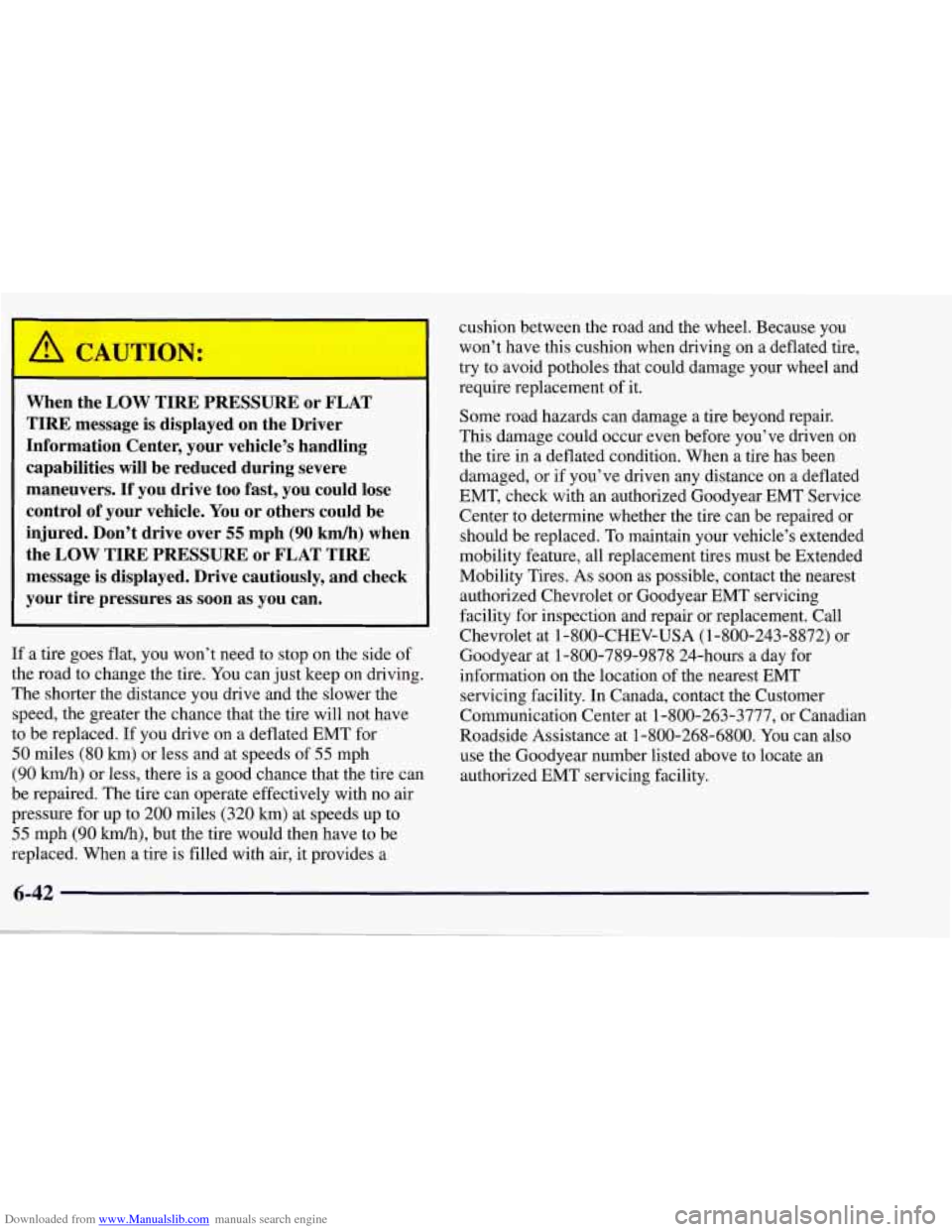
Downloaded from www.Manualslib.com manuals search engine i ,h, CAUTION:
When the LOW TIRE PRESSURE or FLAT TIRE message is displayed on the Driver
Information Center, your vehicle’s handling
capabilities will be reduced during severe
maneuvers.
If you drive too fast, you could lose
control of your vehicle.
You or others could be
injured, Don’t drive over
55 mph (90 km/h) when
the
LOW TIRE PRESSURE or FLAT TIRE
message is displayed. Drive cautiously, and check
your tire pressures as soon as you can.
I
I
If a tire goes flat, you won’t need to stop on the side of
the road to change the tire. You can just keep on driving.
The shorter the distance you drive and the slower the
speed, the greater the chance that the tire will not have
to be replaced.
If you drive on a deflated EMT for
50 miles (80 km) or less and at speeds of 55 mph
(90 km/h) or less, there is a good chance that the tire can
be repaired. The tire can operate effectively with no air
pressure for up to 200 miles (320
km) at speeds up to
55 mph (90 km/h), but the tire would then have to be
replaced. When a tire is filled with air, it provides a cushion between the
road and the wheel. Because you
won’t have this cushion when driving on a deflated tire,
try to avoid potholes that could damage your wheel and
require replacement of it.
Some road hazards can damage a tire beyond repair.
This damage could occur even before you’ve driven on
the tire in
a deflated condition. When a tire has been
damaged, or
if you’ve driven any distance on a deflated
EMT, check with an authorized Goodyear EMT Service
Center to determine whether the tire can be repaired or
should be replaced. To maintain your vehicle’s extended
mobility feature, all replacement tires must be Extended
Mobility Tires. As soon as possible, contact the nearest
authorized Chevrolet or Goodyear EMT servicing
facility for inspection and repair or replacement. Call
Chevrolet at 1-800-CHEV-USA (1-800-243-8872) or
Goodyear at 1-800-789-9878 24-hours a day for
information on the location of the nearest EMT
servicing facility. In Canada, contact the Customer
Communication Center at 1-800-263-3777, or Canadian
Roadside Assistance at 1-800-268-6800. You can also
use the Goodyear number listed above to locate an
authorized EMT servicing facility.
Page 289 of 378
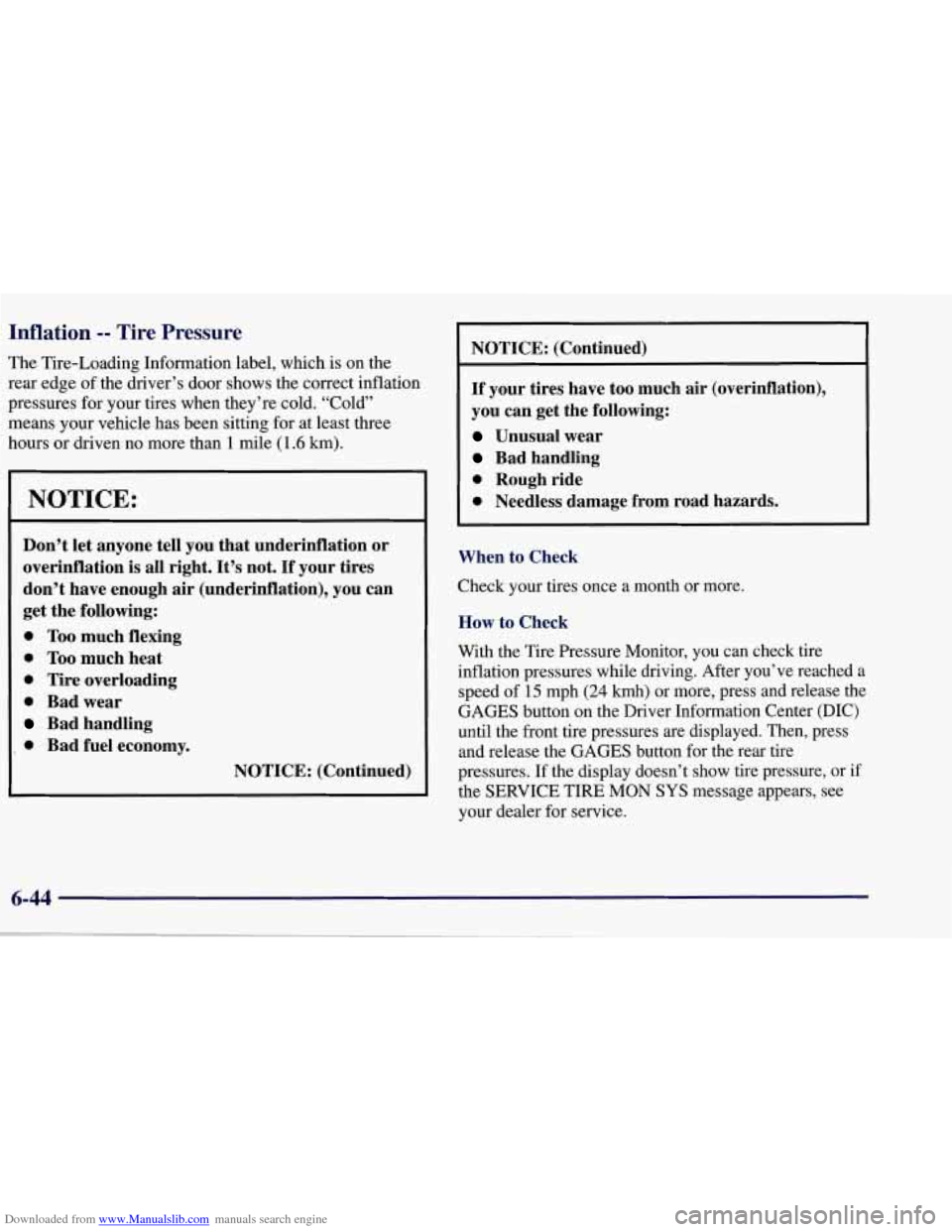
Downloaded from www.Manualslib.com manuals search engine Inflation -- Tire Pressure
The Tire-Loading Information label, which is on the
rear edge of the driver’s door shows the correct inflation
pressures for your tires when they’re cold. “Cold”
means your vehicle has been sitting for at least three
hours or driven no more than
1 mile (1.6 km).
NOTICE:
Don’t let anyone tell you that underinflation or
overinflation is all right. It’s not.
If your tires
don’t have enough
air (underinflation), you can
get the following:
0 Too much flexing
0 Too much heat
0 Tire overloading
0 Bad wear
Bad handling
0 Bad fuel economy.
NOTICE: (Continued) NOTICE: (Continued)
If your tires
have too much air (overinflation).
you can get the following:
Unusual wear
Bad handling
0 Rough ride
0 Needless damage from road hazards.
When to Check
Check your tires once a month or more.
How to Check
With the Tire Pressure Monitor, you can check tire
inflation pressures while driving. After you’ve reached a
speed
of 15 mph (24 kmh) or more, press and release the
GAGES button on the Driver Information Center (DIC)
until the front tire pressures are displayed. Then, press
and release the GAGES button for the rear tire
pressures.
If the display doesn’t show tire pressure, or if
the SERVICE TIRE
MON SYS message appears, see
your dealer for service.
Page 290 of 378
Downloaded from www.Manualslib.com manuals search engine Tire Rotation
The tires on your Corvette are directional and are
different sizes front to rear. Due to this, your tires should
not be rotated. Each tire and wheel should be used only
in the position it is in.
When It’s Time for New Tires
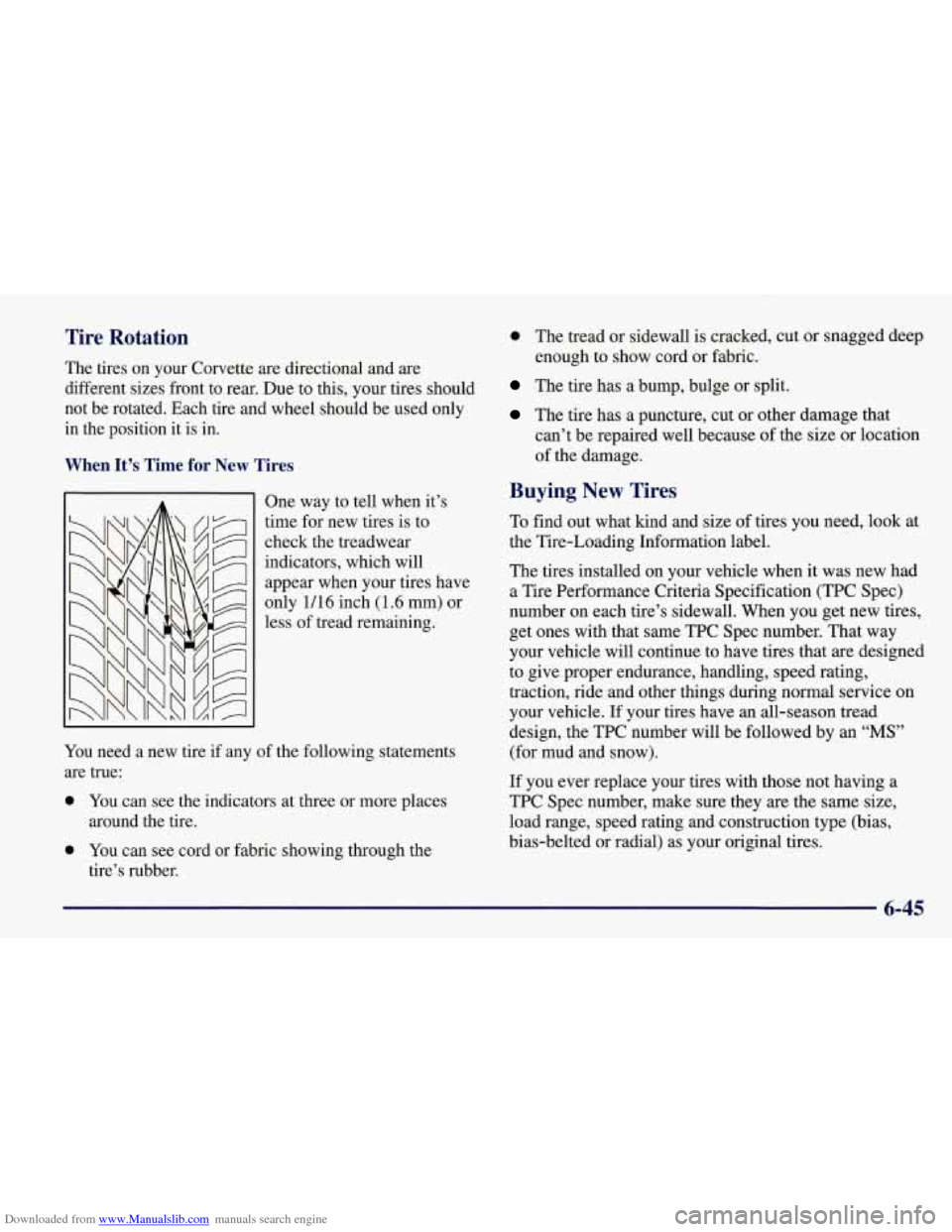
One way to tell when it’s
time for new tires is to
check the treadwear
indicators, which will
appear when your tires have
only 1/16 inch (1.6
mm) or
less of tread remaining.
You need a new tire if
any of the following statements
are true:
0 You can see the indicators at three or more places
around the tire.
0 You can see cord or fabric showing through the
tire’s rubber.
0 The tread or sidewall is cracked, cut or snagged deep
enough to show cord or fabric.
The tire has a bump, bulge or split.
The tire has a puncture, cut or other damage that
can’t be repaired well because of the size or location
of the damage.
Buying New Tires
To find out what kind and size of tires you need, look at
the Tire-Loading Information label.
The tires installed on your vehicle when it was new had
a Tire Performance Criteria Specification (TPC Spec)
number on each tire’s sidewall. When you get new tires,
get ones with that same TPC Spec number. That way
your vehicle will continue to have tires that are designed
to give proper endurance, handling, speed rating,
traction, ride and other things during normal service on
your vehicle. If your tires have an all-season tread
design, the TPC number will be followed by an
“MS”
(for mud and snow).
If you ever replace your tires with those not having a
TPC Spec number, make sure they are the same size,
load range, speed rating and construction type (bias,
bias-belted or radial) as your original tires.
6-45
Page 300 of 378
Downloaded from www.Manualslib.com manuals search engine Cleaning the Outside of the
Windshield and Wiper Blades
If the windshield is not clear after using the windshield
washer, or if the wiper blade chatters when running,
wax, sap or other material may be on the blade
or windshield.
Clean the outside of the windshield with GM
Windshield Cleaner, Bon Ami@ Powder (non-scratching
glass cleaning powder), GM Part
No. 105001 1. The
windshield is clean
if beads do not form when you rinse
it with water.
If you use a glass treatment or conditioner containing
ethyl alcohol or ethyl sulfate on your glass, be sure
to
remove the acrylic roof panel, if so equipped. These
products may damage the panel.
Grime from the windshield will stick to the wiper blades
and affect their performance. Clean the blade by wiping
vigorously with a cloth soaked in full-strength
windshield washer solvent. Then rinse the blade
with water.
Check the wiper blades and clean them as necessary;
replace blades that look worn.
Weatherstrips
Silicone grease on weatherstrips will make them last
longer, seal better, and not stick or squeak. Apply
silicone grease with a clean cloth at least every
six months. During very cold, damp weather more
frequent application may be required. (See
“Recommended Fluids and Lubricants” in the Index.)
Cleaning a Removable Roof Panel
Special care is necessary when cleaning, removing
and/or storing the roof panel.
Flush with water to remove dust and dirt, then dry
the panel.
Clean the panel with GM Glass Cleaner. Leave the
cleaner
on the panel for one minute, then wipe the
panel with a soft, lint-free cloth.
Don’t use abrasive cleaning materials.
If water drops are frequently allowed to dry on the roof
panel, impurities in the water will adhere to the top.
These impurities may etch or mar the finish. When the
panel gets wet, you should dry it off.
6-55
Page 301 of 378
Downloaded from www.Manualslib.com manuals search engine NOTICE:
Do not use a glass treatment or conditioner
containing ethyl alcohol or ethyl sulfate on the
roof panel. These products may damage the panel.
Cleaning the Outside of Your Vehicle
The paint finish on your vehicle provides beauty, depth
of color, gloss retention and durability.
Washing Your Vehicle
The best way to preserve your vehicle’s finish is to keep it
clean by washing it often with lukewarm or cold water.
Don’t wash your vehicle in the direct rays of the sun.
Don’t use strong soaps or chemical detergents. Use
liquid hand, dish or car washing (mild detergent) soaps.
You can get GM-approved cleaning products from your
dealer. (See “Appearance Care and Materials” in the
Index.) Don’t use cleaning agents that
are petroleum
based, or that contain acid or abrasives. All cleaning
agents should be flushed promptly and not allowed to
dry on the surface, or they could stain. Dry the finish
with a soft, clean chamois or an all-cotton towel to
avoid surface scratches and water spotting. High pressure car washes
may cause water to enter
your vehicle.
NOTICE:
Conveyor systems on some automatic car washes
may damage a Corvette. They may not have enough clearance for the undercarriage or for the wide rear tires.
Check with the manager before using a car wash.
Cleaning Exterior LampsLenses
Use lukewarm or cold water, a soft cloth and a liquid
hand, dish or car washing (mild detergent) soap to clean
exterior lamps and lenses. Follow instructions under
“Washing Your Vehicle.”
Finish Care
Occasional waxing or mild polishing of your vehicle by
hand may be necessary to remove residue from the paint
finish. You can get GM-approved cleaning products
from your dealer. (See “Appearance Care and Materials”
in the Index.)
Page 307 of 378
Downloaded from www.Manualslib.com manuals search engine Vehicle Identification Number (VIN)
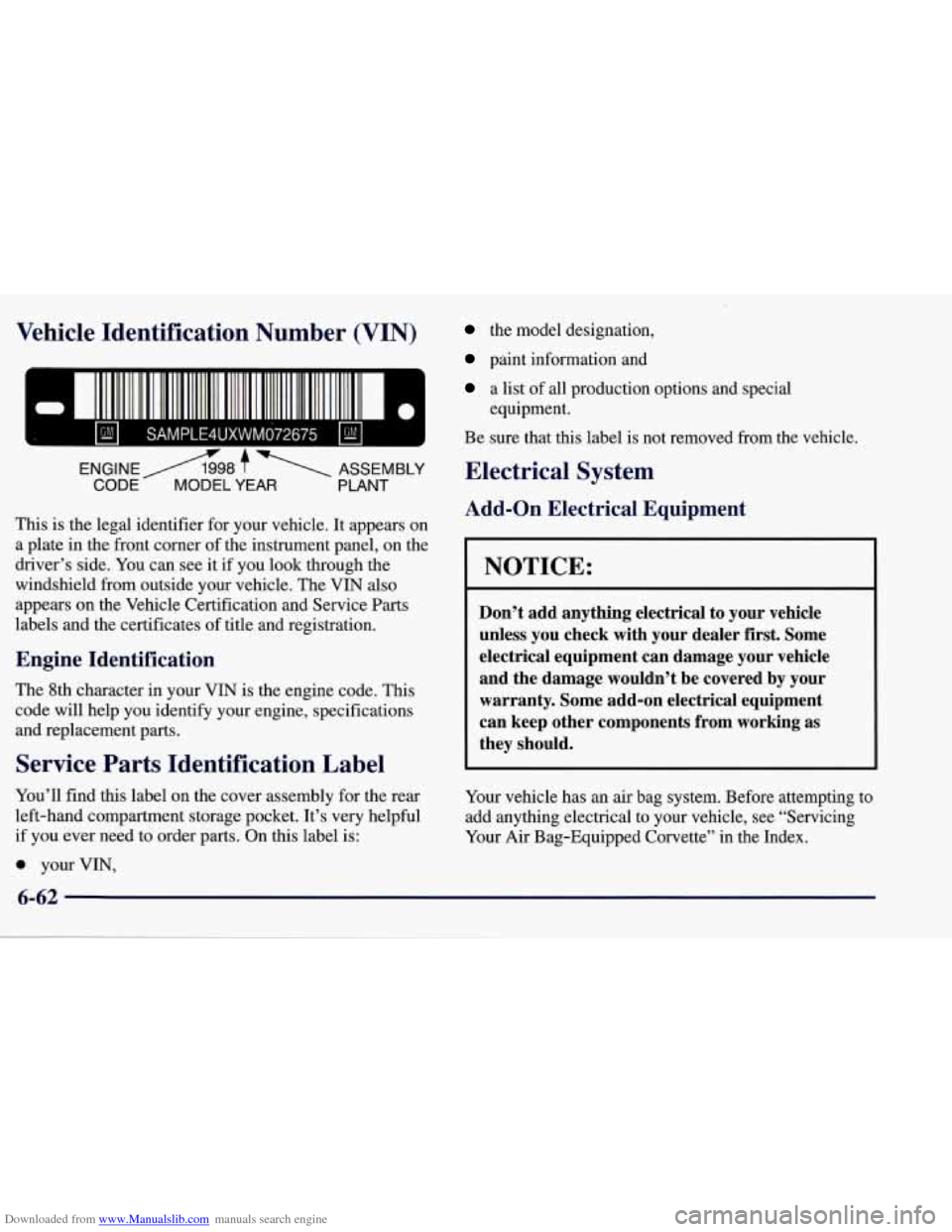
This is the legal identifier for your vehicle. It appears on
a plate in the front comer of the instrument panel, on the
driver’s side. You can see it
if you look through the
windshield from outside your vehicle. The VIN also
appears on the Vehicle Certification and Service
Parts
labels and the certificates of title and registration.
Engine Identification
The 8th character in your VIN is the engine code. This
code will help you identify your engine, specifications
and replacement parts.
Service Parts Identification Label
You’ll find this label on the cover assembly for the rear
left-hand compartment storage pocket. It’s very helpful
if you ever need to order parts. On this label is:
0 your VIN,
the model designation,
paint information and
a list of all production options and special
Be sure that this label is not removed from the vehicle.
equipment.
Electrical System
Add-on
Electrical Equipment
NOTICE:
Don’t add anything electrical to your vehicle
unless you check with your dealer first. Some
electrical equipment can damage your vehicle
and the damage wouldn’t be covered by your
warranty. Some add-on electrical equipment
can keep other components from working as
they should.
Your vehicle has an air bag system. Before attempting to
add anything electrical to your vehicle, see “Servicing
Your
Air Bag-Equipped Corvette” in the Index.
Page 309 of 378
Downloaded from www.Manualslib.com manuals search engine Headlamps
The headlamp wiring is protected by a circuit breaker.
An electrical overload will cause the lamps to go on and
off, or in some cases to remain off. If this happens, have
your headlamp wiring checked right away.
Windshield Wipers
The windshield wiper motor is protected by a fuse and
an internal circuit breaker. If the motor overheats due to
heavy snow, etc., the wiper will stop until the motor
cools. If the overload is caused by some electrical
problem and not snow, etc., be sure to get it fixed.
Power Windows and Other Power Options
Circuit breakers protect the power seats and other power
accessories. When the current load is too heavy, the
circuit breaker opens and closes, protecting the circuit
until the problem is fixed or goes away.
Fuses and Circuit Breakers
The wiring circuits in your vehicle are protected from
short circuits by a combination of maxi-fuses,
mini-fuses and circuit breakers. This greatly reduces the
chance of fires caused by electrical problems. replace
a bad fuse with a new one of the identical size
and rating.
If you ever have a problem on the road and don’t have a
spare fuse, you can borrow one that has the same
amperage. Just pick some feature of your vehicle that
you can get along without
-- like the radio or cigarette
lighter
-- and use its fuse, if it is the correct amperage.
Replace it as soon as you can.
Instrument Panel Fuse Block
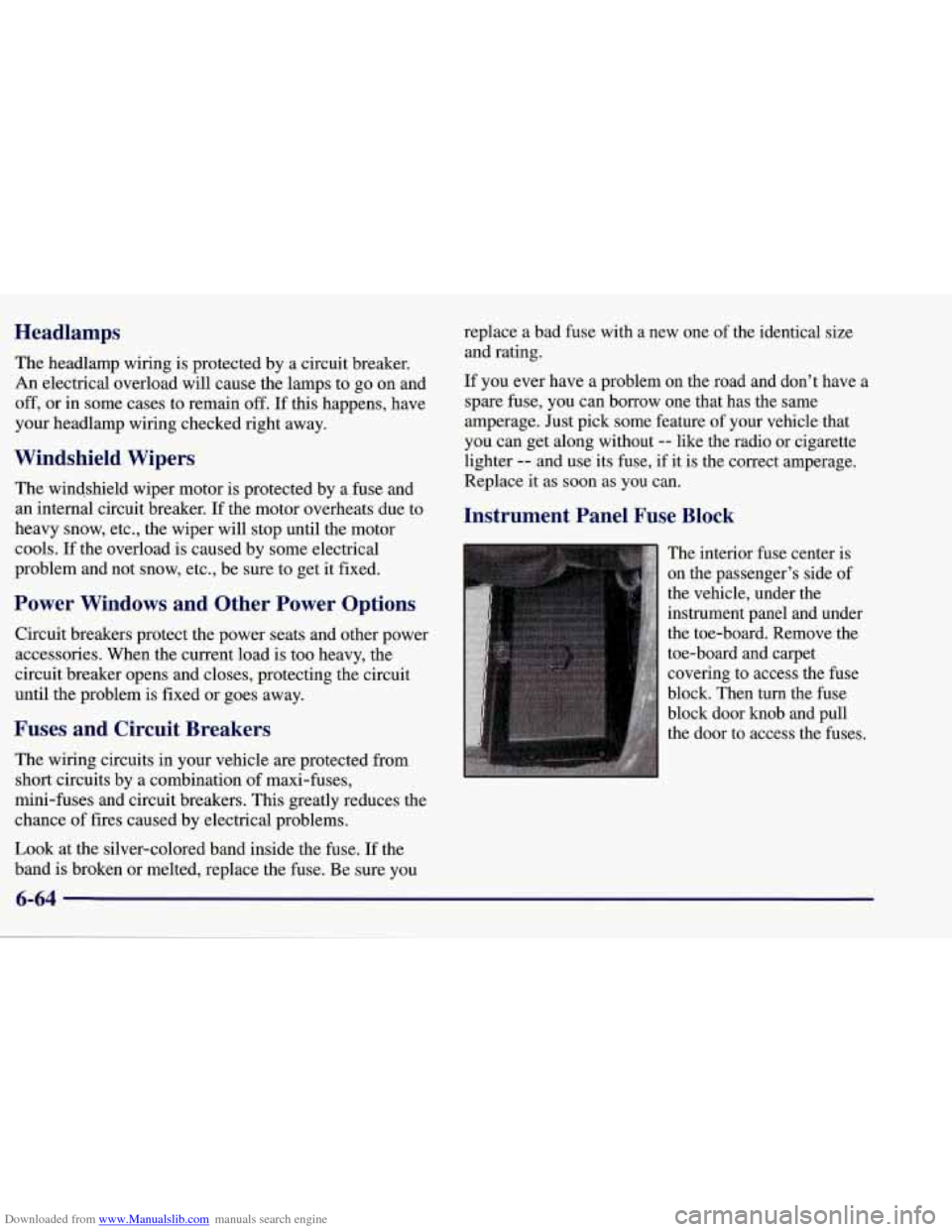
The interior fuse center is
on the passenger’s side of
the vehicle, under the
instrument panel and under
the toe-board. Remove the
toe-board and carpet
covering to access the fuse
block. Then turn the fuse
block door knob and pull
the door
to access the fuses.
Look at the silver-colored band inside the fuse. If the
band is broken or melted, replace the fuse. Be sure you
Page 316 of 378
Downloaded from www.Manualslib.com manuals search engine Wheel Nuts
Wheel Nut Torque .......... 100 lb-ft (140 N-m)
Capacities (Approximate)
The following approximate capacities are given in
United States and metric conversions.
Air Conditioning ... See the refrigerant information
label under the hood.
Automatic Transmission
Drain and Refill ................ 5 quarts (4.7 L)
Overhaul
................. 10.8 quarts (10.2 L)
Coolant System
LS 1 (with M30
automatic transmission)
...... 12.6 quarts (1 1.9 L)
LS 1 (with "6
manual transmission)
....... 12.9 quarts ( 12.2 L)
Crankcase
With Filter Change ........... 6.5 quarts (6.1 L)
Fuel Tank ................. 19.1 gallons (72.3 L)
Manual Transmission
Rear Axle (Overhaul)
................ 4.1
quarts (3.8 1 L)
Lubricant
.................. 1.5 quarts (1 -42 L)
Limited Slip Additive ......... 4 ounces (1 18 ml)
Tire Pressures ...... See Tire-Loading Information
label on rear edge of driver's door.
NOTE: All capacities are approximate. When adding,
be sure to fill to the appropriate level, as recommended
in this manual. Recheck fluid level after filling.
Vehicle Dimensions
Wheelbase .............. 104.5 inches (265.4 cm)
Tread
Front .................. 62.1 inches (157.7 cm)
Rear
.................... .62 inches (157.4 cm)
Length ................. 179.7 inches (456.4 cm)
Width ................... 73.6 inches (1 86.9 cm)
Height .................. 47.7 inches (1 21.1 cm)
6-71