roof CHEVROLET CORVETTE 1998 5.G Owners Manual
[x] Cancel search | Manufacturer: CHEVROLET, Model Year: 1998, Model line: CORVETTE, Model: CHEVROLET CORVETTE 1998 5.GPages: 378, PDF Size: 19.91 MB
Page 9 of 378
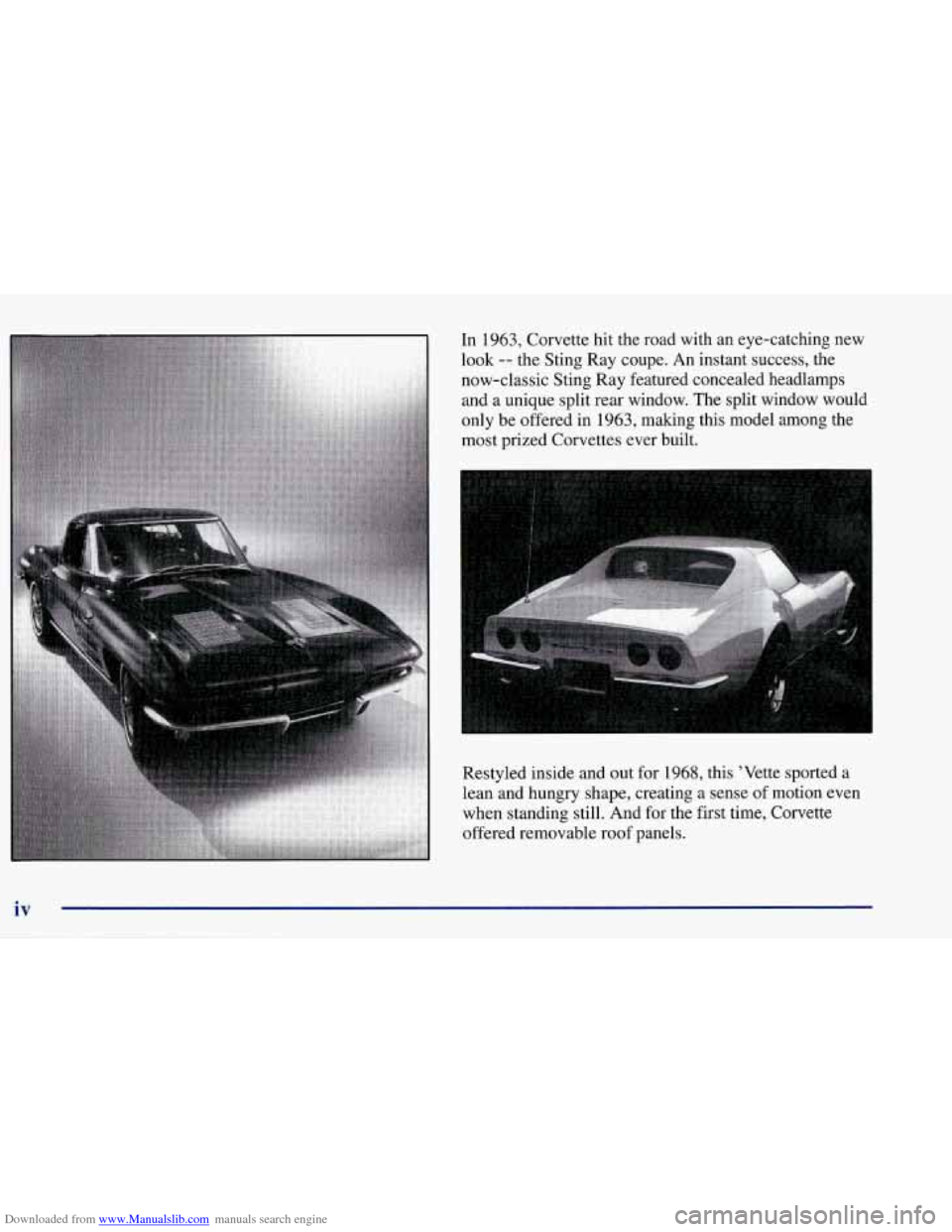
Downloaded from www.Manualslib.com manuals search engine In 1963, Corvette hit the road with an eye-catching new
look
-- the Sting Ray coupe. An instant success, the
now-classic Sting Ray featured concealed headlamps
and a unique split rear window. The split window would
only be offered in
1963, making this model among the
most prized Corvettes ever built.
Restyled inside and out for 1968, this 'Vette sported a
lean and hungry shape, creating a sense of motion even
when standing still.
And for the first time, Corvette
offered removable roof panels.
iv
Page 10 of 378
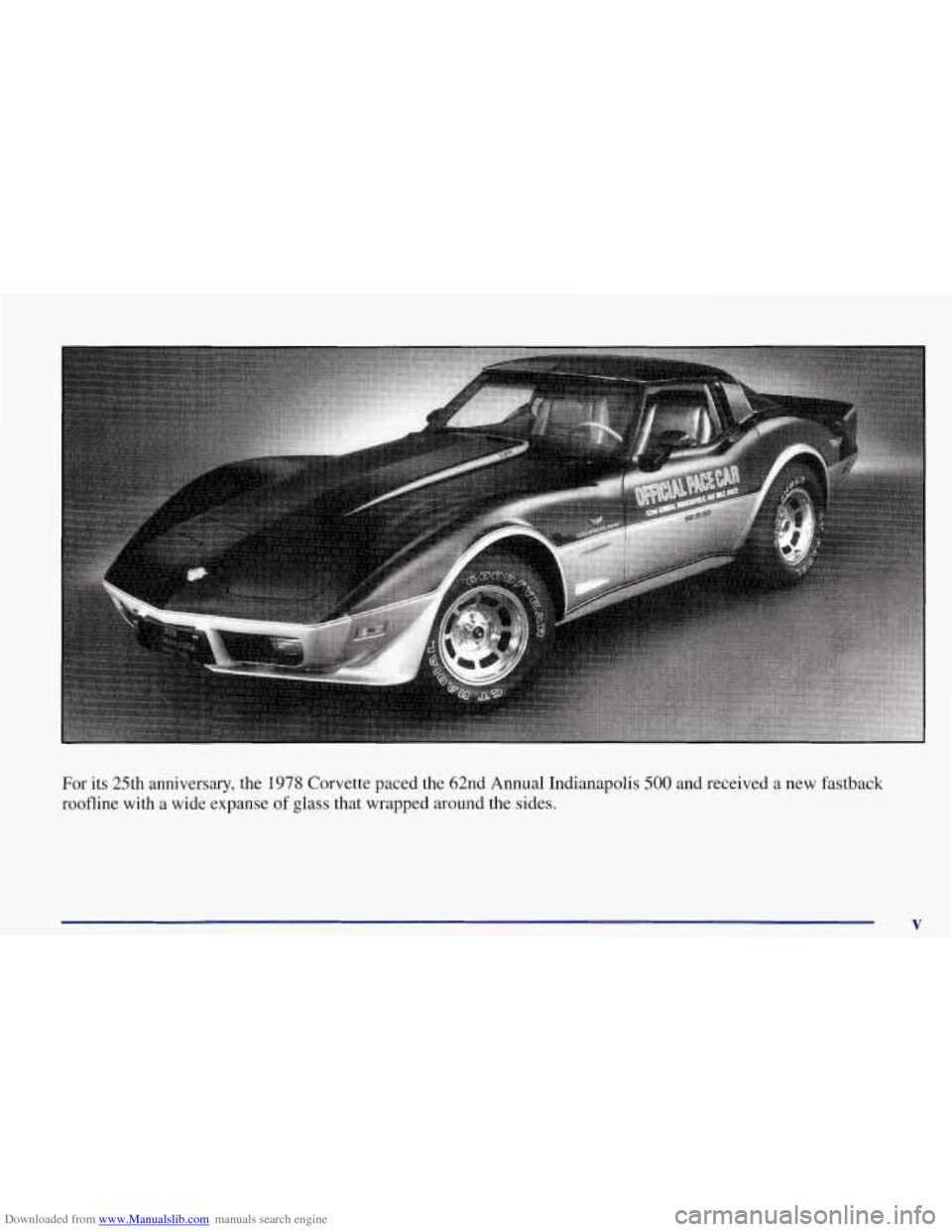
Downloaded from www.Manualslib.com manuals search engine For its 25th anniversary, the 1978 Corvette paced the 62nd Annual Indianapolis 500 and received a new fastback
roofline with a wide expanse of glass that wrapped around the sides.
V
Page 11 of 378
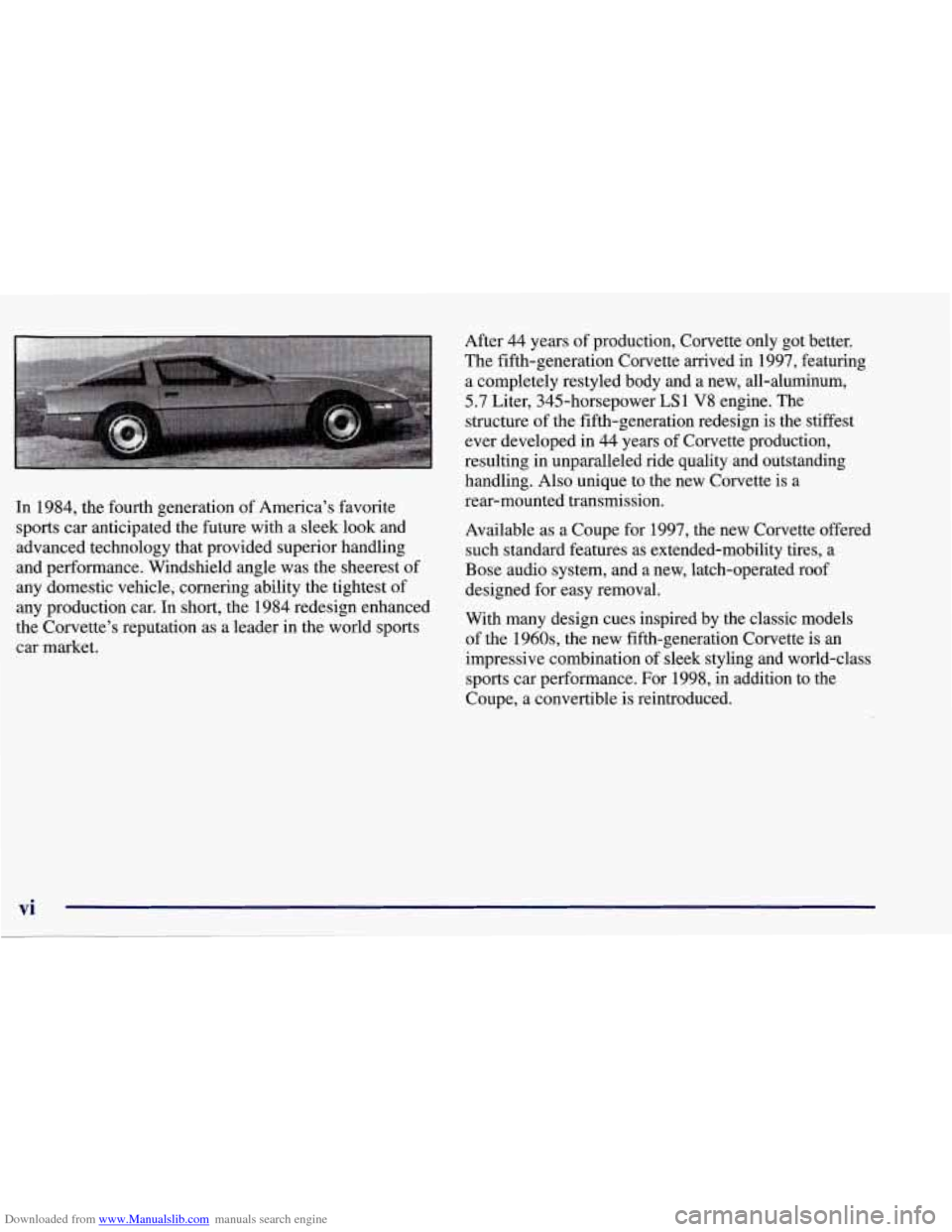
Downloaded from www.Manualslib.com manuals search engine In 1984, the fourth generation of America’s favorite
sports car anticipated the future with a sleek look and
advanced technology that provided superior handling
and performance. Windshield angle was the sheerest of
any domestic vehicle, cornering ability the tightest of
any production car. In short, the 1984 redesign enhanced
the Corvette’s reputation as a leader in the world sports
car market. After
44 years
of production, Corvette only got better.
The fifth-generation Corvette arrived in 1997, featuring
a completely restyled body and a new, all-aluminum,
5.7 Liter, 345-horsepower LS1 V8 engine. The
structure of the fifth-generation redesign is the stiffest
ever developed in 44 years of Corvette production,
resulting in unparalleled ride quality and outstanding
handling. Also unique to the new Corvette is a
rear-mounted transmission.
Available as a Coupe for 1997, the new Corvette offered
such standard features as extended-mobility tires, a
Bose audio system, and
a new, latch-operated roof
designed for easy removal.
With many design cues inspired by the classic models
of the 1960s, the new fifth-generation Corvette is an
impressive combination of sleek styling and world-class
sports car performance. For 1998, in addition to the
Coupe, a convertible is reintroduced.
vi
Page 54 of 378
Downloaded from www.Manualslib.com manuals search engine Section 2 Features and Controls
Here you can learn about the many standard and optional features on your vehicle, and information on starting,
shifting and braking. Also explained are the instrument panel and the warning systems that tell you
if everything is
working properly
-- and what to do if you have a problem.
2-4
2-5
2-6
2-
14
2- 17 2-18
2-20
2-2 1
2-22
2-24
2-26
2-29
2-32
2-34
2-36
2-36 Door Locks
Memory (Option)
Remote Function Actuation
System
Remote Hatch/Trunk Lid Release
Universal Theft-Deterrent System
PASS-Key@
New Vehicle “Break-In”
Ignition Switch Starting Your Engine
Engine Coolant Heater (Canada Only)
Automatic Transmission Operation
Manual Transmission Operation
Parking Brake Shifting Into PARK (P)
(Automatic Transmission Models Only)
Shifting Out of PARK (P)
(Automatic Transmission)
Parking Your Vehicle (Manual Transmission) 2-37
2-37
2-38
2-39 2-39
2-40
2-42
2-50
2-52
2-53
2-54
2-60
2-68
2-74
2-77
2-87 Parking Over
Things That Burn
Engine Exhaust
Running Your Engine While You’re Parked
(Automatic Transmission)
Limited-Slip Rear Axle
Selective Real Time Damping (Option)
Windows
Turn SignalMultifunction Lever
Exterior Lamps
Interior Lamps
Mirrors
Storage Compartments
Roof Panel (Coupe)
Convertible Top (Option)
Instrument Panel
Warning Lights, Gages and Messages
Driver Information Center (DIC)
2-1
Page 108 of 378
Downloaded from www.Manualslib.com manuals search engine Center Console
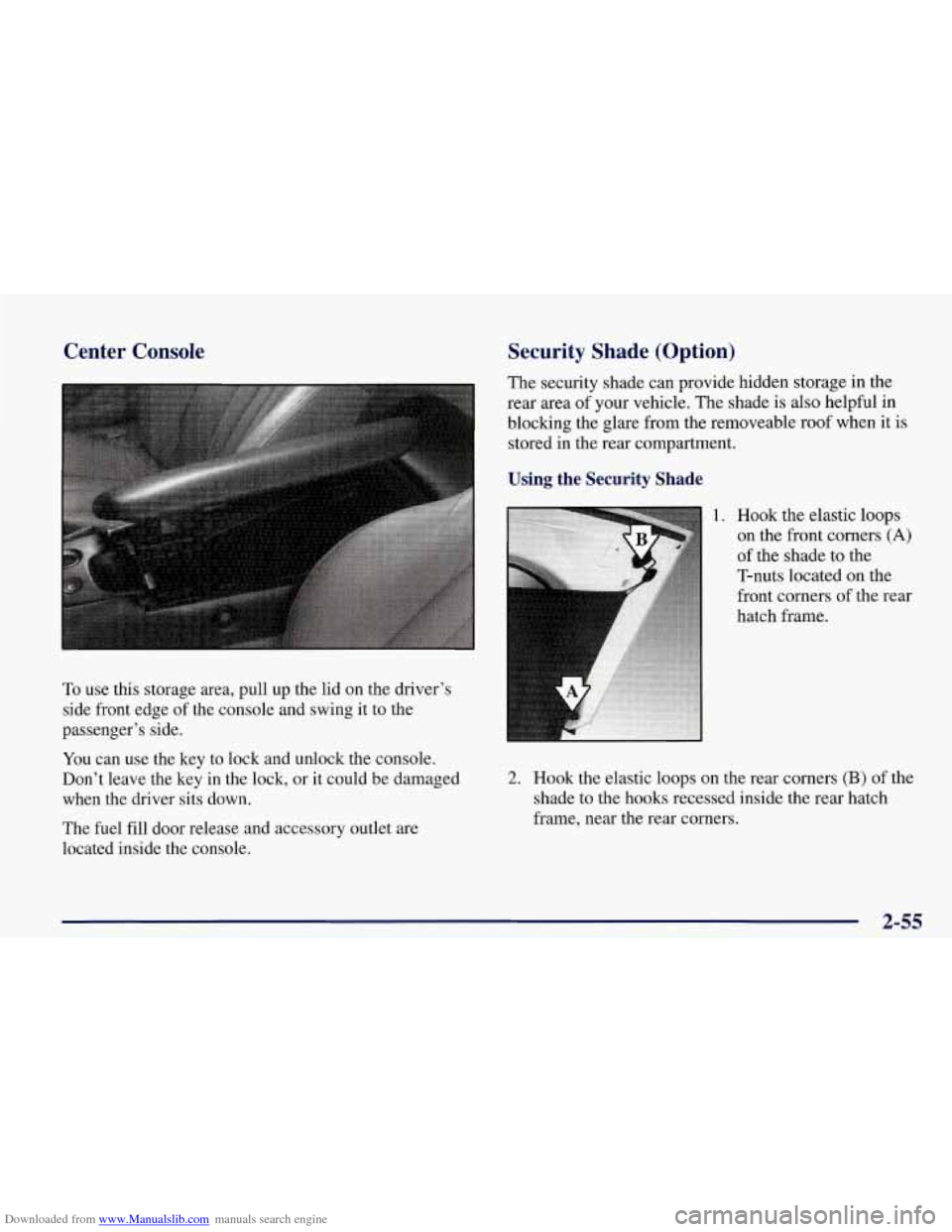
To use this storage area, pull up the lid on the driver's
side front edge of the console and swing it to the
passenger's side.
You can use the key to lock and unlock the console.
Don't leave the key in the lock, or it could be damaged
when the driver sits down.
The fuel fill door release and accessory outlet are
located inside the console.
Security Shade (Option)
The security shade can provide hidden storage in the
rear area of your vehicle. The shade is also helpful in
blocking the glare from the removeable roof when it is
stored in the rear compartment.
Using the Security Shade
1. Hook the elastic loops
on the front corners
(A)
of the shade to the
T-nuts located on the
front corners of the rear
hatch frame.
2. Hook the elastic loops on the rear corners (B) of the
shade to the hooks recessed inside the rear hatch
frame, near the rear corners.
2-55
Page 113 of 378
Downloaded from www.Manualslib.com manuals search engine How to Remove and Replace the Floor Mats Roof Panel (Coupe)
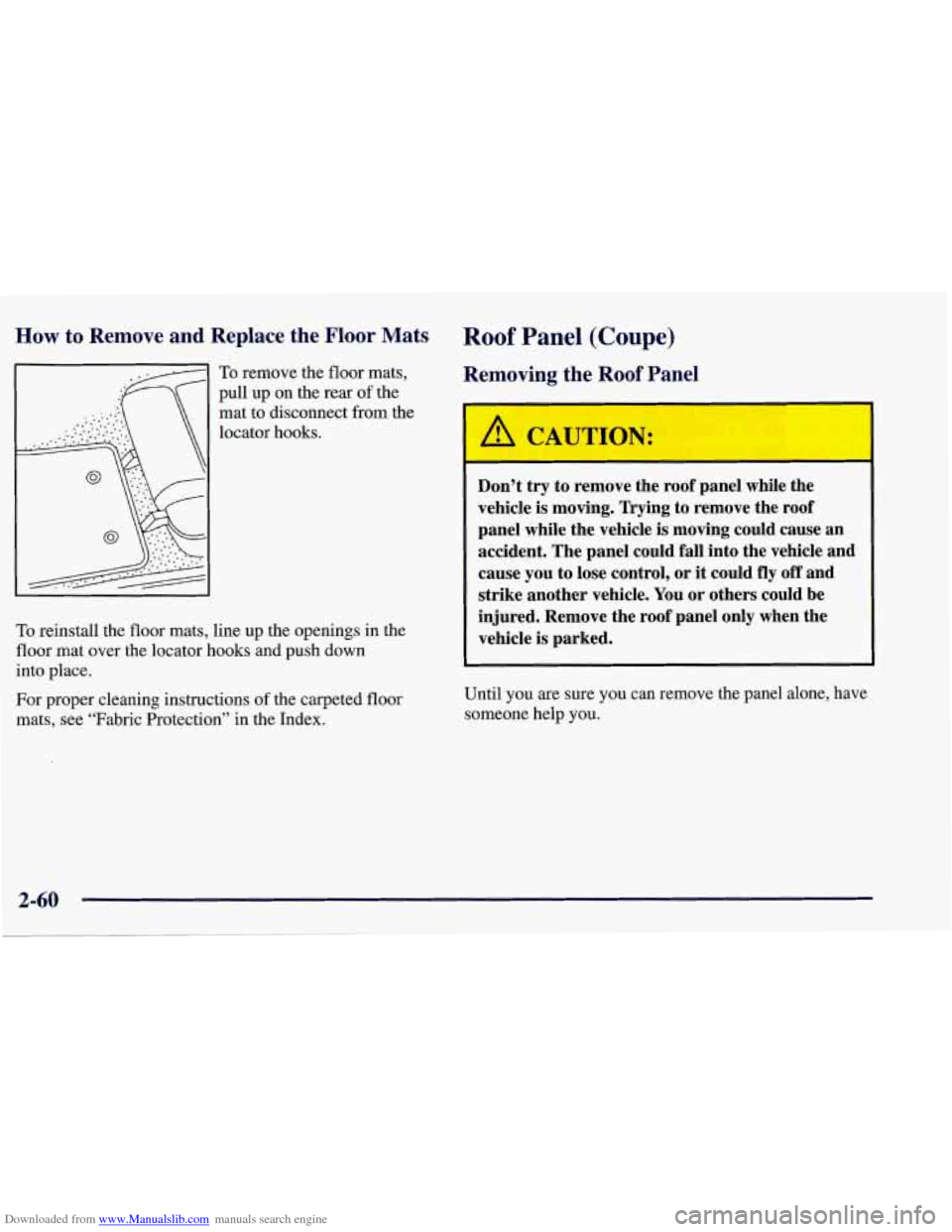
To remove the floor mats,
pull up on the rear of the
mat to disconnect from the
locator hooks.
To reinstall the floor mats, line up the openings in the
floor mat over the locator hooks and push down
into place.
For proper cleaning instructions
of the carpeted floor
mats, see “Fabric Protection” in the Index.
Removing the Roof Panel
I A CAUTION:
Don’t try to remove the roof panel while the
vehicle is moving. Trying to remove the roof
panel while the vehicle is moving could cause
an
accident. The panel could fall into the vehicle and
cause you to lose control, or it could
fly off and
strike another vehicle. You or others could be
injured. Remove the roof panel only when the
vehicle is parked.
Until you are sure you can remove the panel alone, have
someone help
you.
Page 114 of 378
Downloaded from www.Manualslib.com manuals search engine NOTICE:
To avoid damage to the roof panel, paint and
weatherstripping do not drop or rest it on its
edges. Place the roof panel in the egg-shaped
stowage receivers after removing it from
the vehicle.
1. Park on a level surface, set the parking brake firmly
and shift an automatic transmission into PARK (P).
Shift a manual transmission into REVERSE
(R).
Turn the ignition key to OFF. Lower both sunshades
and rotate them toward the door glass.
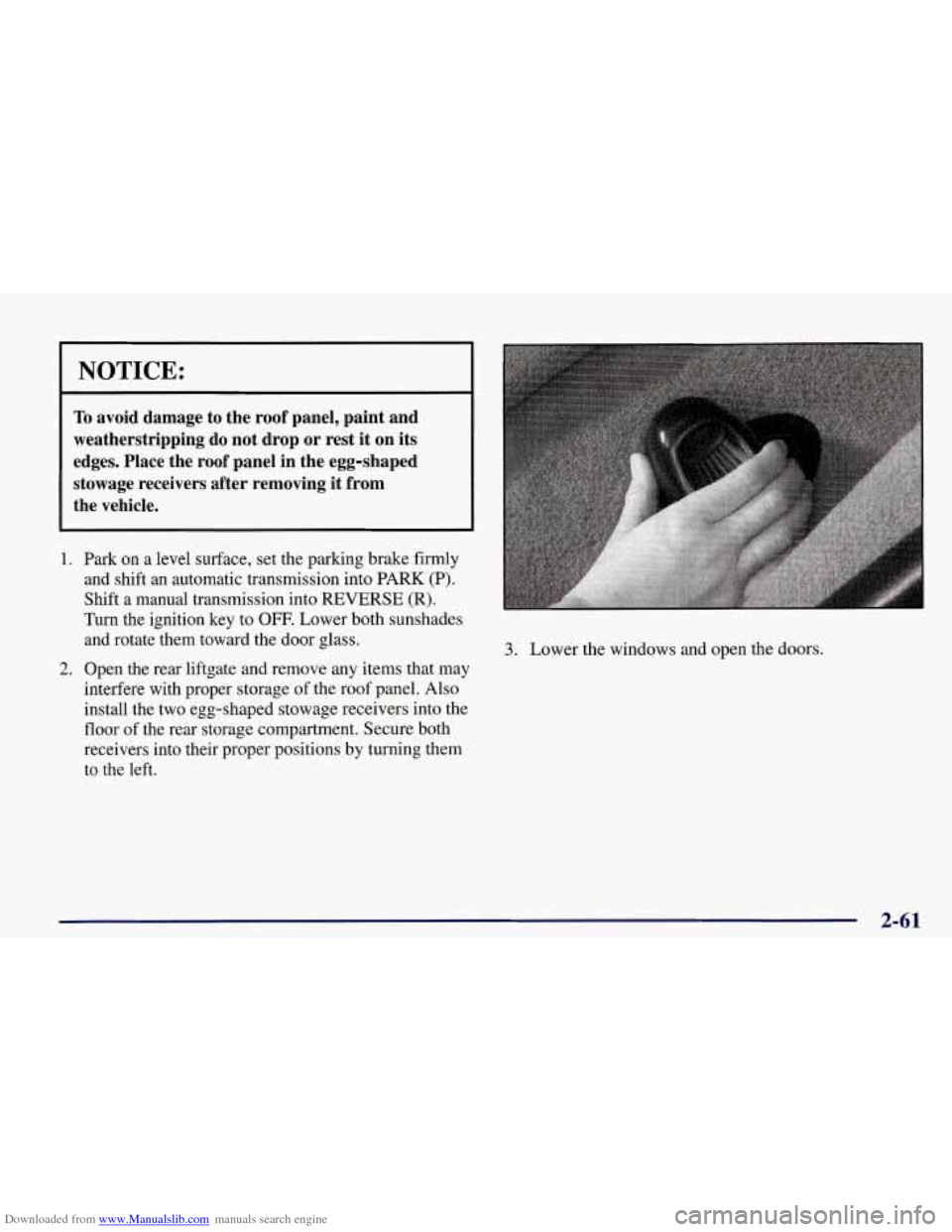
2. Open the rear liftgate and remove any items that may
interfere with proper storage
of the roof panel. Also
install the two egg-shaped stowage receivers into the
floor of the rear storage compartment. Secure both
receivers into their proper positions by turning them
to the left.
3. Lower the windows and open the doors.
2-61
Page 115 of 378
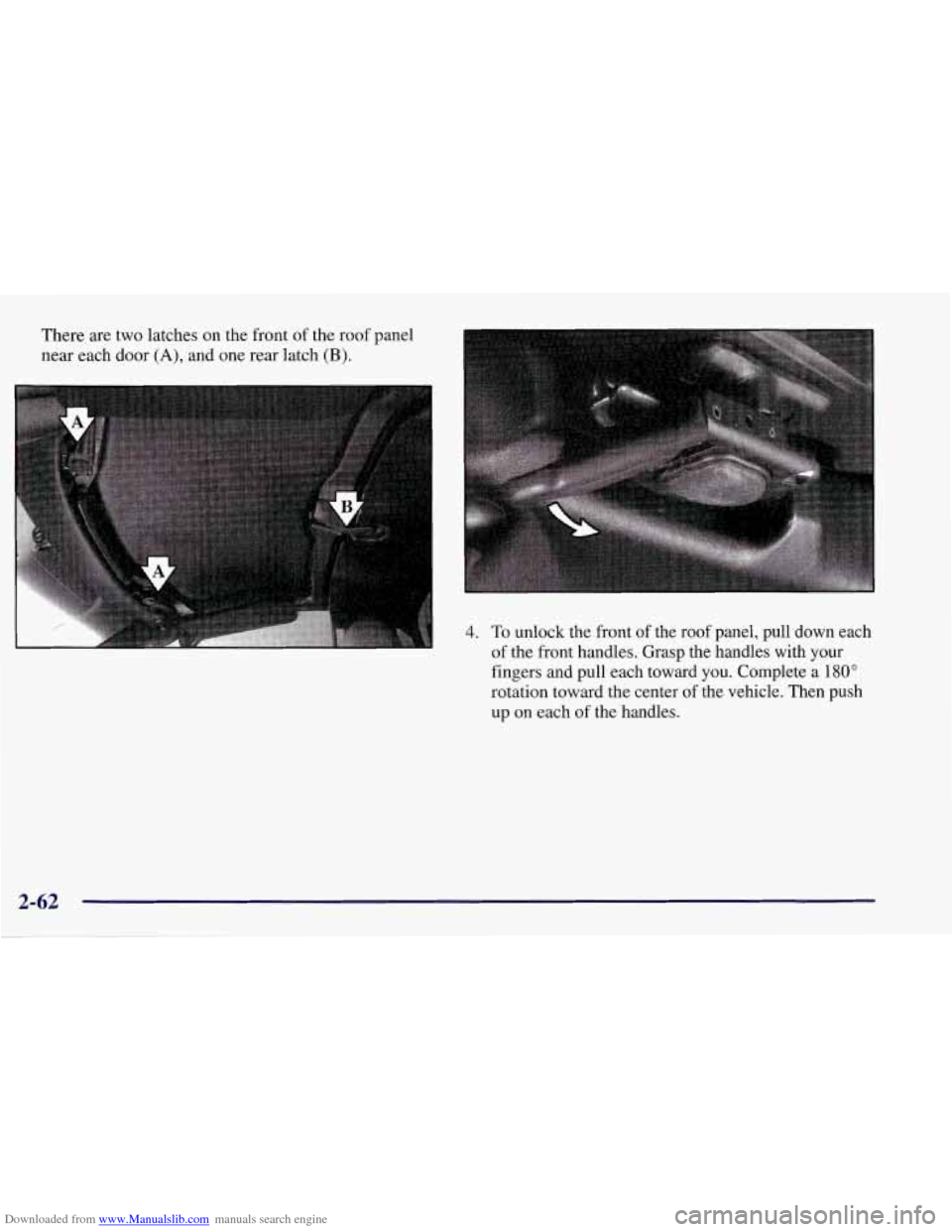
Downloaded from www.Manualslib.com manuals search engine There are two latches on the front of the roof panel
near each door
(A), and one rear latch (B).
4. To unlock the front of the roof panel, pull down each
of the front handles. Grasp the handles with your
fingers and pull each toward
you. Complete a 180"
rotation toward the center of the vehicle. Then push
up
on each of the handles.
2-62
Page 116 of 378
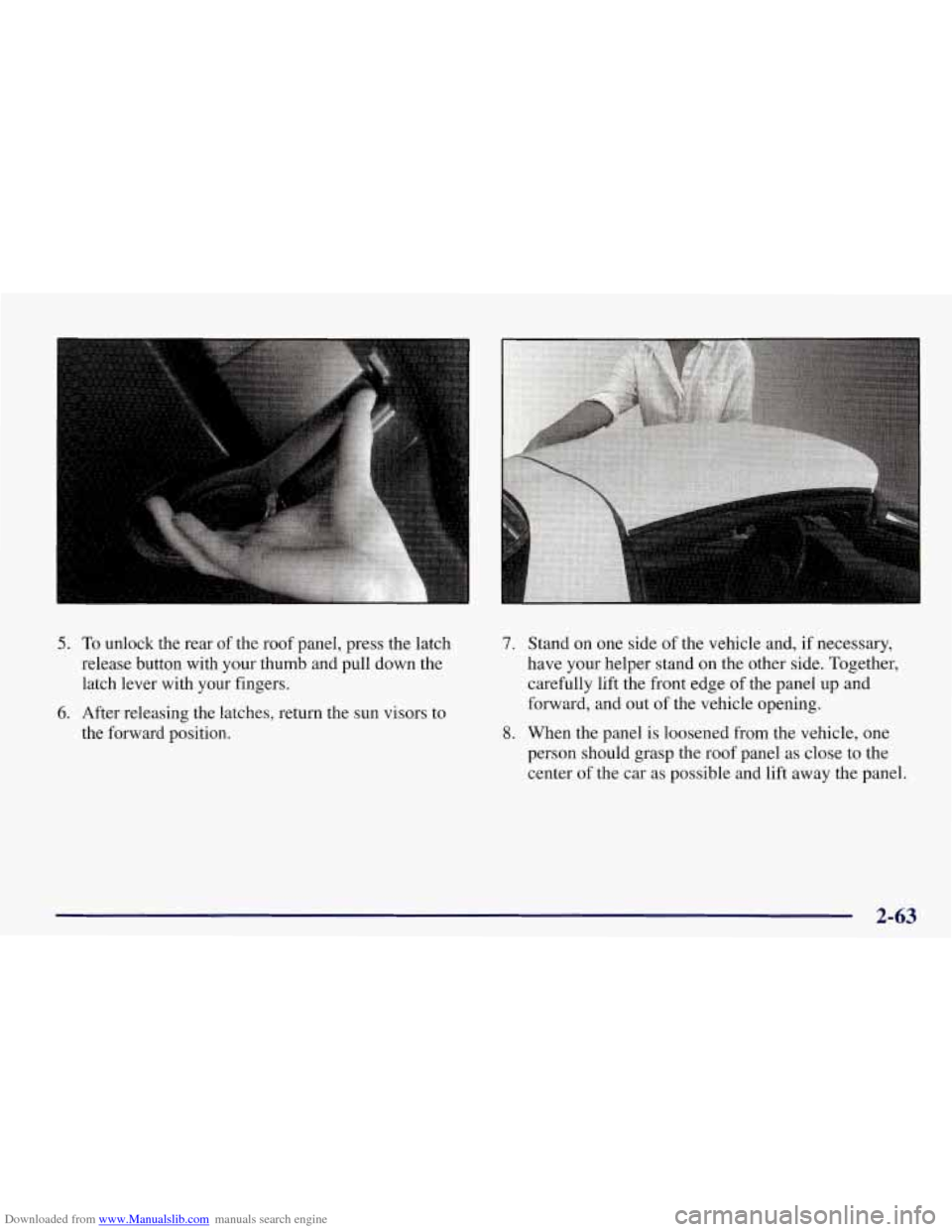
Downloaded from www.Manualslib.com manuals search engine 5. To unlock the rear of the roof panel, press the latch
release button with your thumb and pull down the
latch lever with your fingers.
6. After releasing the latches, return the sun visors to
the forward position.
I
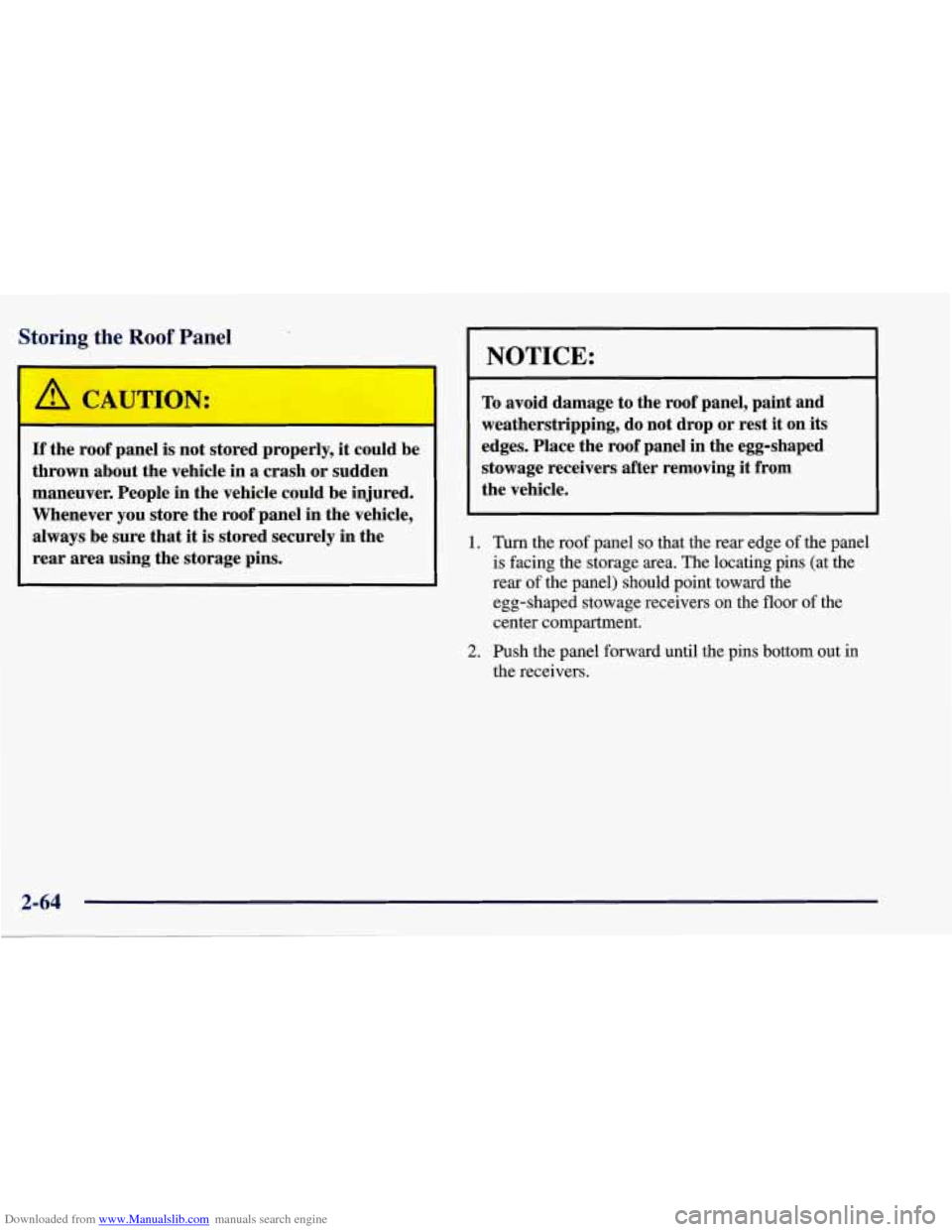
7. Stand on one side of the vehicle and, if necessary,
have your helper stand on the other side. Together,
carefully lift the front edge
of the panel up and
forward, and out
of the vehicle opening.
8. When the panel is loosened from the vehicle, one
person should grasp the roof panel as close to the
center of the
car as possible and lift away the panel.
2-63
Page 117 of 378
Downloaded from www.Manualslib.com manuals search engine Storing the Roof Panel
I A CAUTION
If the roof panel is not stored properly, it could be
thrown about the vehicle in a crash or sudden
maneuver. People in the vehicle could be injured.
Whenever you store the roof panel
in the vehicle,
always be sure that
it is stored securely in the
rear area using the storage pins.
NOTICE:
To avoid damage to the roof panel, paint and
weatherstripping, do not drop or rest it on its
edges. Place the roof panel in the egg-shaped
stowage receivers after removing it from
the vehicle.
1. Turn the roof panel so that the rear edge of the panel
is facing the storage area. The locating pins (at the
rear
of the panel) should point toward the
egg-shaped stowage receivers on the floor of the
center compartment.
2. Push the panel forward until the pins bottom out in
the receivers.