change wheel CHEVROLET CORVETTE 2002 5.G User Guide
[x] Cancel search | Manufacturer: CHEVROLET, Model Year: 2002, Model line: CORVETTE, Model: CHEVROLET CORVETTE 2002 5.GPages: 384, PDF Size: 2.49 MB
Page 224 of 384

4-13
Steering
Power Steering
If you lose power steering assist because the engine stops
or the system is not functioning, you can steer but it will
take much more effort.
Magnetic Speed Variable Assist Steering
Your vehicle is equipped with a steering system that
continuously adjusts the effort you feel when steering
at all vehicle speeds. It provides ease when parking
yet a firm, solid feel at highway speeds.
Steering Tips
Driving on Curves
It's important to take curves at a reasonable speed.
A lot of the ªdriver lost controlº accidents mentioned
on the news happen on curves. Here's why:
Experienced driver or beginner, each of us is subject
to the same laws of physics when driving on curves.
The traction of the tires against the road surface makes it
possible for the vehicle to change its path when you turn
the front wheels. If there's no traction, inertia will keep
the vehicle going in the same direction. If you've ever
tried to steer a vehicle on wet ice, you'll understand this.The traction you can get in a curve depends on the
condition of your tires and the road surface, the angle at
which the curve is banked, and your speed. While you're
in a curve, speed is the one factor you can control.
Suppose you're steering through a sharp curve. Then you
suddenly accelerate. Both control systems
-- steering and
acceleration
-- have to do their work where the tires meet
the road. Adding the sudden acceleration can demand too
much of those places. You can lose control. Refer to
ªTraction Control Systemº in the Index.
What should you do if this ever happens? Ease up on
the accelerator pedal, steer the vehicle the way you
want it to go, and slow down.
Speed limit signs near curves warn that you should
adjust your speed. Of course, the posted speeds are
based on good weather and road conditions. Under less
favorable conditions you'll want to go slower.
If you need to reduce your speed as you approach a
curve, do it before you enter the curve, while your front
wheels are straight ahead.
Try to adjust your speed so you can ªdriveº through
the curve. Maintain a reasonable, steady speed. Wait
to accelerate until you are out of the curve, and then
accelerate gently into the straightaway.
Page 228 of 384

4-17
Loss of Control
Let's review what driving experts say about what happens
when the three control systems (brakes, steering and
acceleration) don't have enough friction where the tires
meet the road to do what the driver has asked.
In any emergency, don't give up. Keep trying to steer and
constantly seek an escape route or area of less danger.
Skidding
In a skid, a driver can lose control of the vehicle.
Defensive drivers avoid most skids by taking
reasonable care suited to existing conditions, and
by not ªoverdrivingº those conditions. But skids
are always possible.
The three types of skids correspond to your vehicle's
three control systems. In the braking skid, your wheels
aren't rolling. In the steering or cornering skid, too
much speed or steering in a curve causes tires to slip
and lose cornering force. And in the acceleration skid,
too much throttle causes the driving wheels to spin.
A cornering skid is best handled by easing your foot
off the accelerator pedal.
Remember: Any traction control system helps avoid
only the acceleration skid.If your TCS system is off, then an acceleration
skid is also best handled by easing your foot off
the accelerator pedal.
If your vehicle starts to slide, ease your foot off the
accelerator pedal and quickly steer the way you want
the vehicle to go. If you start steering quickly enough,
your vehicle may straighten out. Always be ready for a
second skid if it occurs.
Of course, traction is reduced when water, snow, ice,
gravel or other material is on the road. For safety,
you'll want to slow down and adjust your driving to
these conditions. It is important to slow down on
slippery surfaces because stopping distance will be
longer and vehicle control more limited.
While driving on a surface with reduced traction, try
your best to avoid sudden steering, acceleration or
braking (including engine braking by shifting to a
lower gear). Any sudden changes could cause the tires
to slide. You may not realize the surface is slippery
until your vehicle is skidding. Learn to recognize
warning clues
-- such as enough water, ice or packed
snow on the road to make a ªmirrored surfaceº
-- and
slow down when you have any doubt.
Remember: Any anti
-lock brake system (ABS) helps
avoid only the braking skid.
Page 313 of 384

6-41 Extended Mobility Tires
(Except ZO6 Models)
Your vehicle, when new, had Goodyear Extended
Mobility Tires (EMT). There's no spare tire, no tire
changing equipment and no place to store a tire in
the vehicle. Extended Mobility Tires perform so well
without any air that a Tire Pressure Monitor (TPM) is
used to alert you if a tire has lost pressure.
If a tire goes flat, you won't need to stop on the side of
the road to change the tire. You can just keep on driving.
The shorter the distance you drive and the slower the
speed, the greater the chance that the tire will not have to
be replaced. If you drive on a deflated EMT for 50 miles
(80 km) or less and at speeds of 55 mph (90 km/h) or
less, there is a good chance that the tire can be repaired.
The tire can operate effectively with no air pressure for
up to 200 miles (320 km) at speeds up to 55 mph
(90 km/h), but the tire would then have to be replaced. When a tire is filled with air, it provides a cushion
between the road and the wheel. Because you won't
have this cushion when driving on a deflated tire,
try to avoid potholes that could damage your wheel
and require replacement of it.
Some road hazards can damage a tire beyond repair.
This damage could occur even before you've driven on
the tire in a deflated condition. When a tire has been
damaged, or if you've driven any distance on a deflated
EMT, check with an authorized Goodyear EMT Service
Center to determine whether the tire can be repaired or
should be replaced. To maintain your vehicle's extended
mobility feature, all replacement tires must be Extended
Mobility Tires. As soon as possible, contact the nearest
authorized Chevrolet or Goodyear EMT servicing facility
for inspection and repair or replacement. To locate the
nearest Chevrolet or Goodyear EMT servicing facility,
call Roadside Assistance. For phone numbers and
Roadside Assistance details, see ªRoadside Assistanceº
or ªCanadian Roadside Assistanceº in the Index. You
may also contact Goodyear, for the nearest authorized
EMT servicing facility, by calling 1
-800-789-9878.
Page 323 of 384
6-51
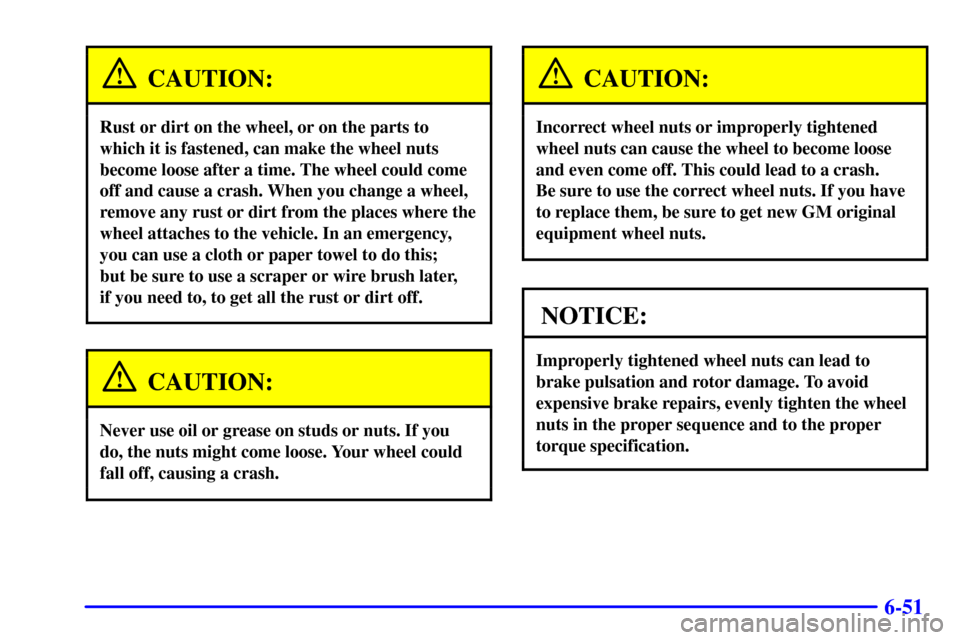
CAUTION:
Rust or dirt on the wheel, or on the parts to
which it is fastened, can make the wheel nuts
become loose after a time. The wheel could come
off and cause a crash. When you change a wheel,
remove any rust or dirt from the places where the
wheel attaches to the vehicle. In an emergency,
you can use a cloth or paper towel to do this;
but be sure to use a scraper or wire brush later,
if you need to, to get all the rust or dirt off.
CAUTION:
Never use oil or grease on studs or nuts. If you
do, the nuts might come loose. Your wheel could
fall off, causing a crash.
CAUTION:
Incorrect wheel nuts or improperly tightened
wheel nuts can cause the wheel to become loose
and even come off. This could lead to a crash.
Be sure to use the correct wheel nuts. If you have
to replace them, be sure to get new GM original
equipment wheel nuts.
NOTICE:
Improperly tightened wheel nuts can lead to
brake pulsation and rotor damage. To avoid
expensive brake repairs, evenly tighten the wheel
nuts in the proper sequence and to the proper
torque specification.