ESP CHEVROLET CORVETTE 2007 6.G Owner's Manual
[x] Cancel search | Manufacturer: CHEVROLET, Model Year: 2007, Model line: CORVETTE, Model: CHEVROLET CORVETTE 2007 6.GPages: 488, PDF Size: 2.62 MB
Page 291 of 488
Try not to pass more than one vehicle at a time
on two-lane roads. Reconsider before passing
the next vehicle.
Do not overtake a slowly moving vehicle too
rapidly. Even though the brake lamps are not
ashing, it might be slowing down or starting
to turn.
If you are being passed, make it easy for the
following driver to get ahead of you. Perhaps
you can ease a little to the right.
Loss of Control
Let us review what driving experts say about what
happens when the three control systems — brakes,
steering, and acceleration — do not have enough
friction where the tires meet the road to do what the
driver has asked.
In any emergency, do not give up. Keep trying to
steer and constantly seek an escape route or
area of less danger.
Skidding
In a skid, a driver can lose control of the vehicle.
Defensive drivers avoid most skids by taking
reasonable care suited to existing conditions, and
by not overdriving those conditions. But skids
are always possible.
The three types of skids correspond to your
vehicle’s three control systems. In the braking
skid, the wheels are not rolling. In the steering or
cornering skid, too much speed or steering in
a curve causes tires to slip and lose cornering
force. And in the acceleration skid, too much
throttle causes the driving wheels to spin.
A cornering skid is best handled by easing your
foot off the accelerator pedal.
Remember: Any traction control system helps
avoid only the acceleration skid. If your traction
control system is off, then an acceleration
skid is also best handled by easing your foot off
the accelerator pedal.
291
Page 293 of 488
Vehicles with the Z51 performance package
have greaseable outer ends on both of the rear
toe-links. Under normal use, lubrication should
be performed as described in the maintenance
schedule. SeeScheduled Maintenance on
page 433andRecommended Fluids and
Lubricants on page 443. If you use the vehicle
for racing, lubrication should be performed at the
end of each racing day. See your dealer/retailer
for lubrication and make sure any needed
repairs are made at once. Proper procedures for
performing these services can be found in the
service manual. SeeService Publications
Ordering Information on page 468.Driving at Night
Night driving is more dangerous than day driving.
One reason is that some drivers are likely to
be impaired — by alcohol or drugs, with night
vision problems, or by fatigue.
Here are some tips on night driving.
Drive defensively.
Do not drink and drive.
Adjust the inside rearview mirror to reduce
the glare from headlamps behind you.
Since you cannot see as well, slow down
and keep more space between you and
other vehicles.
Slow down, especially on higher speed roads.
Your vehicle’s headlamps can light up only so
much road ahead.
In remote areas, watch for animals.
If you are tired, pull off the road in a safe
place and rest.
293
Page 297 of 488
Some Other Rainy Weather Tips
Besides slowing down, allow some extra
following distance. And be especially
careful when you pass another vehicle.
Allow yourself more clear room ahead,
and be prepared to have your view
restricted by road spray.
Have good tires with proper tread depth.
SeeTires on page 378.
City Driving
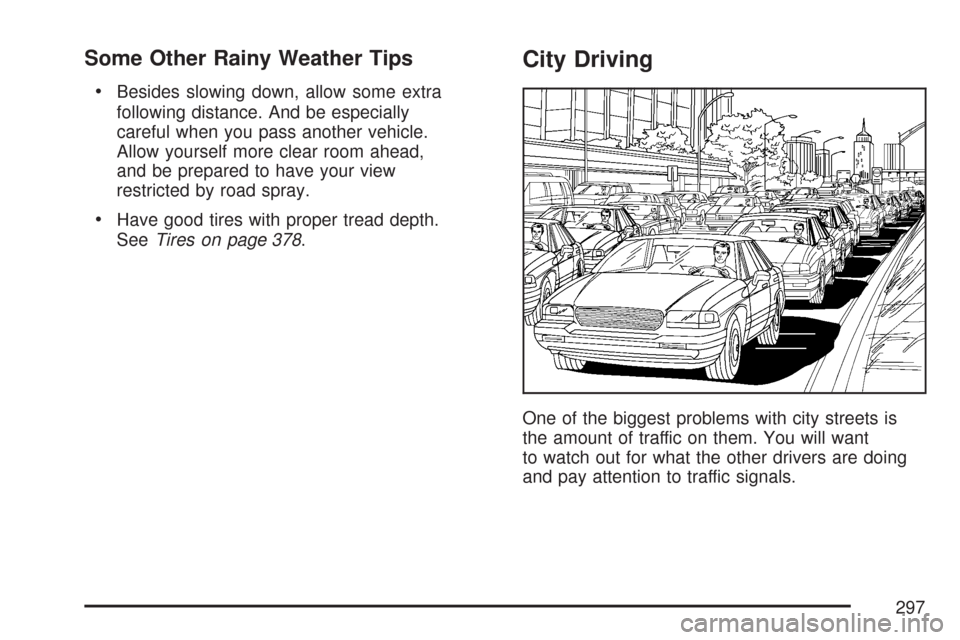
One of the biggest problems with city streets is
the amount of traffic on them. You will want
to watch out for what the other drivers are doing
and pay attention to traffic signals.
297
Page 307 of 488
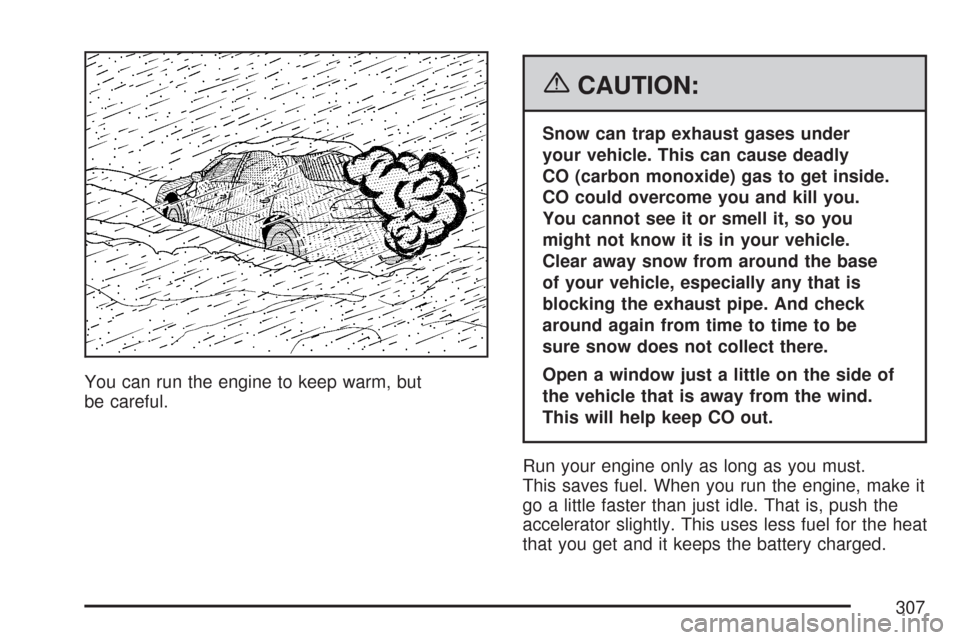
You can run the engine to keep warm, but
be careful.
{CAUTION:
Snow can trap exhaust gases under
your vehicle. This can cause deadly
CO (carbon monoxide) gas to get inside.
CO could overcome you and kill you.
You cannot see it or smell it, so you
might not know it is in your vehicle.
Clear away snow from around the base
of your vehicle, especially any that is
blocking the exhaust pipe. And check
around again from time to time to be
sure snow does not collect there.
Open a window just a little on the side of
the vehicle that is away from the wind.
This will help keep CO out.
Run your engine only as long as you must.
This saves fuel. When you run the engine, make it
go a little faster than just idle. That is, push the
accelerator slightly. This uses less fuel for the heat
that you get and it keeps the battery charged.
307
Page 379 of 488
Low-Prole Performance Tire
The original equipment tires on your vehicle are
classied as low-prole performance tires. These
tires are designed for very responsive driving on
wet or dry pavement. You may also notice more
road noise with low-prole tires and that they
tend to wear faster.
Notice:If your vehicle has low-prole tires,
they are more susceptible to damage from
road hazards or curb impact than standard
prole tires. Tire and/or wheel assembly
damage can occur when coming into contact
with road hazards like, potholes, or sharp
edged objects, or when sliding into a curb.
Your GM warranty does not cover this type
of damage. Keep tires set to the correct
ination pressure and, when possible avoid
contact with curbs, potholes, and other
road hazards.
Winter Tires
If you expect to drive on snow or ice covered
roads often, you may want to get winter tires
for your vehicle. All season tires provide good
overall performance on most surfaces butthey may not offer the traction you would like
or the same level of performance as winter tires
on snow or ice covered roads.
Winter tires, in general, are designed for increased
traction on snow and ice covered roads. With winter
tires, there may be decreased dry road traction,
increased road noise, and shorter tread life. After
switching to winter tires, be alert for changes in
vehicle handling and braking.
See your dealer for details regarding winter tire
availability and proper tire selection. Also, see
Buying New Tires on page 394.
If you choose to use winter tires:
Use tires of the same brand and tread type
on all four wheel positions.
Use only radial ply tires of the same size,
load range, and speed rating as the original
equipment tires.
Winter tires with the same speed rating as your
original equipment tires may not be available for H,
V, W, Y, and ZR speed rated tires. If you choose
winter tires with a lower speed rating, never
exceed the tire’s maximum speed capability.
379
Page 383 of 488
Intended Outboard Sidewall:The side of an
asymmetrical tire, that must always face outward
when mounted on a vehicle.
Kilopascal (kPa):The metric unit for air pressure.
Light Truck (LT-Metric) Tire:A tire used on
light duty trucks and some multipurpose passenger
vehicles.
Load Index:An assigned number ranging
from 1 to 279 that corresponds to the load
carrying capacity of a tire.
Maximum Ination Pressure:The maximum
air pressure to which a cold tire may be inated.
The maximum air pressure is molded onto the
sidewall.
Maximum Load Rating:The load rating for a tire
at the maximum permissible ination pressure
for that tire.
Maximum Loaded Vehicle Weight:The sum of
curb weight, accessory weight, vehicle capacity
weight, and production options weight.
Normal Occupant Weight:The number of
occupants a vehicle is designed to seat multiplied
by 150 lbs (68 kg). SeeLoading Your Vehicle
on page 309.Occupant Distribution:Designated seating
positions.
Outward Facing Sidewall:The side of an
asymmetrical tire that has a particular side that
faces outward when mounted on a vehicle.
The side of the tire that contains a whitewall,
bears white lettering, or bears manufacturer,
brand, and/or model name molding that is
higher or deeper than the same moldings on
the other sidewall of the tire.
Passenger (P-Metric) Tire:A tire used on
passenger cars and some light duty trucks and
multipurpose vehicles.
Recommended Ination Pressure:Vehicle
manufacturer’s recommended tire ination
pressure as shown on the tire placard.
SeeInation - Tire Pressure on page 386and
Loading Your Vehicle on page 309.
Radial Ply Tire:A pneumatic tire in which the
ply cords that extend to the beads are laid
at 90 degrees to the centerline of the tread.
Rim:A metal support for a tire and upon which
the tire beads are seated.
383
Page 390 of 488
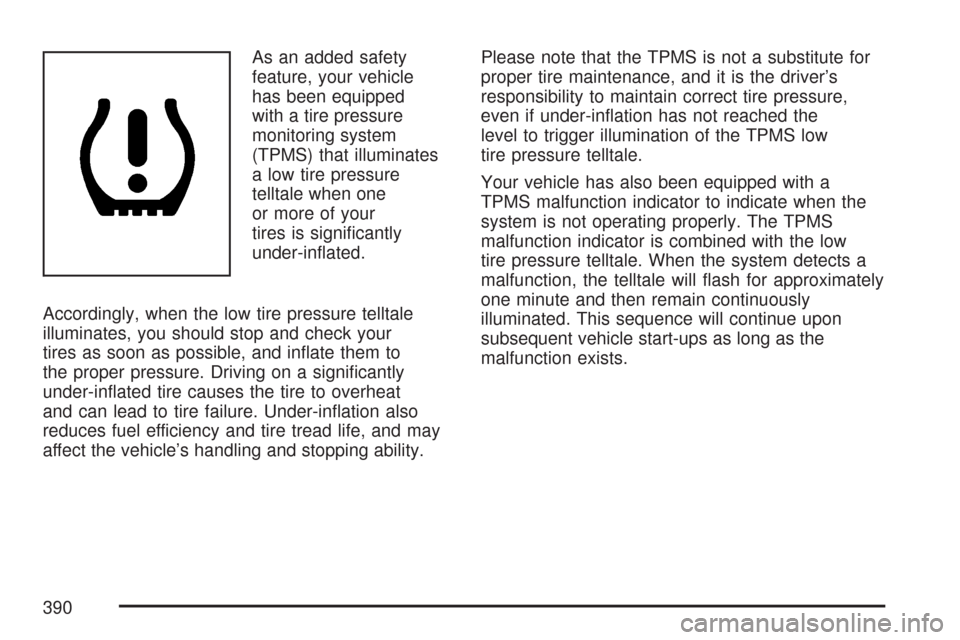
As an added safety
feature, your vehicle
has been equipped
with a tire pressure
monitoring system
(TPMS) that illuminates
a low tire pressure
telltale when one
or more of your
tires is signicantly
under-inated.
Accordingly, when the low tire pressure telltale
illuminates, you should stop and check your
tires as soon as possible, and inate them to
the proper pressure. Driving on a signicantly
under-inated tire causes the tire to overheat
and can lead to tire failure. Under-ination also
reduces fuel efficiency and tire tread life, and may
affect the vehicle’s handling and stopping ability.Please note that the TPMS is not a substitute for
proper tire maintenance, and it is the driver’s
responsibility to maintain correct tire pressure,
even if under-ination has not reached the
level to trigger illumination of the TPMS low
tire pressure telltale.
Your vehicle has also been equipped with a
TPMS malfunction indicator to indicate when the
system is not operating properly. The TPMS
malfunction indicator is combined with the low
tire pressure telltale. When the system detects a
malfunction, the telltale will ash for approximately
one minute and then remain continuously
illuminated. This sequence will continue upon
subsequent vehicle start-ups as long as the
malfunction exists.
390
Page 397 of 488
While the tires available on General Motors
passenger cars and light trucks may vary with
respect to these grades, they must also conform to
federal safety requirements and additional General
Motors Tire Performance Criteria (TPC) standards.
Treadwear
The treadwear grade is a comparative rating based
on the wear rate of the tire when tested under
controlled conditions on a specied government
test course. For example, a tire graded 150 would
wear one and a half (1.5) times as well on the
government course as a tire graded 100. The
relative performance of tires depends upon the
actual conditions of their use, however, and may
depart signicantly from the norm due to variations
in driving habits, service practices, and differences
in road characteristics and climate.
Traction – AA, A, B, C
The traction grades, from highest to lowest, are AA,
A, B, and C. Those grades represent the tire’s
ability to stop on wet pavement as measured under
controlled conditions on specied government test
surfaces of asphalt and concrete. A tire marked C
may have poor traction performance.Warning:The traction grade assigned to this
tire is based on straight-ahead braking traction
tests, and does not include acceleration, cornering,
hydroplaning, or peak traction characteristics.
Temperature – A, B, C
The temperature grades are A (the highest),
B, and C, representing the tire’s resistance to
the generation of heat and its ability to dissipate
heat when tested under controlled conditions
on a specied indoor laboratory test wheel.
Sustained high temperature can cause the
material of the tire to degenerate and reduce
tire life, and excessive temperature can lead to
sudden tire failure. The grade C corresponds
to a level of performance which all passenger car
tires must meet under the Federal Motor Vehicle
Safety Standard No. 109. Grades B and A
represent higher levels of performance on
the laboratory test wheel than the minimum
required by law.
Warning:The temperature grade for this tire is
established for a tire that is properly inated and
not overloaded. Excessive speed, underination,
or excessive loading, either separately or in
combination, can cause heat buildup and
possible tire failure.
397
Page 406 of 488
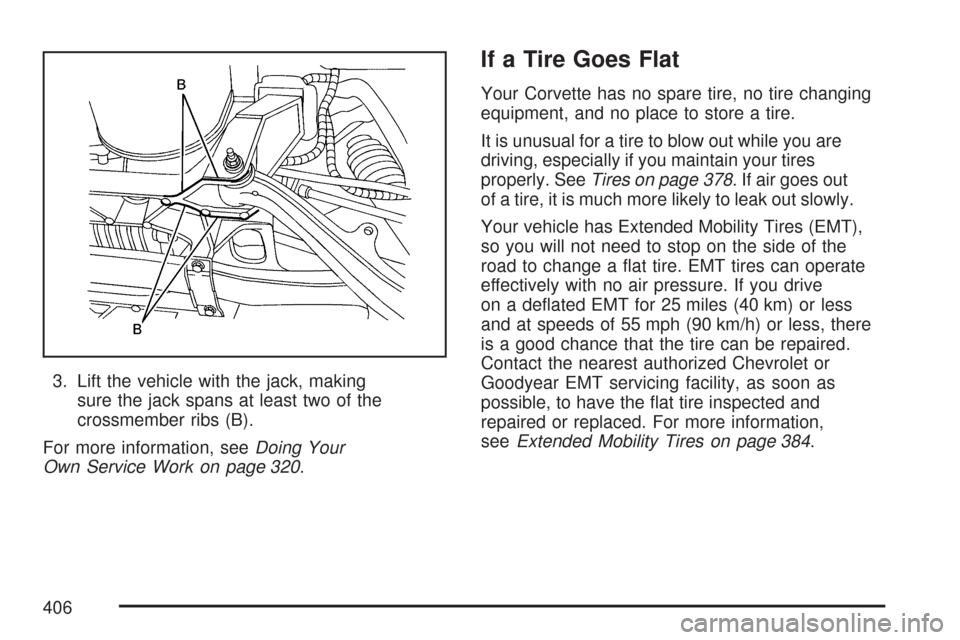
3. Lift the vehicle with the jack, making
sure the jack spans at least two of the
crossmember ribs (B).
For more information, seeDoing Your
Own Service Work on page 320.
If a Tire Goes Flat
Your Corvette has no spare tire, no tire changing
equipment, and no place to store a tire.
It is unusual for a tire to blow out while you are
driving, especially if you maintain your tires
properly. SeeTires on page 378. If air goes out
of a tire, it is much more likely to leak out slowly.
Your vehicle has Extended Mobility Tires (EMT),
so you will not need to stop on the side of the
road to change a at tire. EMT tires can operate
effectively with no air pressure. If you drive
on a deated EMT for 25 miles (40 km) or less
and at speeds of 55 mph (90 km/h) or less, there
is a good chance that the tire can be repaired.
Contact the nearest authorized Chevrolet or
Goodyear EMT servicing facility, as soon as
possible, to have the at tire inspected and
repaired or replaced. For more information,
seeExtended Mobility Tires on page 384.
406
Page 452 of 488
Customer Assistance and
Information
Customer Satisfaction Procedure
Your satisfaction and goodwill are important
to your dealer and to Chevrolet. Normally, any
concerns with the sales transaction or the
operation of your vehicle will be resolved by your
dealer’s sales or service departments. Sometimes,
however, despite the best intentions of all
concerned, misunderstandings can occur. If your
concern has not been resolved to your
satisfaction, the following steps should be taken:
STEP ONE:Discuss your concern with a member
of dealership management. Normally, concerns
can be quickly resolved at that level. If the matter
has already been reviewed with the sales,
service, or parts manager, contact the owner of
the dealership or the general manager.STEP TWO:If after contacting a member of
dealership management, it appears your concern
cannot be resolved by the dealership without
further help, in the U.S., contact the Chevrolet
Customer Assistance Center by calling
1-800-222-1020. In Canada, contact General
Motors of Canada Customer Communication
Centre by calling 1-800-263-3777 (English) or
1-800-263-7854 (French).
We encourage you to call the toll-free number in
order to give your inquiry prompt attention. Please
have the following information available to give
the Customer Assistance Representative:
Vehicle Identication Number (VIN). This is
available from the vehicle registration or title, or
the plate at the top left of the instrument panel
and visible through the windshield.
Dealership name and location.
Vehicle delivery date and present mileage
(kilometers).
When contacting Chevrolet, please remember that
your concern will likely be resolved at a dealer’s
facility. That is why we suggest you follow
Step One rst if you have a concern.
452