ignition CHEVROLET CORVETTE 2007 6.G Owner's Manual
[x] Cancel search | Manufacturer: CHEVROLET, Model Year: 2007, Model line: CORVETTE, Model: CHEVROLET CORVETTE 2007 6.GPages: 488, PDF Size: 2.62 MB
Page 144 of 488
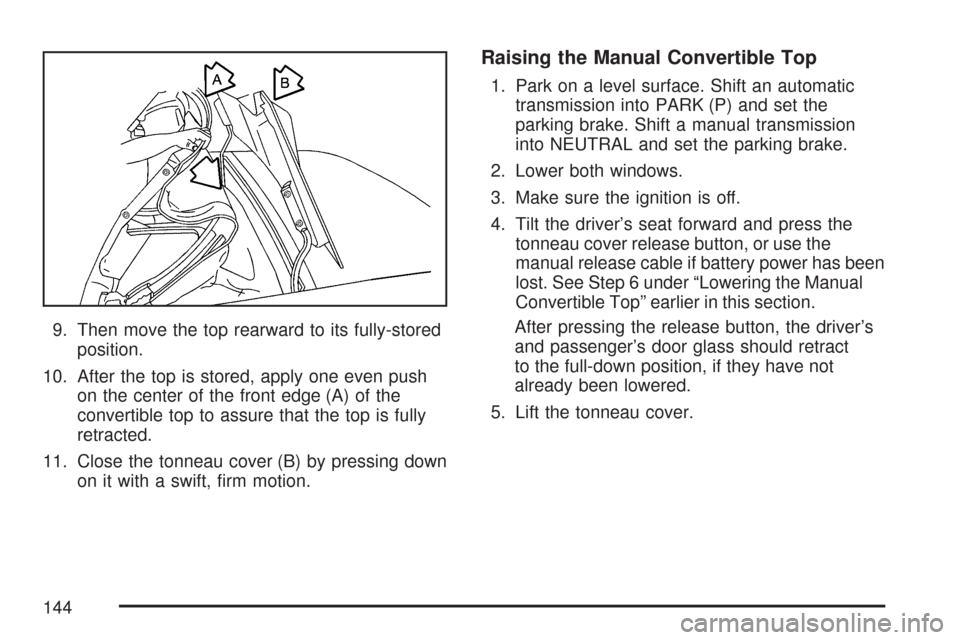
9. Then move the top rearward to its fully-stored
position.
10. After the top is stored, apply one even push
on the center of the front edge (A) of the
convertible top to assure that the top is fully
retracted.
11. Close the tonneau cover (B) by pressing down
on it with a swift, rm motion.
Raising the Manual Convertible Top
1. Park on a level surface. Shift an automatic
transmission into PARK (P) and set the
parking brake. Shift a manual transmission
into NEUTRAL and set the parking brake.
2. Lower both windows.
3. Make sure the ignition is off.
4. Tilt the driver’s seat forward and press the
tonneau cover release button, or use the
manual release cable if battery power has been
lost. See Step 6 under “Lowering the Manual
Convertible Top” earlier in this section.
After pressing the release button, the driver’s
and passenger’s door glass should retract
to the full-down position, if they have not
already been lowered.
5. Lift the tonneau cover.
144
Page 157 of 488
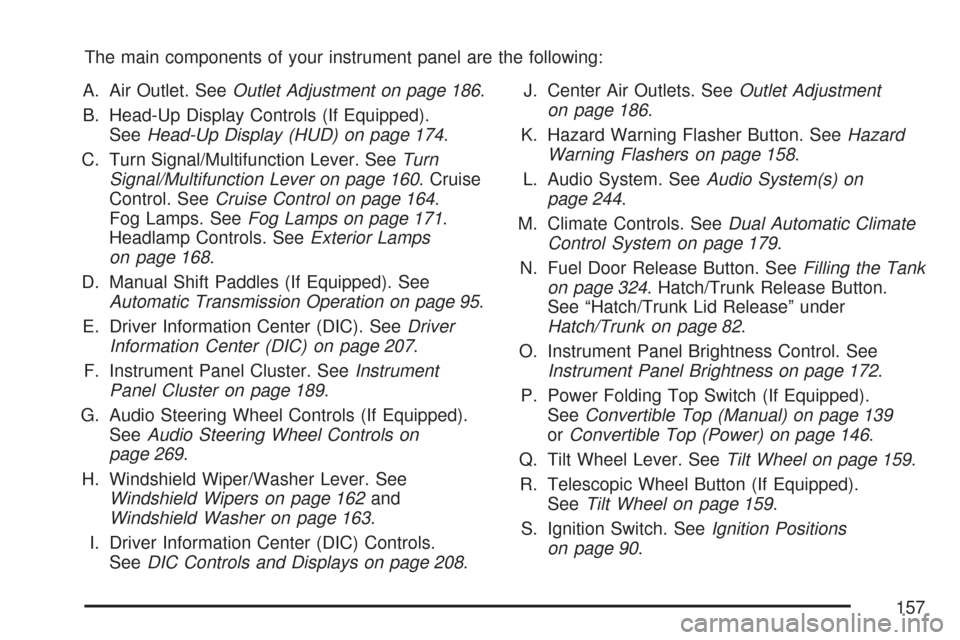
The main components of your instrument panel are the following:
A. Air Outlet. SeeOutlet Adjustment on page 186.
B. Head-Up Display Controls (If Equipped).
SeeHead-Up Display (HUD) on page 174.
C. Turn Signal/Multifunction Lever. SeeTurn
Signal/Multifunction Lever on page 160. Cruise
Control. SeeCruise Control on page 164.
Fog Lamps. SeeFog Lamps on page 171.
Headlamp Controls. SeeExterior Lamps
on page 168.
D. Manual Shift Paddles (If Equipped). See
Automatic Transmission Operation on page 95.
E. Driver Information Center (DIC). SeeDriver
Information Center (DIC) on page 207.
F. Instrument Panel Cluster. SeeInstrument
Panel Cluster on page 189.
G. Audio Steering Wheel Controls (If Equipped).
SeeAudio Steering Wheel Controls on
page 269.
H. Windshield Wiper/Washer Lever. See
Windshield Wipers on page 162and
Windshield Washer on page 163.
I. Driver Information Center (DIC) Controls.
SeeDIC Controls and Displays on page 208.J. Center Air Outlets. SeeOutlet Adjustment
on page 186.
K. Hazard Warning Flasher Button. SeeHazard
Warning Flashers on page 158.
L. Audio System. SeeAudio System(s) on
page 244.
M. Climate Controls. SeeDual Automatic Climate
Control System on page 179.
N. Fuel Door Release Button. SeeFilling the Tank
on page 324. Hatch/Trunk Release Button.
See “Hatch/Trunk Lid Release” under
Hatch/Trunk on page 82.
O. Instrument Panel Brightness Control. See
Instrument Panel Brightness on page 172.
P. Power Folding Top Switch (If Equipped).
SeeConvertible Top (Manual) on page 139
orConvertible Top (Power) on page 146.
Q. Tilt Wheel Lever. SeeTilt Wheel on page 159.
R. Telescopic Wheel Button (If Equipped).
SeeTilt Wheel on page 159.
S. Ignition Switch. SeeIgnition Positions
on page 90.
157
Page 158 of 488
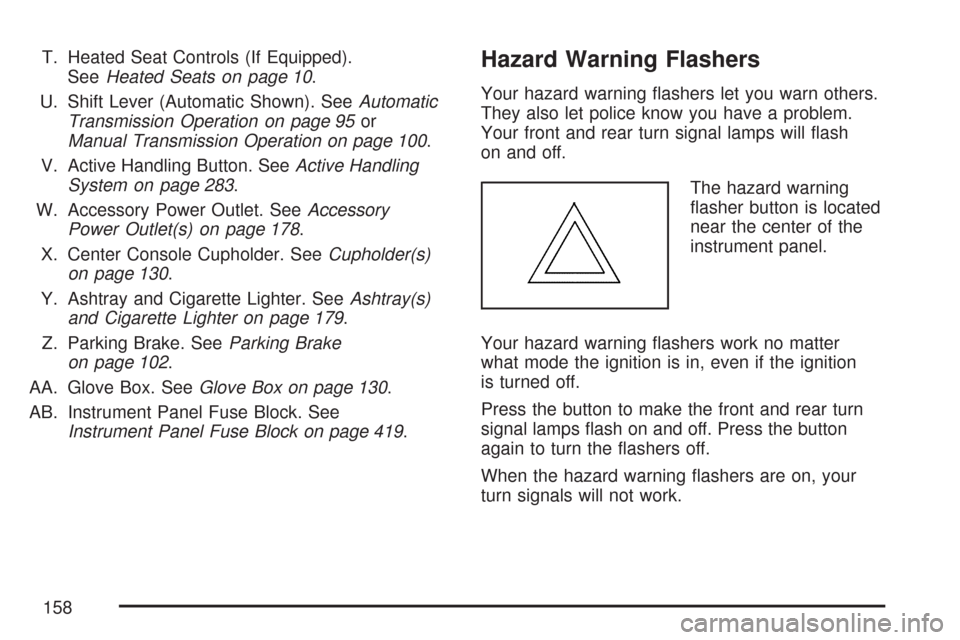
T. Heated Seat Controls (If Equipped).
SeeHeated Seats on page 10.
U. Shift Lever (Automatic Shown). SeeAutomatic
Transmission Operation on page 95or
Manual Transmission Operation on page 100.
V. Active Handling Button. SeeActive Handling
System on page 283.
W. Accessory Power Outlet. SeeAccessory
Power Outlet(s) on page 178.
X. Center Console Cupholder. SeeCupholder(s)
on page 130.
Y. Ashtray and Cigarette Lighter. SeeAshtray(s)
and Cigarette Lighter on page 179.
Z. Parking Brake. SeeParking Brake
on page 102.
AA. Glove Box. SeeGlove Box on page 130.
AB. Instrument Panel Fuse Block. See
Instrument Panel Fuse Block on page 419.Hazard Warning Flashers
Your hazard warning ashers let you warn others.
They also let police know you have a problem.
Your front and rear turn signal lamps will ash
on and off.
The hazard warning
asher button is located
near the center of the
instrument panel.
Your hazard warning ashers work no matter
what mode the ignition is in, even if the ignition
is turned off.
Press the button to make the front and rear turn
signal lamps ash on and off. Press the button
again to turn the ashers off.
When the hazard warning ashers are on, your
turn signals will not work.
158
Page 167 of 488
Cruise Control in Sport (S) and Manual
Paddle Shift Gear Selection
When your vehicle is in Sport (S) and the manual
paddle shift controls are not being used, cruise
control operates in the same manner as Drive (D).
When your vehicle is in Sport (S) and the
manual paddle shift controls are being used,
cruise control operates as follows:
If cruise control is active and a gear is
selected with the manual paddle shift controls,
the vehicle maintains vehicle speed in the
driver selected gear and will not automatically
up-shift or down-shift the transmission
while the driver’s gear selection is active.
If driving in hilly terrain, cruise control may
not be able to maintain vehicle speed if an
up-shift or down-shift is not selected by
the driver. While driving on hilly terrain and
cruise control is active with a manual paddle
shift gear selection, the driver must select
the proper gear for the terrain or select Drive
(D) on the gear range selector for full
automatic transmission operation.
Ending Cruise Control
To end a cruise control session, step lightly on
the brake pedal. If your vehicle has a manual
transmission, lightly tapping the clutch will also end
a cruise control session.
Move the cruise control switch to off to turn the
system completely off.
When cruise control is disengaged, the CRUISE
DISENGAGED message displays on the Driver
Information Center (DIC). SeeDIC Warnings and
Messages on page 214.
Erasing Speed Memory
When you turn off the cruise control or the
ignition, the cruise control set speed memory
is erased.
167
Page 168 of 488
Exterior Lamps
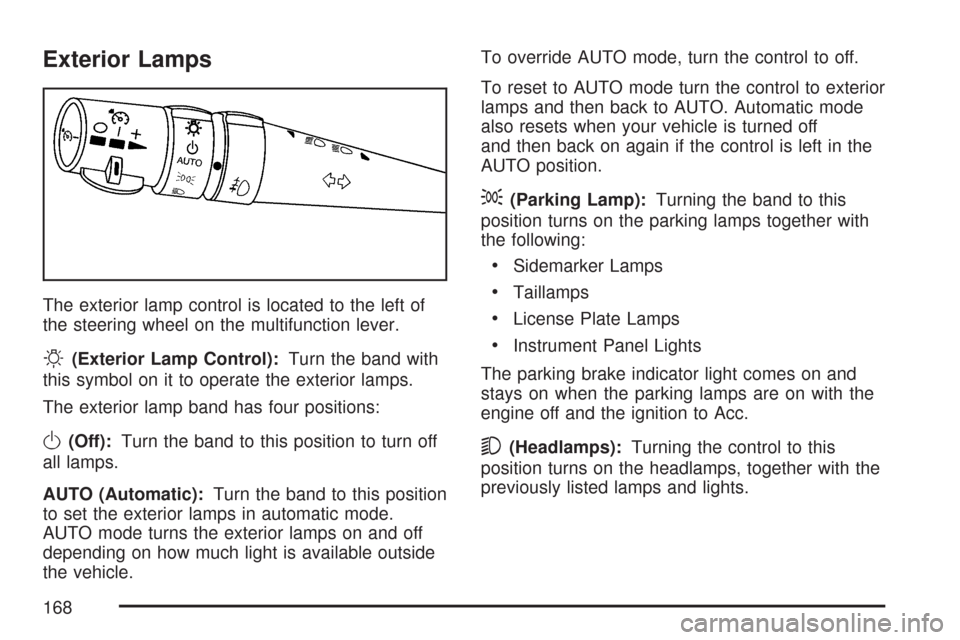
The exterior lamp control is located to the left of
the steering wheel on the multifunction lever.
O(Exterior Lamp Control):Turn the band with
this symbol on it to operate the exterior lamps.
The exterior lamp band has four positions:
O(Off):Turn the band to this position to turn off
all lamps.
AUTO (Automatic):Turn the band to this position
to set the exterior lamps in automatic mode.
AUTO mode turns the exterior lamps on and off
depending on how much light is available outside
the vehicle.To override AUTO mode, turn the control to off.
To reset to AUTO mode turn the control to exterior
lamps and then back to AUTO. Automatic mode
also resets when your vehicle is turned off
and then back on again if the control is left in the
AUTO position.
;(Parking Lamp):Turning the band to this
position turns on the parking lamps together with
the following:
Sidemarker Lamps
Taillamps
License Plate Lamps
Instrument Panel Lights
The parking brake indicator light comes on and
stays on when the parking lamps are on with the
engine off and the ignition to Acc.
5(Headlamps):Turning the control to this
position turns on the headlamps, together with the
previously listed lamps and lights.
168
Page 169 of 488
Wiper Activated Headlamps
This feature activates the headlamps and parking
lamps after the windshield wipers have been in
use for approximately 15 seconds and deactivates
and returns to ambient lighting conditions
15 seconds after the wipers are turned off.
If the exterior lamp control has been turned off or
is in the parking lamp position while the wiper
control is active in any position, the HEADLAMPS
SUGGESTED message appears on the Driver
Information Center (DIC). SeeDIC Warnings and
Messages on page 214.
When the ignition is turned off, the wiper-activated
headlamps will immediately turn off.
Headlamps on Reminder
A warning chime will sound if the exterior lamp
control is left on in either the headlamp or parking
lamp position and the driver’s door is opened
with the ignition off.
Daytime Running Lamps (DRL)
Daytime Running Lamps (DRL) can make it easier
for others to see the front of your vehicle during
the day. DRL can be helpful in many different
driving conditions, but they can be especially
helpful in the short periods after dawn and before
sunset. Fully functional daytime running lamps
are required on all vehicles rst sold in Canada.
The DRL system will make the front turn signal
lamps come on when the following conditions
are met:
It is still daylight and the ignition is on.
The exterior lamp control is in the
AUTO position.
The transmission is not in PARK (P) or
the parking brake is off.
The parking brake is off or the vehicle
speed is greater than 8 mph (13 km/h).
When DRL are on, only the front turn signal lamps
will be on. No other exterior lamps such as the
parking lamps, taillamps, etc. will be on when the
DRL are being used. Your instrument panel
will not be lit up either.
169
Page 171 of 488
Fog Lamps
Use fog lamps for better vision in foggy or misty
conditions.
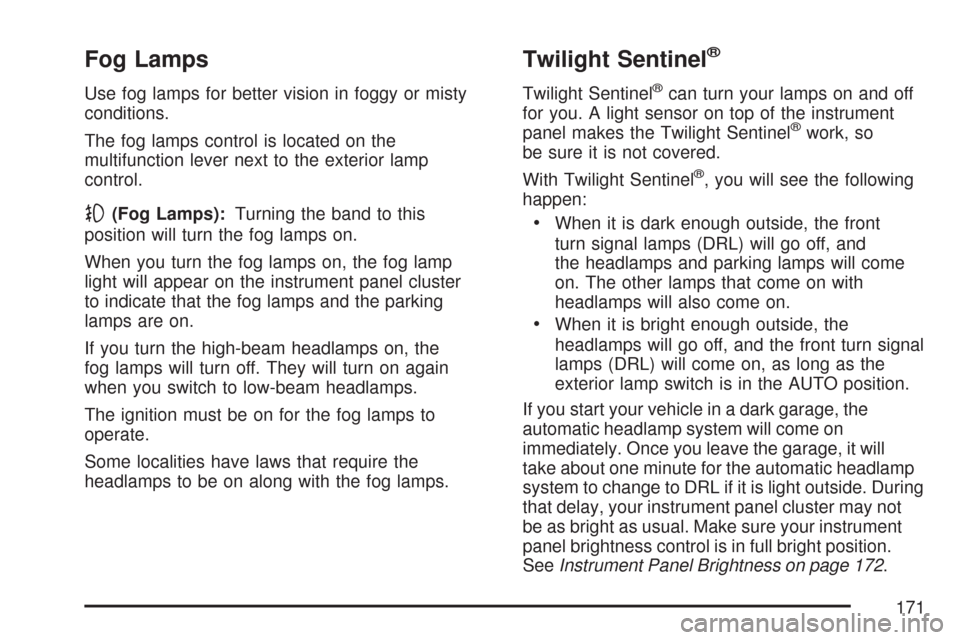
The fog lamps control is located on the
multifunction lever next to the exterior lamp
control.
-(Fog Lamps):Turning the band to this
position will turn the fog lamps on.
When you turn the fog lamps on, the fog lamp
light will appear on the instrument panel cluster
to indicate that the fog lamps and the parking
lamps are on.
If you turn the high-beam headlamps on, the
fog lamps will turn off. They will turn on again
when you switch to low-beam headlamps.
The ignition must be on for the fog lamps to
operate.
Some localities have laws that require the
headlamps to be on along with the fog lamps.
Twilight Sentinel®
Twilight Sentinel®can turn your lamps on and off
for you. A light sensor on top of the instrument
panel makes the Twilight Sentinel
®work, so
be sure it is not covered.
With Twilight Sentinel
®, you will see the following
happen:
When it is dark enough outside, the front
turn signal lamps (DRL) will go off, and
the headlamps and parking lamps will come
on. The other lamps that come on with
headlamps will also come on.
When it is bright enough outside, the
headlamps will go off, and the front turn signal
lamps (DRL) will come on, as long as the
exterior lamp switch is in the AUTO position.
If you start your vehicle in a dark garage, the
automatic headlamp system will come on
immediately. Once you leave the garage, it will
take about one minute for the automatic headlamp
system to change to DRL if it is light outside. During
that delay, your instrument panel cluster may not
be as bright as usual. Make sure your instrument
panel brightness control is in full bright position.
SeeInstrument Panel Brightness on page 172.
171
Page 172 of 488
You can idle the vehicle with the lamps off, even
when it is dark outside.
After starting the vehicle, turn the exterior lamp
control band on the multifunction lever to off
and then release it. The lamps will remain off until
you turn the control band to off again.
Twilight Sentinel
®also provides exterior
illumination as you leave the vehicle. If Twilight
Sentinel
®has turned on the lamps when you turn
off the ignition, your lamps will remain on until:
The exterior lamp switch is moved from
off to the parking lamp position, or
A delay time that you select has elapsed.
See “Personal Options” underDIC Vehicle
Personalization on page 234to select the
delay time that you want. You can also select
no delay time.
If you turn off the ignition with the exterior lamp
switch in the parking lamp or headlamp position, the
Twilight Sentinel
®delay will not occur. The lamps
will turn off as soon as the switch is turned off.
As with any vehicle, you should turn on the regular
headlamp system when you need it.
Exterior Lighting Battery Saver
If the manual parking lamps or headlamps have
been left on, the exterior lamps will turn off as soon
as the ignition is turned off or Retained Accessory
Power (RAP) is active. This protects against
draining the battery in case you have accidentally
left the headlamps or parking lamps on. The battery
saver does not work if the headlamps are turned on
after the ignition switch is turned to off.
If you need to leave the lamps on, use the exterior
lamp control to turn the lamps back on.
Instrument Panel Brightness
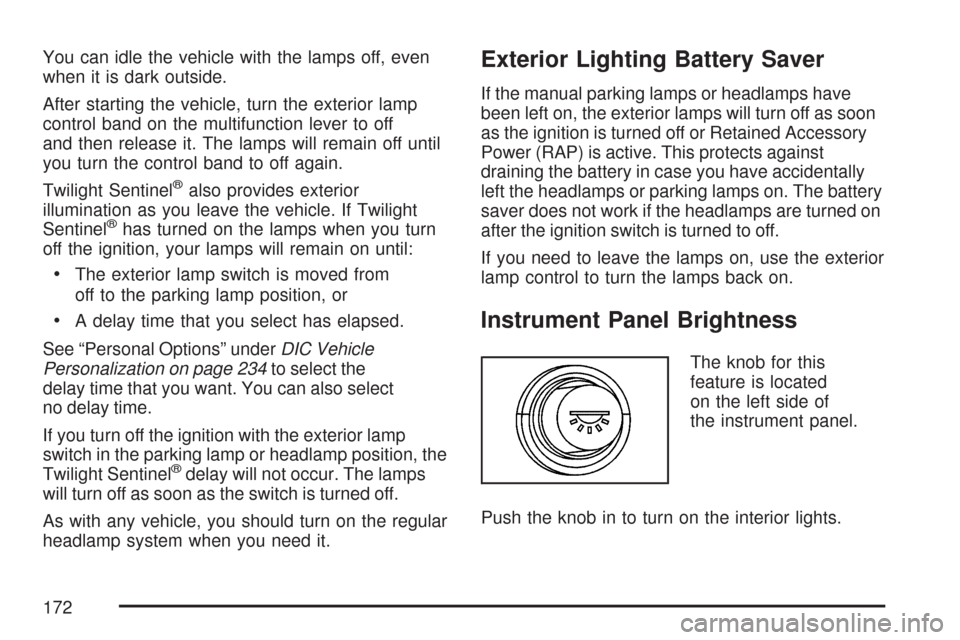
The knob for this
feature is located
on the left side of
the instrument panel.
Push the knob in to turn on the interior lights.
172
Page 173 of 488
Turn and hold the knob clockwise to brighten the
lights or counterclockwise to dim them. During
the day, this knob will adjust the instrument panel
brightness and at night will adjust all interior
lighting.
Be sure not to have this knob turned all the way
down with the lamps on during the day. Your
Driver Information Center (DIC) may not be visible.
Courtesy Lamps
When any door or the hatch/trunk lid is opened,
the interior lamps will go on unless it is bright
outside.
You can also turn the courtesy lamps on and off
by pressing the instrument panel brightness knob.
Entry/Exit Lighting
With entry lighting, the interior lamps will come on
when entering the vehicle. The interior lamps
will come on for about 20 seconds when the
engine is off.
You can turn exit and entry lighting off by quickly
turning the courtesy lamps on and off.
Reading Lamps
The inside rearview mirror includes two reading
lamps. The lamps will go on when a door is
opened. When the doors are closed, each lamp
can be turned on individually by pressing the
switch for that lamp.
An ambient light is located in the passenger sun
visor clip. This light stays on while driving to
keep the cabin from being too dark.
Battery Run-Down Protection
This vehicle has a feature to help prevent the
battery from being drained in case any of
the following lamps are left on; the underhood
lamp, if your vehicle has this feature, vanity mirror
lamps, cargo lamps, reading lamps, console or
glove box lamps. If any of these lamps are left on,
they will automatically time-out after about
10 minutes. To reset it, all of the above lamps
must be turned off or the ignition key on.
173
Page 175 of 488
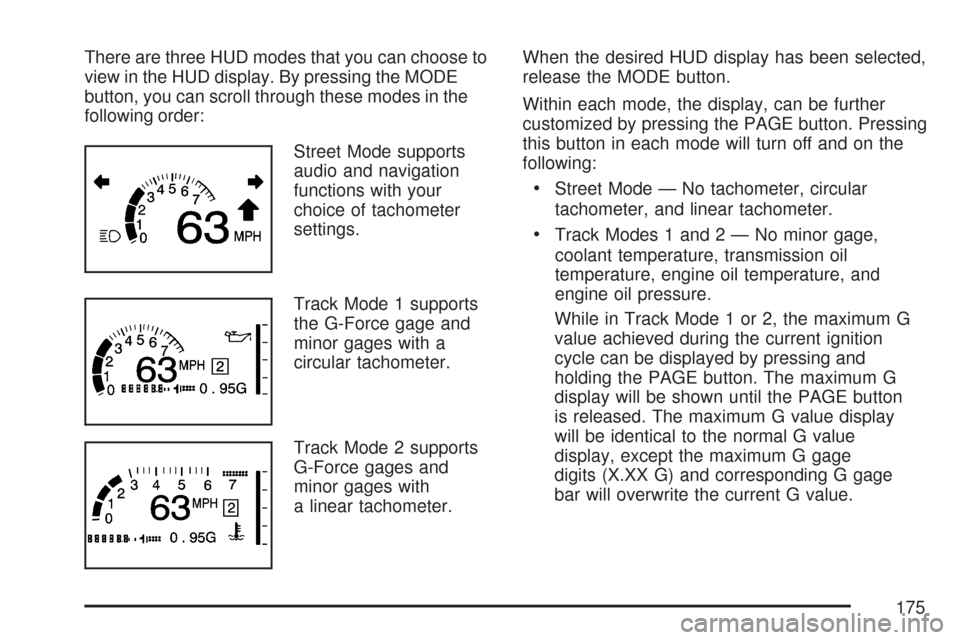
There are three HUD modes that you can choose to
view in the HUD display. By pressing the MODE
button, you can scroll through these modes in the
following order:
Street Mode supports
audio and navigation
functions with your
choice of tachometer
settings.
Track Mode 1 supports
the G-Force gage and
minor gages with a
circular tachometer.
Track Mode 2 supports
G-Force gages and
minor gages with
a linear tachometer.When the desired HUD display has been selected,
release the MODE button.
Within each mode, the display, can be further
customized by pressing the PAGE button. Pressing
this button in each mode will turn off and on the
following:
Street Mode — No tachometer, circular
tachometer, and linear tachometer.
Track Modes 1 and2—Nominor gage,
coolant temperature, transmission oil
temperature, engine oil temperature, and
engine oil pressure.
While in Track Mode 1 or 2, the maximum G
value achieved during the current ignition
cycle can be displayed by pressing and
holding the PAGE button. The maximum G
display will be shown until the PAGE button
is released. The maximum G value display
will be identical to the normal G value
display, except the maximum G gage
digits (X.XX G) and corresponding G gage
bar will overwrite the current G value.
175