ignition CHEVROLET CORVETTE 2007 6.G Owner's Guide
[x] Cancel search | Manufacturer: CHEVROLET, Model Year: 2007, Model line: CORVETTE, Model: CHEVROLET CORVETTE 2007 6.GPages: 488, PDF Size: 2.62 MB
Page 177 of 488
It is possible for sunlight to enter the HUD
making it difficult to see the image. The display
will return to normal when the sunlight is no
longer entering the HUD.
2. Adjust the seat to a comfortable driving
position. If you change your seat position later,
you may have to re-adjust your HUD.
3. Press the up or down arrows to center the
HUD image in your view.
The HUD image can only be adjusted up and
down, not side-to-side.
4. Press the dimmer control downward until the
HUD image is no brighter than necessary.
To turn HUD off, press and hold the (–) button
until the HUD display turns off.
If the sun comes out or it becomes cloudy, you
may need to adjust the HUD brightness again
using the dimmer control. Polarized sunglasses
could make the HUD image harder to see.
The HUD information can be displayed in one
of six languages including English, Spanish,
French, German, Italian or Japanese. The
speedometer can be displayed in either
English or Metric units.To change the language and unit selections, see
“OPTION” underDIC Controls and Displays
on page 208.
Clean the inside of the windshield as needed to
remove any dirt or lm that reduces the sharpness
or clarity of the HUD image.
To clean the HUD, spray household glass cleaner
on a soft, clean cloth. Wipe the HUD lens gently,
then dry it. Do not spray cleaner directly on the lens
because the cleaner could leak into the unit.
If the ignition is on and you can not see the HUD
image, check to see if:
Something is covering the HUD unit.
The HUD dimmer control is adjusted properly.
The HUD image is adjusted to the proper
height.
Ambient light is low, in the direction your
vehicle is facing.
A fuse is blown. SeeFuses and Circuit
Breakers on page 419.
Keep in mind that your windshield is part of the
HUD system. SeeWindshield Replacement
on page 375.
177
Page 184 of 488
These delays prevent false readings. If the
temperature goes down, the outside temperature
will be shown when you start the vehicle. If it
has been turned off for less than three hours, the
temperature will be recalled from the previous
vehicle operation.
There is also an inside temperature sensor
located to the left of the ignition switch. The
automatic climate control system uses this sensor
to receive information, so if you block or cover
it, the system will not function properly.
Defogging and Defrosting
Fog on the inside of windows is a result of high
humidity and moisture condensing on the cool
window glass. This can be minimized if the climate
control system is used properly. There are two
modes to clear fog or frost from your windshield.
Use the oor/defog mode to clear the windows of
fog or moisture and warm the passengers. Use
defrost to remove fog or frost from the windshield
more quickly. To prevent fogging on the inside of
the windows in modes other than oor/defog and
defrost, make sure the air conditioning compressor
is on and recirculation mode is off.
Press the mode button until the defog mode
appears on the display.
-(Floor/Defog):This mode directs the air
equally between the windshield and the oor
outlets with a small amount to the side window
outlets. When you select this mode, the system
turns off recirculation and runs the air-conditioning
compressor unless the outside temperature is
at or below freezing. The recirculation mode
cannot be selected while in the defog mode.
1(Defrost):Pressing this button directs most
of the air to the windshield, with a small amount
directed to the side window outlets. The light on the
button will come on and the digital display will show
the defrost mode symbol and fan speed when the
front defrost mode is being used. In this mode, the
system will automatically turn off the recirculation
and run the air-conditioning compressor, unless
the outside temperature is at or below freezing.
Recirculation cannot be selected while in the
defrost mode. Pressing this button again will return
the system to the last operating mode.
For severe ice conditions, turn the driver’s
temperature knob to 90°F (32°C) while in
defrost mode.
Do not drive the vehicle until all the windows
are clear.
184
Page 190 of 488
Speedometer and Odometer
Your speedometer lets you see your speed in
either miles per hour (mph) or kilometers per
hour (km/h). For more information see “Personal
Options” underDIC Vehicle Personalization
on page 234.
To read the odometer with the ignition off, turn
on the parking lamps.
You may wonder what happens if your vehicle
needs a new odometer installed. The mileage
total of the new odometer will be set to the original
miles (kilometers) of the old odometer. See your
dealer if the odometer must be replaced in
your vehicle.
Tachometer
The tachometer displays the engine speed in
thousands of revolutions per minute (rpm).
Notice:Fuel will shut off at about 6600 rpm
for the base model and 7100 rpm for the
Z06 model. If you continue to drive your vehicle
at the fuel shut off rpm, you could damage
your engine. Be sure to operate your vehicle
below the fuel shut off rpm or reduce your
rpm quickly when the fuel shuts off.
Safety Belt Reminder Light
When the ignition is turned on, a chime will come
on for several seconds to remind people to
fasten their safety belts, unless the driver’s safety
belt is already buckled.
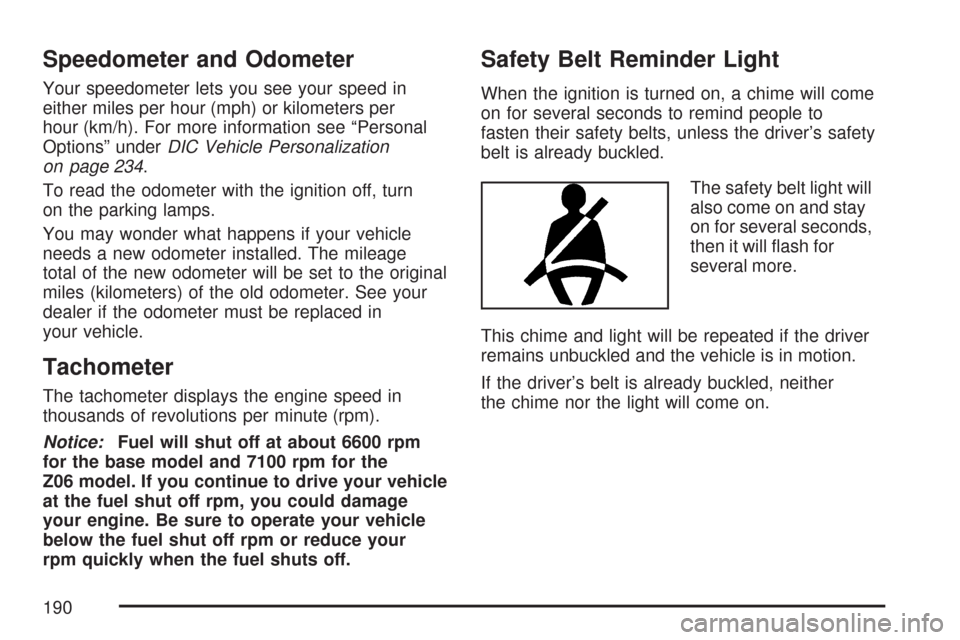
The safety belt light will
also come on and stay
on for several seconds,
then it will ash for
several more.
This chime and light will be repeated if the driver
remains unbuckled and the vehicle is in motion.
If the driver’s belt is already buckled, neither
the chime nor the light will come on.
190
Page 197 of 488
Anti-Lock Brake System
Warning Light
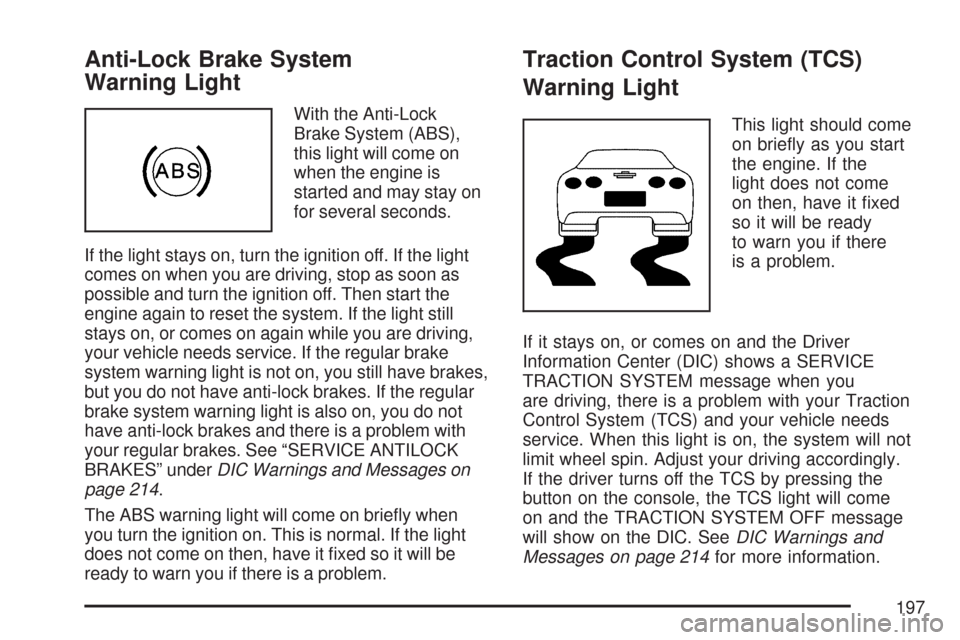
With the Anti-Lock
Brake System (ABS),
this light will come on
when the engine is
started and may stay on
for several seconds.
If the light stays on, turn the ignition off. If the light
comes on when you are driving, stop as soon as
possible and turn the ignition off. Then start the
engine again to reset the system. If the light still
stays on, or comes on again while you are driving,
your vehicle needs service. If the regular brake
system warning light is not on, you still have brakes,
but you do not have anti-lock brakes. If the regular
brake system warning light is also on, you do not
have anti-lock brakes and there is a problem with
your regular brakes. See “SERVICE ANTILOCK
BRAKES” underDIC Warnings and Messages on
page 214.
The ABS warning light will come on briey when
you turn the ignition on. This is normal. If the light
does not come on then, have it xed so it will be
ready to warn you if there is a problem.
Traction Control System (TCS)
Warning Light
This light should come
on briey as you start
the engine. If the
light does not come
on then, have it xed
so it will be ready
to warn you if there
is a problem.
If it stays on, or comes on and the Driver
Information Center (DIC) shows a SERVICE
TRACTION SYSTEM message when you
are driving, there is a problem with your Traction
Control System (TCS) and your vehicle needs
service. When this light is on, the system will not
limit wheel spin. Adjust your driving accordingly.
If the driver turns off the TCS by pressing the
button on the console, the TCS light will come
on and the TRACTION SYSTEM OFF message
will show on the DIC. SeeDIC Warnings and
Messages on page 214for more information.
197
Page 199 of 488
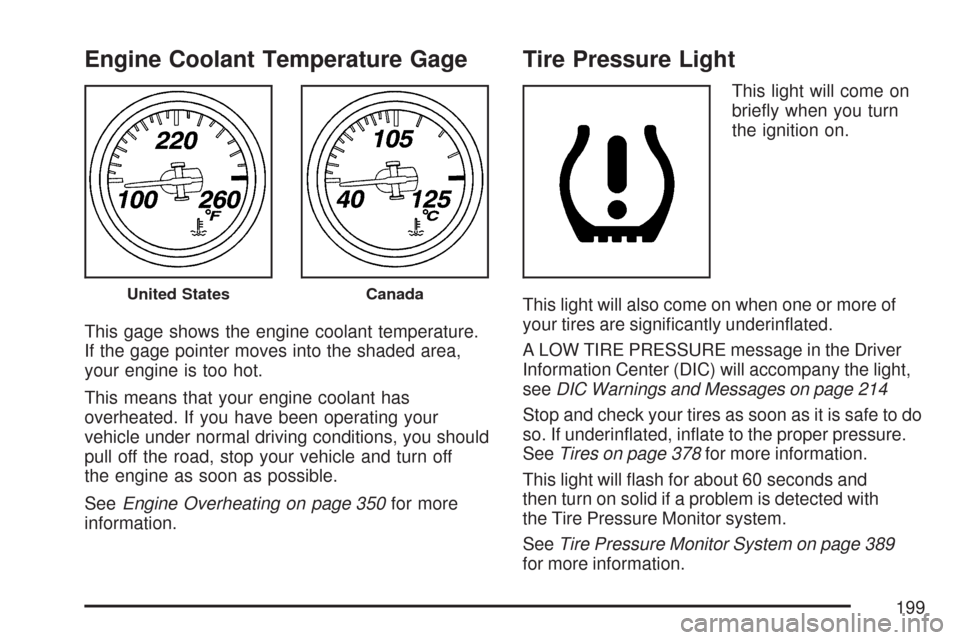
Engine Coolant Temperature Gage
This gage shows the engine coolant temperature.
If the gage pointer moves into the shaded area,
your engine is too hot.
This means that your engine coolant has
overheated. If you have been operating your
vehicle under normal driving conditions, you should
pull off the road, stop your vehicle and turn off
the engine as soon as possible.
SeeEngine Overheating on page 350for more
information.
Tire Pressure Light
This light will come on
briey when you turn
the ignition on.
This light will also come on when one or more of
your tires are signicantly underinated.
A LOW TIRE PRESSURE message in the Driver
Information Center (DIC) will accompany the light,
seeDIC Warnings and Messages on page 214
Stop and check your tires as soon as it is safe to do
so. If underinated, inate to the proper pressure.
SeeTires on page 378for more information.
This light will ash for about 60 seconds and
then turn on solid if a problem is detected with
the Tire Pressure Monitor system.
SeeTire Pressure Monitor System on page 389
for more information.
United StatesCanada
199
Page 200 of 488
Malfunction Indicator Lamp
Check Engine Light
Your vehicle has a
computer which
monitors operation
of the fuel, ignition,
and emission control
systems.
This system is called OBD II (On-Board
Diagnostics-Second Generation) and is intended
to assure that emissions are at acceptable
levels for the life of the vehicle, helping to produce
a cleaner environment. The check engine light
comes on to indicate that there is a problem and
service is required. Malfunctions often will be
indicated by the system before any problem is
apparent. This may prevent more serious damage
to your vehicle. This system is also designed to
assist your service technician in correctly
diagnosing any malfunction.Notice:If you keep driving your vehicle with
this light on, after awhile, the emission controls
might not work as well, your vehicle’s fuel
economy might not be as good, and the engine
might not run as smoothly. This could lead
to costly repairs that might not be covered by
your warranty.
Notice:Modications made to the engine,
transmission, exhaust, intake, or fuel system
of your vehicle or the replacement of the
original tires with other than those of the same
Tire Performance Criteria (TPC) can affect
your vehicle’s emission controls and can cause
this light to come on. Modications to these
systems could lead to costly repairs not
covered by your warranty. This could also
result in a failure to pass a required Emission
Inspection/Maintenance test. SeeAccessories
and Modifications on page 319.
200
Page 203 of 488

Emissions Inspection and
Maintenance Programs
Some state/provincial and local governments have
or may begin programs to inspect the emission
control equipment on your vehicle. Failure to pass
this inspection could prevent you from getting a
vehicle registration.
Here are some things you need to know to help
your vehicle pass an inspection:
Your vehicle will not pass this inspection if the
check engine light is on or not working properly.
To perform a check engine light bulb check with the
keyless ignition, make sure the transmitter fob is in
the passenger compartment. SeeIgnition Positions
on page 90. Press the bottom of the Acc. button on
the instrument panel and hold the button down for
ve seconds. The instrument panel, including the
check engine light, will light up and the ignition will
be on, but the engine will not start — if you pressthe bottom of the Acc. button only briey, less than
ve seconds, the accessory power mode will be
turned on, but not the ignition. After the bulb check,
be sure to press and release the Acc. button again
to turn the ignition off and avoid draining the
vehicle’s battery.
Your vehicle will not pass this inspection if the
OBD (on-board diagnostic) system determines that
critical emission control systems have not been
completely diagnosed by the system. The vehicle
would be considered not ready for inspection.
This can happen if you have recently replaced
the battery or if the battery has run down.
The diagnostic system is designed to evaluate
critical emission control systems during normal
driving. This may take several days of routine
driving. If you have done this and your vehicle
still does not pass the inspection for lack of
OBD system readiness, your dealer can prepare
the vehicle for inspection.
203
Page 207 of 488
Here are ve things that some owners ask about.
All these things are normal and do not indicate
that anything is wrong with the fuel gage.
At the gas station, the gas pump shuts off
before the gage reads the full symbol.
It takes more (or less) fuel to ll up than the
gage reads. For example, the gage reads
half full, but it took more (or less) than half
of the tank’s capacity to t it.
The gage pointer may move while cornering,
braking or speeding up.
The gage may not indicate the tank is empty
when the ignition is turned off.
The gage reading may change slightly within
the rst several minutes after starting the
vehicle.
SeeDIC Controls and Displays on page 208for
more information.
Driver Information Center (DIC)
The Driver Information Center (DIC) gives you
the status of many of your vehicle’s systems.
It is also used to display driver personalization
features and warning/status messages. The
DIC display is located on the instrument panel
cluster below the speedometer and tachometer,
directly above the steering column. The DIC
buttons are located on the instrument panel,
to the right of the instrument panel cluster.
The DIC comes on when the ignition is turned on.
After displaying CORVETTE BY CHEVROLET,
the DIC will display the current driver and
the information that was last displayed before
the engine was turned off.
207
Page 212 of 488
TRIP Button
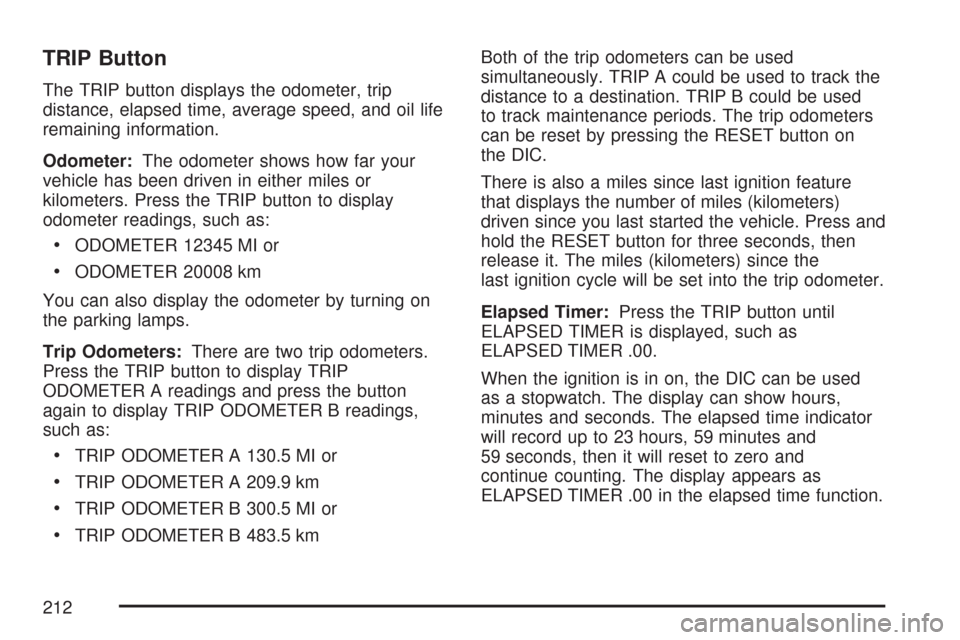
The TRIP button displays the odometer, trip
distance, elapsed time, average speed, and oil life
remaining information.
Odometer:The odometer shows how far your
vehicle has been driven in either miles or
kilometers. Press the TRIP button to display
odometer readings, such as:
ODOMETER 12345 MI or
ODOMETER 20008 km
You can also display the odometer by turning on
the parking lamps.
Trip Odometers:There are two trip odometers.
Press the TRIP button to display TRIP
ODOMETER A readings and press the button
again to display TRIP ODOMETER B readings,
such as:
TRIP ODOMETER A 130.5 MI or
TRIP ODOMETER A 209.9 km
TRIP ODOMETER B 300.5 MI or
TRIP ODOMETER B 483.5 kmBoth of the trip odometers can be used
simultaneously. TRIP A could be used to track the
distance to a destination. TRIP B could be used
to track maintenance periods. The trip odometers
can be reset by pressing the RESET button on
the DIC.
There is also a miles since last ignition feature
that displays the number of miles (kilometers)
driven since you last started the vehicle. Press and
hold the RESET button for three seconds, then
release it. The miles (kilometers) since the
last ignition cycle will be set into the trip odometer.
Elapsed Timer:Press the TRIP button until
ELAPSED TIMER is displayed, such as
ELAPSED TIMER .00.
When the ignition is in on, the DIC can be used
as a stopwatch. The display can show hours,
minutes and seconds. The elapsed time indicator
will record up to 23 hours, 59 minutes and
59 seconds, then it will reset to zero and
continue counting. The display appears as
ELAPSED TIMER .00 in the elapsed time function.
212
Page 213 of 488
You can start or stop the elapsed time by pressing
the RESET button. To reset the elapsed time to
zero, press the RESET button for three seconds
while the timer is displayed.
Pressing and holding the RESET button for at
least 10 seconds will reset the timer display to the
time since last ignition cycle.
Average Speed:Press the TRIP button until the
average speed is displayed, such as:
AVERAGE SPEED 62 MPH or
AVERAGE SPEED 100 km/h
Press and hold the RESET button to reset to
0.0 mph (km/h).
Engine Oil Life:Press the TRIP button until the
engine oil life is displayed, such as OIL LIFE
REMAINING 89%.
This is an estimate of the engine oil’s remaining
useful life. It will show 100% when the system
is reset after an oil change. It will alert you
to change your oil on a schedule consistent with
your driving conditions.When the remaining oil life is low, the system will
alert you with the message CHANGE ENGINE OIL.
Remember, you must reset the engine oil life
system yourself after each oil change. It will not
reset itself. To reset the system, seeEngine
Oil Life System on page 340. Be careful not to
reset the engine oil life system accidentally at any
time other than when the oil has just been
changed. It cannot be reset accurately until the
next oil change.
SeeScheduled Maintenance on page 433and
Engine Oil on page 333for more information.
OPTION Button
The OPTION button allows you to access the
PERSONAL OPTIONS menu and customize the
personalization settings on your vehicle. See
DIC Vehicle Personalization on page 234for more
information.
RESET Button
The RESET button, used along with other buttons,
will reset system functions and turn off or
acknowledge messages on the DIC.
213