coolant CHEVROLET CORVETTE 2007 6.G Owner's Guide
[x] Cancel search | Manufacturer: CHEVROLET, Model Year: 2007, Model line: CORVETTE, Model: CHEVROLET CORVETTE 2007 6.GPages: 488, PDF Size: 2.62 MB
Page 356 of 488
{CAUTION:
You can be burned if you spill coolant
on hot engine parts. Coolant contains
ethylene glycol and it will burn if the
engine parts are hot enough. Do not
spill coolant on a hot engine.
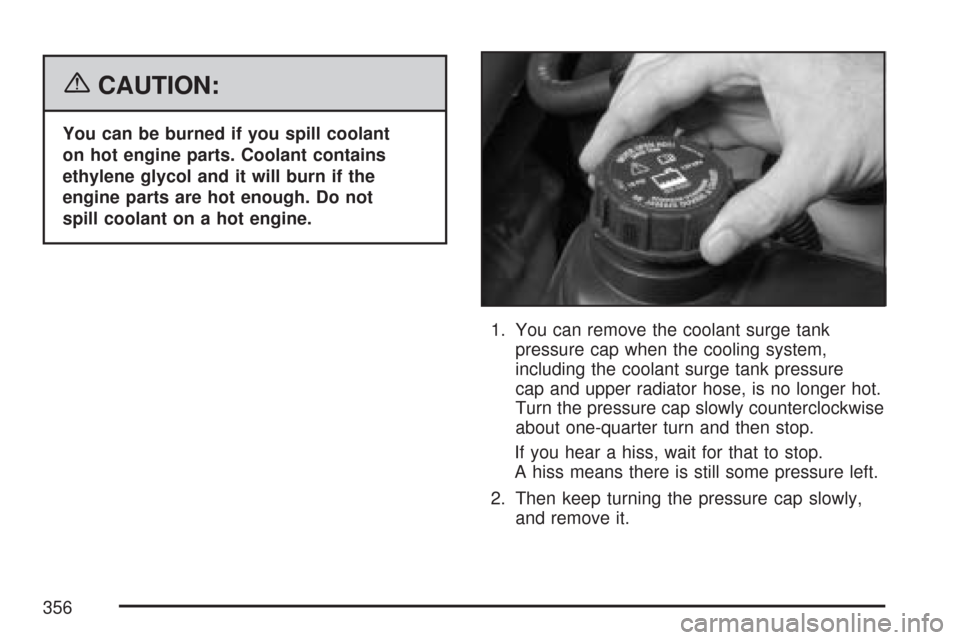
1. You can remove the coolant surge tank
pressure cap when the cooling system,
including the coolant surge tank pressure
cap and upper radiator hose, is no longer hot.
Turn the pressure cap slowly counterclockwise
about one-quarter turn and then stop.
If you hear a hiss, wait for that to stop.
A hiss means there is still some pressure left.
2. Then keep turning the pressure cap slowly,
and remove it.
356
Page 357 of 488
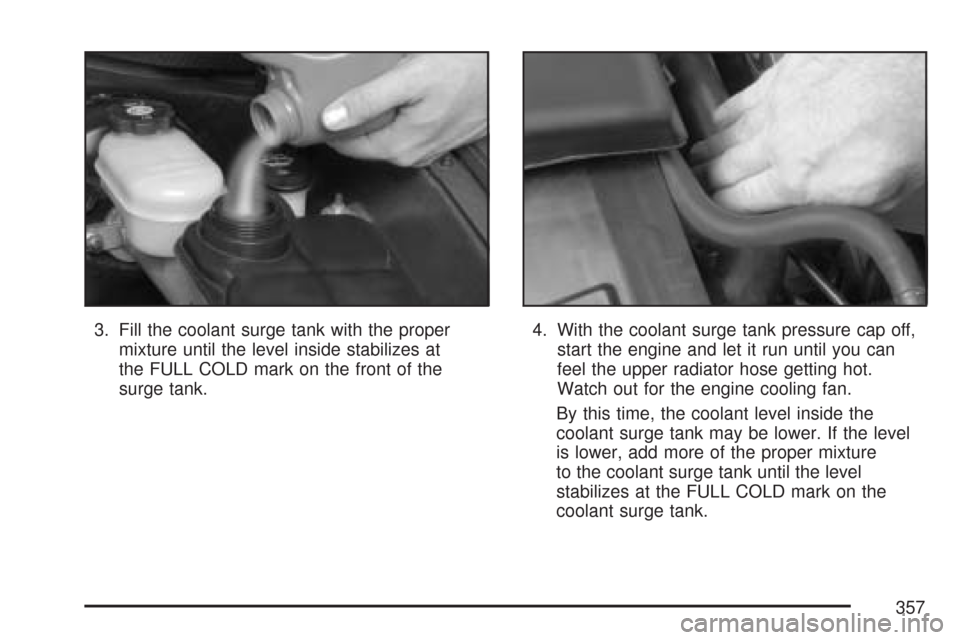
3. Fill the coolant surge tank with the proper
mixture until the level inside stabilizes at
the FULL COLD mark on the front of the
surge tank.4. With the coolant surge tank pressure cap off,
start the engine and let it run until you can
feel the upper radiator hose getting hot.
Watch out for the engine cooling fan.
By this time, the coolant level inside the
coolant surge tank may be lower. If the level
is lower, add more of the proper mixture
to the coolant surge tank until the level
stabilizes at the FULL COLD mark on the
coolant surge tank.
357
Page 358 of 488
5. Then replace the pressure cap. Be sure the
pressure cap is hand-tight and fully seated.
Check the level in the surge tank when
the system has cooled down. If the coolant
is not at the proper level, repeat Steps 1
through 4, then reinstall the pressure cap.
If the coolant is not at the proper level when
the system cools down again, see your dealer.Power Steering Fluid
SeeEngine
Compartment Overview
on page 330for
reservoir location.
When to Check Power Steering Fluid
It is not necessary to regularly check power
steering uid unless you suspect there is a leak
in the system or you hear an unusual noise.
A uid loss in this system could indicate a problem.
Have the system inspected and repaired.
358
Page 360 of 488
Windshield Washer Fluid
What to Use
When you need windshield washer uid, be sure
to read the manufacturer’s instructions before
use. If you will be operating your vehicle in an area
where the temperature may fall below freezing,
use a uid that has sufficient protection against
freezing.
Adding Washer Fluid
Open the cap with the
washer symbol on it.
Add washer uid
until the tank is full. See
Engine Compartment
Overview on page 330
for reservoir location.Notice:
When using concentrated washer uid,
follow the manufacturer’s instructions
for adding water.
Do not mix water with ready-to-use washer
uid. Water can cause the solution to
freeze and damage your washer uid tank
and other parts of the washer system.
Also, water does not clean as well
as washer uid.
Fill the washer uid tank only
three-quarters full when it is very cold.
This allows for uid expansion if freezing
occurs, which could damage the tank if
it is completely full.
Do not use engine coolant (antifreeze)
in your windshield washer. It can damage
the vehicle’s windshield washer system
and paint.
360
Page 382 of 488
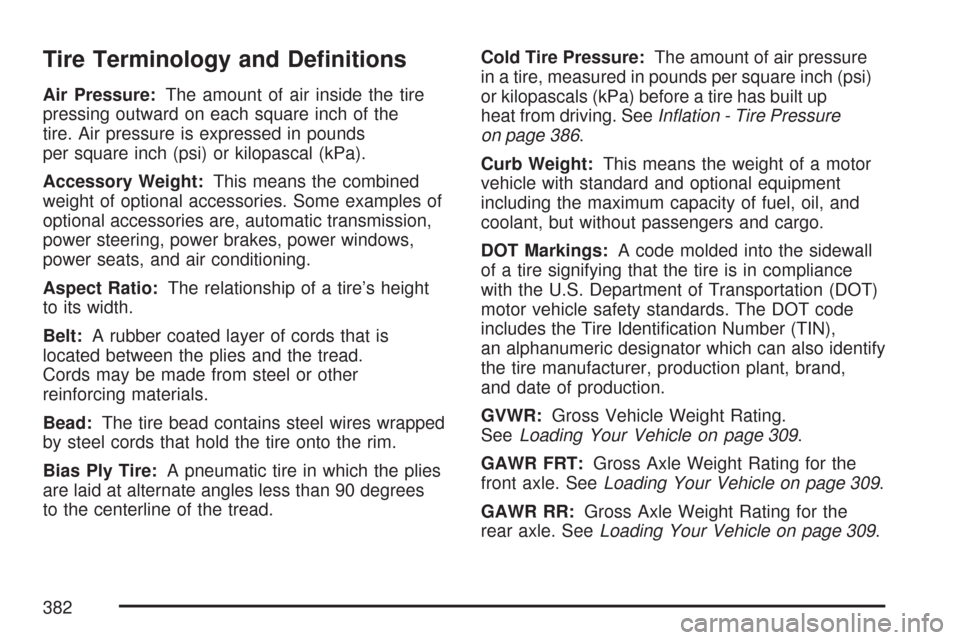
Tire Terminology and Denitions
Air Pressure:The amount of air inside the tire
pressing outward on each square inch of the
tire. Air pressure is expressed in pounds
per square inch (psi) or kilopascal (kPa).
Accessory Weight:This means the combined
weight of optional accessories. Some examples of
optional accessories are, automatic transmission,
power steering, power brakes, power windows,
power seats, and air conditioning.
Aspect Ratio:The relationship of a tire’s height
to its width.
Belt:A rubber coated layer of cords that is
located between the plies and the tread.
Cords may be made from steel or other
reinforcing materials.
Bead:The tire bead contains steel wires wrapped
by steel cords that hold the tire onto the rim.
Bias Ply Tire:A pneumatic tire in which the plies
are laid at alternate angles less than 90 degrees
to the centerline of the tread.Cold Tire Pressure:The amount of air pressure
in a tire, measured in pounds per square inch (psi)
or kilopascals (kPa) before a tire has built up
heat from driving. SeeInation - Tire Pressure
on page 386.
Curb Weight:This means the weight of a motor
vehicle with standard and optional equipment
including the maximum capacity of fuel, oil, and
coolant, but without passengers and cargo.
DOT Markings:A code molded into the sidewall
of a tire signifying that the tire is in compliance
with the U.S. Department of Transportation (DOT)
motor vehicle safety standards. The DOT code
includes the Tire Identication Number (TIN),
an alphanumeric designator which can also identify
the tire manufacturer, production plant, brand,
and date of production.
GVWR:Gross Vehicle Weight Rating.
SeeLoading Your Vehicle on page 309.
GAWR FRT:Gross Axle Weight Rating for the
front axle. SeeLoading Your Vehicle on page 309.
GAWR RR:Gross Axle Weight Rating for the
rear axle. SeeLoading Your Vehicle on page 309.
382
Page 435 of 488
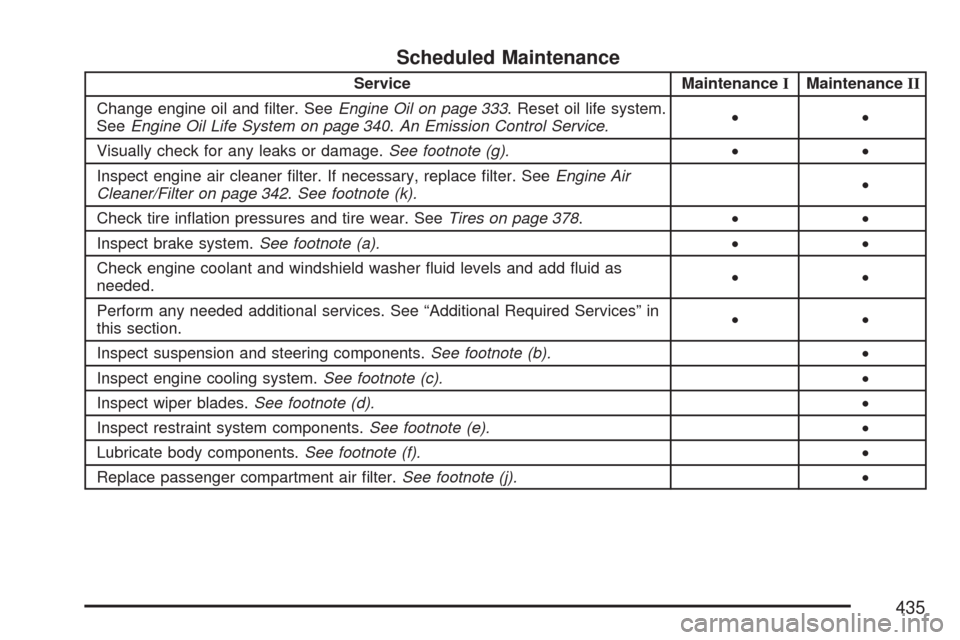
Scheduled Maintenance
Service MaintenanceIMaintenanceII
Change engine oil and lter. SeeEngine Oil on page 333. Reset oil life system.
SeeEngine Oil Life System on page 340.An Emission Control Service.••
Visually check for any leaks or damage.See footnote (g).••
Inspect engine air cleaner lter. If necessary, replace lter. SeeEngine Air
Cleaner/Filter on page 342.See footnote (k).•
Check tire ination pressures and tire wear. SeeTires on page 378.••
Inspect brake system.See footnote (a).••
Check engine coolant and windshield washer uid levels and add uid as
needed.••
Perform any needed additional services. See “Additional Required Services” in
this section.••
Inspect suspension and steering components.See footnote (b).•
Inspect engine cooling system.See footnote (c).•
Inspect wiper blades.See footnote (d).•
Inspect restraint system components.See footnote (e).•
Lubricate body components.See footnote (f).•
Replace passenger compartment air lter.See footnote (j).•
435
Page 438 of 488
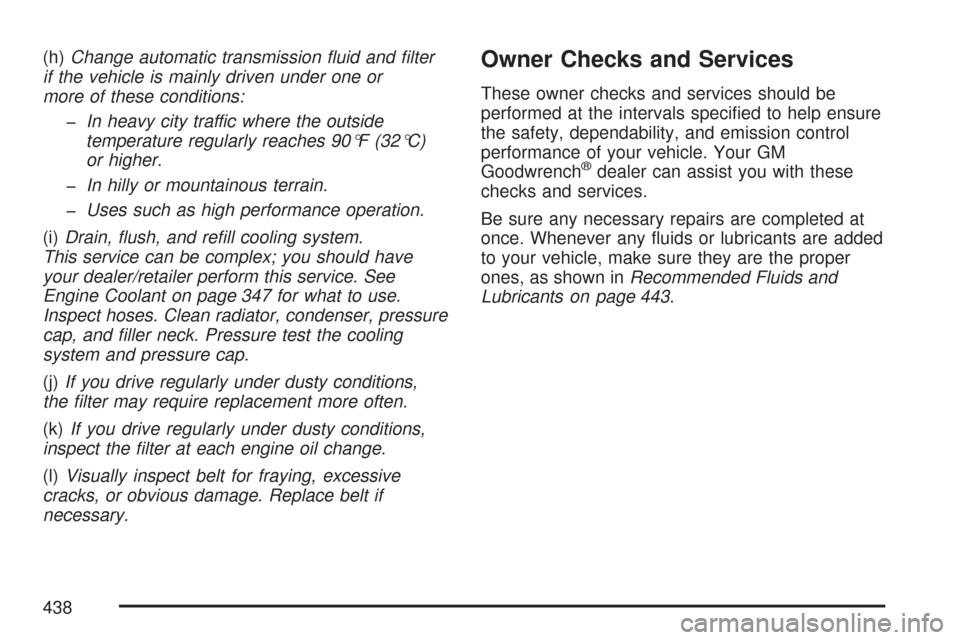
(h)Change automatic transmission uid and lter
if the vehicle is mainly driven under one or
more of these conditions:
In heavy city traffic where the outside
temperature regularly reaches 90°F (32°C)
or higher.
In hilly or mountainous terrain.
Uses such as high performance operation.
(i)Drain, ush, and rell cooling system.
This service can be complex; you should have
your dealer/retailer perform this service. See
Engine Coolant on page 347 for what to use.
Inspect hoses. Clean radiator, condenser, pressure
cap, and ller neck. Pressure test the cooling
system and pressure cap.
(j)If you drive regularly under dusty conditions,
the lter may require replacement more often.
(k)If you drive regularly under dusty conditions,
inspect the lter at each engine oil change.
(l)Visually inspect belt for fraying, excessive
cracks, or obvious damage. Replace belt if
necessary.Owner Checks and Services
These owner checks and services should be
performed at the intervals specied to help ensure
the safety, dependability, and emission control
performance of your vehicle. Your GM
Goodwrench
®dealer can assist you with these
checks and services.
Be sure any necessary repairs are completed at
once. Whenever any uids or lubricants are added
to your vehicle, make sure they are the proper
ones, as shown inRecommended Fluids and
Lubricants on page 443.
438
Page 439 of 488
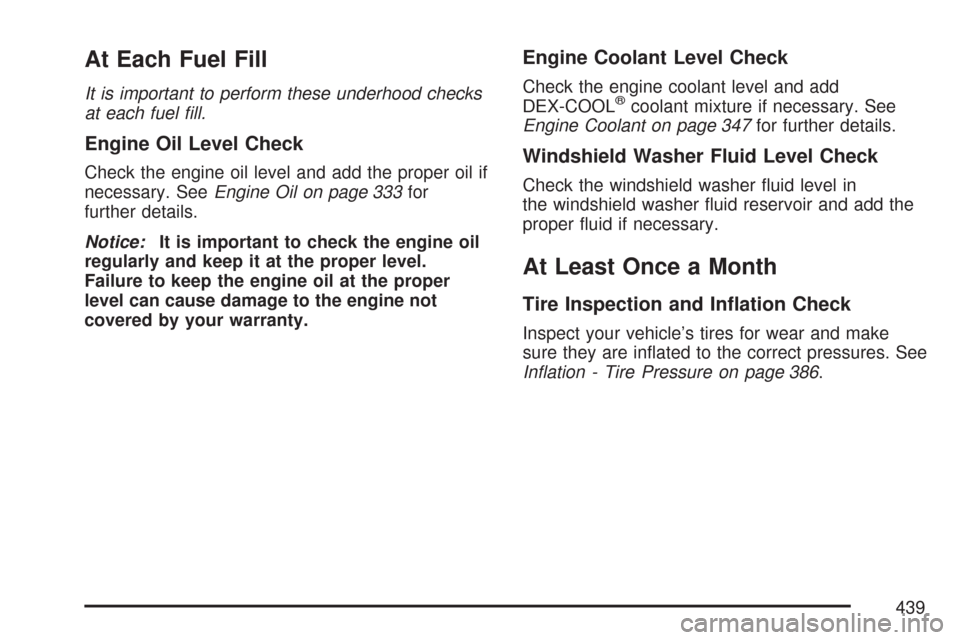
At Each Fuel Fill
It is important to perform these underhood checks
at each fuel ll.
Engine Oil Level Check
Check the engine oil level and add the proper oil if
necessary. SeeEngine Oil on page 333for
further details.
Notice:It is important to check the engine oil
regularly and keep it at the proper level.
Failure to keep the engine oil at the proper
level can cause damage to the engine not
covered by your warranty.
Engine Coolant Level Check
Check the engine coolant level and add
DEX-COOL®coolant mixture if necessary. See
Engine Coolant on page 347for further details.
Windshield Washer Fluid Level Check
Check the windshield washer uid level in
the windshield washer uid reservoir and add the
proper uid if necessary.
At Least Once a Month
Tire Inspection and Ination Check
Inspect your vehicle’s tires for wear and make
sure they are inated to the correct pressures. See
Ination - Tire Pressure on page 386.
439
Page 443 of 488
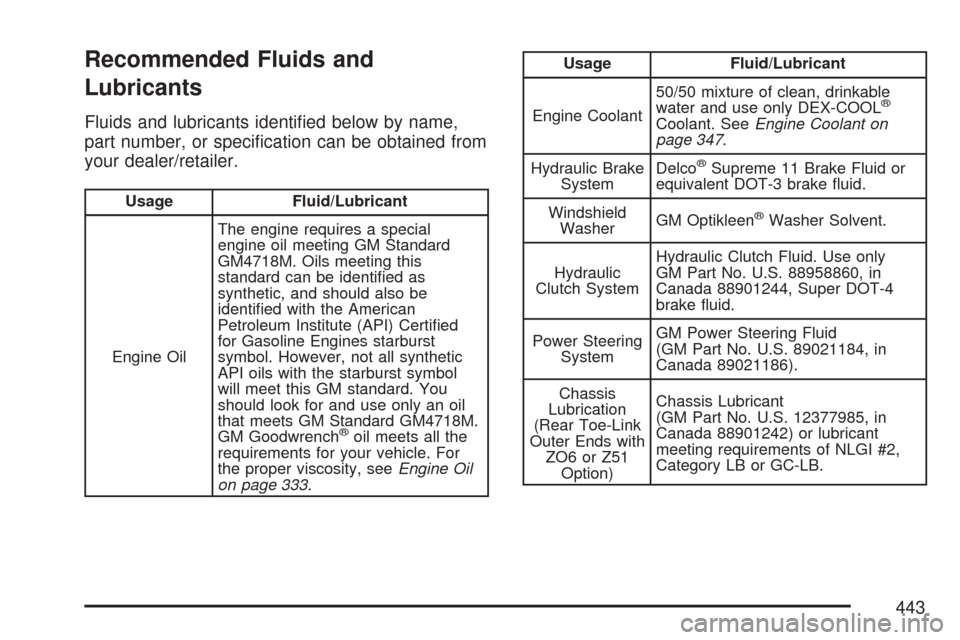
Recommended Fluids and
Lubricants
Fluids and lubricants identied below by name,
part number, or specication can be obtained from
your dealer/retailer.
Usage Fluid/Lubricant
Engine OilThe engine requires a special
engine oil meeting GM Standard
GM4718M. Oils meeting this
standard can be identied as
synthetic, and should also be
identied with the American
Petroleum Institute (API) Certied
for Gasoline Engines starburst
symbol. However, not all synthetic
API oils with the starburst symbol
will meet this GM standard. You
should look for and use only an oil
that meets GM Standard GM4718M.
GM Goodwrench
®oil meets all the
requirements for your vehicle. For
the proper viscosity, seeEngine Oil
on page 333.
Usage Fluid/Lubricant
Engine Coolant50/50 mixture of clean, drinkable
water and use only DEX-COOL
®
Coolant. SeeEngine Coolant on
page 347.
Hydraulic Brake
SystemDelco
®Supreme 11 Brake Fluid or
equivalent DOT-3 brake uid.
Windshield
WasherGM Optikleen
®Washer Solvent.
Hydraulic
Clutch SystemHydraulic Clutch Fluid. Use only
GM Part No. U.S. 88958860, in
Canada 88901244, Super DOT-4
brake uid.
Power Steering
SystemGM Power Steering Fluid
(GM Part No. U.S. 89021184, in
Canada 89021186).
Chassis
Lubrication
(Rear Toe-Link
Outer Ends with
ZO6 or Z51
Option)Chassis Lubricant
(GM Part No. U.S. 12377985, in
Canada 88901242) or lubricant
meeting requirements of NLGI #2,
Category LB or GC-LB.
443
Page 476 of 488
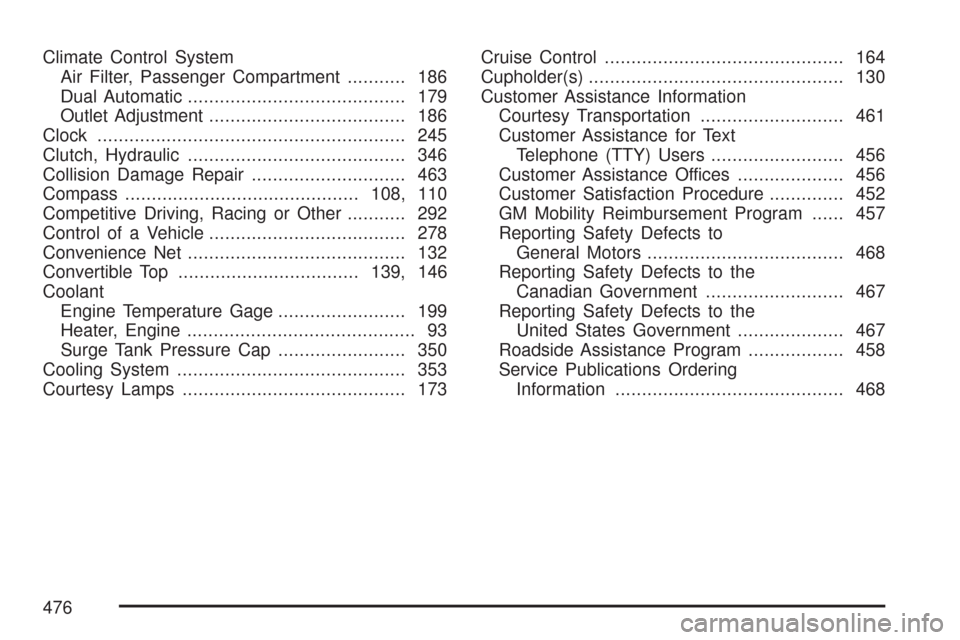
Climate Control System
Air Filter, Passenger Compartment........... 186
Dual Automatic......................................... 179
Outlet Adjustment..................................... 186
Clock.......................................................... 245
Clutch, Hydraulic......................................... 346
Collision Damage Repair............................. 463
Compass............................................108, 110
Competitive Driving, Racing or Other........... 292
Control of a Vehicle..................................... 278
Convenience Net......................................... 132
Convertible Top..................................139, 146
Coolant
Engine Temperature Gage........................ 199
Heater, Engine........................................... 93
Surge Tank Pressure Cap........................ 350
Cooling System........................................... 353
Courtesy Lamps.......................................... 173Cruise Control............................................. 164
Cupholder(s)................................................ 130
Customer Assistance Information
Courtesy Transportation........................... 461
Customer Assistance for Text
Telephone (TTY) Users ......................... 456
Customer Assistance Offices.................... 456
Customer Satisfaction Procedure.............. 452
GM Mobility Reimbursement Program...... 457
Reporting Safety Defects to
General Motors..................................... 468
Reporting Safety Defects to the
Canadian Government.......................... 467
Reporting Safety Defects to the
United States Government.................... 467
Roadside Assistance Program.................. 458
Service Publications Ordering
Information........................................... 468
476