seats CHEVROLET CORVETTE 2008 6.G User Guide
[x] Cancel search | Manufacturer: CHEVROLET, Model Year: 2008, Model line: CORVETTE, Model: CHEVROLET CORVETTE 2008 6.GPages: 432, PDF Size: 2.4 MB
Page 60 of 432
Servicing Your Airbag-Equipped
Vehicle
Airbags affect how your vehicle should be serviced.
There are parts of the airbag system in several places
around your vehicle. Your dealer/retailer and the service
manual have information about servicing your vehicle
and the airbag system. To purchase a service manual,
seeService Publications Ordering Information on
page 7-17.
{CAUTION:
For up to 10 seconds after the ignition is
turned off and the battery is disconnected, an
airbag can still inate during improper service.
You can be injured if you are close to an
airbag when it inates. Avoid yellow
connectors. They are probably part of the
airbag system. Be sure to follow proper
service procedures, and make sure the person
performing work for you is qualied to do so.
Adding Equipment to Your
Airbag-Equipped Vehicle
Q:Is there anything I might add to or change
about the vehicle that could keep the airbags
from working properly?
A:Yes. If you add things that change your vehicle’s
frame, bumper system, height, front end or side
sheet metal, they may keep the airbag system from
working properly. Changing or moving any parts of
the front seats, safety belts, the airbag sensing and
diagnostic module, steering wheel, instrument panel,
the inside review mirror, front sensors, or airbag
wiring can affect the operation of the airbag system.
In addition, your vehicle has a passenger sensing
system for the right front passenger’s position, which
includes sensors that are part of the passenger’s
seat. The passenger sensing system may not
operate properly if the original seat trim is replaced
with non-GM covers, upholstery or trim, or with GM
covers, upholstery or trim designed for a different
vehicle. Any object, such as an aftermarket seat
heater or a comfort enhancing pad or device,
1-56
Page 142 of 432
T. Heated Seat Controls (If Equipped). SeeHeated
Seats on page 1-4.
U. Shift Lever (Automatic Shown). SeeAutomatic
Transmission Operation on page 2-26orManual
Transmission Operation on page 2-30.
V. Active Handling Button. SeeActive Handling System
on page 4-7.
W. Accessory Power Outlet. SeeAccessory Power
Outlet(s) on page 3-24.
X. Selective Ride Control. SeeSelective Ride Control
on page 4-10.
Y. Center Console Cupholder. SeeCupholders on
page 2-53.
Z. Ashtray and Cigarette Lighter. SeeAshtray(s) and
Cigarette Lighter on page 3-25.
AA. Parking Brake. SeeParking Brake on page 2-32.
AB. Glove Box. SeeGlove Box on page 2-53.
AC. Instrument Panel Fuse Block. SeeInstrument Panel
Fuse Block on page 5-100.Hazard Warning Flashers
Your hazard warning ashers let you warn others.
They also let police know you have a problem. Your
front and rear turn signal lamps will ash on and off.
The hazard warning
asher button is located
near the center of the
instrument panel.
Your hazard warning ashers work no matter what
mode the ignition is in, even if the ignition is turned off.
Press the button to make the front and rear turn
signal lamps ash on and off. Press the button again to
turn the ashers off.
When the hazard warning ashers are on, your turn
signals will not work.
3-6
Page 168 of 432
Outlet Adjustment
Use the tab located on the air outlets to change the
direction of the airow.
Operation Tips
Clear away any ice, snow or leaves from the air
inlets at the base of the windshield that may
block the ow of air into your vehicle.
Use of non-GM approved hood deectors may
adversely affect the performance of the system.
Keep the area around the base of the instrument
panel console and air path under the seats clear
of objects to help circulate the air inside of
your vehicle more effectively.
Passenger Compartment Air Filter
The passenger compartment air lter removes certain
particles from the air including pollen and dust particles.
Reductions in airow, which may occur more often in
dusty areas, indicate that the lter may need to be
replaced. SeeScheduled Maintenance on page 6-4for
information on how often to replace the lter.
Notice:Driving without a passenger compartment
air lter in place can cause water and small
particles, like paper and leaves, to be pulled into
your climate control system which may cause
damage to it. Make sure you always replace the old
lter with a new one.
The passenger compartment air lter is located on the
passenger side of the engine compartment near the
battery. SeeEngine Compartment Overview on
page 5-14.
3-32
Page 188 of 432
DIC Operation and Displays
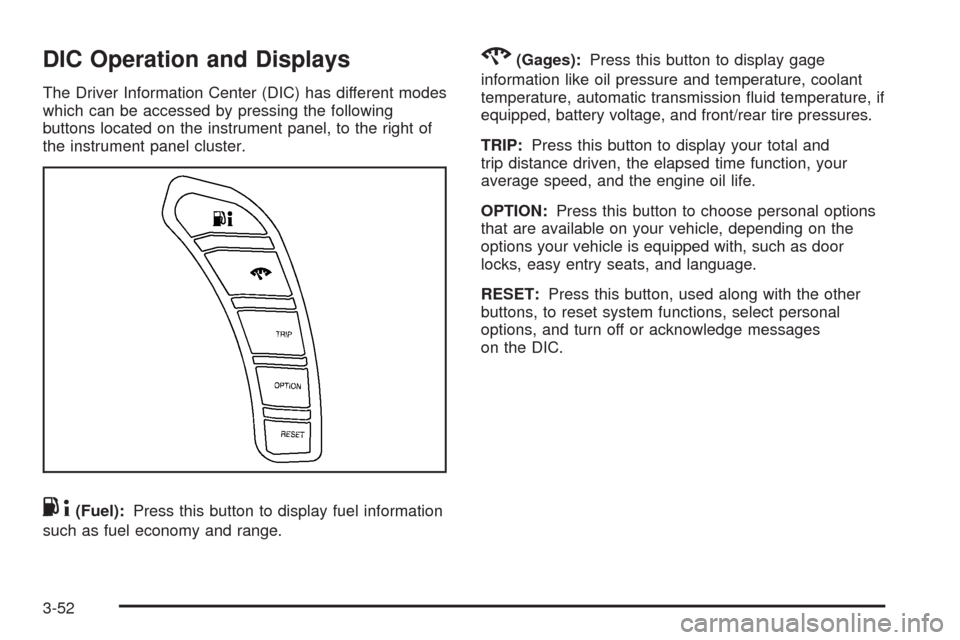
The Driver Information Center (DIC) has different modes
which can be accessed by pressing the following
buttons located on the instrument panel, to the right of
the instrument panel cluster.
.4(Fuel):Press this button to display fuel information
such as fuel economy and range.
2(Gages):Press this button to display gage
information like oil pressure and temperature, coolant
temperature, automatic transmission uid temperature, if
equipped, battery voltage, and front/rear tire pressures.
TRIP:Press this button to display your total and
trip distance driven, the elapsed time function, your
average speed, and the engine oil life.
OPTION:Press this button to choose personal options
that are available on your vehicle, depending on the
options your vehicle is equipped with, such as door
locks, easy entry seats, and language.
RESET:Press this button, used along with the other
buttons, to reset system functions, select personal
options, and turn off or acknowledge messages
on the DIC.
3-52
Page 271 of 432
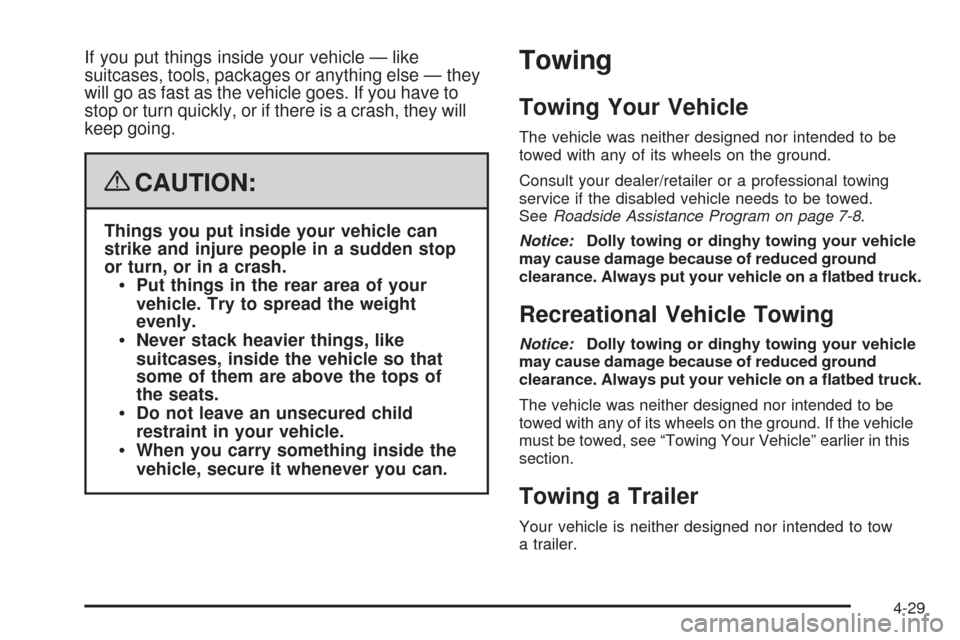
If you put things inside your vehicle — like
suitcases, tools, packages or anything else — they
will go as fast as the vehicle goes. If you have to
stop or turn quickly, or if there is a crash, they will
keep going.
{CAUTION:
Things you put inside your vehicle can
strike and injure people in a sudden stop
or turn, or in a crash.
Put things in the rear area of your
vehicle. Try to spread the weight
evenly.
Never stack heavier things, like
suitcases, inside the vehicle so that
some of them are above the tops of
the seats.
Do not leave an unsecured child
restraint in your vehicle.
When you carry something inside the
vehicle, secure it whenever you can.
Towing
Towing Your Vehicle
The vehicle was neither designed nor intended to be
towed with any of its wheels on the ground.
Consult your dealer/retailer or a professional towing
service if the disabled vehicle needs to be towed.
SeeRoadside Assistance Program on page 7-8.
Notice:Dolly towing or dinghy towing your vehicle
may cause damage because of reduced ground
clearance. Always put your vehicle on a atbed truck.
Recreational Vehicle Towing
Notice:Dolly towing or dinghy towing your vehicle
may cause damage because of reduced ground
clearance. Always put your vehicle on a atbed truck.
The vehicle was neither designed nor intended to be
towed with any of its wheels on the ground. If the vehicle
must be towed, see “Towing Your Vehicle” earlier in this
section.
Towing a Trailer
Your vehicle is neither designed nor intended to tow
a trailer.
4-29
Page 334 of 432
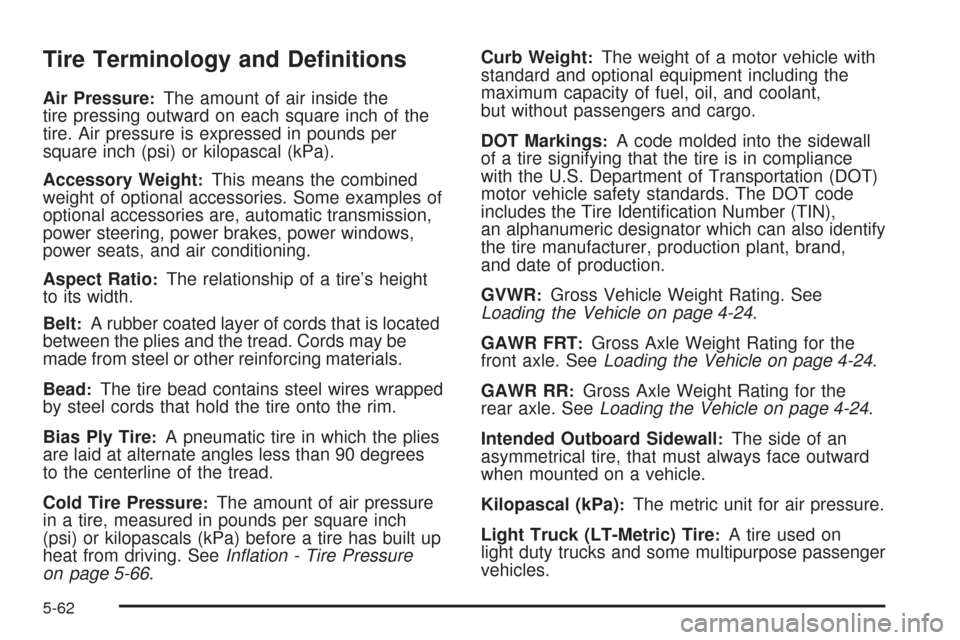
Tire Terminology and Denitions
Air Pressure:The amount of air inside the
tire pressing outward on each square inch of the
tire. Air pressure is expressed in pounds per
square inch (psi) or kilopascal (kPa).
Accessory Weight
:This means the combined
weight of optional accessories. Some examples of
optional accessories are, automatic transmission,
power steering, power brakes, power windows,
power seats, and air conditioning.
Aspect Ratio
:The relationship of a tire’s height
to its width.
Belt
:A rubber coated layer of cords that is located
between the plies and the tread. Cords may be
made from steel or other reinforcing materials.
Bead
:The tire bead contains steel wires wrapped
by steel cords that hold the tire onto the rim.
Bias Ply Tire
:A pneumatic tire in which the plies
are laid at alternate angles less than 90 degrees
to the centerline of the tread.
Cold Tire Pressure
:The amount of air pressure
in a tire, measured in pounds per square inch
(psi) or kilopascals (kPa) before a tire has built up
heat from driving. SeeInflation - Tire Pressure
on page 5-66.Curb Weight
:The weight of a motor vehicle with
standard and optional equipment including the
maximum capacity of fuel, oil, and coolant,
but without passengers and cargo.
DOT Markings
:A code molded into the sidewall
of a tire signifying that the tire is in compliance
with the U.S. Department of Transportation (DOT)
motor vehicle safety standards. The DOT code
includes the Tire Identication Number (TIN),
an alphanumeric designator which can also identify
the tire manufacturer, production plant, brand,
and date of production.
GVWR
:Gross Vehicle Weight Rating. See
Loading the Vehicle on page 4-24.
GAWR FRT
:Gross Axle Weight Rating for the
front axle. SeeLoading the Vehicle on page 4-24.
GAWR RR
:Gross Axle Weight Rating for the
rear axle. SeeLoading the Vehicle on page 4-24.
Intended Outboard Sidewall
:The side of an
asymmetrical tire, that must always face outward
when mounted on a vehicle.
Kilopascal (kPa)
:The metric unit for air pressure.
Light Truck (LT-Metric) Tire
:A tire used on
light duty trucks and some multipurpose passenger
vehicles.
5-62
Page 371 of 432
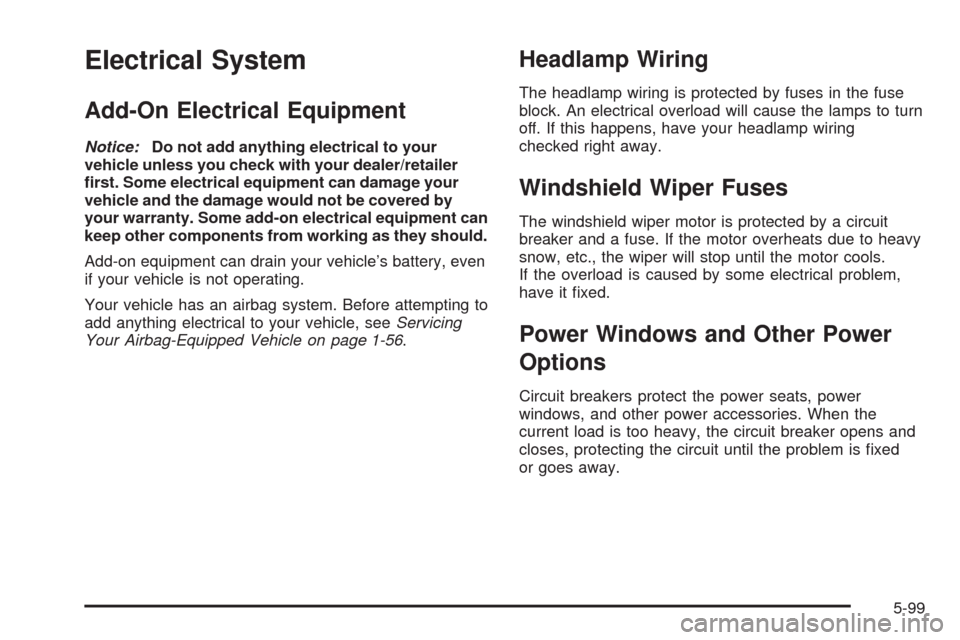
Electrical System
Add-On Electrical Equipment
Notice:Do not add anything electrical to your
vehicle unless you check with your dealer/retailer
rst. Some electrical equipment can damage your
vehicle and the damage would not be covered by
your warranty. Some add-on electrical equipment can
keep other components from working as they should.
Add-on equipment can drain your vehicle’s battery, even
if your vehicle is not operating.
Your vehicle has an airbag system. Before attempting to
add anything electrical to your vehicle, seeServicing
Your Airbag-Equipped Vehicle on page 1-56.
Headlamp Wiring
The headlamp wiring is protected by fuses in the fuse
block. An electrical overload will cause the lamps to turn
off. If this happens, have your headlamp wiring
checked right away.
Windshield Wiper Fuses
The windshield wiper motor is protected by a circuit
breaker and a fuse. If the motor overheats due to heavy
snow, etc., the wiper will stop until the motor cools.
If the overload is caused by some electrical problem,
have it xed.
Power Windows and Other Power
Options
Circuit breakers protect the power seats, power
windows, and other power accessories. When the
current load is too heavy, the circuit breaker opens and
closes, protecting the circuit until the problem is xed
or goes away.
5-99
Page 375 of 432
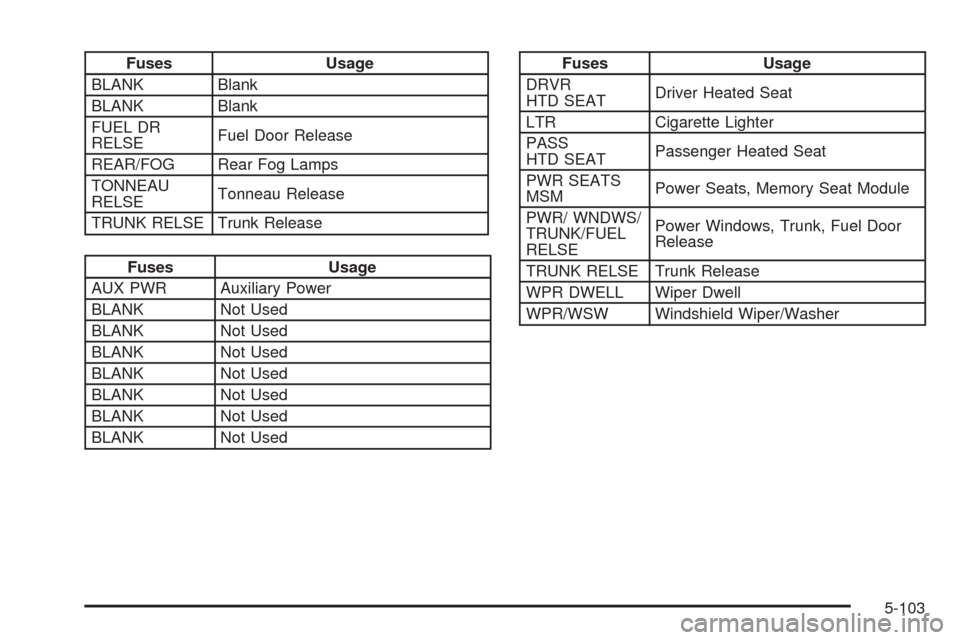
Fuses Usage
BLANK Blank
BLANK Blank
FUEL DR
RELSEFuel Door Release
REAR/FOG Rear Fog Lamps
TONNEAU
RELSETonneau Release
TRUNK RELSE Trunk Release
Fuses Usage
AUX PWR Auxiliary Power
BLANK Not Used
BLANK Not Used
BLANK Not Used
BLANK Not Used
BLANK Not Used
BLANK Not Used
BLANK Not Used
Fuses Usage
DRVR
HTD SEATDriver Heated Seat
LTR Cigarette Lighter
PASS
HTD SEATPassenger Heated Seat
PWR SEATS
MSMPower Seats, Memory Seat Module
PWR/ WNDWS/
TRUNK/FUEL
RELSEPower Windows, Trunk, Fuel Door
Release
TRUNK RELSE Trunk Release
WPR DWELL Wiper Dwell
WPR/WSW Windshield Wiper/Washer
5-103
Page 424 of 432
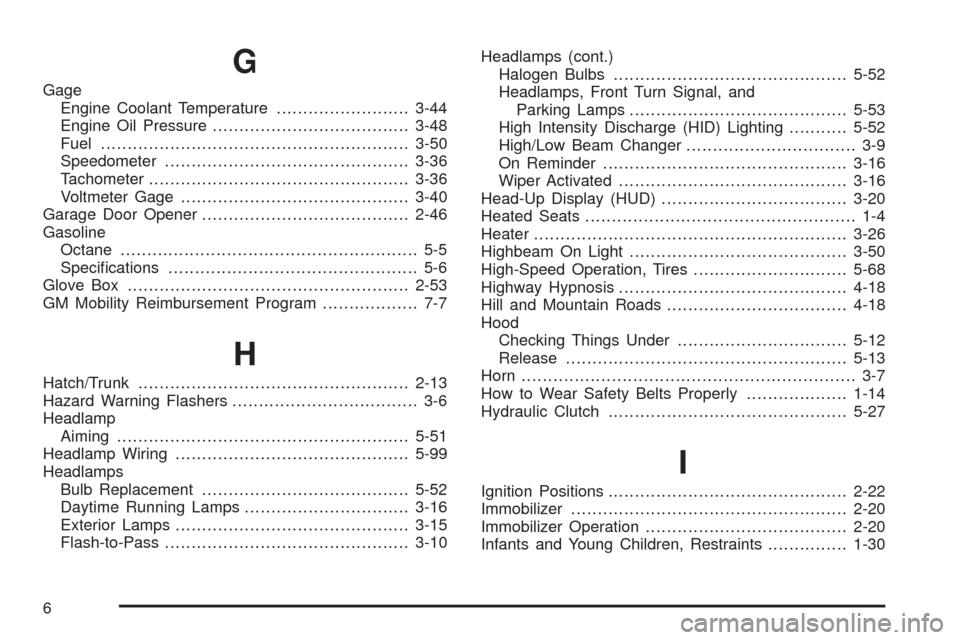
G
Gage
Engine Coolant Temperature.........................3-44
Engine Oil Pressure.....................................3-48
Fuel..........................................................3-50
Speedometer..............................................3-36
Tachometer.................................................3-36
Voltmeter Gage...........................................3-40
Garage Door Opener.......................................2-46
Gasoline
Octane........................................................ 5-5
Specications............................................... 5-6
Glove Box.....................................................2-53
GM Mobility Reimbursement Program.................. 7-7
H
Hatch/Trunk...................................................2-13
Hazard Warning Flashers................................... 3-6
Headlamp
Aiming .......................................................5-51
Headlamp Wiring............................................5-99
Headlamps
Bulb Replacement.......................................5-52
Daytime Running Lamps...............................3-16
Exterior Lamps............................................3-15
Flash-to-Pass..............................................3-10Headlamps (cont.)
Halogen Bulbs............................................5-52
Headlamps, Front Turn Signal, and
Parking Lamps.........................................5-53
High Intensity Discharge (HID) Lighting...........5-52
High/Low Beam Changer................................ 3-9
On Reminder..............................................3-16
Wiper Activated...........................................3-16
Head-Up Display (HUD)...................................3-20
Heated Seats................................................... 1-4
Heater...........................................................3-26
Highbeam On Light.........................................3-50
High-Speed Operation, Tires.............................5-68
Highway Hypnosis...........................................4-18
Hill and Mountain Roads..................................4-18
Hood
Checking Things Under................................5-12
Release.....................................................5-13
Horn ............................................................... 3-7
How to Wear Safety Belts Properly...................1-14
Hydraulic Clutch.............................................5-27
I
Ignition Positions.............................................2-22
Immobilizer....................................................2-20
Immobilizer Operation......................................2-20
Infants and Young Children, Restraints...............1-30
6
Page 426 of 432
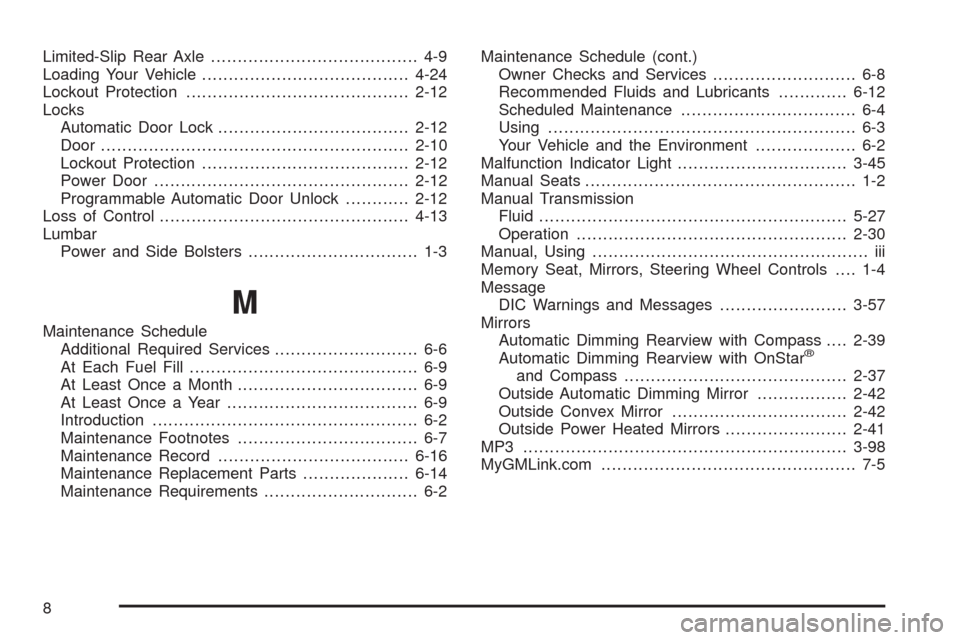
Limited-Slip Rear Axle....................................... 4-9
Loading Your Vehicle.......................................4-24
Lockout Protection..........................................2-12
Locks
Automatic Door Lock....................................2-12
Door ..........................................................2-10
Lockout Protection.......................................2-12
Power Door ................................................2-12
Programmable Automatic Door Unlock............2-12
Loss of Control...............................................4-13
Lumbar
Power and Side Bolsters................................ 1-3
M
Maintenance Schedule
Additional Required Services........................... 6-6
At Each Fuel Fill........................................... 6-9
At Least Once a Month.................................. 6-9
At Least Once a Year.................................... 6-9
Introduction.................................................. 6-2
Maintenance Footnotes.................................. 6-7
Maintenance Record....................................6-16
Maintenance Replacement Parts....................6-14
Maintenance Requirements............................. 6-2Maintenance Schedule (cont.)
Owner Checks and Services........................... 6-8
Recommended Fluids and Lubricants.............6-12
Scheduled Maintenance................................. 6-4
Using.......................................................... 6-3
Your Vehicle and the Environment................... 6-2
Malfunction Indicator Light................................3-45
Manual Seats................................................... 1-2
Manual Transmission
Fluid..........................................................5-27
Operation...................................................2-30
Manual, Using.................................................... iii
Memory Seat, Mirrors, Steering Wheel Controls.... 1-4
Message
DIC Warnings and Messages........................3-57
Mirrors
Automatic Dimming Rearview with Compass....2-39
Automatic Dimming Rearview with OnStar
®
and Compass..........................................2-37
Outside Automatic Dimming Mirror.................2-42
Outside Convex Mirror.................................2-42
Outside Power Heated Mirrors.......................2-41
MP3 .............................................................3-98
MyGMLink.com................................................ 7-5
8