warning light CHEVROLET CORVETTE 2008 6.G User Guide
[x] Cancel search | Manufacturer: CHEVROLET, Model Year: 2008, Model line: CORVETTE, Model: CHEVROLET CORVETTE 2008 6.GPages: 432, PDF Size: 2.4 MB
Page 158 of 432
When the desired HUD display has been selected,
release the MODE button.
Within each mode, the display, can be further
customized by pressing the PAGE button. Pressing this
button in each mode will turn off and on the following:
Street Mode — No tachometer, circular tachometer,
and linear tachometer.
Track Modes 1 and 2 — No minor gage, coolant
temperature, transmission oil temperature, engine
oil temperature, and engine oil pressure.
While in Track Mode 1 or 2, the maximum G value
achieved during the current ignition cycle can be
displayed by pressing and holding the PAGE button.
The maximum G display will be shown until the
PAGE button is released. The maximum G value
display will be identical to the normal G value
display, except the maximum G gage digits (X.XX G)
and corresponding G gage bar will overwrite the
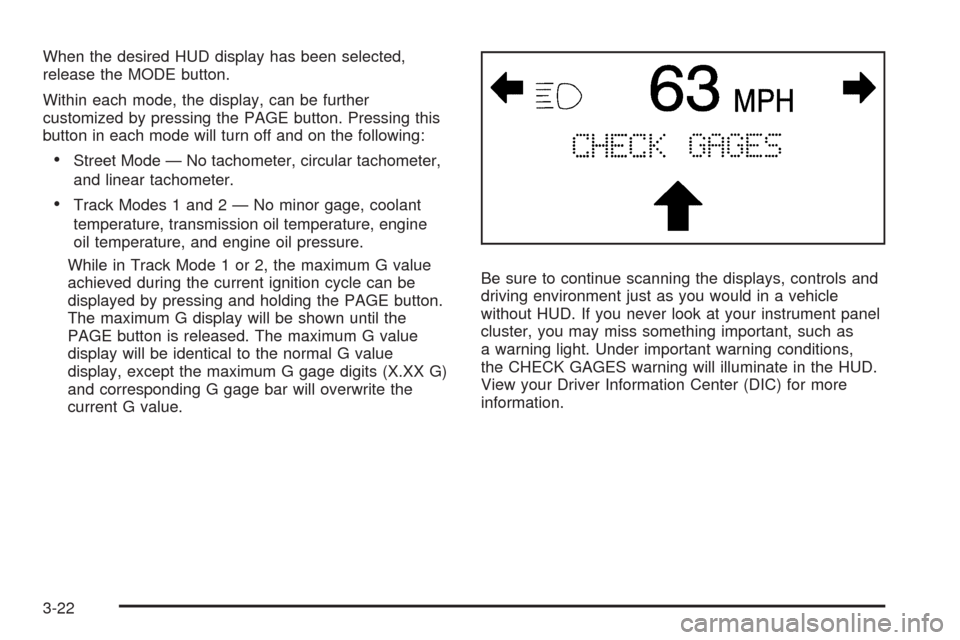
current G value.Be sure to continue scanning the displays, controls and
driving environment just as you would in a vehicle
without HUD. If you never look at your instrument panel
cluster, you may miss something important, such as
a warning light. Under important warning conditions,
the CHECK GAGES warning will illuminate in the HUD.
View your Driver Information Center (DIC) for more
information.
3-22
Page 170 of 432
Warning Lights, Gages, and
Indicators
This part describes the warning lights and gages that
may be on your vehicle. The pictures will help you
locate them.
Warning lights and gages can signal that something is
wrong before it becomes serious enough to cause
an expensive repair or replacement. Paying attention to
your warning lights and gages could also save you
or others from injury.
Warning lights come on when there may be or is a
problem with one of your vehicle’s functions. As you
will see in the details on the next few pages, some
warning lights come on briey when you start the engine
just to let you know they are working. If you are
familiar with this section, you should not be alarmed
when this happens.Gages can indicate when there may be or is a problem
with one of your vehicle’s functions. Often gages
and warning lights work together to let you know when
there is a problem with your vehicle.
When one of the warning lights comes on and stays
on when you are driving, or when one of the gages
shows there may be a problem, check the section
that tells you what to do about it. Please follow this
manual’s advice. Waiting to do repairs can be
costly — and even dangerous. So please get to know
your warning lights and gages. They are a big help.
Your vehicle has a Driver Information Center that works
along with the warning lights and gages. SeeDriver
Information Center (DIC) on page 3-51.
3-34
Page 171 of 432
Instrument Panel Cluster
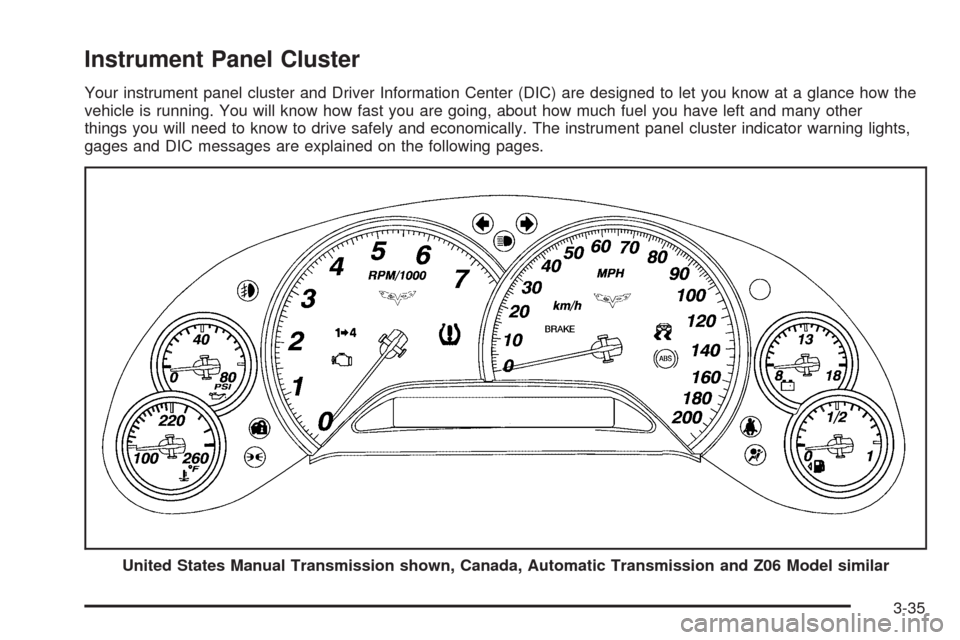
Your instrument panel cluster and Driver Information Center (DIC) are designed to let you know at a glance how the
vehicle is running. You will know how fast you are going, about how much fuel you have left and many other
things you will need to know to drive safely and economically. The instrument panel cluster indicator warning lights,
gages and DIC messages are explained on the following pages.
United States Manual Transmission shown, Canada, Automatic Transmission and Z06 Model similar
3-35
Page 173 of 432
Airbag Readiness Light
There is an airbag readiness light on the instrument
panel cluster, which shows the airbag symbol. The
system checks the airbag’s electrical system for
malfunctions. The light indicates if there is an electrical
problem. The system check includes the airbag
sensor, the pretensioners, the airbag modules, the
wiring and the crash sensing and diagnostic module.
For more information on the airbag system, seeAirbag
System on page 1-43.
This light comes on when
the vehicle is started,
and ashes for a
few seconds. The light
should go out when
the system is ready.
If the airbag readiness light stays on after the vehicle is
started or comes on while driving, the airbag system
may not work properly. Have your vehicle serviced
right away.{CAUTION:
If the airbag readiness light stays on after you
start your vehicle, it means the airbag system
may not be working properly. The airbags in
your vehicle may not inate in a crash, or they
could even inate without a crash. To help
avoid injury to yourself or others, have your
vehicle serviced right away.
The airbag readiness light should ash for a few seconds
when the engine is started. If the light does not come on
then, have it xed immediately. If there is a problem with
the airbag system, an airbag Driver Information Center
(DIC) message may also come on. SeeDIC Warnings
and Messages on page 3-57for more information.
3-37
Page 177 of 432
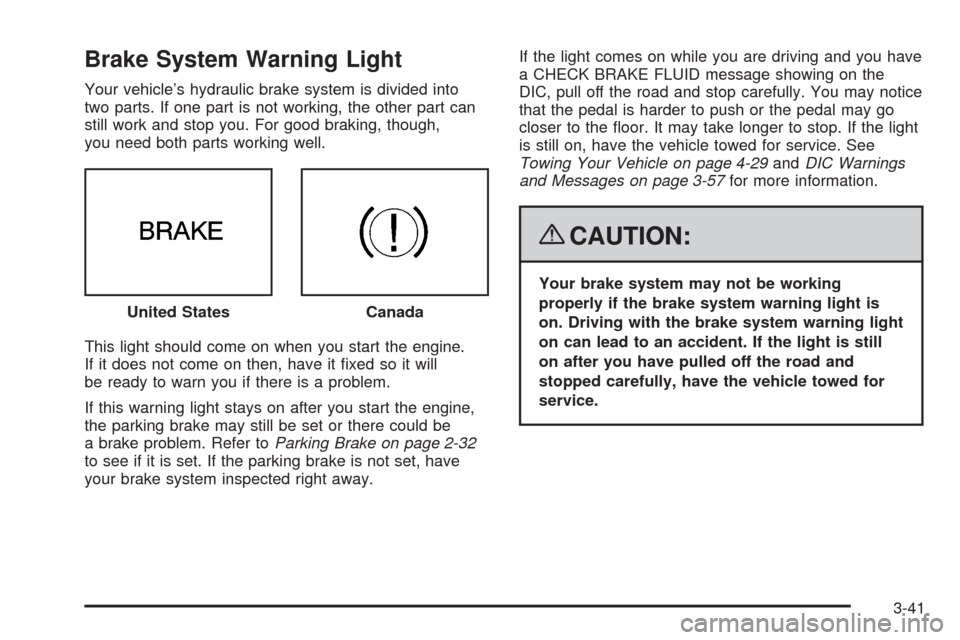
Brake System Warning Light
Your vehicle’s hydraulic brake system is divided into
two parts. If one part is not working, the other part can
still work and stop you. For good braking, though,
you need both parts working well.
This light should come on when you start the engine.
If it does not come on then, have it xed so it will
be ready to warn you if there is a problem.
If this warning light stays on after you start the engine,
the parking brake may still be set or there could be
a brake problem. Refer toParking Brake on page 2-32
to see if it is set. If the parking brake is not set, have
your brake system inspected right away.If the light comes on while you are driving and you have
a CHECK BRAKE FLUID message showing on the
DIC, pull off the road and stop carefully. You may notice
that the pedal is harder to push or the pedal may go
closer to the oor. It may take longer to stop. If the light
is still on, have the vehicle towed for service. See
Towing Your Vehicle on page 4-29andDIC Warnings
and Messages on page 3-57for more information.
{CAUTION:
Your brake system may not be working
properly if the brake system warning light is
on. Driving with the brake system warning light
on can lead to an accident. If the light is still
on after you have pulled off the road and
stopped carefully, have the vehicle towed for
service. United States
Canada
3-41
Page 178 of 432
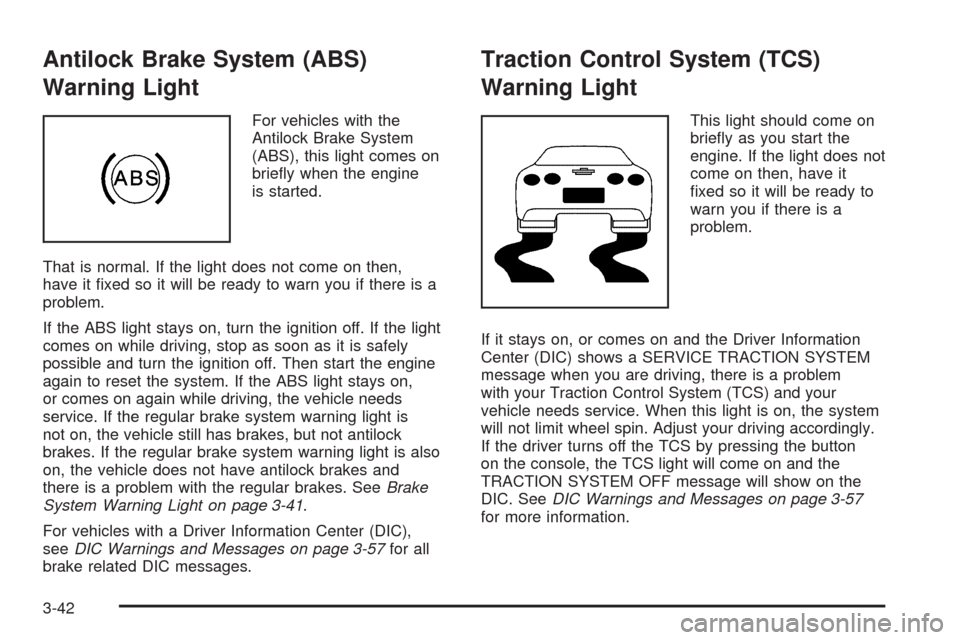
Antilock Brake System (ABS)
Warning Light
For vehicles with the
Antilock Brake System
(ABS), this light comes on
briey when the engine
is started.
That is normal. If the light does not come on then,
have it xed so it will be ready to warn you if there is a
problem.
If the ABS light stays on, turn the ignition off. If the light
comes on while driving, stop as soon as it is safely
possible and turn the ignition off. Then start the engine
again to reset the system. If the ABS light stays on,
or comes on again while driving, the vehicle needs
service. If the regular brake system warning light is
not on, the vehicle still has brakes, but not antilock
brakes. If the regular brake system warning light is also
on, the vehicle does not have antilock brakes and
there is a problem with the regular brakes. SeeBrake
System Warning Light on page 3-41.
For vehicles with a Driver Information Center (DIC),
seeDIC Warnings and Messages on page 3-57for all
brake related DIC messages.
Traction Control System (TCS)
Warning Light
This light should come on
briey as you start the
engine. If the light does not
come on then, have it
xed so it will be ready to
warn you if there is a
problem.
If it stays on, or comes on and the Driver Information
Center (DIC) shows a SERVICE TRACTION SYSTEM
message when you are driving, there is a problem
with your Traction Control System (TCS) and your
vehicle needs service. When this light is on, the system
will not limit wheel spin. Adjust your driving accordingly.
If the driver turns off the TCS by pressing the button
on the console, the TCS light will come on and the
TRACTION SYSTEM OFF message will show on the
DIC. SeeDIC Warnings and Messages on page 3-57
for more information.
3-42
Page 179 of 432
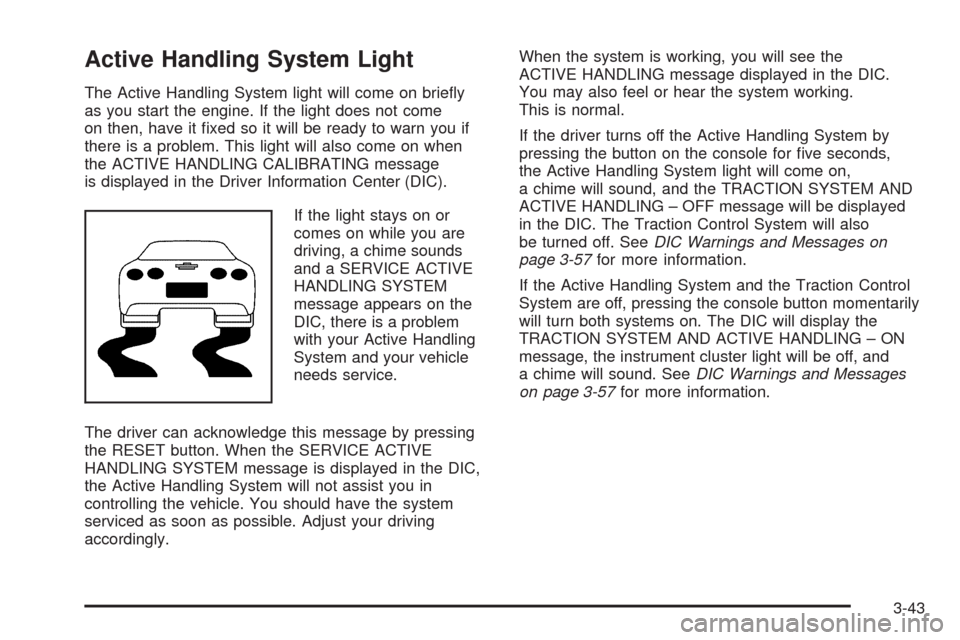
Active Handling System Light
The Active Handling System light will come on briey
as you start the engine. If the light does not come
on then, have it xed so it will be ready to warn you if
there is a problem. This light will also come on when
the ACTIVE HANDLING CALIBRATING message
is displayed in the Driver Information Center (DIC).
If the light stays on or
comes on while you are
driving, a chime sounds
and a SERVICE ACTIVE
HANDLING SYSTEM
message appears on the
DIC, there is a problem
with your Active Handling
System and your vehicle
needs service.
The driver can acknowledge this message by pressing
the RESET button. When the SERVICE ACTIVE
HANDLING SYSTEM message is displayed in the DIC,
the Active Handling System will not assist you in
controlling the vehicle. You should have the system
serviced as soon as possible. Adjust your driving
accordingly.When the system is working, you will see the
ACTIVE HANDLING message displayed in the DIC.
You may also feel or hear the system working.
This is normal.
If the driver turns off the Active Handling System by
pressing the button on the console for ve seconds,
the Active Handling System light will come on,
a chime will sound, and the TRACTION SYSTEM AND
ACTIVE HANDLING – OFF message will be displayed
in the DIC. The Traction Control System will also
be turned off. SeeDIC Warnings and Messages on
page 3-57for more information.
If the Active Handling System and the Traction Control
System are off, pressing the console button momentarily
will turn both systems on. The DIC will display the
TRACTION SYSTEM AND ACTIVE HANDLING – ON
message, the instrument cluster light will be off, and
a chime will sound. SeeDIC Warnings and Messages
on page 3-57for more information.
3-43
Page 180 of 432
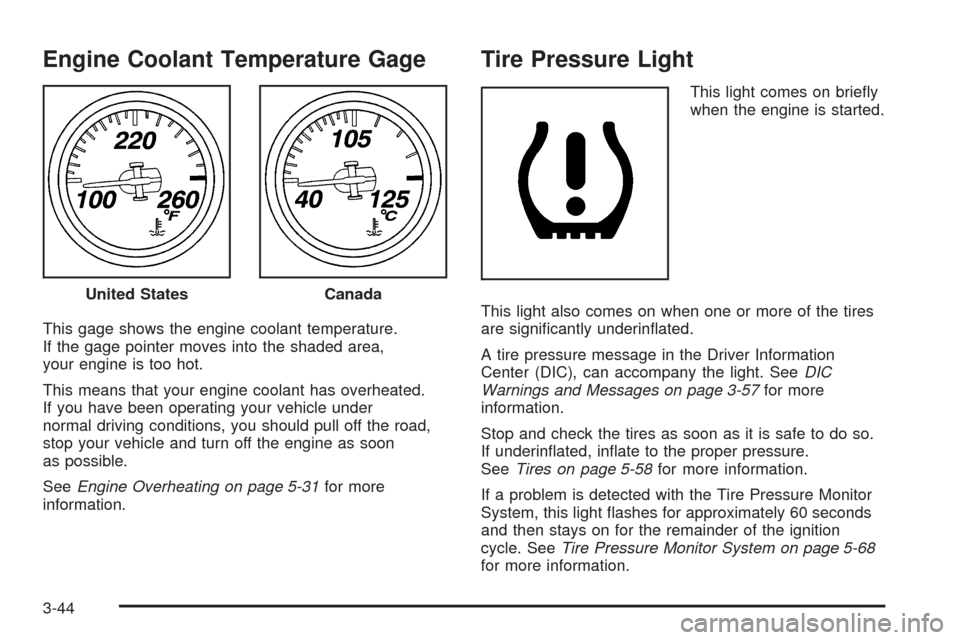
Engine Coolant Temperature Gage
This gage shows the engine coolant temperature.
If the gage pointer moves into the shaded area,
your engine is too hot.
This means that your engine coolant has overheated.
If you have been operating your vehicle under
normal driving conditions, you should pull off the road,
stop your vehicle and turn off the engine as soon
as possible.
SeeEngine Overheating on page 5-31for more
information.
Tire Pressure Light
This light comes on briey
when the engine is started.
This light also comes on when one or more of the tires
are signicantly underinated.
A tire pressure message in the Driver Information
Center (DIC), can accompany the light. SeeDIC
Warnings and Messages on page 3-57for more
information.
Stop and check the tires as soon as it is safe to do so.
If underinated, inate to the proper pressure.
SeeTires on page 5-58for more information.
If a problem is detected with the Tire Pressure Monitor
System, this light ashes for approximately 60 seconds
and then stays on for the remainder of the ignition
cycle. SeeTire Pressure Monitor System on page 5-68
for more information. United States
Canada
3-44
Page 187 of 432
Here are ve things that some owners ask about.
All these things are normal and do not indicate that
anything is wrong with the fuel gage.
At the gas station, the gas pump shuts off before
the gage reads the full symbol.
It takes more (or less) fuel to ll up than the gage
reads. For example, the gage reads half full,
but it took more (or less) than half of the tank’s
capacity to t it.
The gage pointer may move while cornering,
braking or speeding up.
The gage may not indicate the tank is empty when
the ignition is turned off.
The gage reading may change slightly within the
rst several minutes after starting the vehicle.
SeeDIC Operation and Displays on page 3-52for more
information.
Driver Information Center (DIC)
The Driver Information Center (DIC) gives you the
status of many of your vehicle’s systems. It is also
used to display driver personalization features and
warning/status messages. The DIC display is located on
the instrument panel cluster below the speedometer
and tachometer, directly above the steering column.
The DIC buttons are located on the instrument panel,
to the right of the instrument panel cluster.
The DIC comes on when the ignition is turned on. After
displaying CORVETTE BY CHEVROLET, the DIC
will display the current driver and the information that
was last displayed before the engine was turned off.
If a problem is detected, a warning message will appear
on the DIC display. Be sure to take any message that
appears on the display seriously and remember that
clearing the message will only make the message
disappear, not correct the problem.
If your vehicle has the Head-Up Display (HUD) and you
use the Manual Paddle Shift feature, the gear will
display in the HUD, except if your vehicle has the
Navigation system and the HUD is displaying
turn-by-turn guidance information. If the HUD is
displaying turn-by-turn guidance information, the gear
instead displays in the DIC. See “Manual Paddle
Shift” underAutomatic Transmission Operation on
page 2-26and “Head-Up Display (HUD)” in the index of
the Navigation system manual for more information.
3-51
Page 196 of 432
If the driver remains unbuckled when the ignition is on
and the vehicle is in motion, the reminder will be
repeated. If the driver’s safety belt is already buckled,
this message and chime will not come on.
This message is an additional reminder to the safety
belt reminder light in the instrument panel cluster.
SeeSafety Belt Reminders on page 3-36for more
information.
CHANGE ENGINE OIL
This message displays when the life of the engine oil
has expired. SeeScheduled Maintenance on page 6-4.
After an oil change, the engine oil life system must
be reset. See “Engine Oil Life” underDIC Operation
and Displays on page 3-52. Also, seeEngine Oil on
page 5-17andEngine Oil Life System on page 5-23for
more information.
CHECK BRAKE FLUID
This message displays, a chime sounds, and the brake
system warning light on the instrument panel cluster
turns on if the ignition is on to inform the driver that the
brake uid level is low. SeeBrake System Warning
Light on page 3-41. Have the brake system serviced by
your dealer/retailer as soon as possible. SeeBrakes
on page 5-42.
CHECK COOLANT LEVEL
This message displays when the engine coolant level
is low. Have the cooling system serviced by your
dealer/retailer as soon as possible. SeeEngine Coolant
on page 5-28.
CHECK GAS CAP
This message displays if the fuel cap has not been fully
tightened. Check the fuel cap to make sure that it is
on properly. Once tightened, it takes at least one
overnight park to reset or clear this message. If both the
CHECK GAS CAP message and the malfunction
indicator lamp in the instrument panel cluster are on,
you may need to see your dealer/retailer for service.
SeeMalfunction Indicator Lamp on page 3-45for more
information.
CHECK OIL LEVEL
On some vehicles, this message displays and two
chimes sound if the oil level in the vehicle is low.
Once the vehicle senses a change in the engine oil
level, the light remains off.
If this message appears after starting the engine,
the engine oil level may be too low. You may need to
add oil. SeeEngine Overheating on page 5-31.
3-60