tow CHEVROLET CORVETTE 2008 6.G Owner's Guide
[x] Cancel search | Manufacturer: CHEVROLET, Model Year: 2008, Model line: CORVETTE, Model: CHEVROLET CORVETTE 2008 6.GPages: 432, PDF Size: 2.4 MB
Page 268 of 432
5.Determine the combined weight of luggage
and cargo being loaded on the vehicle. That
weight may not safely exceed the available
cargo and luggage load capacity calculated
in Step 4.
6.If your vehicle will be towing a trailer, the load
from your trailer will be transferred to your
vehicle. Consult this manual to determine how
this reduces the available cargo and luggage
load capacity of your vehicle.
Your vehicle is neither designed nor intended
to tow a trailer.
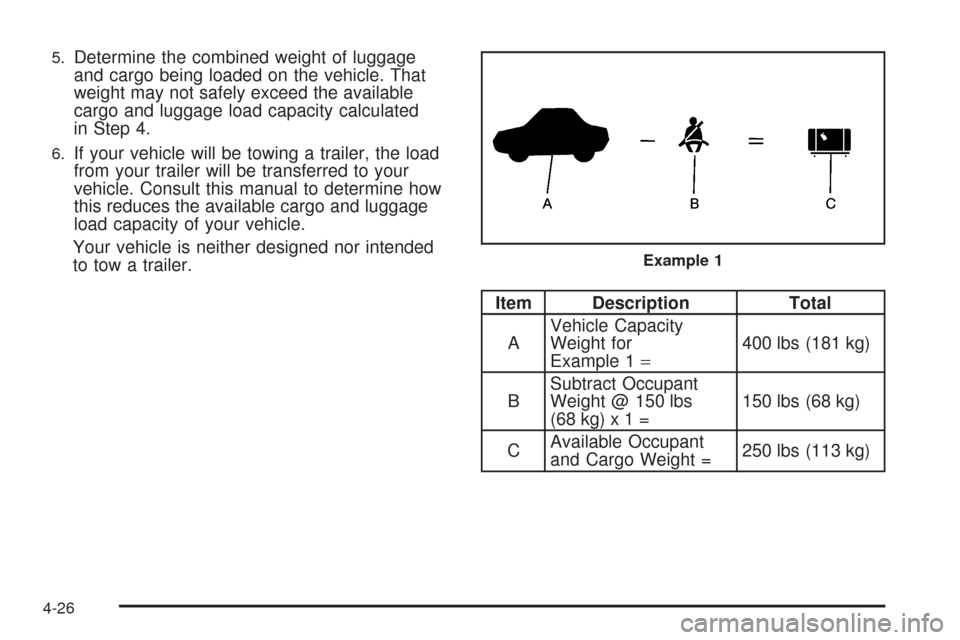
Item Description Total
AVehicle Capacity
Weight for
Example 1=400 lbs (181 kg)
BSubtract Occupant
Weight @ 150 lbs
(68kg)x1=150 lbs (68 kg)
CAvailable Occupant
and Cargo Weight =250 lbs (113 kg)
Example 1
4-26
Page 271 of 432
If you put things inside your vehicle — like
suitcases, tools, packages or anything else — they
will go as fast as the vehicle goes. If you have to
stop or turn quickly, or if there is a crash, they will
keep going.
{CAUTION:
Things you put inside your vehicle can
strike and injure people in a sudden stop
or turn, or in a crash.
Put things in the rear area of your
vehicle. Try to spread the weight
evenly.
Never stack heavier things, like
suitcases, inside the vehicle so that
some of them are above the tops of
the seats.
Do not leave an unsecured child
restraint in your vehicle.
When you carry something inside the
vehicle, secure it whenever you can.
Towing
Towing Your Vehicle
The vehicle was neither designed nor intended to be
towed with any of its wheels on the ground.
Consult your dealer/retailer or a professional towing
service if the disabled vehicle needs to be towed.
SeeRoadside Assistance Program on page 7-8.
Notice:Dolly towing or dinghy towing your vehicle
may cause damage because of reduced ground
clearance. Always put your vehicle on a atbed truck.
Recreational Vehicle Towing
Notice:Dolly towing or dinghy towing your vehicle
may cause damage because of reduced ground
clearance. Always put your vehicle on a atbed truck.
The vehicle was neither designed nor intended to be
towed with any of its wheels on the ground. If the vehicle
must be towed, see “Towing Your Vehicle” earlier in this
section.
Towing a Trailer
Your vehicle is neither designed nor intended to tow
a trailer.
4-29
Page 289 of 432
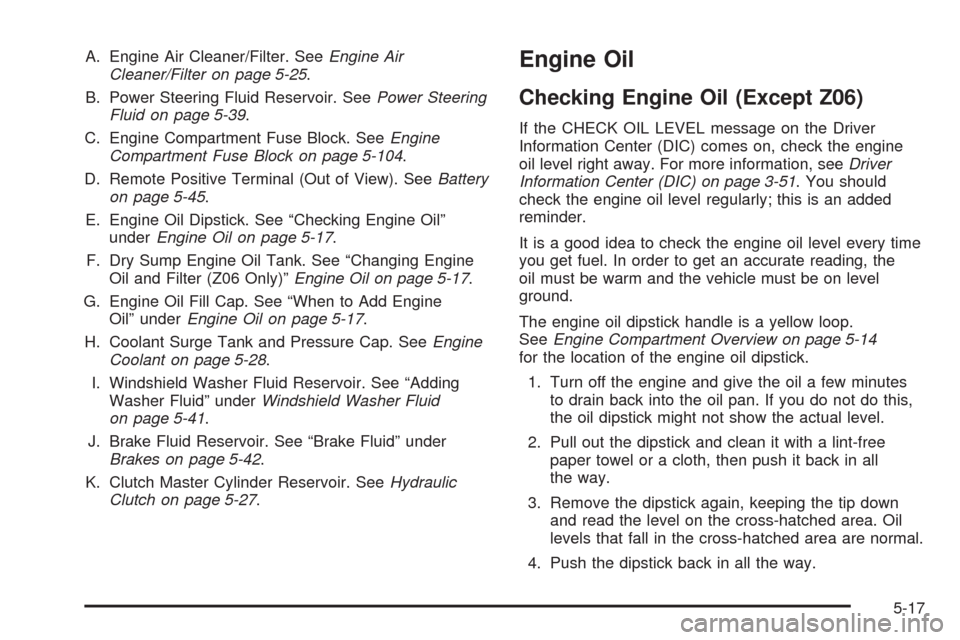
A. Engine Air Cleaner/Filter. SeeEngine Air
Cleaner/Filter on page 5-25.
B. Power Steering Fluid Reservoir. SeePower Steering
Fluid on page 5-39.
C. Engine Compartment Fuse Block. SeeEngine
Compartment Fuse Block on page 5-104.
D. Remote Positive Terminal (Out of View). SeeBattery
on page 5-45.
E. Engine Oil Dipstick. See “Checking Engine Oil”
underEngine Oil on page 5-17.
F. Dry Sump Engine Oil Tank. See “Changing Engine
Oil and Filter (Z06 Only)”Engine Oil on page 5-17.
G. Engine Oil Fill Cap. See “When to Add Engine
Oil” underEngine Oil on page 5-17.
H. Coolant Surge Tank and Pressure Cap. SeeEngine
Coolant on page 5-28.
I. Windshield Washer Fluid Reservoir. See “Adding
Washer Fluid” underWindshield Washer Fluid
on page 5-41.
J. Brake Fluid Reservoir. See “Brake Fluid” under
Brakes on page 5-42.
K. Clutch Master Cylinder Reservoir. SeeHydraulic
Clutch on page 5-27.Engine Oil
Checking Engine Oil (Except Z06)
If the CHECK OIL LEVEL message on the Driver
Information Center (DIC) comes on, check the engine
oil level right away. For more information, seeDriver
Information Center (DIC) on page 3-51. You should
check the engine oil level regularly; this is an added
reminder.
It is a good idea to check the engine oil level every time
you get fuel. In order to get an accurate reading, the
oil must be warm and the vehicle must be on level
ground.
The engine oil dipstick handle is a yellow loop.
SeeEngine Compartment Overview on page 5-14
for the location of the engine oil dipstick.
1. Turn off the engine and give the oil a few minutes
to drain back into the oil pan. If you do not do this,
the oil dipstick might not show the actual level.
2. Pull out the dipstick and clean it with a lint-free
paper towel or a cloth, then push it back in all
the way.
3. Remove the dipstick again, keeping the tip down
and read the level on the cross-hatched area. Oil
levels that fall in the cross-hatched area are normal.
4. Push the dipstick back in all the way.
5-17
Page 292 of 432
3. Wait at least ve minutes (but not more than
20 minutes) to allow oil to drain and settle in
the engine.
4. Remove the dipstick from the external engine oil
tank and clean it with a lint-free paper towel or a
cloth. Re-insert the dipstick into the external oil tank,
pushing it all the way in until it stops.
5. Remove the dipstick from the oil tank and read the
level on the cross-hatched area. Oil levels that fall
in the cross-hatched area are normal.
When to Add Engine Oil (Z06 Only)
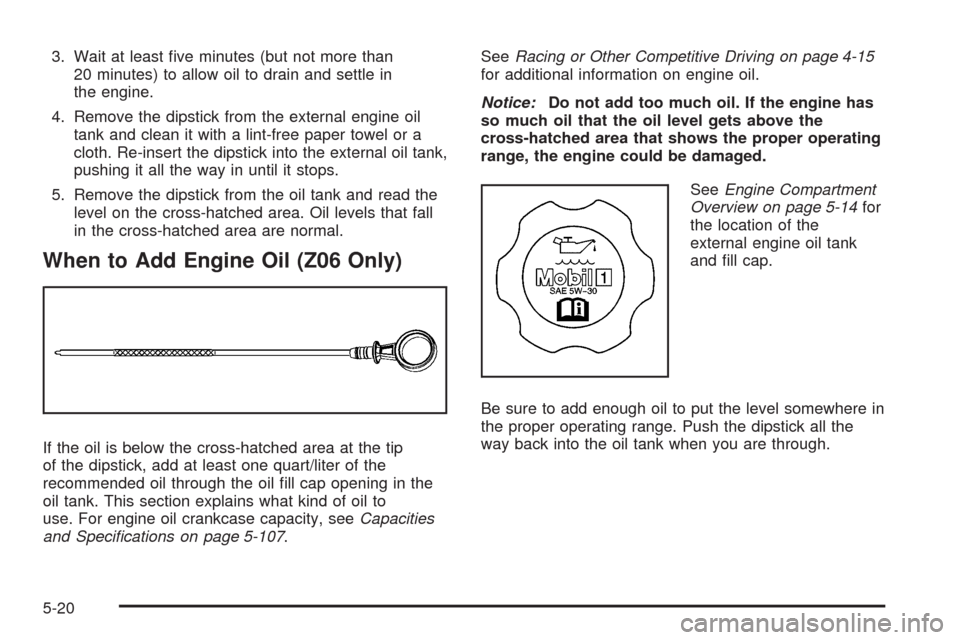
If the oil is below the cross-hatched area at the tip
of the dipstick, add at least one quart/liter of the
recommended oil through the oil ll cap opening in the
oil tank. This section explains what kind of oil to
use. For engine oil crankcase capacity, seeCapacities
and Specifications on page 5-107.SeeRacing or Other Competitive Driving on page 4-15
for additional information on engine oil.
Notice:Do not add too much oil. If the engine has
so much oil that the oil level gets above the
cross-hatched area that shows the proper operating
range, the engine could be damaged.
SeeEngine Compartment
Overview on page 5-14for
the location of the
external engine oil tank
and ll cap.
Be sure to add enough oil to put the level somewhere in
the proper operating range. Push the dipstick all the
way back into the oil tank when you are through.
5-20
Page 302 of 432
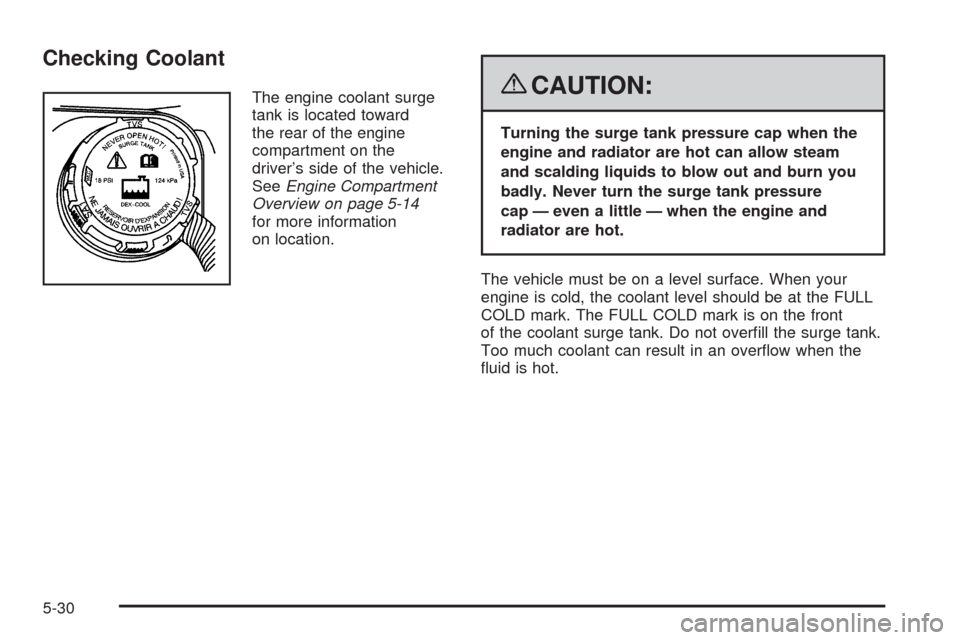
Checking Coolant
The engine coolant surge
tank is located toward
the rear of the engine
compartment on the
driver’s side of the vehicle.
SeeEngine Compartment
Overview on page 5-14
for more information
on location.{CAUTION:
Turning the surge tank pressure cap when the
engine and radiator are hot can allow steam
and scalding liquids to blow out and burn you
badly. Never turn the surge tank pressure
cap — even a little — when the engine and
radiator are hot.
The vehicle must be on a level surface. When your
engine is cold, the coolant level should be at the FULL
COLD mark. The FULL COLD mark is on the front
of the coolant surge tank. Do not overll the surge tank.
Too much coolant can result in an overow when the
uid is hot.
5-30
Page 326 of 432
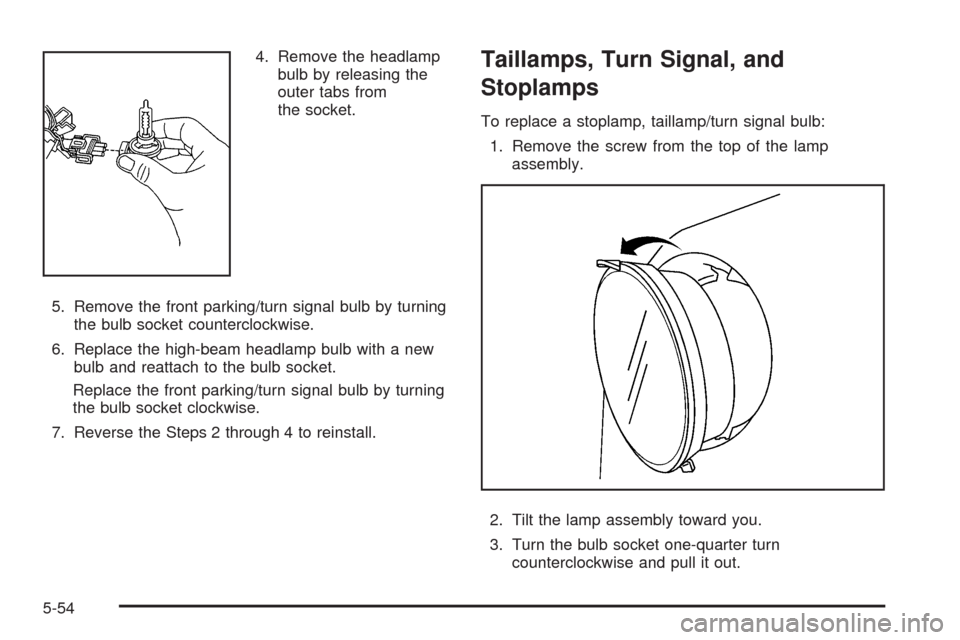
4. Remove the headlamp
bulb by releasing the
outer tabs from
the socket.
5. Remove the front parking/turn signal bulb by turning
the bulb socket counterclockwise.
6. Replace the high-beam headlamp bulb with a new
bulb and reattach to the bulb socket.
Replace the front parking/turn signal bulb by turning
the bulb socket clockwise.
7. Reverse the Steps 2 through 4 to reinstall.Taillamps, Turn Signal, and
Stoplamps
To replace a stoplamp, taillamp/turn signal bulb:
1. Remove the screw from the top of the lamp
assembly.
2. Tilt the lamp assembly toward you.
3. Turn the bulb socket one-quarter turn
counterclockwise and pull it out.
5-54
Page 351 of 432
{CAUTION:
Using the wrong replacement wheels, wheel
bolts, or wheel nuts on your vehicle can be
dangerous. It could affect the braking and
handling of your vehicle, make your tires lose
air and make you lose control. You could have
a collision in which you or others could be
injured. Always use the correct wheel, wheel
bolts, and wheel nuts for replacement.
Notice:The wrong wheel can also cause problems
with bearing life, brake cooling, speedometer or
odometer calibration, headlamp aim, bumper height,
vehicle ground clearance, and tire clearance to
the body and chassis.
{CAUTION:
Rust or dirt on a wheel, or on the parts to
which it is fastened, can make wheel nuts
become loose after a time. The wheel
could come off and cause a crash. When
you change a wheel, remove any rust or
dirt from places where the wheel attaches
to the vehicle. In an emergency, you can
use a cloth or a paper towel to do this;
but be sure to use a scraper or wire brush
later, if you need to, to get all the rust or
dirt off.
{CAUTION:
Never use oil or grease on studs or the
threads of the wheel nuts. If you do, the wheel
nuts might come loose and the wheel could
fall off, causing a crash.
5-79
Page 360 of 432
Your dealer/retailer has a product for cleaning your
vehicle’s glass. Should it become necessary, you can
also obtain a product from your dealer/retailer to remove
odors from your vehicle’s upholstery.
Do not clean your vehicle using:
A knife or any other sharp object to remove a soil
from any interior surface.
A stiff brush. It can cause damage to your vehicle’s
interior surfaces.
Heavy pressure or aggressive rubbing with a
cleaning cloth. Use of heavy pressure can damage
your interior and does not improve the effectiveness
of soil removal.
Laundry detergents or dishwashing soaps with
degreasers can leave residue that streaks and
attracts dirt. For liquid cleaners, about 20 drops
per gallon (3.78 L) of water is a good guide.
Use only mild, neutral-pH soaps.
Too much cleaner that saturates the upholstery.
Organic solvents such as naptha, alcohol, etc. that
can damage your vehicle’s interior.
Fabric/Carpet
Use a vacuum cleaner with a soft brush attachment
frequently to remove dust and loose dirt. A canister
vacuum with a beater bar in the nozzle may only
be used on oor carpet and carpeted oor mats. For
any soil, always try to remove it rst with plain water or
club soda. Before cleaning, gently remove as much
of the soil as possible using one of the following
techniques:
For liquids: gently blot the remaining soil with a
paper towel. Allow the soil to absorb into the
paper towel until no more can be removed.
For solid dry soils: remove as much as possible
and then vacuum.
To clean:
1. Saturate a lint-free, clean white cloth with water or
club soda.
2. Wring the cloth to remove excess moisture.
5-88
Page 361 of 432
3. Start on the outside edge of the soil and gently rub
toward the center. Continue cleaning, using a clean
area of the cloth each time it becomes soiled.
4. Continue to gently rub the soiled area until the
cleaning cloth remains clean.
5. If the soil is not completely removed, use a mild
soap solution and repeat the cleaning process
that was used with plain water.
If any of the soil remains, a commercial fabric cleaner or
spot lifter may be necessary. When a commercial
upholstery cleaner or spot lifter is to be used, test a
small hidden area for colorfastness rst. If the locally
cleaned area gives any impression that a ring formation
may result, clean the entire surface.
After the cleaning process has been completed, a paper
towel can be used to blot excess moisture from the
fabric or carpet.Coated Moldings
These moldings are around the hatch opening in the
rear area.
When lightly soiled, wipe with a sponge or soft
lint-free cloth dampened with water.
When heavily soiled, use warm soapy water.
Leather
A soft cloth dampened with water can be used to
remove dust. If a more thorough cleaning is necessary,
a soft cloth dampened with a mild soap solution can
be used. Allow the leather to dry naturally. Do not use
heat to dry. Never use steam to clean leather. Never
use spot lifters or spot removers on leather. Many
commercial leather cleaners and coatings that are sold
to preserve and protect leather may permanently
change the appearance and feel of your leather and are
not recommended. Do not use silicone or wax-based
products, or those containing organic solvents to clean
your vehicle’s interior because they can alter the
appearance by increasing the gloss in a non-uniform
manner. Never use shoe polish on leather.
5-89
Page 363 of 432
Weatherstrips
Silicone grease on weatherstrips will make them last
longer, seal better, and not stick or squeak. Apply
silicone grease with a clean cloth. During very cold,
damp weather frequent application may be required.
SeeRecommended Fluids and Lubricants on page 6-12.
Washing Your Vehicle
The best way to preserve your vehicle’s nish is to keep
it clean by washing it often.
Notice:Certain cleaners contain chemicals that
can damage the emblems or nameplates on
your vehicle. Check the cleaning product label. If it
states that it should not be used on plastic parts,
do not use it on your vehicle or damage may occur
and it would not be covered by the warranty.
Do not wash the vehicle in direct sunlight. Use a car
washing soap. Do not use cleaning agents that
are petroleum based or that contain acid or abrasives,
as they can damage the paint, metal or plastic on
your vehicle. Approved cleaning products can be
obtained from your dealer/retailer. SeeVehicle
Care/Appearance Materials on page 5-97.Follow all manufacturers’ directions regarding correct
product usage, necessary safety precautions and
appropriate disposal of any vehicle care product.
Rinse the vehicle well, before washing and after to
remove all cleaning agents completely. If they are
allowed to dry on the surface, they could stain.
Dry the nish with a soft, clean chamois or an all-cotton
towel to avoid surface scratches and water spotting.
High pressure car washes may cause water to enter the
vehicle. Avoid using high pressure washes closer
than 12 inches (30 cm) to the surface of the vehicle.
Use of power washers exceeding 1,200 psi (8 274 kPa)
can result in damage or removal of paint and decals.
Cleaning Exterior Lamps/Lenses
Use only lukewarm or cold water, a soft cloth and a car
washing soap to clean exterior lamps and lenses.
Follow instructions underWashing Your Vehicle on
page 5-91.
5-91