automatic transmission CHEVROLET CORVETTE 2008 6.G Workshop Manual
[x] Cancel search | Manufacturer: CHEVROLET, Model Year: 2008, Model line: CORVETTE, Model: CHEVROLET CORVETTE 2008 6.GPages: 432, PDF Size: 2.4 MB
Page 388 of 432
(f)Lubricate all key lock cylinders and body door
hinges. Lubricate all hinges and latches, including those
for the hood, rear compartment, console door, and
any folding seat hardware. More frequent lubrication
may be required when exposed to a corrosive
environment. Applying silicone grease on weatherstrips
with a clean cloth will make them last longer, seal
better, and not stick or squeak.
(g)A fluid loss in any vehicle system could indicate a
problem. Have the system inspected and repaired
and the fluid level checked. Add fluid if needed.
(h)Change automatic transmission fluid and filter if the
vehicle is mainly driven under one or more of these
conditions:
In heavy city traffic where the outside temperature
regularly reaches 90°F (32°C) or higher.
In hilly or mountainous terrain.
Uses such as high performance operation.
(i)Drain, flush, and refill cooling system. This service
can be complex; you should have your dealer/retailer
perform this service. See Engine Coolant on page 5-28
for what to use. Inspect hoses. Clean radiator,
condenser, pressure cap, and filler neck. Pressure
test the cooling system and pressure cap.(j)If you drive regularly under dusty conditions, the filter
may require replacement more often.
(k)If you drive regularly under dusty conditions, inspect
the filter at each engine oil change.
(l)Visually inspect belt for fraying, excessive cracks, or
obvious damage. Replace belt if necessary.
(m)Drain, flush, and refill clutch hydraulic system at a
regular service interval (IorII) every two years.
This service can be complex; you should have your
dealer/retailer perform this service. See Hydraulic Clutch
on page 5-27.
Owner Checks and Services
These owner checks and services should be performed
at the intervals specied to help ensure vehicle safety,
dependability, and emission control performance. Your
dealer/retailer can assist with these checks and services.
Be sure any necessary repairs are completed at once.
Whenever any uids or lubricants are added to the
vehicle, make sure they are the proper ones, as shown
inRecommended Fluids and Lubricants on page 6-12.
6-8
Page 390 of 432
3. On automatic transmission vehicles, try to start the
engine in each gear. The vehicle should start only
in PARK (P) or NEUTRAL (N). If the vehicle
starts in any other position, contact your
dealer/retailer for service.
On manual transmission vehicles, put the shift lever
in NEUTRAL, push the clutch pedal down halfway,
and try to start the engine. The vehicle should
start only when the clutch pedal is pushed down all
the way to the oor. If the vehicle starts when
the clutch pedal is not pushed all the way down,
contact your dealer/retailer for service.Automatic Transmission Shift Lock
Control System Check
{CAUTION:
When you are doing this inspection, the
vehicle could move suddenly. If the vehicle
moves, you or others could be injured.
1. Before you start, be sure you have enough room
around the vehicle. It should be parked on a level
surface.
2. Firmly apply the parking brake. SeeParking Brake
on page 2-32.
Be ready to apply the regular brake immediately if
the vehicle begins to move.
3. With the engine off and without applying the regular
brake, try to move the shift lever out of PARK (P)
with normal effort. If the shift lever moves out
of PARK (P), contact your dealer/retailer for service.
6-10
Page 391 of 432
Parking Brake and Automatic
Transmission Park (P)
Mechanism Check
{CAUTION:
When you are doing this check, your vehicle
could begin to move. You or others could be
injured and property could be damaged. Make
sure there is room in front of your vehicle in
case it begins to roll. Be ready to apply the
regular brake at once should the vehicle begin
to move.Park on a fairly steep hill, with the vehicle facing
downhill. Keeping your foot on the regular brake,
set the parking brake.
To check the parking brake’s holding ability: With
the engine running and transmission in
NEUTRAL (N), slowly remove foot pressure from
the regular brake pedal. Do this until the vehicle is
held by the parking brake only.
To check the PARK (P) mechanism’s holding
ability: With the engine running, shift to PARK (P).
Then release the parking brake followed by the
regular brake.
Contact your dealer/retailer if service is required.
Underbody Flushing Service
At least every spring, use plain water to ush any
corrosive materials from the underbody. Take care to
clean thoroughly any areas where mud and other debris
can collect.
6-11
Page 392 of 432
Recommended Fluids and
Lubricants
Fluids and lubricants identied below by name, part
number, or specication can be obtained from your
dealer/retailer.
Usage Fluid/Lubricant
Engine OilThe engine requires a special
engine oil meeting GM Standard
GM4718M. Oils meeting this
standard can be identied as
synthetic, and should also be
identied with the American
Petroleum Institute (API) Certied
for Gasoline Engines starburst
symbol. However, not all synthetic
API oils with the starburst symbol
will meet this GM standard. Look for
and use only an oil that meets
GM Standard GM4718M. For the
proper viscosity, seeEngine Oil on
page 5-17.
Engine Coolant50/50 mixture of clean, drinkable
water and use only DEX-COOL
®
Coolant. SeeEngine Coolant on
page 5-28.
Usage Fluid/Lubricant
Hydraulic Brake
SystemDelco
®Supreme 11 Brake Fluid or
equivalent DOT-3 brake uid.
Windshield
WasherOptikleen
®Washer Solvent.
Hydraulic
Clutch SystemHydraulic Clutch Fluid. Use only
GM Part No. U.S. 88958860,
in Canada 88901244,
Super DOT-4 brake uid.
Power Steering
SystemGM Power Steering Fluid
(GM Part No. U.S. 89021184,
in Canada 89021186).
Chassis
Lubrication
(Rear Toe-Link
Outer Ends with
ZO6 or Z51
Option)Chassis Lubricant
(GM Part No. U.S. 12377985,
in Canada 88901242) or lubricant
meeting requirements of NLGI #2,
Category LB or GC-LB.
Manual
TransmissionManual Transmission Fluid
(GM Part No. U.S. 88861800,
in Canada 88861801).
Automatic
TransmissionDEXRON
®-VI Automatic
Transmission Fluid.
6-12
Page 420 of 432
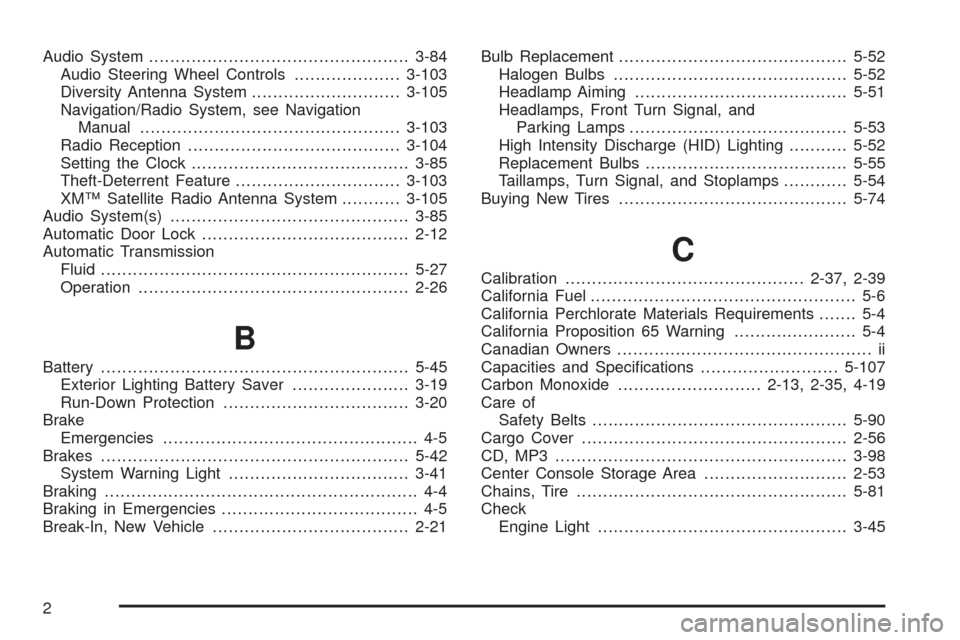
Audio System.................................................3-84
Audio Steering Wheel Controls....................3-103
Diversity Antenna System............................3-105
Navigation/Radio System, see Navigation
Manual.................................................3-103
Radio Reception........................................3-104
Setting the Clock.........................................3-85
Theft-Deterrent Feature...............................3-103
XM™ Satellite Radio Antenna System...........3-105
Audio System(s).............................................3-85
Automatic Door Lock.......................................2-12
Automatic Transmission
Fluid..........................................................5-27
Operation...................................................2-26
B
Battery..........................................................5-45
Exterior Lighting Battery Saver......................3-19
Run-Down Protection...................................3-20
Brake
Emergencies................................................ 4-5
Brakes..........................................................5-42
System Warning Light..................................3-41
Braking........................................................... 4-4
Braking in Emergencies..................................... 4-5
Break-In, New Vehicle.....................................2-21Bulb Replacement...........................................5-52
Halogen Bulbs............................................5-52
Headlamp Aiming........................................5-51
Headlamps, Front Turn Signal, and
Parking Lamps.........................................5-53
High Intensity Discharge (HID) Lighting...........5-52
Replacement Bulbs......................................5-55
Taillamps, Turn Signal, and Stoplamps............5-54
Buying New Tires...........................................5-74
C
Calibration.............................................2-37, 2-39
California Fuel.................................................. 5-6
California Perchlorate Materials Requirements....... 5-4
California Proposition 65 Warning....................... 5-4
Canadian Owners................................................ ii
Capacities and Specications..........................5-107
Carbon Monoxide...........................2-13, 2-35, 4-19
Care of
Safety Belts................................................5-90
Cargo Cover..................................................2-56
CD, MP3 .......................................................3-98
Center Console Storage Area...........................2-53
Chains, Tire...................................................5-81
Check
Engine Light...............................................3-45
2
Page 423 of 432
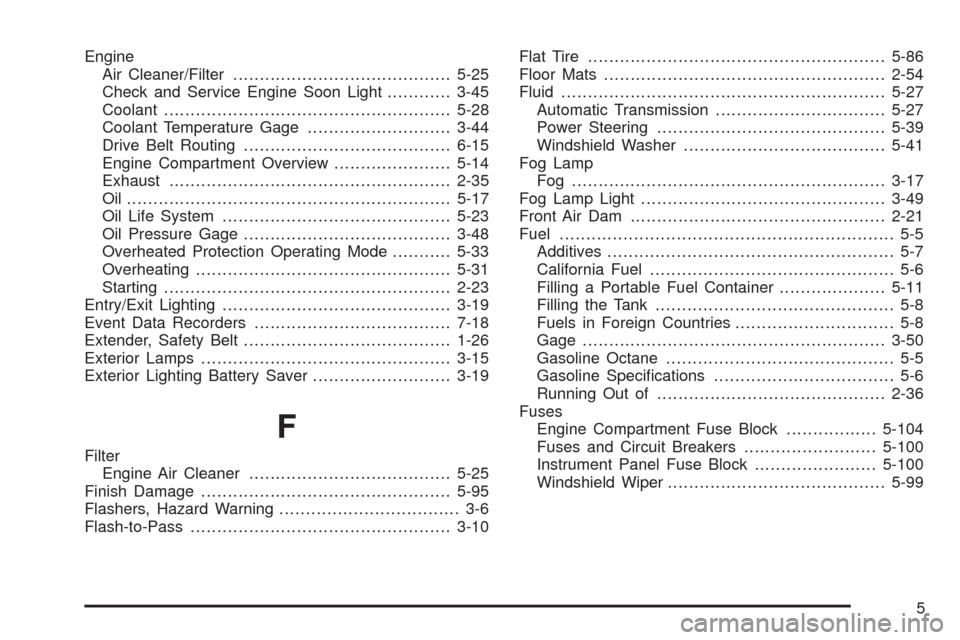
Engine
Air Cleaner/Filter.........................................5-25
Check and Service Engine Soon Light............3-45
Coolant......................................................5-28
Coolant Temperature Gage...........................3-44
Drive Belt Routing.......................................6-15
Engine Compartment Overview......................5-14
Exhaust.....................................................2-35
Oil .............................................................5-17
Oil Life System...........................................5-23
Oil Pressure Gage.......................................3-48
Overheated Protection Operating Mode...........5-33
Overheating................................................5-31
Starting......................................................2-23
Entry/Exit Lighting...........................................3-19
Event Data Recorders.....................................7-18
Extender, Safety Belt.......................................1-26
Exterior Lamps...............................................3-15
Exterior Lighting Battery Saver..........................3-19
F
Filter
Engine Air Cleaner......................................5-25
Finish Damage...............................................5-95
Flashers, Hazard Warning.................................. 3-6
Flash-to-Pass.................................................3-10Flat Tire........................................................5-86
Floor Mats.....................................................2-54
Fluid.............................................................5-27
Automatic Transmission................................5-27
Power Steering...........................................5-39
Windshield Washer......................................5-41
Fog Lamp
Fog ...........................................................3-17
Fog Lamp Light..............................................3-49
Front Air Dam................................................2-21
Fuel............................................................... 5-5
Additives...................................................... 5-7
California Fuel.............................................. 5-6
Filling a Portable Fuel Container....................5-11
Filling the Tank............................................. 5-8
Fuels in Foreign Countries.............................. 5-8
Gage .........................................................3-50
Gasoline Octane........................................... 5-5
Gasoline Specications.................................. 5-6
Running Out of...........................................2-36
Fuses
Engine Compartment Fuse Block.................5-104
Fuses and Circuit Breakers.........................5-100
Instrument Panel Fuse Block.......................5-100
Windshield Wiper.........................................5-99
5
Page 426 of 432
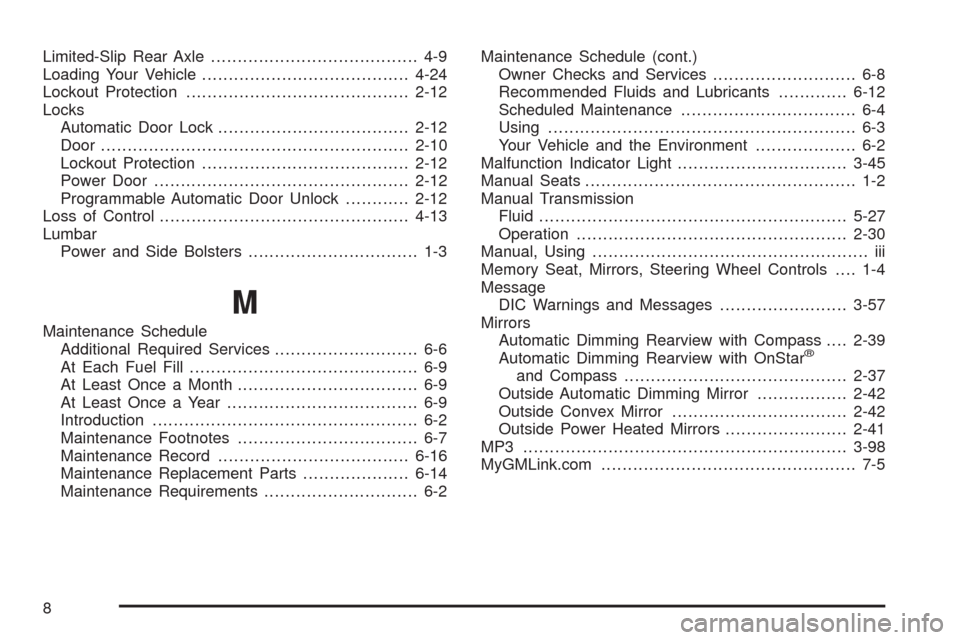
Limited-Slip Rear Axle....................................... 4-9
Loading Your Vehicle.......................................4-24
Lockout Protection..........................................2-12
Locks
Automatic Door Lock....................................2-12
Door ..........................................................2-10
Lockout Protection.......................................2-12
Power Door ................................................2-12
Programmable Automatic Door Unlock............2-12
Loss of Control...............................................4-13
Lumbar
Power and Side Bolsters................................ 1-3
M
Maintenance Schedule
Additional Required Services........................... 6-6
At Each Fuel Fill........................................... 6-9
At Least Once a Month.................................. 6-9
At Least Once a Year.................................... 6-9
Introduction.................................................. 6-2
Maintenance Footnotes.................................. 6-7
Maintenance Record....................................6-16
Maintenance Replacement Parts....................6-14
Maintenance Requirements............................. 6-2Maintenance Schedule (cont.)
Owner Checks and Services........................... 6-8
Recommended Fluids and Lubricants.............6-12
Scheduled Maintenance................................. 6-4
Using.......................................................... 6-3
Your Vehicle and the Environment................... 6-2
Malfunction Indicator Light................................3-45
Manual Seats................................................... 1-2
Manual Transmission
Fluid..........................................................5-27
Operation...................................................2-30
Manual, Using.................................................... iii
Memory Seat, Mirrors, Steering Wheel Controls.... 1-4
Message
DIC Warnings and Messages........................3-57
Mirrors
Automatic Dimming Rearview with Compass....2-39
Automatic Dimming Rearview with OnStar
®
and Compass..........................................2-37
Outside Automatic Dimming Mirror.................2-42
Outside Convex Mirror.................................2-42
Outside Power Heated Mirrors.......................2-41
MP3 .............................................................3-98
MyGMLink.com................................................ 7-5
8
Page 431 of 432
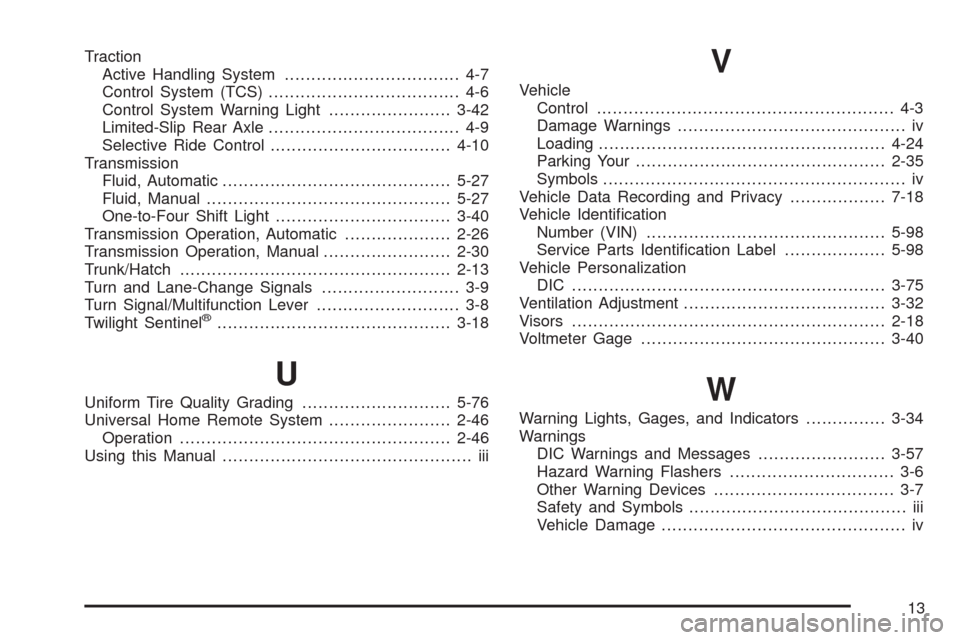
Traction
Active Handling System................................. 4-7
Control System (TCS).................................... 4-6
Control System Warning Light.......................3-42
Limited-Slip Rear Axle.................................... 4-9
Selective Ride Control..................................4-10
Transmission
Fluid, Automatic...........................................5-27
Fluid, Manual..............................................5-27
One-to-Four Shift Light.................................3-40
Transmission Operation, Automatic....................2-26
Transmission Operation, Manual........................2-30
Trunk/Hatch...................................................2-13
Turn and Lane-Change Signals.......................... 3-9
Turn Signal/Multifunction Lever........................... 3-8
Twilight Sentinel
®............................................3-18
U
Uniform Tire Quality Grading............................5-76
Universal Home Remote System.......................2-46
Operation...................................................2-46
Using this Manual............................................... iii
V
Vehicle
Control........................................................ 4-3
Damage Warnings........................................... iv
Loading......................................................4-24
Parking Your...............................................2-35
Symbols......................................................... iv
Vehicle Data Recording and Privacy..................7-18
Vehicle Identication
Number (VIN).............................................5-98
Service Parts Identication Label...................5-98
Vehicle Personalization
DIC ...........................................................3-75
Ventilation Adjustment......................................3-32
Visors...........................................................2-18
Voltmeter Gage..............................................3-40
W
Warning Lights, Gages, and Indicators...............3-34
Warnings
DIC Warnings and Messages........................3-57
Hazard Warning Flashers............................... 3-6
Other Warning Devices.................................. 3-7
Safety and Symbols......................................... iii
Vehicle Damage.............................................. iv
13