lock CHEVROLET CORVETTE 2009 6.G User Guide
[x] Cancel search | Manufacturer: CHEVROLET, Model Year: 2009, Model line: CORVETTE, Model: CHEVROLET CORVETTE 2009 6.GPages: 434, PDF Size: 2.53 MB
Page 61 of 434
If this happens, use the following steps to allow the
system to detect that person and enable the right front
passenger frontal airbag and seat-mounted side
impact airbag (if equipped):
1. Turn the vehicle off.
2. Remove any additional material from the seat, such
as blankets, cushions, seat covers, seat heaters, or
seat massagers.
3. Place the seatback in the fully upright position.
4. Have the person sit upright in the seat, centered on
the seat cushion, with legs comfortably extended.
5. Restart the vehicle and have the person remain in
this position for two to three minutes after the on
indicator is lit.
Additional Factors Affecting System
Operation
Safety belts help keep the passenger in position on the
seat during vehicle maneuvers and braking, which helps
the passenger sensing system maintain the passenger
airbag status. See “Safety Belts” and “Child Restraints” in
the Index for additional information about the importance
of proper restraint use.If the shoulder portion of the belt is pulled out all the
way, the child restraint locking feature will be engaged.
This may unintentionally cause the passenger sensing
system to turn the airbag(s) off for some adult size
occupants. If this happens, let the belt go back all the
way and start again.
A thick layer of additional material, such as a blanket or
cushion, or aftermarket equipment such as seat covers,
seat heaters, and seat massagers can affect how well the
passenger sensing system operates. We recommend
that you not use seat covers or other aftermarket
equipment except when approved by GM for your specic
vehicle. SeeAdding Equipment to Your Airbag-Equipped
Vehicle on page 1-58for more information about
modications that can affect how the system operates.
{CAUTION:
Stowing of articles under the passenger seat or
between the passenger seat cushion and seatback
may interfere with the proper operation of the
passenger sensing system.
1-57
Page 67 of 434
Keys...............................................................2-3
Keyless Access System...................................2-4
Keyless Access System Operation....................2-5
Doors and Locks............................................2-10
Door Locks..................................................2-10
Power Door Locks........................................2-12
Automatic Door Lock.....................................2-12
Programmable Automatic Door Unlock.............2-12
Lockout Protection........................................2-12
Hatch..........................................................2-13
Windows........................................................2-16
Power Windows............................................2-17
Sun Visors...................................................2-18
Theft-Deterrent Systems..................................2-18
Theft-Deterrent System..................................2-18
Immobilizer..................................................2-19
Immobilizer Operation....................................2-20
Starting and Operating Your Vehicle................2-21
New Vehicle Break-In....................................2-21
Front Air Dam..............................................2-21
Ignition Positions..........................................2-22Retained Accessory Power (RAP)...................2-23
Starting the Engine.......................................2-23
Automatic Transmission Operation...................2-26
Manual Transmission Operation......................2-30
Parking Brake..............................................2-32
Shifting Into Park (Automatic Transmission)......2-33
Shifting Out of Park......................................2-34
Parking the Vehicle (Manual Transmission).......2-34
Parking Over Things That Burn.......................2-35
Engine Exhaust............................................2-35
Running the Vehicle While Parked..................2-36
Mirrors...........................................................2-37
Automatic Dimming Rearview Mirror...............
.2-37
Compass.....................................................2-37
Outside Power Mirrors...................................2-39
Outside Automatic Dimming Mirror..................2-39
Outside Convex Mirror...................................2-40
Outside Heated Mirrors..................................2-40
OnStar
®System.............................................2-40
Universal Home Remote System......................2-44
Universal Home Remote System Operation......2-44
Section 2 Features and Controls
2-1
Page 70 of 434
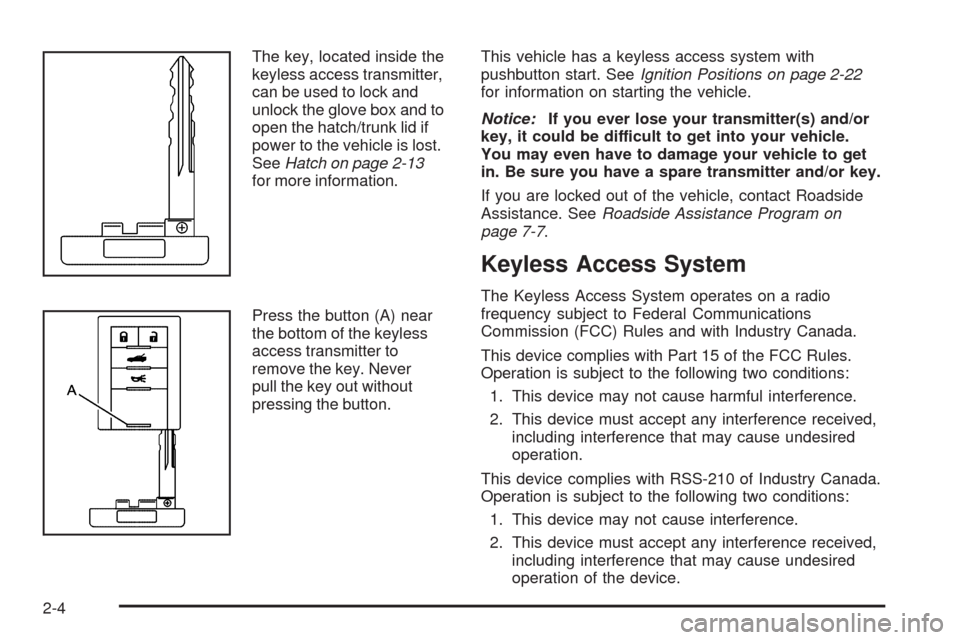
The key, located inside the
keyless access transmitter,
can be used to lock and
unlock the glove box and to
open the hatch/trunk lid if
power to the vehicle is lost.
SeeHatch on page 2-13
for more information.
Press the button (A) near
the bottom of the keyless
access transmitter to
remove the key. Never
pull the key out without
pressing the button.This vehicle has a keyless access system with
pushbutton start. SeeIgnition Positions on page 2-22
for information on starting the vehicle.
Notice:If you ever lose your transmitter(s) and/or
key, it could be difficult to get into your vehicle.
You may even have to damage your vehicle to get
in. Be sure you have a spare transmitter and/or key.
If you are locked out of the vehicle, contact Roadside
Assistance. SeeRoadside Assistance Program on
page 7-7.
Keyless Access System
The Keyless Access System operates on a radio
frequency subject to Federal Communications
Commission (FCC) Rules and with Industry Canada.
This device complies with Part 15 of the FCC Rules.
Operation is subject to the following two conditions:
1. This device may not cause harmful interference.
2. This device must accept any interference received,
including interference that may cause undesired
operation.
This device complies with RSS-210 of Industry Canada.
Operation is subject to the following two conditions:
1. This device may not cause interference.
2. This device must accept any interference received,
including interference that may cause undesired
operation of the device.
2-4
Page 71 of 434
Changes or modications to this system by other than
an authorized service facility could void authorization to
use this equipment.
If there is a decrease in the keyless access transmitter
range, try this:
Check the distance. The transmitter may be too far
from the vehicle. It may be necessary to stand closer
during rainy or snowy weather.
Check the location. Other vehicles or objects may be
blocking the signal. Take a few steps to the left or
right, hold the transmitter higher, and try again.
Check the transmitter’s battery. See “Battery
Replacement” underKeyless Access System
Operation on page 2-5.
Make sure that an electronic device such as a
cellular phone or lap top computer is not causing
interference.
If the transmitter is still not working correctly, see
your dealer/retailer or a qualied technician for
service.
Keyless Access System Operation
The Keyless Access System transmitter functions
work up to 100 feet (30 m) away from the vehicle.
Keyless Unlocking
Press the door handle sensor to unlock and open the
doors if the keyless access transmitter is within range.
SeeDoor Locks on page 2-10and “Passive Door Unlock”
underDIC Vehicle Personalization on page 3-71for
additional information.
Keyless Locking
The doors lock after several seconds if all doors are
closed and at least one keyless access transmitter
has been removed from the interior of the vehicle.
To customize whether the doors automatically lock
when exiting the vehicle, see “Passive Door Locking”
underDIC Vehicle Personalization on page 3-71for
additional information.
2-5
Page 72 of 434
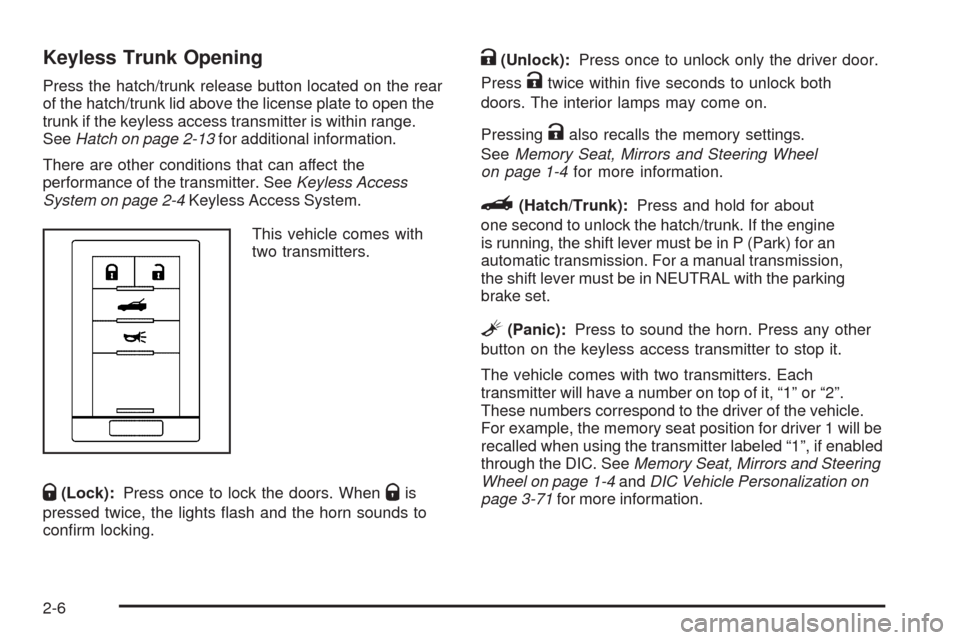
Keyless Trunk Opening
Press the hatch/trunk release button located on the rear
of the hatch/trunk lid above the license plate to open the
trunk if the keyless access transmitter is within range.
SeeHatch on page 2-13for additional information.
There are other conditions that can affect the
performance of the transmitter. SeeKeyless Access
System on page 2-4Keyless Access System.
This vehicle comes with
two transmitters.
Q(Lock):Press once to lock the doors. WhenQis
pressed twice, the lights ash and the horn sounds to
conrm locking.
K(Unlock):Press once to unlock only the driver door.
Press
Ktwice within ve seconds to unlock both
doors. The interior lamps may come on.
Pressing
Kalso recalls the memory settings.
SeeMemory Seat, Mirrors and Steering Wheel
on page 1-4for more information.
}(Hatch/Trunk):Press and hold for about
one second to unlock the hatch/trunk. If the engine
is running, the shift lever must be in P (Park) for an
automatic transmission. For a manual transmission,
the shift lever must be in NEUTRAL with the parking
brake set.
L(Panic):Press to sound the horn. Press any other
button on the keyless access transmitter to stop it.
The vehicle comes with two transmitters. Each
transmitter will have a number on top of it, “1” or “2”.
These numbers correspond to the driver of the vehicle.
For example, the memory seat position for driver 1 will be
recalled when using the transmitter labeled “1”, if enabled
through the DIC. SeeMemory Seat, Mirrors and Steering
Wheel on page 1-4andDIC Vehicle Personalization on
page 3-71for more information.
2-6
Page 76 of 434
Doors and Locks
Door Locks
{CAUTION:
Unlocked doors can be dangerous.
Passengers — especially children — can
easily open the doors and fall out of a moving
vehicle. When a door is locked it will not
open. You increase the chance of being
thrown out of the vehicle in a crash if the
doors are not locked. So, wear safety belts
properly and lock the doors whenever you
drive.
Young children who get into unlocked vehicles
may be unable to get out. A child can be
overcome by extreme heat and can suffer
permanent injuries or even death from heat
stroke. Always lock your vehicle whenever
you leave it.
Outsiders can easily enter through an
unlocked door when you slow down or stop
your vehicle. Locking your doors can help
prevent this from happening.There are several ways to lock and unlock your vehicle.
From the outside, press the lock or unlock button on
the keyless access transmitter.
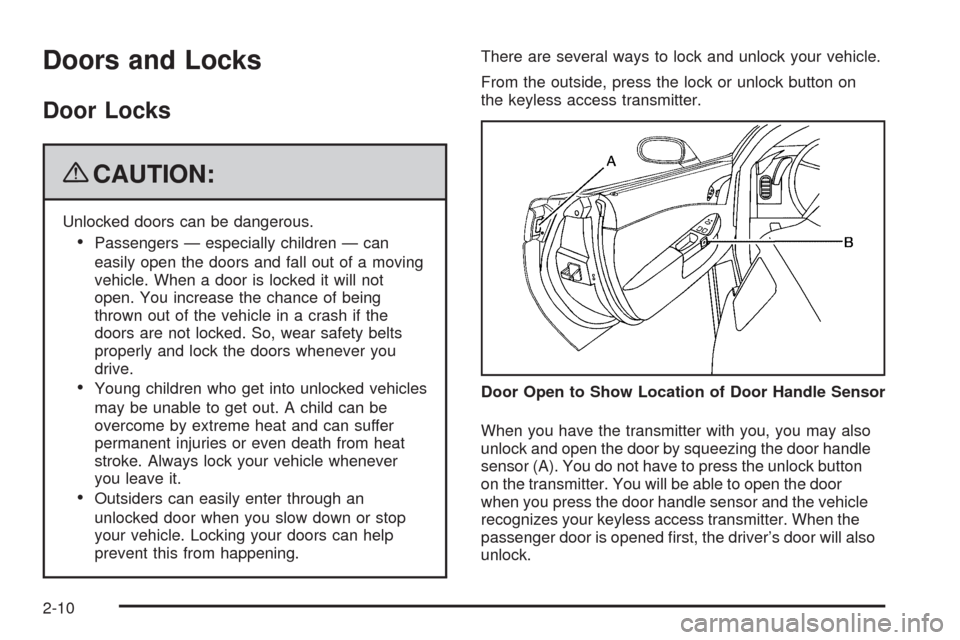
When you have the transmitter with you, you may also
unlock and open the door by squeezing the door handle
sensor (A). You do not have to press the unlock button
on the transmitter. You will be able to open the door
when you press the door handle sensor and the vehicle
recognizes your keyless access transmitter. When the
passenger door is opened rst, the driver’s door will also
unlock.Door Open to Show Location of Door Handle Sensor
2-10
Page 77 of 434

From the inside, use the power door lock switch
located at the top of the door panel near both windows.
SeePower Door Locks on page 2-12.
To open a door from the inside, press the button (B)
in front of the door handle and push the door open.
You will hear a tone when the button is pressed.
If power to the vehicle or the keyless access transmitter
is lost, there are two ways to open the door.
From inside the vehicle, use the door release handle
located on the oor next to each seat. Pull the handle
up to unlock and unlatch the door.From outside the vehicle, use the key in the cylinder
above the license plate to open the hatch then use the
door release tab located on the carpet inside the hatch
on the driver’s side of the vehicle. Pull the tab to unlock
and unlatch the driver’s door. SeeKeys on page 2-3for
information on opening the hatch during a loss of power.
2-11
Page 78 of 434
Power Door Locks
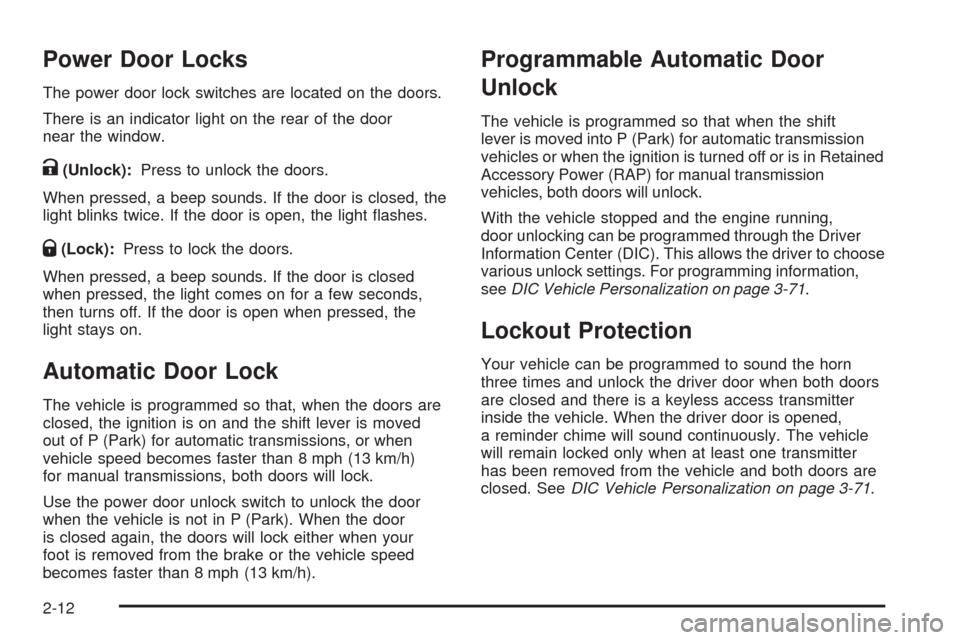
The power door lock switches are located on the doors.
There is an indicator light on the rear of the door
near the window.
K(Unlock):Press to unlock the doors.
When pressed, a beep sounds. If the door is closed, the
light blinks twice. If the door is open, the light ashes.
Q(Lock):Press to lock the doors.
When pressed, a beep sounds. If the door is closed
when pressed, the light comes on for a few seconds,
then turns off. If the door is open when pressed, the
light stays on.
Automatic Door Lock
The vehicle is programmed so that, when the doors are
closed, the ignition is on and the shift lever is moved
out of P (Park) for automatic transmissions, or when
vehicle speed becomes faster than 8 mph (13 km/h)
for manual transmissions, both doors will lock.
Use the power door unlock switch to unlock the door
when the vehicle is not in P (Park). When the door
is closed again, the doors will lock either when your
foot is removed from the brake or the vehicle speed
becomes faster than 8 mph (13 km/h).
Programmable Automatic Door
Unlock
The vehicle is programmed so that when the shift
lever is moved into P (Park) for automatic transmission
vehicles or when the ignition is turned off or is in Retained
Accessory Power (RAP) for manual transmission
vehicles, both doors will unlock.
With the vehicle stopped and the engine running,
door unlocking can be programmed through the Driver
Information Center (DIC). This allows the driver to choose
various unlock settings. For programming information,
seeDIC Vehicle Personalization on page 3-71.
Lockout Protection
Your vehicle can be programmed to sound the horn
three times and unlock the driver door when both doors
are closed and there is a keyless access transmitter
inside the vehicle. When the driver door is opened,
a reminder chime will sound continuously. The vehicle
will remain locked only when at least one transmitter
has been removed from the vehicle and both doors are
closed. SeeDIC Vehicle Personalization on page 3-71.
2-12
Page 80 of 434
Hatch/Trunk Lid Release
There are several ways to release the hatch/trunk lid.
If your vehicle has an automatic transmission, the shift
lever must be in P (Park). For manual transmission
vehicles, the parking brake must be set when the
ignition is started for the hatch/trunk release to operate.
The parking brake does not need to be set when the
ignition is off for the hatch/trunk release to operate.
SeeParking Brake on page 2-32.
V(Hatch/Trunk):Press the hatch/trunk lid release
button, located on the instrument panel to the left of the
steering wheel. The theft-deterrent alarm system
must not be armed.
}(Hatch/Trunk):Press the hatch/trunk lid release
button on the keyless access transmitter. SeeKeyless
Access System on page 2-4.
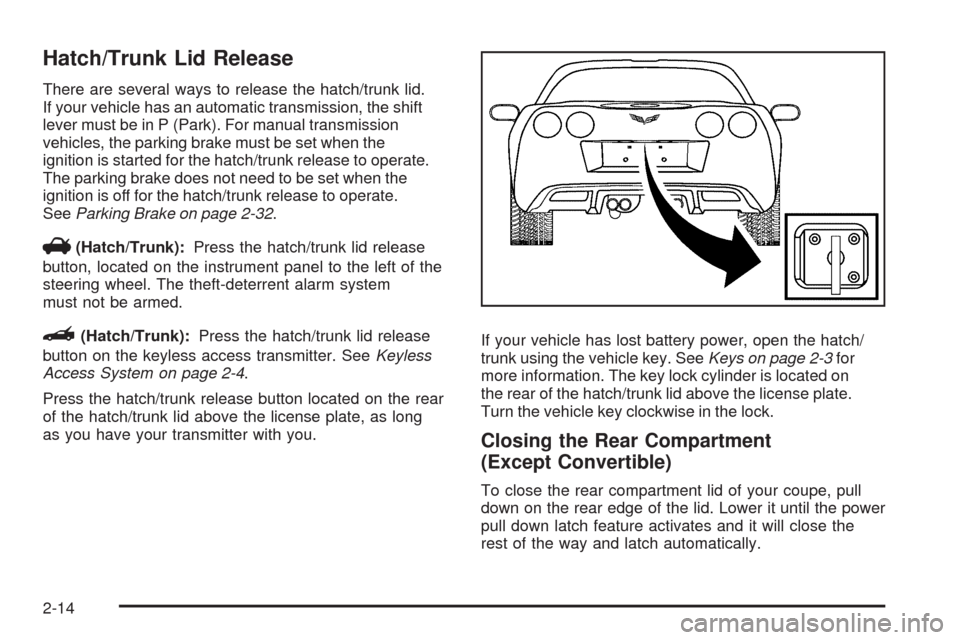
Press the hatch/trunk release button located on the rear
of the hatch/trunk lid above the license plate, as long
as you have your transmitter with you.If your vehicle has lost battery power, open the hatch/
trunk using the vehicle key. SeeKeys on page 2-3for
more information. The key lock cylinder is located on
the rear of the hatch/trunk lid above the license plate.
Turn the vehicle key clockwise in the lock.
Closing the Rear Compartment
(Except Convertible)
To close the rear compartment lid of your coupe, pull
down on the rear edge of the lid. Lower it until the power
pull down latch feature activates and it will close the
rest of the way and latch automatically.
2-14
Page 84 of 434
Sun Visors
Pull the visor toward you, or move it to the side to help
reduce glare.
To use the lighted mirror, lift the cover.
Theft-Deterrent Systems
Vehicle theft is big business, especially in some cities.
This vehicle has theft-deterrent features, however,
they do not make it impossible to steal.
Theft-Deterrent System
This vehicle has a theft-deterrent alarm system.
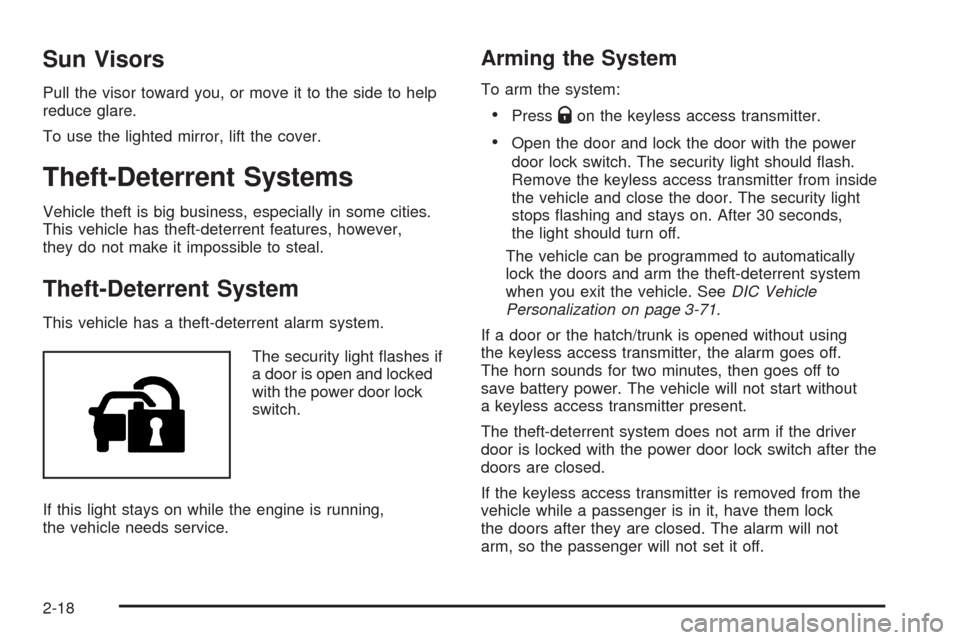
The security light ashes if
a door is open and locked
with the power door lock
switch.
If this light stays on while the engine is running,
the vehicle needs service.
Arming the System
To arm the system:
PressQon the keyless access transmitter.
Open the door and lock the door with the power
door lock switch. The security light should ash.
Remove the keyless access transmitter from inside
the vehicle and close the door. The security light
stops ashing and stays on. After 30 seconds,
the light should turn off.
The vehicle can be programmed to automatically
lock the doors and arm the theft-deterrent system
when you exit the vehicle. SeeDIC Vehicle
Personalization on page 3-71.
If a door or the hatch/trunk is opened without using
the keyless access transmitter, the alarm goes off.
The horn sounds for two minutes, then goes off to
save battery power. The vehicle will not start without
a keyless access transmitter present.
The theft-deterrent system does not arm if the driver
door is locked with the power door lock switch after the
doors are closed.
If the keyless access transmitter is removed from the
vehicle while a passenger is in it, have them lock
the doors after they are closed. The alarm will not
arm, so the passenger will not set it off.
2-18